
Displaying items by tag: Grayson Kennedy
Gwydion Theatre Delivers More than a Satire in Lynn Nottage’s Por’ Knockers
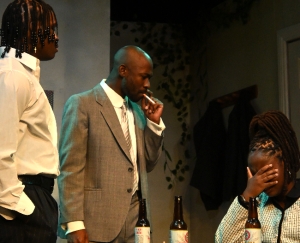
Lynn Nottage is a skilled playwright, and prolific especially considering the high quality of her works: Pulitzer winners Ruined and Sweat. Or the remarkable By the Way, Meet Vera Stark, a kind of All About Eve with the starlet’s Black maid in the Eve role. And then Intimate Apparel, which won wide and very deserved praise. While her scripts vary widely in storyline, they are loaded with very real, authentic characters.
So getting a chance to see an early Nottage work—Gwydion Theatre’s production of Por’ Knockers (1995)—has an especial appeal. It is Nottage’s second play, and it had a turbulent life after premiering Off Broadway in New York at The Vineyard Theatre. Then it went to London. After its London run was cut short, Nottage told The Guardian, “I still remember an audience member ripping up their programme into tiny shreds and throwing it like confetti, saying: ‘I am cancelling my subscription to the theatre!’”
It’s not that the play is bad. In fact it is very good. It was the subject that caused problems: five activists of the imaginary People's Diasporatic Party blow up an FBI building to protest the treatment of African-Americans in the U.S. The play centers on the tension and anxiety within that band of conspirators before and after their destructive venture.
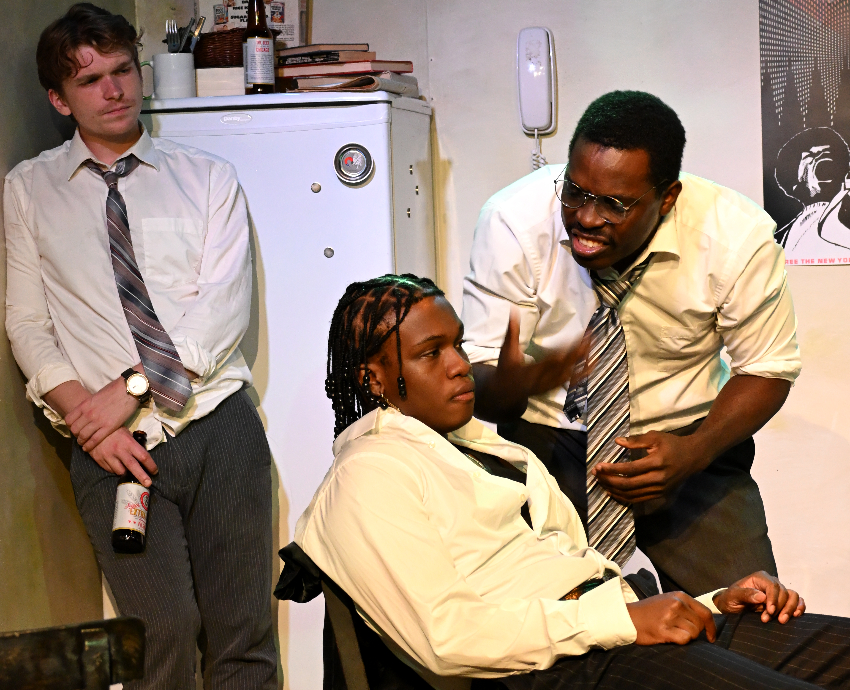
Grayson Kennedy (l-r), Joseph Percy and Dontaye Albert.
Por’ Knockers (the name refers to Guyanese gold panners) was having a successful and well-received run in London until Timothy McVeigh carried out a similar bombing of the FBI building in Oklahoma City. And so the script has been shelved since. Until Gwydion Theatre in Chicago succeeded in mounting this production at Greenhouse Theater.
“This play is so special to us at Gwydion,” says Grayson Kennedy, who is Gwydion Theatre’s Artistic Director. “It was a show that we have wanted to do since our first season.” (Kennedy acts in the show as well.)
Directed for Gwydion Theatre by Makari Robinson-McNeese, Por’ Knockers is widely regarded as a political satire, almost a parody of a “people’s revolutionary army.” But Nottage gives it a level of depth, with five fully-realized characters, each with different backgrounds and motives for the bombing.
In the opening scene of the one act, Nottage establishes the who's who: the mature, grounded Kwami (Kevin Aoussou is astoundingly good); the hyper-kinetic paranoid James (Dontaye Albert is remarkable); a thuggish Ahmed (Joseph Percy); the lone woman in the group, the academic Tamara (Justice Ford); and the lone vacillating white guy, Lewis (Grayson Kennedy is excellent). And then there is this oddly magical entry, Lance (Jimmie Roger III), a machete wielding Guyanese gold prospector visible only to Kwami, whose character happens to be Guyanese-American.
The group’s anxiety is palpable, each expressing it uniquely according to the personalities Nottage has drawn for us. Tempers flare, violence seems to bubble just under the surface as the characters play out their fears. As they leave the apartment for this carefully planned rendezvous with destruction, it is Kwami who exits last, straightening the furniture and quietly telegraphing to the audience a disdain for his fellows.
The passage of time throughout the show is registered by the subtly changing hues of daylight filtering through the window blinds. (Lighting Designer Emma Berry deserves praise for this subtle but important element.)
When they return, hours later, they are filled with excitement over the bombing, and soon enough trepidation builds about what will follow. Tamara offers words of reassurance. “We succeeded,” she says. But only four have returned. That hyper-kinetic paranoid James is nowhere to be seen, further heightening the anxiety in the room. He hasn’t followed the plan. When James does return, having ridden the train to the end of the line and back—“I wanted to make sure I wasn’t followed,” he tells them—he also delivers shocking news: the building was unexpectedly occupied, by children.
A portable radio that was to keep them up to date is malfunctioning because of bad batteries. Lewis delivers a “white man” pronouncement and orders Ahmed to get decent replacement batteries. This doesn’t go down well and violence threatens. Kwami, feeling internal pressure to be the patriarch and the decider on strategy, resists the role, then reluctantly takes it.
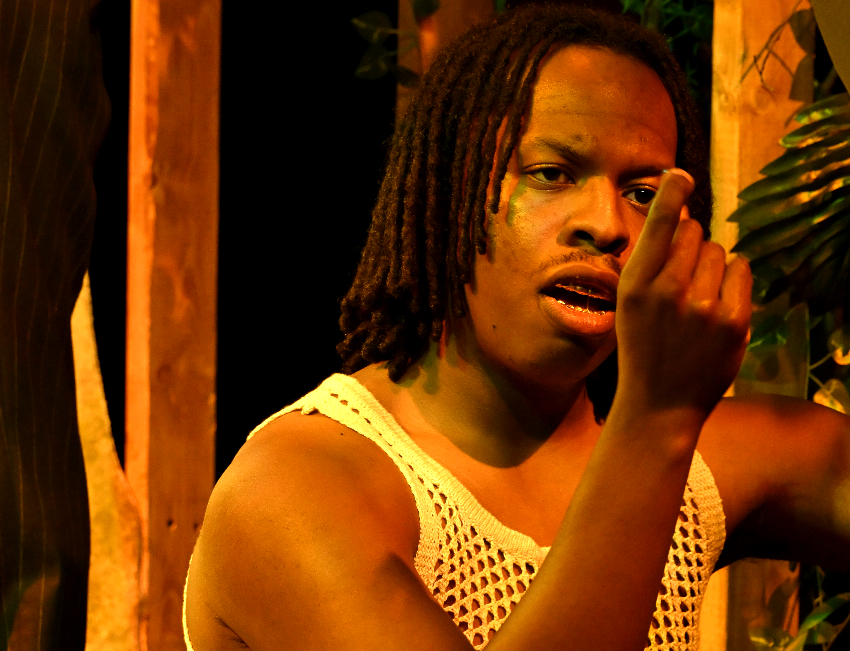
Jimmie Roger III
At this point, the play makes a departure. It remains a parody and these activists do seem inept, but they are also caught in an existential quandary. This takes shape in the lone land line on the wall, a 1990s touch tone wall phone, which will be their means to call the FBI and take claim for the bombing, and make a statement of their motives.
Over the remainder of the play, this brigade of the People's Diasporatic Party swings between ruminations on the morality of their action, or attacking each other. Percy’s Ahmed phrases his sense of their predicament, “I ain't afraid of death. I’m afraid of nobody noticing it. I want my death to be a defining event.”
That phone sits on the wall, a mute expression of the culmination of their destructive act: taking credit for it. Between the tense discussion, the five each take a turn at calling in, when the pressure of the moment drives them to the phone. Yet there is one constraint after another that inhibits them from successfully completing the call: first, they don’t have the number; then they are reluctant to pay 75 cents to “the system” to get directory assistance; after they tear the number from the phone book Lewis calls, and realizes he doesn’t know what to say and hangs up. Tamara calls, but becomes mired in voice mails and transfers and gives up.
Ford’s Tamara seems the most tormented by moral issues of having killed children. Notably, whenever Kwami wants to rally the group, he addresses them as “brothers” then throws in a lagging “and sister,” a low-key running joke for the audience, though not the characters on stage. Eventually the phone call gets through in a resolution of that conceit, which Nottage has used effectively to put each personality on display.
Early works by writers arrive unfettered by reputation and uncontaminated by any self-consciousness with which acclaim may impart. It is my feeling that early writing by authors of any medium allows us a window into that unbridled creative energy.
In Por’ Knockers Nottage inserts that sixth character, the silent, machete wielding Lance, who appears periodically, visible only to Kwami. He prowls the stage front during these brief magical interludes, humming or singing softly. When the other four see Kwami drifting away, he self-consciously explains he is channeling ancestors.
Nottage’s success has not diminished her work, but only affirmed her remarkability. Two subsequent plays like Ruined (its 2008 world premier was at the Goodman, where it returns as part of the next season) and Sweat both won Pulitzers, a first for a woman playwright. Nottage also wrote the book for two Broadway musicals: MJ and The Secret Life of Bees.
Por’ Knockers, which comes recommended, runs through October 4, 2026 at The Greenhouse Theatre.
Powerhouse Performances on Display in Gwydion's Dry Powder
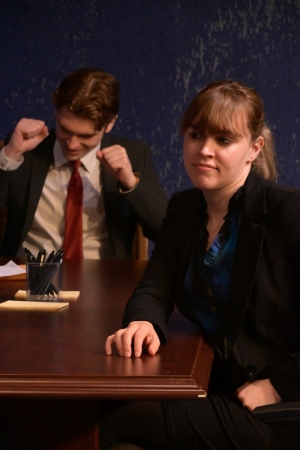
In the sharp-tongued world of Sarah Burgess’s Dry Powder, presented by Gwydion Theatre Company at the Greenhouse Theater Center, the pursuit of money is a blood sport. The play centers on a high-stakes private equity firm caught in a massive public relations nightmare after laying off thousands of grocery store workers the same week its co-founder threw a flashy engagement party featuring an elephant – but it was just one elephant!
All hope isn’t lost for their reputation, however. A potential way out comes thanks to a struggling, American-made luggage company that believes the firm can save them. Of course, as the firm weighs the acquisition, their definition of “help” may not align with the company’s. At the helm is Rick, the ultimate decision-maker, who has two distinct angels on his shoulders: Seth, the optimistic partner who brought the deal to the table, and Jenny, his cold-hard-cash counterpart. From Seth’s perspective, the deal is a perfect fit; they can rescue an American brand without layoffs and emerge as heroes. For Jenny, this luggage company is just baggage—unless it can be downsized, moved overseas, and engineered into something it once stood against.
Directed with precision by Ellie Thomson, Dry Powder completes Gwydion Theatre’s season, which has explored themes of class, money, and power, and how all three can entangle the soul. The production asks what happens to our humanity when everything is reduced to a column on a balance sheet.
The production thrives on the electric, friction-filled chemistry of its cast, anchored by a series of standout performances.
Carol Kelleher delivers a masterclass performance as Jenny. Playing the de facto villain of the piece, Kelleher crafts a remarkably complex and compelling performance that is utterly enjoyable to watch. She doesn’t just play the role; she completely becomes the character, infusing Jenny’s brutal, unrelenting perspective of greed with a sharp humor. Her performance ensures that even at Jenny’s most calculating, you cannot look away.
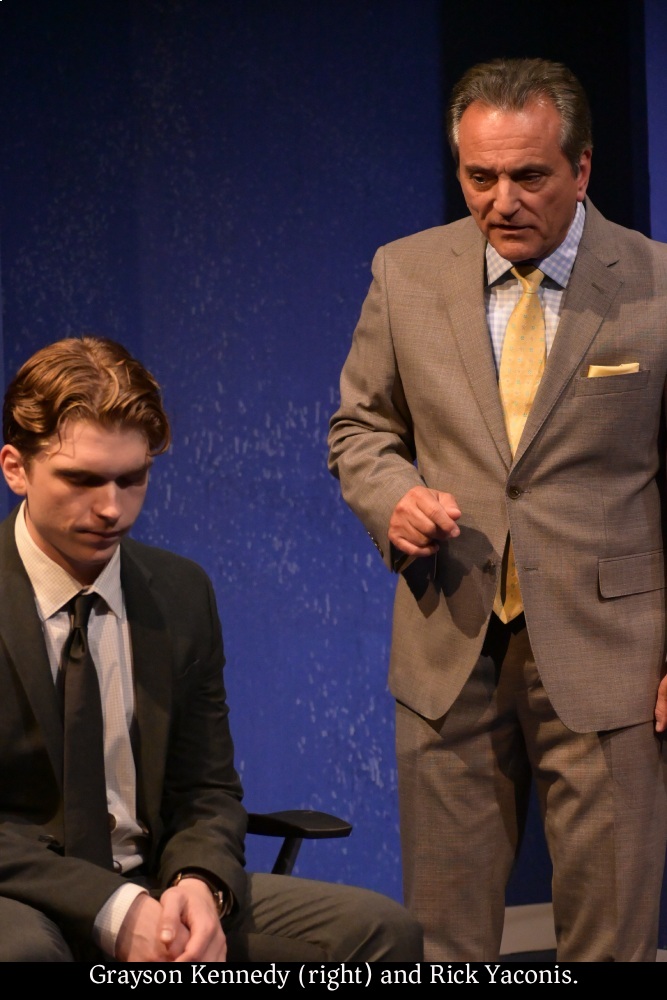
As the firm’s head, Rick Yaconis turns in a powerful performance, deftly striking the balance between a paternal mentor and a greasy titan. He shifts effortlessly between a ruthless opponent and a pat-you-on-the-back salesman.
Grayson Kennedy, a founding member of Gwydion Theatre, brings immense depth to Seth, the firm’s supposedly earnest, morally grounded partner. His clean-cut delivery fits the role perfectly.
Tommy Thams, co-founder of the theatre company, rounds out the dynamic as Jeff, the CEO of the targeted luggage company. Thams infuses Jeff with the relaxed, easygoing charm of an old buddy, making the audience root for the company’s success and feel genuinely betrayed by what unfolds in the final act.
Burgess’s script is complex, mining dark humor from the shifting dynamics and war of words between these characters.
Ultimately, Dry Powder leaves the audience reflecting inward. It might be easy to dismiss this play if we aren't personally in a position to dismantle - or attempt to save - a multimillion-dollar company, but the narrative transcends the boardroom. The play holds up a mirror and forces us to look closely at ourselves: Are we good or are we just being nice?
As Jenny pointedly notes, she never lies to the client. Her emotions, her greed, and her hawkish nature are never disguised. Seth, conversely, hides behind a comforting “nice guy” persona, genuinely believing he occupies the moral high ground. But in trying to appease both sides – a greedy firm and a company that needs help – is he actually better or just deceiving himself?
It’s these thought-provoking questions that make Gwydion Theatre’s production a gripping triumph that lingers long after the final blackout.
Dry Powder plays at the Greenhouse Theater until July 26. Tickets and show information here.
Gwydion's The Lower Depths at Chopin Theatre: An Avalanche of Anguish

I like theatre that’s deep, thoughtful, angsty. There’s much to be said for a play providing undemanding escape, but I prefer to challenge my mind, to make me think. And THE LOWER DEPTHS, as adapted by Grayson Kennedy for Gwydion Theatre Company, certainly did that. Don’t see this alone – you’ll want to talk about it afterward. And do not forget to take your Prozac!
The play is the second in Gwydion Theatre's "Season of Class", exploring classism in society. THE LOWER DEPTHS, written in 1902, explores themes of truth vs. illusion, hope vs. despair, through characters like a thief, a prostitute, and an alcoholic actor in a dreary flophouse on the Volga. The central conflict emerges with the arrival of a mysterious tramp who offers hope through stories and advice. However, hope cannot long survive the lodgers’ perpetually bewailing their travails and vicissitudes.
I was initially anxious about how such a large cast (13!) could operate in the confined space of Chopin Theatre. I personally love Chicago’s singular streetfront theatres, boasting perhaps 50 seats and 200-300 square feet of stage space. See, I like to be immersed in the players’ pheromone cloud, perhaps even bespattered with various bodily fluids.
Y’know, reading back over that, it doesn’t sound very inviting, but trust me on this. And trust Chicago as well – Gwydion is oner of the myriad smaller companies that showcase the multitude of superlative actors in this town. In decades of attending these storefront venues I’ve seen plays I didn’t like, I’ve been critical of some production decisions, but very seldom are the actors themselves disappointing. We are very fortunate here in Chicago. I only wish I could believe these professionals are earning paychecks commensurate with their skill.
Where was I? Oh yes, big cast; and I find myself unable to single out the players of individual characters. I always try in these reviews to praise each actor on their individual performance but between their sheer numbers and the peculiarities of Russian names I can but name the cast and beg the actors’ forgiveness:
Alex Levy (Vaska Pepel); Katherine Schwartz (Vasilisa Karpovna); Matt Mitchell (Mikahil Kostilyoff); Brynn Aaronson (Natasha Karpovna); Tommy Thams (Andrei Mitritch Kleshtch); Hannah Freund (Anna Kleshtch); Christopher Meister (Abram Medviedeff);Bryan Breau (The Baron); Evan Bradford (The Actor); John Nicholson (Satine); Howard Raik (Luka); Maddie Hillock (Kvashnya); Abraham Deitz-Green (Alyoshka); Maya Moreau (Swing); Grayson Kennedy (Swing).
If I’m totally honest (and I owe this stellar troupe that much), even as it was playing, I couldn’t keep track of which character was who. To my relief, this did not interfere with my appreciation of the play and the performances, as it is actually in keeping with the theme of the play. THE LOWER DEPTHS tends to undermine the individuality of the characters: they are emulsified into a slurry of Poor People, faceless and nameless. In this THE LOWER DEPTHS mirrors the attitudes of our Administration: they’re po’ folks, not actual people with real needs and feelings.
Adapted by Maxim Gorky, he was more interested in the characters than in creating a formal plot. There’s no linear sense to the situations portrayed – a woman is dying; the landlord is heartless; everyone’s having an affair with someone – but these are only separate instances in their overall wretchedness. Tellingly, none of them acknowledge any kinship in their tribulations; no one ever says, ‘yeah, I know what that’s like’ or ‘something like that happened to me once’. Thus, while society depersonalizes them, each isolates themself within the siloes of their personal experiences.
Luka, an elderly tramp, arrives with a philosophy of consolation and a better life. Reactions to this message - this theme of harsh truth versus the comforting lie - pervades the play and divides the inhabitants into opposing camps of the hopeful and the realists. Most of them choose to deceive themselves rather than acknowledge the bleak reality of their condition, leading inevitably to violence and death.
Oi! I’m supposed to be encouraging you to see this play, but you’d need to be, like me, a real angst enthusiast to be attracted by my description! But if you do like exploring the depths of desolation; the frequency of forlornness; the drama of dreariness … then THE LOWER DEPTHS is the play for you!
The production team included its artistic directors Tommy Thams and Grayson Kennedy and was drawn largely from Gwidion company members. Scenic Designer Hayley Wellenfeldt and Morgan Kinglsey created a monochromatic and versatile set with Lighting Designer Sam Bessler effectively defining scenes and characters. Costume Designers Cindy Moon and Grace Weir differentiated the subtle differences between, say, the actor and the Baron. Sound Designer Rick Reid sourced authentic Russian period music while Stage Manager Katie Espinoza pulled it all together and put it out there fluidly.
The Lower Depths is the first time in Russian literature that society’s outcasts took center stage in a drama. In claiming importance and humanity for a class that Gorky described as “ex-people” and “creatures who were once men,” he moved Russian drama into the political and social arena that would lead to revolution. May that purpose prevail in our own trying times!
THE LOWER DEPTHS plays at Chopin Theatre through February 28 - https://chopintheatre.com/.
RECOMMENDED
This review is proudly shared with our friends at www.TheatreInChicago.com.
Outstanding Performances Make 'This Is Our Youth' a Winning Production

“This Is Our Youth,” with mesmerizing performances by Kason Chesky as Warren, Grayson Kennedy as Dennis, and Annalie Ciolino as Jessica, is still vital and fresh nearly thirty years after its Off Broadway premiere. Playwright Kenneth Lonergan set it in 1982 during the Reagen era, but these 48 hours in the lives of three dissolute young adults read fresh and vital today as it did almost 30 years ago.
Much of that is attributable to the outstanding performances of all three actors in Gwydion Theatre’s production at Greenhouse Theatre. Under the direction of Andrew Shipman, this trio really gives voice to Lonergan’s deftly drawn characters - locked in their personal traumas and immersed in the travails of their emergence from their upper middle class homes to independence. It’s just a snapshot - two days - during which the characters have some of their best and worst moments.
The two-act play is simple and straightforward: 19-year-old Warren has been booted from his house by his abusive dad, a driven businessman, and secretly lifts $15,000 of dad’s cash as he heads out. Arriving at his friend Dennis’s apartment, suitcase in hand, Warren is a dweeb and awkward, totally aggravating, and we soon side with the more dynamic and charismatic Dennis, who doesn’t want the risk of harboring Warren and his cash.
But Dennis relents, and hatches a plan for the hapless Warren to replenish the missing funds that he has carelessly spent along the way. Here’s how Buzz editor Ken Payne described it in the 2014 Steppenwolf production: a hair-brained scheme where they would buy some coke, keep some for themselves, cut it and then resell it for a profit exceeding the amount needed to replace the full fifteen thousand dollars.
Though I saw the 2014 Steppenwolf version of “This Is Our Youth,” which starred Michael Cera and Kieran Caulkin, I liked this version much, much better. Cera, in the Warren role, was a one-note actor, and Caulkin had nothing to play against - I really didn’t notice how good the script was. In Gwydion Theatre’s sterling production, we quickly learn that these young men have a neurotically abusive relationship.
Dennis is an ill-tempered drug user and purveyor; and Warren weathers a constant barrage of his demeaning put-downs and mean-spirited physical jousting.
When Dennis departs to carry out the scheme, we have a chance to meet Jessica, and Ciolino’s performance is outstanding. Her character allows the other dimensions of Warren’s personality to unfold, and we gain empathy andrespect for the two as more fully emotionally developed individuals, especially compared to Dennis.
Throughout the play, the conversations deliver the exposition and backstories effortlessly, another tribute to Lonergan’s script, and why this play resurfaces so frequently, and remains fresh and meaningful. The two-act run time is over two hours plus intermission. But it grips our interest throughout, and never really falters. Chesky’s Warren is onstage nearly throughout, and he delivers a remarkable performance, but Kennedy and Ciolino are every bit his equals. The energy required of Kennedy in the role of the manic, drug-altered Dennis, may be a formula for stage burn-out, but he carried it off admirably on opening night.
“This Is Our Youth” comes highly recommended, and runs through September 28 at the Greenhouse Theatre Center on Lincoln Avenue in Chicago.
Review: 'The Zoo Story' at Gwydion Theatre Company

It’s hard to imagine a time in which Edward Albee was considered an “emerging” playwright, but his first play, ‘The Zoo Story’ failed to impress New York producers in 1958. Of course, the play has since gone on to become a classic and is currently being revived by new-to-Chicago Gwydion Theatre Company.
Edward Albee always felt like something was missing from his two-character, one-act play about a man whose peaceful afternoon reading in the park is disrupted by a seemingly unstable young man. In the early 2000s, he eventually wrote a prequel called ‘Homelife” and the two plays are usually performed as ‘Edward Albee’s Home at the Zoo.’ Albee would eventually restrict the performing rights for ‘The Zoo Story’ in favor of the complete play.
In the years since Albee’s death, his estate has eased up on some of his more stringent demands when it came to performance rights. As such, Gwydion’s revival is a somewhat rare opportunity to see Albee’s text performed as it was originally conceived. Though, it’s fairly clear why Albee added a first act to this odd little play.
It should come as no surprise that this play, like many of his others, is linguistic gymnastics relying heavily on good casting for cohesion. Thankfully this production is in good hands with Bob Webb as distinguished Peter and Grayson Kennedy as stark, raving Jerry. Under Morgan Wilson’s direction, the play leaps off the page and becomes a story with a rhythm you can follow.
Sparse staging really turns the focus onto the back-and-forth power play between Jerry and Peter and ultimately asks the question: what do either of these characters really want? Albee doesn’t necessarily make that so clear, leaving it up to the audience to come to their own conclusions. Both Kennedy and Webb spar well off one another in what actually feels like fairly modern dialogue, despite some outdated mid-century turns-of-phrase.
It's not often you get to see ‘The Zoo Story’ as it was originally produced, and it’s always exciting when a new theater company opens in Chicago. If this production is any indication, the future looks bright for Gwydion Theatre Company.
Through October 15 at Greenhouse Theater Center. 2257 N Lincoln Ave This email address is being protected from spambots. You need JavaScript enabled to view it.





Latest Articles
-
 Music Theater Works Pours a Beachy Cocktail with Escape to Margaritaville
Written by Kimberly KatzA gentle, tide‑easy current settles in right from the start, immediately signaling the kind of story this musical wants to tell. Rather than relying on big, splashy moments, it settles into a warm, beach-side rhythm, inviting the audience into a…
Music Theater Works Pours a Beachy Cocktail with Escape to Margaritaville
Written by Kimberly KatzA gentle, tide‑easy current settles in right from the start, immediately signaling the kind of story this musical wants to tell. Rather than relying on big, splashy moments, it settles into a warm, beach-side rhythm, inviting the audience into a… -
 Chicago Shakespeare Makes Winter’s Tale a Story Worth Telling
Written by Angelo CamposChicago Shakespeare Theater’s production of The Winter’s Tale delivers a compelling evening of theater, showcasing an exceptional company of actors working at the top of their craft. Under the direction of Artistic Director Edward Hall, this staging marks an exciting…
Chicago Shakespeare Makes Winter’s Tale a Story Worth Telling
Written by Angelo CamposChicago Shakespeare Theater’s production of The Winter’s Tale delivers a compelling evening of theater, showcasing an exceptional company of actors working at the top of their craft. Under the direction of Artistic Director Edward Hall, this staging marks an exciting… -
 A Joe & Melanie Thing Theatre Company announces The Hanukkah Humbug at Greenhouse Theater Center - December 3-6
Written by Buzz Center StageThe world premiere of The Hanukkah Humbug brings ghosts, history, tradition, and a whole lot of family fun to the Greenhouse Theater Center just in time for the holidays, Melanie Ann Apel promises a lively, family-friendly experience with this new…
A Joe & Melanie Thing Theatre Company announces The Hanukkah Humbug at Greenhouse Theater Center - December 3-6
Written by Buzz Center StageThe world premiere of The Hanukkah Humbug brings ghosts, history, tradition, and a whole lot of family fun to the Greenhouse Theater Center just in time for the holidays, Melanie Ann Apel promises a lively, family-friendly experience with this new… -
 Remy Bumppo’s Mud Row: A Family Haunted by the Past
Written by Wesley DavidRemy Bumppo opens its 30th anniversary season with Mud Row, a play by Tony Award nominee and MacArthur “Genius” Grant recipient Dominique Morisseau. Expertly directed by Malkia Stampley, this production is a sublime examination of family, inheritance, and the difficult…
Remy Bumppo’s Mud Row: A Family Haunted by the Past
Written by Wesley DavidRemy Bumppo opens its 30th anniversary season with Mud Row, a play by Tony Award nominee and MacArthur “Genius” Grant recipient Dominique Morisseau. Expertly directed by Malkia Stampley, this production is a sublime examination of family, inheritance, and the difficult…
Does your theatre company want to connect with Buzz Center Stage or would you like to reach out and say "hello"? Message us through facebook or shoot us an email at This email address is being protected from spambots. You need JavaScript enabled to view it..
*This disclaimer informs readers that the views, thoughts, and opinions expressed in the text belong solely to the author, and not necessarily to Buzz Center Stage. Buzz Center Stage is a non-profit, volunteer-based platform that enables, and encourages, staff members to post their own honest thoughts on a particular production.