
Displaying items by tag: Sonia Goldberg
Production of THE IMPORTANCE OF BEING EARNEST Does Not Fully Recognize Its Importance at Oak Park Festival
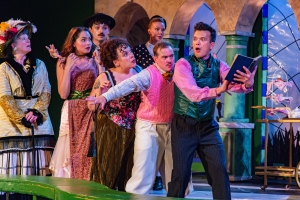
It is possible that Oak Park Festival Theatre’s production of Oscar Wilde’s 1895 “trivial comedy for serious people,” The Importance of Being Earnest, was suffering from some opening night jitters and that the actors will settle in and trust the verbal comedy in the script, but on this beautiful evening under the stars, there was too much mugging and nudging going on. Nevertheless, Wilde’s play, about two young men, Algernon (August Forman) and Jack (Chad Bay), who have both invented alibis - Algernon an invalid friend named Bunbury in the country and Jack a degenerate younger brother in town--to allow them to indulge their socially questionable whims, leading to the difficulty of having to explain why neither is Ernest, is still funny. And, despite the excesses on display, this staging still holds many delights for fans of Wilde, verbal comedy, and, particularly in the second act, some smartly choreographed slapstick. What is missing from much of the evening is earnestness. Many of the actors seemed to be in search of motivation and the stakes that propel them through this admittedly effervescent frolic.
Working with a talented cast of regional stage actors, director Kathryn Walsh has not created a secure world for her creative team to inhabit, resulting in an often funny but not dynamic production, with shrill delivery and broad physical comedy undermining human-scale relationships. The tone and gestures of the various characters range wildly, as do the design elements. The whimsical, vaguely Victorian costumes, while fun, support the cartoonish elements of the production, while not always clearly defining the characters. The lighting design by Devin Cameron is appropriately warm and effectively saturated but also deploys unnecessary flourishes to support the comedic business. The scenic design by Evan Frank likewise captures the locations of the play and allows the actors to find many levels - literally - as they shift allegiances and stratagems. Justin Cavazos’s sound design and compositions lend unobtrusive support, except for one hilariously developed cue that draws attention to itself in a good way. Overall, Walsh’s production would be better served by trusting the script and the audience, especially in the first act, when we are getting to know the characters and their desires. That said, both Walsh’s direction and her cast fully commit to the amorous and combative collisions at the beginning of the second act, which showcases the physical and verbal comedic gifts of all to uproarious effect.
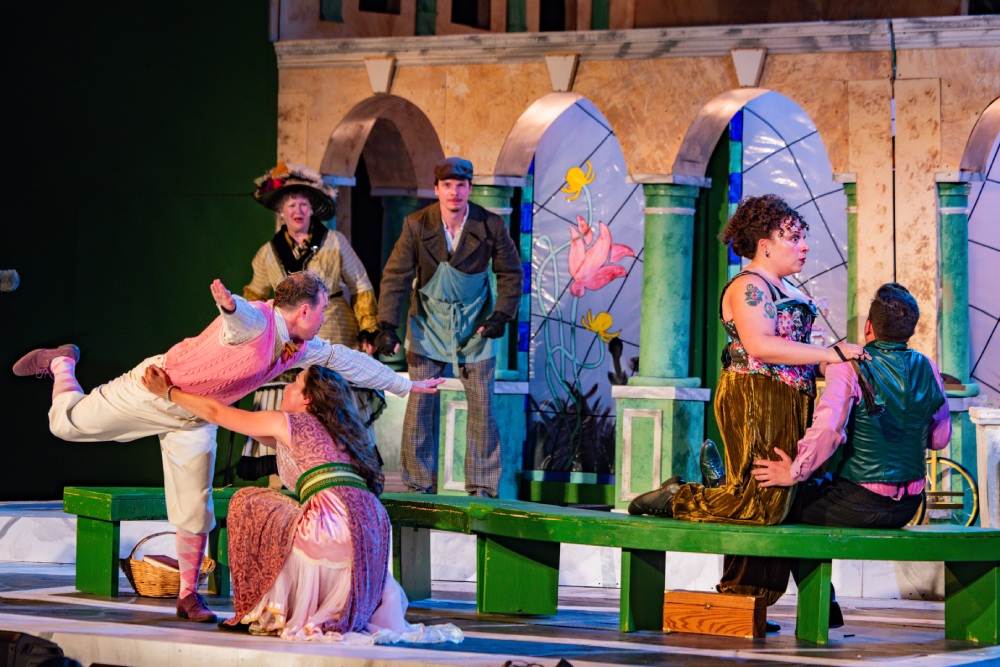
As part of the Oak Park Festival Theatre's 51st season (left to right) August Foreman, Barbara Zahora, Aurora Pennepacker, Drew Bos, Sonia Goldberg and Chad Bay in The Importance of Being Earnest at Austin Gardens.
One of the things that makes The Importance of Being Earnest work is the moral certitude that the characters bring to their pronouncements, no matter how absurd they are or whether their actions correspond to their words. This certitude also grounds the characters in their truths and forms the foundation of their interactions, but too often the actors are checking in with the audience to see if they got the joke (especially when many of Wilde’s observations still resonate) or negotiating with the lines. By the middle of the second act, the characters begin to define themselves, but much opportunity for connection is lost in the first. August Forman as Algernon flings himself into the role with wild abandon and invites the audience along for the ride. An adept comedian, Forman’s strategy often pays off but undermines Algernon’s insecurity as he balances his needs with society’s demands. All that aside, his Algernon’s compulsion for muffins is not to be missed. As his friend Ernest, who is actually Jack, Chad Bay does a good job of playing the less self-aware of the friends and playing up the character’s completely unjustified horror at Algernon’s embrace of Bunburyism. As Jack’s romantic interest, and Algernon’s cousin, Gwendolen, Sonia Goldberg at times overplays her character’s pretensions, some of which Gwendolen is still struggling to master, making Goldberg’s characterization overwhelmingly self-possessed at times. Conversely, Barbara Zahora lacks the imperiousness of many Lady Bracknells, giving the character an interesting warmth, but making her power solely transactional, which could be an interesting choice if it were played more fully. Aurora Pennepacker as Cecily strikes the most effective balance between the verbal and physical comedy, making the most of the opportunities to show Cecily’s willingness to exploit others’ assumptions about her character and her real understanding of her powerlessness without this ability. In Jodi Gage’s performance, Ms. Prism is a refreshingly insightful tutor to Cecily, while doggedly hanging onto youthful romanticism. Gabriel Armstrong is a very youthful Reverand Chasuble, celebrating his sudden relevance in parish life. Drew Bos may be the youngest actor to play the dual roles of Lane and Merriman in a professional production and wisely focuses on the class commentary afforded by the butlers of their respective households. His droll Lane gives Algernon food for thought in Act I, while his Merriman, already suffering from the physical strain of servitude despite his youth, effectively times his long-suffering pauses at each new demand (though Bos may need a visit to a chiropractor after the run). The experienced cast expertly and clearly delivers Wilde’s witticisms, which are always worth revisiting and occasionally resonate with the current social dynamics.
As the run continues, the production will most likely settle in and allow the script to propel the pacing and action more fully, especially in the more expository first act. There is much to appreciate in Oak Park Festival Theatre’s The Importance of Being Earnest, including a smart cast who find both the verbal and physical humor inherent to the play. Director Kathryn Walsh and her cast also explore fresh takes on the characters, some more successful than others, but always welcome. For those unfamiliar with Wilde’s play, this production is a solid introduction.
The Importance of Being Earnest runs in repertory with Hamlet, through August 14, outdoors in Austin Gardens in Oak Park, Illinois. Visit Season 51 | Oak Park Festival Theatre or call (708) 300-9396 for tickets and more information. Note: a number of the actors perform in both Earnest and Hamlet, and Oak Park Festival Theatre is offering discounted tickets for audiences who want to see both.
'Into the Woods' an Exciting Musical Fairytale Mashup at Chopin Theater

I’ll admit it: I knew little about “Into the Woods” before seeing the new production at Chicago’s Chopin Theatre. I’m not particularly fond of the composer, Stephen Sondheim. I’d bailed early watching the 2014 film with Meryl Streep. So I challenged myself to find out why it is so popular. And now I know: it’s really good.
At a venue like Chopin Theatre, in the intimate downstairs theater, you’ll have a chance to appreciate the dark humor of the book by James Lapine, and music and lyrics by Sondheim. No doubt you will come away as I did, experiencing the power mined from a most creative mash-up of four familiar fairy tales, and very much liking its dark, funny humor.
Lapine and Sondheim tap four classic fairy tales—Rapunzel, Little Red Riding Hood, Jack and the Beanstalk, and Cinderella—building a cast of characters that for the first time meet each other. And we discover on stage they have a lot in common.
Among the cast are two princes, Shea Hopkins as Cinderella’s Prince and Jonathan Allsop as Rapunzel’s Prince, who bond in their shared quests. Princessy figures Cinderella (Madison Kauffman) and Rapunzel (Ismael Garcia) share the spotlight. And then there are the younger innocent players, Little Red (aka Riding Hood, Anna Selbert) and Jack (Kevin Parra) of Beanstalk fame. Both get into trouble for not following their mothers’ orders.
And of course we see those mean-spirited characters, The Witch (Stephanie Stockstill) who entrapped Rapunzel in that stairless tower and Cinderella’s Stepmother (Emily Goldberg)—though these two don’t really connect.
Bits of the classic stories are recounted, but “Into the Woods” faces us squarely with the shadowy parts. Yes Rapunzel let down her long hair for that prince and they fell in love. But there is more in Grimm’s Fairy Tales (I reread them all after seeing the show): The Witch cuts off Rapunzel’s hair, banishes her to wander a wasteland, and tricks the Prince into climbing up. He falls into a thornbush and pierces his eyes. Another element I hadn’t recalled until my rereading of Rapunzel: a couple aiming to have a child are the origins of the long-haired beauty’s predicament. (This couple seems to be drawn from the original tale, in which the husband surrenders Rapunzel to compensate The Witch for his theft from her garden.) In the play, that husband becomes The Baker (Kevin Webb) who with The Baker's Wife (Sonia Goldberg) goes on a quest in order to have a child.
Sondheim and Lapine take these stories into uncharted territory in Act 2 as the characters suffer retributions unleashed for their selfish acts. As originally told, after Jack sells a cow for those magic beans, he climbs into the Giant’s lair and robs him, then kills the Giant as he pursues him down the beanstalk. The play adds a riff to that tale: the Giant’s widow (Honey West) chases Jack and wreaks havoc in the kingdom in her pursuit of justice.
The stories are woven together into a cohesive whole guided by Narrator, played so remarkably well by August Forman, who doubles as Mysterious Man. It is the strength of Forman’s performance that makes the many moving parts fit together; they are onstage continuously and tirelessly. It’s truly remarkable to behold.
Kokandy Productions’ show, directed and tightly choreographed by Derek Van Barham, meets the demands of this funny and inventive book by Lapine, with music and lyrics by Sondheim. Entrances and action are timed with exacting precision.
A pair of grand pianos are center stage, with keyboardists Ariana Miles and Evelyn Ryan replacing full orchestration, and fully integrated to the action around them. Kudos to these two for their exemplary artistry.
What’s not to like in “Into the Woods”? Just one thing: that Wolf? His ears are way too round and small.
At its 1986 Broadway debut, “Into the Woods” was seen by many as an allegory for the havoc wreaked by the early AIDS crisis. It’s easy to see why during Act 2. Sondheim has demurred from that interpretation, and now nearly 50 years later, there is nothing explicitly alluding to AIDS. Our contemporary climate crisis fits aptly into interpretations of the play now. And that is a tribute to the work’s timeless character, and longstanding appeal.
“Into the Woods” runs through December 22, 2024 at The Chopin Theatre in Chicago.
Review: Pippin at North Shore Center for the Performing Arts

Fun fact. I went into Music Theater Works’ production of Pippin knowing the songs, knowing the show, and knowing I’d have a good time. But afterwards, I learned from my daughter, herself a current member of Scotch’n’Soda Theatre, Carnegie Mellon University’s student theater troupe, that the beloved musical didn’t just appear out of thin air, manufactured by the Broadway gods and bestowed upon us earthly theatergoers.
But Pippin didn’t just appear magically like all the good shows seem to have done. It was originally written by Stephen Schwartz as a student show for Scotch’n’Soda Theatre before its first Broadway run, directed by the great Bob Fosse. Knowing that now, the show’s youthful exuberance and dated innocence makes sense. Of course it was written by a kid, albeit a very talented kid.
Knowing that, the show means that much more—the story of a talented kid figuring out life and yearning for something, written by a kid like that. And knowing that, it’s fitting that my favorite part of this fine production of Pippin, directed by Kyle A. Dougan at the North Shore Center for the Performing Arts, was its young and talented and eager and enthusiastic ensemble. Seriously, the ensemble works (and sings and dances and acts) their tails off.
Choreographed by Mollyanne Nunn and Kaitlyn Pasquinelli, both ensemble members as well, there is always something fascinating going on across the stage; I never knew quite where to look because there was always someone stunning me with a dance move or making me laugh with a random bit of incidental tomfoolery. The scenic design by Shane Cinal and the costumes by Jazmin Aurora Medina only furthered the youthful feel, for me especially, as the themes and color palette and props all screamed 80s and 90s. And said costumes and props were put to good use by the cast, with Ciara Hickey and Jordan Ordonez two standouts, the latter joining Lacey Jack and Sonia Goldberg’s Leading Player for the dance scene in “Glory.”
Goldberg starred last year in Theo Ubique’s Once Upon a Mattress, and again takes center stage in the role of Leading Player, originated by Ben Vereen, leading the production throughout. Goldberg also leads youthful and yearning Pippin through the show’s story, for this production played by Connor Ripperger. Both Ripperger and Goldberg have phenomenal vocal skills, and show them off throughout. Their talents are matched by the rest of the main cast, including a hilarious (and hilariously costumed) Thomas M. Shea as Pippin’s royal father, King Charlemagne, Andrew Freeland as Lewis, Desiree Gonzalez as Catherine, and Di’Aire Wilson as Theo. The two women competing in the king’s life are wonderful; Kathleen Puls Andrade’s Berthe kills “No Time at All” (helped out, of course, by the audience on the choruses) and Savannah Sinclair flashes her dancing skills as Fastrada.
But again, this production is most enjoyable as a whole—because of all the talent onstage, because of all the enthusiasm shown by every single member of the cast, and because of all the hard work that has obviously been put into the show by everyone involved with Music Theater Works. I’d be remiss if I didn’t mention the orchestra, conducted by Justin Akira Kono. Kono leads the strings, horns, and trumpets through the show’s beloved soundtrack, and gives it a real Broadway feel. Because yes, this might be a show about youthful angst, written by a college kid for a college theater, but it’s also a beloved Broadway classic, jam-packed with beloved standards. And from now through June 25, you can see the cast and crew of Music Theater Works give it their all in Pippin at the North Shore Center for the Performing Arts in Skokie.
'Hershel and the Hannukah Goblins' Reaches Out to Virtual Audience

This is the third year that Strawdog Theatre Company is presenting its adaptation of Eric Kimmel’s children’s book Hershel and the Hannukah Goblins, but this is 2020 and a pandemic has forced the performance to go online. The outlines are still there: a traveling troupe of vaudevillian players fallen on hard times barters with an innkeeper for room and board, sharing a story for food. Hershel and the Hannukah Goblins is that story, about the wily grandfather of the troupe’s leader and his efforts to save Hannukah from the goblins who have taken over the old synagogue and who, for reasons unknown, hate Hannukah and blow out the candles and throw the latkes on the floor whenever anyone tries to celebrate the holiday. The cast is talented and energetic and give their all, interacting with the unseen virtual audience, but the absence of that audience casts a pall on the proceedings. The show is still a sweet reminder of the traditions of the season: the food, the lighting of the menorah, the dreidel, and, most importantly, the community and generosity that is celebrated. But without an audience of children to play along, the show struggles to take off. That said, Strawdog has done what they can to ensure that families (though not reviewers watching in their living rooms with blind cats in their laps) can create a fun and festive event with a little advance preparation. There are coloring pages that help tell Hershel’s story and there are moments when parents can guide their offspring to offer magic words or evaluate the quantity of gold required for a dreidel game. There is a song to guide the making of latkes, and songs to light each candle. If you are a parent of kids, especially those under 10, who wants to create a live living room experience, the ingredients are all available.
Hershel and the Hannukah Goblins recalls the stories of Sholem Aleichem, with the title character tasked with outwitting an ever-more threatening gaggle of goblins to save Hannukah, which the town has not been able to celebrate since the goblins took up residence in the creepy, old synagogue. Director Spencer Ryan Diedrick has recruited a young, musically talented ensemble to tell the story, and even tries to recreate the live theater experience with a pre-show warm-up of songs and knock-knock jokes. All the actors take on multiple roles and perform from their own homes. Diedrick has ensured that props make their way smoothly from screen to screen, the action is fast-paced, and the cast connect as best as they can with their young spectators. The spritely songs by Jacob Combs, mostly performed live by the cast under the musical direction of Celia Villacres, are klezmer-based but with an appealing contemporary beat to make them accessible and danceable for audiences new to the genre. Even though the performance would not exist without the magic of technology, this is a decidedly low-tech adaptation, with actors employing masks, puppets, costume accessories, acoustic instruments and papier-mâché props to tell the story. Aly Amidei’s costumes are reminiscent of the early 19th century, but also reflect the homespun aesthetic of the “traveling” company. The props by Manny Ortiz are bold and colorful and easy to manipulate onscreen. The masks and puppets that represent the goblins are a clever range of folded paper puppets to sock puppets to baroque papier-mâché masks which convey the ever-more-menacing goblins. No need to worry about frightening the children, though; these goblins are not the sharpest demons in the drawer and should not give even the youngest and most sensitive viewers any trouble sleeping.
The cast, led by Rebecca Keeshin (who also plays a mean ukulele) as Hershel, and including Julia Atkin, Sonia Goldberg, and Ian Minh, interact as best as Zoom will allow with each other and the audience. They quickly add costume pieces to take on different roles, share songs and jokes, and gleefully inhabit various goblins (or interact with different goblins, in the case of Keeshin). Their performances will no doubt encourage young people to talk to the screens in front of them.
Though the end of Hershel’s quest is never in doubt, any more than the players’ welcome into the community, Hershel and the Hanukkah Goblins will provide a joyful diversion for families of young children willing to add some spirit at home. Despite the opportunities offered by moving the show online, Strawdog Theatre Company has opted for a stripped-down, old-fashioned children’s theater experience. If you have a young audience at home, and want to take them to the theater, clear some space in front of the screen and play along. Then they can color in the show-related pictures and help make latkes. It will take some effort at home, but the Hannukah show can be saved.
Hershel and the Hannukah Goblins will be performed live, online, through December 20, Saturdays and Sundays at 1pm and 4pm. Tickets are $25 - $30 and are available at www.strawdog.org.


Latest Articles
-
 Powerhouse Performances on Display in Gwydion's Dry Powder
Written by Angelo CamposIn the sharp-tongued world of Sarah Burgess’s Dry Powder, presented by Gwydion Theatre Company at the Greenhouse Theater Center, the pursuit of money is a blood sport. The play centers on a high-stakes private equity firm caught in a massive…
Powerhouse Performances on Display in Gwydion's Dry Powder
Written by Angelo CamposIn the sharp-tongued world of Sarah Burgess’s Dry Powder, presented by Gwydion Theatre Company at the Greenhouse Theater Center, the pursuit of money is a blood sport. The play centers on a high-stakes private equity firm caught in a massive… -
 Production of THE IMPORTANCE OF BEING EARNEST Does Not Fully Recognize Its Importance at Oak Park Festival
Written by Kerstin BroockmannIt is possible that Oak Park Festival Theatre’s production of Oscar Wilde’s 1895 “trivial comedy for serious people,” The Importance of Being Earnest, was suffering from some opening night jitters and that the actors will settle in and trust the…
Production of THE IMPORTANCE OF BEING EARNEST Does Not Fully Recognize Its Importance at Oak Park Festival
Written by Kerstin BroockmannIt is possible that Oak Park Festival Theatre’s production of Oscar Wilde’s 1895 “trivial comedy for serious people,” The Importance of Being Earnest, was suffering from some opening night jitters and that the actors will settle in and trust the… -
 The Beautiful Overthinking of Gary Gulman’s 7th Hour
Written by Ken PayneGary Gulman brings his new tour, 7th Hour: An All New Standup Show, to The Den Theatre, offering Chicago audiences a chance to see a comic who has spent decades refining the long-form, slow-burn style that has become unmistakably his.…
The Beautiful Overthinking of Gary Gulman’s 7th Hour
Written by Ken PayneGary Gulman brings his new tour, 7th Hour: An All New Standup Show, to The Den Theatre, offering Chicago audiences a chance to see a comic who has spent decades refining the long-form, slow-burn style that has become unmistakably his.… -
 Court Theatre presents the Spotlight Reading Series A Century of Black Progress August 7 – 22
Written by Buzz Center StageUnder the leadership of Marilyn F. Vitale Artistic Director Avery Willis Hoffman and Executive Director Angel Ysaguirre, Court Theatre proudly presents the Spotlight Reading Series. The Spotlight Reading Series will run from Friday, August 7, through Saturday, August 22, at venues throughout Chicago. Curated by…
Court Theatre presents the Spotlight Reading Series A Century of Black Progress August 7 – 22
Written by Buzz Center StageUnder the leadership of Marilyn F. Vitale Artistic Director Avery Willis Hoffman and Executive Director Angel Ysaguirre, Court Theatre proudly presents the Spotlight Reading Series. The Spotlight Reading Series will run from Friday, August 7, through Saturday, August 22, at venues throughout Chicago. Curated by…
Does your theatre company want to connect with Buzz Center Stage or would you like to reach out and say "hello"? Message us through facebook or shoot us an email at This email address is being protected from spambots. You need JavaScript enabled to view it..
*This disclaimer informs readers that the views, thoughts, and opinions expressed in the text belong solely to the author, and not necessarily to Buzz Center Stage. Buzz Center Stage is a non-profit, volunteer-based platform that enables, and encourages, staff members to post their own honest thoughts on a particular production.