
Displaying items by tag: David Schwimmer
Lookingglass announces new leadership team

Lookingglass Theatre Company today announced a new leadership structure that brings together four longtime members of its acclaimed ensemble and new Board leadership, marking an exciting next chapter for the Tony Award-winning Chicago theater company.
Ensemble Members Ericka Ratcliff and David Catlin have been elected Co-Artistic Directors. Former Lookingglass Creative Producer Philip R. Smith will become Executive Director and Ensemble Member and co-founder David Schwimmer will serve as Producing Director. Most recently, Ratcliff was Literary Manager at Chicago Shakespeare Theater. David Catlin was the founding co-Artistic Director of Lookingglass, then served as Artistic Director from 2003-2010 and is a tenured Associate Professor and Head of Acting at Northwestern University. Philip R. Smith has been the Associate Director of Advancement at Writers Theatre after decades of working in multiple leadership roles at Lookingglass.
Lookingglass also welcomes new leadership to its Board of Directors, with Marci Masur serving as Board President and Deann Bayless as Board Chair.
The transition comes as Ensemble Member Kasey Foster completes her three-year term as Artistic Director, during which Lookingglass emerged from its post-pandemic pause, returned to producing and laid the groundwork for an ambitious new era for the company. Artistic Directors at Lookingglass are elected by the company's ensemble to three-year terms.
The new leadership structure comes at a moment of renewed artistic and institutional momentum for Lookingglass, building on nearly four decades of boundary-pushing work while setting the stage for an ambitious future. In 2026, Lookingglass celebrated two successful productions in its recently renovated space and hosted the most successful gala in its history. The company also recently signed a new 20-year lease at the Water Tower Water Works, securing its home for the next generation of Lookingglass artists and audiences, while exploring expanded programming, partnerships and earned-revenue opportunities designed to support continued artistic and institutional growth.
Ratcliff and Catlin will share responsibility for the artistic vision and programming of Lookingglass, extending the company's deeply collaborative approach to its artistic leadership. Together, the four leaders bring decades of experience as artists, directors and producers at Lookingglass, pairing deep institutional knowledge with distinct perspectives and a shared commitment to the company's defining values of collaboration, transformation and invention as they build on Lookingglass's artistic legacy and shape what comes next.
"What excites me most about stepping into this role is the sheer range of talent in this Ensemble, and the opportunity to figure out together how we can continue to create the settings for risk, experimentation and ambitious work that might feel impossible anywhere else," comments Ratcliff. "That is the unique power of Lookingglass. The impossible is the point, but the purpose is what makes the risk matter. We want to honor the history and DNA of Lookingglass and continue to push it forward, giving our artists and collaborators room to make work that surprises us, challenges us and feels deeply connected to this city."
"Collaboration is a core value that courses deep in the veins of Lookingglass– nearly four decades deep," says Catlin. "Kasey, alongside our incredible staff and board, led us through unprecedented challenges so that we can take the baton and steward Lookingglass' signature immersive, transformative, and inventive storytelling, to ignite the imaginations of Chicago audiences in their favorite castle on Michigan Avenue."
As Producing Director, Schwimmer will build on his renewed involvement with Lookingglass, focusing on producing, partnerships, fundraising and expanding opportunities for the company's work and artists. Earlier this year, the Lookingglass co-founder described his renewed commitment to the company as "doubling down," as he expanded his involvement and efforts to strengthen the theater's long-term sustainability.
"I'm thrilled to join this 'Dream Team' in a more official capacity," notes Schwimmer. "Lookingglass cannot have asked for a more experienced, passionate, fun and tenacious group of go-getters to grab the helm. To quote the White Queen from Through the Looking-Glass, this gang not only believes in 'as many as six impossible things before breakfast' — but DOES them."
As Executive Director, Smith will oversee the company's administrative and organizational operations, working alongside Ratcliff, Catlin and Schwimmer to support Lookingglass's artistic ambitions and long-term institutional growth. Smith has been involved in the artistic leadership of Lookingglass since 2000 and has helped produce more than 70 productions for the company.
"What has kept me rooted at Lookingglass for more than three decades is its willingness to imagine what might seem impossible—and then find a way to make it possible," says Smith. "That is what draws so many people to this great theatre. My goal, with this remarkable team in place, is to lift up and bring together their singular imagination, care, and experience around a clear vision: to build a sustainable and thrilling producing model that gives Lookingglass the freedom to do its most ambitious and distinctive work and then to share it with Chicago's unrivaled audiences."
Lookingglass also welcomes new leadership to its Board of Directors, with Marci Masur serving as Board President and Deann Bayless as Board Chair. Masur and Bayless bring extensive experience spanning business, philanthropy, civic engagement and Chicago's arts community and will work alongside the company's new leadership team as Lookingglass continues to strengthen its institutional foundation and expand its reach.
"Lookingglass reflects Chicago at its best: inventive, collaborative and unafraid to try something no one has seen before. That spirit has been part of the company's heartbeat for nearly four decades. This leadership team knows it deeply and has the vision to carry it forward. The more people we bring into that experience, the stronger Chicago's creative future becomes," notes incoming Board President Marci Masur.
ABOUT THE LEADERSHIP TEAM
ERICKA RATCLIFF, Co-Artistic Director
Ericka Ratcliff has performed at Lookingglass in Black Diamond, Around the World in 80 Days and Peter Pan (A Play), as well as assistant-directed and dramaturged Thaddeus and Slocum: A Vaudeville Adventure. Her additional credits include work with The Second City, Steppenwolf Theatre Company, Northlight Theatre, Alliance, Milwaukee Rep, Pittsburgh Playwrights Chicago Shakespeare Theater, Congo Square Theatre, The House Theatre of Chicago and others. She most recently served as Coordinating Producer for Goodman Theatre's 100 Free Acts of Theater and as Literary Manager at Chicago Shakespeare Theater, following her time as Artistic Director of Congo Square Theatre.
DAVID CATLIN, Co-Artistic Director
David Catlin is a founding Ensemble Member, actor, writer, director and former Artistic Director, Managing Director, and Director of Artistic Development at Lookingglass. Catlin's extensive directing and acting credits at Lookingglass span the company's history including Lookingglass Alice, Mary Shelley's Frankenstein and Moby Dick. Catlin is an Artistic Associate with Actors Gymnasium and is Head of Acting at Northwestern University.
DAVID SCHWIMMER, Producing Director
David Schwimmer is a co-founder of Lookingglass and an actor, director and producer in theater, television and film. His Lookingglass directing credits include his adaptations of Studs Terkel's RACE and Upton Sinclair's The Jungle. His television and film credits include Friends, for which he received an Emmy Award nomination; American Crime Story: The People v. O.J. Simpson, for which he received a second Emmy nomination; Band of Brothers, Curb Your Enthusiasm, the Madagascar films and, most recently, Goosebumps for Disney+. His extensive directing career spans theater, television and film.
PHILIP R. SMITH, Executive Director
Phil Smith is a longtime Lookingglass Ensemble Member who has been involved in the artistic leadership of the company since 2000 as Casting Director, Artistic Director, Producing Director and Creative Director, helping to produce more than 70 plays. As Creative Producer, he co-served as Casting Director, produced many of the annual galas, and acted as a primary artistic liaison to the Development Department.
Prior to joining this new Lookingglass team, Phil spent two years as Associate Advancement Director at Writers Theatre in Glencoe, where he played a leading role in securing $1.3M in production support for the Jeff Award-winning production of Leopoldstadt.
In his return to Lookingglass in this new leadership role, he is especially energized by working together with this great community to help generate the structure, resources and momentum needed to create and present the bold, inventive, and deeply engaging work that has long been a Lookingglass trademark.
MARCI MASUR, Board President
Marci Masur is a strategic executive and civic leader known for advancing complex, high-impact initiatives at the intersection of business, philanthropy, and Chicago's civic community. Most recently, as a Managing Director at a leading financial services firm, she oversaw a global real estate portfolio and led a significant investment in its Chicago headquarters. Her career has centered on organizational strategy, operational transformation, major capital projects and building partnerships across the corporate, government and nonprofit sectors. A committed advocate for Chicago, Masur has helped strengthen institutions that shape the city's future.
DEANN BAYLESS, Board Chair
Deann Bayless is one of the nation's foremost women restaurateurs. Together with her husband, Rick Bayless, she opened Chicago's Frontera Grill in 1987, followed by Topolobampo, with both restaurants earning the James Beard Foundation's Outstanding Restaurant award. Bayless has served on the boards of Chicago Public Media and Women Chefs & Restaurateurs and, with Rick Bayless, established the Bayless Family Foundation to support Chicago's theater community.
THE LOOKINGGLASS ENSEMBLE
The Ensemble includes: Atra Asdou, Kareem Bandealy, Walter Briggs, Mara Blumenfeld, J. Nicole Brooks, David Catlin, Thom Cox, Larry DiStasi, Kevin Douglas, Christine Mary Dunford, Laura Eason, Anthony Fleming III, Raymond Fox, Kasey Foster, Joy Gregory, Doug Hara, David Kersnar, Sylvia Hernandez-DiStasi, Anthony Irons, Louise Lamson, Wendy Mateo, Dan Ostling, Andre Pluess, Ericka Ratcliff, David Schwimmer, Joey Slotnick, Phil Smith, Heidi Stillman, Tracy Walsh, Andy White, Temple Williams III, Matthew C. Yee and Mary Zimmerman.
BOARD OF DIRECTORS
Lookingglass welcomes David Reifman, Melanie Pickett, Michael Costabile and David Quinn to its Board of Directors. They join current Board members Steve Armstrong, Deann Bayless, Alexandra Bradbury, Chanon DiCarlo, Charlie Frankel, Lee Golub, Mike Harrington, Turiya Luzadder, Marci Masur, Nina Nashif, James Oh, Jennifer O'Neill, Bob Palffy, Carolyn Ravichandran, Abbie Roth, M.D., Yasmeen Soin, Catie Walsh Headtke, Steve Weiss, David Catlin, Ericka Ratcliff and David Schwimmer.
STAFF
The Lookingglass staff includes: Philip Smith (Executive Director), David Catlin (Co-Artistic Director), Ericka Ratcliff (Co-Artistic Director), David Schwimmer (Artistic Producer), Olivia Tritschler (General Manager), Kasey Foster (Outgoing Artistic Director), Molly Bunder (Director of Education and Engagement), Katie Tuttle (Interim Director of Development), Scott Letscher (Director of Ticketing and Audience Services), Mark Bracken (Director of Production), Kate Sullivan Coombs (Managing Producer), Mantra Radhakrishnan (Grant Manager), Spencer Diedrick (Donor Relations and Data Associate, Front of House Associate), Annaliese Baker (Marketing Manager), Kimberly Lawson (Sales & Partnership Coordinator), Libby Lane (Scene Shop Coordinator), Skate Ehling (Technical Director), Dan Machalinksi (Technical Director), Savana Nix (Costume Director), Ally Perparos (Sound Supervisor), and Aaron Lichamer (Lighting Supervisor). Front of House: Gabriella Ashlin (House Manager Lead),Tamara Becker (Concessions Lead), Spencer Diedrick (Front of House Associate), Ashley Keys (Front of House Associate), Delaney Spielman (Front of House Associate), Ashley Keys (Front of House Associate), Kosi Achife (Front of House Associate), M.J. Krystosek (Front of House Associate), Nathan Short (Front of House Associate), Paulette Maher (Front of House Associate), Sage Peacock (Front of House Associate), Ty Bonneville (Front of House Associate). Teaching Artists: Katy Boza, Isabella Bradley, Melissa Briskman, Molly Bunder, Milo Christner, Claudio Jean Carlos, Fay Florence-Steddum, Larry Grimes, Claribel Gross, Ariya Hawkins, Risha Hill, Juliet Kang Huneke, Louise Lamson, Ellie Levine, Michelle Moe, Laura Murillo Hart, Kelly Nesheim, Edmund O'Brien, Michaelyn Oby, August Petry, Austin Rambo, Ky Rambo, Alyssa Ramos, Sivan Spector, Myra Su, Autumn Thelander, Oskar Westbridge, Scott Westerman and Matthew Yee.
ABOUT THE LOOKINGGLASS 2026/27 SEASON
Lookingglass Theatre's 2026/2027 Season is currently underway with the Chicago presentation of Kowalski, featuring Johnny Galecki and Jacob Moskivitz, followed by two signature Lookingglass world premieres: Ensemble Member and Tony Award winner Mary Zimmerman's adaptation of The Yearling and Ensemble Member J. Nicole Brooks' second play in a planned trilogy about Chicago mayors, Prince Hal. Subscription and Memberships are available now for purchase at lookingglasstheatre.org or by phone at 312.337.0665. The Lookingglass box office is located at Water Tower Water Works, 163 E Pearson St at Michigan Ave.
Subscribers unlock special discounted tickets, priority seating, and a range of additional benefits. Lookingglass three show Subscription Series pricing starts at $224.00. Lookingglass Memberships offer exclusive perks, including access to Premium Center Seats, VIP ticketing, priority access to limited-run experiences, invitations to exclusive rehearsal events as well as many other benefits. Pricing and details of benefits for both Members and Subscribers can be found at https://lookingglasstheatre.org/join-us/membership/.
ABOUT LOOKINGGLASS THEATRE COMPANY
Founded in 1988 by graduates of Northwestern University, Lookingglass Theatre Company is a nationwide leader in the creation and presentation of new, cutting-edge theatrical works and in sharing its ensemble-based theatrical techniques with Chicago-area students, teachers and organizations through Education and Community Programs. Guided by an artistic vision centered on the core values of collaboration, transformation and invention, Lookingglass seeks to capture audiences' imaginations, leaving them changed, charged and empowered.
Recipient of the 2011 Tony Award for Outstanding Regional Theatre, Lookingglass has built a national reputation for artistic excellence and ensemble-based theatrical innovation. Notable world premieres include Mary Zimmerman's Tony Award-winning Metamorphoses and The Odyssey, J. Nicole Brooks' Her Honor Jane Byrne, David Schwimmer's adaptation of Upton Sinclair's The Jungle and Studs Terkel's Race: How Blacks and Whites Think and Feel about the American Obsession, Matthew C. Yee's Lucy and Charlie's Honeymoon, Heidi Stillman's Cascabel, created in collaboration with renowned Chef Rick Bayless, and David Catlin's Moby Dick and Lookingglass Alice.
In Lookingglass' White Rooster, Yee Conjures an Intriguing World Where Old and New Collide

White Rooster arrives at Lookingglass Theatre with the kind of wild, genre‑bending confidence that reminds you why this ensemble has always been one of Chicago’s most inventive storytellers. Ensemble member Matthew C. Yee - doubling as writer and director - conjures a darkly funny, legend-steeped ghost story that feels mischievously modern in this world‑premiere production. What begins as a family tale rooted in early‑1900s China unfurls into a surreal, music‑laced journey through a spirit-ridden American town of gold prospectors, where the living and the dead negotiate unfinished business with equal parts tenderness and absurdity.
That sense of slipping between worlds is echoed the moment you enter the space. For two gripping hours, the audience is submerged into a mysterious, rickety mining town - red light seeping through the floorboards as white, flowing curtains above and below the attic sensually breathe with every spectral draft. A mine entrance sits just below the stage; a shadowy passage characters slip into when needed to dig deeply for gold - and climb back out only if they are fortunate.
The theatre is arranged in a bold, innovative configuration that feels unmistakably Lookingglass, and once the lights go down, our surroundings tilt sideways. White Rooster summons a realm of folklore and restless spirits in a spellbound theatrical storm. There isn’t a bad seat in the intimate Lookingglass house.
Yee’s setting brilliantly blends Chinese mythology with timeworn Americana, woven together through Lookingglass’ trademark physicality and vivid visual artistry. Lookingglass builds a set that’s equal parts dusty ghost town and drifting dreamscape, all weathered wood, shifting platforms, and shadow‑hungry corners. Nothing stays still for long. Cloth walls slide softly across the room, lighting tricks the eye into seeing motion, and the entire environment reacts to the characters’ emotional temperature - as if the town itself is leaning in to listen.
The tone in White Rooster swings delightfully between eerie and, at times, hilarious – a fiancé who won’t stay dead, a sister who won’t stay buried, and a rooster whose presence is as oddly ominous as it is absurd. The stage is set for a journey that feels truly singular, a ride unlike anything else audiences will encounter.

Karen Aldridge in Lookingglass' White Rooster. Photo by Justin Barbin.
The story centers on Min (finely played by Sunnie Eraso), a young woman desperate to outrun her past, only to discover that the past travels fast - especially when it’s carrying old curses, stubborn spirits, and grief that refuses to stay buried. As the spirit world starts calling to her, we’re left wondering whether she’ll remain among the living or cross over to the dead.
Min stands at the center of White Rooster like a live wire - restless and, at the same time, determined. I feel that through her, the story becomes something of a tug‑of‑war between who we were raised to be and who we’re trying desperately to become. And every time Min thinks she’s found solid ground, the environment around her shifts - sometimes literally - reminding her that souls from the past don’t just haunt; they negotiate, bargain, and occasionally throw a tantrum in grand fashion.
Maria (fiercely played by Karen Aldridge) and John (vibrantly inhabited by Mark Montgomery) are Min’s parents and June (Noelle Oh – bravo!) her sister. Together they orbit Min with the gravitational pull of family - comforting one moment, complicating everything the next. Maria brings the ancestral weight, the traditions and expectations that shape the supernatural rules of this world – and she can tell a mean ghost story.
Reilly Oh is outstanding as Pong, a mythic wildcard who brings humor, mystery, and a touch of the uncanny. Pong is the character who reminds you that in this universe, what lies beyond the veil isn’t just a threat - it’s a personality, a mood, a powerful force with its own agenda. He and Min develop real, and complicated, feelings for each other, until an unexpected twist shifts the story’s course and ushers the white rooster into a central role.
Through it all, Pong’s parents Judy (Louise Lamson) and Hao (Daniel Lee Smith) are a strong support system for both Min and their son. Their performances, full of humor and tenderness, add texture and tension - the sort of familial presence that renders grief both intimate and unwieldy. In the meantime, June, Min’s ethereal sister residing in the attic, expands the emotional landscape. She gives Min someone who reflects the stakes of staying connected even when everything inside her screams to run. Together, they form a constellation of women whose histories overlap, collide, and echo through the dust of this otherworldly settlement. And in a twist that complicates everything, June’s heart belongs to the version of Pong that no longer exists. Blink and you’ll miss something; the play keeps unfolding in unexpected ways.
Fang, a medicine man and Wu are played by Elliot Esquivel through April 5th and Nik Kmiecik April 8th-26th. The two slip between identities with the fluidity of spirits who’ve long stopped caring about the boundary between the living and the dead. They capture the play’s obsession with inheritance - what we cling to, what we hide away, and what keeps clawing back to the surface no matter how deeply it’s buried. In the process, Esquivel scores a generous share of genuine laugh‑out‑loud moments.
Together, this ensemble of characters creates an atmosphere that’s sinister, hilarious, and deeply human, the kind of emotional tapestry that Lookingglass loves to unravel right in front of you. Though Yee’s approach is thematic rather than didactic, he offers no crystal‑clear moral - instead, June, Min’s spectral sister, delivers the closest thing to one: a deep, aching hunger for something she can’t find, especially heard in the way she screams “I’m hungry! I’m hungry!” It’s a hunger shared by every ghost drifting through this world or the next.

(from left) Noelle Oh, Reilly Oh, Sunnie Eraso in White Rooster at Lookingglass Theatre. Photo by Juston Barbin.
Ghost stories flare to life throughout the play by various characters - crisp, vivid, and wickedly staged - sending me right back to those childhood nights when one good scare made you latch onto the nearest friend. And, like a haunted house, the set and effects amplify it all, bringing this shadow-touched world to life with real ingenuity. Layered with White Rooster’s puppetry, which moves like a shared heartbeat - one force sculpting the landscape, the other lending its phantoms their physical form - the result feels kinetic in the eeriest way.
Yes, the puppetry slips right into this dimension, never as a gimmick but as the show’s beating heart of paranormal logic. From shadow‑puppeted silhouettes rippling across illuminated draperies to Dave and his scene‑stealing pet pig to the white rooster that becomes its own mythic force, the blend of object manipulation and visual animation is an imaginative jolt that feels handcrafted and otherworldly at the same time. Together, the set and puppets create a realm that feels porous and alive, the kind of roguish, immersive ecosystem where even the furniture seems menacingly capable of waking up.
This haunted domain comes to life through the combined minds of Natsu Onoda Power (scenery), Mara Blumenfeld (costumes), Hannah Wien (lighting), Justin Cavazos (sound and score), Amanda Herrmann (props), and Caitlin McLeod (puppets). Their contributions braid together - darkness blooming, objects murmuring, fabrics holding memory - until the world feels less crafted than conjured. The result is a creation that’s tactile, mischievous and emotionally grounded even as it spirals into folklore‑fueled madness. Lookingglass completely immerses us in the supernatural.
Says Artistic Director Kasey Foster on Yee’s offering, “White Rooster has been a thrilling ride from its very first conception in 2020. Matt chooses unique stories to tell, entirely original and fresh, and in his debut role as Director at Lookingglass, he has brought that same originality and "cool" to the staging and design of White Rooster.”
And ‘cool’ is right, with cast members trading off on electric guitar - distortion blazing and ominous percussion driving the suspense. The show’s mix of humor and heartbreak, along with its inventive staging, makes it feel unmistakably like a Lookingglass premiere: collaborative, imaginative, and rooted in personal storytelling.
During the opening night festivities, I chatted briefly with co‑founder and board member David Schwimmer, who was clearly thrilled to discuss the theatre’s refreshed, reimagined space. Lookingglass Theatre’s recent renovation marks a striking reinvention of its public presence. The historic Pumping Station now opens directly onto Michigan Avenue, leading into a bright, flexible lobby that doubles as a café, gathering space, and creative hub. Modular seating, projection surfaces, and expanded rehearsal and education areas turn the venue into an all‑day destination, while warm touches - from celestial‑inspired terrazzo floors to an amber “lantern” box office - give the space its signature glow. More than a facelift, the redesign reshapes how Lookingglass engages its community, creating a welcoming, versatile home for its imaginative spirit.
In the end, in this recently renovated theatre and with this world premiere, White Rooster heralds Matthew C. Yee as a rising playwright‑director with a gift for weaving myth, humor, and heartbreak into something wholly new.
Highly recommended.
White Rooster runs at Lookingglass through April 26, 2026, with performances most Wednesdays through Saturdays at 7:30 p.m. and select matinees at 2:00 p.m. on Thursdays, Saturdays, and Sundays. Tickets through the Lookingglass box office start at $33, while Hot Tix lists discounted seats in the $51–$62 range, and select Lookingglass Class events offer pay‑what‑you‑can options. The run also features several special performances, including Folklore Day on March 22 at 2:00 p.m., a mask‑required show on March 25 at 7:30 p.m., open captioning on April 3 at 7:30 p.m., and AAPI Night on April 9 at 7:30 p.m. For tickets and/or more information, click here.
This review is proudly shared with our friends at www.TheatreInChicago.com.
Plantation! is Woke and Funcomfortable

On a beautiful plantation in the modern day South, a mother asks her three daughters what they would change in the world, if they could. After rattling off some Miss America-esque answers – including "giving a croissant to a homeless person" – the girls go back to their own self-interests, i.e. taking recreational painkillers and prepping for a reality show audition.
Their world gets turned upside down when their mother announces that they will be hosting, and gifting the deed of the family plantation to, three black women, women who are descendants of a slave who worked on the plantation and had relations with the family's great-great-grandfather. Although with very different backgrounds, upbringings, and access to privilege due to skin color, these seven women are family.
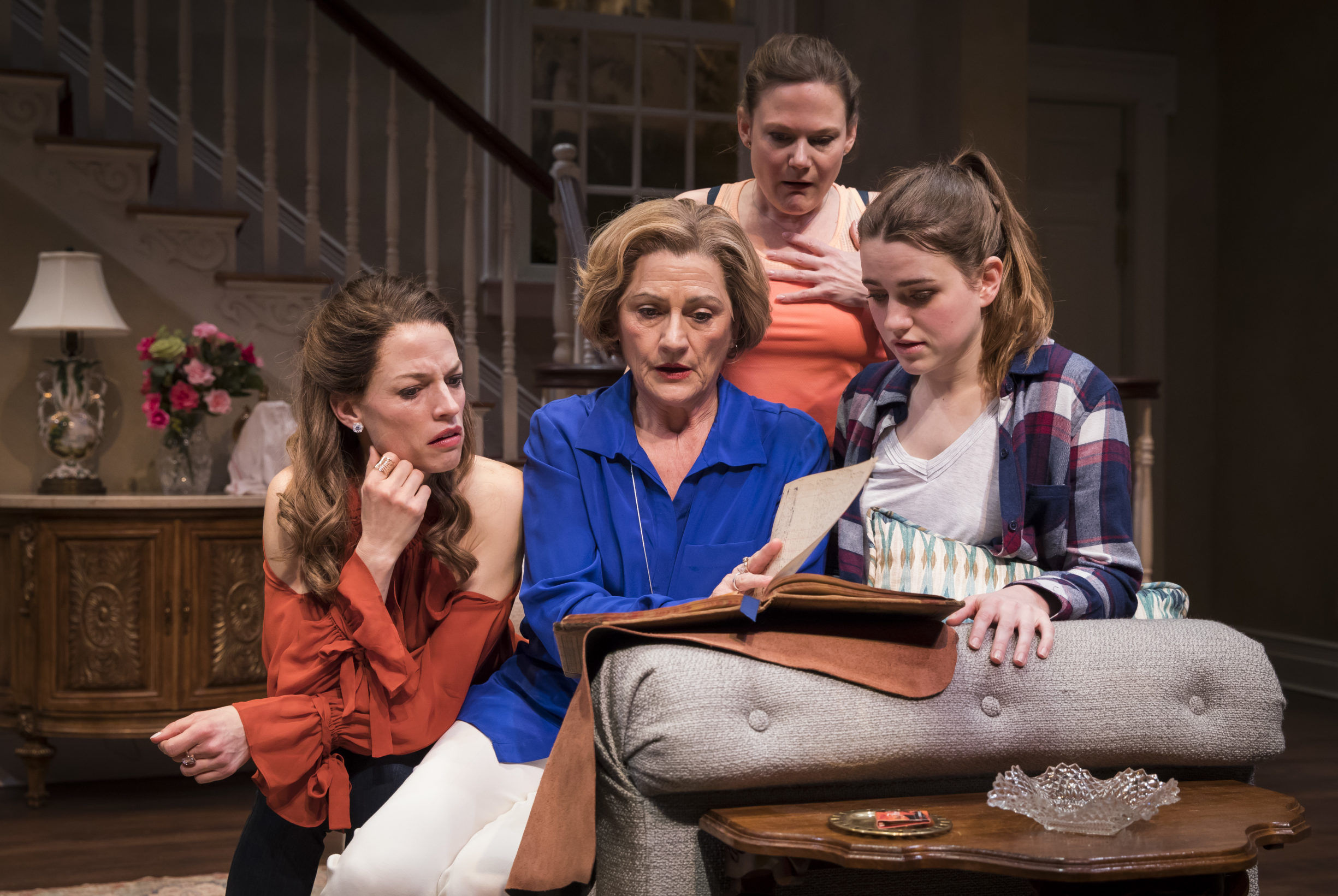
Not to get all "Webster's Dictionary defines..." but I have to say it a little louder for the All Lives Matter folks in the back: A privilege is a special advantage or benefit available only to a particular person or group of people. A benefit, for instance, like a big, beautiful plot of land that your family forced slaves to maintain. Or, for instance, a thriving business that has clothed, fed, and housed generations of white descendants for centuries while providing nothing to the black descendants of the people without whom there wouldn't be a business. The slaves did the work, yet it's the family of the slaveowners who reap the benefits.
This 21st century answer to reparations is inspiring and brilliantly funny, with a fast-paced and clever script by Kevin Douglas and superb directing by David Schwimmer. Plantation! is both a conversation starter and high quality entertainment. Chaos and comedy ensue while the six girls try to make nice and get to know each other, all while griping beyond each others' backs about who really deserves the plantation. The play is a hilarious send-up of well-meaning white people; who sincerely want to help, yet do nothing when presented with the chance to do so; who swear up and down they aren't racist, yet date a member of the KKK because he doesn't go to "all" of the meetings.

In one scene, the girls are all Southern-Belle'd out in big, old-fashioned dresses for a fancy dinner on the estate. When the black girls turn on some music and start dancing, one of the white girls yells that it's like they have Beyonce in the house. Her sister admonishes her, "That's racist."
"No, it's not. That's a compliment," one of the black girls replies, high-fiving her sisters. The white sister who thought she was rightly calling out racism shakes her head, "You people are confusing." The black sisters share a glance. "That's racist," they say. Case in point, maybe listen to what people who experience racism have to say about it before defining racism for them. (Also, rule of thumb, don't make black people explain Black Lives Matter to you – which, naturally, plays out onstage here. Google is your friend.)
Finally, the cast of eight women knocked it out of the park with their chemistry and comedic timing. Besides the fabulous poofy dresses, it seemed to me that this play could've been cast with either men or women and the story would be the same. Props to Lookingglass and Douglas for not setting the default to "male." And for not being afraid to have a mixed race cast discuss race and make everyone in the audience, to use the playwright's own word, a little "funcomfortable".
Plantation is playing at Lookingglass Theatre Company through April 22nd. Tickets on LookingglassTheatre.org.



Latest Articles
-
 Music Theater Works Pours a Beachy Cocktail with Escape to Margaritaville
Written by Kimberly KatzA gentle, tide‑easy current settles in right from the start, immediately signaling the kind of story this musical wants to tell. Rather than relying on big, splashy moments, it settles into a warm, beach-side rhythm, inviting the audience into a…
Music Theater Works Pours a Beachy Cocktail with Escape to Margaritaville
Written by Kimberly KatzA gentle, tide‑easy current settles in right from the start, immediately signaling the kind of story this musical wants to tell. Rather than relying on big, splashy moments, it settles into a warm, beach-side rhythm, inviting the audience into a… -
 Chicago Shakespeare Makes Winter’s Tale a Story Worth Telling
Written by Angelo CamposChicago Shakespeare Theater’s production of The Winter’s Tale delivers a compelling evening of theater, showcasing an exceptional company of actors working at the top of their craft. Under the direction of Artistic Director Edward Hall, this staging marks an exciting…
Chicago Shakespeare Makes Winter’s Tale a Story Worth Telling
Written by Angelo CamposChicago Shakespeare Theater’s production of The Winter’s Tale delivers a compelling evening of theater, showcasing an exceptional company of actors working at the top of their craft. Under the direction of Artistic Director Edward Hall, this staging marks an exciting… -
 A Joe & Melanie Thing Theatre Company announces The Hanukkah Humbug at Greenhouse Theater Center - December 3-6
Written by Buzz Center StageThe world premiere of The Hanukkah Humbug brings ghosts, history, tradition, and a whole lot of family fun to the Greenhouse Theater Center just in time for the holidays, Melanie Ann Apel promises a lively, family-friendly experience with this new…
A Joe & Melanie Thing Theatre Company announces The Hanukkah Humbug at Greenhouse Theater Center - December 3-6
Written by Buzz Center StageThe world premiere of The Hanukkah Humbug brings ghosts, history, tradition, and a whole lot of family fun to the Greenhouse Theater Center just in time for the holidays, Melanie Ann Apel promises a lively, family-friendly experience with this new… -
 Remy Bumppo’s Mud Row: A Family Haunted by the Past
Written by Wesley DavidRemy Bumppo opens its 30th anniversary season with Mud Row, a play by Tony Award nominee and MacArthur “Genius” Grant recipient Dominique Morisseau. Expertly directed by Malkia Stampley, this production is a sublime examination of family, inheritance, and the difficult…
Remy Bumppo’s Mud Row: A Family Haunted by the Past
Written by Wesley DavidRemy Bumppo opens its 30th anniversary season with Mud Row, a play by Tony Award nominee and MacArthur “Genius” Grant recipient Dominique Morisseau. Expertly directed by Malkia Stampley, this production is a sublime examination of family, inheritance, and the difficult…
Does your theatre company want to connect with Buzz Center Stage or would you like to reach out and say "hello"? Message us through facebook or shoot us an email at This email address is being protected from spambots. You need JavaScript enabled to view it..
*This disclaimer informs readers that the views, thoughts, and opinions expressed in the text belong solely to the author, and not necessarily to Buzz Center Stage. Buzz Center Stage is a non-profit, volunteer-based platform that enables, and encourages, staff members to post their own honest thoughts on a particular production.