
Displaying items by tag: Issy van Randwyck
Chicago Shakespeare Makes Winter’s Tale a Story Worth Telling
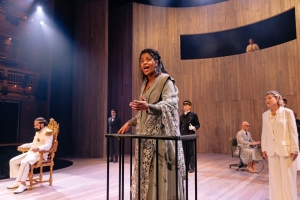
Chicago Shakespeare Theater’s production of The Winter’s Tale delivers a compelling evening of theater, showcasing an exceptional company of actors working at the top of their craft. Under the direction of Artistic Director Edward Hall, this staging marks an exciting experiment for the theater as the troupe performs in repertoire, set to follow this production with A Midsummer Night’s Dream in November. Though The Winter’s Tale remains one of Shakespeare’s lesser-known plays, Hall breathes fresh vitality into the work, framing it like a classic fairy tale. Playing a child, Felicia Oduh begins the show opening a picture book in view of a toy ship and a teddy bear, foreshadowing what is to come.
The piece opens with a joyous celebration as King Leontes tries to convince his childhood best friend, King Polixenes, to remain a little longer in his company. But the homesick royal denies every plea, until the beautiful Queen Hermione persuades him to stay. At her success, Leontes is suddenly possessed by jealousy, wondering why her efforts worked. His wild imagination corrodes his sanity quickly, and in no time, he’s envisioned a forbidden affair between his pregnant wife and his most loyal friend. His nobles fail to reel him in, and his madness drives him to forsake everything, even banishing his newborn daughter, only to discover his accusations had no merit. His only hope now rests in a prophecy and the hope that he’ll be reunited with his child one day.
This production thrives as a true ensemble piece, with the majority of the cast adeptly tackling dual roles. Demetrios Troy plays the maddened Leontes with fierce conviction, delivering an inspired portrayal of a ruler’s terrifying mental unraveling. Opposite him, Jessica Dean Turner brings raw emotion to Queen Hermione, grounding her betrayal in a profound, heartbreaking depth. Issy van Randwyck is a force to be reckoned with as Paulina. She commands the stage with a presence capable of calling down fire from heaven or piercing with her witty remarks dipped in uncompromising truth. Providing comedic relief, Kevin Gudahl and Dan Haller share delightful chemistry as the simple-minded shepherd and his son. Later, Sean Fortunato’s turn as the rogue Autolycus provides an absolute audience treat, creating a larger-than-life, hilarious scoundrel infused with a playful rock edge. His playful French accent was especially hilarious.
While the cast excels, the production’s main hurdles stem from the disjointed nature of Shakespeare's text. Act One functions as a powerful, high-stakes drama, illustrating how a poisoned mind can devastate love and life. Act Two, however, pivots sharply, opening with upbeat musical numbers, including a sequence featuring the cast as “baahing” sheep (one even relieves himself on stage). The second half feels in many ways like an extended tangent from the primary plot, as we’re promised a return to Leontes’ court. Still, while it’s a diversion, it is an entertaining one.
Also, no production of The Winter’s Tale would be complete without addressing the play's most famous stage direction, "Exit, pursued by a bear," and Chicago Shakespeare’s iteration does not disappoint. They unleash a creature that is truly the stuff of nightmares.
Despite the script's structural awkwardness, Hall has crafted an enjoyable and emotionally resonant piece of theater powered by artists who elevate every moment. The ensemble brings richness and warmth to these complex characters, capturing the audience’s heart while delivering laughter throughout.
Overall, this presentation stands as another triumph for Chicago Shakespeare Theater, proving that even Shakespeare's lesser-known works can shine brilliantly in the hands of a gifted company.
The Winter's Tale runs until December 12.
https://www.chicagoshakes.com/productions/2627-winters-tale/
Merry Mischief in Windsor: Chicago Shakespeare’s Fast, Funny Triumph

Shakespeare’s comedies share a familiar architecture: mistaken identity, disguises, intersecting plotlines, a generous helping of prose, and language that delights in wordplay and double entendre. They are also, crucially, driven by sharp, intelligent women who often see more clearly than the men around them. With that foundation in mind, Chicago Shakespeare Theater’s production of The Merry Wives of Windsor leans confidently into these conventions - and then accelerates them - resulting in a delightfully mischievous evening.
Directed with precision and pace by Phillip Breen, the production wastes no time settling in. It moves briskly, almost breathlessly at times. Breen understands that comedy, especially Shakespearean comedy, thrives on rhythm. Doors must slam at just the right moment, disguises must be revealed a beat too late, and jokes must land before the audience has time to anticipate them. Here, the timing is razor-sharp, aided immeasurably by a cast of 22 actors who navigate the text with clarity and ease.
Max Jones’ set design cleverly situates Windsor in a contemporary world of affluence and quiet excess. This is a town where privilege is not just visible - it is assumed. Children attend private school, men play rugby, and women occupy a social sphere of lunches and shopping that doubles as a kind of informal power network. The Garter Inn, rendered as a dimly lit bar with a billiards table anchoring the space, becomes a playground for Falstaff’s schemes. In contrast, Dr. Caius’ sterile office reception area offers a clinical absurdity, while the Ford household gleams with white carpeting, glass, and sweeping staircases - its opulence undercut by the chaos unfolding within. A particularly fluid set change transforms the space with near-magic, reinforcing the play’s obsession with illusion and transformation. The final forest scene, textured with dirt mounds and trees, grounds the production just enough before it tips fully into theatrical fantasy.
What emerges most clearly in this production is the idea that Windsor is a world turned slightly askew. No one is quite what they claim to be. The knight, Sir John Falstaff, is anything but noble - he is vain, opportunistic, and gloriously ridiculous. The doctor, Caius, is less healer than hot-headed rival, perpetually threatening violence. The clergyman’s thick accent renders him a subject of humor rather than authority. Even the Justice of the Peace seems more eager for confrontation than civility. It is a community in which status is worn like a costume—and just as easily discarded.

Photo by Kyle Flubacker.
At the center of it all are the “merry wives,” who prove themselves to be the most grounded and perceptive figures on stage. Ora Jones’ Mistress Page and Issy Van Randwyck’s Mistress Ford anchor the production with wit and composure. They are never merely reactive; they orchestrate the action, turning Falstaff’s attempted manipulation into a series of escalating humiliations. Their intelligence drives the comedy, ensuring that the laughter always has a point of view.
The supporting cast is equally strong. Chike Johnson’s Master Page exudes an easy confidence, while Timothy Edward Kane’s Master Ford leans fully into the character’s jealousy, finding both humor and unease in his suspicion. Nate Burger’s Dr. Caius is a comic standout, his bluster and indignation landing with delightful force. Nancy Voigts brings a bustling energy to Mistress Quickly, threading together the play’s many schemes, while Paul Oakley Stovall’s Justice Shallow captures the absurdity of self-importance.
And then there is Jason Simon’s Falstaff - a performance that embraces the character’s excess without apology. Legend has it that Queen Elizabeth I so adored Falstaff that she demanded to see him in love. Here, however, Falstaff is in love with nothing so much as himself. Simon leans into that vanity, crafting a figure who is both despicable and irresistibly watchable. His repeated downfalls never diminish him; instead, they reveal the elasticity of his ego.
Ultimately, this production succeeds because it trusts the mechanics of Shakespearean comedy while fully committing to its world. Disguises are embraced, identities are blurred, and language sparkles with innuendo. Yet beneath the laughter lies a sharper observation: that power, status, and even identity itself are often performances. In Windsor, everyone is playing a role - some just play it better than others.
Highly Recommended
When: Through May 3
Where: Chicago Shakespeare Theater 800 East Grand Avenue in Chicago
Tickets: $60 - $120
Box Office: 312-595-5600
Info: www.chicagoshakes.com
This review is proudly shared with our friends at www.TheatreInChicago.com.





Latest Articles
-
 Holiday Hilarity! Paramount presents The Second City’s Nut-Cracking Holiday Revue at downtown Aurora’s Copley Theatre, Nov. 20-Dec. 23
Written by Buzz Center StageNeed something better than old reruns of Hallmark Movies this holiday season? Want to see some real nut-crackers? Then dash on through the snow to catch The Second City’s Nut-Cracking Holiday Revue, November 20-December 23 at Paramount’s Copley Theatre, 8…
-
Mary, A Holiday Dansical Returns for one performance only at Logan Center December 13th
Written by Buzz Center StageBlack Girls Dance®, which centers Black and Brown girls in joyful community, presents its sixth annual production of Mary, A Holiday Dansical, choreographed, written, and directed by Founder Erin Barnett. This fundraiser returns for one night only Sunday, December 13…
-
 The Gift Theatre's Hayward: A Floridian-Style Shiva
Written by Wesley DavidThere are funerals where grief brings a family together, and then there are funerals where grief opens the door to everything a family has spent years trying to keep buried. In Hayward, playwright Netta Walker turns a father’s funeral into…
-
JK Entertainment presents WHEN WE WERE YOUNG AND UNAFRAID at Greenhouse Theater Center November 12 – 29, 2026
Written by Buzz Center StageJK Entertainment has released first look rehearsal photos for WHEN WE WERE YOUNG AND UNAFRAID, the first production of the company's second season. JK Entertainment's production brings this story to Chicago audiences November 12–29, inviting audiences to consider how far…
Does your theatre company want to connect with Buzz Center Stage or would you like to reach out and say "hello"? Message us through facebook or shoot us an email at This email address is being protected from spambots. You need JavaScript enabled to view it..
*This disclaimer informs readers that the views, thoughts, and opinions expressed in the text belong solely to the author, and not necessarily to Buzz Center Stage. Buzz Center Stage is a non-profit, volunteer-based platform that enables, and encourages, staff members to post their own honest thoughts on a particular production.