
Displaying items by tag: Victor Musoni
The Gift Theatre's Hayward: A Floridian-Style Shiva
There are funerals where grief brings a family together, and then there are funerals where grief opens the door to everything a family has spent years trying to keep buried. In Hayward, playwright Netta Walker turns a father’s funeral into a reckoning with family secrets, unresolved pain, and the ghosts that refuse to stay in the past.
Given a bold world-premiere production by The Gift Theatre, presented at Steppenwolf’s 1700 Theater, Hayward, directed by AmBer Montgomery, reimagines elements of Hamlet and Electra through the eyes of Luna, the youngest daughter in a deeply complicated family. On the day of her father’s funeral, Luna announces that his ghost has come to visit her. What follows is part family drama, part dark comedy, and part haunting exploration of the emotional inheritance passed from one generation to the next.
The play opens with a funeral, and from the moment the family enters, it is clear that this will be no ordinary farewell.
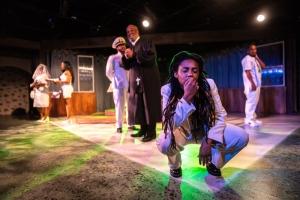
Luna (Ireon Roach), her father’s favorite child, is overwhelmed by grief as she stands at the podium to deliver his eulogy. Her siblings seem considerably less interested in mourning. Eric (Victor Musoni), dressed in a white memorial T-shirt and sagging pants, and Leila (Sydney Charles), wearing a white dress that seems decidedly inappropriate for the occasion, give the impression they would rather be anywhere else. Their oldest brother, AJ (Gregory Fenner), a military man, stands rigidly at attention, as though guarding the proceedings at a state funeral.
Seated apart from the chaos is Maria (Shanesia Davis), the family matriarch, dressed in white, her face veiled and a white handkerchief close at hand. She carries herself with the solemnity of a woman accustomed to holding a family together, even when its members threaten to tear one another apart.
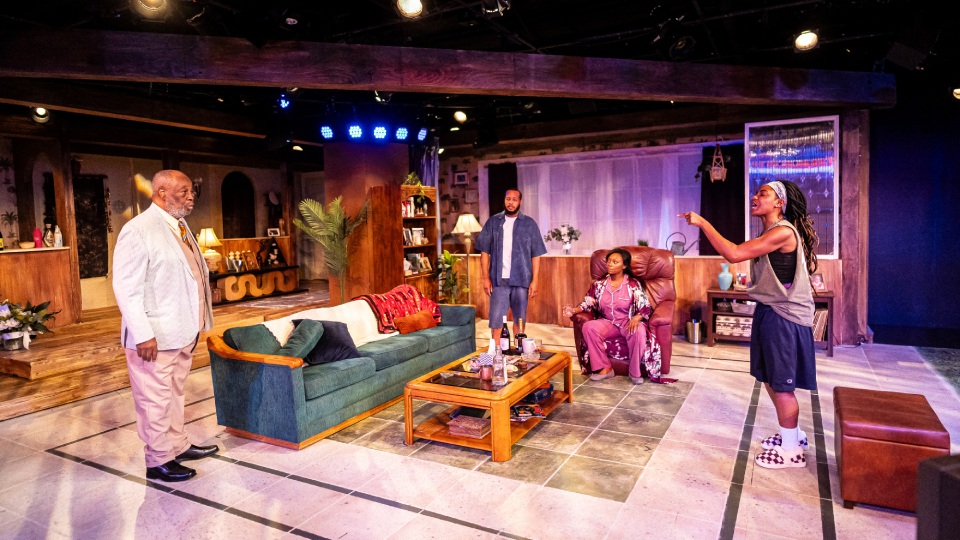
(from left) Alfred Wilson, Gregory Fenner, Shanesia Davis and Ireon Roach in The Gift Theatre's presentation of Hayward at Steppenwolf’s 1700 Theater. Photo by Joe Mazza / Brave Lux.
During the service, Luna sees her deceased father, Tony (Watson Swift). Her vision is quickly dismissed, but the encounter signals that something deeper is happening within this family. At the gravesite, the arrival of Uncle Johnson (Alfred Wilson), who is also a pastor, adds another layer of tension. There is little pastoral comfort in Johnson’s approach. He berates the family, directing particular hostility toward Luna because of who she is.
Religion, family expectations, and personal identity collide, and the resulting arguments reveal a household where love and resentment have become inseparable. The siblings fight, challenge one another, and expose old wounds, yet beneath their dysfunction is a recognizable bond. They may not know how to care for one another gracefully, but the connection remains.
At the center is Luna, whose grief is both the most visible and the most unsettling. Her father’s visits are not simply a supernatural manifestation of mourning; he has a request for her that reaches beyond the grave. As the family’s history unfolds, we learn that Tony served in the military during the Gulf War and returned carrying psychological wounds. The play suggests that the trauma he experienced did not end with him. His children, particularly Luna, may have inherited some of the emotional consequences without fully understanding their origins.
Walker’s most compelling achievement is her creation of characters who feel genuinely complicated. These are not tidy theatrical portraits of a dysfunctional family. They are people whose behavior can be outrageous, infuriating, and unexpectedly tender, sometimes within the same scene. The comedy emerges naturally from their interactions, offering relief without entirely diminishing the pain beneath the laughter.
Montgomery has assembled a strong ensemble and directs the actors with a clear sense of purpose. One of the production’s funniest moments comes when Maria sits center stage and her children gradually gather around her, one by one, as if seeking the comfort of the family’s center. When the last child arrives, Maria simply gets up and leaves them together. The gesture is hilarious, revealing, and familiar to anyone who has watched a family matriarch reach the limits of her patience. It is a moment best experienced rather than explained.
The scenic design is another notable achievement. The stage transforms from a church to a gravesite and eventually into the family’s living room. The final home setting is impressively detailed, providing a convincing domestic space in which the family’s conflicts can continue to unfold. My reservation is the time required to complete the transformation. Although the finished environment is effective, the process of getting there interrupts the production’s momentum.
Ultimately, Hayward is an entertaining and ambitious work that uses humor, supernatural elements, and family conflict to examine the lasting effects of trauma. Walker’s play is interested in the emotional territory families occupy: the memories they avoid, the wounds they pass along, and the love that survives even when they struggle to express it.
Still, the play would benefit from sharpening its central argument about mental health. Tony’s military service and the suggestion of inherited trauma offer fertile ground, but the relationship between psychological injury, family behavior, and Luna’s experiences could be developed with greater clarity. The subject deserves more than implication, particularly when the play so effectively demonstrates how one person’s unresolved pain can shape an entire household.
With its memorable characters, dark humor, and committed performances, Hayward offers a lively and often moving portrait of a family trying to find its way through grief. Like a Floridian-style shiva, the gathering is noisy, irreverent, and emotionally unpredictable. The dead may have been laid to rest, but in this family, the past is very much alive.
RECOMMENDED
When: Through Nov. 15
Where: Steppenwolf’s 1700 Theatre 1700 N. Halsted St. Chicago
Tickets: $45 - $50
Chicago Shakespeare Theater’s Rome Sweet Rome Modernizes Julius Caesar

Walking into the Courtyard Theater for Rome Sweet Rome, you might find it’s impossible not to be taken aback by the design. College Pollard’s Scenic Design astounds – particularly with the large replica Michaelangelo’s sculpture the David at the center. The catch? The statue is featured from behind, giving the audience a prime view of the David’s backside for the entire performance. Especially when combined with Lighting Designer Jesse Klug’s bright, flashing lights and Jax and Composer Jeffrey JQ Qiayum’s invitation to get up and dance to the bumping mix blasting through the speakers, space sets the audience up for two things:
- This play clearly takes place in some version of Rome.
- Nothing can quite prepare the audience for the event that they are about to experience.
The Q Brothers Collective’s Rome Sweet Rome is an adaptation of William Shakespeare’s Julius Caesar, but with quite a few twists – including a full 90s hip-hop soundtrack and fun, top-notch choreography from Tanji Harper. The production is a party from the moment the lights come up, and looking around at the audience surrounding me at this performance, it was clear everyone was ready to lean in.
Caesar (POS), the charismatic tyrant at the center, carries a strong hold over Rome. He continues to pass increasingly absurd laws out of fear of losing that control. When Caesar makes the decision to outlaw bread, a select group decides it’s time to take action. Cash (Jonathan Shaboo), Brutus (Victor Musoni), and Casca (Danielle Davis) decide to stage a coup and take him down. The question is, will they succeed? Can they bring bread back to Rome before it’s too late?

Janyce Caraballo (center) with the company of Rome Sweet Rome at Chicago Shakespeare Theater, a wild and satirical new “add-rap-tation” of Shakespeare’s Julius Caesar from Q Brothers Collective (GQ, JQ, JAX, and POS). September 23-October 19, 2025, in the Courtyard Theater.
It’s not hard to miss the political undertones beneath. A power-hungry ruler at the center who continues to grasp at power in any way he can. This theme is present in the original source material and certainly makes its way into the adaptation. We continue to see history repeating itself. Greedy rulers leave voids for those just like them to take their place – often times more paranoid than the last and grasping even harder at whatever they can.
However, the Q Brothers do their work to carry the story further into today. In a key moment when Brutus turns to the audience and instead, makes it about us. The lights in the audience come up and he pointedly asks if this is what we want. Do we want to murder him? Do we see the trends and do we want to change them? Musoni certainly builds a chemistry with the audience in this moment, and you might find it’s easy to allow the fourth wall to come down and begin to engage in the dialogue. Though a little on the nose, the message acts as a helpful reminder that these stories are more timely than ever. Perhaps we can all do with a little “on the nose” as we continue to navigate what to do next in this political climate.
Full of a pizazz and a poignant message, Rome Sweet Rome has a little something for everyone. Whether you are a die-hard Shakespeare fan or this is your first time with the material, the Q Brothers make Julius Caesar accessible, and even invite us to take a little accountability along the way.
RECOMMENDED
Rome Sweet Rome runs through October 19, 2025 at Chicago Shakespeare Theater. For tickets and information, see the Chicago Shakespeare Theater website.
*This review is also shared on https://www.theatreinchicago.com/!
Fat Ham at Goodman Theatre: Bold, Hilarious, and Heartfelt

James Ijames' Pulitzer Prize-winning play, Fat Ham, bursts onto the Goodman Theatre stage in a vibrant, deeply resonant co-production with Definition Theatre. Directed with an expert hand by Definition Theatre's Artistic Director Tyrone Phillips, this contemporary reinvention of Hamlet dazzles with humor, heart, and a profound exploration of identity, toxic masculinity, and generational burdens.
Set in a Southern backyard during a family barbecue, Fat Ham transforms Shakespeare's dark tragedy into a poignant yet hilarious meditation on living one's truth. At the center of this narrative is Juicy, played with remarkable nuance and emotional depth by Trumane Alston. Juicy's journey of self-discovery unfolds amid the ghosts—both literal and figurative—of his family's past, grappling with expectations of masculinity and the weight of inherited trauma.
Alston's performance is layered and compelling; his Juicy is introspective and tender yet brimming with an undercurrent of resilience, given time he will lean more into the character arc. His comedic timing is impeccable, delivering Ijames' sharp and incisive dialogue with a natural ease that invites the audience into his emotional world. Juicy's interactions with his spirited best friend Tio, brought to life by the dynamic Victor Musoni, provide some of the play's most humorous and thought-provoking moments. Musoni's portrayal of Tio is electric, offering a counterpoint to Juicy's introspection with boundless energy and unfiltered wisdom.
Ronald Connor impresses in the dual role of Rev and Pap, seamlessly shifting between the domineering ghost of Juicy's father and the charismatic over-sexed preacher presiding over family affairs. His presence looms large, embodying the toxic masculinity that haunts Juicy's world with an intensity that is both chilling and oddly comedic. Opposite him, Anji White as Tedra, Juicy's vivacious mother, delivers a powerhouse performance—balancing maternal warmth with an underlying desperation to escape her own past.
Ireon Roach’s Opal is a revelation, with her confidence simmering to the surface, while Sheldon Brown’s Larry, a stoic Marine grappling with his own identity, offers a poignant reflection of the play’s central themes. And no production would be complete without the powerhouse that is E. Faye Butler, whose presence on stage is nothing short of magical.
The technical elements of the production elevate the storytelling to new heights. Arnel Sancianco’s set design captures the essence of a Southern backyard with rich, lived-in detail, creating a tangible sense of place that enhances the play’s themes of home and heritage. Jos N. Banks’ costume designs are vibrant and character-driven, reflecting each individual's inner conflicts and outward personas. Jason Lynch’s lighting design cleverly shifts from naturalistic warmth to eerie supernatural hues, underscoring the play’s tonal shifts. Meanwhile, Willow James’ sound design punctuates the emotional beats with a careful blend of music and ambient sounds that ground the play’s heightened moments.
Phillips’ direction is both deft and sensitive. He embraces the play's comedic elements without undercutting its emotional weight. He crafts a production that honors Ijames’ bold vision while allowing the cast to fully explore the complexities of their characters.
Fat Ham is a triumph—an innovative, riotously funny, and ultimately moving exploration of what it means to break free from the ghosts of the past and forge an authentic future. Whether you're a Shakespeare purist or someone looking for a fresh, contemporary take on a classic story, this production offers something truly special.
With an outstanding ensemble, sharp direction, and a creative team firing on all cylinders, Fat Ham at Goodman Theatre is a must-see theatrical event that redefines what it means to inherit, to resist, and to thine own self be true.
Highly Recommended
When: Through March 2
Where: Goodman Theatre, 170 N. Dearborn St.
Tickets: $25 - $85
Info: Goodmantheatre.org/Ham
The Most Spectacularly Lamentable Trial of Miz Martha Washington funny but not funny ha-ha, funny like, oh sh*t!

Black and Irish Twitter had a field day upon the death of Her Highness Queen Elizabeth II. No tears were shed other than tears of laughter and joy at the demise of a colonizer. Telling Black twitter to be respectful of the death of the woman who inherited the legacy of an empire that contributed to the Trans-Atlantic Slave Trade, or Irish twitter to mourn the woman whose legacy includes Black Sunday is truly an eye rolling, laugh inducting matter…sorry Chris. It is ironic “The Most Spectacularly Lamentable Trial of Miz Martha Washington”, lambasting the “Mother of Our Country”, opened the same weekend as the death of the Queen of the Commonwealth.
I learned so much from seeing this play. Much of James Ijames play is based on historical fact. Martha Dandridge Custis was a widow with two children and enslaved people when she married George Washington. She had an illegitimate half-sister, Ann, born into slavery, thanks to her father. Ann had a son named William. William is both nephew and grandson to Martha since it is believed Martha’s son, John Custis is Williams’s father. George Washington did instruct his wife to release his enslaved people upon his death. Martha feared her life was in jeopardy and expressed it to Abigail Adams. James Ijames did his research writing this exceptional play. The writing is relevant, thought-provoking, and extremely entertaining.
The play opens Christmas eve night. An enslaved woman, Ann Dandridge is attending to a dying Martha Washington. Just outside and within ear shot are Miz Washington’s enslaved chattel waiting for the glorious moment of her death. They are aware of the clause in her late husbands will freeing them of servitude upon her death, and they can hardly contain themselves. Miz Washington falls into a deep sleep and finds herself in a fever dream where she will have to account for the people she has enslaved.
Then the fun begins……
Not every director or actor could have pulled off this spectacle. And believe me, it was a spectacle. There was nothing small or tentative about this production. It was big, it was bold, it was Black and Beautiful. Director Whitney White used every fiber of all her talented actors to wonderful results. The ensemble consists of Sydney Charles as Priscilla, Celeste M. Cooper as Doll, Donovan Session as Sucky-Boy, Carl Clemons-Hopkins as Davy, Victor Musoni as William, Nikki Crawford as Ann Dandridge, and Cindy Gold as Martha Washington. All the ensemble members, except Cindy Gold, play a host of other characters.
Clint Ramos’ set design is interesting, dark, and foreboding at times, at other times a circus
Izumi Inaba’s costumes showed a vivid imagination, among the best I’ve seen. There are several scene and costume changes and for the life of me, I’m not sure how they were done so quick and effortlessly.
Ijames doesn’t romanticize slavery as I’ve seen in other plays. There is nothing nice about slavery. Ijames has made his enslaved people the antagonist to an American way of life, putting them at odds with those who romanticize this country.
I got into a row with someone on twitter about my indifference to the Queen’s death. He reminded me the British Empire abolished slavery decades before the United States. I reminded him the British Empire used slave labor to harvest sugarcane, they realized enslaved people with machetes aren’t good for business.
This production is highly recommended.
THE MOST SPECTACULARLY LAMENTABLE TRIAL OF MIZ MARTHA WASHINGTON runs through October 9, 2022 at Steppenwolf Theatre Company, 1650 North Halsted. Tickets are $20-$96.



Latest Articles
-
 Holiday Hilarity! Paramount presents The Second City’s Nut-Cracking Holiday Revue at downtown Aurora’s Copley Theatre, Nov. 20-Dec. 23
Written by Buzz Center StageNeed something better than old reruns of Hallmark Movies this holiday season? Want to see some real nut-crackers? Then dash on through the snow to catch The Second City’s Nut-Cracking Holiday Revue, November 20-December 23 at Paramount’s Copley Theatre, 8…
-
Mary, A Holiday Dansical Returns for one performance only at Logan Center December 13th
Written by Buzz Center StageBlack Girls Dance®, which centers Black and Brown girls in joyful community, presents its sixth annual production of Mary, A Holiday Dansical, choreographed, written, and directed by Founder Erin Barnett. This fundraiser returns for one night only Sunday, December 13…
-
 The Gift Theatre's Hayward: A Floridian-Style Shiva
Written by Wesley DavidThere are funerals where grief brings a family together, and then there are funerals where grief opens the door to everything a family has spent years trying to keep buried. In Hayward, playwright Netta Walker turns a father’s funeral into…
-
JK Entertainment presents WHEN WE WERE YOUNG AND UNAFRAID at Greenhouse Theater Center November 12 – 29, 2026
Written by Buzz Center StageJK Entertainment has released first look rehearsal photos for WHEN WE WERE YOUNG AND UNAFRAID, the first production of the company's second season. JK Entertainment's production brings this story to Chicago audiences November 12–29, inviting audiences to consider how far…
Does your theatre company want to connect with Buzz Center Stage or would you like to reach out and say "hello"? Message us through facebook or shoot us an email at This email address is being protected from spambots. You need JavaScript enabled to view it..
*This disclaimer informs readers that the views, thoughts, and opinions expressed in the text belong solely to the author, and not necessarily to Buzz Center Stage. Buzz Center Stage is a non-profit, volunteer-based platform that enables, and encourages, staff members to post their own honest thoughts on a particular production.