
Displaying items by tag: Grace Steckler
A Midsummer Night’s Dream: Chicago Shakespeare’s Circus of Love and Mischief
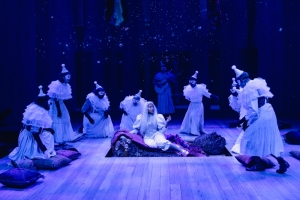
Chicago Shakespeare Theater celebrates its 40th Anniversary season with the second production of its ambitious repertory. A Midsummer Night’s Dream is directed by Artistic Director Edward Hall with all the magic, spectacle, and visual amazement of a circus extravaganza. Presented in repertory with Shakespeare’s The Winter’s Tale, these productions offer audiences two very different journeys into Shakespeare’s imagination, where love, jealousy, power, and transformation take center stage.
In A Midsummer Night’s Dream, four young lovers find themselves entangled in a romantic mess when they venture into an enchanted forest ruled by mischievous fairies. Shakespeare’s familiar comedy of mistaken identities, misplaced affections, and magical interference becomes an opportunity for theatrical invention. Here, the forest is less a woodland retreat and more of a fantastical playground where anything can happen.
The mortals include Sean Fortunato as Theseus, Jessica Dean Turner as Hippolyta, Felicia Oduh as Hermia, Kevin Gudahl as Hermia’s father, Esteban Ortiz-Villacorta as Demetrius, Dan Haller as Lysander, and Grace Steckler as Helena. The craftsmen - amateur actors rehearsing a play for the upcoming wedding - include Erick Hellman as Peter Quince, a carpenter; Chiké Johnson as Nick Bottom, a weaver; Kieran McCabe as Francis Flute, a bellows-mender; Issy Van Randwyck as Robin Starveling, a tailor; Ronald L. Connor as Tom Snout, a tinker; and Demetrios Troy as Snug, a joiner.
Among the evening's comic highlights is Chiké Johnson as Nick Bottom. His transformation into a creature with the head of an ass is wonderfully realized, both visually and physically. Johnson embraces the absurdity of the transformation with such comic confidence that Bottom becomes impossible to resist. His bewilderment, self-importance, and complete obliviousness to his altered appearance make his encounters with Titania, who has fallen under a love spell, all the more hilarious. It is a delightful reminder of Shakespeare's genius for finding comedy in human vanity and the ridiculous ways love can make fools of us all.
Completing the ensemble are the inhabitants of the fairy kingdom. Fortunato doubles as Oberon, King of the Fairies, while Turner transforms into Titania, Queen of the Fairies. Patty Roache takes on Robin Goodfellow, delivering one of the most delightfully puckish interpretations of Puck I've encountered. Roache seems to relish every opportunity to stir up trouble, and their physicality brings an added dimension to the character's mischief.
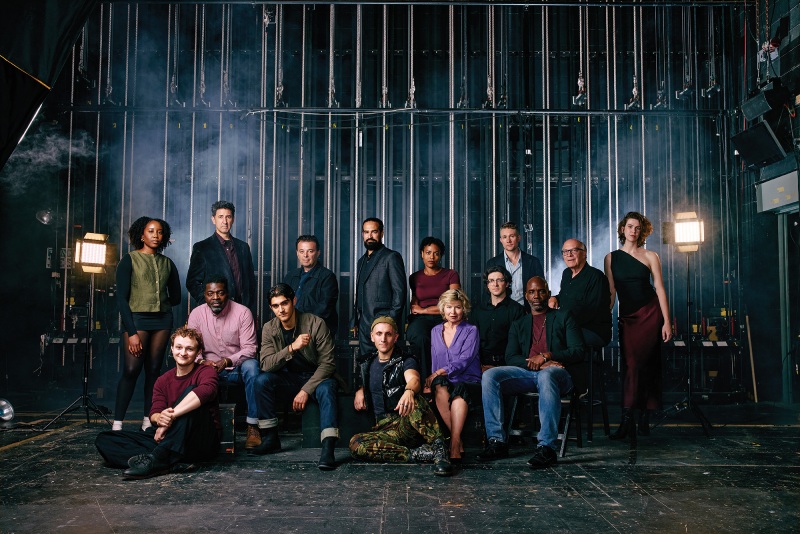
The cast of Chicago Shakespeare Theater's A Midsummer Night’s Dream. Photo by Kyle Flubacker.
One of the production's most striking achievements is Michael Pavelka's costume design, which is visually stunning, imaginative, and remarkably cohesive. The mortals inhabit a sophisticated palette of winter white and camel. The men wear tailored suits and coats with fur collars, while the younger men sport varsity jackets, cuffed trousers, sweater vests, and crisp white shirts. The women's dresses evoke 1940s silhouettes, creating an elegant period-inspired aesthetic.
The craftsmen are dressed in costumes that identify their respective trades, while the fairies appear as Pierrot pixies, dressed entirely in white, complete with half-masks and delicate lace collars. Oberon and Titania make a dramatic visual statement: the Queen wears a lush white brocade gown, while the King is dressed in stark black. Their contrasting costumes reinforce the tension between these two powerful personalities. Robin Goodfellow, meanwhile, is outfitted as a striped mime with hints of leather, perfectly suited to the character's playful and unpredictable nature.
The set is deliberately stark, giving the performers room to move and allowing the physical spectacle to take precedence. One particularly memorable visual is Robin Goodfellow's entrance. Rising from the floor, twirling onto the stage, and observing the action from suspended silks like an aerialist, Roache turns Puck's entrances into miniature circus performances. It is an imaginative theatrical touch that reinforces the production's magical atmosphere.
Yet beneath all the spectacle is Shakespeare's enduring exploration of human foolishness. The lovers are tossed about by their own desires, Oberon and Titania engage in a battle of wills, and Bottom's transformation into an ass provides an absurd reminder that love doesn't always recognize what it sees. Shakespeare understands that love can be irrational, jealousy can be destructive, and human beings are often their own worst enemies.
That is part of the pleasure of this comedy. We laugh at the lovers' confusion while recognizing something familiar in their inability to control their emotions. The fairy world may be magical, but its inhabitants are hardly immune to the pettiness and power struggles of the human world.
The pairing with The Winter's Tale makes this repertory season particularly intriguing. Both plays explore jealousy, love, and transformation, but arrive at very different destinations. Where A Midsummer Night's Dream resolves its romantic entanglements through enchantment and comedy, The Winter's Tale confronts the devastating consequences of jealousy and the difficult possibility of forgiveness.
For its 40th Anniversary season, Chicago Shakespeare Theater reminds us why Shakespeare continues to captivate audiences. His characters may be centuries old, but their desires, insecurities, foolishness, and capacity for love remain remarkably recognizable. This A Midsummer Night's Dream embraces the theatrical possibilities of the play, inviting us into a world where imagination takes flight and the unexpected is always just around the corner.
Highly Recommended
When: Through January 3
Where: Chicago Shakespeare Theater 800 East Grand Avenue in Chicago
Runtime: 2 hours 30 minutes with a 15-minute intermission
Box Office: 312-595-5600
Info: www.chicagoshakes.com
Pure Vocal Magic: Goodman’s Octet Redefines Musical Innovation

Dave Malloy’s Octet is a musical with daring aspirations, currently gracing the stage in a powerhouse co-production between the Raven Theatre and the Goodman Theatre. This staging, directed by Keira Fromm, first debuted at the intimate Raven Theatre, where it enjoyed a highly successful run before its move to the Goodman - a transition that proves the project is as robust as it is ambitious. Octet stands apart as a completely a cappella experience, relying entirely on the human voice to build its intricate, immersive, and haunting soundscape.
Malloy’s imprint is everywhere in this piece. He wrote the music, lyrics, book, and even the intricate vocal arrangements, crafting a score constructed without a single instrument to generate its tension, beauty, and emotional architecture.
Set in a sparse, church-basement style meeting room, the play introduces us to the “Friends of Saul,” a support group for people struggling with internet addiction. Their relationship to the online world is so fraught that they refuse to say its name, calling it only “the monster” to avoid giving it more power. Throughout their time together, the eight participants take turns sharing fears of being canceled, pornography, gaming, the pull of incel communities, and the inability to connect with others. Their discussions are brutally honest, darkly comedic, laced with expletives, and at one point offer an especially disturbing illustration of just how grotesque the monster can be. It’s unlike anything before.
The show threads each character’s intimate, emotionally charged account into sweeping ensemble passages that rise like contemporary hymns, the group joining voices to confront and grieve the “monster” that binds them. The interplay creates a pulse that feels communal and ritualistic, as though every personal admission is carried forward and reshaped by the collective.
The performances are nothing short of a whirlwind. The talent onstage is beyond belief. The ensemble showcases astonishing vocal mastery, blending with precision to create rich, enveloping music.
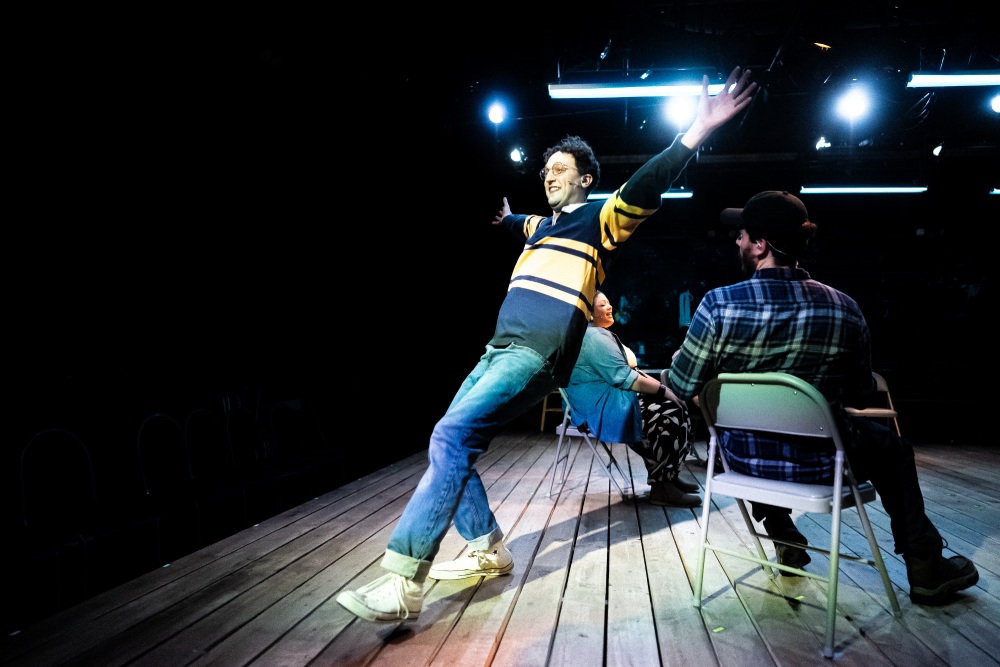
Sam Shankman in Dave Malloy's Octet at Goodman THeatre in collaboration with Raven Theatre. Photo by Joe Mazza.
Neala Barron, as Jessica, is phenomenal with powerhouse vocals and a dynamic stage presence. Her rendition of “Refresh” is delivered with the intensity of a tiger trapped in a cage, perfectly capturing the visceral feeling of being humiliated online and the subsequent rage against the world. Along with dramatic chops, she makes her comedic lines sizzle.
Sam Shankman plays the comedy perfectly as Henry. His portrayal of a tone-deaf, slightly dorky addict is both identifiable and deeply empathetic. His song “Candy” is a standout that demonstrates how this ensemble can craft story using only a cappella sound and how their movement reinforces the narrative.
Teressa La Gamba, as Paula, the group’s moderator, brings a gentle strength and compassion that helps root the show. But when she sings, it feels as if the roof will fly off. She commands the stage with perfect vocal precision, whether in a solo or complex ensemble passages.
The set is intentionally sparse and open, which functions perfectly for the show’s focused format, a choice scenic designer Milo Bue shapes with thoughtful restraint. The lighting design, crafted by Maximo Grano de Oro, is similarly impressive. Overhead lights shift deftly from the feel of a bland meeting room to the vibrant, chaotic interior of a Candy Crush interface or the dark corners of a character’s mind. In an instant, you can be transported to an entirely different plane and lost in its overwhelming atmosphere.
As the plot unravels, the staging seems intent on exploring where hope can or cannot be found, and it makes clear that faith-based religion is not where it looks. The script often approaches Christian belief with a skeptical edge, sketching certain “believer” archetypes in broad, unflattering strokes. The structure of “Friends of Saul” reinforces this orientation, lightly echoing the format of Alcoholics Anonymous. AA, one of the most widely recognized recovery communities, is often described as spiritual in nature, while many participants experience it as rooted in a faith-guided model, as it was originally intended. “Friends of Saul,” by contrast, operates with a more nonreligious bent, occasionally running out of pamphlets for “Steps for Agnostics and Atheists,” a detail made all the more ironic given that their meetings take place in a church basement - a space that pointedly distances itself from the faith‑oriented tradition AA is often associated with.
That contrast deepens in “Little God,” one of the staging’s more unusual songs. Here, Marvin (Jordan Golding), a committed atheist, describes an encounter with an all-powerful being represented onstage by a small girl and reflects on his compulsion to debate creationists about evolution. The moment is very much Malloy’s choice, framing Marvin’s fixation as a kind of intellectual loop: the irresistible pull of trying to reason through the idea that something as vast as existence might emerge from nothing at all, a purposeful artistic angle that shapes the show’s worldview.
Given these choices, the staging’s perspective may not resonate as strongly with audiences who hold traditional Christian views, which seems intentional, reflecting a deliberate direction in Malloy’s overall vision. In contrast, the show places greater emphasis on new age spirituality and tarot, treating these elements with notable sincerity. Each character has direct parallels to tarot cards, and Velma (Joryhebel Ginorio) finds her spiritual awakening through them. In fact, she is the only member of the group who speaks the monster’s true name, “internet,” throughout the night. Ultimately, the musical suggests that a blend of new age spirituality and human connection is the most viable path to inner peace.
Although these elements may pose challenges for certain audiences, Octet remains a triumph of vocal performance. These actors represent the highest caliber of Chicago talent, and when their voices come together, the result is breathtaking and inspiring. If you are looking for choral artistry, Octet delivers. For some audiences, Octet’s philosophical stance may feel more contemplative than corrective, raising more questions than answers about our relationship to the online world - but its musical brilliance makes the journey more than worthwhile.
Recommended.
Venue: The Goodman Theatre – The Owen 170 N. Dearborn Street, Chicago
Run Dates: Through August 2
Performance Schedule:
- Wednesdays: 7:30 p.m.
- Thursdays: 2:00 p.m. & 7:30 p.m. (No evening performance on July 30)
- Fridays: 7:30 p.m.
- Saturdays: 1:00 p.m. & 7:30 p.m.
- Sundays: 2:00 p.m. (Additional 7:30 p.m. performance on August 2)
Running Time: 1 hour, 35 minutes (no intermission)
Box Office: 312-443-3800
Tickets: https://www.goodmantheatre.org




Latest Articles
-
 A Midsummer Night’s Dream: Chicago Shakespeare’s Circus of Love and Mischief
Written by Wesley DavidChicago Shakespeare Theater celebrates its 40th Anniversary season with the second production of its ambitious repertory. A Midsummer Night’s Dream is directed by Artistic Director Edward Hall with all the magic, spectacle, and visual amazement of a circus extravaganza. Presented…
-
 THEATER UNSPEAKABLE ANNOUNCES MIME OR NOTHING, FEBRUARY 5 - 28, 2027
Written by Buzz Center StageTheater Unspeakable is proud to announce the cast and creative team for the Midwest Premiere of Mime or Nothing, February 5 - 28, 2027 at Theater Wit, 1229 W. Belmont Ave. Mime or Nothing is written by and starring Marc…
-
 'Oh, Buddy' a Lighthearted Absurdist Look at Transgender Issues in the Workplace
Written by Bill EslerLeave it to Trap Door Theatre to find an absurdist play, their milieu, that’s a funny, fresh take on office culture and a trans sex change surgery of a key employee, New Guy (Jack Bowes is excellent). Hal Cosentino’s Oh,…
-
Filament Theatre announces 2026/27 Season With returning interactive family favorites: Fort-building fun with FORTS and performance installation for babies RAIN
Written by Buzz Center StageFilament Theatre (4041 N. Milwaukee Avenue in Portage Park), the Northwest Side’s premier theater for young audiences, is delighted to announce the upcoming programs and plays in its 2026/27 Season. The popular immersive fort-building play experience for families, FORTS, returns…
Does your theatre company want to connect with Buzz Center Stage or would you like to reach out and say "hello"? Message us through facebook or shoot us an email at This email address is being protected from spambots. You need JavaScript enabled to view it..
*This disclaimer informs readers that the views, thoughts, and opinions expressed in the text belong solely to the author, and not necessarily to Buzz Center Stage. Buzz Center Stage is a non-profit, volunteer-based platform that enables, and encourages, staff members to post their own honest thoughts on a particular production.