
Displaying items by tag: Jodi Gage
Production of THE IMPORTANCE OF BEING EARNEST Does Not Fully Recognize Its Importance at Oak Park Festival
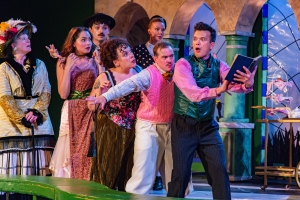
It is possible that Oak Park Festival Theatre’s production of Oscar Wilde’s 1895 “trivial comedy for serious people,” The Importance of Being Earnest, was suffering from some opening night jitters and that the actors will settle in and trust the verbal comedy in the script, but on this beautiful evening under the stars, there was too much mugging and nudging going on. Nevertheless, Wilde’s play, about two young men, Algernon (August Forman) and Jack (Chad Bay), who have both invented alibis - Algernon an invalid friend named Bunbury in the country and Jack a degenerate younger brother in town--to allow them to indulge their socially questionable whims, leading to the difficulty of having to explain why neither is Ernest, is still funny. And, despite the excesses on display, this staging still holds many delights for fans of Wilde, verbal comedy, and, particularly in the second act, some smartly choreographed slapstick. What is missing from much of the evening is earnestness. Many of the actors seemed to be in search of motivation and the stakes that propel them through this admittedly effervescent frolic.
Working with a talented cast of regional stage actors, director Kathryn Walsh has not created a secure world for her creative team to inhabit, resulting in an often funny but not dynamic production, with shrill delivery and broad physical comedy undermining human-scale relationships. The tone and gestures of the various characters range wildly, as do the design elements. The whimsical, vaguely Victorian costumes, while fun, support the cartoonish elements of the production, while not always clearly defining the characters. The lighting design by Devin Cameron is appropriately warm and effectively saturated but also deploys unnecessary flourishes to support the comedic business. The scenic design by Evan Frank likewise captures the locations of the play and allows the actors to find many levels - literally - as they shift allegiances and stratagems. Justin Cavazos’s sound design and compositions lend unobtrusive support, except for one hilariously developed cue that draws attention to itself in a good way. Overall, Walsh’s production would be better served by trusting the script and the audience, especially in the first act, when we are getting to know the characters and their desires. That said, both Walsh’s direction and her cast fully commit to the amorous and combative collisions at the beginning of the second act, which showcases the physical and verbal comedic gifts of all to uproarious effect.
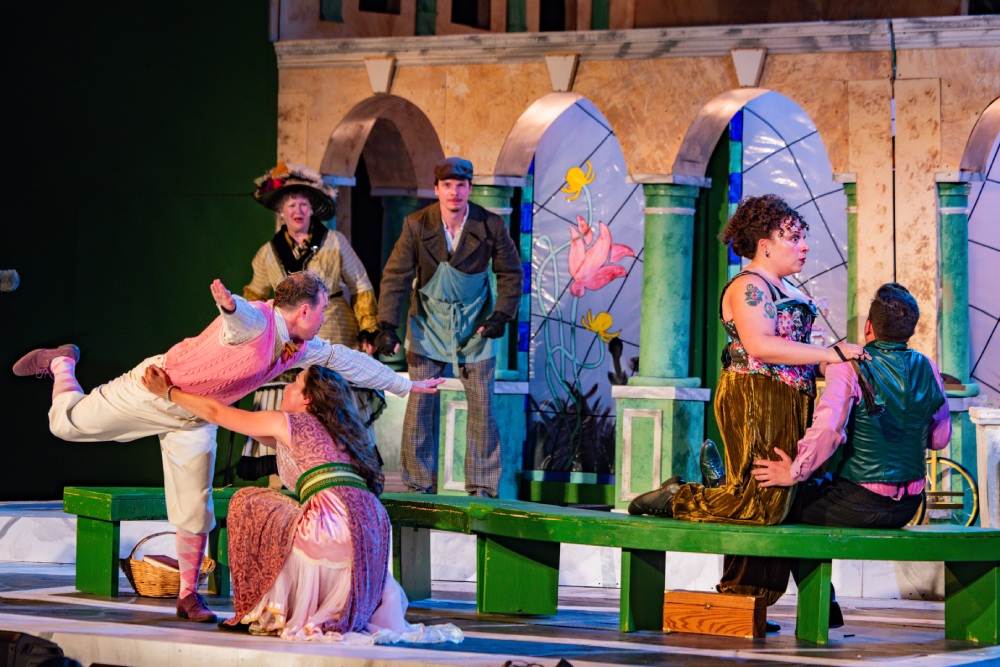
As part of the Oak Park Festival Theatre's 51st season (left to right) August Foreman, Barbara Zahora, Aurora Pennepacker, Drew Bos, Sonia Goldberg and Chad Bay in The Importance of Being Earnest at Austin Gardens.
One of the things that makes The Importance of Being Earnest work is the moral certitude that the characters bring to their pronouncements, no matter how absurd they are or whether their actions correspond to their words. This certitude also grounds the characters in their truths and forms the foundation of their interactions, but too often the actors are checking in with the audience to see if they got the joke (especially when many of Wilde’s observations still resonate) or negotiating with the lines. By the middle of the second act, the characters begin to define themselves, but much opportunity for connection is lost in the first. August Forman as Algernon flings himself into the role with wild abandon and invites the audience along for the ride. An adept comedian, Forman’s strategy often pays off but undermines Algernon’s insecurity as he balances his needs with society’s demands. All that aside, his Algernon’s compulsion for muffins is not to be missed. As his friend Ernest, who is actually Jack, Chad Bay does a good job of playing the less self-aware of the friends and playing up the character’s completely unjustified horror at Algernon’s embrace of Bunburyism. As Jack’s romantic interest, and Algernon’s cousin, Gwendolen, Sonia Goldberg at times overplays her character’s pretensions, some of which Gwendolen is still struggling to master, making Goldberg’s characterization overwhelmingly self-possessed at times. Conversely, Barbara Zahora lacks the imperiousness of many Lady Bracknells, giving the character an interesting warmth, but making her power solely transactional, which could be an interesting choice if it were played more fully. Aurora Pennepacker as Cecily strikes the most effective balance between the verbal and physical comedy, making the most of the opportunities to show Cecily’s willingness to exploit others’ assumptions about her character and her real understanding of her powerlessness without this ability. In Jodi Gage’s performance, Ms. Prism is a refreshingly insightful tutor to Cecily, while doggedly hanging onto youthful romanticism. Gabriel Armstrong is a very youthful Reverand Chasuble, celebrating his sudden relevance in parish life. Drew Bos may be the youngest actor to play the dual roles of Lane and Merriman in a professional production and wisely focuses on the class commentary afforded by the butlers of their respective households. His droll Lane gives Algernon food for thought in Act I, while his Merriman, already suffering from the physical strain of servitude despite his youth, effectively times his long-suffering pauses at each new demand (though Bos may need a visit to a chiropractor after the run). The experienced cast expertly and clearly delivers Wilde’s witticisms, which are always worth revisiting and occasionally resonate with the current social dynamics.
As the run continues, the production will most likely settle in and allow the script to propel the pacing and action more fully, especially in the more expository first act. There is much to appreciate in Oak Park Festival Theatre’s The Importance of Being Earnest, including a smart cast who find both the verbal and physical humor inherent to the play. Director Kathryn Walsh and her cast also explore fresh takes on the characters, some more successful than others, but always welcome. For those unfamiliar with Wilde’s play, this production is a solid introduction.
The Importance of Being Earnest runs in repertory with Hamlet, through August 14, outdoors in Austin Gardens in Oak Park, Illinois. Visit Season 51 | Oak Park Festival Theatre or call (708) 300-9396 for tickets and more information. Note: a number of the actors perform in both Earnest and Hamlet, and Oak Park Festival Theatre is offering discounted tickets for audiences who want to see both.
'The Writer' Attempts to Flip the Script

The Writer by Ella Hickson, now in its U.S. premiere at Steep Theatre under the sure direction of Georgette Verdin, is a maddening yet compelling exploration of art, power, commerce, and gender. It is messy, incisive, and brashly frustrating. It is the anti-Barbie, exploring patriarchy, empowerment, and self-determination in a world without a hint of pink. People in this world must earn a living, which really gets in the way of idealism. The Writer is full of unwinnable arguments, plus a few that where the victories are the opposite of what one would like them to be. In a loosely defined series of scenes and rebuttals, the eponymous Writer reveals herself through excerpts from her plays and scenes from her life, though the lines between these are deliberately blurry. Both in the fictionalized versions of herself, and in the real (but are they? —our narrator seems a little unreliable), the Writer spends much of the play defending herself and her work, with only limited success.
Verdin has assembled a fine cast of both Steep Theatre regulars and guest artists willing to throw themselves into the melee that is this play. Lucy Carapetyan plays the Writer with an edgy and anxious self-righteousness that invites sympathy but not empathy, and occasionally veers into unpleasant self-absorption. As her fictional doppelganger and sometime lover, Krystal Ortiz’s grounded presence often makes the Writer’s points more effectively than the Writer herself, while also showing the pitfalls of the Writerly vision. Peter Moore as the Director is tasked with representing the Patriarchy and does so with the right amount of creeping condescension tempered with a pragmatic humanism that allows his arguments to resonate more than Hickson may like—or exactly how much she would like. Nate Faust makes one want to like his characters, bringing a guileless charm to his roles as the character of the Director and the real-life boyfriend of the Writer; he plays the former with a disarming openness that makes his over-bearing attitude more grating, and the latter with a weirdly imperious lack of self-esteem. Jodi Gage and Allyce Torres take on multiple roles throughout, but especially in a second act scene that breaks both the conventions of the play and the urban setting, embodying a mythological world where women are freed from the constraints of patriarchal norms in a piece that seeks to surmount conflict and tension in a modern, tribal ritual dance (Successful? No... but it requires commitment from its performers nevertheless).
The design elements also reflect the ephemeral nature of the theatre experience and the idea that reality itself is an extension of this experience. The “staged” scenes are stripped to their essentials—performer and text, with occasional projections to amplify this relationship and break away from the more concrete spaces of the rest of the play. The scenes that presumably show the Writer’s real life are played on precariously assembled sets that only partially define the spaces that they create. Scenic designer Sotirios Livaditis has created deliberately artificial stage sets with visual counterpoints that reinforce the spaces’ connections to the Writer, though the many moving parts make for some clunky scene changes. As the Writer’s perception of reality shifts into the metaphorical—writing being a calling and a life—the lighting (by Brandon Wardell) and sound (by Thomas Dixon) reflect the increasingly tenuous scenic elements, and occasionally mirror the darkness and self-doubt of the characters’ thoughts. Costume designer Gregory Graham conveys the practical concerns of the characters (and creates the modern tribal costume—accessorized athleisure: why not?) and clearly defines the difference between those who need to project a certain image and those who are privileged not to do so. Movement director Claire Bauman creates a plausible performance art ritual dance. Intimacy Director Gaby Labotka struggles with the reality of the more intensely sexual moments as far as pacing and masking (there is a lot more blanket work than there probably would be if the characters were as alone as they are meant to be), and the beats of the intimate scenes feel both awkwardly slow and rushed.
Director Verdin mostly allows the ambiguities of The Writer to be as frustrating as Ella Hickson most likely intended. She also leans into the bracing humor and combativeness of the dialogue, which is often laugh-out-loud-funny, even as the characters struggle to find common ground or solid answers. Having been written at the beginning of the #MeToo movement, the play mostly deals with the power of institutional patriarchies to shape attitudes, tastes, social hierarchies, age (what happens when an angry young woman grows older?), art, and, yes, sex. There are brief nods to intersectionality and economic class, and Verdin’s production acknowledges that these nods leave several elephants waiting in the wings in order to focus on feminism. The play and production are smart enough to understand that this two-hour dialectic is premised on the privilege of being part of a world where art provides a living for some and is affordable to others. Most people will find something to nod in agreement with, and that may not always be what the person next to them is nodding about. Hickson has written a metatheatrical puzzle box of polemical arguments, but fortunately she has also created characters that go beyond their arguments, especially in the hands of a sensitive director and a talented and empathetic cast. The Writer offers an opportunity to question what makes good Art (theater specifically, but as a metaphor for capital-A Art), the role and responsibility of the artist in society, and whether art is an extension of patriarchy or a tool to fight it. It does not offer any answers, which may have some echoing the words of one of the characters, who demands in vain that the Writer “write an ending.” But then they would miss out on the opportunity to do so over drinks after the show.
The Writer runs through September 16 at The Edge Theater 5451 North Broadway, with performances Thursday, Friday, and Saturday nights at 7:30 pm, and Sunday matinees at 3pm. For tickets and more information contact the box office at (773) 649-3186 or www.steeptheatre.com.


Latest Articles
-
 Powerhouse Performances on Display in Gwydion's Dry Powder
Written by Angelo CamposIn the sharp-tongued world of Sarah Burgess’s Dry Powder, presented by Gwydion Theatre Company at the Greenhouse Theater Center, the pursuit of money is a blood sport. The play centers on a high-stakes private equity firm caught in a massive…
Powerhouse Performances on Display in Gwydion's Dry Powder
Written by Angelo CamposIn the sharp-tongued world of Sarah Burgess’s Dry Powder, presented by Gwydion Theatre Company at the Greenhouse Theater Center, the pursuit of money is a blood sport. The play centers on a high-stakes private equity firm caught in a massive… -
 Production of THE IMPORTANCE OF BEING EARNEST Does Not Fully Recognize Its Importance at Oak Park Festival
Written by Kerstin BroockmannIt is possible that Oak Park Festival Theatre’s production of Oscar Wilde’s 1895 “trivial comedy for serious people,” The Importance of Being Earnest, was suffering from some opening night jitters and that the actors will settle in and trust the…
Production of THE IMPORTANCE OF BEING EARNEST Does Not Fully Recognize Its Importance at Oak Park Festival
Written by Kerstin BroockmannIt is possible that Oak Park Festival Theatre’s production of Oscar Wilde’s 1895 “trivial comedy for serious people,” The Importance of Being Earnest, was suffering from some opening night jitters and that the actors will settle in and trust the… -
 The Beautiful Overthinking of Gary Gulman’s 7th Hour
Written by Ken PayneGary Gulman brings his new tour, 7th Hour: An All New Standup Show, to The Den Theatre, offering Chicago audiences a chance to see a comic who has spent decades refining the long-form, slow-burn style that has become unmistakably his.…
The Beautiful Overthinking of Gary Gulman’s 7th Hour
Written by Ken PayneGary Gulman brings his new tour, 7th Hour: An All New Standup Show, to The Den Theatre, offering Chicago audiences a chance to see a comic who has spent decades refining the long-form, slow-burn style that has become unmistakably his.… -
 Court Theatre presents the Spotlight Reading Series A Century of Black Progress August 7 – 22
Written by Buzz Center StageUnder the leadership of Marilyn F. Vitale Artistic Director Avery Willis Hoffman and Executive Director Angel Ysaguirre, Court Theatre proudly presents the Spotlight Reading Series. The Spotlight Reading Series will run from Friday, August 7, through Saturday, August 22, at venues throughout Chicago. Curated by…
Court Theatre presents the Spotlight Reading Series A Century of Black Progress August 7 – 22
Written by Buzz Center StageUnder the leadership of Marilyn F. Vitale Artistic Director Avery Willis Hoffman and Executive Director Angel Ysaguirre, Court Theatre proudly presents the Spotlight Reading Series. The Spotlight Reading Series will run from Friday, August 7, through Saturday, August 22, at venues throughout Chicago. Curated by…


Does your theatre company want to connect with Buzz Center Stage or would you like to reach out and say "hello"? Message us through facebook or shoot us an email at This email address is being protected from spambots. You need JavaScript enabled to view it..
*This disclaimer informs readers that the views, thoughts, and opinions expressed in the text belong solely to the author, and not necessarily to Buzz Center Stage. Buzz Center Stage is a non-profit, volunteer-based platform that enables, and encourages, staff members to post their own honest thoughts on a particular production.