
Displaying items by tag: Issy van Randwyck
A Midsummer Night’s Dream: Chicago Shakespeare’s Circus of Love and Mischief
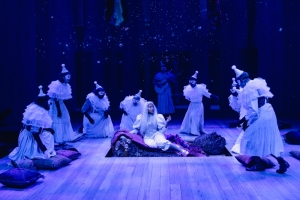
Chicago Shakespeare Theater celebrates its 40th Anniversary season with the second production of its ambitious repertory. A Midsummer Night’s Dream is directed by Artistic Director Edward Hall with all the magic, spectacle, and visual amazement of a circus extravaganza. Presented in repertory with Shakespeare’s The Winter’s Tale, these productions offer audiences two very different journeys into Shakespeare’s imagination, where love, jealousy, power, and transformation take center stage.
In A Midsummer Night’s Dream, four young lovers find themselves entangled in a romantic mess when they venture into an enchanted forest ruled by mischievous fairies. Shakespeare’s familiar comedy of mistaken identities, misplaced affections, and magical interference becomes an opportunity for theatrical invention. Here, the forest is less a woodland retreat and more of a fantastical playground where anything can happen.
The mortals include Sean Fortunato as Theseus, Jessica Dean Turner as Hippolyta, Felicia Oduh as Hermia, Kevin Gudahl as Hermia’s father, Esteban Ortiz-Villacorta as Demetrius, Dan Haller as Lysander, and Grace Steckler as Helena. The craftsmen - amateur actors rehearsing a play for the upcoming wedding - include Erick Hellman as Peter Quince, a carpenter; Chiké Johnson as Nick Bottom, a weaver; Kieran McCabe as Francis Flute, a bellows-mender; Issy Van Randwyck as Robin Starveling, a tailor; Ronald L. Connor as Tom Snout, a tinker; and Demetrios Troy as Snug, a joiner.
Among the evening's comic highlights is Chiké Johnson as Nick Bottom. His transformation into a creature with the head of an ass is wonderfully realized, both visually and physically. Johnson embraces the absurdity of the transformation with such comic confidence that Bottom becomes impossible to resist. His bewilderment, self-importance, and complete obliviousness to his altered appearance make his encounters with Titania, who has fallen under a love spell, all the more hilarious. It is a delightful reminder of Shakespeare's genius for finding comedy in human vanity and the ridiculous ways love can make fools of us all.
Completing the ensemble are the inhabitants of the fairy kingdom. Fortunato doubles as Oberon, King of the Fairies, while Turner transforms into Titania, Queen of the Fairies. Patty Roache takes on Robin Goodfellow, delivering one of the most delightfully puckish interpretations of Puck I've encountered. Roache seems to relish every opportunity to stir up trouble, and their physicality brings an added dimension to the character's mischief.
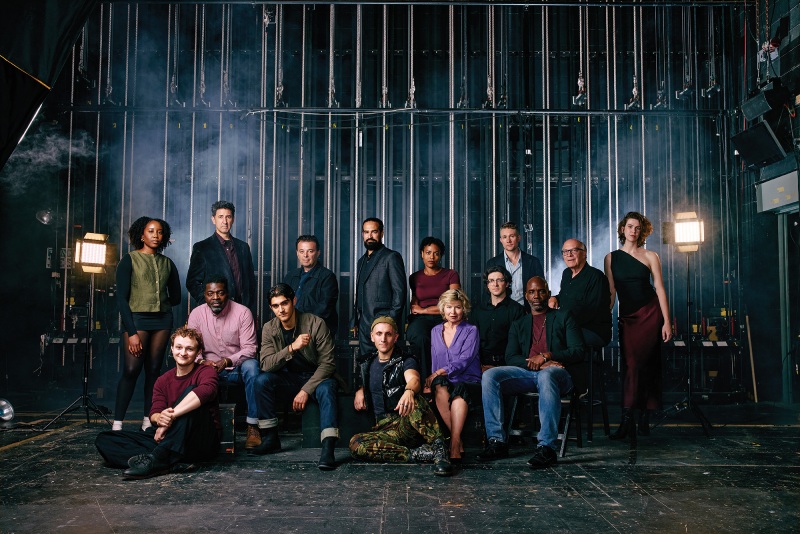
The cast of Chicago Shakespeare Theater's A Midsummer Night’s Dream. Photo by Kyle Flubacker.
One of the production's most striking achievements is Michael Pavelka's costume design, which is visually stunning, imaginative, and remarkably cohesive. The mortals inhabit a sophisticated palette of winter white and camel. The men wear tailored suits and coats with fur collars, while the younger men sport varsity jackets, cuffed trousers, sweater vests, and crisp white shirts. The women's dresses evoke 1940s silhouettes, creating an elegant period-inspired aesthetic.
The craftsmen are dressed in costumes that identify their respective trades, while the fairies appear as Pierrot pixies, dressed entirely in white, complete with half-masks and delicate lace collars. Oberon and Titania make a dramatic visual statement: the Queen wears a lush white brocade gown, while the King is dressed in stark black. Their contrasting costumes reinforce the tension between these two powerful personalities. Robin Goodfellow, meanwhile, is outfitted as a striped mime with hints of leather, perfectly suited to the character's playful and unpredictable nature.
The set is deliberately stark, giving the performers room to move and allowing the physical spectacle to take precedence. One particularly memorable visual is Robin Goodfellow's entrance. Rising from the floor, twirling onto the stage, and observing the action from suspended silks like an aerialist, Roache turns Puck's entrances into miniature circus performances. It is an imaginative theatrical touch that reinforces the production's magical atmosphere.
Yet beneath all the spectacle is Shakespeare's enduring exploration of human foolishness. The lovers are tossed about by their own desires, Oberon and Titania engage in a battle of wills, and Bottom's transformation into an ass provides an absurd reminder that love doesn't always recognize what it sees. Shakespeare understands that love can be irrational, jealousy can be destructive, and human beings are often their own worst enemies.
That is part of the pleasure of this comedy. We laugh at the lovers' confusion while recognizing something familiar in their inability to control their emotions. The fairy world may be magical, but its inhabitants are hardly immune to the pettiness and power struggles of the human world.
The pairing with The Winter's Tale makes this repertory season particularly intriguing. Both plays explore jealousy, love, and transformation, but arrive at very different destinations. Where A Midsummer Night's Dream resolves its romantic entanglements through enchantment and comedy, The Winter's Tale confronts the devastating consequences of jealousy and the difficult possibility of forgiveness.
For its 40th Anniversary season, Chicago Shakespeare Theater reminds us why Shakespeare continues to captivate audiences. His characters may be centuries old, but their desires, insecurities, foolishness, and capacity for love remain remarkably recognizable. This A Midsummer Night's Dream embraces the theatrical possibilities of the play, inviting us into a world where imagination takes flight and the unexpected is always just around the corner.
Highly Recommended
When: Through January 3
Where: Chicago Shakespeare Theater 800 East Grand Avenue in Chicago
Runtime: 2 hours 30 minutes with a 15-minute intermission
Box Office: 312-595-5600
Info: www.chicagoshakes.com
Chicago Shakespeare Makes Winter’s Tale a Story Worth Telling
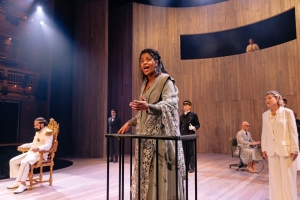
Chicago Shakespeare Theater’s production of The Winter’s Tale delivers a compelling evening of theater, showcasing an exceptional company of actors working at the top of their craft. Under the direction of Artistic Director Edward Hall, this staging marks an exciting experiment for the theater as the troupe performs in repertoire, set to follow this production with A Midsummer Night’s Dream in November. Though The Winter’s Tale remains one of Shakespeare’s lesser-known plays, Hall breathes fresh vitality into the work, framing it like a classic fairy tale. Playing a child, Felicia Oduh begins the show opening a picture book in view of a toy ship and a teddy bear, foreshadowing what is to come.
The piece opens with a joyous celebration as King Leontes tries to convince his childhood best friend, King Polixenes, to remain a little longer in his company. But the homesick royal denies every plea, until the beautiful Queen Hermione persuades him to stay. At her success, Leontes is suddenly possessed by jealousy, wondering why her efforts worked. His wild imagination corrodes his sanity quickly, and in no time, he’s envisioned a forbidden affair between his pregnant wife and his most loyal friend. His nobles fail to reel him in, and his madness drives him to forsake everything, even banishing his newborn daughter, only to discover his accusations had no merit. His only hope now rests in a prophecy and the hope that he’ll be reunited with his child one day.
This production thrives as a true ensemble piece, with the majority of the cast adeptly tackling dual roles. Demetrios Troy plays the maddened Leontes with fierce conviction, delivering an inspired portrayal of a ruler’s terrifying mental unraveling. Opposite him, Jessica Dean Turner brings raw emotion to Queen Hermione, grounding her betrayal in a profound, heartbreaking depth. Issy van Randwyck is a force to be reckoned with as Paulina. She commands the stage with a presence capable of calling down fire from heaven or piercing with her witty remarks dipped in uncompromising truth. Providing comedic relief, Kevin Gudahl and Dan Haller share delightful chemistry as the simple-minded shepherd and his son. Later, Sean Fortunato’s turn as the rogue Autolycus provides an absolute audience treat, creating a larger-than-life, hilarious scoundrel infused with a playful rock edge. His playful French accent was especially hilarious.
While the cast excels, the production’s main hurdles stem from the disjointed nature of Shakespeare's text. Act One functions as a powerful, high-stakes drama, illustrating how a poisoned mind can devastate love and life. Act Two, however, pivots sharply, opening with upbeat musical numbers, including a sequence featuring the cast as “baahing” sheep (one even relieves himself on stage). The second half feels in many ways like an extended tangent from the primary plot, as we’re promised a return to Leontes’ court. Still, while it’s a diversion, it is an entertaining one.
Also, no production of The Winter’s Tale would be complete without addressing the play's most famous stage direction, "Exit, pursued by a bear," and Chicago Shakespeare’s iteration does not disappoint. They unleash a creature that is truly the stuff of nightmares.
Despite the script's structural awkwardness, Hall has crafted an enjoyable and emotionally resonant piece of theater powered by artists who elevate every moment. The ensemble brings richness and warmth to these complex characters, capturing the audience’s heart while delivering laughter throughout.
Overall, this presentation stands as another triumph for Chicago Shakespeare Theater, proving that even Shakespeare's lesser-known works can shine brilliantly in the hands of a gifted company.
The Winter's Tale runs until December 12.
https://www.chicagoshakes.com/productions/2627-winters-tale/
Merry Mischief in Windsor: Chicago Shakespeare’s Fast, Funny Triumph

Shakespeare’s comedies share a familiar architecture: mistaken identity, disguises, intersecting plotlines, a generous helping of prose, and language that delights in wordplay and double entendre. They are also, crucially, driven by sharp, intelligent women who often see more clearly than the men around them. With that foundation in mind, Chicago Shakespeare Theater’s production of The Merry Wives of Windsor leans confidently into these conventions - and then accelerates them - resulting in a delightfully mischievous evening.
Directed with precision and pace by Phillip Breen, the production wastes no time settling in. It moves briskly, almost breathlessly at times. Breen understands that comedy, especially Shakespearean comedy, thrives on rhythm. Doors must slam at just the right moment, disguises must be revealed a beat too late, and jokes must land before the audience has time to anticipate them. Here, the timing is razor-sharp, aided immeasurably by a cast of 22 actors who navigate the text with clarity and ease.
Max Jones’ set design cleverly situates Windsor in a contemporary world of affluence and quiet excess. This is a town where privilege is not just visible - it is assumed. Children attend private school, men play rugby, and women occupy a social sphere of lunches and shopping that doubles as a kind of informal power network. The Garter Inn, rendered as a dimly lit bar with a billiards table anchoring the space, becomes a playground for Falstaff’s schemes. In contrast, Dr. Caius’ sterile office reception area offers a clinical absurdity, while the Ford household gleams with white carpeting, glass, and sweeping staircases - its opulence undercut by the chaos unfolding within. A particularly fluid set change transforms the space with near-magic, reinforcing the play’s obsession with illusion and transformation. The final forest scene, textured with dirt mounds and trees, grounds the production just enough before it tips fully into theatrical fantasy.
What emerges most clearly in this production is the idea that Windsor is a world turned slightly askew. No one is quite what they claim to be. The knight, Sir John Falstaff, is anything but noble - he is vain, opportunistic, and gloriously ridiculous. The doctor, Caius, is less healer than hot-headed rival, perpetually threatening violence. The clergyman’s thick accent renders him a subject of humor rather than authority. Even the Justice of the Peace seems more eager for confrontation than civility. It is a community in which status is worn like a costume—and just as easily discarded.

Photo by Kyle Flubacker.
At the center of it all are the “merry wives,” who prove themselves to be the most grounded and perceptive figures on stage. Ora Jones’ Mistress Page and Issy Van Randwyck’s Mistress Ford anchor the production with wit and composure. They are never merely reactive; they orchestrate the action, turning Falstaff’s attempted manipulation into a series of escalating humiliations. Their intelligence drives the comedy, ensuring that the laughter always has a point of view.
The supporting cast is equally strong. Chike Johnson’s Master Page exudes an easy confidence, while Timothy Edward Kane’s Master Ford leans fully into the character’s jealousy, finding both humor and unease in his suspicion. Nate Burger’s Dr. Caius is a comic standout, his bluster and indignation landing with delightful force. Nancy Voigts brings a bustling energy to Mistress Quickly, threading together the play’s many schemes, while Paul Oakley Stovall’s Justice Shallow captures the absurdity of self-importance.
And then there is Jason Simon’s Falstaff - a performance that embraces the character’s excess without apology. Legend has it that Queen Elizabeth I so adored Falstaff that she demanded to see him in love. Here, however, Falstaff is in love with nothing so much as himself. Simon leans into that vanity, crafting a figure who is both despicable and irresistibly watchable. His repeated downfalls never diminish him; instead, they reveal the elasticity of his ego.
Ultimately, this production succeeds because it trusts the mechanics of Shakespearean comedy while fully committing to its world. Disguises are embraced, identities are blurred, and language sparkles with innuendo. Yet beneath the laughter lies a sharper observation: that power, status, and even identity itself are often performances. In Windsor, everyone is playing a role - some just play it better than others.
Highly Recommended
When: Through May 3
Where: Chicago Shakespeare Theater 800 East Grand Avenue in Chicago
Tickets: $60 - $120
Box Office: 312-595-5600
Info: www.chicagoshakes.com
This review is proudly shared with our friends at www.TheatreInChicago.com.

Trap Door Theatre Presents: The False Servant, Written by Pierre de Marivaux, Translated by Martin Crimp, Directed by Kay Martinovich. Opens January 14th, 2027
18 November 2026 in Upcoming TheatreTrap Door Theatre is thrilled to begin its mainstage work of their 33rd season with Martin Crimp's take on the…

Steppenwolf Theatre Presents JESSIE MUELLER WITH SETH RUDETSKY – December 18 & 19
18 November 2026 in Upcoming TheatreSteppenwolf Theatre Company and Mark Cortale welcome back Tony Award winner Jessie Mueller (Beautiful: The Carole King Musical, Waitress) for a…
A Midsummer Night’s Dream: Chicago Shakespeare’s Circus of Love and Mischief
16 November 2026 in Theatre in ReviewChicago Shakespeare Theater celebrates its 40th Anniversary season with the second production of its ambitious repertory. A Midsummer Night’s Dream…

THEATER UNSPEAKABLE ANNOUNCES MIME OR NOTHING, FEBRUARY 5 - 28, 2027
16 November 2026 in Upcoming TheatreTheater Unspeakable is proud to announce the cast and creative team for the Midwest Premiere of Mime or Nothing, February…

'Oh, Buddy' a Lighthearted Absurdist Look at Transgender Issues in the Workplace
16 November 2026 in Theatre in ReviewLeave it to Trap Door Theatre to find an absurdist play, their milieu, that’s a funny, fresh take on office…

"An Evening with Gary Sinise" Author of "Graceful Warrior" to Benefit WSFDV at the MAC November 23rd
16 November 2026 in Theatre BuzzWest Suburban Foundation for Disabled Veterans (WSFDV) presents "An Evening with Gary Sinise," Author of "Graceful Warrior" at the McAninch…

VAPE! THE GREASE PARODY CELEBRATES HOMECOMING WITH SPECIAL THEMED PERFORMANCES THIS WEEKEND
16 November 2026 in Theatre BuzzCHICAGO, Homecoming just got a whole lot greasier. With friends, family and college classmates making their way back to Chicago…

BrightSide Theatre announces cast and creative team for THE SECRET GARDEN IN CONCERT, January 8 -17, 2027
16 November 2026 in Upcoming TheatreBrightSide Theatre has announced the cast and creative team for its concert performance of THE SECRET GARDEN. The musical, based…

The Beatrix Potter Holiday Party at Chicago Children’s Theatre’s returns for the holidays, December 5-27
16 November 2026 in Upcoming TheatreChicago Children’s Theatre’s 21st Birthday Season continues with its annual holiday rite of passage for Chicago toddlers, The Beatrix Potter…

Filament Theatre announces 2026/27 Season With returning interactive family favorites: Fort-building fun with FORTS and performance installation for babies RAIN
16 November 2026 in Upcoming TheatreFilament Theatre (4041 N. Milwaukee Avenue in Portage Park), the Northwest Side’s premier theater for young audiences, is delighted to…

‘Our Town’ Finds Big Feelings in an Ordinary Small Town
15 November 2026 in Theatre in ReviewI’ll admit I had never seen, read, or even heard of Our Town before opening weekend. All I knew going…

The Latest 'Dante 360' Leads to Paradise, Particularly for Dante-philes
14 November 2026 in Theatre in ReviewDante 360 Virgil Edition is the latest iteration of a performance work first launched in 2021. Directed by Peggy Garvey,…

Citadel Theatre Captures the Magic of Old-Time Radio in It's a Wonderful Life: A Live Radio Play
14 November 2026 in Theatre in ReviewThere is something undeniably captivating about witnessing the magic of old-time radio brought to life on stage. In an era…
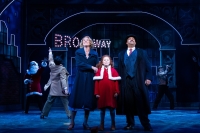
Genuine Heart Meets Classic Charm in Drury Lane’s Sunny Holiday Revival of Annie
13 November 2026 in Theatre in ReviewAlmost fifty years after she first sang her way into Broadway history, the sun is still shining bright in Oakbrook…

Beggin' For Something: Jersey Boys Falls Flat at CIBC
12 November 2026 in Theatre in ReviewWhen I was growing up in Southern California, the radio dial of our family car was always tuned to one…
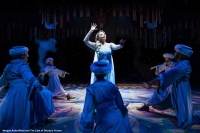
Warm Hearts in a Wintry Arendelle: Disney's Frozen the Musical Shines at Marriott Theatre
12 November 2026 in Theatre in ReviewDisney's Frozen the Musical arrives at Marriott Theatre's intimate in-the-round stage with a story most audience members already know, though…

Theater of the Mind: Not Your Typical Juggernaut
10 November 2026 in Theatre in ReviewAt this stage of his career, David Byrne’s name alone fills concert halls and theaters. The “singer, songwriter, musician, record…

Redtwist Theatre Announces its Cast and Creative Team for Robert Falls' Directed FLYING MONKEYS - Dec 6 - Jan 17
10 November 2026 in Upcoming TheatreAward-winning Redtwist Theatre announces the cast and creative team for this added special engagement to its 2026 - 2027 season,…
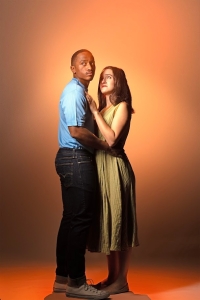
Romeo y Julieta - A bilingual adaptation of Shakespeare's classic is transported to 1960s Miami - January 29 – March 14, 2027
10 November 2026 in Upcoming TheatreChicago Shakespeare Theater (CST) announces the cast and creative team for Romeo y Julieta, Karen Zacarías and Henry Godinez's bilingual…

The Second City announces casting for the 5th annual Black Excellence Revue - February 5 – March 13, 2027
10 November 2026 in Upcoming TheatreFive years in, The Second City's Black Excellence Revue continues to bring bold comedy, fresh perspectives and an unmistakable sense…

An Incredibly Good Snapshot of Our Social Discourse in 'Heroes of the Fourth Turning'
10 November 2026 in Theatre in ReviewSettling in for A Red Orchid Theatre’s Heroes of the Fourth Turning, I knew next to nothing, having no familiarity…

Porchlight’s Out of This World “Little Shop of Horrors” lands at Biograph Theater
10 November 2026 in Theatre in ReviewFew musicals are as fun to sing (and watch) as “Little Shop of Horrors”. It’s not a huge surprise that…
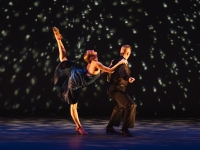
Giordano’s delectable Untamed Passion lights the fire of true love
10 November 2026 in Dance in ReviewFew dance companies can claim both the history and continued relevance of Giordano Dance Chicago. More than sixty years after…

A Murder Is Announced Is Murderously Entertaining
09 November 2026 in Theatre in ReviewFew authors have mastered the art of the whodunit quite like Agatha Christie, whose intricate mysteries continue to captivate audiences…

Oil Lamp Theater Announces Single Tickets for its 2027 Season are Now On Sale
09 November 2026 in Upcoming TheatreOil Lamp Theater announces that single tickets are now available for its 2027 season in addition to four-show and three-show…

Mexodus Gives Voice to a Rarely Told Story of Freedom
08 November 2026 in Theatre in ReviewWhat is Mexodus? Part concert, part theatrical journey, and part history lesson, it explores a rarely told chapter of the…

Sardonic Love In The Time of Gen Z: World Premiere of The Break Up at Rivendell Theatre
08 November 2026 in Theatre in ReviewThere are more important things in the world to worry about. At some point in our lives we’ve heard this…

Finding Light in Winter: The Snow Queen at The Den Theatre
07 November 2026 in Theatre in ReviewFirst published by Hans Christian Andersen in 1844, The Snow Queen has captivated readers for nearly two centuries. Now, The…

25 Years of It's A Wonderful Life at American Blues Theater
06 November 2026 in Upcoming TheatreAmerican Blues Theater announces its 25th Anniversary production of It's a Wonderful Life: Live in Chicago! from Frank Capra's film…

Dear Rhoda, a new play set at Chicago’s Dil Pickle Club, opens January 7 at Theater Wit
05 November 2026 in Upcoming TheatreDear Rhoda invites audiences into the chaotic world of 1920s Chicago, where love refuses to surrender to fear. Inspired by…





Latest Articles
-
 Steppenwolf Theatre Presents JESSIE MUELLER WITH SETH RUDETSKY – December 18 & 19
Written by Buzz Center StageSteppenwolf Theatre Company and Mark Cortale welcome back Tony Award winner Jessie Mueller (Beautiful: The Carole King Musical, Waitress) for a special holiday engagement. Catch the Broadway star live in Chicago before she heads back to New York next spring in the…
-
Trap Door Theatre Presents: The False Servant, Written by Pierre de Marivaux, Translated by Martin Crimp, Directed by Kay Martinovich. Opens January 14th, 2027
Written by Buzz Center StageTrap Door Theatre is thrilled to begin its mainstage work of their 33rd season with Martin Crimp's take on the classic scandalous tale of Pierre de Marivaux's The False Servant, directed by resident director, Kay Martinovich. The False Servant will…
-
 A Midsummer Night’s Dream: Chicago Shakespeare’s Circus of Love and Mischief
Written by Wesley DavidChicago Shakespeare Theater celebrates its 40th Anniversary season with the second production of its ambitious repertory. A Midsummer Night’s Dream is directed by Artistic Director Edward Hall with all the magic, spectacle, and visual amazement of a circus extravaganza. Presented…
-
THEATER UNSPEAKABLE ANNOUNCES MIME OR NOTHING, FEBRUARY 5 - 28, 2027
Written by Buzz Center StageTheater Unspeakable is proud to announce the cast and creative team for the Midwest Premiere of Mime or Nothing, February 5 - 28, 2027 at Theater Wit, 1229 W. Belmont Ave. Mime or Nothing is written by and starring Marc…


Does your theatre company want to connect with Buzz Center Stage or would you like to reach out and say "hello"? Message us through facebook or shoot us an email at This email address is being protected from spambots. You need JavaScript enabled to view it..
*This disclaimer informs readers that the views, thoughts, and opinions expressed in the text belong solely to the author, and not necessarily to Buzz Center Stage. Buzz Center Stage is a non-profit, volunteer-based platform that enables, and encourages, staff members to post their own honest thoughts on a particular production.