
Displaying items by tag: live theatre
A People: A Sweeping, Soul‑Stirring Journey That Celebrates Jewish Identity
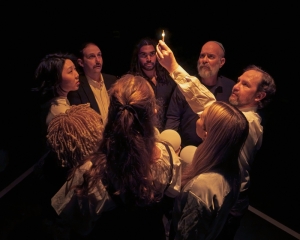
An extraordinary eight-person ensemble fuels the sweeping storytelling of A People - a production presented collaboratively by Arts Judaica and YI Love Jewish - shifting through nearly 80 characters across generations and geographies. Though only one cast member is Jewish, playwright LM Feldman intentionally assembled a diverse ensemble to reflect the many ways Jewish identity manifests - across culture, theology, race, queerness, and lived experience - underscoring that there is no single way to be part of a people.
The performance thrives on the versatility of this cast, featuring standout contributions from Douglas Levin, who provides an authentic and anchoring sincerity, and Charity Schultz, who illuminates her roles with magnetic charm. Daniel Boughton moves with ease between sharp humor and striking emotional depth, and Jin Ai anchors the production’s stillest moments with a quiet power, enriched by her beautifully integrated guitar work. Zach Kunde cuts through the space with sharp intellect and a commanding vocal presence, while Haley Schenk turns a single, piercing glance into some of the production’s most potent dramatic beats, and she even threads in flute playing that adds a surprising, delicate texture. The momentum never falters thanks to Xavier Mattison’s vibrant energy and tenderness, while Freya Churchwell rounds out the ensemble with impressive, wide‑ranging versatility and delivers some of the play’s genuine laugh‑out‑loud exchanges. Together, they weave a unified and deeply affecting tapestry of human survival.
This remarkable stage chemistry is guided by director Avi Hoffman, an acclaimed figure in global Jewish theater who recently directed and starred in a historic Yiddish production of Death of a Salesman in Bucharest, Romania. Having previously earned a Drama Desk nomination for playing Willy Loman in New York, Hoffman injects this local production with masterful artistic insight. Under his careful guidance, the non-linear, fragmented script by L. M. Feldman avoids confusion, gaining immense clarity and striking a perfect balance between epic historical weight and intimate human connection.
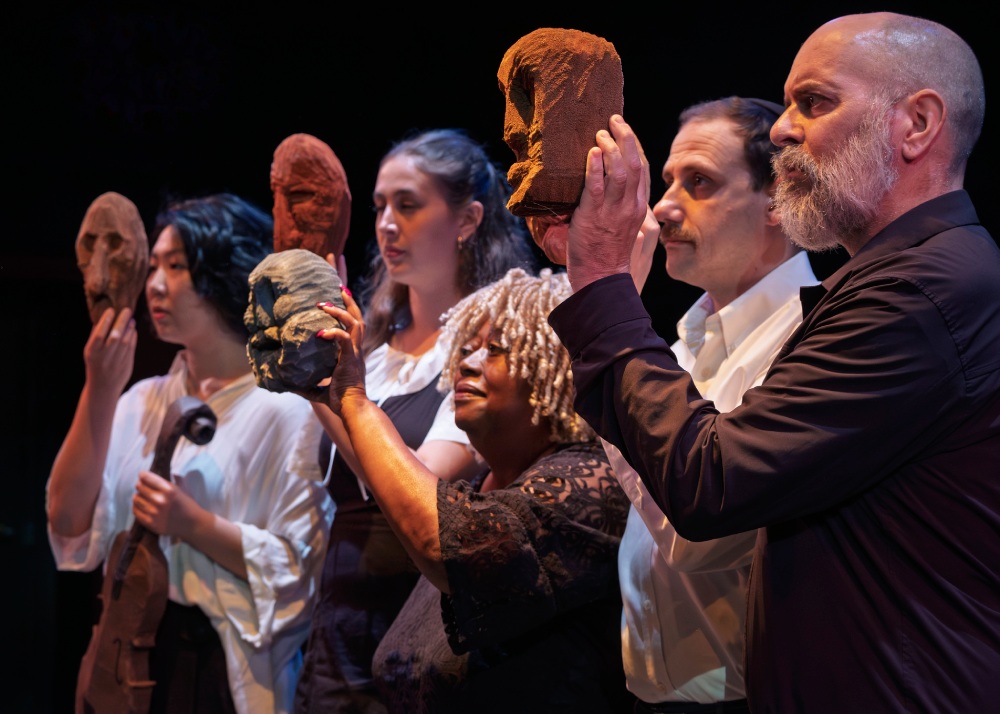
L-R: Jin Ai, Charity Schultz, Freya Churchwell, Zach Kunde, Douglas Levin. Photos by Logan and Candice Conner, Oonphotography.
Starting with the diaspora of the Jewish people that have become scattered throughout the world, the production explores several expressions of Judaism while ultimately reinforcing the idea that, despite their differences, they remain one people - and a remarkable people at that. It touches on beautiful threads of Jewish history, including the teaching that Moses received not only the written Torah referred to as “The Hand” at Mount Sinai but also the Oral Torah referred to as “The Tongue,” which was an interesting fact that I did not ever learn about the Torah in Hebrew school. I was also unaware of another phenomenon that members of the Jewish community called “tonals” actually memorized whole portions of the Torah to recite and sing so that the Torah portion could be performed for groups of students/scholars etc., to discuss and watch. The important thing that came out of this discussion of the Torah and the essential thing that makes Judaism different from other religions is that Jews learned and passed on the teachings of the Torah and the Talmud for the purpose of discussing them and learning from them and interpreting them and re-interpreting them -so as not to force them down anyone’s throat to be followed with blind faith.
As a Jew, I appreciated how the piece pokes gentle fun at our tradition of spirited debate - a trait that can be both energizing and, at times, hilariously counterproductive.
They are so intelligent at debating with each other that sometimes they nitpick each other to the end of a discussion that could otherwise forward the family or community or couple in a more positive way.
One of the production’s most profound scenes comes when a character asks a 90‑year‑old what history lives in the wrinkles of their face - how an entire lifetime, nearly a century of memory, can be held within one fragile human body. Another moment that stayed with me was the gentle but urgent insistence that nurturing future generations is vital to the continuity of the Jewish people.
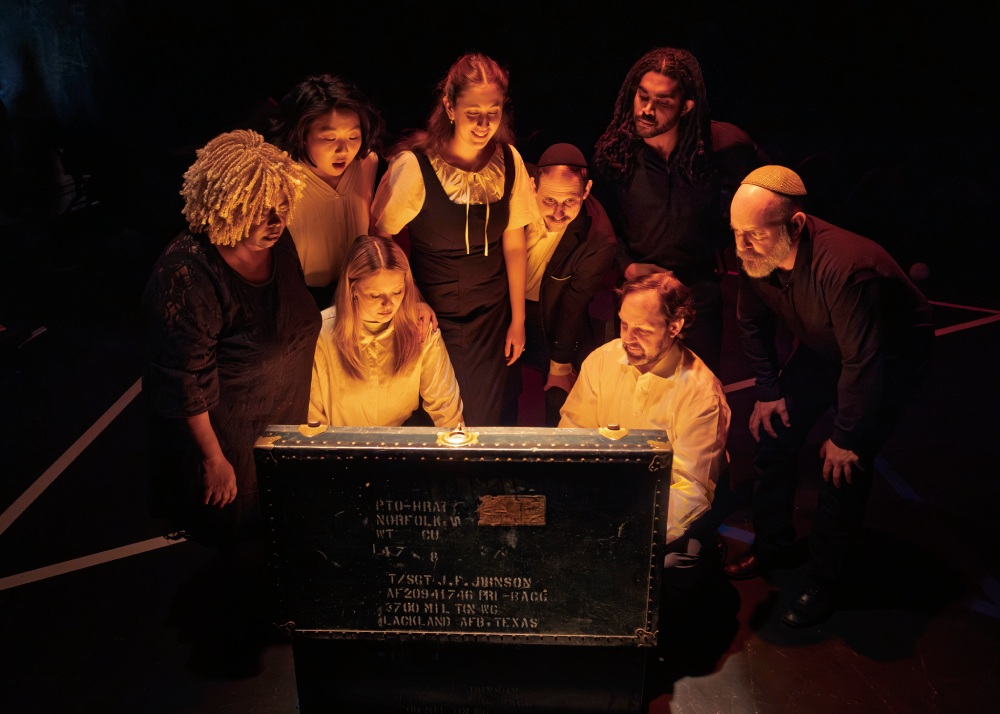
Back row L-R: Freya Churchwell, Jin Ai, Charity Schultz, Xavier Mattison, Zach Kunde, Douglas Levin. Front L-R: Haley Schenk, Daniel Boughton.
The differences among them are many, yet a shared thread still binds them together. One character argues passionately for a two‑state solution, while another hopes her girlfriend will one day be fully embraced by her community. A rabbi even confronts a group of Jewish Christmas carolers, shouting, ‘Why are you doing this?’ as the story considers how and why some Jews celebrate Christmas - a reflection of how the holiday’s overwhelming cultural presence in America can blur the line between religious observance and simple seasonal participation. And still, beneath all these disagreements and divergences, the play returns to the same essential truth: that despite their varied beliefs, identities, and practices, they remain part of one people.
This production was perfect for me as a Reform Jew who has been struggling in recent years with the current rise in antisemitism and my own childhood feelings of being a “self-hating Jew”. I remember being told as a teenager by my talent agent applying for theater roles that I needed to change my last name from Katz to Cates, implying that I would not be cast with a Jewish last name.
The work also reminded me that many young women today - queer and straight alike - continue to push back against the patriarchal elements of Judaism. It echoes the long history of restrictions found in early texts, where girls as young as 12 years old were defined by their childbearing potential and barred from studying sacred writings.
On the plus side, it brought me back to the beauty of the Yiddish language and how I hunger for the sounds of my great grandmother Fanny’s voice and my grandmother Lillian’s voice saying, ‘Have a little nosh!’ and, ‘We love you so much we’re kvelling!’”
The set is intentionally simple: a large Star of David stretches across the floor of Theater Wit’s intimate in‑the‑round space, immediately grounding the production in its cultural and spiritual roots. A few risers punctuate the stage, giving actors elevated platforms for defining moments, while small prop boxes at either end glow when opened, revealing modest but striking items that carry surprising emotional weight. Puppets appear briefly as well, echoing the woodworking projects referenced in the story and adding a tactile, handmade quality to the world. It’s an effective setup for this play - the open space becomes essential as the ensemble moves fluidly around the stage, frequently breaking the fourth wall to bless a volunteering audience member, pass out challah, ask questions, or coax the crowd into clapping along.
By luck, I chose the seat that happened to be in the spotlight for participation, and I was delighted when one actor asked me to be his ‘bubbe’ - his grandmother. When I said, ‘Yes! I will be your grandma!’ He gently took my hand, giving me a grateful squeeze. At another point, one of the actors - dressed as a bride - asked if he could give one of the audience members a blessing. I immediately said, ‘Yes!’ and he came over and placed his hands gently on my head - he was wearing the traditional lace head covering the bride on her wedding day - and he wished me great life blessings of joy and to find a wonderful husband. It was a delightful, intimate moment, and I hope that everyone who sees the show volunteers to experience that.
Throughout much of the play, the actors also wear small placards hanging from their necks, each bearing a single word such as “wrestle,” “struggle,” and “legacy.” These signs become a quiet but potent visual motif, suggesting the burdens, questions, and inheritances each character carries across time. They function almost like distilled themes of Jewish history itself - reminders that to be part of a people is to wrestle with identity, to struggle for continuity, and to consider what legacy one leaves behind. Other words appear as the ensemble shifts through eras, each one offering a compact window into the emotional or spiritual weight of the moment.
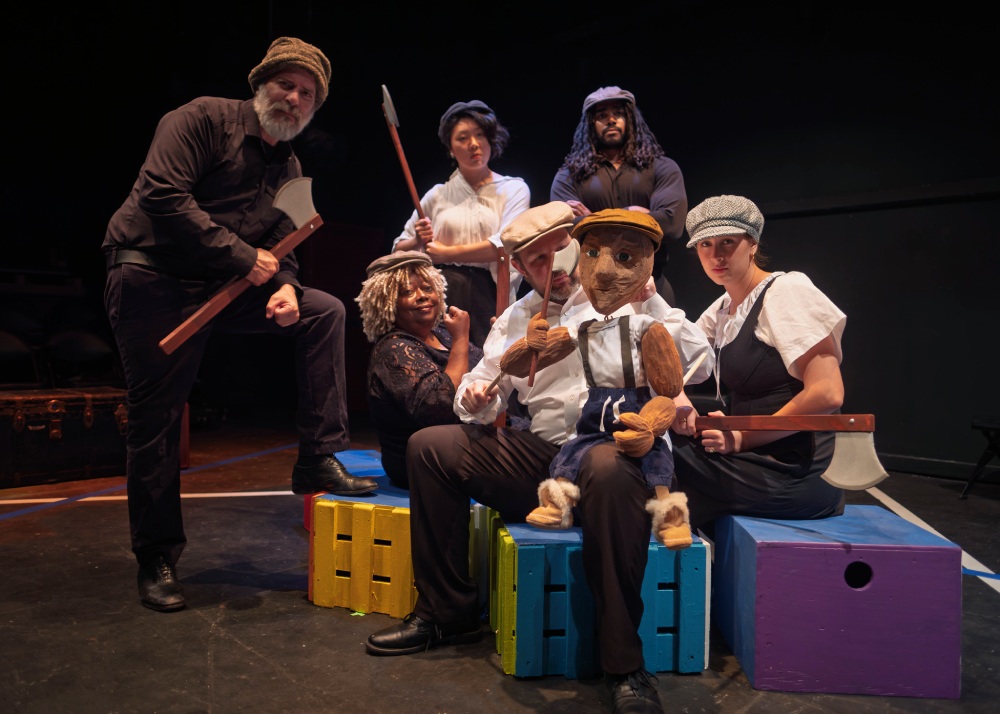
Back row L-R: Douglas Levin, Jin Ai, Xavier Mattison. Front row L-R: Freya Churchwell, Daniel Boughton, Charity Schultz.
My only note - and this is for the author, not the cast or director - is that of all the various types of Jews included in this piece - Reform, Conservative, queer, self‑hating, Orthodox, even atheist - the one type of Jew that was not represented was the Messianic Jew, of which I am one.
Messianic Jews (not to be confused with the organization Jews for Jesus) are Jews who believe that Jesus is the Messiah spoken of in the Old Testament - the ‘Christed One,’ meaning the one anointed with the oil of blessing. In those same scriptures, this figure is described as the blessed one who would be ‘pierced through his hands and feet,’ yet ‘whose bones would not be broken.’
Messianic Jews also believe that, regardless of his lineage - whether Yeshua was a descendant of King David or not - his purpose in allowing himself to be publicly killed, and then healing his own body three days later, was to show that this world is made of spirit, or ‘shimmering motes,’ as he called them. This was long before molecular structure or the effects of consciousness on physical matter were even theorized. All of his miracles were mitzvahs - acts of goodness - centered on healing and feeding the poor, the sick, and the disabled.
At the very least, Jesus was a respected, super advanced, rabbi, rebel and healer who introduced the idea that women were worthy of learning the Torah and receiving healing from his touch whether they were Jewish or not. This Feminist thought alone was a very radical and world changing idea that women of all nations and all religions are eternally grateful for.
Given all that Yeshua represents historically and spiritually to many Jews, I was surprised that his name never surfaced in a piece that explores so many branches of Jewish identity, its factions, and its many splintered paths. I compare his omission from Jewish studies when debating this with my friends to discussing basketball history without mentioning Michael Jordan or discussing physics without ever mentioning Albert Einstein - not a judgment, just an observation about the scope of the narrative.
In any case, author LM Feldman has created a marvelously complex and deliciously enjoyable reminder of all the different expressions of Judaism, and of the lush intelligence and grace of Jewish people around the globe caught up in the current battle to stay alive and well. Le Chaim!
A People was a very deeply inspiring and delightful experience for me, especially at this unprecedented time in history. This heartfelt production of A People helped this Jewish girl from Miami, Florida remember so many of the great things about my Jewish heritage; the sights, the sounds, the heated discussions, the music, the fabulous food, the funny family dinners, my own bat mitzvah… just so many things that make me proud to be a Jew today.
With its blend of live music and rapid-fire storytelling, the production compresses five thousand years of Jewish history and cultural inheritance into a brisk, engaging evening. A People stands out as essential summertime theater, honoring its deep historical foundations while resonating powerfully with contemporary audiences.
Mazel Tov and Highly Recommended!
Running through July 5 at Theater Wit.
Astonrep Approaches Uncle Vanya’s Appeal from a Novel New Angle
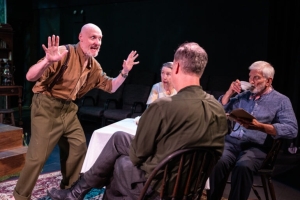
Anton Chekhov, a Russian playwright who was also a doctor, can claim a level of regard few writers achieve and maintain so long after their deaths. Born in 1860, the same year the Republican Party nominated Abraham Lincoln for President, his plays are routinely produced on stages in America and around the world because of what they reveal about who we are. That’s especially true for Chekhov’s Uncle Vanya, written in 1899, just a few years before the playwright died. Its popularity may be due to its mystery. Is it about resilience or is it about failure? Is it a comedy or a tragedy? It’s the kind of work that leaves you with questions about not only its two main characters, Sonya and her Uncle Vanya, but also about us.
A part of the city’s theater community since 2011, Astonrep Productions is a small Chicago company intent on “creating compelling and intimate experiences that challenge audiences”. Their interpretation of Uncle Vanya that opened over the weekend at The Edge Off Broadway succeeds in doing so with some reservations.
It’s the first American company to mount this commissioned 2024 Canadian adaptation of Chekhov’s classic. Liisa Repo-Martell’s revamp of the play dutifully adheres to the structure, plot themes and character composition of the original. But the play’s softer aspects, the features that define its essence and purpose, are less reliable and sure.
Displeasure with self is one of first things we get a sense of when the play opens. But even before that awareness sets in, there’s a curiosity the audience notices while they’re selecting their seats before the play begins. A man is slouched in an upholstered chair with one leg over its arm. He’s at the back of the stage and asleep. (We later learn he’s passed out drunk.) Soon after and closer to us, a man and woman are talking. They’re in the sprawling home of a rural Russian estate well over 100 years ago. He’s Mikhail Astrov (Robert Tobin), the local doctor and she’s Marina, a housekeeper very ably played by Liz Cloud, who clearly possesses a warm motherly instinct and a sharp wit. Astrov’s lamenting his fate as a country doctor. It’s all tedium. The people are gossip thirsty “savages”. His life has no fulfillment. He’s not married. He’s not in love with anybody and his youth is behind him. The demands of his work, a sour outlook and his liberties with vodka are catching up with him by slowly dismantling his good looks.
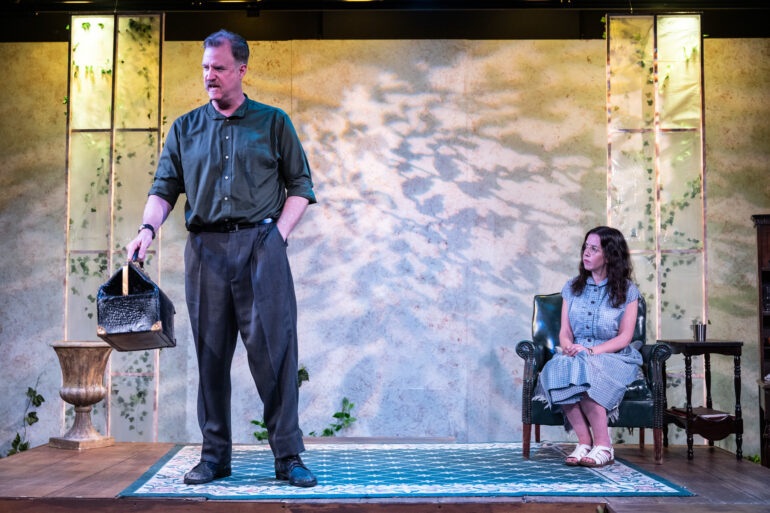
L-R: Robert Tobin, Natalie Hurdle. Photo by Paul Goyette.
By calling him a moron, the doctor’s antipathy for the sleeping man is made clear even before he wakes up.
As more people enter the story, we find ourselves in the middle of a family crisis. Vanya, the man who was sleeping in the chair, and his niece Sonya (Natalie Hurdle) have been the caretakers of the estate since her mother died. Sonya’s father, Alexandre (Geoff Isaac), is a professor in the city who’s been forced out of his university position and has now returned to the homestead. He’d been relying on income from the estate to support his lifestyle in town. He’s not returned alone. Joining him is his much younger and very beautiful second wife, Yelena, with Andi Muriel in the role. Things are tense. Alexandre’s pompous and obliviously demanding. And Vanya, played with visceral intensity by Rian Jairell, is demonstrably resentful.
An appeasing conflict avoider, Sonya’s loyalties are split between the natural draw a child has to her father and her uncle who’s labored with her to keep the estate viable at tremendous personal sacrifice to them both. Now a young woman, she seems to know it’s Vanya who’s been more the nurturing father presence for her and that other than each other, the estate is all that either of them have.
Additional strain is added with the presence of Yelena. Her beauty is like an intoxicant for both Vanya and the dissatisfied doctor, Astrov. They’re both brazen in their desire for her. Watching them shamelessly try to seduce her is equal parts comic and piteous.
With so much instability, friction and doubt in the air, you’d expect to feel the charge of that energy engulfing the air. Directed by Derek Bertelsen, it doesn’t arrive with any real intensity until the second act when Sonya’s father floats the idea of selling the estate. And that’s despite the considerable investments Jairell as Vanya had been contributing up to that point. Because It’s so transparent Alexandre wants the money from the sale to fund his return to the city and his refined form of living, Vanya’s resentment turns to rage. Finally filling the production with heat.
It dials up too when Sonya confesses her attraction, indeed love, for Astrov to Yelena. Unrequited never looked so vulnerable and fragile.
Part of Repo-Martell’s adaptation included revising the language to be more contemporary and ostensibly more approachable. It works in an essential way. Both Jeremiah Barr’s handsome set and Natalie Shoch’s costume designs are ambiguous enough to blur any specific time reference. But in the back of your mind you know this is all happening in a very distant time and place. One where duty and tradition held much more sway. That difference can often be found in the words used to express and explain obligations and choices. Here there’s a nagging sense that you may be missing important steppingstones.
In the end, things aren’t much different from where we found them in the beginning. Except everyone is much more depleted. Drained. But still tasked with shouldering their disappointments and continuing with their lives. In Chekhov’s original script, the word “rest” is used to represent that place of willful resignation that amounts to acceptance of one’s inevitable destiny. In this adaptation, the word “peace” is substituted. They say the same thing about something we’ve all experienced. When we’ve had to pull ourselves up out of the ashes and push forward. Uncle Vanya brings that feeling front and center and offers understanding through catharsis. That alone will keep it in heavy production for a few more centuries at least.
Uncle Vanya
Through July 5, 2026
Astonrep Productions
Venue: The Edge Off Broadway
1133 W. Catalpa Avenue
Chicago, IL 60640
For more information or tickets: https://www.astonrep.com
This review is proudly shared with our friends at www.TheatreInChicago.com.
Couch Penny Ensemble’s An Oak Tree: A Raw, Unrehearsed Descent Into Grief
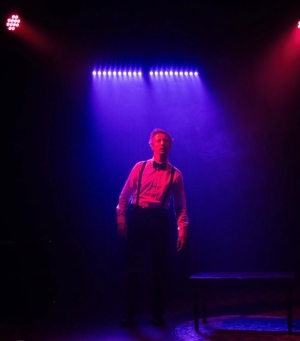
Couch Penny Ensemble, in association with Theatre Arcana, presents the ambitious and experimental An Oak Tree, a raw, unconventional approach to theater that is sure to spark conversations on the nature of grief and the experience itself.
In writing An Oak Tree, playwright Tim Crouch wanted to replicate the disorienting nature of grief. The play features two actors - one who has rehearsed the script (the Hypnotist) and another who has neither seen nor read it (the Father). The Hypnotist acts as a dual guide both for the actor playing the Father and the audience, as this one-of-a-kind experience comes to life.
For each performance, a new, different actor takes on the role of the Father, and it’s their job to live in the moment, breathing life into this character through the use of real-time instructions (given via headphones) and script lines given to them on the spot. The result is an unpolished, raw theater experience. The format is intriguing and innovative - a reflection on grief itself. When tragedy happens, you aren’t prepared for it, and you suddenly find yourself wrestling with a script that is unrehearsed.
Under Bryce Lederer’s direction, the production leans into the play’s shifting dynamics, shaping its unpredictability into something sharply focused and theatrically alive.
Riles August Holiday anchors the evening as the Hypnotist, delivering a technically demanding and well-acted performance. Holiday does a fantastic job of drawing a sharp line between his moments in character - playing a defensive, fragile man - and his moments acting as an administrative guide, calmly steering both his co-star and the audience through the mechanics of the script.
On this evening, Suzy Krueckeberg played the Father, and one can only imagine the excitement and the nerves of taking on such a role. As the Father, she was required to relive the trauma of losing a daughter and process the deterioration of her family without rehearsing - no small task. Krueckeberg did a good job finding the part and taking the audience on the journey with her.
For all its ingenuity, An Oak Tree serves a very specific appetite. This is avant-garde, experimental theater through and through. If you are an audience member searching for that specific brand of rule-breaking performance art, there is plenty to analyze here. Personally, I felt the script left something to be desired. In an examination of grief, I felt at times it was too simplistic or trod ground others had covered more effectively.
That said, it was a unique and interesting experience to see an actor walk a tightrope, constructing a character in front of the audience’s eyes. Holiday’s emotional depth on stage was a treat as well.
An Oak Tree runs at Greenhouse Theater Center until July 5th.
This review is proudly shared with our friends at www.TheatreInChicago.com.
Champions of Magic Captures the Thrill of Live Performance

One of the things I have always thought that concerts and other live events had over theatre is the energy of the crowd afterward. While people certainly leave plays and musicals moved, impressed, or deep in conversation, there is often a certain reserve to the way theatre audiences spill out onto the sidewalk. That was not the case after Champions of Magic at Studebaker Theater.
Leaving the theatre, the crowd was electric. People of all ages and backgrounds were in full childlike awe, excitedly recounting their favorite tricks, debating the moments that scared or shocked them most, and trying (mostly unsuccessfully) to understand how any of it could have been done. At one point, while my friend and I were part of the herd heading toward the train, an older man turned to us mid-discussion and said, “Usually, I see tricks and, even if I don’t know exactly how they did it, I can wrap my head around it just being an illusion. That was true magic.” And it was – that’s the only explanation.
That reaction captures the biggest strength of the night: it makes magic feel genuinely special again. In an age when so much of our entertainment is filtered through screens, clips, and behind-the-scenes explainers, it is easy to think you have already “experienced” these kinds of illusions through television or YouTube. But seeing them live, in a room full of people gasping, laughing, screaming, and turning to strangers in disbelief, is a completely different kind of experience – one you can only get from the Champions of Magic, themselves.
The large-scale magic show runs upwards of 2.5 hours, including one intermission, and is loosely structured as a rotation between three featured acts: Young & Strange (Richard Young, Sam Strange), Liberty Laren, and Fernando Velasco. While each performer brings their own style and specialties, the show works best when it feels like a shared, collaborative spectacle. There is something especially exciting about seeing different magicians combine their individual strengths to create an experience that feels bigger, stranger, and more theatrical than a traditional magic show.

The company of Champions Of Magic - photo by Bill Axell.
The variety of tricks is especially impressive. Champions of Magic includes everything from classic illusions, like the classic woman-sawed-in-half, to large-scale and death-defying stunts, to more intimate pieces of sleight of hand with audience interaction. Some tricks are quick and funny; others are story-driven and beautiful. The show also includes bits of magic history, particularly through fourth-generation magician Liberty Larsen’s family history as the founders of the Magic Castle. This was one of the most interesting threads in the evening, and I found myself wishing there had been even more of that magical history woven throughout the show.
The production is also extremely audience - and family-friendly, with plenty of built-in participation. Volunteers are selected in playful ways, such as by launching ping-pong balls into the audience, and several children are brought onstage as assistants. That said, parents should be warned before intermission: the glowing “red light, green light” magic toy promoted during the show costs $30 in the lobby – much more than I expected and not advertised until kids were already next in line for their new toy.
Aside from the occasional product placement, the show’s biggest issue was with pacing. I understand that a production of this scale needs slower, smaller tricks for both budget and timing reasons, and not every moment can or should be a massive illusion. Still, for a show pushing two and a half, there were stretches that felt extensively padded with smaller-scale filler. Ironically, the grand finale had the opposite problem. It was packed with multiple incredible tricks, but they came so quickly - back-to-back - that there was barely time to absorb one astonishing moment before the next was already underway. A little more breathing room there would have made the ending feel even more satisfying, without risking exposing the secrets at play.
Even with those pacing issues, Champions of Magic is a very fun, very unique night out. It is bigger, more surprising, and more communal than I expected, and it reminded me how powerful live spectacle can be when experienced with an audience fully willing to believe in what they are seeing. Whether or not it was “true magic,” it certainly felt like it.
Originally scheduled to run through July 5th, Champions of Magic was extended before opening due to popular demand – now running at Studebaker Theater through August 23rd. Tickets are available at https://championsofmagictour.com/.
*Extended through September 2nd
Lookingglass' Untitled Vampire Play has bite

Lookingglass Theatre Company continues its tradition of staging visually inventive and thought-provoking world premieres with its latest production, Untitled Vampire Play. Written by Lookingglass Ensemble Member Kevin Douglas - who has previously crafted well-received work for the company, including Thaddeus and Slocum: A Vaudeville Adventure - this comedy-drama uses supernatural lore to dissect the vulnerabilities of modern relationships.
The story centers on a delightfully bizarre “meet the parents” scenario. Dom (Jordan Anthony Arredondo), an everyman bartender, introduces his parents to his new girlfriend, Val (Courtney Rikki Green). The twist? Val is a centuries-old vampire. But don’t worry - she gets her blood from ethical sources, not human victims. Dom’s parents laugh it off, though, thinking their son’s girlfriend has a few screws loose.
Meanwhile, Val’s “brother” Roderick (Walter Briggs) resurfaces, wanting to reconnect. In reality, they are former lovers, but after his betrayal, she ran away. Val doubts that he’s changed, but her progeny, Rose (Jin Park), gets sucked into his orbit despite being under Val’s supernatural control. As Roderick carelessly makes kills in Chicago, bodies begin piling up, drawing the attention of Dom’s mother - a police detective - and a vampire hunter descended from Van Helsing. Who said love was easy? The result is a look at relationships in all of their messy, bloody glory.
Briggs turns in an excellent performance as Roderick, playing the charismatic bad boy with ease. He channels the classic Hollywood vampire aesthetic with immaculate fashion and a distinct, formal vocal cadence that commands the room. Sure, he’s a villain, but he’s fun to watch, especially with the little flairs he adds to his characterization.
Kareem Bandealy is another standout, tackling two completely contrasting roles. He plays Dom's father, Louie, with a relentless barrage of corny vampire dad jokes, then completely transforms into Lance Tardis Van Helsing, a fierce vampire hunter with an equally fierce hair flip.

Courtney Rikki Green as Val inUntitled Vampire Play at Lookingglass Theatre. Photo by Justin Barbin.
Anchoring the whole cast, though, is Green, who brings immense emotional weight to her performance as the complex Val. Serving as the real window into this hidden world, Green charts her character's profound transformation, as Val wrestles with whether she is seeking genuine love or simply trying to outrun eternal loneliness.
Beneath the fangs, the play asks a deeply human question: What does it mean to love someone? It explores the underlying selfishness that often masks itself as romance. Val wants Dom to turn into a vampire so they can be together forever, viewing his reluctance as a rejection of her identity rather than a defense of his own humanity. Meanwhile, Dom uses Val as an emotional security blanket to quiet his own intense insecurities. Through these characters, Douglas examines how control, weakness, danger, and even lust can taint love, or at least the illusion of it.
The script could use a bit of trimming in its exploration, as there are moments that feel repetitive, alongside a few minor plot weaknesses. For instance, it seems odd that a police detective would wait so long to investigate self-proclaimed vampires once gruesome deaths with animal-like attack marks begin happening. Furthermore, one thing I certainly could have gone without was a gruesome scene where the vampires feast on a victim, using gummy worms to simulate intestines. Still, beneath those rough edges, the play’s core story has real spark, offering a fresh, funny twist on vampire mythology that keeps the audience engaged.
I’d be remiss not to praise the play’s design. The technical execution is a masterclass in atmospheric world-building. Scenic designer Alyssa Mohn delivers an expert landscape featuring coffins that seamlessly rise from and sink into the stage floor. This clever staging pairs beautifully with Andre Pluess’s precise sound design and Jason Lynch’s lighting choices - ranging from moody washes to stark spotlights and flashing accents - to wrap the theater in an escalating sense of intrigue and peril. The atmosphere creates moments when you’re not sure if you might be the next victim.
Inventively directed by Devon de Mayo, the production also incorporates fun moments of audience engagement, whether it’s handing theatergoers caution tape to hold at a crime scene or a rather messy vampire kill that sprays stage blood into the front row.
While it doesn’t entirely break new ground, Untitled Vampire Play is creative and visually arresting. At a time when modern relationships are being heavily dissected in media - such as in the hit Obsession - Untitled Vampire Play tosses its fangs into the conversation, leaving the audience to wrestle with what should encompass the core tenets of love.
Recommended.
Untitled Vampire Play is being performed at Lookingglass Theatre through July 12th.
This review is proudly shared with our friends at www.TheatreInChicago.com.
Tom Stoppard’s epic finale Leopoldstadt is an instant classic at Writers Theatre

What would you do if you found out your heritage wasn’t what you thought it was? In Tom Stoppard’s case, he wrote a sweeping, epic play about it. Glencoe’s Writers Theatre brings Leopoldstadt to the Chicago area for the first time since its West End and Broadway runs in the early 2020s. Directed by Carey Perloff, a longtime friend and collaborator of Stoppard’s, this final stage play proves to be among his best.
Stoppard passed away late last year but he left a decades-long cannon of seminal stage and screenplays. When his semi-autobiographical play “Leopoldstadt” began performances in the West End in early 2020, he was sure it would be his last. Though he wrote it in a year, it took nearly 30 years to find the narrative. Stoppard, who was raised as a gentile most of his life, was told by a family member in 1993 he was of Jewish heritage and that many of his family members were murdered in the Holocaust. Stoppard escaped Czechoslovakia as a child and was raised in the UK entirely unaware.
A blended Jewish-Catholic family’s history in 20th century Vienna is divided neatly into four pivotal scenes with a sizeable cast of some of Chicago’s best. In the first scene, a Christmas party (1900), we’re shown a Vienna in which Jews were considered equals. Families had interfaith marriages and shared holiday celebrations. By the second scene (1924), WWI has redrawn the maps of Europe. Austria, as well as the family, finds itself in a precarious place. Scene three (1938) portrays an Austria fully committed to the Third Reich and family alliances are put to the test when the family is forced out of their home by the Nazis. The final scene (1955) happens in the aftermath of Austria’s reunification following WWII. This last scene mirrors Stoppard’s own life and serves as an emotional climax to a play that is often dense with political and historical theory.

The cast of Leopoldstadt. Photo by Michael Brosilow.
Writers Theatre’s production is as faithful to the original as you can get. Carey Perloff directed the Boston and D.C. premieres too. Along with an all-star cast of Chicago heavy hitters, Perloff’s production will likely be remembered as the definitive Midwestern revival. Between Ken MacDonald’s set and Alex Jeager’s costumes, audiences are sure to be swept away to a different time and place that can feel eerily reminiscent to the present.
As the eras change so do the actors playing the characters. Stoppard’s script trusts that the storytelling is so engaging that audiences will figure out who’s who by the context clues, and he was right. Some may find the story hard to follow but thankfully a helpful lobby installation catches everyone up on the history of Austria during this time period.
Writers Theatre favorite Kate Fry plays a Catholic woman, Gretl, who marries into a prominent Jewish family. Her performance is at first charming but by the end heartbreaking. Jessie Fischer delivers a transformative performance, particularly during the final scene. Rounding out the male ensemble is Ian Barford as Hermann who plays a converted catholic, but it’s his deterioration that is unforgettable. Justin Albinder is given the meatiest part of the final scene and his ability to switch from one emotion to the next is some of the most natural acting of the evening.
Leopoldstadt is every bit as epic as something like Gone with the Wind. Much like the famed novel and movie, this play tells the story of a civilization, a family, lost to the tragedy of war. It’s a story of a family’s near extinction. Stoppard’s brilliance is on full display and how lucky are we to have this capstone for his illustrious career?
Through August 16 at Writers Theatre. 325 Tudor Ct, Glencoe, IL. 847-242-6000
https://www.writerstheatre.org/events/leopoldstadt
This review is proudly shared with our friends at www.TheatreInChicago.com.
Nunsense, Not Quite Immaculate - But Blessed With a Strong Cast

Following its recent winter production of Sister Act, Drury Lane Theatre returns to the convent with Nunsense, a light-hearted musical comedy which, as the title implies, is a lot of nonsense.
The premise is funny, albeit morbid. After an unfortunate mishap, 52 members of the Little Sisters of Hoboken die from tainted soup prepared by Sister Julia, Child of God. With limited resources, the surviving nuns can only cover the funeral expenses of some of their sisters - leaving the remaining four bodies in their convent freezer, awaiting burial. How can they solve this problem? Well, stage a variety show, obviously! After all, while these women are nuns, they all wanted a moment in the spotlight.
E. Faye Butler, who also directed Sister Act, returns to stage Nunsense and injects the same optimism into this show. Unfortunately, it lacks the same substance, failing to elevate its premise beyond the initial idea.
The origin of Nunsense seems to explain its structural weakness. In the early 1980s, playwright Dan Goggin created a line of tongue-in-cheek greeting cards featuring a nun offering witty, irreverent quips. The cards were a hit, and Goggin used them as a jumping-off point for a cabaret show, which was later expanded into a full-length musical.
Unfortunately, the script doesn’t have much narrative depth or structural momentum. It seems to wander through quips and gags, trying to find a laugh rather than developing character or plot. At one point, we learn that a health inspector will fine them if they can’t raise the money by tomorrow, but it doesn’t land as a serious threat or even a driving force for the remainder of the show. The problem even has a quick resolution when Sister Mary Amnesia remembers her identity and discovers she’s suddenly rich thanks to a contest - talk about a deus ex machina (mary-ina, if you will).

Rachel Carreras in Drury Lane THeatre's Nunsense. Photos by Caitlin Dennis.
The book’s weaknesses are unfortunate because the cast is genuinely strong. Every member brings spectacular vocals to the stage, effortlessly belting out musical numbers and sounding excellent throughout.
Sharriese Hamilton delivers a standout performance as Sister Hubert. Her sassy comebacks and vocal riffs are hilarious, especially her trill in their rap. Her big second-act number, "Holier Than Thou," takes the audience to church and gives the show a much-needed jolt of energy. Cory Goodrich, Rachel Carreras, Kelly Felthous, and Aurora Boe also do well in their solo moments, whether it’s physical comedy, playing with a puppet, or ballet. Felthous gets to shine with her audience work and banter, and it is fun to see the cast do callbacks to specific interactions, such as flirting with or chiding audience members.
The show succeeds best when it moves quickly. Without much plot, gags can get tired easily. For instance, the Reverend Mother accidentally inhales a drug found in the girls’ locker room and goes to pieces. The sequence goes on a few beats too long. Transitions also could be tightened so the show doesn’t lose steam between numbers.
Nunsense is a fun idea, but the script fails to execute it satisfyingly. It’s also unclear who the intended audience is; the PG‑13 tone might make it a slightly tougher fit for families, even though they’d otherwise be a natural demographic.
While each performer gets a well-deserved moment to shine, it is a shame that such a talented cast doesn't have better material to serve either their collective skills or a meaningful story. Drury Lane's Nunsense has its moments, but it never quite reaches divine heights.
This review is proudly shared with our friends at www.TheatreInChicago.com.
Where Identity Slides: Steppenwolf’s Mesmerizing Catch as Catch Can

Mia Chung’s Catch as Catch Can, which premiered with Page 73 in New York in 2018, arrives at Steppenwolf Theatre - one of Chicago’s most dynamic and daring artistic institutions - with a production that immediately embraces the play’s slippery, shape-shifting nature. Chung’s script thrives on emotional volatility and fractured identity, and Steppenwolf’s staging taps into that energy from the outset, preparing the audience for a world where the familiar can tilt, distort, and reassemble without warning.
Catch as Catch Can begins with the familiar comfort of kitchen-table talk between two New England mothers, Roberta Lavecchia and Theresa Phelan. Under Amy Morton’s direction, those early scenes feel lived-in and deceptively ordinary - two longtime friends trading stories, worries, and family updates with the shorthand of people who have known each other for decades. But as the play unfolds, that everyday warmth becomes the launching point for a story that veers into far more disorienting territory. The return of Tim Phelan unsettles the delicate balance between the Lavecchias and the Phelans, stirring up old assumptions, unspoken resentments, and long-dormant family myths. What begins as a simple homecoming slowly reveals itself as a catalyst for emotional slippage, where memories blur, loyalties shift, and the characters’ sense of who they are - and who they have been to each other - starts to fracture. Morton guides this progression from domestic realism to psychological unraveling with remarkable control, allowing the play’s humor, tension, and creeping dread to coexist in the same breath.
The production’s boldest device - three actors portraying all six characters - becomes the heartbeat of the evening. Gary Cole (as Roberta and Robbie Lavecchia), Audrey Francis (as Lon and Daniela Lavecchia), and Tim Hopper (as Theresa Phelan and Tim Phelan) deliver performances that are nothing short of remarkable. Morton directs them with a sculptor’s precision, shaping each transformation through voice, posture, and energy rather than costume changes or props. The actors rarely add so much as an apron, a pair of glasses, or a purse to differentiate roles; instead, they rely on the smallest shifts in breath, cadence, or physical weight. Even the simplest physical actions - threading a needle, folding laundry, lifting a heavy picture onto a wall, or a mother rolling out her famous meatballs - become character markers, subtle cues that signal who is speaking without ever breaking the flow of the scene. At times, it feels as though six fully realized people are occupying the room, even though only three bodies ever stand onstage.
After the opening scene, it took me a few minutes to recalibrate to the production’s rhythm, especially as the actors began switching characters with such speed and minimal visual cues. But that adjustment period is brief. Before long, the doubling feels not only natural but essential, a kind of theatrical language the production teaches you how to read. Once you settle into its cadence, the transformations become thrilling rather than disorienting, sharpening the play’s emotional stakes and deepening its sense of unease.
The rapid-fire switching becomes its own kind of theatrical whiplash. An actor may leap from one character to another every other sentence, often without a single visual clue, and Morton ensures each pivot lands cleanly without losing an ounce of emotional clarity. The play becomes a fault line in constant motion, where identities slide, collide, and splinter beneath the surface.

Gary Cole, Tim Hopper and Audrey Francis (L-R) in Steppenwolf Theatre's Catch As Catch Can. Photo by Michael Brosilow.
All three performers - Gary Cole, Audrey Francis, and Tim Hopper - are longtime Steppenwolf ensemble members, bringing a shared artistic vocabulary that sharpens every transformation onstage.
Cole toggles between Roberta’s brittle warmth and Robbie’s restless bravado with astonishing finesse. This production marks his first return to a Chicago stage in more than 25 years, and it is a triumphant homecoming. He is known to many for Office Space, Talladega Nights, HBO’s Veep, NCIS, and one of my favorite roles - Mike Brady in The Brady Bunch Movie and its sequel. Cole reminds audiences that his stage roots run deep. As Roberta, he carries a soft, fluttering concern that sits right behind the eyes; as Robbie, that same gaze sharpens into something quicker, hotter, and more impulsive. His ability to pivot between those energies with nothing more than a shift in breath or a recalibrated stance makes each transition feel both seamless and startling. It is a performance built on precision, but it never feels mechanical.
Francis brings an equally impressive duality to Lon and Daniela. In addition to being a Steppenwolf ensemble member, she now serves as the company’s artistic director alongside Glenn Davis, a role that underscores her influence on Chicago’s theatrical landscape. Known for standout performances in The Herd, Dance Nation, her work on Chicago Med, and directorial skill in You Will Get Sick, she grounds Lon with a quiet, blue-collar steadiness, a man who absorbs the world before reacting to it. Daniela, by contrast, is all edges and alertness, her movements tighter and her voice pitched with a nervous brightness that hints at deeper cracks. Francis masterfully switches entire gravitational centers. The clarity of her physical vocabulary makes each character instantly legible without a single costume change.
Hopper’s pairing may be the most haunting of the three. With Steppenwolf credits that include The Crucible, The Flick, and Buried Child, he brings a raw, unsettling honesty to both Theresa and Tim. His Theresa is a portrait of unraveling vulnerability, a woman whose emotional seams are beginning to split in ways she can barely articulate. His Tim, meanwhile, carries the quiet desperation of someone trying to hold himself together even as the ground shifts beneath him. Hopper plays both roles with a volatility that feels almost dangerous. The characters mirror and distort one another, creating an emotional echo that deepens the play’s sense of unease. Watching him slip between them is like watching a reflection break apart and reassemble in real time.
Together, these performances form the core of the production’s power. With Morton’s direction guiding every pivot, the trio creates the uncanny sensation that the stage is populated by twice as many people as are physically present. Their transformations are so quick and so clean that the audience must stay alert, tracking identities as they slide, collide, and reform. It is a feat of acting that is both technically dazzling and emotionally resonant, and it is the reason the play’s unstable world feels so alive.
As the story darkens - touching on mental health, racism, cultural tension, and the fragile scaffolding that holds families together - the doubling amplifies the instability. Chung threads moments of racial bias and coded language into the fabric of these families’ interactions, revealing how prejudice can hide inside the most casual exchanges and how easily it can rupture long-standing bonds. Morton understands that the play’s power lies in this slippage, and she allows the actors to push into the unsteady terrain without ever losing emotional truth. The result is a production that feels intimate yet vertiginous, a domestic drama that slowly cracks open into a haunting exploration of identity and the roles we inherit, perform, and sometimes cannot escape.

Andrew Boyce’s scenic design is a quiet marvel, giving the production a sense of dimensionality that feels both naturalistic and subtly disorienting. The main playing space is an open living room, flanked on one side by an entryway and a partial view into the kitchen, and on the other by a long hallway that suggests the deeper interior of the house. Just beyond the living room, another room is visible past a second hallway, creating the impression of a home that extends well beyond the edges of the stage. Boyce’s layout allows the audience to feel as though they’re peering into a fully lived-in environment, one with corners, thresholds, and unseen rooms that hold their own histories. Yuki Nakase Link’s lighting deepens this effect, subtly sculpting each corridor and doorway so the house seems to breathe with possibility - sometimes warm and inviting, sometimes shadowed with tension. It is a multidimensional design that grounds the play’s domestic realism while subtly reinforcing the sense that something inside this home - and inside these families - is evolving.
In their Artistic Director note, Glenn Davis and Audrey Francis frame Catch as Catch Can as a rare convergence of timing, artistry, and ensemble history - a production long delayed, now finally realized with the team that first set out to make it in 2020. They speak to the play’s uncanny pull, describing how Chung’s story has embedded itself in the company’s imagination, refusing to loosen its grip. For them, the doubling is not just a theatrical device but a test of the ensemble’s virtuosity, a chance for Steppenwolf to stretch its actors toward the edges of what performance can hold. And at the heart of their message is the idea that the play’s exploration of identity, home, and the selves we construct makes it a fitting capstone to the theatre’s 50th anniversary season - a reminder of how Steppenwolf’s long-standing commitment to family drama, artistic risk, and shared storytelling continues to shape its legacy.
Catch as Catch Can ultimately lands with the force of a quiet detonation, its emotional aftershocks lingering long after the final blackout. Morton and her trio of actors craft a world that feels both intimate and treacherous, a place where identity slips, refracts, and reforms in ways that are as unsettling as they are compelling. It is the kind of production that rewards close attention and invites conversation long after you’ve left the theatre - about family, perception, and the narratives we inherit without realizing it. Catch as Catch Can runs at Steppenwolf through July 12, with performances throughout the week, and it is very highly recommended for anyone who craves theatre that challenges, unsettles, and stays with you.
For tickets and/ or more show information, click here.
This review is proudly shared with our friends at www.TheatreInChicago.com.
Factory Theater’s Two Out of Three Falls is a Theatrical Event

Those familiar with the Factory Theater space might feel themselves do a double take upon entering the theater for Two Out of Three Falls. Scenic Designer Manuel Ortiz completely transforms the space. The three-quarter thrust stage that has been there for years is gone – replaced by a wrestling ring that consumes an entire side of the theater. The ring is detailed, complete with lockers and wall decoration that completely transform that side of the space into a wrestling gym. To say that Ortiz outdoes himself in this endeavor is an understatement, because you might just find that the design is highly effective in drawing you into the thrilling vibe of the event.
Written by Bill Daniel, Two Out of Three Falls follows Johanna Goodish (Brittany Ellis), a wrestler struggling to step out of the shadow of wrestling legend King Kong Bruiser, also known as her father. Haunted by his literal ghost (Eric Frederickson), Goodish commits to the one act that she feels can set her free – challenging her father’s killer, Eduardo Quinones “El Moreton” (Sam Ramirez), to a wrestling match on live TV. If all goes according to plan, Quinones won’t live to see another day.
Directed by Ashley Yates, much of the production feels like a live wrestling match. As Goodish and her various opponents throughout the play take the ring, audience members at this Opening Night performance screamed and hollered. The design invites audiences to choose their opponent of choice, and you might just find that the intimate feel of the theater makes you feel like you are a part of the action. The work of Fight Designer Kate Lass and Wrestling Consultant Axel Rico shines in these scenes and certainly makes for an entertaining and lively evening.
The high-energy wrestling scenes act as a helpful contrast to some of the more intimate moments of the play – particularly within the relationship of Goodish and her manager, Meg Bishop (SaniaFaith). For so much of the story, Ellis brings a strong, confident character to Goodish. She is unafraid to fight back against her opponents, and she ensures that she is the last one standing at all costs. However, with Meg Bishop, we see a different side of Goodish. Ellis brings a quieter, more grounded character to these scenes. There is a vulnerability between Bishop and Goodish that you might just find helps us believe in this duo win. SaniaFaith and Ellis play off each other beautifully, bringing a genuine humor to the relationship that pushes it over the top.
The hype of the wrestling matches alone makes Two Out of Three Falls worth a watch. The stellar scenic design and strong ensemble make it a night of intrigue and fun.
Two Out of Three Falls runs through July 18 at the Factory Theater – 1623 W. Howard Street. For tickets and information, see the Factory Theater website.
RECOMMENDED
This review is proudly shared with our friends at www.TheatreInChicago.com.
Bargatze’s Big Dumb Eyes Tour Lands in Rosemont With Subtle Force

Nate Bargatze’s Big Dumb Eyes tour made its stop at the Allstate Arena in Rosemont with the steady, understated presence that has become central to his appeal. Bargatze continues to draw humor from the small missteps and everyday confusions that shape his storytelling, easing the audience into his rhythm rather than pushing for big moments. His unhurried delivery works surprisingly well in a venue of this size, creating a sense of shared focus that settles over the room as he builds each joke with quiet precision.
This powerhouse comedy tour is anchored by host Julian McCullough, whose easygoing charm and quick-hit crowd work set the tone for the night before the headliner ever steps onstage. He’s joined by a sharp trio of comics - Greg Warren, Gary Vider, and Jonnie W - each bringing a distinct comedic style that keeps the momentum building from set to set. Warren’s dry, story-driven humor, Vider’s understated oddball delivery, and Jonnie W’s musical-comedy flair create a well-balanced undercard that feels like a full evening of stand-up on its own. Together, they form a tightly assembled lineup that primes the audience perfectly for the main event.
Julian McCullough, Greg Warren, Gary Vider, and Jonnie W will all be making upcoming appearances at Zanies Rosemont, giving Chicago-area comedy fans several chances to catch them live. McCullough returns to the club on June 5–7, while Greg Warren is scheduled for a special event weekend on May 22–23. Jonnie W will headline Zanies Rosemont on July 26, and Gary Vider’s next Chicago-area dates are at Zanies Chicago on March 27–28, offering multiple showtimes across both nights.
Bargatze has been performing in arenas for some time now, and the format suits him more naturally than one might expect. The in-the-round staging keeps him accessible from every direction, while the large video screens ensure that even the most subtle expressions read clearly throughout the space. It is an effective setup for a comedian whose style relies on nuance rather than volume. In a venue as large as Allstate, laughter does not always erupt all at once - it spreads gradually, section by section, until the entire arena is moving with the same steady momentum.
A significant portion of Bargatze’s material continues to revolve around his family, with stories about parenting, marriage, and the everyday negotiations that come with trying to make sense of the world alongside the people closest to you. But he also branches into the absurdities of modern life, touching on everything from AI to self-driving cars to couples therapy - and even the baffling challenge of buying a horse, because, as he points out, who actually knows the price of a horse? These moments are not exaggerated or heightened for effect. Instead, he treats them with the same calm, observational tone that defines his work. The humor comes from the honesty of the situations and the quiet recognition they spark, especially for audiences who see their own households and daily frustrations reflected in his.
His Rosemont appearance is one stop in a long stretch of dates as the Big Dumb Eyes tour continues across major arenas nationwide. The upcoming schedule includes cities throughout the Midwest, East Coast, and South, each offering a chance for audiences to experience how his understated approach translates to rooms of this scale. At this point, Bargatze stands among the strongest stand-ups touring at the arena level, not because he relies on spectacle, but because his material remains consistent, grounded, and effective no matter the size of the venue.
In the end, the Allstate Arena stop underscored why Bargatze’s rise has felt so steady and assured. His comedy does not demand attention - it earns it through clarity, timing, and a genuine connection to the everyday experiences he describes. For a comedian whose style is built on understatement, filling an arena might seem counterintuitive, yet he makes the space feel surprisingly intimate. It is a testament to his craft and a clear sign that his place on the arena circuit is well deserved.
Identity Performing Arts' Fifth Anniversary Gala: Movement That Keeps Becoming
19 October 2026 in Dance in ReviewFive years is an important milestone for any arts organization, but for a contemporary dance company it also marks an…

Overshadowed Theatrical Productions Brings Beloved Holiday Classic It’s a Wonderful Life to the Stage
18 October 2026 in Upcoming TheatreThis holiday season, Overshadowed Theatrical Productions is thrilled to present the timeless holiday classic, It’s a Wonderful Life, live on…
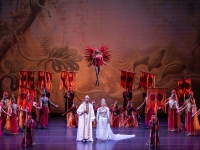
Dance Theatre of Harlem fills Auditorium Theatre with fire and funk
18 October 2026 in Dance in ReviewProjecting a vibe that felt more homecoming party than ballet presentation, Dance Theatre of Harlem returned to Chicago on October…
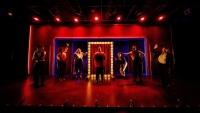
“A Strange Loop” Lets the Intrusive Thoughts Win at Raven Theatre in partnership with About Face Theatre
17 October 2026 in Theatre in ReviewA musical, but it’s just the voices in your head. Sounds just crazy enough to win the 2020 Pulitzer for…

Announcing Goodman's 22nd New Stages 2026 Festival Line-Up
15 October 2026 in Upcoming TheatreFrom a "Kung Fu rom-com" to a witchy new musical, The Goodman's popular New Stages Festival in its 22nd year continues…

TIMELINE THEATRE’S 100TH PRODUCTION, THE CHICAGO PREMIERE OF LAURA WADE’S HOME, I’M DARLING, DIRECTED BY MECHELLE MOE, SATIRIZES THE SEDUCTIVE FANTASY OF A “SIMPLER PAST,” NOVEMBER 11 - DECEMBER 13
14 October 2026 in Upcoming TheatreTimeLine Theatre’s 30th Anniversary Season at its new home in Uptown rolls merrily along in November with the company’s 100th…

Court Theatre announces America@250 - Now is the Time: Artists Go to Work
14 October 2026 in Theatre BuzzUnder the leadership of Marilyn F. Vitale Artistic Director Avery Willis Hoffman and Executive Director Angel Ysaguirre, Court Theatre proudly…
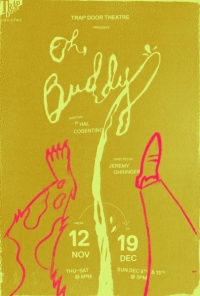
Trap Door Theatre Presents the World Premiere of OH, BUDDY, by Hal Cosentino. Opening November 12th, 2026
14 October 2026 in Upcoming TheatreTrap Door Theatre is thrilled to continue its 33rd season with a Chicago Premiere of Oh, Buddy, written by Hal…
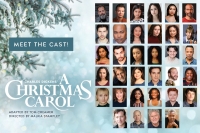
Announcing the Cast of the 49th A CHRISTMAS CAROL
14 October 2026 in Upcoming TheatreTis the season, in spite of today's unseasonable temps, as A Christmas Carol begins rehearsals for The Goodman's 49th annual…

NOVA ENTERTAINMENT CURRENT AND UPCOMING 2026 CIRCA PINTIG UPDATES
14 October 2026 in Now PlayingNova Entertainment is pleased to announce the upcoming performance schedule and updates for CIRCA Pintig, with a visual rebrand and…
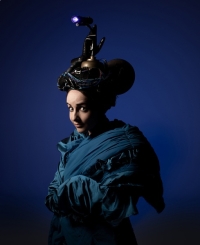
Steppenwolf Theatre Announces "ha ha ha ha ha ha ha" January 13 – February 7, 2027
14 October 2026 in Upcoming TheatreThe blurb is: hahahahahahahahahaha hahahahahahaha hihihi hahahahahahaha hoho hahahhahaha hehe hahahahahahahahahaha. Julia Masli's award-winning solo phenomenon ha ha ha ha…

'Sanctuary Stories' Ventures Into Emotional Drama Behind the News on Immigration
13 October 2026 in Theatre in ReviewSanctuary Stories plumbs the line between theater and journalism, and the powerful human dramas both can depict. Funded by a Northwestern…
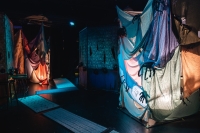
Inside Six Strange Worlds: Exquisite Corpse VI: LULLABIES
13 October 2026 in Theatre in ReviewFor its sixth Halloween season, Rough House Theater Co. has transformed Steppenwolf’s Merle Reskin Garage into a spectacular puppet haunted…
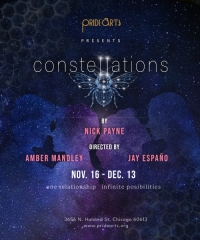
PrideArts announces cast and production teams for Nick Payne's CONSTELLATIONS, performed by alternating same-sex casts, November 13- December 13
12 October 2026 in Upcoming TheatreThursdays – Saturdays at 7:00 pm, Sundays at 3 pm Additional Saturday matinees at 3:00 pm on November 28 and December…
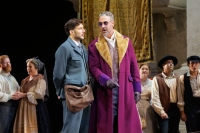
Robert Falls Directs a Sinfully Satisfying Don Giovanni at Lyric Opera of Chicago
11 October 2026 in Theatre in ReviewLet he without sin cast the first stone, Lyric’s “Don Giovanni” seemingly says when they bring up the house lights…

Teatro Vista Productions in collaboration with Audible presents Cafecito & Loops: A Mexodus Listening Tour Headed South Sundays, through November 1st
11 October 2026 in Now PlayingTeatro Vista Productions (TVP), the Midwest's only Latine-led Equity theatre company, in collaboration with Audible, presents Cafecito & Loops: A…
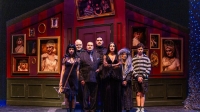
BrightSide’s Addams Family Musical Revives the Wonderfully Weird World of the Addams Clan
10 October 2026 in Theatre in ReviewThey're creepy and they're kooky, Mysterious and spooky, They're altogether ooky, The Addams Family. Yes, ooky. BrightSide Theatre’s production of…
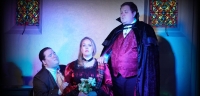
Chicago City Opera Delivers a Rare Operatic Haunting with Der Vampyr
08 October 2026 in Theatre in ReviewWith Halloween creeping closer, there’s something fitting about revisiting one of opera’s earliest flirtations with macabre horror - especially in…

Avalanche Theatre stages the world premiere of They Broke Up by Skyler Tarnas November 6–22, 2026
08 October 2026 in Upcoming TheatreAvalanche Theatre announces the world premiere production of They Broke Up by Chicago playwright Skyler Tarnas, November 6–22, 2026. Opening…

Oil Lamp Theater Announces the cast and creative team for the return of IT'S A WONDERFUL LIFE: A LIVE RADIO PLAY, Nov. 20 - Dec. 27
08 October 2026 in Upcoming TheatreOil Lamp Theater is proud to announce the cast and creative team for its next production and the final production…
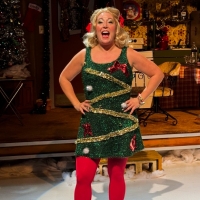
Adults-only holiday fun: Who's Holiday! brings R-rated Cindy-Lou Who back to Theater Wit for her sixth year, Nov. 27-Dec. 27
08 October 2026 in Upcoming TheatreChristmas Day is in our grasp. Why the vodka? Glad you asked! Who's Holiday! brings R-rated Cindy-Lou Who back to…
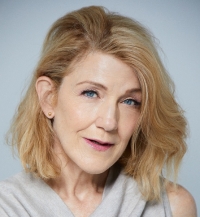
Two-Time Tony Award-Winning Actress Victoria Clark To Receive the Sarah Siddons Society Award at Annual Benefit on Monday, November 9, 2026
08 October 2026 in Theatre BuzzThe Sarah Siddons Society is pleased to present its 2026 Award to actress and director Victoria Clark, who recently starred…
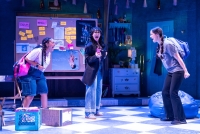
Goodman's Dead Girl’s Quinceañera: When Fifteen Meets the Adult World
07 October 2026 in Theatre in ReviewAt fifteen, the world can feel like a television show you haven't quite figured out how to turn off. For…

Steppenwolf Theatre's ADIRONDACK CHAIR CIRCLE In Rehearsal – Playing October 22 – December 6, 2026 – World Premiere!
07 October 2026 in Upcoming TheatreSteppenwolf Theatre Company, the nation's premier ensemble theater company, is pleased to launch its 51st Season with the world premiere of…
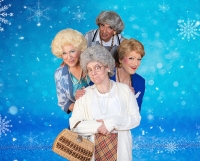
Hell in a Handbag Productions Announces 25th Anniversary Season!
07 October 2026 in Upcoming TheatreHell in a Handbag Productions is thrilled to announce its 25th Anniversary Season, featuring three "camptacular" shows guaranteed to delight lovers of…

Chicago’s Theater Wit introduces new Watchword closed captioning system, dramatically improving access in all three of its theaters
07 October 2026 in Theatre BuzzChicago’s Theater Wit is now offering new, state-of-the-art closed captioning service, marking a dramatic improvement in making live theater more…

Paramount Theatre’s reimagined A Christmas Carol promises to be a dazzling new, all-ages spectacle for Chicago’s holiday theater season, November 11-January 3
07 October 2026 in Upcoming Theatre“God bless us, everyone,” because there’s a fresh, new, reimagined version of Charles Dickens’ classic tale A Christmas Carol debuting…
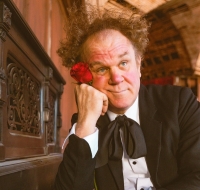
"John C. Reilly is Mister Romantic" Returns to Steppenwolf Theatre - December 10 – 13, 2026
06 October 2026 in Upcoming TheatreFollowing last year's critically acclaimed, sell-out engagement, Steppenwolf Theatre Company is pleased to announce the return of John C. Reilly…

Saint Sebastian Players Open 45th Season With A Murder Is Announced by Agatha Christie Classic Miss Marple Mystery Runs Oct. 23–Nov. 15
06 October 2026 in Upcoming TheatreThe Saint Sebastian Players open their 45th season of travels to different places with A Murder is Announced, a classic Miss Marple mystery…
Announcing "The Goodman, For Good" Campaign
06 October 2026 in Theatre BuzzToday, Goodman Theatre raises the curtain on its future as leadership and artists share a vision for its next century…



Latest Articles
-
 Identity Performing Arts' Fifth Anniversary Gala: Movement That Keeps Becoming
Written by Wesley DavidFive years is an important milestone for any arts organization, but for a contemporary dance company it also marks an artistic coming of age. Identity Performing Arts celebrated its fifth anniversary at the Edlis Neeson Theater at the Museum of…
Identity Performing Arts' Fifth Anniversary Gala: Movement That Keeps Becoming
Written by Wesley DavidFive years is an important milestone for any arts organization, but for a contemporary dance company it also marks an artistic coming of age. Identity Performing Arts celebrated its fifth anniversary at the Edlis Neeson Theater at the Museum of… -
 Overshadowed Theatrical Productions Brings Beloved Holiday Classic It’s a Wonderful Life to the Stage
Written by Buzz Center StageThis holiday season, Overshadowed Theatrical Productions is thrilled to present the timeless holiday classic, It’s a Wonderful Life, live on stage. As Frank Capra’s legendary film celebrates its 80th anniversary, this stage adaptation offers the perfect way for families and…
Overshadowed Theatrical Productions Brings Beloved Holiday Classic It’s a Wonderful Life to the Stage
Written by Buzz Center StageThis holiday season, Overshadowed Theatrical Productions is thrilled to present the timeless holiday classic, It’s a Wonderful Life, live on stage. As Frank Capra’s legendary film celebrates its 80th anniversary, this stage adaptation offers the perfect way for families and… -
 Dance Theatre of Harlem fills Auditorium Theatre with fire and funk
Written by Susan LiebermanProjecting a vibe that felt more homecoming party than ballet presentation, Dance Theatre of Harlem returned to Chicago on October 17th after a 10-year absence. The Auditorium Theatre audience took a while to assemble itself largely because people were having…
Dance Theatre of Harlem fills Auditorium Theatre with fire and funk
Written by Susan LiebermanProjecting a vibe that felt more homecoming party than ballet presentation, Dance Theatre of Harlem returned to Chicago on October 17th after a 10-year absence. The Auditorium Theatre audience took a while to assemble itself largely because people were having… -
 “A Strange Loop” Lets the Intrusive Thoughts Win at Raven Theatre in partnership with About Face Theatre
Written by John AccroccoA musical, but it’s just the voices in your head. Sounds just crazy enough to win the 2020 Pulitzer for Drama. “A Strange Loop” by Michael R. Jackson finally makes its Chicago premiere at Raven Theatre in a co-production with…
“A Strange Loop” Lets the Intrusive Thoughts Win at Raven Theatre in partnership with About Face Theatre
Written by John AccroccoA musical, but it’s just the voices in your head. Sounds just crazy enough to win the 2020 Pulitzer for Drama. “A Strange Loop” by Michael R. Jackson finally makes its Chicago premiere at Raven Theatre in a co-production with…


Does your theatre company want to connect with Buzz Center Stage or would you like to reach out and say "hello"? Message us through facebook or shoot us an email at This email address is being protected from spambots. You need JavaScript enabled to view it..
*This disclaimer informs readers that the views, thoughts, and opinions expressed in the text belong solely to the author, and not necessarily to Buzz Center Stage. Buzz Center Stage is a non-profit, volunteer-based platform that enables, and encourages, staff members to post their own honest thoughts on a particular production.