
Displaying items by tag: Emily Lotspeich
Gabriel Garcia Marquez's Dark Children’s Tale Translates to Stellar Show in ’The Man Who Fell with the Rain’

An exceptionally good show is now on stage at Chicago’s Trap Door Theatre. This wonder—The Man Who Fell with the Rain— has been translated through three languages on its way to the footlights in its U.S. premiere, right here on the tiny stage on Cortland Ave.
Originating in Spanish as a children’s tale by Columbian Nobel Laureate Gabriel Garcia Marquez, it was turned into a script by Andrei Kureichik, a Belorussian playwright, then translated to English by John Freedman. All that before being adapted and directed by Kay Martinovich for a perfect and very cogent rendering by the Trap Door players in its U.S. premiere.
The Man Who Fell with the Rain hews closely to Marquez’s original short work, “A Very Old Man With Enormous Wings: A Tale For Children,” while playwright Kureichik has unpacked the important details touched only lightly in the original. It becomes truly theatrical as we watch the story unfold that Marquez charted.
The script brings us an Old Man With Enormous Wings (Richard Cotovsky) who is discovered unconscious in the backyard of the Husband (Dan Cobbler) and the Wife (Laura Nelson). The couple also happen to have a two-week-old baby in their house, and a nosy know-it-all Neighbor Woman (Emily Lotspeich) is certain the winged creature is an aging angel who was intending on taking the baby. Her advice: beat him to death with a cudgel.
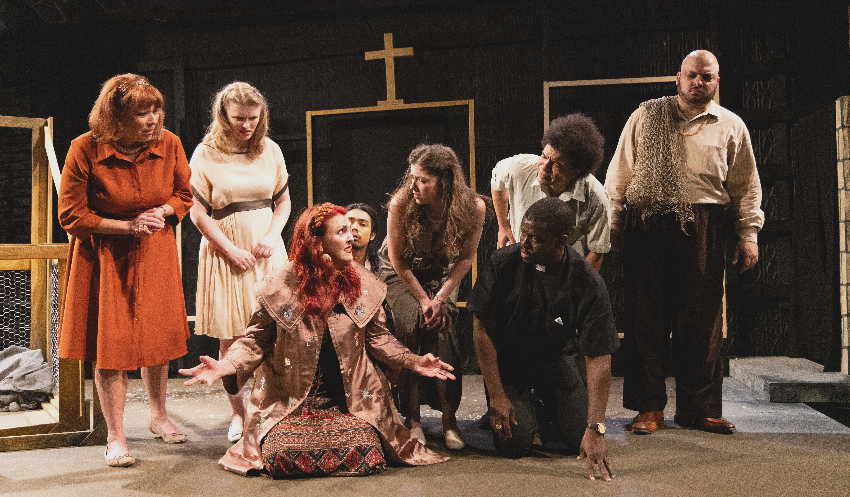
The cast of The Man Who Fell with the Rain at Trap Door Theatre through September 26, 20206
The couple take pity on the Old Man, and instead place him in their chicken coop, intending to keep his presence a secret. But word gets out and neighbors, and then spectators descend on their abode. The Old Man has regained consciousness and the couple try communicating—but he speaks only his own unknown tongue. Neighbors speculate on what to do with him, suggesting vriously to put him over the military and end wars; or make him a governmental magistrate; perhaps put him out to stud to generate a winged human master race.
The local Priest (Keith Surney) is called in, since the Old Man seems perhaps to be an angel, but there is nothing in the doctrinal books that explains the possibility of an aged, injured angel. So he writes his bishop, who writes his primate, who will then write the Pope for guidance. As this lengthy process continues, and the crowds grow, the couple decides to charge admission for a look at the Old Man.
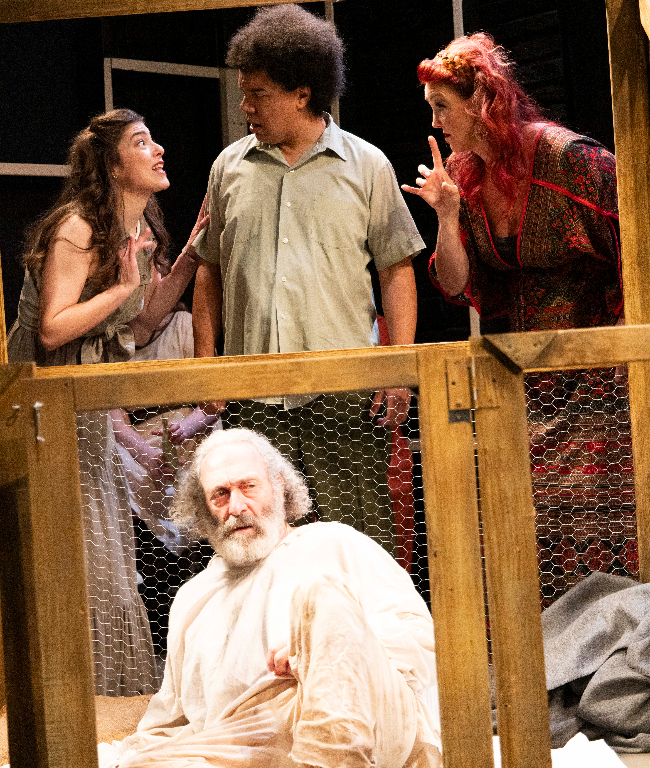
Laura Nelson, Dan Cobbler, Emily Lotspeich, and (foreground) Richard Cotovsky in The Man Who Fell with the Rain.
Marquez and the playwright Kureichik provide us a scenic display of society, and the human comedy that so readily arises in its waters. The convoluted religious hierarchical pronouncements delivered by the Priest extend the fun of this strange state of affairs. Other characters arrive, including a girl who has become a Spider Woman (Gracie Wallace), all natural to the magical realism that is Marquez’s stock in trade.
Yet this show is not played for broad comedy. The story line and gradual revelations unfold with restraint. And it is the performances that director Martinovich has drawn from these performers that make this show stratospherically good.
Most memorable for me are two performances: Richard Cotovsky’s Old Man, whose mostly silent acting is magnetic as he quietly gets his bearings and increasingly engages the neighbors and spectators. And Emily Lotspeich’s Neighbor Woman, who is so perfectly recognizable from life. She moves from one certainty to another and always speaks authoritatively, even as her previous pronouncements have proven false. She knows, for example, that this Old Man should be fed a dangerous chemical which she supplies for $50—”Angel food is not cheap!” she declares.
When the Old Man goes dormant and the couple thinks he has died, she advises on his burial: cut off his wings, fold them over him, place a ring of 49 candles around him, then burn him. Despite her certitude, they decide to use a hot branding iron on the Old Man, and he immediately rises and flaps his wings. For his part, the Priest brings only questions, not answers, from the church. They are adsked if the Old Man has a navel, for example, to determine if he is human rather than angelic.
Yes it is a rather dark children’s tale. The Brothers Grimm are also dark, in the original text. What a fairy tale can do is describe to children (and grown-ups) the inexplicable behavior of adults. And the resolution of the play is positive and very satisfying. The townspeople are left as the Old Man found them, and we expect nothing changes, no one learns anything—just like real life.
Highly recommended, advanced ticket sales had driven an extension of the run of The Man Who Fell with the Rain even before opening night, but make haste. The extended run ends September 26, 2026 at Trap Door Theatre at 1655 W. Corland in Chicago.
A Farcical Feverdream that Works: Trapdoor Theatre's 'The Cuttlefish'

Trapdoor Theatre’s “The Cuttlefish” ought to be confounding, but somehow this 1920’s surrealist play from Poland is clear as a bell. Though ostensibly about the philosophical struggle between art and politics, the audience easily recognized echoes of the present-day overall fix in which society finds itself.
Before any dialog, even before house lights go down, “The Cuttlefish, or the Hyrcanian Worldview” (its full title) opens somewhat bewilderingly on a stage with four characters: a masked, gold-clad Statue of Alice D’Or (Keith Surney), whose postures beside a short classic stone column suggest a Greek sculpture. Further backstage is a high ranking church cleric in mitre and liturgical robes, gesturing spiritually—Pope Julius II (Emily Lotspeich), patron of Raphael and Michelangelo. Stage left, a figure in a suit slouches and periodically collapses against a wall, the artist Pavel Rockhoffer (Nicole Wiesner). And a woman wanders, hands outspread—the Mother (Venice Averyheart) of Rockhoffer, who settles into a seat and manages percussion.
What is going on? The audience puzzles through these characters, trying to make sense of the silent tableau, and the lights go down and dialog begins. Rockhoffer has become pessimistic about his creative works, which we learn have been condemned by a government council. “My art is a lie, a carefully planned hoax,” says Rockhoffer.
“Even prisoners serving a life sentence still want to live,” the Statue offers. Along the way Julius remarks, “A man without a worthy adversary is like God without Satan,” and leaving, offers “I wish you a short and unexpected death.” With very little naturalism or conventional exposition, these snippets reveal the conflict that is to be resolved by the end of “The Cuttlefish.”
But it is with the arrival of King Hyrcan IV (David Lovejoy) when the story comes alive. A villainous despot, he smooth-talks Rockhoffer, coaxing him to abandon his dedication to absolute artistic ideals, and come on over to pragmatic freedom of Hyrcania, the land he rules.
Lovejoy is an energetic force on stage, and brings the play to life. “I am a superman, or ‘an uber mensch’” King Hyrcan declares, convincingly. He offers to unchain the artist from historic patronage of entities like Julius, and to have full freedom.
“What do you believe in?” queries Rockhoffer.
“In myself,” King Hyrcan shoots back, and as inexorably as the manosphere today sucks in its lost, wandering adherents, Rockhoffer, after a bit of resistance, falls under his spell. He obeys when Hyrcan tells him to jettison his fiance Ella (Gus Thomas), as unfitting for the new Hyrcanian order. King Hyrcan works his wiles on a weakened Julius, who admits to doubt and crumbles too.
As the action unfolds and the plot thickens, it becomes clearer that the times prophesied by “The Cuttlefish,” which unfolded in the rise of fascist Germany, offer parallels to today —when cultural centers are being expropriated and renamed, arts funding cancelled, and freedom of expression curtailed.
The magic of Trap Door is its penchant for mining an obscure work of 1920s playwright Stanislaw Witkiewicz (translated by Daniel Gerould) to find a work that is regarded as a precursor to later absurdist and expressionist stage works in the 1930s. Under the direction of Nicole Wiesner, what might have been an inscrutable drama instead is intuitively understandable. As we laugh with relief at the line, “One can only hope” (the Mother’s interjection about the end of such terrible times), we may be reminded of Kurt Vonnegut’s advice: “The arts are not a way to make a living. They are a very human way of making life more bearable.”
“The Cuttlefish, or the Hyrcanian Worldview” runs through April 25 at Chicago’s Trap Door Theatre and comes recommended.
This review is proudly shared with our friends at www.TheatreInChicago.com.
Emile Zola Adaptation 'Nana' Is a Triumph at Magical Trap Door Theater

For the final show of its 30th anniversary season, Trap Door Theatre—the little company that could—has selected a sure-fire hit with a production of “Nana,” a play based on the 19th century melodrama about an actress and bordello courtesan, Nana, by French author Emile Zola.
Adapted for the stage by the late Olwen Wymark, and co-directed by choreographer Miguel Long and managing director Nicole Weisner, this reimagining of the original 2002 production at the tiny theater—tucked away behind a restaurant at 1655 W. Cortland—was flawless on opening night. It’s a cabaret style musical, and the premise of the story gives us a Parisian cabaret that doubles as a bordello, allowing occasions for song and dance that fit the storyline perfectly.
As the audience arrives, the actors are already in character, welcoming us as patrons of the establishment. At curtain time, the anticipation builds among onstage patrons—mostly emotionally overwrought, palavering males—all hoping for a glance of recognition from Nana when she arrives.
After this artful build-up, which heightens the expectation of the audience as well, drapes are snapped opened for the big reveal: Nana (Maryam Abdi is miraculous) emerges on a swing as a vision of Venus—long blonde tresses, and a gossamer robe opened to barely cover her breasts, minimally hidden by glittery clamshell pasties. It’s all very nineteenth century, and the men fit exactly in our expectations of swooning romantic gestures salted with salacious innuendo.

Amber Washington in "Nana"at Trap Door Theatre through May 19.
We also meet the coterie of sophisticated ladies in orbit around Nana. There is Sabine (Amber Washington) just too too, all wrapped in a gorgeous gown and chapeau, waving a cigarette holder while delivering bon mots and pithy observations. And her dresser Zoe (Emily Lotspeich), who carefully manages the arrivals of suitors, parceling them out to every room until Nana’s apartment is filled. And Satin (Emily Nicholson), Nana’s BFF and occupying the same role, just at a lower echelon than our diva.
The song and dance numbers were quite good, and flawlessly performed.

Dan Cobbler, Emily Nichelson, and Emily Lotspeich in "Nana" at Trap Door Theatre through May 18, 2024.
Always in need of cash, Nana is pursued by a chorus of snarling creditors, who snarl in unison, to powerful effect on stage.Yet there is a substantial core to Zola's story: Nana, as she rises in stature as the object of desire for wealthy men, extorts them in their ardor, then walks all over them when their funds are depleted. She does this with greater rapidity, yet their generosity never falters. For example, Steiner (David Lovejoy is terrific) has given her a country retreat amid a high society and royal enclave, yethe never receives thanks or very much of Nana’s attention, who only escalates her demands for cash and orders this paramour to surrender his own key to the house he bought for Nana.
Indeed, Nana plays all her many suitors to the limit, relenting only enough when she senses she has pushed too far, an incredibly adept dominatrix.
Yet amid all this, Nana has a private life, and we learn where her earnings go. She retains her maiden aunt (Tia Pinson is the essence of propriety) to care for her infant. And she also has a significant other, Fanton (Caleb Lee Jenkins is the playful, yet mercenary scoundrel). We soon see that Fanton does to Nana what she does to her suitors, though far worse, as he is also physically abusive.
Nana, whose reputation has preceded her, is rejected by the "polite" society around her country home, though local suitors visit surreptitiously. And ultimately, Nana meets her fated downfall in full expression of melodramatic justice.
Costumes (Rachel Sypniewski) are spectacular, as are wids (Igor Shashkin) and make-up (Zsofia Otvos). Most amazing in this Trap Door Theatre production is the performance of Maryam Abdi as Nana. Abdi dominates her suitors, and the stage. She is fully in the role, inhabiting Nana’s character in a star-is-born delivery that would fit comfortably in an Off-Broadway, or even Broadway. So too for the entire cast. The Trap Door Theatre has outdone itself with “Nana,” a jewel in its 30th season celebration. “Nana” runs through May 19 at Trap Door Theatre, 1655 W. Cortland St. in Chicago.
*Extended through May 25th




Latest Articles
-
 Holiday Hilarity! Paramount presents The Second City’s Nut-Cracking Holiday Revue at downtown Aurora’s Copley Theatre, Nov. 20-Dec. 23
Written by Buzz Center StageNeed something better than old reruns of Hallmark Movies this holiday season? Want to see some real nut-crackers? Then dash on through the snow to catch The Second City’s Nut-Cracking Holiday Revue, November 20-December 23 at Paramount’s Copley Theatre, 8…
Holiday Hilarity! Paramount presents The Second City’s Nut-Cracking Holiday Revue at downtown Aurora’s Copley Theatre, Nov. 20-Dec. 23
Written by Buzz Center StageNeed something better than old reruns of Hallmark Movies this holiday season? Want to see some real nut-crackers? Then dash on through the snow to catch The Second City’s Nut-Cracking Holiday Revue, November 20-December 23 at Paramount’s Copley Theatre, 8… -
Mary, A Holiday Dansical Returns for one performance only at Logan Center December 13th
Written by Buzz Center StageBlack Girls Dance®, which centers Black and Brown girls in joyful community, presents its sixth annual production of Mary, A Holiday Dansical, choreographed, written, and directed by Founder Erin Barnett. This fundraiser returns for one night only Sunday, December 13…
-
 The Gift Theatre's Hayward: A Floridian-Style Shiva
Written by Wesley DavidThere are funerals where grief brings a family together, and then there are funerals where grief opens the door to everything a family has spent years trying to keep buried. In Hayward, playwright Netta Walker turns a father’s funeral into…
The Gift Theatre's Hayward: A Floridian-Style Shiva
Written by Wesley DavidThere are funerals where grief brings a family together, and then there are funerals where grief opens the door to everything a family has spent years trying to keep buried. In Hayward, playwright Netta Walker turns a father’s funeral into… -
JK Entertainment presents WHEN WE WERE YOUNG AND UNAFRAID at Greenhouse Theater Center November 12 – 29, 2026
Written by Buzz Center StageJK Entertainment has released first look rehearsal photos for WHEN WE WERE YOUNG AND UNAFRAID, the first production of the company's second season. JK Entertainment's production brings this story to Chicago audiences November 12–29, inviting audiences to consider how far…


Does your theatre company want to connect with Buzz Center Stage or would you like to reach out and say "hello"? Message us through facebook or shoot us an email at This email address is being protected from spambots. You need JavaScript enabled to view it..
*This disclaimer informs readers that the views, thoughts, and opinions expressed in the text belong solely to the author, and not necessarily to Buzz Center Stage. Buzz Center Stage is a non-profit, volunteer-based platform that enables, and encourages, staff members to post their own honest thoughts on a particular production.