
Displaying items by tag: Buddy Holly
Buddy Holly’s Brilliance, Reawakened on the Drury Lane Stage
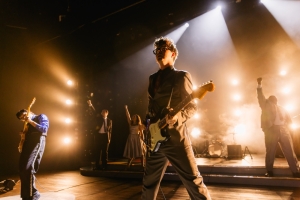
Drury Lane Theatre opens its latest musical with a warm jolt of rock ’n’ roll energy as Buddy – The Buddy Holly Story, by Alan James, returns to the stage, decades after its 1989 debut at the Plymouth Theatre Royal in England. What began as a modest jukebox biography has grown into a global crowd pleaser, and Drury Lane’s production celebrates everything that made Buddy Holly a seismic force - the sound, the swagger, and the fearless creativity of a young artist reshaping American music before the world even realized it was happening.
Buddy – The Buddy Holly Story had already shown how actor‑musician theatre could thrive, pairing a biographical narrative with dramatic scenes and a concert‑style climax that traced Holly’s artistic evolution before building to a full musical finale. Nearly two decades later, when Million Dollar Quartet premiered, the influence was unmistakable. Million Dollar Quartet distilled that approach, replacing the cradle-to-grave arc with a single-night reenactment inside Sun Studio. Instead of character development, it relied on direct address, minimal plot, and the raw electricity of live performance. The shared DNA is clear - legendary early rock played by the actors themselves - but Million Dollar Quartet takes a different approach. It’s a performance framed as a single moment in history, whereas Buddy – The Buddy Holly Story is a story‑driven musical that builds toward a showcase, ultimately shaping the theatrical vocabulary that Million Dollar Quartet would later draw from.
That lineage sets the stage for what Drury Lane achieves here. This staging traces Holly’s meteoric rise from Lubbock teenager to chart-topping innovator, capturing the joy, drive, and restless imagination that defined his short but revolutionary career. Drury Lane emphasizes so well the live-show pulse, packing the evening with hits, tight musicianship, and the infectious spirit of 1950s rock ’n’ roll. The production revisits the era beautifully and recreates the thrill of watching a new sound take flight in real time. With its high-energy ensemble and a lead performance that channels Holly’s mix of sweetness and swagger, Buddy delivers both nostalgia and immediacy, reminding audiences why his influence still reverberates through rock, pop, and musical theatre. It is a dynamic tribute to a musician who changed everything - and whose story still lands with irresistible rhythm. And as the story reaches its final stretch, the production kicks fully into showcase mode, delivering a roof-raising finish that feels less like musical theatre and more like being dropped into a live 1950s rock ’n’ roll set.
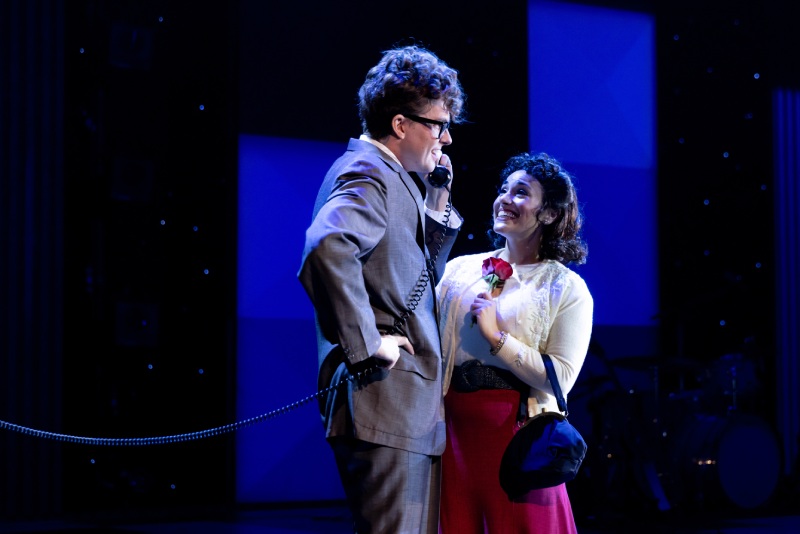
Joey Chelius as Buddy Holly and Samantha Sayah as Maria Elena Santiago Holly. All photos by Kyle Flubacker.
It is no surprise that the Drury Lane cast is top notch as always. Under the sharp direction of Matthew D. Carney and the vibrant choreography of Kenny Ingram, the ensemble delivers the kind of crisp musicianship and infectious charge this show demands. Joey Chelius makes a terrific Buddy Holly - charismatic, boyish, and fully in command of the rock ’n’ roll pioneer’s sound and spirit. He brings an easy, unaffected charm to the role, pairing Holly’s trademark vocal clarity with a grounded emotional throughline that keeps the performance from ever feeling like mere impersonation. Chelius captures the spark of a young artist discovering his own power. His playful, high-energy guitar work adds an extra lift of authenticity - the kind of spirited musicianship that makes the stage feel like a live 1950s jam session. When he locks in with the band, the stage lights up with the kind of voltage that makes you forget you are watching an actor at all. He is backed by an outstanding trio of Crickets: Alek Boggio as drummer Jerry Allison, Grant Alexander Brown as bassist Joe B. Mauldin, and Elliot Coe Esquivel as guitarist Niki Sullivan, who doubles as Richie Valens and plays the hell out of “La Bamba.” Together, they create a tight, exhilarating band that feels more like a live performance when they jam than a traditional musical number, filling the room with the kind of raw, unfiltered early rock drive that Buddy Holly himself once ignited.
As someone already familiar with Holly’s catalog, I walked away an even bigger fan - the show makes his artistry feel immediate, alive, and impossible not to resist. I was also struck by a detail I hadn’t known before seeing this production. Early in his career, Holly faced strong pressure from his record label to adopt a more conventional country‑western sound and image. The show makes clear that he flatly refused to be branded that way, holding fast to the rockabilly edge and melodic style that defined his emerging voice. Rather than reshape his music to fit a marketable country mold, he committed to the sound he believed in - a choice that ultimately set him apart and helped spark a new era in American rock ’n’ roll.
Samantha Sayah offers a gentle, grounding presence as Maria Elena Santiago Holly, anchoring the emotional stakes of Buddy’s personal life with warmth and quiet strength. She provides a steady, heartfelt counterbalance to the show’s high‑voltage musical energy, reminding us of the love and partnership that shaped Holly beyond the spotlight. She also adds a charming layer to the live music, stepping in with the band on keyboard while doubling in another role with easy versatility. Marta Bady is terrific across multiple roles, matched by Eric Andrew Lewis, who shines in a variety of roles and puts his vocal talent on full display. Together they deliver one of the night’s standout moments when they tear into “Shout” and absolutely bring the house down. Bady plays several roles throughout the show, including Marlena Madison, the smoldering and vibrant co‑host/performer at the Apollo Theater, and she’s compelling in every one of them. She brings a confident, magnetic stage presence that elevates each number she touches. Productions like this often skew male‑driven simply because of the era they depict, which places a particular weight on the women in the cast. Here, the two female performers supply all the necessary feminine energy, charisma, and sensuality that help charge the production with the same spark Buddy Holly inspired in his fans - a blend of modern edge and romantic warmth that defined his music.
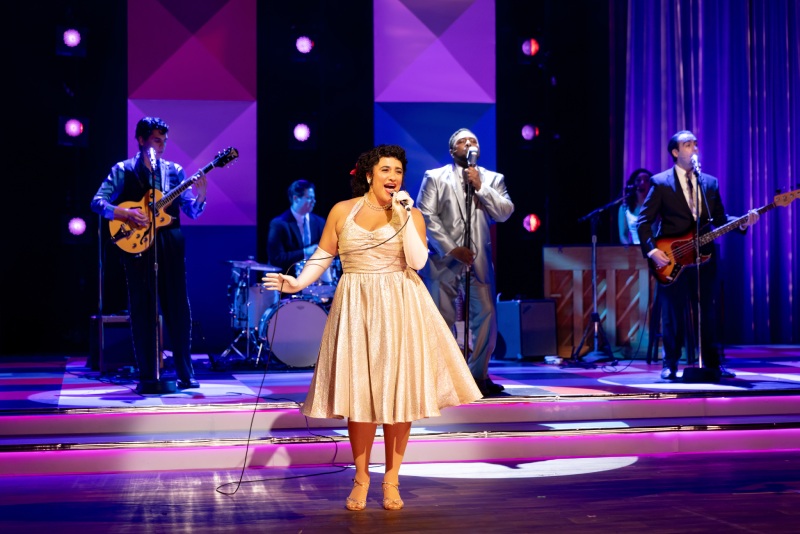
Marta Bady and cast.
Russell Mernaugh is another standout, slipping into several characters with ease, but it is his turn as The Big Bopper during Buddy’s final showcase that truly stops the show - an unforgettable moment that is off the charts good.
Beyond the performances, one of the unexpected pleasures of this production is watching Buddy Holly’s rock ’n’ roll evolution unfold as the show progresses. Drury Lane emphasizes the early chapters of his career, showing him as a shy, slightly unpolished teenager pushed toward the country genre his record label expected him to embrace. Holly’s early career also reflects a familiar music-industry pitfall: he accepted a restrictive record deal that undervalued his talent - a pattern that has continued to affect young artists from his era all the way to the present day. Those early scenes capture the tension between who he was told to be and who he was becoming - an artist quietly steering himself away from Nashville conventions and toward the raw, rhythmic spark of the new sound that felt truer, bolder, and entirely his own. As the productions unfolds, that tentative spark grows into full-fledged confidence. The shift is fascinating to watch: a young musician testing boundaries until he suddenly realizes he is creating something revolutionary.
The show’s greatest thrill comes from the music - a steady stream of Buddy Holly hits that still come alive with the invention and joy he poured into them in the late 1950s. Musical Director Chuck Mead’s fine choices amplify that spirit, shaping arrangements that feel larger than life at times without ever losing the raw simplicity that defined Holly’s sound. Drury Lane’s production treats these songs not as museum pieces but as living, breathing bursts of the raw spark of early rock, and Joey Chelius really delivers, driving each number with clarity, charm, and an effortless command of Holly’s style. Classics like “Peggy Sue,” “That’ll Be the Day,” “Everyday,” and “Oh Boy” land with fresh vitality, while the amped-up concert sequences bring the crowd to its feet. The band’s tight harmonies, crisp instrumentation, and sheer exuberance remind audiences just how groundbreaking Holly’s music was - and why these songs continue to resonate across generations.
Buddy Holly’s world comes alive so vividly thanks to the outstanding work of the design team - Lauren Nichols’ scenic design, Rachel Boylan’s period-perfect costumes, Lee Fiskness’ dynamic lighting, and Leland Plumridge’s crisp, full-bodied sound. The sets move fluidly from the intimacy of a recording studio to a series of performance stages, including a striking recreation of the famous Apollo in Harlem, NY. This core team does a fantastic job creating an atmosphere that feels authentic, immersive, and at times downright electric, giving the production its vibrant sense of place and time.
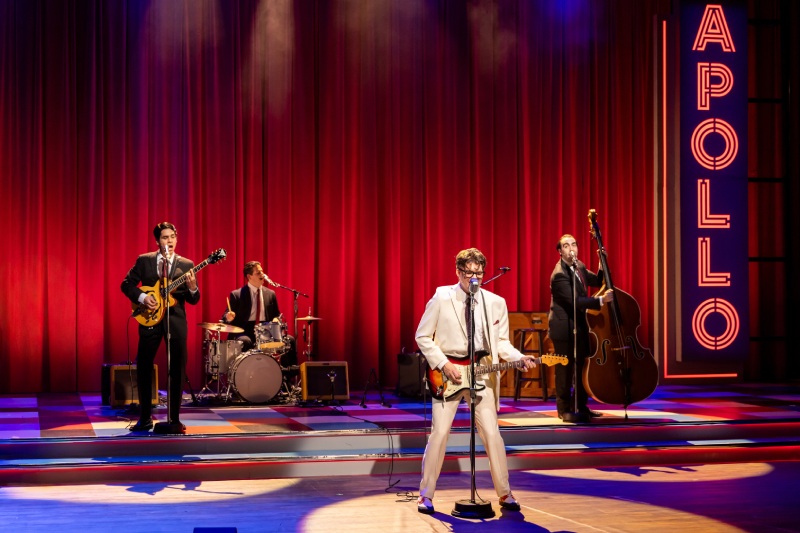
(left to right) Elliot Coe Esquivel, Alek Boggio, Joey Chelius, Grant Alexander Brown as Buddy Holly and the Crickets in Buddy – The Buddy Holly Story.
It is impossible to watch Buddy – The Buddy Holly Story without feeling the weight of how young he was when his life ended - just 22, still in the earliest stretch of a career that was already reshaping American music. The production doesn’t dwell on the tragedy, but knowing what comes after gives the final moments an undeniable ache. And because the show focuses, rightly, on celebration rather than sorrow, it’s worth briefly stepping beyond the edges of the stage to revisit the real history behind that night - not to overshadow the production, but to deepen the audience’s appreciation of what it’s honoring. Holly chartered the plane because the tour bus had broken down repeatedly, had no heat, and had already hospitalized his original drummer with frostbite - forcing a local substitute to step in. He simply wanted to get to Fargo early to rest, do laundry, and escape the miserable travel conditions.
The seats on the flight were traded for entirely practical reasons among Holly’s actual Winter Dance Party band and tour mates. J.P. Richardson (“The Big Bopper”), sick with the flu, asked current Crickets bass player Waylon Jennings for his seat, and Jennings agreed. Ritchie Valens and touring guitarist Tommy Allsup flipped a coin for the remaining spot, and Valens won. None of these decisions were driven by fear of the flight itself. The pilot, Roger Peterson, was young but licensed, and witnesses reported a normal takeoff. In reality, Holly was flying in dangerous winter weather - not a dramatic “storm warning” scenario, but conditions poor enough to make the trip risky, and they played a major role in the crash.
It’s also worth remembering that the show is, at heart, a feel-good celebration - not only of Holly, but of the three extraordinary artists who lost their lives that night. Still, for the sake of historical clarity, their deaths were the result of circumstances that never should have existed. The tour bus failures, the brutal cold, and the frostbite suffered by a band member were all consequences of a music industry unwilling to provide even basic support for the musicians it relied on. The concert they were traveling toward was not a high-stakes engagement; under safer, more humane conditions, the artists should have been given the option to delay the trip. Instead, a combination of grueling tour logistics and record-label cost-cutting placed them in harm’s way, costing the music world three bright stars.
Holly died in that crash on February 3, 1959, alongside fellow rock and roll trailblazers Ritchie Valens (just 17 years old), and J.P. “The Big Bopper” Richardson, as well as Peterson. The accident - later immortalized as “the day the music died” - cut short three rising careers in a single instant. Holly had recorded only a few years’ worth of material, yet his influence still reverberates through rock, pop, and country. And watching his world come alive so vividly onstage, you can’t help but wonder what other genius music he might have created had he been given even a little more time.
Buddy - The Buddy Holly Story is an easy show to wholeheartedly suggest - a colorful, high-energy celebration of a musical pioneer whose influence still echoes across generations. It is a fantastic homage to an incredible artist. Drury Lane Theatre’s production captures both the thrill of Holly’s sound and the poignancy of his too-short life, delivering an experience that feels as heartfelt as it is electrifying. This musical runs August 19 through October 18 at Drury Lane Theatre in Oakbrook, with a run time of 2 hours including a 20-minute intermission and comes highly recommended.
For tickets and/or more information, click here.
"Oh Boy!" Marriott's 'Buddy: The Buddy Holly Story' amazes in every way

As a Buddy Holly obsessive—glasses tattooed around an arm, email handle for years, a novel and even a podcast someplace or the other—I was beyond thrilled when I learned the fine folks at the Marriott Theatre would be reviving Buddy: The Buddy Holly Story, a show I’ve seen quite a few times over the years. About five years ago, I was privileged to review American Blues Theater’s Jeff Award-winning Buddy: The Buddy Holly Story, still one of the best shows I’ve ever seen. And as I perused the playbill for the Marriott’s current revival, names from that 2018 show jumped off the page and assured me that this production would be in capable hands.
The capable hands of this Buddy Holly are attached to Kieran McCabe, who in 2018 played The Crickets’ drummer, Jerry Allison. Here’s the thing about Buddy Holly—he was young. His very short career—cut short by a fateful winter plane ride from Iowa bound for Fargo—ended when he was just 22 years old. So, while many Buddies have the look, have the guitar chops, have the West Texas drawl, and even have the hiccupping vocals, most of them are grownups wearing Buddy Holly glasses.
Not McCabe. He brings a fresh-faced, boyish energy to the role. He’s no adult cosplaying as a kid. He’s a young rock ‘n’ roller with a pair of dark-rimmed specs on his face, a Fender Stratocaster strapped to his chest, and a whole life of possibilities ahead of him, not a care in the world. As McCabe’s Buddy leads us through Holly’s catalog of songs—did I mention the brevity of the career during which these songs were created?! — with rockers like “Peggy Sue,” “Oh Boy,” and “Not Fade Away” getting us moving, and tender ballads like “True Love Waits” breaking our hearts since we how this story ends, he transports us not just to Buddy’s life in Texas and New Mexico and New York, but more importantly to a simpler, younger time of backbeats and rockabilly. Song after song after song, Kieran McCabe’s Buddy Holly rocks.
Reprising her part from the 2018 production as Buddy’s young wife Maria Elena, Molly Hernandez joins McCabe in bringing confident familiarity to the show. Besides her role as Buddy’s muse, Hernandez also adds to the cast’s musical prowess—providing close harmonies in western girl group numbers, backing vocals throughout, and some really good trumpet playing during the show’s final concert.
Also returning to a role he’d played before is Shaun Whitley as Crickets bassist Joe B. Mauldin. Whitley leads the cast—not just the Crickets, filled out here by Jed Feder as drummer Allison and Michael Kurowski as the “4th Cricket” (the show’s stand-in for Buddy’s real-life rhythm guitarists Niki Sullivan and Tommy Allsup), but everyone else, too—through a setlist of rock ‘n’ roll classics, from Buddy’s songs to others the audience knew and loved.

Kieran McCabe as Buddy Holly. Photo by Liz Lauren.
The rest of the cast is rounded out by musical ringers, too. Ellie Kahn as Vi Petty sprinkles angelic charm onto Buddy’s ballad, “Everyday,” as she tinkles the celesta, and plays keyboards and piano throughout, as does Cory Goodrich. Alex Goodrich’s Norman Petty and various other old-timey music industry fellows are as vital to the story as his musical contributions are to the show. Marcus Terell and Christopher Wren fill out the cast and the band, while Jordan Arredondo’s Ritchie Valens gets the crowd on their feet with a rousing “La Bamba.”
Valens, of course, died in the same crash that took Buddy’s life, as did J.P. Richardson, known to the world as The Big Bopper. David Stobbe, most recently seen stealing scenes—and his son Huck’s nest egg—in Mercury Theater’s Big River, fills out the Bopper’s flashy period suit and plays the role to the hilt. Another local favorite, Melanie Brezill—who has amazed in every show I’ve seen her in, from Chicago Children’s Theatre to a play about Nina Simone—dazzles, especially during the Apollo Theater scene in which she duets with Terell on “Shout.”
But, again, it’s the music that’s the point of this show, from Buddy Holly’s songs to Valens’ and Richardson’s and all of the other oldies the audience enjoys. And it’s this cast, directed by Amber Mak, who put the songs center stage. Because while Holly and Valens and Richardson and so many other rock ‘n’ rollers might have died far too soon, their music will always be alive, so long as there are youthful and talented singers and musicians to keep them that way. Sing and dance along, from now through August 13, to Buddy: The Buddy Holly Story at The Marriott Theatre in Lincolnshire, to this music that will never die.
Words of Love: The Buddy Holly Story at American Blues Theater

I came into the American Blues Theater for its Chicago revival of Buddy: The Buddy Holly Story a bit apprehensive. See, I’m a Buddy Holly superfan. Seriously. I’ve got a couple tattoos inspired by the rock legend, I once even wrote an entire novel about him (which nobody can or will read…not just yet), and I know his story and his music about as geekily and obsessively as a guy could. So, having a special spot in my heart for this legend who’d been gone for decades by the time I came along, I’m often very critical of cultural (mis)representations of Charles Hardin Holley, including a traveling tour of the same show I saw back in college.
Partly my apprehension is because of the many things that the show (and the 1970s Hollywood biopic that jumpstarted the career of Gary Busey) gets factually wrong. Thing is, most biographical jukebox musicals do the same for their subjects, as they need to manufacture drama and condense a life’s story (even a life cut as short as Buddy’s). But mostly it’s because every portrayal I’ve seen of Buddy falls into the same trap that other impersonations do. They all rely on caricature, on the obvious, instead of something that’s more fulsome and true.
But I promise you, rock ‘n’ roll fans, that the American Blues Theater’s current production of Buddy skirts these traps, instead providing an honest and beautiful portrayal of Holly’s lifework, while also showing the audience a rollicking good time.
The key to the show, of course, is Buddy. Playing the part of the young Texan is Canadian Zachary Stevenson. A veteran of this show (and others, including Million Dollar Quartet, from the same era), Stevenson knows the material and the man. It shows from the get-go, as Buddy’s early vocal and guitar performances are hesitant, if youthfully energetic. That youthful energy is kept up for the whole show (a must, since Holly was just 22 when he died), but Stevenson also gives us a Buddy who comes into his own as a singer, a songwriter, a guitarist, and a man. And while the twang and hiccups he includes in Buddy’s performances are there, as they must be, he doesn’t rely on these tics and tricks. Instead, Stevenson’s Buddy has a warm, beautiful voice, and serenades us (and his castmates) with tender ballads, as well as toe-tapping rockers. This Buddy isn’t just an impersonation with a drawl and a pair of black-rimmed glasses hastily slapped on. Zachary Stevenson’s Buddy is a labor of love.
But the rest of the cast, directed by Lili-Anne Brown, labor lovingly, as well. The theater’s intimate, and the performers all play their instruments and sing their songs up close and in view of the audience. Shaun Whitley (himself a veteran of Million Dollar Quartet, with almost 2,000 performances as Carl Perkins under his belt) holds down the Crickets’ low end, slapping the upright bass (and even riding it at one point!), while also providing vocal harmonies and even playing violin on a couple softer numbers. The Crickets’ drummer is played by Kieran McCabe, who provides the groove and youthful energy. A fourth Cricket is played by Michael Mahler, who is also the production’s music director, directing the rest of a ridiculously multi-talented cast.
And that cast really does everything, from playing the important roles in Buddy’s life to playing the soundtrack of his life. Liz Chidester lights up the stage whenever she’s on it, first as Vi Petty, the wife of Buddy’s producer, tickling the keys of a celeste on Buddy’s beautiful “Everyday,” before adding boogie-woogie piano on several songs, and energetic dancing to several more. Derek Hasenstab plays the part of Vi’s husband Norman, but also picks up the bass and the guitar for many other songs. Molly Hernandez is alluring as she plays Maria Elena, the woman who enjoyed a whirlwind romance with Buddy and a tragically short marriage to him, as well. And Vasily Deris and Cisco Lopez are right on as the two stars – The Big Bopper and Ritchie Valens – who accompanied Buddy on his final tour and on that final flight that ended in an Iowa cornfield in 1959.
Those famous names you probably know are not the only talent to grace the American Blues stage, however. It seems that all of the cast are multi-instrumentalists and very talented vocalists. Ian Paul Custer spreads the news as Buddy’s early champion, DJ Hi Pockets Duncan, while also playing the saxophone and piano. Chuckie Benson and Kiersten Hodgens get the crowd jumping and shouting at the famous Apollo Theater before an early and iconic Crickets concert there. And Ann Delaney, Daniel Riley, and Lauren Vogel round out this exceptional ensemble, playing multiple roles, singing acapella doo-wop, and helping tell Buddy’s story and play his songs.
And it’s those songs – from early Western numbers like “Blue Days, Black Nights” and “Rock Around Ollie Vee” to Buddy’s hits “That’ll Be the Day” and “Peggy Sue” and “Oh Boy” to later more mature fare (mind you, all of this output and growth was done in less than two years, a fact the show hammers home) such as “Words of Love” and “Raining in My Heart” and “True Love Ways” – that best tell the Buddy Holly Story. A story of talent and tragedy. A story of youthful rebellion and musical growth. And, as the last of those tunes shows when Stevenson plays it solo on an acoustic guitar for his pregnant wife on their living room couch before he leaves for his fateful final trip, it’s a story told warmly and lovingly and truthfully.
Buddy: The Buddy Holly Story is being performed at Stage 773 through May 26th. For more performance information, visit americanbluestheater.com.
*Now extended through September 15th



Latest Articles
-
 Music Theater Works Pours a Beachy Cocktail with Escape to Margaritaville
Written by Kimberly KatzA gentle, tide‑easy current settles in right from the start, immediately signaling the kind of story this musical wants to tell. Rather than relying on big, splashy moments, it settles into a warm, beach-side rhythm, inviting the audience into a…
Music Theater Works Pours a Beachy Cocktail with Escape to Margaritaville
Written by Kimberly KatzA gentle, tide‑easy current settles in right from the start, immediately signaling the kind of story this musical wants to tell. Rather than relying on big, splashy moments, it settles into a warm, beach-side rhythm, inviting the audience into a… -
 Chicago Shakespeare Makes Winter’s Tale a Story Worth Telling
Written by Angelo CamposChicago Shakespeare Theater’s production of The Winter’s Tale delivers a compelling evening of theater, showcasing an exceptional company of actors working at the top of their craft. Under the direction of Artistic Director Edward Hall, this staging marks an exciting…
Chicago Shakespeare Makes Winter’s Tale a Story Worth Telling
Written by Angelo CamposChicago Shakespeare Theater’s production of The Winter’s Tale delivers a compelling evening of theater, showcasing an exceptional company of actors working at the top of their craft. Under the direction of Artistic Director Edward Hall, this staging marks an exciting… -
 A Joe & Melanie Thing Theatre Company announces The Hanukkah Humbug at Greenhouse Theater Center - December 3-6
Written by Buzz Center StageThe world premiere of The Hanukkah Humbug brings ghosts, history, tradition, and a whole lot of family fun to the Greenhouse Theater Center just in time for the holidays, Melanie Ann Apel promises a lively, family-friendly experience with this new…
A Joe & Melanie Thing Theatre Company announces The Hanukkah Humbug at Greenhouse Theater Center - December 3-6
Written by Buzz Center StageThe world premiere of The Hanukkah Humbug brings ghosts, history, tradition, and a whole lot of family fun to the Greenhouse Theater Center just in time for the holidays, Melanie Ann Apel promises a lively, family-friendly experience with this new… -
 Remy Bumppo’s Mud Row: A Family Haunted by the Past
Written by Wesley DavidRemy Bumppo opens its 30th anniversary season with Mud Row, a play by Tony Award nominee and MacArthur “Genius” Grant recipient Dominique Morisseau. Expertly directed by Malkia Stampley, this production is a sublime examination of family, inheritance, and the difficult…
Remy Bumppo’s Mud Row: A Family Haunted by the Past
Written by Wesley DavidRemy Bumppo opens its 30th anniversary season with Mud Row, a play by Tony Award nominee and MacArthur “Genius” Grant recipient Dominique Morisseau. Expertly directed by Malkia Stampley, this production is a sublime examination of family, inheritance, and the difficult…
Does your theatre company want to connect with Buzz Center Stage or would you like to reach out and say "hello"? Message us through facebook or shoot us an email at This email address is being protected from spambots. You need JavaScript enabled to view it..
*This disclaimer informs readers that the views, thoughts, and opinions expressed in the text belong solely to the author, and not necessarily to Buzz Center Stage. Buzz Center Stage is a non-profit, volunteer-based platform that enables, and encourages, staff members to post their own honest thoughts on a particular production.