
Displaying items by tag: Chicago opera
Chicago City Opera Delivers a Rare Operatic Haunting with Der Vampyr
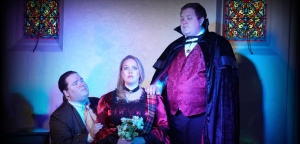
With Halloween creeping closer, there’s something fitting about revisiting one of opera’s earliest flirtations with macabre horror - especially in a production presented and performed by Chicago City Opera (COT). Der Vampyr may not enjoy the mainstream familiarity of later supernatural works, but its mix of moonlit superstition, doomed romance, and aristocratic menace makes it an ideal October offering. As audiences lean into the season’s appetite for the eerie, Marschner’s opera emerges as a surprisingly modern ancestor to everything from Victorian melodrama to contemporary horror musicals.
Though often treated as a standalone curiosity, Der Vampyr has a lineage that begins well outside the opera house. The story originates with John Polidori’s 1819 prose tale The Vampyre, one of the first works to codify the seductive, aristocratic vampire archetype. Polidori’s narrative was adapted into a German stage play by Heinrich Ludwig Ritter, whose dramatization became the direct source for Wilhelm August Wohlbrück’s libretto. Heinrich Marschner’s 1828 opera builds on Ritter’s theatrical version, shaping the material into a darkly romantic, musically driven narrative that blends early Romantic lyricism with gothic theatrics. In short: Polidori’s story inspired Ritter’s play, and Ritter’s play became the foundation for Marschner’s opera.
Set in early 19th century Scotland, the opera follows Lord Ruthven, a charismatic nobleman cursed with vampirism and bound to claim new victims before dawn or face eternal damnation. After surviving a near fatal attack, the young hero Edgar becomes unknowingly entangled in Ruthven’s hunt. Ruthven first targets the innocent Janthe, luring her to a ruined castle under the guise of seduction, and later sets his sights on Malwina, Edgar’s beloved, whose wedding night becomes his final opportunity to fulfill his deadly pact. As Edgar pieces together the truth, the opera accelerates toward a frantic race against sunrise: Ruthven’s identity is exposed, his supernatural bargain collapses, and the community rallies to save Malwina as the vampire is ultimately destroyed. What remains is a blend of gothic suspense, romantic rescue, and early Romantic moral drama - a seasonally perfect slice of operatic horror as Halloween approaches.
Jeremiah Strickler commands the evening as Lord Ruthven, delivering a performance that blends aristocratic charm with a chilling, predatory stillness. His presence anchors the production - vocally assured, theatrically magnetic, and always in control of the opera’s gothic pulse. Opposite him, Jordan Loyd brings a clear, earnest intensity to Edgar Aubry, shaping the role with a bright tenor and a palpable sense of moral urgency. Loyd had some of the most spectacular and heartfelt vocal moments of the evening, particularly toward the end of Act II as he reflects on his past love. Jessie Lyons’ Malwina adds welcome tenderness, her lyrical phrasing and grounded sincerity adding to the opera’s romantic core. Ariel Emma’s Janthe provides one of the night’s most striking early moments, her brief arc handled with vivid color and fearless commitment, and some of the notes she held were genuinely astounding - the kind that stop the room for a beat. Keaton Payne’s Humphrey von Davenaut provides a sturdy, authoritative counterweight, shaped by both his assured delivery and his expressive, sharply drawn presence. Meanwhile, Molly Clementz (also the production’s graphic designer) brings Emmy Perth to life with bright energy and an impressive finesse that lifts every moment she’s given, adding flashes of warmth, wit, and a polished musicality - especially in the way she shapes and sustains her notes with such control and clarity.
Bat Collazo’s George Dibdin and Kevin Wheatle’s John Berkley round out the ensemble with crisp, well-shaped character work that keeps the world of the opera humming with specificity.
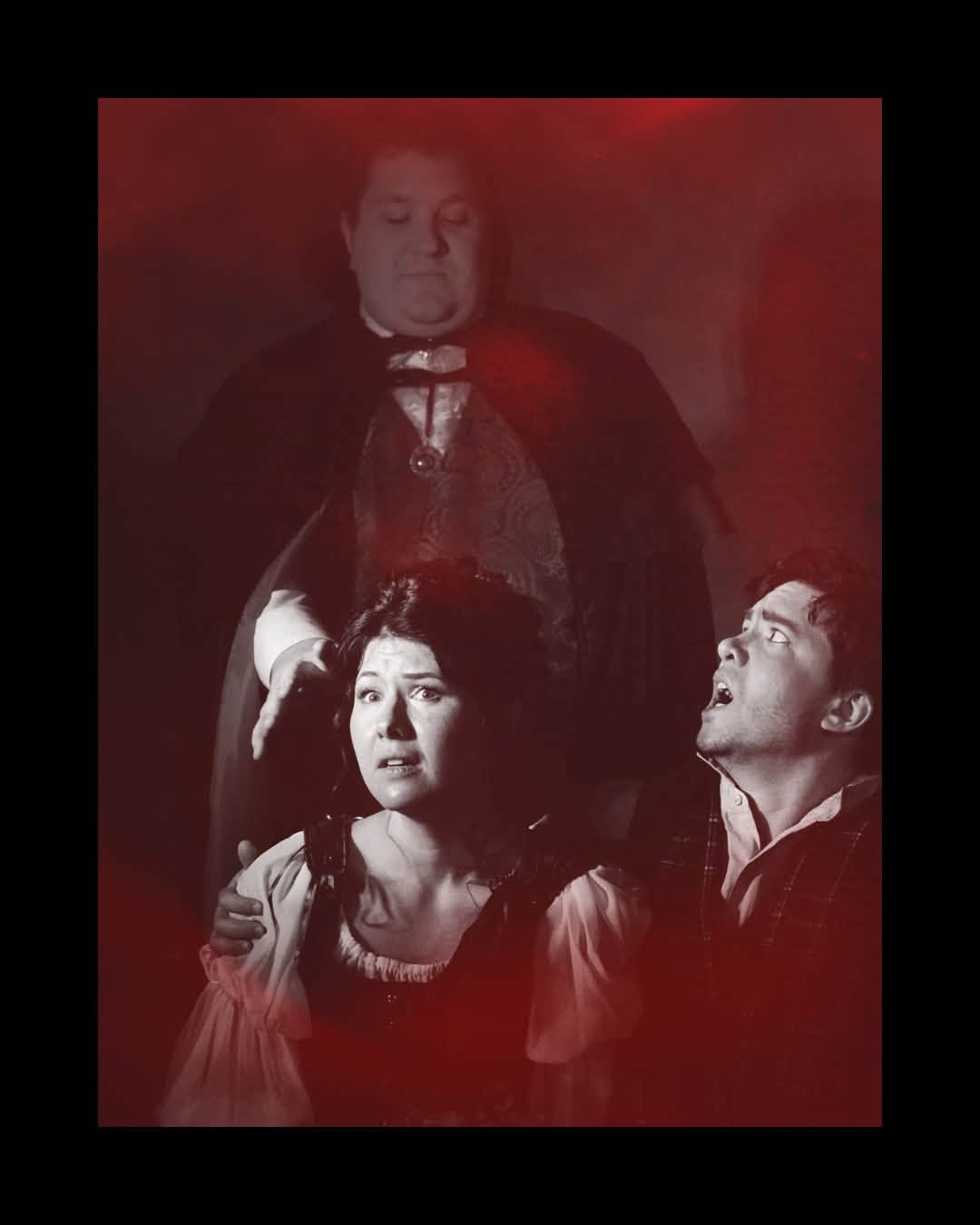
Jerimiah Strickler (rear) Molly Clemenntz (left) and Bat Collazo in Chicago City Opera's Der Vampyr.
One of the unexpected pleasures of the evening was simply hearing each singer on their own - every voice carrying its own color, character, and emotional weight. But when paired, those timbres intertwined with a striking naturalness, and in the moments when all eight sang off one another at once, the result was nothing short of exquisite. The ensemble sound had a richness and immediacy that felt almost architectural, each voice reinforcing the next until the room seemed to vibrate with a unified, resonant force. It was a reminder of how thrilling Marschner’s writing can be when performed by artists who listen as intently as they sing.
Behind the scenes, Alexis Enyart conducts with sharp dramatic instinct, shaping Marschner’s score with clarity and momentum. SarahAnn Sutter’s direction deepens the production’s impact, treating Der Vampyr not merely as gothic spectacle but as a living, breathing psychological drama. She embraces the opera’s supernatural flair with confidence - the shadows, the proximity, the sudden shifts in tone - yet she never lets the human stakes slip away. Sutter has a keen sense for spatial storytelling, using the venue’s architecture to heighten tension and intimacy; she sends performers through the aisles and along the home’s sweeping historic staircase, activating much of the house as part of the dramatic landscape. Her staging choices reveal a director who understands how early Romantic horror works best: not through excess, but through precision, ambience, and emotional clarity. Supported by Jordan Crice’s deft piano work and Adam Nicholson’s distinctive set design, the result is a production where every element feels intentionally placed and dramatically charged. Thanks to this talented cast and creative team, Chicago City Opera builds a world where early Romantic horror feels both stylish and surprisingly immediate.
Although Der Vampyr travels through a handful Chicago area venues during its run, the performance I attended on opening night unfolded inside the storied Colvin House - a location that feels almost predestined for this opera. Colvin House, beautifully placed across the street from Lake Michigan on the corner of Thorndale Avenue and Sheridan Road, proves to be an inspired setting for Der Vampyr, its historic architecture and intimate, richly textured rooms amplifying the opera’s gothic mood in ways a traditional proscenium simply can’t match. The building’s carved woodwork, shadow friendly corners, period furnishings, and old-world elegance create a natural sense of suspense and closeness, allowing the audience to feel almost inside the drama rather than observing it from a distance. The scale of the space heightens the tension - Ruthven’s entrances feel more dangerous, Janthe’s fate more immediate, Malwina’s peril more personal. Colvin House becomes a living extension of the opera’s supernatural world and a perfect match for Marschner’s early Romantic horror.
Despite all its strengths, the evening wasn’t without a minor but noticeable drawback. Although brief stretches of dialogue were exchanged in English, the opera itself is sung in its original German, making the surtitles essential for most. Unfortunately, the monitor displaying those subtitles sat off to the front side and too low to be easily seen by much of the audience; only those in the unobstructed front section had a consistently clear view. Sitting in the third row opposite the monitor side, I was able to catch most of the surtitles when first‑row head movement allowed, but many around me – and further back - were blocked entirely. I’m no set designer, but raising the monitor and centering it - even if it encroached slightly into the stage picture - would make the surtitles far more accessible, a small trade off that would greatly improve audience experience. In the meantime, I strongly recommend that attendees read the Act I and Act II synopsis in the program before the performance begins; with that context in hand, most will have a solid grasp of the unfolding drama even if the surtitles prove difficult to see.
Regardless of that small hiccup, the opera itself remained a beautiful, wonderfully performed experience - rich in mood, artistry, and musical power.
Der Vampyr is recommended as a rare and atmospheric experience - the kind of intimate, site specific opera that feels tailor made for October. For audiences looking to embrace the season with something truly unique, this production offers a gothic thrill you won’t find anywhere else. Upcoming performances include Wednesday, October 7 at Colvin House (7pm), Friday, October 9 at Fulton Street Art Center (7pm), and Sunday, October 11 at Skokie Theatre (3pm).
Opera Festival of Chicago Delivers an Assured, Full‑Hearted La Bohème
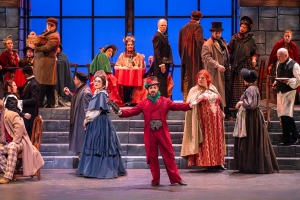
Opera Festival of Chicago continues its season with two mainstage productions - La Bohème and Adriana Lecouvreur - each featuring the Opera Festival of Chicago Orchestra and Chorus and performed at the George Van Dusen Theatre at the North Shore Center for the Performing Arts in Skokie.
I had the chance to see Giacomo Puccini’s La Bohème, directed by Festival General Director Sasha Gerritson and conducted by Sir Emanuele Adrizzi, and it proved to be an outstanding, deeply felt evening of music and drama.
Giacomo Puccini’s La Bohème unfolds in the chilly garrets and bustling cafés of 1830s Paris, where a group of young artists survive on charm, wit, and the fragile hope that beauty might be enough to sustain them. The opera begins in a drafty attic shared by the poet Rodolfo and the painter Marcello, whose playful banter masks the hunger and hardship of their bohemian life. Everything shifts when Mimì, a shy, dreamy seamstress with a failing candle and failing health, knocks on their door. Her tender connection with Rodolfo ignites instantly, carrying them into the vibrant chaos of Café Momus, where Marcello’s fiery former lover Musetta steals the spotlight with her flirtations and razor‑sharp instincts.
But as winter settles in, the opera’s warmth gives way to harsher truths. Only the rich are safe and well fed in this cold bleak landscape of artistic poverty. Mimì’s illness worsens, and Rodolfo’s fear of losing her fractures their love, even as they cling to moments of sweetness. Both Mimì and Rodolfo are swept up in the sudden, poetic rush of feeling that sparks between them during their first meeting over her extinguished candle, a moment Puccini shapes with irresistible warmth. Their ensuing duet, “O soave fanciulla,” is written as a rush of idealized, almost dreamlike love - sung here with such radiance that it feels too perfect to endure, and tragically it doesn’t, as the briefness of their time together becomes one of the opera’s most heartbreaking truths.
By the final act, the bohemians reunite in their attic, trying to conjure laughter out of scarcity, until Musetta arrives with the gravely weakened Mimì. What follows is one of opera’s most devastating endings: a quiet, intimate vigil as Rodolfo realizes too late that the love he tried to protect has slipped beyond saving. Puccini shapes this world with music that aches, soars, and ultimately reminds us how fiercely we hold on to joy, even as life insists on its fragility. Puccini also paints a world in which artists of every stripe are routinely exploited by the comfortable classes - the dull rich, who commission work and then pay only sporadically, as if deprivation were somehow a necessary ingredient of genius. In reality, it is the indifference of these wealthy patrons that forces the bohemians into constant hardship, driving them to beg, borrow, and even steal simply to keep food on the table and have their housing bills covered.
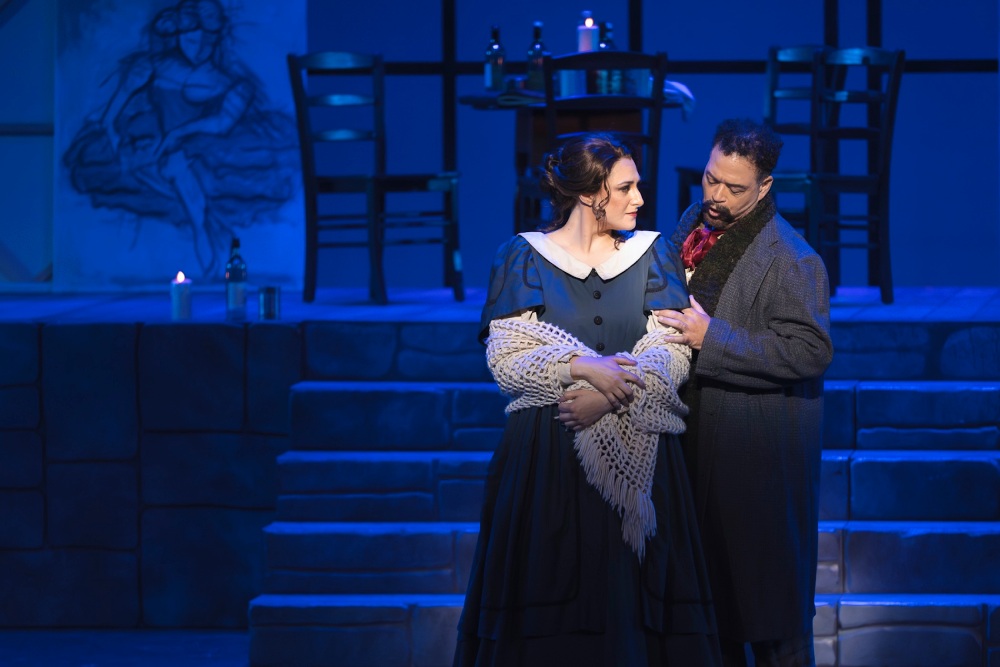
(L to R) Alexandra Razskazoff, “Mimi” and Nathan Granner, “Rodolfo” in LA BOHÈME. Photos by A.Deran Photography.
This La Bohème features a cast whose vocal and dramatic instincts sharpen Puccini’s world into something immediate and deeply felt. Alexandra Razskazoff’s Mimì is nothing short of luminous - her soprano glowing with warmth yet edged with delicacy, embodying a young woman whose softness hides a life lived perilously close to the margins. A rising artist with an increasingly international footprint, Razskazoff traces Mimì’s arc with such emotional transparency that her final moments land with quiet, devastating force. Opposite her, tenor Nathan Granner brings a beautifully burnished tone and an instinctive musicality to Rodolfo. Long admired for his expressive phrasing and crossover versatility, Granner sings with a poet’s sensitivity; his Rodolfo is impulsive, romantic, and heartbreakingly human, especially as love and fear begin to pull him apart.
Catherine Antonia Samartin lights up the stage as Musetta, her bright, agile soprano and irresistible charisma making every entrance feel like a spark catching fire. Musetta is also the victim of this us versus them world where her beauty and charms are commodified on the older wealthy man she is forced to keep company with in order to receive her beautiful wardrobe and warm home to live in. Her scenes with Kenneth Stavert’s Marcello are especially electric. Stavert, with his rich, grounded baritone and wonderfully lived‑in ease, brings both humor and heart to the painter whose bravado barely conceals his vulnerability. Anthony Reed’s Colline provides a beautifully resonant counterweight to the lovers’ volatility - his “Vecchia zimarra” delivered with a quiet, dignified ache that speaks volumes about loyalty and sacrifice. Jonathan Wilson brings quicksilver energy and crisp comedic timing to Schaunard, shaping the role with warmth and buoyancy, while veteran bass William Powers steals scenes with effortless charm as both Benoit and Alcindoro, reminding audiences why he remains one of American opera’s most reliable character treasures. David Greene adds a welcome burst of color as Parpignol, enriching the Act II bustle with a touch of whimsy. This ensemble shapes a Bohème that feels vividly inhabited and emotionally true, a testament to what Puccini’s world becomes when every performer contributes with such specificity, generosity, and heart.
One of the production’s most striking assets is its massive, 50‑plus‑member chorus, whose sheer presence reshapes the entire world of La Bohème. Their sound adds a thrilling sweep to Puccini’s score, amplifying the emotional stakes and giving the bustling Parisian scenes a vivid, lived‑in texture. In Act II especially, the sheer size and vocal richness of the ensemble create a sense of overwhelming festivity, making the Christmas Eve Café Momus tableau feel like a city bursting with life. But the chorus also deepens the opera’s more intimate moments, surrounding the central lovers with a sonic landscape that underscores both the joy and the fragility of their world. It’s a rare gift to hear a chorus of this scale in a production of Bohème, and here it elevates the performance into something grander, more immersive, and undeniably unforgettable.
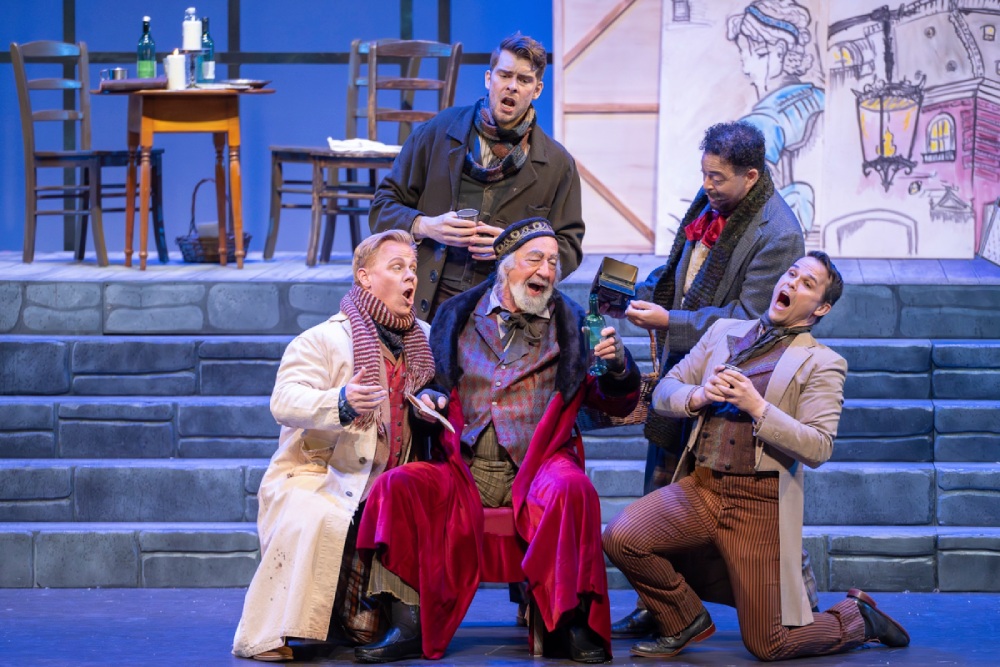
(L to R) Kenneth Stavert, “Marcello;” Anthony Reed, “Colline;” William Powers, “Benoit;” Nathan Granner, “Rodolfo” and Jonathan Wilson, “Schaunard” in LA BOHÈME from Opera Festival of Chicago. Photos by A.Deran Photography.
The set itself is perfectly workable and the large video boards truly animate the space, supplying shifting imagery of snowfall and other atmospheric touches throughout the evening. Because the opera is sung in Italian, overhead supertitles - crisply projected and easy to follow - add a modern presentational layer that supports the storytelling without ever competing with Puccini’s world.
This La Bohème resonates with honesty, heart, and thrilling musicality, carried by a cast and chorus performing at the height of their powers. It’s a standout achievement for Opera Festival of Chicago - and a compelling reason to experience not only this production but also their Adriana Lecouvreur, by Francesco Cilea, directed by Shifra Werch and also conducted by Sir Emanuele Andrizzi, which promises its own dramatic and musical rewards.
Recommended.
Performances are held at the North Shore Center for the Performing Arts in Skokie.
La Bohème - Friday, June 26 at 7:30 p.m., Wednesday, July 1 at 7:30 p.m., and Sunday, July 5 at 2 p.m.
Adriana Lecouvreur - Sunday, June 28 at 2 p.m. and Friday, July 3 at 7:30 p.m.
Tickets range from $25 to $150 and are available at www.OperaFestivalChicago.org.
Reimagined Madama Butterfly at the Lyric a Masterpiece in its Own Right

Created in 1904, Giacomo Puccini’s Madama Butterfly has become one of the world’s greatest and most popular operas. New York’s Metropolitan Opera alone had performed it 902 times prior to the beginning of its 2023-24 season. Renowned for his gifts for melody, Puccini’s musical component is ravishingly beautiful. His manner of intermixing cultural references into his orchestration also makes it exquisitely complex. Enhanced with a gripping story about the power of trust and the fragility of love, Madama Butterfly qualifies as an irrefutable masterpiece. Throughout its existence though, the opera has also been an artistic triumph with issues.
An adaptation of a one-act play written in 1900, which itself was based on a short story by an American author, John Luther Long two years earlier, it’s been criticized as being a flawed fantasy. One created by white men about the essence of another culture. In this case, Japan. In Madama Butterfly, an American, Lt. B. F. Pinkerton, arrives in the island country and soon begins a quest for love. A love that he never plans to be lasting. Once he returns state side, he’ll re-enter the mainstream and marry traditionally.
Since its origin, issues of perception and portrayal have always haunted Puccini’s Madama Butterfly. He composed it in partnership with Giuseppe Giacosa and Luigi Illica who wrote the text or libretto. For most of the opera’s existence, the way Japanese culture and its people were projected robbed them of dimension and ultimately diminished their humanity. In both early productions of the opera and in virtually all that followed, Japanese men saw their virility erased while Japanese women watched their deference be reduced to an exaggerated docility. As intrinsically lovely Madama Butterfly is as a creative jewel, for the Japanese people and many others of color, it has also been deeply problematic.
For Matthew Ozawa, Director and Chief Artistic Officer of the Lyric Opera of Chicago, it was as well. As a Japanese-American director of operatic works, his relationship with Puccini’s masterpiece has been fraught. He knew intrinsically as a director he could never present it in a conventional way. If he were ever to take on the challenge of staging the piece, he would do it through more enlightened eyes. The current production of Madama Butterfly he directs at the Lyric, running through April 12th, shows how spectacular a 122-year-old classic can look and feel with a total makeover by a gifted artisan.
Ozawa’s Madama Butterfly, co-produced by the Cincinnati Opera, Pittsburg Opera, Detroit Opera and the Utah Opera, dismantles the old format and completely rebuilds it in a contemporary context. The overhaul was so comprehensive, keeping the original orchestration and libretto unaltered and intact was a condition for greenlighting his vision.

The Company of Madama Butterfly.
Like many men of his generation, Ozawa loved playing video games growing up. It wasn’t a leap for him to envision Madama Butterfly taking on the features of a machine generated video game offering a portal to an alternate reality. Pinkerton (tenor Evan LeRoy Johnson) would travel to Japan through his headset and begin a journey that would lead to the devastating consequences we all know will follow.
But first, like any talented leader, Ozawa needed to assemble a team to bring his concept to fruition. Based on opening night’s performance at the Lyric, a better dream team probably doesn’t exist. Recruiting all females as his key collaborators, who were either Japanese or Japanese-American, cultural accuracy and agency would no longer be a concern. Each of them a heavy hitter in her respective craft, the composite experience they created was so remarkable it could easily be considered revelatory. The superb impact of Kimie Nishikawa’s set designs and Yuki Nakase Link’s lighting talents made on the production’s visual potency and dynamism can’t be overstated.
A muted background would suddenly blaze in dramatic color and fill with subtly ornate splendor when Pinkerton donned the goggles that would transport him to Japan. There, Maiko Matsushima’s costume designs bowled you away with their texture, imagination, sophistication and beauty.
Even when we first finally meet Cio-Cio-San, Butterfly, played by Karah Son, we’re visited with the unexpected. She’s as small and delicate as butterflies are, but in her words and carriage you sense the steel in her spine. At 15, she may have become a geisha to support herself, but she’s clearly proud of the fact that she’s also “well-bred”. That inner dignity is an ever-present element of her character.
Son has played this crucial character in houses around the globe; in her native Korea, Warsaw, Berlin, Bologna, Los Angeles and San Francisco just to list a few. This production marks her Lyric debut. She knows this part. From the excellence of her soprano Saturday night, and the flawlessness of her acting abilities, she is this part.
Johnson, a wonderful tenor who’s also making his debut at the Lyric, makes a compelling Pinkerton. He doesn’t quite comprehend the import of his words when Sharpless (Zachary Nelson) tells him to “Be Careful, she trusts you”, until it’s too late. Finally realizing what that trust has cost releases his humanity. But it can’t stop the payment deception exacts.
In the final scene, where only pathos is expected, this presentation all but blinds you with the complex beauty of real life through the fiction of a story. Ozawa’s brilliant directing, Son’s gifts as a marvelous actress/vocalist and Puccini’s stunning score converge to cause the soul to quake.
Puccini’s Madama Butterfly now truly soars.
Madama Butterfly
Through April 12, 2026
Lyric Opera of Chicago
20 N. Wacker Drive
Chicago, IL 60606
For more information and tickets: https://www.lyricopera.org
Highly Recommended
This review is proudly shared with our friends at www.TheatreInChicago.com.



Latest Articles
-
 Goodman's Dead Girl’s Quinceañera: When Fifteen Meets the Adult World
Written by Wesley DavidAt fifteen, the world can feel like a television show you haven't quite figured out how to turn off. For Salma (Jacqueline Guillen), it may be even more difficult. She watches too much television—especially detective shows—and has begun to see…
Goodman's Dead Girl’s Quinceañera: When Fifteen Meets the Adult World
Written by Wesley DavidAt fifteen, the world can feel like a television show you haven't quite figured out how to turn off. For Salma (Jacqueline Guillen), it may be even more difficult. She watches too much television—especially detective shows—and has begun to see… -
 Chicago City Opera Delivers a Rare Operatic Haunting with Der Vampyr
Written by Ken PayneWith Halloween creeping closer, there’s something fitting about revisiting one of opera’s earliest flirtations with macabre horror - especially in a production presented and performed by Chicago City Opera (COT). Der Vampyr may not enjoy the mainstream familiarity of later…
Chicago City Opera Delivers a Rare Operatic Haunting with Der Vampyr
Written by Ken PayneWith Halloween creeping closer, there’s something fitting about revisiting one of opera’s earliest flirtations with macabre horror - especially in a production presented and performed by Chicago City Opera (COT). Der Vampyr may not enjoy the mainstream familiarity of later… -
 Collaboraction to premiere Mud Life, drawn from Willie Round’s experience as a writer and rapper on Chicago’s west side, October 21-November 15
Written by Buzz Center StageMud Life, a world premiere drama by Chicago writing duo G. Riley Mills and Willie Round, drawn from Round’s life experiences as an emerging writer, rapper and producer, opens Collaboraction Theatre’s 2026-27 season, October 21 - November 15.Round and Mills…
Collaboraction to premiere Mud Life, drawn from Willie Round’s experience as a writer and rapper on Chicago’s west side, October 21-November 15
Written by Buzz Center StageMud Life, a world premiere drama by Chicago writing duo G. Riley Mills and Willie Round, drawn from Round’s life experiences as an emerging writer, rapper and producer, opens Collaboraction Theatre’s 2026-27 season, October 21 - November 15.Round and Mills… -
Steppenwolf Theatre's ADIRONDACK CHAIR CIRCLE In Rehearsal – Playing October 22 – December 6, 2026 – World Premiere!
Written by Buzz Center StageSteppenwolf Theatre Company, the nation's premier ensemble theater company, is pleased to launch its 51st Season with the world premiere of Chicago playwright Stephanie Alison Walker's biting satire Adirondack Chair Circle, directed by Tony Award winner Pam MacKinnon (Downstate, Edward Albee's Who's Afraid of Virginia…
Does your theatre company want to connect with Buzz Center Stage or would you like to reach out and say "hello"? Message us through facebook or shoot us an email at This email address is being protected from spambots. You need JavaScript enabled to view it..
*This disclaimer informs readers that the views, thoughts, and opinions expressed in the text belong solely to the author, and not necessarily to Buzz Center Stage. Buzz Center Stage is a non-profit, volunteer-based platform that enables, and encourages, staff members to post their own honest thoughts on a particular production.