
Displaying items by tag: Sadieh Rifai
Steppenwolf's Adirondack Chair Circle: The Joke Lands. Then What?
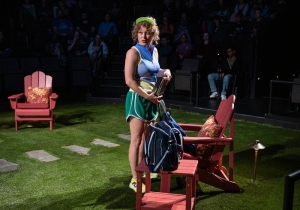
I went into Adirondack Chair Circle wondering what a new play about book bans could add to a conversation whose arguments most of its audience could probably already recite. A world premiere at Steppenwolf seemed worth giving the benefit of the doubt; perhaps it would serve as an accessible way into a larger examination of attacks on education, parenthood and the politics of protecting children. By the end, I was still wondering what, beyond an opportunity to laugh at Republicans, this new play felt that it had accomplished.
Written by Stephanie Alison Walker and directed by Pam MacKinnon, Adirondack Chair Circle gathers a group of affluent suburban mothers in Banna’s backyard, where their social circle doubles as a planning committee for getting books removed from school libraries. Leading up to the important school board vote, Banna (Katrina Lenk), Libby (Sadieh Rifai) and Winona (Wendy Mateo) have their comfortable routine disrupted by neighborhood liberal Evelyn Grace (Caroline Neff).
There is plenty to laugh at, and the cast delivers those laughs with precision. But the script spends so much time rehearsing familiar right-wing arguments – abundant references to acronyms like CRT and SEL, and willy-nilly use of buzzwords like “gender” and “grooming” – that it leaves little room for original examination of what lies beneath them. Statements likely to strike a Steppenwolf audience as outrageous are presented as though their outrageousness alone makes them satire. I wanted the play to do something more with them; exposing hypocrisy can be satisfying, but satire falls flat without anything new to say about its targets.
The most frustrating missed opportunity is Banna’s relationship with her child, Charlie, who has recently begun using they/them pronouns. This comes up repeatedly, but the play gives Banna little space to move beyond a longing look or an exasperated admission that she does not understand. Here is a conflict with the potential to complicate everything she claims to believe: the distance between an abstract political position and the actual person she loves. I wanted to watch her negotiate that distance, whether she managed to cross it or dug herself further in. Either could have revealed more than another familiar exchange about what children should be allowed to read.
Lenk inhabits Banna’s tight-faced suburban-housewife composure so completely that even her expressions feel practiced. There is a particular kind of control in the performance, a sense of someone carefully maintaining her public facade, à la Kardashian-Jenner. The writing rarely gives her enough room to explore what happens when it slips, although Lenk certainly seems capable of delivering more complexity. All four women feel pulled directly from an affluent suburb, and their interactions are among the production’s greatest strengths. The warmth comes with a biting undertone; belonging to this circle clearly requires knowing which disagreements can be spoken aloud.
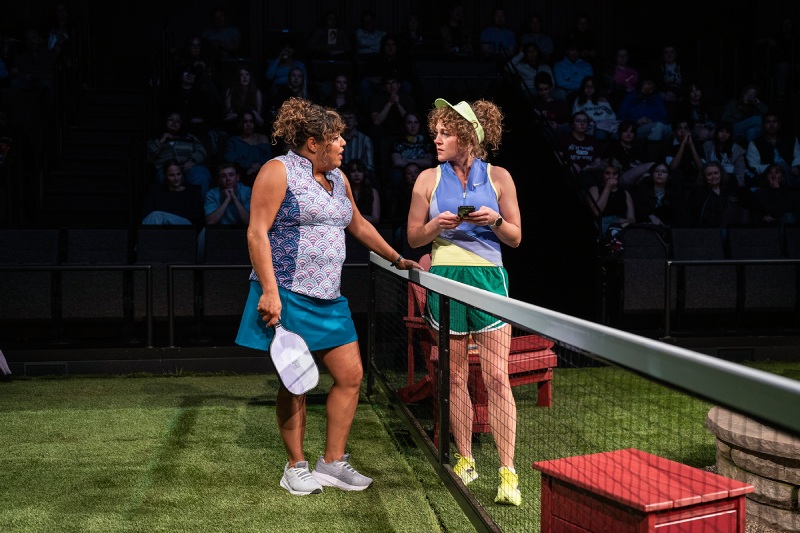
(left to right) Wendy Mateo and ensemble member Caroline Neffin Steppenwolf Theatre Company’s world premiere of Adirondack Chair Circle. Photo by Michael Brosilow.
Outside of the inner circle, Neff is especially good as Evelyn Grace, capturing the bubbly awkwardness of someone who wears her politics openly and sincerely wants to have conversations that the people around her would prefer to avoid. Her performance is so appealing that it further exposes the imbalance in Winona’s dilemma. Mateo has the difficult task of making her character seem torn between two sides when the script gives the conservative position so little persuasive weight. The audience is given little reason to share Winona’s uncertainty, leaving Mateo straining to supply tension the writing has not fully earned.
Possibly the most compelling performance, however, belongs to the crow. David Darrow plays the bird that frequents Banna’s backyard, serving as narrator, occasional instigator, and a rotating cast of additional characters. His physical acting is remarkable, shifting between avian movement and instantly differentiated human figures, sometimes with barely a moment between them. The device often works beautifully, giving the story a playful perspective beyond the women’s immediate circle.
At the climactic school board vote, though, that flexibility becomes a limitation. With Darrow jumping rapidly from person to person, MacKinnon’s staging prioritizes the comic momentum of the transformations over the reactions of the women whose campaign has brought us here. The scene feels muddied and rushed, and the small interactions that might have made the vote consequential get lost. There was room to let the moment breathe without sacrificing its comedy.
Todd Rosenthal’s scenic design is clean and thoughtfully organized, with smart places for props and an effective use of the backyard’s different spaces. Yet the Ensemble Theater’s arena configuration, with the audience looking down into the action, does little to alleviate the growing feeling that we are watching conservatives in a zoo – gawking as much as observing. The production gives us a comfortable vantage point from which to observe and laugh but does little to make us question that position. Some of the staging also invests more time in various jokes than it earns, particularly the recurring bird-dropping effects. The variety of ways to make bird poop appear does not justify the time spent moving between them.
Spoiler warning: The following paragraph discusses the ending.
The conclusion crystallizes my frustration. After more than two hours spent building Banna’s campaign and its personal consequences, the play leaves her alone and unhappy. Winona arrives to explain that Banna’s unhappiness comes not from regretting her actions, but from having “never actually cared” about the cause she was pursuing. I found this infuriating. Whether Banna’s conviction was sincere matters less than what the play gives up by resolving her behavior this way. There is something much more difficult, and potentially revealing, in examining a person who believes she is doing good while causing harm. People can love their children, think they are protecting them, and still be profoundly misguided. Reducing Banna’s investment to insincerity lets the play sidestep that contradiction just when it might finally have confronted something in a novel way.
I do not expect a comedy to change the mind of every person who sees it, nor does a play even necessarily need to persuade political opponents to justify its existence. But Adirondack Chair Circle offers little to challenge the people already on its side, either. The relationships contain opportunities to examine how people arrive at these beliefs, what sustains them, and what might make them reconsider. Too often, however, those opportunities, the very things I look for in theatre, are discarded in favor of another chance to laugh at those we disagree with.
And, for what it’s worth, did I laugh? Yes. Did I recognize members of my extended family in what I was laughing at, and find some catharsis in that? Also, yes. But I left without feeling that I understood those people any better or had gained much beyond the satisfaction of knowing we disagreed and perhaps a little more vindication. Adirondack Chair Circle finds easy laughs with an audience already on its side, and its cast makes those laughs stick. But humor can coexist with something more, and I wanted a world premiere at Steppenwolf to offer more than just the satisfaction of being in on the joke.
Adirondack Chair Circle is running in Steppenwolf Theatre Company’s Ensemble Theater and has been extended through December 13, 2026. Tickets are available at Steppenwolf Theatre Company.
A Red Orchid’s The Targeted Builds a Case for Compassion

If you’ve ever worked in an urban coffee shop, chances are you’ve encountered at least one ultra-paranoid kook who believes the government is spying on them. Often they’re filling out long journals or manifestos. Or perhaps that one crazy uncle we all seem to have who believes in way too many conspiracy theories. These loveable, but disturbed weirdos commonly refer to themselves as “targeted individuals.”
Hanna Kime’s new play The Targeted makes its world premiere at A Red Orchid Theatre. In it, she empathetically explores the lives of these folks and what draws them to their beliefs. Though it is at times humorous, Kime’s play is not exploitative. Rather, she builds an entire ecosystem for not only those affected by this kind of thinking, but the ways in which others profit from it.
Grace Dolezal-Ng directs a bonafide dream cast of some of Chicago’s best actresses. They turn the main stage at The Chopin into a woodsy, weekend retreat called The Solidarity and Truth Summit. Rhonda (Kirsten Fitzgerald), Didi (Natalie West) at first seem very nice and chummy when welcoming newcomer Sherry (Sadieh Rifai), but as the weekend wears on, fractures begin to form. Rhonda is immediately mistrustful of Mia (Stephanie Shum), another newbie who is very upfront about not being a believer in government tracking conspiracies; she’s only there to support her misguided younger brother Eric (Glenn Obrero). The power structure becomes more complicated once the organizer of the summit, Jeff (Lawrence Grimm), starts giving whacky lectures.
In 95 minutes of quick-moving scenes, each character reveals how this affliction has sabotaged their personal lives. At the beginning, you can almost convince yourself these people are normal, just with some strange ideas. Sadieh Rifai plays Sherry with such naive conviction that you can’t imagine a simple, suburban housewife could ever be tempted by this rabbit hole. Through her character, Kime makes a thinly veiled parallel to the “Q-Anon” to “Trad Wife” pipeline. In contrast, Kirsten Fitzgerald’s Rhonda is hard as nails and her desire to control the weekends’ narrative speaks directly to just how dangerously persuasive conspiratorial ideology can be.
The central storyline presents itself in the relationship between Eric and Mia though. As a non-believer, Mia is outnumbered and it’s not long before she begins questioning her own sanity. Stephanie Shum plays the voice of reason with a quintessential authority. Her character’s demand for truth shows how frustrating independent thinking can feel in group settings.
While there is certainly a rubber-necking quality to the topic at hand, Kime never treats her characters as some sort of Netflix documentary sideshow specimens. Natalie West plays one of the weirder believers but her quirky softness makes her one of the show’s most endearing characters, even if she is hawking metaphoric snake oil for a living.
In the end, Kime lets the audience make up their own mind as to whether these folks actually believe what they’re talking about, or whether they’re just extremely lonely. It’s hard to criticize conspiracy theorists in an era in which almost every aspect of our federal government seems to be conspiring against its people. Kime builds a case for compassion with The Targeted.
Through June 21st at A Red Orchid Theatre. At Chopin Theatre. 1543 W Division St. 773-278-1500.
This review is proudly shared with our friends at www.TheatreInChicago.com.
Review: You Will Get Sick at Steppenwolf Theatre

If ever given the chance to see Amy Morton on her home stage at Steppenwolf–take it. She stars in the Chicago premiere of Noah Diaz’s ‘You Will Get Sick’ alongside fellow ensemble members Cliff Chamberlain, Namir Smallwood, Jordan Arredondo and Sadieh Rifai. Steppenwolf Theatre Artistic Director Audrey Francis directs this inventive new production with theatricality and compassion.
‘You Will Get Sick’ comes from writer and screenwriter Noah Diaz. It was previously seen at The Roundabout Theatre in which the late Linda Lavin starred to rave reviews. It’s the oddball story of a man with a secret (Namir Smallwood) who pays a woman (Amy Morton) to have uncomfortable conversations with the people in his life. At first the woman seems only motivated by money, but in time she becomes his unlikely confidant. The woman is preoccupied with her own dreams of starring in a local production of ‘The Wizard of Oz’. As his condition worsens, they live under the constant threat of attack from giant birds overhead.
The list of things that make this play unique is much longer than the list of things that make it familiar. On one hand, it’s not hard to draw a connection between the man’s wasting illness and his new friend’s obsession with being Dorothy Gale in ‘The Wizard of Oz’. This a story about a queer man and the illness that he will eventually succumb to. All the while, an off-stage narrator gives the internal stage directions for how the man feels. Each actor embodies several other unnamed characters that revolve around him in some way.
Sadieh Rifai portrays a handful of zany characters from nurses to new age theatre teachers, but as his sister receives bad news from Amy Morton’s character, her fury is electrifying. Rifai makes the most of Diaz’s gallows humor. Amy Morton’s performance is the centerpiece of the play though. As with her co-stars she wears a few unnamed character’s hats throughout the show, but as what’s described as “an older woman” who’s both a profit-driven jerk and a reliable caregiver–she’s complex and utterly realistic.
Diaz makes a point with ‘You Will Get Sick’ that illness in our society is seen as a moral failing. The man is ashamed for people to know he’s ill, but he’s even more embarrassed of his failing limbs. Namir Smallwood is heartbreaking as a man so lonely he has to pay people to be kind. Conversely, Cliff Chamberlain hilariously plays a swirl of toxically positive characters that seem to only exist to annoy those dealing with traumatic reality.
There’s something hard to define about ‘You Will Get Sick’, but instead of wondering what it’s about, perhaps Diaz wants you to feel what it’s about. Between the dreamy dialogue and Audrey Francis’ sumptuous vision for this production, there’s an emotional energy on stage that is quite literally magic in some parts. Even though there is tragedy in life, what this play explores is what can grow out of that and what parts of people do we carry with us after they’re gone?
Through July 20 at Steppenwolf Theatre Company. 1650 N Halsted St. 312-335-1650
*This review is also featured on https://www.theatreinchicago.com/!




Latest Articles
-
 Steppenwolf's Adirondack Chair Circle: The Joke Lands. Then What?
Written by Maddie BurroughsI went into Adirondack Chair Circle wondering what a new play about book bans could add to a conversation whose arguments most of its audience could probably already recite. A world premiere at Steppenwolf seemed worth giving the benefit of…
-
 Nov. 23 at the MAC: "An Evening with Gary Sinise" Author of "Graceful Warrior" to Benefit WSFDV
Written by Buzz Center StageWest Suburban Foundation for Disabled Veterans (WSFDV) presents "An Evening with Gary Sinise," Author of "Graceful Warrior" at the McAninch Arts Center (MAC) located on the campus of College of DuPage, 425 Fawell Blvd. Monday, Nov. 23 at 6:30 p.m. Sinise, an…
-
 Remarkable Production Makes 'The Royale" a Knockout Show
Written by Bill EslerWriters Theatre scores a knockout production with Marco Ramirez’s 2013 play, The Royale. Under the direction of Tyrone Phillips, we see this widely-produced script (it played New York’s Lincoln Center a decade ago) executed to perfection. Centered on boxing legend…
-
David Salsbery Fry returns to Chicago Opera Theater for fourth production with company in Chicago Premiere The Importance of Being Earnest - December 2-6
Written by Buzz Center StageDavid Salsbery Fry sings the role of Rev. Canon Chasuble in the Chicago Premiere of Chicago Opera Theater’s (COT) production of Castelnuovo-Tedesco’s humorous and final stage work – a “sparkling operatic adaptation of Oscar Wilde’s beloved play and a joyful tribute to…
Does your theatre company want to connect with Buzz Center Stage or would you like to reach out and say "hello"? Message us through facebook or shoot us an email at This email address is being protected from spambots. You need JavaScript enabled to view it..
*This disclaimer informs readers that the views, thoughts, and opinions expressed in the text belong solely to the author, and not necessarily to Buzz Center Stage. Buzz Center Stage is a non-profit, volunteer-based platform that enables, and encourages, staff members to post their own honest thoughts on a particular production.