
Displaying items by tag: Ariana Burks
Goodman's Dead Girl’s Quinceañera: When Fifteen Meets the Adult World
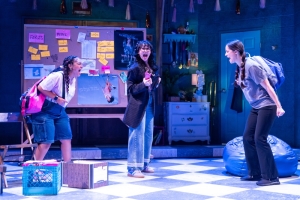
At fifteen, the world can feel like a television show you haven't quite figured out how to turn off.
For Salma (Jacqueline Guillen), it may be even more difficult. She watches too much television—especially detective shows—and has begun to see the world through the eyes of a detective. So when Maria (Andrea Ferro) disappears, Salma doesn't simply wonder where her friend is. She decides to investigate.
She recruits Este (Carmen Berkeley) and Phoebe (Ariana Burks) to help her find Maria, and Phanèsia Pharel's Dead Girl's Quinceañera takes off from there.
Produced by Goodman Theatre in association with Chicago Latino Theater Alliance, the production is a collective World Premiere with Barrington Stage Company and Hartford Stage. Directed by Melia Bensussen, the play has at times the quick-cut energy of the procedural television shows that inspired Pharel when she originally conceived the work.
And it moves fast.
Very fast.
Pharel understands the language of fifteen-year-old girls—the rapid-fire speech, the sudden shifts in thought, the jokes that arrive in the middle of serious conversations and the ability to move from one subject to another without warning. These girls don't simply talk; they process.
And Salma processes everything like a detective.
Television has given her a vocabulary for understanding crime, clues and suspects. She has watched enough procedural television shows to believe she knows how an investigation works. There is something funny about her confidence, but there is also something unsettling about it. For all the light-heartedness there’s an air that something isn’t right.
Pharel wisely doesn't allow that danger to become the only thing we see. The girls joke, argue, tease one another and behave like fifteen-year-olds. Their humor is genuine, but it also creates an increasingly uneasy contrast with what may be happening beyond their immediate world.
That contrast gives the play its darker edge.
The girls are dealing with situations that are far more adult than they are. Salma's television education has taught her that mysteries have clues and crimes have solutions. But real life doesn't necessarily follow the rules of a television show.
The four girls come from distinctly different cultural backgrounds. Salma is Cuban, Este is Salvadorian, Phoebe is Dominican/Haitian, and her cousin Maria is Dominican. Their different cultural experiences shape their ideas about family, friendship, behavior and what it means to grow up American, while their interactions allow Pharel to explore questions of identity, belonging and how young people see one another across economic and cultural lines. Yet they share something equally important: they are all approximately fifteen years old, and they are all American.
Pharel doesn't present Latino identity as one uniform experience. Instead, she allows the girls' differences to shape their relationships and their understanding of the world. They are negotiating family expectations, cultural identity and American teenage life simultaneously.
Dead Girl’s Quinceañera is ambitious, culturally layered and unapologetically youthful. Pharel gives us four girls who may come from different places, but who share the complicated experience of growing up American while carrying the histories, expectations and family secrets that shape who they are. As those secrets begin to surface, friendship is tested, identities are questioned, and the girls are forced to confront realities far beyond their years.
Ultimately, this is a play about friendship, identity and agency—and about young women discovering that sometimes the most important story is the one they have the courage to uncover for themselves.
RECOMMENDED
When: Through Nov. 1
Where: Goodman Theatre, 170 N. Dearborn St.
Tickets: $34-$79
Info: www.goodmantheatre.org
Box Office: 312-443-3800
Antigone…..He ain’t heavy, He’s my Brother

Court Theatre culminates its "Oedipus Trilogy" with a captivating production of "Antigone," marking an exhilarating conclusion. For those who witnessed the illuminating "Oedipus Rex" and the soulfully performed "Gospel at Colonus," the profound experience of "Antigone" brings a bittersweet moment of reflection. A fitting finale to the house of Oedipus.
Director Gabrielle Randle-Bent brilliantly implores us to consider another woman who defied unjust authority despite the potential consequences. The action starts with a recording of women discussing someone (Rosa Parks?) who refused to give up her seat on public transportation in the south. It sets the mood for the arguments we will hear.
The action starts after the death of Eteocles and Polyneices. Their uncle, now King, Creon (stoically played by Timothy Edward Kane) has decreed while Eteocles shall be buried a hero, anyone who buries Polyneices’s body will be put to death. He feels to bury Polyneices, a traitor, would be an afront to the Gods, Creon wants to solidify his power and assert his absolute authority and demonstrate his unwavering rule.
Antigone (the wonderful Aeriel Williams) feels it is her duty to her family and to the Gods to give her brother a proper burial regardless of what he may have done. This is the classic argument of divine authority over earthly jurisdiction, separation of church and state. Creon's decree forbidding Polyneices' burial directly contradicts divine laws. By burying him, Antigone asserts religious obligations over human-made laws, challenging Creon's authority and upholding the divine order.
Antigone shares her grief and her plans to bury her brother with her sister Ismene (Ariana Burks is sublime). Sharing her burden with her sister allows Antigone to express her grief, anger, and determination. Ismene's understanding and possible support could validate her decision and provide emotional strength.
The two-person chorus of Demophilos (Danielle David) and Euboule (Cage Sebastian Pierre) serves as the pulse of the community. They provide essential background information; they offer social and moral commentary. Speaking directly into microphones, they created a charged atmosphere that amplified the power of their voices. They used facial expressions, call and response and movement to bring their words to life, connecting, us, the audience, to the text on an emotional level unheard of in classical Greek plays.
Haimon's (Matthew C. Yee) tragic suicide serves as an indictment of Creon's relentless inflexibility, highlighting the devastating consequences of his flawed choices.
Julian Parker provided important information as well as lighthearted laughs as the Watchmen who becomes Messenger. I’ve been following his career for some time, and he’s only gotten better.
Cheryl Lynn Bruce as the Blind Prophetess, Tiresias was the embodiment of truth and wisdom. Warning of the potential dangers of pride and hubris, she gave an air of unquestioned authority.
The costume design by Raquel Adorno ran the gamut from Creon’s money green suit to the mud-cloth inspired ensemble worn by The Watchmen who becomes messenger. Antigone silver studded blouse was in stark contrast to Ismene muted soft colors. The costumes were a feast for the eyes.
Even in the face of dire consequences. Antigone's willingness to sacrifice her life underscores the importance of honoring family and divine obligations above all else. Her death serves as a powerful testament to the strength of individual conviction and the consequences of challenging authority. Additionally, Antigone's martyrdom solidifies her legacy as a symbol of resistance against tyranny and a defender of moral righteousness.
No, I’m not giving up this seat! No, My brother will not rot in the sun!
When: To March 2
Where: Court Theatre, 5535 S. Ellis Ave.
Tickets: $40-$70
Info: courtheatre.org
Running time: 1 hours and 35 minutes with no intermission
Dance Nation Reminds Us of the Unlimited Promise of Youth

Dance Nation is the story of a school dance team of thirteen-year-olds. The concept may seem to have dubious appeal, but Dance Nation quickly sinks its teeth into our attention with its opening scene.
Director and choreographer Lee Sunday Evans has put the students in sailor suits, and they rigidly perform a very well-rehearsed but uninspired tap dance number, moving just awkwardly enough through its limited steps and gestures to reveal that they are adolescents.
With that admirable bit of stagecraft by director Evans, the script by Clare Barron comes to life, firmly establishing the players (the actors range in age from their 20s to 60-something) as a believable band of pre-pubescent girls, with one like-aged boy, Luke. Kudos to these actors.
The play itself is strong, compelling enough to merit a Drama Desk Ensemble Award and an Obie Awards Special Citation this year. And it was a Pulitzer finalist.
Anyone who has been involved with competitive middle school regional, state and national competitions – soccer, Little League, debate team, what have you – will recognize the frenzied energy that students and faculty put toward winning. In the case of Dance Nation, the strangely imagined choreography and dance storylines are developed and directed by the dance team leader, Teacher Pat (Tim Hopper).
The dynamic emotional lives of these students is the heart of the play. Audrey Francis is Vanessa; Caroline Neff is Zuzu; Karen Rodriguez plays Amina; Ariana Burkes is Sofia; Adithi Chandrashekar is Connie; Ellen Maddow is Maeve; and Shanesia Davis is Ashlee. Torrey Hansen is Luke. It’s a hoot to see these actors of all ages capture the physical style and the angst of these adolescents. And they do it so well!
Barron gives us, in Teacher Pat, something familiar: a bit of a tyrant, who is as at once capricious, manipulative and authoritarian. Teacher Pat is not imaginative perhaps, but he is filled with conviction and certainty in his beliefs.
Teacher Pat comes and goes on stage. Most of the time is focused on the student interactions. But when he is there, sometimes it's quite harmful, as when he tries to dissuade Zuzu from quitting the dance team telling her that she will ruin her chances of ever pursuing dance again.
We also see the appearance of some of the mothers of the students, who Barron captures perfectly in these fleeting scenes. Some mothers are amazingly nurturant, wise, supportive, while one in particular - Zuzu's mother - has an unhealthy and neurotic emotional enmeshment with her daughter.
Teacher Pat drives the students forward for the upcoming national competition in Tampa, that they will win in dramatic stages through two smaller regional competitions before getting to the nationals. Aiming to get them fired up about the dance show he will soon reveal, Teacher Pat turns it on:
“Let’s give them something to tell them there is a revolution coming out of Liverpool Indiana!” he says. (Hopper delivers the line so perfectly, appending Indiana after just a beat.) The show that will spark this revolution is overwrought and cockamamie.
The students struggle through insecurities, personal issues, and the competitive challenges - but are generally bonded as a mutually supportive group. Barron also affords those flashes in scenes in which we can see laid out before us the promise of a young person who is destined to achieve great things in life.
Dance Nation runs through February 2, 2020 at Steppenwolf Theatre. Don't miss it!




Latest Articles
-
 Goodman's Dead Girl’s Quinceañera: When Fifteen Meets the Adult World
Written by Wesley DavidAt fifteen, the world can feel like a television show you haven't quite figured out how to turn off. For Salma (Jacqueline Guillen), it may be even more difficult. She watches too much television—especially detective shows—and has begun to see…
Goodman's Dead Girl’s Quinceañera: When Fifteen Meets the Adult World
Written by Wesley DavidAt fifteen, the world can feel like a television show you haven't quite figured out how to turn off. For Salma (Jacqueline Guillen), it may be even more difficult. She watches too much television—especially detective shows—and has begun to see… -
 Chicago City Opera Delivers a Rare Operatic Haunting with Der Vampyr
Written by Ken PayneWith Halloween creeping closer, there’s something fitting about revisiting one of opera’s earliest flirtations with macabre horror - especially in a production presented and performed by Chicago City Opera (COT). Der Vampyr may not enjoy the mainstream familiarity of later…
Chicago City Opera Delivers a Rare Operatic Haunting with Der Vampyr
Written by Ken PayneWith Halloween creeping closer, there’s something fitting about revisiting one of opera’s earliest flirtations with macabre horror - especially in a production presented and performed by Chicago City Opera (COT). Der Vampyr may not enjoy the mainstream familiarity of later… -
 Collaboraction to premiere Mud Life, drawn from Willie Round’s experience as a writer and rapper on Chicago’s west side, October 21-November 15
Written by Buzz Center StageMud Life, a world premiere drama by Chicago writing duo G. Riley Mills and Willie Round, drawn from Round’s life experiences as an emerging writer, rapper and producer, opens Collaboraction Theatre’s 2026-27 season, October 21 - November 15.Round and Mills…
Collaboraction to premiere Mud Life, drawn from Willie Round’s experience as a writer and rapper on Chicago’s west side, October 21-November 15
Written by Buzz Center StageMud Life, a world premiere drama by Chicago writing duo G. Riley Mills and Willie Round, drawn from Round’s life experiences as an emerging writer, rapper and producer, opens Collaboraction Theatre’s 2026-27 season, October 21 - November 15.Round and Mills… -
Steppenwolf Theatre's ADIRONDACK CHAIR CIRCLE In Rehearsal – Playing October 22 – December 6, 2026 – World Premiere!
Written by Buzz Center StageSteppenwolf Theatre Company, the nation's premier ensemble theater company, is pleased to launch its 51st Season with the world premiere of Chicago playwright Stephanie Alison Walker's biting satire Adirondack Chair Circle, directed by Tony Award winner Pam MacKinnon (Downstate, Edward Albee's Who's Afraid of Virginia…
Does your theatre company want to connect with Buzz Center Stage or would you like to reach out and say "hello"? Message us through facebook or shoot us an email at This email address is being protected from spambots. You need JavaScript enabled to view it..
*This disclaimer informs readers that the views, thoughts, and opinions expressed in the text belong solely to the author, and not necessarily to Buzz Center Stage. Buzz Center Stage is a non-profit, volunteer-based platform that enables, and encourages, staff members to post their own honest thoughts on a particular production.