
Displaying items by tag: Madeleine Shows
An Incredibly Good Snapshot of Our Social Discourse in 'Heroes of the Fourth Turning'
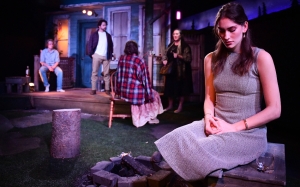
Settling in for A Red Orchid Theatre’s Heroes of the Fourth Turning, I knew next to nothing, having no familiarity with the playwright Will Arbery. Partly by design, I avoid preconceived notions and try to listen to the play itself, and watch the performers as I review. Even with so-called “canon” plays like Chekov or Miller.
With Heroes of the Fourth Turning, I soon learned why this script was a 2020 Pulitzer finalist, and won accolades on Broadway (an Obie award among others). It’s the writing. (Shout out to dramaturg Michele Uy; you can get a taste of Arbery’s style on Netflix in his 2025 film, Sacrifice, a satire with Anya Taylor-Joy, Chris Evans and John Malkovich.)
The production at A Red Orchid is smashingly good—tightly directed by the estimable dado with a first rate cast that has mastered this challenging, wonderfully wordy work. (The title refers to a fourth stage of an 80-year cycle in which American history resets itself, tears down the old order and forces a rebirth.)
Unaware of any of this, just listening to its two-plus hours of non-stop dialog set on a back porch near the campus of the small liberal arts college, I can say Abery’s script is remarkable, capturing the tenor of our social discourse in the period culminating in the first term of Donald Trump’s presidency. Arbery has delivered a public service that historians will treasure for centuries. For he has captured with precision the tenor of the conversations, debates, the arguments we currently undertake, rendering faithfully the language, the reasoning, the syntax, the syllogisms, and replete with logical fallacies that permeate so much of what we dispute.
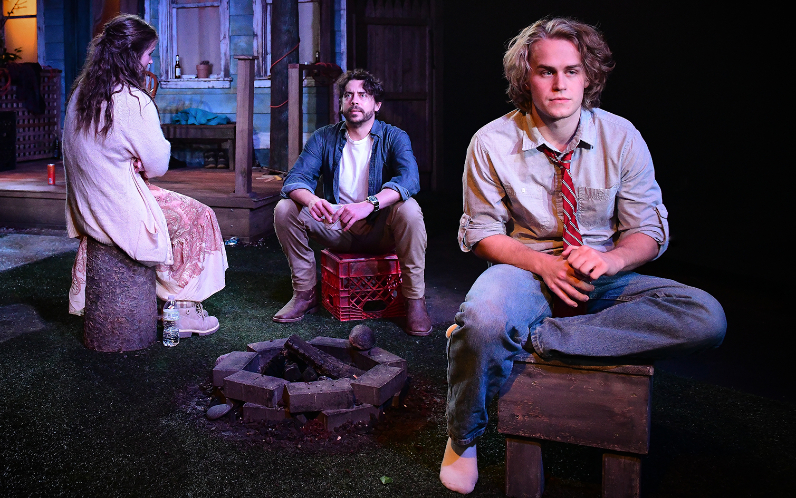
Magdalena Dalzell, Nate Santana and Beck Nolan (right). Photo by Evan Hanover.
Heroes of the Fourth Turning takes place on the back porch and garden of a white clapboard house where four graduates of the small Catholic liberal arts Transfiguration College in Wyoming have gathered. All are a few years into their work and life, and a bit inebriated from a party inside, perhaps in anticipation of an imminent solar eclipse. But for these four, the more significant occasion is to celebrate the appointment of their beloved educator and mentor Gina (Kirsten Fitzgerald) to head the school. But Gina doesn’t appear for hours into the play. So the four have plenty of time to talk amongst themselves. Talk they do, as we listen in.
We learn their paths of life have begun to form, though not solidified. To a greater extent their belief systems, and their approach to life, are firming up. The powerful performers in this show are admirably harnessed by director dado, whose excellent work was seen in A Red Orchid’s Six Men Dressed As Stalin.
We first meet Justin (Nate Santana captures the role impeccably), who was an older student and is more mature. We’re at his house in Wyoming. In the opening scene he grabs a rifle and shoots a deer far off in the distance. Back at the porch, he attempts to slaughter his wounded quarry, but his hand trembles as he holds the knife. “I guess I had too much time alone,” Justin tells himself.
In scenes following the rest of this excellent cast arrives: Emily (Magdalena Dalzell) escapes from the party inside to the porch. Emily is gentle, a woman of sorrow and perpetual suffering, both from the duress of counselling pregnant clients considering abortions, and emotionally from the mean-spirited war of words that puts her friends at each other's throats.
Soon we meet Kevin (Beck Nolan) with long blonde locks and a load of longing for love, who works at a Catholic publishing firm in Oklahoma. Eventually Teresa (Isa Grofsorean perfectly carries the role) appears, also escaping the now waning festivities. Teresa is clearly different: coiffed and manicured, and wearing a designer frock with off the bias hem, while the rest are grunge and denim (costumes by Madeleine Shows). Theresa’s polished presentation foreshadows what we’ll learn about her worldview.
The playwright arranges pairings of characters, and we see the disconsolate, love-starved and quite drunk Kevin beseeching her for attention. This is where Theresa, who is engaged, lets him have it. “It’s nice to see you feel responsible to perform your self loathing,” she tells Kevin, branding him weak and not in her league. “Talk to me about adult things,” and “I want to have a normal conversation like adults.” Kevin tells her, “It’s so messed up, it will lead to a four hour conversation,” then drunkenly to Theresa, “I love your brain.”
When Kevin is alone with Emily, he wears his neediness on his arm, but Emily is kinder in her rejection of this puppy at her feet.
All this establishes the characters rather quickly before the serious discussions begin. Anyone who has witnessed a convo among millennials will recognize the endless “chewing of the cud” such conversations entail. Like the mesmerizing drone of “Sienfeld,” (the show about nothing) one surrenders to a miasma of discursion when folks are fired up to converse.
But this conversation is on a topic all will find of interest, as it touches on the survival of the Republic, or of Western Civilization, depending on where you’re coming from.
By anchoring these four young adults in a Catholic college, playwright Arbery narrows the range of conversation to the spectrum of conservatism. So when they talk about topics central to the MAGA crowd, such as abortion or gender, viewpoints range from hardened doctrinaire Theresa, a fan of Steve Bannon, who recommends hanging for the reluctant mothers; through Justin, who seems more stoical than vindictive; to Emily who empathizes with suffering; to Kevin, who can hear what is compelling for pro-choice advocates. These subjects drive Theresa into a rage.
“The lepers need to be healed, not championed for their leprosy,” she says, skewering liberal identity politics. “Otherwise, what are we? A throbbing mass of genderless narcissists. There’s no ‘thisness’ in the liberal future.” Theresa sees the proper political position as bound up with her vision of Christian nationalism that will preserve Western civilization. “What’s really radical is sacrifice. Painful particularity is what we need. Otherwise we’re culturally lobotomized. We’ll be force-fed brand new oppressed identities every year and we’ll bow to the tyranny of rights.”
By excluding voices from the liberal side of the spectrum, Arbery gives us a chance to hear the conservative arguments without the dissonant clash of culture. These characters debate the Virgin Mary’s role in their spiritual life, speak freely of attending weekday mass, and live uninhibitedly Catholic lives. They are all on the same page, but interpret the text differently. Emily, for instance, while against abortion, professes to love the benighted pro-choicers regardless.
Each character has one or more lengthy monologues and these are delivered with a skillfulness one associates with those sometimes unhinged flights in Steppenwolf shows. Early on, Justin shares with the group a children’s story he has composed, a rather lengthy “The Grateful Acre.” Both beautiful and alarming, its repetitive refrain is hypnotic, especially in its delivery in Nate Santana’s rich baritone. I searched around for the origin of this basically environmental saga of stoic indomitability of the natural world, and found that Arbery crafted it just for this play.
When Gina finally does arrive, she sizes up her students as they test her mettle. It’s a combustible scene, and draws the play to a satisfying close. Highly recommended, Heroes of the Fourth Turning runs through December 6, 2026 at A Red Orchid Theatre on Wells St. in Chicago.



Latest Articles
-
 An Incredibly Good Snapshot of Our Social Discourse in 'Heroes of the Fourth Turning'
Written by Bill EslerSettling in for A Red Orchid Theatre’s Heroes of the Fourth Turning, I knew next to nothing, having no familiarity with the playwright Will Arbery. Partly by design, I avoid preconceived notions and try to listen to the play itself,…
-
 Goodman Theatre Announces Cast of JOHN PROCTOR IS THE VILLAIN Playing January 23 – February 21
Written by Buzz Center StageSmall-town scandal ignites the Albert Theatre stage this winter at the Chicago premiere of Kimberly Belflower's Tony Award-nominated Broadway smash hit John Proctor Is the Villain—the country's most-produced production this season. Marti Lyons makes her Goodman directing debut, returning to…
-
25 Years of It's A Wonderful Life at American Blues Theater
Written by Buzz Center StageAmerican Blues Theater announces its 25th Anniversary production of It's a Wonderful Life: Live in Chicago! from Frank Capra's film and directed by Executive Artistic Director Gwendolyn Whiteside with musical direction by Ensemble Member Michael Mahler. It's a Wonderful Life:…
-
Oil Lamp Theater Announces Single Tickets for its 2027 Season are Now On Sale
Written by Buzz Center StageOil Lamp Theater announces that single tickets are now available for its 2027 season in addition to four-show and three-show subscriptions. The 2027 season opens with a love story signed in ink, Ken Ludwig’s Dear Jack, Dear Louise, February 12,…
Does your theatre company want to connect with Buzz Center Stage or would you like to reach out and say "hello"? Message us through facebook or shoot us an email at This email address is being protected from spambots. You need JavaScript enabled to view it..
*This disclaimer informs readers that the views, thoughts, and opinions expressed in the text belong solely to the author, and not necessarily to Buzz Center Stage. Buzz Center Stage is a non-profit, volunteer-based platform that enables, and encourages, staff members to post their own honest thoughts on a particular production.