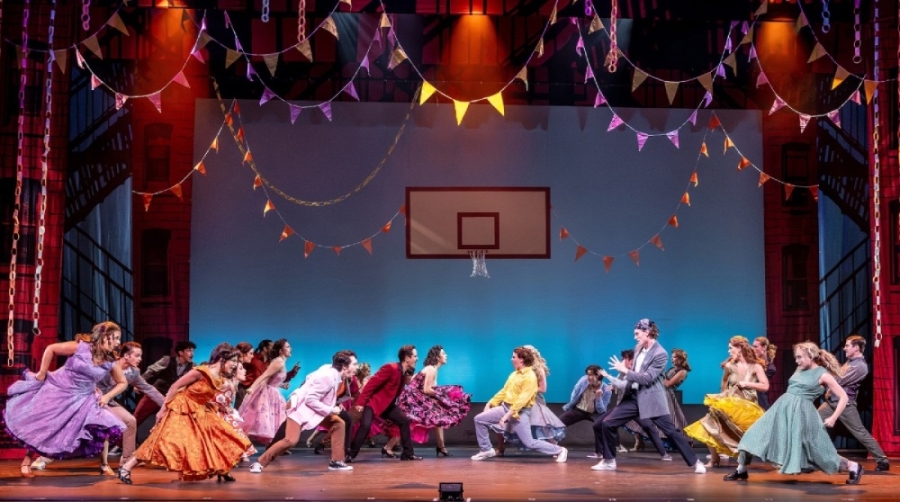
Some musicals carry such cultural weight that every new production feels like a referendum on how well a company can honor the original while making it feel alive again. West Side Story is one of those titles - a towering achievement in American musical theatre, a work whose emotional force and artistic innovation have endured for generations. Music Theater Works has now taken on this iconic musical at the North Shore Center for the Performing Arts in Skokie, and the result is a vibrant, beautifully staged production that captures both the drive and the aching humanity at the heart of the piece.
West Side Story is a modern retelling of Shakespeare’s Romeo and Juliet, but instead of two feuding families, it confronts the racial and cultural fault lines running through 1950s New York City. The Jets, a group of white American teenagers clinging to their sense of territory, clash with the Sharks, a Puerto Rican gang fighting for dignity, safety, and the right to belong in a city that continually pushes them to the margins. Their conflict is not just about turf; it is fueled by fear, resentment, and the prejudice that shapes how each group sees the other. When Tony, a former Jet trying to build a life beyond the violence, meets Maria, the sister of Sharks leader Bernardo, their connection is immediate and transformative. What begins as a spark of hope quickly becomes a dangerous love story unfolding against a backdrop of cultural tension, territorial pride, and escalating hostility.
As the feud intensifies, the young couple’s attempts to carve out a future together collide with the realities of their world. The rumble between the Jets and Sharks sets off a tragic chain of events, leaving Tony and Maria grasping for peace in a city determined to deny it. The musical’s final moments - heartbreaking, inevitable, and deeply human - underscore the cost of hatred and the fragile possibility of reconciliation.
The production also underscores one of the musical’s most enduring truths: that the idealism Tony and Maria cling to is constantly at war with the harsher realities shaping their world.
The creative pedigree behind West Side Story remains one of the most extraordinary collaborations in theatre history. Leonard Bernstein’s sweeping, genre‑blending score, Stephen Sondheim’s razor‑sharp lyrics, Arthur Laurents’ emotionally charged book, and Jerome Robbins’ groundbreaking choreography combine to create a work that is as musically thrilling as it is dramatically devastating. Bernstein’s score - among the most challenging he ever composed and one he found deeply artistically satisfying - remains one of his most defining artistic accomplishments. It is a piece that demands precision, passion, and a deep understanding of its themes, and Music Theater Works rises to that challenge with clarity and heart.
The company’s production is superbly realized, delivering crisp choreography, rich orchestral color, and performances that honor the emotional stakes of the story. It is a staging that respects the legacy of West Side Story while making the experience feel immediate and alive for today’s audiences.
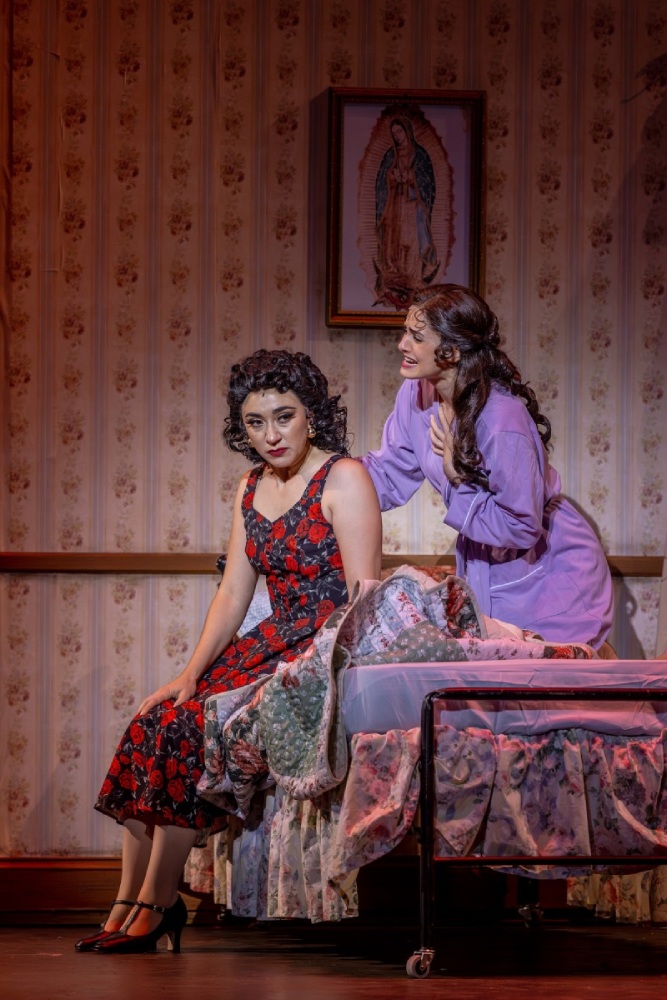
(L to R) Pauleth Jauregui as Anita and Isabella Ruano as Maria in WEST SIDE STORY from Music Theater Works.
The cast is terrific, but it is Isabella Ruano as Maria and Pauleth Jauregui as Anita who anchor the production, grounding it with performances that feel both lived‑in and emotionally urgent. Ruano’s Maria is luminous from her first entrance, her voice soaring through “Tonight” with a clearness and warmth that make the character’s hope feel newly electric. Jauregui matches her beat for beat, delivering an Anita rich with fire, humor, and heartbreak; her vibrant, sharply etched “America” is one of the evening’s defining moments. Together, they anchor the musical’s emotional arc with a confidence that elevates every scene they touch.
Offering a warm, earnest Tony is Luke Nowakowski, his ringing tenor in “Maria” and sincerity in “Something’s Coming” providing a steady, heartfelt counterpoint to the show’s rising tensions. Emmanuel Ramirez’s Bernardo contributes a controlled intensity, shaping the Sharks’ dynamic with quiet authority, while Kameron Rojas Schueneman’s Chino adds thoughtful, understated work that lands effectively in the final scenes.
Connor Ripperger brings a commanding presence as Riff, sharpening the Jets’ energy with restless physicality and crisp musical attack. His leadership in “Cool” gives the number a taut, combustible edge that sets the tone for the gang’s world.
If there’s one aspect that doesn’t land quite as strongly in this otherwise beautifully executed production, it’s the chemistry between Tony and Maria. While both Nowakowski and Ruano act with sincerity and sing with impressive range, clarity, and confidence, their scenes together occasionally feel more musically aligned than emotionally connected. The relationship lands, but at times you want a deeper spark between them - a stronger sense of shared urgency to match the vocal strength they each bring individually. And because this performance comes so early in the run, it’s easy to imagine that their connection will deepen as the actors settle further into each other’s rhythms.
That note aside, the principal cast delivers a production driven by strong voices and sharply drawn character work, with Ruano and Jauregui leading the charge.
The wider ensemble gives the production its pulse, moving with a clarity and drive that continually pushes the story forward, and Eric Desnoyers brings a welcome touch of humor as Officer Krupke, landing sharp comedic beats that lighten the show’s more chaotic moments. But above all, it is the wide-ranging, contemporary ballet-infused dance sequences that catch fire - those large, kinetic passages where movement becomes the show’s primary language. Much of the choreography folds fighting into dance, turning confrontation into something almost balletic: graceful, sculpted, and charged with tension. The company navigates these moments with remarkable control, letting the beauty of the movement coexist with the danger underneath.
In these sequences, the ensemble moves with a shared purpose, letting the choreography shape the conflict and momentum without overstating it. Their control and cohesion give the dance its impact, turning each major passage into a clear highlight that quietly but confidently lifts the production.
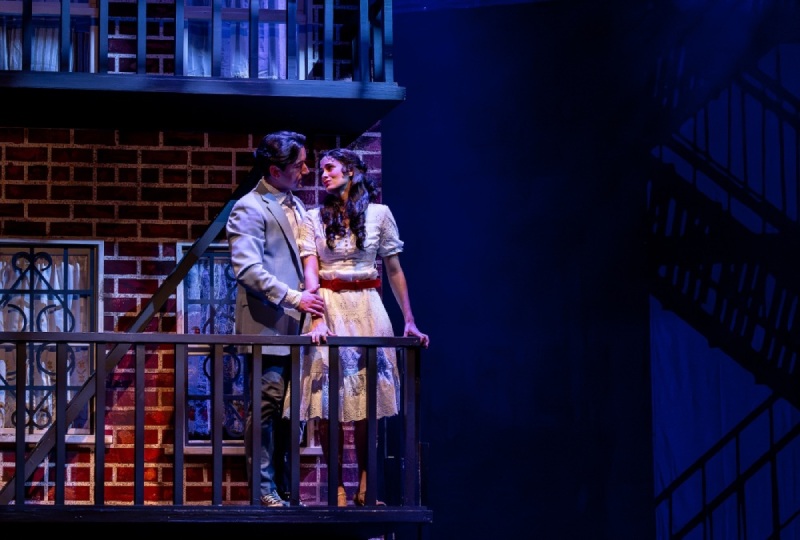
(L to R) Luke Nowakowski and Isabella Ruano in WEST SIDE STORY from Music Theater Works at North Shore Center for the Performing Arts.
Though the stage musical has always kept its original song order - and I understand the desire to preserve that structure - I’ve long hoped to see a production take a cue from the film in one particular moment. In the movie, “America” becomes a spirited debate between the Shark men and women, with Bernardo and Anita sparring over their hopes and frustrations about life in the United States. That dynamic not only brings Bernardo further into focus and deepens his relationship with Anita, it also gives the number a fuller, more energized sweep by letting a larger group of dancers drive its rhythm. The stage version’s women‑only arrangement works, but the film’s version has always struck me as the more dramatically rich and character‑revealing choice.
Beyond the choreography, the production’s artistic leadership is equally strong. The creative team brings seamless cohesion to this production. Director Sasha Gerritson guides the story with clarity and emotional focus, while co-choreographers Clayton Cross and Isa Ramirez deliver movement that honors the show’s iconic style with a fresh, contemporary lift. Linda Madonia’s musical direction keeps Bernstein’s score warm, tight, and expressive, supported by Justin Kono’s precise, sensitive conducting. The orchestra plays Bernstein’s score with crisp articulation and a full, glowing sound, letting the music’s rhythmic bite and lyrical sweep land with real impact. David Serrano’s Spanish translation adds welcome authenticity, with Spanish subtitles projected overhead during musical numbers that make the language accessible to both native speakers and those following along. The production’s most charged moments are shaped with care and impact through intimacy and violence choreography crafted by Nick Sandys.Director Sasha Gerritson guides the story with clarity and emotional focus, while co-choreographers Clayton Cross and Isa Ramirez deliver movement that honors the show’s iconic style with a fresh, contemporary lift. Linda Madonia’s musical direction keeps Bernstein’s score warm, tight, and expressive, supported by Justin Kono’s precise, sensitive conducting. The orchestra plays Bernstein’s score with crisp articulation and a full, glowing sound, letting the music’s rhythmic bite and lyrical sweep land with real impact. David Serrano’s Spanish translation adds welcome authenticity, with Spanish subtitles projected overhead during musical numbers that make the language accessible to both native speakers and those following along. The production’s most charged moments are shaped with care and impact through intimacy and violence choreography crafted by Nick Sandys.
Visually, the production is exceptionally well crafted. Bob Knuth’s scenic design and Cecilia Chan’s props work ground the story firmly in its era, giving the stage a lived-in authenticity that supports the drama without overwhelming it. The printed scenic drops hanging above and along the sides and rear of the stage - with their black windows, fire escapes, and bold red backgrounds - add a distinctive graphic layer, subtly echoing the stark lines and verticality of the 1961 movie poster designed by Joe Caroff. It is a smart visual nod that connects the production to its cinematic legacy without feeling derivative, instead offering a familiar, poster-like clarity that frames the action with understated style.
Bob Kuhn’s costumes and Kristen Brinati’s wardrobe leadership capture the period with clean, thoughtful detail, while Alice Salazar and Melanie Saso’s hair, wig, and makeup design add the finishing touches that make the Jets and Sharks feel fully appreciated. Andrew Meyers’ lighting brings sharp contrast and emotional texture to the stage, and Stephanie Farina’s sound design keeps the vocals and orchestra balanced and clear. This talented team builds an environment that feels true to the time, the place, and the heartbeat of West Side Story.
Taken together, these elements give the production a unity that extends well beyond its individual performances. The design work, staging choices, and musical precision all reinforce one another, creating a West Side Story that feels both faithful to its roots and freshly energized for a new audience. Taken together, these elements give the production a unity that extends well beyond its individual performances. The design work, staging choices, and musical precision all reinforce one another, creating a West Side Story that feels both faithful to its roots and freshly energized for a new audience. It’s a staging that understands the show’s emotional architecture and honors it with care. A staging this confident proves just how alive West Side Story can still feel.
Music Theater Works brings all of this together in a final product that feels both classic and newly urgent. Their West Side Story is a richly performed, thoughtfully designed, and confidently led production that honors the legacy of this landmark musical while giving it the vitality it deserves. Audiences can experience this outstanding staging August 13–30, 2026, and full details - including tickets - are available at www.musictheaterworks.com.
Recommended.
