
Displaying items by tag: Funny
A Loving, Delight‑Packed Celebration: Joan Crawford Goes to Hell Marks 25 Years of Handbag
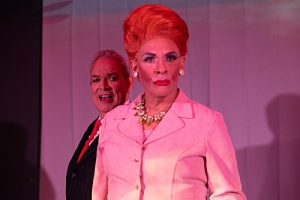
Hell in a Handbag Productions celebrates its 25th year with a revival of Joan Crawford Goes to Hell, a sharp, mischievous look at the Hollywood icon through the company’s signature parody lens. It is truly perfect timing that Handbag's guiding force David Cerda has chosen to do this play in the hellish year of 2026. First staged in 1999 by Sweetback Productions, the show is currently staged at The Clutch with a fresh cast and a renewed appetite for chaos, blending biography, satire, and Crawford’s own self-mythologizing into a hypnotic, magnificent, and powerfully funny indictment of one of Hollywood’s greatest movie stars. It’s a wildly funny show, bristling with the kind of big, brazen laughs that Handbag delivers better than anyone. The premise is simple and delicious: Joan Crawford dies and lands in hell, where she’s forced to relive scenes from her life as filtered through daughter Christina’s memories, including the indelible Mommie Dearest moments, from the wire hanger tirade to the all-out battle royale between mother and daughter.
One of the show’s sharpest structural choices is the way it pits Christina’s Mommie Dearest against Joan’s own memoir, My Way of Life. Each woman clings to her version of the truth, and the production amplifies that contradiction by having the characters volley excerpts from their respective accounts. Christina’s recollections paint a childhood marked by significant acts of child abuse and cruelty, while Joan counters with polished, self‑protective passages that insist on glamour, discipline, and maternal devotion. The back‑and‑forth becomes a theatrical tug‑of‑war over legacy itself. The truth is, legacy is all that was important to Joan Crawford because she cared more about public perception than her own children.
Handbag’s reimagining of the most unforgettable Mommie Dearest moments hits home in both comedy and tragedy, reminding us why those scenes have stayed lodged in the cultural imagination for decades.
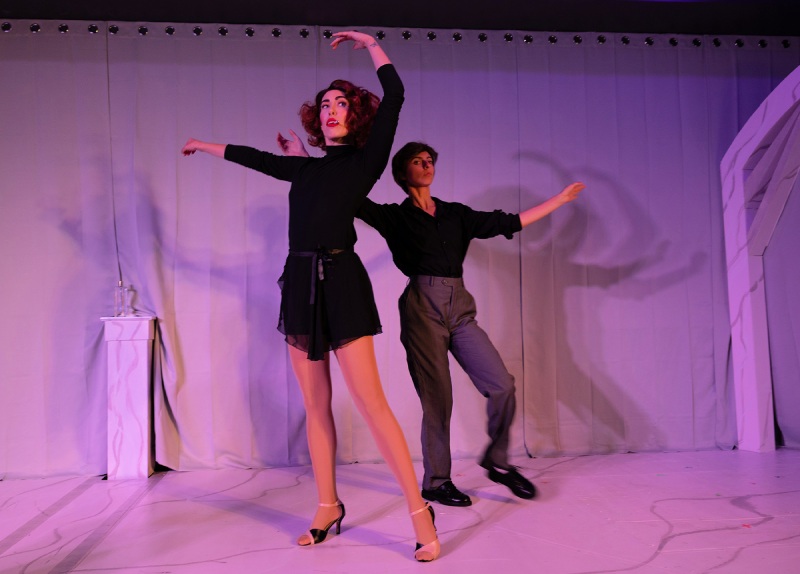
(left to right) Gretchen Greear and Anna Rose Steinmayer in Hell in a Handbag Productions’ revival of Joan Crawford Goes To Hell.
With Christina and Joan locked in a battle over whose version of the truth will prevail, Handbag pushes the idea even further: Joan isn’t embodied by just one performer. She’s split into three distinct incarnations, each capturing a different era and emotional temperature. David Cerda, as Joan #1, the older, not-so-remorseful, excuse-making Joan who has just passed away, delights everyone in the role with a wry, sardonic comic edge (and yes, Handbag finds a way to even make a deathbed funny). Gretchen Greear steps in as Joan #2, the impeccably polished Hollywood star, while Nicholas Ian unleashes Joan #3, the volatile, larger-than-life tempest with a hair-trigger temper. Together, the trio creates a lively rotation that keeps the show moving and underscores the contradictions that fueled Crawford’s public image. I really enjoyed watching the three Joans bounce off one another – the interplay keeps the show unpredictable in the best way.
By splitting Joan Crawford into three personalities, the production sharpens our view of the forces pressing in on her - Hollywood’s unforgiving demands, the intimidation she faced under MGM studio head Louis B. Mayer, and the specter of financial ruin - all seen through Christina’s spooky, subjective retelling of her mother’s life.
And Cerda, now back as his premiere character Joan Crawford, also recorded an album called The Joans back in 2001, and the music is used in this play. Having also been in a band at the time we met, I remember feeling an immediate connection with David - a kind of gay fairy godmother - from the first time I heard him elicit enormous laughs from his loving audiences through Joan’s curling blood‑red lips.
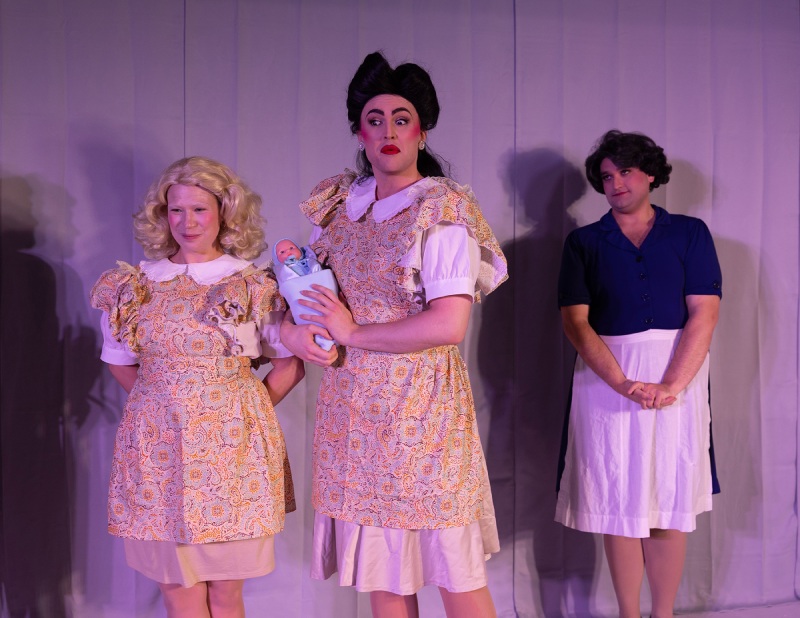
(left to right) Haley Gillman,Nicholas Ian and Ryan Kenny.
Joan’s remorse is fleeting at best. The production makes it clear that even when she’s forced to relive the worst moments of her life, including the cruelty toward Christina, the chaos she inflicted on friends, and the emotional wreckage she left behind, she rarely accepts responsibility. Instead, she pivots, excuses, reframes, or outright denies, often doubling down on the very behaviors that landed her in trouble in the first place. When Joan Crawford is asked if she had any regrets about her dramatic life decisions, she answers with a martini dry, rock solid “absolutely not” that millions of women from her generation to the present will all echo with a fury. Handbag plays this not as tragedy but as sharp comedy: Joan’s instinct for self-preservation is so strong that the devil himself can’t pry a sincere apology out of her. The result is funny, pointed, and perfectly in line with the company’s parody style.
At the same time, the play doesn’t ignore the darker realities of Crawford’s life. Even though Joan Crawford was accused of severe child abuse by two of her adopted children, the play also acknowledges that a woman alone in the world at that time - especially one operating at her level of Hollywood fame and power - would have faced enormous pressure, mind‑bending double standards, and relentless scrutiny, including outright sexist abuse both behind the scenes and sometimes in public.
I’ve always appreciated Handbag’s knack for casting performers who can land both the joke and the heart of a moment, and this group embodies that beautifully. A steady, clear‑eyed anchor comes through in TJ O’Brien’s performance as Adult Christina, while Haley Gillman supplies a youthful spark as her younger counterpart. As Carol Ann, Ryan Kenny delivers some of the evening’s most reliable laughs, playing a maid whose patience seems almost supernatural. Lori Lee steps into a few sharply etched roles, including Helga, a housemaid and recipient of Crawford’s iconic “I’m not mad at you. I’m mad at the dirt” line, and Al Steele, the Pepsi executive who became Crawford’s fourth husband.
Good-natured and genial, Michael Rashid’s Greg brings an easy charm to the MGM lawyer who helped facilitate Christina’s adoption, though even he eventually reaches his limit with the Crawford tumult. A devilish glint runs through Nick Dorado’s turn as Mr. Deville, guiding Joan through her infernal afterlife, while Anna Rose Steinmayer and Tyler Calhoun add texture throughout the ensemble.
The magnificent projections, beautifully designed by DJ Douglass, deliciously underscore how much of Crawford’s power came from the control of her face - the slick black rolls of shiny hair, the hours of evenly applied makeup, the sweet yet searing expressions, those magnificent, even terrifying eyes. She quite literally had to possess the “looks that kill” to survive the jungle of Hollywood. The projections draw from multiple sources, each revealing a different facet of her beauty and its eventual fading, including one haunting image of her gaunt body dancing in an old nightgown near the end of her life. Handbag uses these projections to sprinkle in memorable cameo appearances: Jennifer Engstrom of A Red Orchid Theatre and Coco Sho Nell materialize as yet more versions of Joan, adding to the show’s gleeful multiplicity.
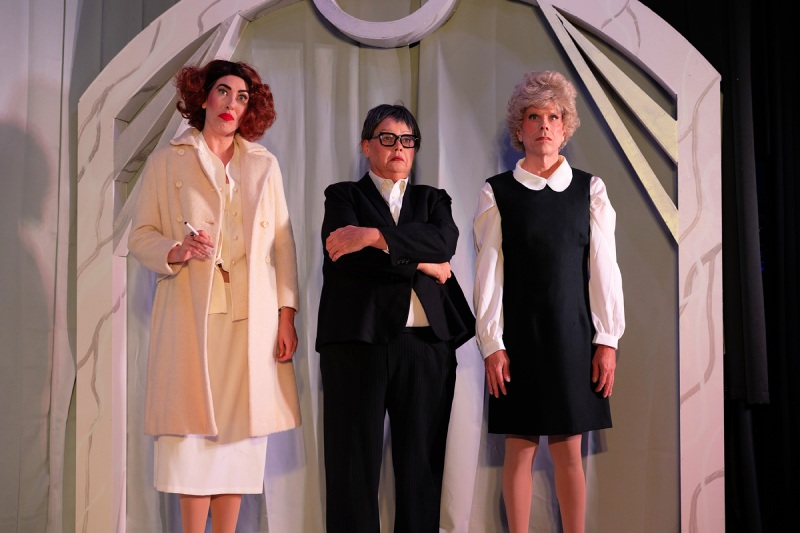
(left to right) Gretchen Greear and ensemble members Lori Lee and TJ O’Brien. Photos by Rick Aguilar Studios.
Playwright and Artistic Director David Cerda once again proves why Handbag’s voice is so distinct, shaping the material with his trademark blend of camp, bite, and affectionate parody. In perfect sync with that tone, director Cheryl Snodgrass keeps the energy sharp and well-paced, guiding the ensemble through the show’s chaos with a steady hand and a clear understanding of how Handbag humor lands best.
I noticed early on that what makes David’s writing - and the plays he produces - so special is the deeply compassionate view of life he brings from the woman’s side of things. Cerda doesn’t just tease the audience with camp, easy and tawdry jokes, he educates, encourages and supports his audience with easy and tawdry jokes.
Even Hell needs a good design team, and this one delivers the right mix of style, practicality, and playful flair. Marcus Klein’s scenic design uses a simple, brilliant, sparkling catwalk feel that suits the production well, giving the cast plenty of room to play without clutter. Costumes by Ben Argenta Kress are perfectly designed to reflect the period with style and humor, Syd Genco’s makeup design adds dramatic, expressive detail, and Keith Ryan’s wig work rounds out the look with steady, character-focused polish.
If you’re already a fan of David Cerda as Joan Crawford and of Hell in a Handbag Productions, you should still do yourself a favor and watch Mommie Dearest before seeing the show. You’ll laugh hysterically, and during the play you’ll fully appreciate the immaculate detail the production and cast bring to the black‑and‑white film projections, the hair and wigs, the makeup, costumes, and jewelry - all crafted to showcase the utmost in humor, radiance, and accuracy.
For two decades, Buzz Center Stage has lovingly followed Handbag’s work, and in their 25th anniversary celebratory season, Joan Crawford Goes to Hell does what the company does best: delivers affectionate and hilarious parody with a genius wink of glamour. It’s a light, funny summer offering with a faithfully committed ensemble and a clear love for the material.
Joan Crawford Goes to Hell runs August 21st through September 27th at The Clutch, 4335 N. Western Ave. Tickets available at handbagproductions.org.
Highly recommended.
Playmakers Lab’s That’s Weird Grandma’s 25th Birthday is a fine place to giggle
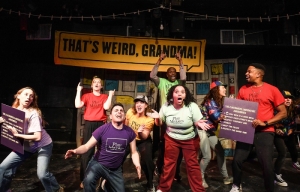
If you need an energy boost, skip the can of Monster and get yourself, plus loved ones of any age, to Playmakers Lab’s tasty birthday cake of a show. The very first edition of That’s Weird, Grandma, culled from Chicago elementary school students’ stories, occurred in the spring of 2001. The revue has somehow survived 9/11, Covid, funding cuts and all other slams against children’s wildest dreams and highest hopes.
No wonder director Brandon Cloyd and the cast can’t hide their excitement. Presented for the last 25 years at the Neo-Futurist Theater, That’s Weird, Grandma provides an hour of escape from adult common sense. It is rough hewn stuff, as scrappy in production and performance values as the gritty venue itself. But it’s a fine place to giggle at the audition of a giraffe who desperately wants to join the circus or a song about a burping bunny.
Cloyd’s intensity as he welcomes the audience reflects the entire project. What goes on in kids’ heads – and later on paper – matters enough to these dedicated grownups to say it out loud and in full volume. Young imaginations may lack both polish and boundaries, but the tales they generate don’t necessarily need a formal beginning, middle or end; or a neat divide between fact or fiction.
For example, “My Sister Fell” gets no farther than a little girl falling on some garbage and crying. “Rose Saves Tony” refers to Lake Michigan as an “ocean” which, given its vastness, makes perfect sense. With sheer glee, the ensemble performs the scene that gave birth to Playmaker Lab’s show title a quarter century ago – a grandma’s “weird” explanation of why her teeth are gleaming white.
Notable among the more complete sketches, “Egg Adventures” has the last remaining egg in a container urgently asking its commander via walkie-talkie to send reinforcements. Out come hens who lay more eggs, even as the commander warns, “Some of you will not be coming back.”
Ensemble members, who serve as teaching artists for the creative writing residencies, celebrate their double duty as educators and performers throughout the show. In addition to the current cast, actors from prior productions lend cameo performances – a nod to the past and a hope that Playmakers Lab can keep its weirdness going for years to come.
Runtime: 1 hour
Remaining show dates: Saturday Aug. 29, Sunday, Aug. 30, Saturday, Sept. 5 and Sunday, Sept 6; all performances at 2 pm
Playmakers Laboratory at Neo-Futurist Theater: 5153 N. Ashland Ave, Chicago
Tickets: www.playmakerslab.org.
From Subway Cars to Chicago Stages: Marcus Monroe at The Comedy Bar

Sometimes the best way to find a comedian who’s new to you is by stumbling onto a clip that stops your scroll cold. That’s exactly how I first encountered Marcus Monroe: a burst of chaotic silliness on Instagram that made me immediately wonder what his full stand-up looked like beyond the quick-hit reels. As I have with both up-and-coming comedians, and even more established ones I haven’t really explored, I first discovered Monroe online by chance. Outside of a good handful of snippets - mostly from his Stand Up on the Subway series that I’ll get to shortly - I had very little to go on in terms of what his actual live stand-up would be like. In his case, I couldn’t stop watching the run of hilarious reels: quick, character-driven, highly silly bursts of comedy that immediately stood out for their timing and playful absurdity. Those clips ended up being a solid introduction to Monroe’s live show, which delivers a smart, engaging blend of his signature comedy. And yes - he’s genuinely funny.
I finally saw him live at The Comedy Bar in downtown Chicago, and it was the perfect venue to experience his style up close. The night was packed with laughs. Opener Brett Druck was outstanding, delivering sharp, tightly crafted jokes with a calm confidence that immediately locked the room in. His humor leans clever and observational, the kind of writing that sneaks up on you and lands with a clean, satisfying snap, perfectly setting the stage for headliner Marcus Monroe.
Monroe’s current tour highlights the style he’s become known for: sharp, in-your-face comedic banter paired with fast-paced variety performance. Born and raised in Milwaukee, Wisconsin, and now residing in New York City, Monroe brings a Midwest-friendly looseness to his delivery, even as he leans into the nonconformist energy that has defined his career. He’s a past recipient of the Andy Kaufman Award, given annually to a performer whose originality and creative spirit echo Kaufman’s own. His résumé spans television appearances, cruise line entertainment, and major comedy festivals, and he’s been seen by millions, including performances on The Late Show with David Letterman and America’s Got Talent.
Onstage, he delivers a tight, energetic set that mixes storytelling, improvisation, and physical comedy in a way that feels both polished and spontaneous. His crowd work delivers some of his best moments - he’s genuinely comfortable interacting with the audience, slipping into quick riffs and playful exchanges that feel effortless and keep the room locked in. His material ranges widely, from the chaos of travel and performing on the road, to the odd realities of being somewhat of a “variety act” in a stand-up world, to the strange encounters that come with doing comedy in unconventional spaces. He also dives into his relationship with his wife, who’s fifteen years older and has been with him for over a decade. They never signed a prenup, but he’s unfazed - as he jokes, everything’s hers anyway. In fact, most of her belongings came from a divorce settlement with her ex-husband, so should they ever split, Monroe figures he’d walk away with half of Steve’s stuff. And toward the end of the show, he folds in his juggling - often with sharp knives - not as a gimmick, but as a comedic tool he uses for timing, misdirection, and playful escalation, giving his set a physical dimension most stand-ups don’t attempt. And this is the same guy who has juggled flaming torches while riding a sky-high unicycle, so the physicality isn’t just a flourish - it’s part of his comedic DNA.
A major part of Monroe’s growing national profile comes from his Stand Up on the Subway series, the viral project that helped expand his audience far beyond traditional comedy venues. For more than two years, he’s been performing fully costumed bits on New York City trains, transforming everyday commutes into pop-up comedy sets. The punchlines in these subway bits, while some downright goofy, are often purposefully so bad in a brilliant way - beyond dad-joke territory and deep into gleeful absurdity - that they loop back around into being hilarious. It’s part of what makes the series addictive, and I’ve become hooked on watching each new character drop into a train car with that “what’s he going to do next?” unpredictability. His Stand Up on the Subway series has now surpassed 100 million views and even features cameos from Bowling for Soup, Train, Bobby Moynihan, BBMak, Ryan Cabrera, and more, adding an extra layer of delightful unpredictability to the chaos. His roster of subway personas is part of the fun: Michael Jackson, Marty McFly, Ozzy Osbourne, the Grinch, Ronald McDonald, Freddie Mercury, a watermelon, a foot, Uncle Sam, an emo kid, and an endless supply of other characters pulled from whatever corner of his imagination he’s exploring that day. He’s even created a Chicago version on the EL train, suiting up as a Bears player for a local twist. The reactions - amused, confused, delighted, or occasionally baffled - become part of the show, and the series has become a defining piece of his creative identity.
Taken together, the tour, the reels, and the Stand Up on the Subway series reveal a performer who thrives on unpredictability, connection, and inventive silliness. Monroe isn’t trying to reinvent comedy so much as he’s carving out his own lane within it, one built on enthusiasm, oddball charm, and a willingness to commit fully to the bit. It’s a combination that works, and his stand-up is highly recommended. For upcoming tour dates, videos, and more of his character work, visit www.marcusmonroe.com.
A Legendary Transformation: John Mulaney’s Historic Night at Wrigley Field
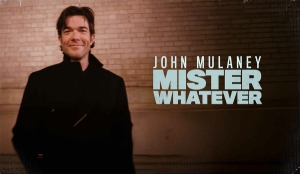
John Mulaney didn’t just perform at Wrigley Field. He made history there. In a venue synonymous with baseball legends, rock icons, and century-old Chicago lore, Mulaney became the first comedian ever to headline a full stand-up show at Wrigley Field, and, depending on which version of the truth you prefer, possibly the largest live audience for a comedian in history. Whether or not the record is airtight, the scale of the night was undeniable. Chicago turned out in force for one of its own.
A New Chapter: The Mister Whatever Tour
Mulaney’s Mister Whatever tour marks a tonal shift from the raw confessionals of Baby J. Where that show dissected his intervention, addiction, and the wreckage of his personal life, Mister Whatever leans into the absurdity of middle age, fatherhood, and domestic unpredictability. The storytelling remains fast, sharp, and unmistakably Mulaney, but now filtered through the lens of a man navigating toddlers, in-laws, and the strange mundanity of being a grown-up with a past.
Family Life and Fatherhood: Comedy in the Trenches
Mulaney’s material about family life is some of his richest yet, especially when he dives into the sprawling constellation of his new in-laws. Marrying into Olivia Munn’s Vietnamese-Chinese family gives him endless fodder, and he mines it with precision: overbearing relatives, cultural misunderstandings, and the kind of familial chaos that feels both universal and deeply specific. He even slips into a Vietnamese accent, a move he preemptively defends by insisting he has “earned the right” because they are his actual family now. It’s classic Mulaney: self-aware, slightly provocative, and delivered with a wink.
His bits about raising two toddlers are equally sharp. He compares dealing with a three-year-old to working in a toxic workplace, complete with unreasonable demands, emotional volatility, and a boss who has no concept of time. The late-night meltdowns, the negotiations over snacks, the existential exhaustion of parenting: he turns it all into a comedic autopsy of modern fatherhood.
And then there is the “wallet allowance,” a running gag about his post-rehab financial oversight. According to Mulaney, his wife and even bank cashiers treat him like a teenager with limited privileges. It’s a sly, self-deprecating way of acknowledging his past without dwelling in it.
Absurd Observations and Pop Culture: Mulaney’s Sweet Spot
Where Mulaney truly thrives is in the absurdity of everyday grievances, and his extended rant about modern $1,000 drying machines is a highlight of the night. He builds an entire comedic architecture around the decline of appliance quality: how dryers now seem designed to not dry clothes, how they beep like needy robots, how they offer dozens of settings but none that actually work. It’s the kind of bit only Mulaney can stretch into a full routine, turning a mundane annoyance into operatic frustration.
His pop culture and political impressions land just as hard. His RFK Jr. impression is a showstopper: wild, unhinged, and delivered with a kind of manic sincerity that had the stadium roaring. He skewers billionaires, public figures, and the bizarre circus of current events with the same blend of sharpness and silliness that has always defined his best work.
And then comes one of the night’s funniest detours. His bit about being possessed by Satan, specifically how Satan always does it the exact same way, with someone jolting upright in bed and unleashing a string of profanity, becomes one of the night’s sharpest and most ridiculous highlights. It’s pure Mulaney: theatrical, absurd, and delivered with the timing of a performer who knows exactly how long to let a joke breathe before landing it.
A Chicago Homecoming with Legendary Guests
What made the night feel truly monumental were the surprise guests, each adding their own flavor to the celebration.
Buddy Guy, Chicago blues royalty, took the stage and tore into a couple of songs, including a blistering rendition of “Sweet Home Chicago.” Seeing Buddy Guy at Wrigley Field would be a thrill on its own. Seeing him as part of a John Mulaney comedy show felt like a surreal Chicago fever dream.
Fred Armisen followed with a brilliantly odd set that blended music and comedy. Switching between guitar and drums, he delivered the kind of deadpan, musically infused humor that only Armisen can pull off. It was weird, delightful, and perfectly calibrated for a stadium crowd.
Richard Kind served as a sort of comedic emcee, popping in with jokes, introductions, and the warm, slightly bewildered charm that makes him such a beloved character actor. His presence added a theatrical looseness to the night.
And then, in a moment that felt like a benediction, David Letterman stepped out to introduce Mulaney. Letterman may be from Indiana, but in Chicago terms, that is close enough. His dry, understated introduction gave the night a sense of occasion, like a passing of the comedic torch from one generation to the next.
A Night That Felt Bigger Than Comedy
What made Mulaney’s Wrigley Field show remarkable wasn’t just the scale, or the guests, or the historic firsts. It was the sense of homecoming. Mulaney performed with the confidence of someone who knows the city in his bones: its rhythms, its humor, its contradictions. The stadium setting didn’t dilute his intimacy. It amplified it. His storytelling reached throughout the Friendly Confines without losing its specificity.
In a venue built for legends, Mulaney delivered a night worthy of the space.
The Beautiful Overthinking of Gary Gulman’s 7th Hour

Gary Gulman brings his new tour, 7th Hour: An All New Standup Show, to The Den Theatre, offering Chicago audiences a chance to see a comic who has spent decades refining the long-form, slow-burn style that has become unmistakably his. His five sold-out shows over the weekend are being recorded for an upcoming comedy special, giving each performance an added spark as he works through material with both confidence and care. Gulman’s comedy has always lived in the space between sharp observation and gentle self-reflection, and this latest set continues that progression with a mix of wry honesty and carefully shaped storytelling. His stop at The Den feels less like a routine tour date and more like a chance to watch a veteran performer stretch into new territory while still delivering the precision that has made him one of stand-up’s most quietly dependable voices.
The evening opened with Evanston’s own Sam Froum, whose set proved to be a sharp and genuinely funny warm-up for the night. He brought an easy confidence and a quick, clever rhythm to the stage, landing jokes with the kind of timing that immediately pulls a room in. It was a strong showing, and a fitting lead-in to Gulman’s tightly built headlining act.
Across 7th Hour, Gulman moves through a wide constellation of personal history, weaving together stories that span his depression, his admiration for his father’s unwavering integrity despite the loss of friends it may have cost him, and the realities of growing up with a single mother while navigating the rough edges of two bullying older brothers. His Jewish upbringing becomes a recurring thread, most notably in an extended, delightfully overthought retelling of the story of Moses - a bit that shifts from biblical epic to neurotic character study in a way only he can pull off. From there, he wonders aloud why Jewish people didn’t simply “like” Jesus so that Christianity might have evolved into an upbeat, colorful, pastel-tinted sect of Judaism, only to immediately challenge his own premise with the kind of self-correcting logic that fuels his best material. That exploration leads him into Jesus’ Sermon on the Mount, where he zeroes in on “do unto others as you would have them do unto you,” a phrase he deeply takes to heart, breaking it down with methodical curiosity as he imagines Jesus trying it out in front of smaller crowds at "open mounts" before delivering it on the big stage. Along the way, he has fun with the apostles - especially John and “Doubting” Thomas - treating them less as distant religious figures and more as characters he can analyze, tease, and reinterpret through his own gently overthinking lens. He even slips in a detour to Christian Bale’s Batman, acting out a hilarious gravel‑voiced exchange with Gary Oldman’s Commissioner Gordon that fits seamlessly into his stream of overthought observations.
He also devotes time to the values and education he drew from PBS, especially the steady presence of Mr. Rogers, whom he references with undeniable affection. Gulman lights up when recalling – and briefly singing – the closing song, “It’s Such a Good Feeling,” along with the simple but radical reassurance Mr. Rogers offered at the end of each episode: “I like you just the way you are.” He treats that sentiment with an earnest respect that shows how deeply it shaped him, even as he wonders aloud how anyone can truly live as their full, unfiltered self outside of a very small circle of people. He folds in humorous family stories tied to pledge drives, broadening the emotional palette of 7th Hour and grounding the comedy in the cultural touchstones that helped him make sense of the world long before he ever stepped onstage.
Gulman’s humor is a distinct blend of long-form storytelling, analytical overthinking, gentle self-examination, and slow-burn observational detail. He builds jokes the way essayists build arguments - layering premises, revisiting ideas, correcting himself mid thought, and letting the comedy emerge from the precision of his logic as much as from the punchline. His style is warm, meticulous, literary, and deeply human, often turning small moments from childhood, religion, or pop culture into sprawling, carefully engineered comedic set pieces.
And in 7th Hour, he brings that entire toolkit with him - sharper, fuller, and more emotionally grounded than ever. The show feels like Gulman operating at the height of his powers, shaping personal history into comedy with a confidence that suggests he knows he’s building material worthy of an upcoming special. What stands out most is how fully he leans into that mastery; 7th Hour plays like a comic working with total clarity of purpose and delivering exactly the kind of work only he can create.
Gulman’s career has been shaped by a steady run of smart, carefully built specials that highlight his gift for long-form comedy. From Boyish Man and In This Economy? to the critically praised It’s About Time and The Great Depresh, he has assembled a body of work defined by warmth, clarity, and an almost literary sense of structure. His stand-up has also been a reliable presence on late-night television, with memorable sets on Conan, The Late Show with Stephen Colbert, Jimmy Kimmel Live, and The Tonight Show, each showcasing his ability to turn everyday frustrations and cultural quirks into slow-building, sharply observed stories. Together, these appearances have cemented him as one of the most consistent and quietly influential voices in contemporary stand-up.
If you get the chance to see Gulman live, take it. 7th Hour shows a comedian in full command of his craft, delivering work that is thoughtful, funny, and unmistakably his. It’s the kind of performance that reminds you why stand-up, at its best, feels both intimate and expansive at the same time.
Bargatze’s Big Dumb Eyes Tour Lands in Rosemont With Subtle Force

Nate Bargatze’s Big Dumb Eyes tour made its stop at the Allstate Arena in Rosemont with the steady, understated presence that has become central to his appeal. Bargatze continues to draw humor from the small missteps and everyday confusions that shape his storytelling, easing the audience into his rhythm rather than pushing for big moments. His unhurried delivery works surprisingly well in a venue of this size, creating a sense of shared focus that settles over the room as he builds each joke with quiet precision.
This powerhouse comedy tour is anchored by host Julian McCullough, whose easygoing charm and quick-hit crowd work set the tone for the night before the headliner ever steps onstage. He’s joined by a sharp trio of comics - Greg Warren, Gary Vider, and Jonnie W - each bringing a distinct comedic style that keeps the momentum building from set to set. Warren’s dry, story-driven humor, Vider’s understated oddball delivery, and Jonnie W’s musical-comedy flair create a well-balanced undercard that feels like a full evening of stand-up on its own. Together, they form a tightly assembled lineup that primes the audience perfectly for the main event.
Julian McCullough, Greg Warren, Gary Vider, and Jonnie W will all be making upcoming appearances at Zanies Rosemont, giving Chicago-area comedy fans several chances to catch them live. McCullough returns to the club on June 5–7, while Greg Warren is scheduled for a special event weekend on May 22–23. Jonnie W will headline Zanies Rosemont on July 26, and Gary Vider’s next Chicago-area dates are at Zanies Chicago on March 27–28, offering multiple showtimes across both nights.
Bargatze has been performing in arenas for some time now, and the format suits him more naturally than one might expect. The in-the-round staging keeps him accessible from every direction, while the large video screens ensure that even the most subtle expressions read clearly throughout the space. It is an effective setup for a comedian whose style relies on nuance rather than volume. In a venue as large as Allstate, laughter does not always erupt all at once - it spreads gradually, section by section, until the entire arena is moving with the same steady momentum.
A significant portion of Bargatze’s material continues to revolve around his family, with stories about parenting, marriage, and the everyday negotiations that come with trying to make sense of the world alongside the people closest to you. But he also branches into the absurdities of modern life, touching on everything from AI to self-driving cars to couples therapy - and even the baffling challenge of buying a horse, because, as he points out, who actually knows the price of a horse? These moments are not exaggerated or heightened for effect. Instead, he treats them with the same calm, observational tone that defines his work. The humor comes from the honesty of the situations and the quiet recognition they spark, especially for audiences who see their own households and daily frustrations reflected in his.
His Rosemont appearance is one stop in a long stretch of dates as the Big Dumb Eyes tour continues across major arenas nationwide. The upcoming schedule includes cities throughout the Midwest, East Coast, and South, each offering a chance for audiences to experience how his understated approach translates to rooms of this scale. At this point, Bargatze stands among the strongest stand-ups touring at the arena level, not because he relies on spectacle, but because his material remains consistent, grounded, and effective no matter the size of the venue.
In the end, the Allstate Arena stop underscored why Bargatze’s rise has felt so steady and assured. His comedy does not demand attention - it earns it through clarity, timing, and a genuine connection to the everyday experiences he describes. For a comedian whose style is built on understatement, filling an arena might seem counterintuitive, yet he makes the space feel surprisingly intimate. It is a testament to his craft and a clear sign that his place on the arena circuit is well deserved.
Fault Shakes Up Chicago Shakespeare Theater with Fierce, Funny Chaos

Dark comedies built around relationship dynamics have always drawn me in because they reveal conflict with a kind of honesty that feels both familiar and unpredictable. When couples clash, the humor isn’t just situational; it’s rooted in history, habit, and the tiny emotional landmines only long-term partners know how to trigger. Fault fits squarely into that tradition, taking the everyday rhythms of a long marriage and pushing them just far enough to expose the raw, funny, and uncomfortable truths beneath the surface. That blend of recognition and surprise is exactly what makes this kind of comedy so compelling, and why Fault lands with such a specific charge.
That sense of intimate volatility is exactly what Jason Alexander explores in his return to Chicago Shakespeare Theater. With Fault, he brings the sharp directorial instinct he showed in his earlier CST production Judgment Day and applies it to a far more contained emotional landscape. In this world premiere written by Scooter Pietsch, he shapes the play’s tightening grid of tension and moral uncertainty with a touch that feels both precise and unexpectedly humane. The result is a tightly focused piece driven by tension that sparks almost instantly - less an explosive outburst than a controlled shift in the room - with the personal fractures between the characters steering the story toward its breaking point.

Pictured are Enrico Colantoni (Jerry), Playwright Scooter Pietsch, Rebecca Spence (Lucy), Nick Marini (Shaun), and Director Jason Alexander. April 18– May 24, 2026, in The Yard at Chicago Shakespeare. Photo by Justin Barbin.
In Fault, the night detonates the moment Jerry Green walks in expecting to celebrate a career defining merger and instead finds his wife, Lucy, in an intimate moment with a young man she has just met, Shaun. What could have ended in a single, stunned confrontation instead becomes the spark for a long, spiraling night in which no one is allowed to leave, and nothing stays contained. The shock of the discovery quickly gives way to a volatile mix of accusations, shifting alliances, and long suppressed grievances, turning their home into a closed-door standoff where every truth feels like a trap and every explanation opens a deeper wound. Jerry and Lucy have long operated as a high functioning power couple, relying on professional unity to keep their marriage steady; once that balance collapses, the cracks at home widen just as quickly. It is interesting that Pietsch also underscores the irony that Jerry’s career‑defining merger has just made the couple newly minted billionaires after a long string of failures, and yet - proving that all the money in the world can’t change some people - they still behave like high‑achieving narcissists, turning their blame and abuse on each other and on the young stranger they’ve invited into their lavish home.
As the hours stretch on, the situation tilts from chaotic to revealing, exposing the fractures that have been quietly shaping this marriage for decades. Jerry’s need for control, Lucy’s hunger for something unspoken, and Shaun’s unexpected presence collide in ways that force each of them to confront what they’ve been avoiding. What begins as a moment of betrayal becomes a full-scale excavation of loyalty, resentment, and the stories couples tell themselves to stay intact. The play’s dark humor emerges from this escalating tension - how quickly a single mistake can unravel a life, and how a marriage can be tested most brutally not by the act itself, but by everything it brings to the surface. And just to remind you, this is a comedy - and a hilarious one at that.
Jerry even admits at one point that arguments never really have winners, a truth he delivers with the weary certainty of someone who has spent years circling the same conversational battlegrounds. Yet the play understands something deeper and more uncomfortable: that couples can become strangely addicted to the very banter that exhausts them. The back‑and‑forth may bruise, but it also affirms a shared language, a familiar rhythm, a way of feeling alive inside a relationship that has otherwise gone quiet. In Fault, that warped need becomes both a source of comedy and a mirror held up to the audience, revealing how easily love and combat can blur when two people know each other too well.
For all its blistering comedy, Fault is threaded with the quieter, more unsettling realizations that come with aging - what it means to feel your desirability slipping, to lose track of the person you married, or to crave the parts of yourself you fear have vanished. The betrayals at the center of the play aren’t just about infidelity; they’re about the desperate need to feel seen, wanted, and alive again. Beneath the chaos and sharp-edged humor runs a steady pulse of vulnerability, as each character confronts the version of themselves they’ve been avoiding. And just when the night seems like it can’t twist any further, the play barrels into a smash bang ending that lands with real force - the kind that sends audiences out buzzing, debating, and replaying the final moments long after the curtain comes down.

Presenting the world premiere dark comedy Fault, by Scooter Pietsch and directed by Jason Alexander. Featuring Enrico Colantoni (Jerry) and Nick Marini (Shaun). Photo by Justin Barbin.
The cast of Fault features three principal performers, each driving a different charge in the play’s volatile, rapidly escalating night. Enrico Colantoni gives Jerry Green a grounded, lived in presence, letting decades of pent up frustration surface through tightly controlled physical choices and a dry comic timing that makes his smallest shifts register. Opposite him, Chicago favorite Rebecca Spence shapes Lucy Green with a blend of wit, restraint, and emotional clarity; her sharp physical beats and instinctive timing keep each exchange taut while still allowing the humor to flicker through. Shaun, whose chance encounter with Lucy at the bar leads him into the Green household, played by Nick Marini, adds a destabilizing charge to the night, using quick, reactive movement and an agile sense of timing to tilt the dynamic just enough to expose the deeper fractures beneath the couple’s carefully maintained surface.
Their combined work is strengthened by the breadth of experience each actor brings to the stage. Colantoni’s long career in film and television, including standout turns in Veronica Mars and Galaxy Quest, gives his performance a steady, lived in weight. Spence, a Chicago mainstay with a Jeff Award and recent visibility in The Madison, brings sharp focus and emotional clarity to Lucy. Marini adds a younger charge to the trio, drawing on credits like Cobra Kai and Dropout TV to shape a presence that subtly disrupts the relationship dynamic.
The action unfolds inside a tastefully appointed luxury home crafted by scenic designer Paul Tate DePoo III, who gives the Greens a space that gleams with success without ever feeling sterile. A streamlined bar sits at the rear of the room, and the warm finishes, refined furnishings, and subtle touches make the environment inviting rather than ostentatious - a polished retreat that still feels lived in. It’s the kind of setting that should radiate comfort and control, yet under Alexander’s direction it gradually sharpens, its clean lines and curated surfaces taking on a quiet tension as the night begins to break down.
Alexander’s own trajectory mirrors that same level of craft, extending far beyond the stage. Although Jason Alexander is widely known for his television work on Seinfeld and film roles ranging from Pretty Woman to Shallow Hal, he brings none of that celebrity shorthand to Fault. Instead, his decades in front of the camera seem to refine his instincts behind the table. His sense of timing, character shaping, and emotional pacing reflect the precision of someone who has lived inside stories of every scale. It’s a résumé that could easily overshadow a production, yet here it deepens his approach, grounding the play’s volatility in choices that feel thoughtful rather than showy.
Running just ninety minutes without an intermission, Fault maintains a tight, steady pulse that matches the tightening chamber of its late-night unraveling. Chicago Shakespeare Theater presents the world premiere through May 26, offering audiences a sharply observed look at a marriage pushed past its breaking point. What stays with you isn’t only the tension or the humor, but the clarity of the production itself, which recognizes how a single, seismic domestic shift can rattle everything a couple has built, sending shockwaves through a foundation that once seemed unshakeable.
Highly recommended.
For tickets and/or more show information, click here.
This review is proudly shared with our friends at www.TheatreInChicago.com.
Premiere of OUT HERE at Court Theatre a Charming Deconstruction of Marriage and Musical

Everyone encounters many crossroads in their lives, where they make a choice that determines the future…and many people live to regret it. That is where Dawn, the protagonist of Out Here, the new musical receiving its premiere at Court Theatre finds herself. Unlike most people, however, her realization does not come in a quiet moment of reflection, but just as she and her husband, Brian, and 15-year-old daughter, Cleo, have discovered that they have a band and an audience. It’s a lot, and the extremely metatheatrical musical reflects the chaos well. While there are drawbacks to the format, including the impossibility of fully developing most of the characters, the one-act musical by Leslie Buxbaum (book and lyrics) and Erin McKeown (music and lyrics), based on a concept by Buxbaum, McKeown and David J. Levin, is an entertaining and often moving reflection on personal choices and the people they affect.
Breaking the fourth wall is a hallmark of musical theater, and metatheatrical reflections on the musical being performed are also not uncommon these days, but Out Here takes these conceits to a new level. And that, arguably, is what makes it work so well. The characters must learn how to respond to the fact that they are living their lives in a musical as they navigate the changes in their family structure. The musical form proves to be a convenient way to condense the journey into an evening for the benefit of the audience that comes with it. It also provides a metaphor for the families’ (there are several) journeys from fumbling with new relationships and legal and geographic uncertainty to settling into the rhythms of new lives. The music reflects the jarring awkwardness of both the unexpected performance and the fallout of Dawn’s announcement that her “here” is no longer where she wants to be. As they get more comfortable with both performance and marital differences, the characters begin to exploit their access to a band—and apparently new-found guitar skills—to sing their own songs and share their emotions with each other and the audience. Buxbaum and McKeown toy with breaking the rules of musical theater, allowing characters to exit to the green room and the lobby and to directly address the band and audience. When a mediator is needed, he enters from the band and introduces potential shared custody options in song—a song that that Cleo recognizes from a friend’s experience (and wonders if she could get a puppy, too). Director Chay Yew wisely trusts the material and allows characters and audience to just keep up—no unnecessary scene changes or projections indicating changes in setting—making for a fast-paced exploration of relationships, time, and what’s important in a life. It’s occasionally messy or unfulfilled, but always compelling.

Photo of Alex Goodrich, Ellie Duffey, and Becca Ayers in Out Here at Court Theatre. Phot by Michael Brosilow.
Despite all the metatheatrical machinations, Out Here has an easy-to-follow plot and a singular protagonist. This is Dawn’s story, and the character uses this to her advantage, controlling both the narrative and the other characters as much as possible—though neither musicals nor reality allow for time travel, not that Dawn doesn’t try. While passionately pursuing the life that she wants (and simultaneously trying to figure out what that means), Dawn could quickly become grating, as she seems to be surrounded by good options and supportive friends and family, plus a band. Fortunately, Becca Ayers brings lightness and self-awareness to the role, as well as the ability to belt out power ballads and harmonize with her partners in multiple musical genres. Cliff Chamberlain as Brian plays to his strengths as a mostly non-musical actor—and his voice works well for the folksy guitar serenades that Brian chooses as his musical medium. He is charming and initially almost overly forbearing but grows stronger as he realizes that he has been given an opportunity that he is not willing to give up. As their daughter, Cleo, Ellie Duffey is charismatic and complicated, thrilled to have an audience, wanting to support her parents, but irritated that she is being left out of the decision-making. When she finally gets a song, it’s a propulsive punk declaration that is a necessary release. Bethany Thomas as Robin, Dawn’s ex-girlfriend who reluctantly reenters Dawn’s life, is uncompromising and vulnerable, wanting to rekindle their relationship, but justifiably apprehensive, and her dynamic voice is perfect to convey both her character’s surety about what she needs, and her fear that she might be disappointed again. Thomas’s comic timing also complements Robin’s sarcasm.
Alex Goodrich brings charm and flair to the most musical-theater role of the musical, Martin—he’s in the band! He’s the mediator! He’s the BFF! He can be anything you want him to be, keep the tempo and find the right accompaniment. Though not personally invested, his empathetic performance ingratiates him to both the family and the audience. Also, part of the familial rebuild are Gina, the woman Brian begins dating and Jett, Robin’s grown child. They, too, get swept up in the musical, but they do not have their own songs (maybe if there were a second act?), though they manage to hold their own in the musical/slash family drama they have entered. Amanda Pulcini brings a grounded humor and composure to the most awkward of situations Gina finds herself in. The fact that Jett’s entrance is often introduced with the ominous phrase “the plot thickens” is ironic, since Jett, as played by Z Mowry, is amiable and understanding, someone who seems like a good person to have as a friend, and usually offers sound advice that helps the plot along.
The musical and the cast get top-notch support from the designers and musicians. Co-orchestrator (with Erin McKeown), conductor, and keyboard player Christie Chiles Twillie backs up the vocals and underscores the book perfectly, keeping the tempos tight and the volume attuned to the singers and the script. Breon Arzell’s movement adds controlled chaos, matching the verbal humor and tension with apt but unintrusive movement. Scenic Designers Andrew Boyce and Lauren M. Nichols have created a musical-scale proscenium out of roof beams that mirror the moods of the home’s inhabitants, with a large but cozy interior and expansive outside. Sound designer Lee Fiskness integrates sound effects with the music to mesh the sounds of home with the beats of the band. The musicians make it seem possible to suddenly have a life become a musical, moving easily between styles, “acting” in response to the cast and swelling instrumental lines for onstage instruments.
Whether one likes Out Here will probably depend on one’s tolerance for stories of privileged people choosing between multiple good options surrounded by understanding friends and family. However, there is no denying that using a DIY musical to represent the struggles of a family trying to deal with change is a resonant metaphor, and the music captures some common challenges in fresh and thought-provoking ways. The book by Leslie Buxbaum explores the joy and tension of familial and other relationships with compassion and a great deal of humor. Erin McKeown’s music (with lyrics by Buxbaum and McKeown) allows the audience to get to know the characters and share moments from years of their lives in around 90 minutes (the magic of “theater time”). Chay Yew’s production is fast-paced, uncluttered, funny, moving, and thoughtful. Though Out Here wisely avoids trying to tie up all loose ends, it leaves the audience with a lot of good questions to ponder.
Out Here runs through May 10 at Court Theatre, Wed/Thurs/Fri at 7:30pm, Sat/Sun at 2:00pm & 7:30pm.
This review is proudly shared with our friends at www.TheatreInChicago.com.
Reservation Mayhem, One Man, Forty Voices: Mike Newquist Ignites 'Fully Committed' at The Den

Get ready - those phones are about to explode, and Sam is already spinning like a top trying to catch every single one. It’s a full‑blown ring‑storm, and he’s diving into it with the hectic energy of someone who knows the chaos is coming and still can’t outrun it.
A brisk, razor‑funny powder keg of a play, Fully Committed tracks a single frantic day in the life of Sam, the lone reservationist at one of Manhattan’s most elite - and most impossible - restaurant. Becky Mode’s script is a full‑tilt high‑wire act, and Mike Newquist tears across nearly forty characters with the kind of breakneck precision that makes your head spin. As Sam, he’s already a live wire - but then he’s also snapping into entitled celebrities, neurotic assistants, tyrannical chefs, and every flavor of fine‑dining madness that dares to ring his desk. It’s dazzling, anxious, and wildly fun to watch him juggle it all without ever dropping the thread. The comedy snaps because each character is so sharply etched, and Newquist seamlessly shifts among them with the kind of finesse that turns mayhem into art.
At its heart, the nearly 90-minute play gleefully skewers the rituals of status and the agitated, almost feral hunger for exclusivity, exposing just how ridiculous people become when a reservation turns into a badge of power. Sam becomes the unseen fulcrum of that world, and his day unravels from merely hectic to outright surreal as he absorbs tantrums, negotiates impossible demands, and fights to keep a grip on his own sense of worth. Watching Newquist as Sam behind that reservation desk in a constant tinderbox had me instantly aware that I wouldn’t survive two hours in his shoes. His frantic charm and barely contained panic sells the chaos and sparks a whole new respect for the people who actually thrive in that kind of daily combustion.
Fully Committed lands as hard as it does because it’s rooted in real industry absurdity. Mode shaped these characters straight out of real restaurant‑world encounters, giving the show a mix of satirical whirlwind and a bite of truth that feels both sharply recognizable and wickedly real.
Throughout the play, I loved how Sam’s dad kept slipping into the heavy commotion with that gentle, grounding voice - just long enough to let the whole room exhale. Each time he called, Sam’s entire demeanor flipped in an instant; you could watch him go from frazzled to peaceful like someone had hit a reset switch. Those brief check-ins made it clear how a few steady words from a gentle, supportive father (or friend/family member) can cut straight through the noise, offering a tiny pocket of calm even when everything else is burning down around him.
Mike Newquist is pure kinetic joy onstage, delivering a commanding turn in Fully Committed. The Chicago‑based actor and improviser thrives in the city’s storefront trenches, bouncing between sharp‑edged comedy, character chameleon work, and the kind of ensemble disorder where anything can - and usually does - happen. He’s popped up with PrideArts, AstonRep, and The Comrades, tackling everything from contemporary drama to high-velocity comic mayhem. In Fully Committed, it’s his quick‑switch agility that makes him a blast to watch.
Directed by Derek Bertelsen, this Chicago staging arrives with a jolt of fresh energy and real immediacy. Newquist’s performance becomes the engine that drives the whole night, while Bertelsen keeps the momentum razor‑sharp, the pacing tight, and every character shift snapping cleanly into place.
The Den Theatre hosts the run March 13–28, 2026, with performances on Friday and Saturday nights at 7:30 p.m. Tickets for Fully Committed at The Den Theatre are just $26. For tickets and/or any more show information, click here.
Recommended.
This review is proudly shared with our friends at www.TheatreInChicago.com.
Halloween was never so funny - 'The Golden Girls: Bea Afraid!'

Just in time for Halloween comes Hell in a Handbag’s The Golden Girls: Bea Afraid! The play’s name itself probably tips most off that audiences will be in for one helluva ride. Handbag found much success in the past couple of years creating their own hysterical episodes of The Golden Girls, Vol 1 was extended twice and moved to a larger theater while Vol 2 also made waves. So, a Halloween special featuring our four favorite seniors – why not?
Artistic Director David Cerda and company are working double time right now performing in Artificial Jungle at 7:30 p.m. (through October 28th) followed by Bea Afraid! at 10:30 p.m. To say this theatre company works hard is an understatement. And one thing is for sure – there’s a whole lot of funny in each production.
Bea Afraid! gives us two Halloweeny episodes, the first a clever whodunit that gets sillier by the second (that’s a good thing) followed by a demon possession that you will never forget. As laughter-filled as the second episode was, my friend walked away saying, “That actually kind of scared me.” So, laughs and scares – the best of both worlds – the treat followed by the trick. Between scenes Golden Girls trivia is held and tongue-and-cheek prizes are handed over to the lucky winners, such as the lady who sat in front of me that was handed a tube of anti-itch crème. How well do you know the gals?
Cerda returns as Dorothy displaying the same dominance over the role that helped make Vol 1 such a smash hit while Ed Jones reprises his role as Rose and commands a laugh just about every time a line is delivered. Adrian Hadlock also rejoins the cast and again nails the role of Dorothy’s razor-sharp witted mother, Sophia. Grant Drager is ever so saucy as our beloved, loose-legged, Blanche, a role that AJ Wright played so well in the first of the hilarious franchise. The cast is rounded out by such brilliantly humorous talents as Chazie Bly, Michael S. Miller, Michael Rashad, Duane W. Taylor, Robert Williams and Maureen SanDiego, who stars as the evening’s hostess.
Created by David Cerda and directed by Becca Holloway, this is a Halloween show not to be missed. Handbag gets another feather in their cap for yet another hysterical production, leaving us to eagerly await the next Golden Girls adventures - please say there will be more!
The Golden Girls: Bea Afraid! Is being performed at Stage 773 through November 2nd. For tickets and/or more show information visit www.handbagproductions.org.




Latest Articles
-
 Overhsdowed's Flame of Fire Finds Humanity, Strength, and Forgiveness in a Tragic Chapter of Missionary History
Written by Ken PayneOvershadowed Productions’ Flame of Fire revisits one of the most polarizing true stories in mid‑century missionary history, and the result is a tense, deeply human portrait of faith, conviction, and consequence. Written by Artistic Director Reba Hervas, the play draws…
Overhsdowed's Flame of Fire Finds Humanity, Strength, and Forgiveness in a Tragic Chapter of Missionary History
Written by Ken PayneOvershadowed Productions’ Flame of Fire revisits one of the most polarizing true stories in mid‑century missionary history, and the result is a tense, deeply human portrait of faith, conviction, and consequence. Written by Artistic Director Reba Hervas, the play draws… -
 Cast and Production Team Announced for Fleetwood-Jourdain Theatre's THE NICETIES, October 31 – November 15
Written by Buzz Center StageFleetwood -Jourdain Theatre, an award-winning theatre company that has been thrilling audiences with over four decades of unique, inspirational, and invigorating Black American and African Diaspora-centered storytelling, has announced the cast and production team for the final production of its 2026 season. THE…
Cast and Production Team Announced for Fleetwood-Jourdain Theatre's THE NICETIES, October 31 – November 15
Written by Buzz Center StageFleetwood -Jourdain Theatre, an award-winning theatre company that has been thrilling audiences with over four decades of unique, inspirational, and invigorating Black American and African Diaspora-centered storytelling, has announced the cast and production team for the final production of its 2026 season. THE… -
Goodman’s centennial is its all‑time most successful year, with 300,000 patrons at 4,000 performances & events
Written by Buzz Center StageThe Goodman wraps its 2025/2026 Centennial Season, an unprecedented line-up marking the 100th anniversary of Chicago's flagship not-for-profit theater, as the most successful in its history. Today, the theater released its "A Century of Impact" report, detailing milestone programming and attendance…
-
 Class is back in session with Victory Gardens’ World Premiere of The Humanities
Written by John AccroccoCoincidentally (or not), Victory Gardens’ new play about a controversial campus speaker opens just days after the one-year anniversary of Charlie Kirk’s assassination. Returning from a lengthy hiatus, Victory Gardens once again lights up the Biograph Theater with the world…
Class is back in session with Victory Gardens’ World Premiere of The Humanities
Written by John AccroccoCoincidentally (or not), Victory Gardens’ new play about a controversial campus speaker opens just days after the one-year anniversary of Charlie Kirk’s assassination. Returning from a lengthy hiatus, Victory Gardens once again lights up the Biograph Theater with the world…
Does your theatre company want to connect with Buzz Center Stage or would you like to reach out and say "hello"? Message us through facebook or shoot us an email at This email address is being protected from spambots. You need JavaScript enabled to view it..
*This disclaimer informs readers that the views, thoughts, and opinions expressed in the text belong solely to the author, and not necessarily to Buzz Center Stage. Buzz Center Stage is a non-profit, volunteer-based platform that enables, and encourages, staff members to post their own honest thoughts on a particular production.