
Displaying items by tag: Nina Simone
ETA’s for colored girls Honors the Enduring Power of Ntozake Shange
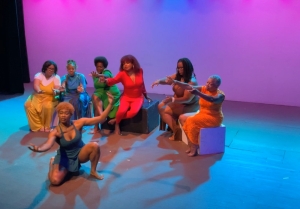
Nearly fifty years after its groundbreaking premiere, Ntozake Shange's for colored girls who have considered suicide / when the rainbow is enuf remains one of the most important works ever written for the American stage. Neither conventional play nor musical, Shange called her work a "choreopoem," a seamless fusion of poetry, dance, music, and theatrical ritual that forever changed the landscape of Black theatre.
When the work premiered in 1976 it shattered theatrical conventions. The original production gave Black women something rarely afforded on the American stage: the authority to tell their own stories without apology, through language that was lyrical, raw, sensual, political, and deeply personal. At a time when Black women were often relegated to supporting roles in theatre, Shange centered their voices, their pain, their joy, and ultimately, their survival. The production earned multiple Tony Award nominations and cemented itself as a cornerstone of the American theatrical canon.
Its relevance today is perhaps even more striking. In an era shaped by conversations surrounding gender-based violence, mental health, reproductive autonomy, identity, and the ongoing struggle for Black women to be fully seen and heard, Shange's words continue to resonate with astonishing clarity. The emotional truths embedded in her poetry refuse to age.
ETA Creative Arts Foundation's production, directed by Donn Carl Harper, wisely understands that the strength of for colored girls lies in trusting Shange's language. Harper resists the temptation to over-direct or impose unnecessary concepts upon the material. His direction is careful, respectful, and largely unobtrusive, allowing the poetry to remain the undeniable centerpiece.
The production, however, begins on an unfortunate note. Opening night started approximately thirty minutes late, a delay that inevitably affected the audience's energy. Compounding that issue was the decision to open with Nina Simone's haunting "Four Women." While Simone's anthem is unquestionably a masterpiece and shares thematic kinship with Shange's work, its placement here felt somewhat gratuitous. After already waiting half an hour, the audience was asked to spend another five minutes listening to a recorded song while nothing occurred onstage. Rather than heightening anticipation, the extended prelude tested the audience's patience before the choreopoem had the opportunity to speak for itself.
Once the production settles into Shange's text, however, it finds its rhythm.
Levi Wilkins' abstract scenic design provides an uncluttered visual landscape that allows the performers to inhabit both literal and emotional spaces. His lighting effectively supports the shifting moods of the evening, although both scenic and lighting concepts occasionally seem content to complement the material rather than challenge it. Given the limitless theatrical possibilities inherent in a choreopoem, I wish he would have made bolder visual choices that embrace the work's dreamlike qualities.
Markene Peavy's costume designs honor the play's iconic color symbolism, a safe choice, but it doesn't distinguish each woman as individuals, a missed opportunity. Peavy's choreography becomes the production's most compelling storytelling device. Rather than serving as decorative movement between monologues, the choreography extends Shange's language into the body, allowing emotion to continue flowing.
Among the ensemble, Madison Savannah (Lady in Purple) emerges as an exceptional physical storyteller. Her dancing possesses remarkable precision, grace, and emotional transparency, making every movement feel deeply connected to the poetry. She consistently commands attention without disrupting the ensemble's collective balance.
The performances throughout demonstrate a clear understanding that these women are not individual characters so much as facets of a shared experience.
Tina Marie (Lady in Red) delivers her poetry with commanding authority and emotional maturity. Margo Harper (Lady in Blue) brings quiet dignity and introspection, while Deborah Ross (Lady in Green) grounds her moments with warmth and humanity. Tracey Renee (Lady in Orange) finds welcome humor amid the heartbreak, providing necessary moments of emotional release. L.A. Holts (Lady in Yellow) infuses her work with youthful vitality and infectious spirit. Kennedi Coleman (Lady in Brown) offers moments of thoughtful restraint that contribute beautifully to the ensemble's collective voice.
Opening night also presented an increasingly familiar frustration that falls outside the production itself but nonetheless affected the theatrical experience. The persistent glow of cell phones and repeated audience distractions proved difficult to ignore. Theatre remains one of the few art forms built upon a shared agreement between artists and audience to be fully present in the moment. When that agreement is repeatedly broken, everyone in the room loses something.
Even with its uneven opening and a few missed opportunities for greater theatrical imagination,
ETA's production succeeds where it matters most: it trusts Shange.
That trust is ultimately enough.
Nearly fifty years after its premiere, for colored girls who have considered suicide / when the rainbow Is enuf continues to remind audiences that Black women's stories are not peripheral to the American experience - they are central to it. Their pain, laughter, sensuality, vulnerability, resilience, and joy remain as urgent today as they were in 1976.
Shange did more than write a play. She created a language for survival.
ETA Creative Arts Foundation honors that legacy with sincerity, sensitivity, and respect, reminding us that some masterpieces require no reinvention- only artists willing to listen deeply enough to let them speak.
Recommended
When: thru August 31
Where: 7558 South Chicago Ave Chicago
Tickets: $30 - $50 general admission
Four Women: Nina Simone Leaves Us All with the Backlash Blues

My gateway to Nina Simone fandom came when I was a kid, watching some crummy 90's action movie that was somehow soundtracked by Ms. Simone’s music. Her take on George Harrison’s “Here Comes the Sun” was both recognizable to young me as a Beatles tune, but it was also strange, alien, powerful, wistful, something completely different than anything I’d heard before. Not the song. But the singer. It was a gateway, for sure.
From there, I ended up with a CD reissue of her late-60s Sings the Blues album, an even better introduction for a clueless young white boy to this complicated genius — one with toe-tappers, showtunes, pop tunes, and yes, the blues. Perhaps the most powerful tune on there, perhaps one even too powerful for me at the time, was Langston Hughes’ “Backlash Blues,” which laments that “the world is big and bright and round and it’s full of folks like me who are black, yellow, beige, and brown.”
In the years since, I’ve grown, as my love and understanding of Nina Simone — the musician, the public figure, the strong woman, and the complex human being — has grown. And now maybe I’m old enough or wise enough or just ready to appreciate the picture of this woman and “folks like” her that Christina Ham’s Nina Simone: Four Women paints for us, as currently performed at Skokie’s Northlight Theatre, directed by Kenneth L. Roberson.
The play itself is named for one of Ms. Simone’s most powerful compositions, one about women “who are black, yellow, beige, and brown.” But it is also framed around what is perhaps an imagined 1960's fever dream of Ms. Simone’s, in the wake of the horrific 1963 bombing of Birmingham’s historic 16th Street Baptist Church in which four beautiful little African-American girls were murdered.
In the play, Ms. Simone is joined in the church’s wreckage by three other African-American women, each of them representing someone Nina sang about in “Four Women.” Above, I wondered if the play’s setting and the four women’s existence are perhaps imagined, based not only on Ms. Simone’s actual history, but her history of mental illness, as well.
The truth is, perhaps, somewhere in between, and that makes the play work. There are hints at Ms. Simone’s mental health throughout the play — voices and sounds she hears — but they don’t completely define her. And there are, for me at least, distracting bits of expository history — biographical details that might be fleshed out if this were a more standard “jukebox musical” — but I didn’t let them get in the way of the four women onstage. And those four women are what make the play work.
First, Sydney Charles is Nina Simone. And is she ever. I heard the rare complaint after the show that her character didn’t feel quite human. But that affect — that coldness, that stateliness, that hurt — seemed to me so in character. Ms. Charles voice, while very good, doesn’t quite match the richness and depth of Ms. Simone’s, but I’m not sure anyone’s does. But as the play went on, Charles’ voice grows stronger, as does her performance, until she is raging, proud, and loud at the world.
The strongest performance comes from the woman who shares the stage the longest with Ms. Charles — Deanna Reed-Foster’s Sarah. What could have veered into the territory of stereotype is fleshed out and deep thanks to the work of Ms. Reed-Foster, a Chicago actress whose work I realized I’ve seen on the TV show, Chicago Fire. If Nina Simone was perhaps superhuman in some ways and unable to convey the tenderness of humanity in others, “Auntie Sarah” gives the show its human and humane center, moving from fear to anger, from joy to sorrow, filling the theater with her beautiful voice and grounding the stage and the story on it.
The other two actresses in the show, Ariel Richardson and Melanie Brezill, also shine. Ms. Richardson brings us the 1960's modern woman, polished and self-assured, while Brezill (who was a highlight last year on the stage of the Chicago Children’s Theatre) shimmies, struts, and slurs as a more worldly woman, doing so in the performance I saw on a broken stiletto heel! The piano accompaniment and musical direction is provided by Daniel Riley, himself a part of the show for much of the evening.
So, while this play is not a standard jukebox musical about, nor a factual portrait of, one of our most gifted and enigmatic musical geniuses, I think it works because it is neither. Nina Simone couldn’t and cannot be separated from her music or her times or who she was or who people think she is. And, soundtracked by wonderful live performances of many of Ms. Simone’s most powerful songs, Nina Simone: Four Women doesn’t try to do any of those things. It lets Nina’s words and Nina’s music tell a story, even if her own story cannot be told.
Sweet Honey In The Rock with Ladysmith Black Mambazo: Voices Ring Loud at Ravinia

It is rare indeed when one goes to see a concert featuring a total of fifteen musicians, yet only one instrument is played all night. This is what you would’ve been in for if you caught the mutualistic pairing of Sweet Honey In The Rock with Ladysmith Black Mambazo this past Monday at Ravinia. Both a cappella groups have been around for over 40 years and show no signs of slowing down, though they have rearranged their membership occasionally. Together on this balmy night in Highland Park, they put on a moving and impressive show...their blending voices as refreshing as the evening breeze.
Experiencing Sweet Honey In The Rock is like having four female Bobby McFerrins on stage at the same time. Whether scatting drum beats, mimicking horn blasts, or singing soaring leads, each member contributed equally in creating a big sound full of dense gospel harmonies. Their fifth member is longtime sign language interpreter, Shirley Childress, who signed and gyrated with gusto, even trading licks with the only instrumentalist of the night, bassist Romeir Mendez. Their original songs featured poignant tales about civil rights and injustice, honing in on recent killings in the news, then they would follow up with uplifting call-and-response chants of peace and love. At times, it got a little awkward due to the lack of the audience’s willingness to sing out on the touchy topics, but things relaxed when they treated us to a stirring cover of jazz standard and Nina Simone hit, “Feeling Good.” While the heavy repertoire and bass solos may have been too much for some, these “Honeys” are still a force to be reckoned with.
Ladysmith Black Mambazo’s sound is immediately recognizable and one-of-a-kind. This nine-piece, all-male vocal group has been around since the late 60’s, making their biggest splash backing Paul Simon on his seminal Graceland album in 1986. Featuring traditional South African Zulu lyrics, rhythms and harmonies, the depth and power of their music can make your hair stand on end, as mine did often that night. Quaking low drones blended seamlessly with pitch-perfect falsettos, at times accented by intricate bird calls and the tell-tale clicks of the Zulu language. Like Sweet Honey, their songs switched from serious issues such as apartheid to more joyous stories of young love and discovery. In addition to the incredible music, I was equally impressed by their synchronized and athletic dance routines. All the members, including one who joined back in 1969, were doing repeated head-high leg kicks that would make the Rockettes proud, singing all the while. This was all rounded out by their charming stories and cheeky banter in between songs. It was obvious that these men were truly enjoying themselves onstage and their enthusiasm was infectious. As I circled the grounds numerous times trying to stroll my three-year-old to sleep, I saw nothing but smiles all around. For those, like me, who were not familiar with their music outside of Graceland, this had no bearing once each song began. Despite the language barrier, a short synopsis in English before each song from alternating members was enough to let your imagination fill in the blanks. The biggest treat of the night was probably when we got to hear “Homeless” from Graceland, penned by Paul Simon and LBM’s founder, Joseph Shabalala. They ended their set with a counting of their blessings as a group and a heartfelt thank you to the audience and their supporters. It was a fitting end to a wonderful concert. Ladysmith Black Mambazo is a class act and international treasure that is a must for any musical bucket list.
Review: Sunset Baby at Timeline Theatre

What drew me to this play is the powerful message around civil rights and the negative impact it had on the children of activist. Sunset Baby is about a women named after Nina Simone whose parents were a part of the Black Panthers. After her mother passes away, her father comes back into her life after what seems to have been a long stint in prison. playwright Dominique Morriseau, who landed the Edward M. Kennedy Prize for her previous work, Detroit '67, comes back with another fine effort Sunset Baby a story of generation gaps and healing old wounds.
As I walked closer to the stage at Timeline Theater, I saw large signs of many individuals who have contributed to the civil rights movement such as Audre Lorde, Bell Hooks, Malcolm X, Tupac Shukar, Nina Simone, and DeRay Mckesson who works with Black Lives Matter. The short descriptions of these individuals were informative and appreciated and also helped set the tone for this play.
The plays opens up with Nina, played by Anji White, getting ready to go hustle and make some money with her boyfriend, Damon (Kelvin Roston Jr.). As she is getting ready, she gets a buzz from downstairs thinking it was him but it is instead her estranged father Kenyatta (Phillip Edward Van Lear). Nina blames her father for the addictions her mother had which ultimately led to her death. What is uncovered through this encounter is Kenyatta's desire to locate unsent letters from Nina's mother, Ashanti X, while in prison.
Although the play had a lot of ups and downs to keep the audience busy, I still left wanting more. There could have been more about the political activism around Kenyatta. I believe more details should have been explored a bit more as well as character development. The acting itself was very strong. Phillip Edward Van Lear's demeanor throughout the play was calm as Kenyatta but when he talked about his experiences, he did a great job of appearing physically agitated, making his role even more believable.
Sunset Baby will be at Timeline Theater from January 21st through April 10th. Visit http://www.timelinetheatre.com/sunset_baby/ for more details on obtaining tickets to see this powerful cast.


Latest Articles
-
 Steppenwolf Theatre Presents ADIRONDACK CHAIR CIRCLE – October 22 – December 6, 2026 – World Premiere!
Written by Buzz Center StageSteppenwolf Theatre Company, the nation's premier ensemble theater company, is pleased to continue its 51st Season with the world premiere of Chicago playwright Stephanie Alison Walker's biting satire Adirondack Chair Circle, directed by Tony Award winner Pam MacKinnon (Downstate, Edward Albee's Who's Afraid of Virginia Woolf?), playing October 22 — December…
Steppenwolf Theatre Presents ADIRONDACK CHAIR CIRCLE – October 22 – December 6, 2026 – World Premiere!
Written by Buzz Center StageSteppenwolf Theatre Company, the nation's premier ensemble theater company, is pleased to continue its 51st Season with the world premiere of Chicago playwright Stephanie Alison Walker's biting satire Adirondack Chair Circle, directed by Tony Award winner Pam MacKinnon (Downstate, Edward Albee's Who's Afraid of Virginia Woolf?), playing October 22 — December… -
Writers Theatre celebrates record-breaking 2025/26 Season with artistic growth and unprecedented ticket sales
Written by Buzz Center StageWriters Theatre, under the leadership of Executive Director Kathryn M. Lipuma and Alexandra C. and John D. Nichols Artistic Director Braden Abraham, concluded its 2025/26 season by shattering box office, attendance, and fundraising records, and cementing its position as a premier national hub for theatre excellence…
-
American Blues Theater names Nia Akilah Robinson the recipient of the 2026 Blue Ink Award for her play Overnight at the Museum and announces featured finalists Benjamin Benne and Claire Crowley
Written by Buzz Center StageAmerican Blues Theater, under the continued leadership of Executive Artistic Director Gwendolyn Whiteside, announces the recipient of the 2026 Blue Ink Award is Nia Akilah Robinson for her play Overnight at the Museum. As part of the award, Robinson receives a $3,000 cash prize and a staged reading…
-
 ETA’s for colored girls Honors the Enduring Power of Ntozake Shange
Written by Wesley DavidNearly fifty years after its groundbreaking premiere, Ntozake Shange's for colored girls who have considered suicide / when the rainbow is enuf remains one of the most important works ever written for the American stage. Neither conventional play nor musical,…
ETA’s for colored girls Honors the Enduring Power of Ntozake Shange
Written by Wesley DavidNearly fifty years after its groundbreaking premiere, Ntozake Shange's for colored girls who have considered suicide / when the rainbow is enuf remains one of the most important works ever written for the American stage. Neither conventional play nor musical,…
Does your theatre company want to connect with Buzz Center Stage or would you like to reach out and say "hello"? Message us through facebook or shoot us an email at This email address is being protected from spambots. You need JavaScript enabled to view it..
*This disclaimer informs readers that the views, thoughts, and opinions expressed in the text belong solely to the author, and not necessarily to Buzz Center Stage. Buzz Center Stage is a non-profit, volunteer-based platform that enables, and encourages, staff members to post their own honest thoughts on a particular production.