
Displaying items by tag: Sam Jones
‘Our Town’ Finds Big Feelings in an Ordinary Small Town
I’ll admit I had never seen, read, or even heard of Our Town before opening weekend. All I knew going in was that it was an old-timey, early 1900s American play with a young love story set in a small Northeast town. I’ve been to the Greenhouse Theater Center before and was looking forward to seeing another production in Lincoln Park. Lazy Susan Theatre Co. kicks off its fourth season with Thornton Wilder’s Our Town, a play Edward Albee called “the greatest American play ever written,” and it turned out to be a quiet, gentle show that sneaks up on you in the final act.
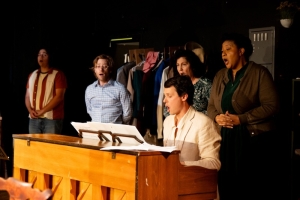
The evening begins before the play does. At the entrance of the theater, there was a map and pins for the audience to pick up and place on the town where they grew up. Naturally, I grabbed one and pinned my hometown of Lincoln, Nebraska. It was a fun touch that fit the play’s idea that Grover’s Corners could be any town, anywhere. Then, as I settled into the cozy upstairs theater, the whole cast gathered and sang John Denver’s “Take Me Home, Country Roads.” It was a warm, welcoming moment that made the small space feel like a front porch, and it flowed right into Act I.
Directed by Matthew Masino, the story takes place in Grover’s Corners, New Hampshire, beginning in 1901. The Stage Manager, played by Dontaye Albert, guides us through the town and the daily routines of the Gibbs and Webb families. Act I opens with a paper boy chatting with Dr. Gibbs (Timothy Griffin) as the town wakes up. Act II jumps ahead three years as neighbors George (Sam Jones) and Emily (Hannah Loessberg) fall in love and prepare to marry. Act III moves to the town cemetery, where the story turns somber.
The set is as simple as it gets: a wood floor, a stabilizing pole in the middle of the stage, two kitchen tables, some chairs, two ladders, a piano, and a little shelving. The actors improvise with imaginary cups, newspapers, plates, and even an invisible horse. This is by design, since Wilder’s script famously asks for “No Curtain, No Scenery” so that the audience focuses on the relationships. As a very visual person, I’ll admit it took some effort. The missing coffee mugs and kitchen set-up asked a lot of my imagination, though I understand the limits of a small-budget production. One of my favorite uses of the minimal set came when George and Emily climbed ladders to talk to each other from their bedroom windows. It was a simple, charming way to show the first sparks of their young love, and I enjoyed seeing how a couple of ladders could stand in for two houses. I later learned that the ladders are a common staple for the set design of this play.
The opening was the hardest part for me. The Stage Manager begins by mapping out Grover’s Corners, from the churches and homes to the farms and stores, and I had trouble picturing the layout and character of the town. Things settled once the story got going, with the paper boy, Dr. Gibbs, and the neighboring families going about their mornings.
Albert’s Stage Manager is the heart of this production. He carries the show with a smooth voice and strong storytelling, and he tosses in just enough comedy to keep the audience engaged. I enjoyed the little facts about the town, from its population to the land to the church denominations. At one point, he and Mr. Webb, the town’s newspaper editor, invite three audience members to ask questions about the town, including whether people drink, whether the town has any culture, and what it plans to do about its injustices. It’s a fun, interactive moment that make the play feel more alive.
Hannah Loessberg is another standout as Emily Webb. She is believable as a curious, bright young girl, with the mannerisms, joy, and excitement for life you would expect, and she looks young and full of promise. Over the course of the play, we watch her mature from a naive teenager to a young woman marrying George, and Loessberg captures that growth well. Then she shifts the mood completely in Act III, with believable anxiety and sadness as Emily faces her death and the life she’s leaving behind. The audience around me was clearly moved, and some were brought to tears.
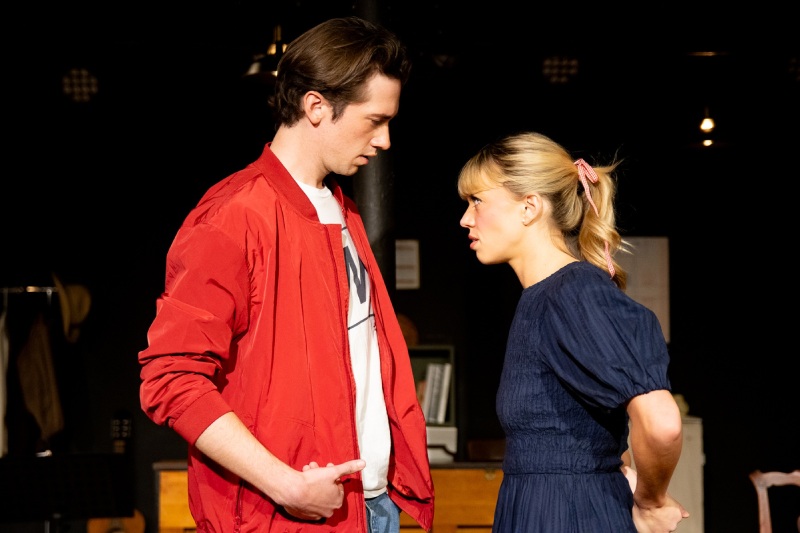
Sam Jones and Hannah Loessberg in Lazy Susan Theatre Co.'s Our Town.
Sam Jones plays George Gibbs, and he’s a good fit for the part. He’s always on cue with his lines and shares strong chemistry with Emily. At times, I wasn’t fully convinced by him as a teenage boy, which may be partly because he’s so tall. He definitely comes across as juvenile, though there were a few moments where I could tell he was acting. In the graveyard scene, however, he cried real tears at the loss of his wife, which added to the emotion of that scene.
Lauren Slone is equally strong as Mrs. Gibbs, George’s mother. She owns her lines and delivers them with passion, and she is a convincing, strong-willed mother who works hard to keep her home running. Her performance takes a sharp turn in Act III. In the graveyard, she is hardened and stone-faced, with little to say and no joy left, which makes the loss of her character hit even harder.
Live music plays between scenes, mostly on piano and guitar. I loved it. It was upbeat and gave the show a charming rhythm as we moved between the Gibbs and Webb homes. The pianist turns out to be Daniel Martin, who also plays Simon Stimson, the town’s organist. Martin is a wonderful pianist and does a great job as a grumpy, pessimistic drunkard.
The lighting and sound design did a lot of work on a bare stage. The lights shifted to show the difference between day and night, and in the graveyard they captured the darkness and unease of the scene. Soft cricket sounds played during the night scenes and in the cemetery, which helped set the mood without any set pieces. This is one reason the graveyard still worked emotionally, even though I wasn’t fully convinced by the setting.
The costumes also didn’t fully match the setting. Some actors were dressed for the early 1900s, while other outfits looked like they came straight out of the 80s. A red windbreaker, jeans, and high-top sneakers felt out of place to me. Even on a tight budget, I wish there had been a little more effort to bring the costumes together.
The pacing was a bit slow for me in the first two acts. The love story builds gradually, and although the wedding was fun to watch, it lacked real drama. The piano transitions and the narrator kept me engaged, and the show picked up speed after the wedding. I do wish we had seen more of the life events leading up to the wedding and then the deaths, since the play skips ahead in time. That is how Wilder wrote it, but it left me wanting more.
The real drama comes in the final act. For most of the show, life in Grover’s Corners is simple and comforting, and no one faces real hardship until Act III. In the cemetery, we learn that Mrs. Gibbs has passed, that Emily has died in childbirth, and that Simon Stimson has taken his own life. The graveyard scene is dark and heavy, with the “dead” sitting still in chairs, and Emily realizes how badly she wants to be alive. The actors did a good job with it. Still, the lack of set design kept me from fully believing the graveyard, and I felt that scene needed more to sell it.
I walked out feeling a bit melancholy. The play leaves you with the dead in the graveyard wishing they had appreciated life more, and with Emily revisiting her own birthday, wanting nothing more than for her parents to really see her. It’s one of those plays that sends you home reflecting on your own life and wanting to be more present and joyful in everyday moments. The pin I placed in Lincoln, Nebraska earlier in the night had me thinking back to my own days growing up. The world around us changes day after day and year after year, and Our Town reminds you to appreciate the present and look around often.
The show runs about 2 hours and 25 minutes with two 10-minute intermissions. I’d recommend it to anyone who loves American history and to anyone who enjoys supporting local theatre companies. If you’re in the mood for an old-time, thought-provoking story about enjoying life in the moment, because it can be unexpectedly taken from us even when everything feels comfortable and normal, this is a good pick.
Content Warning: Our Town contains themes of death and dying, discussions of mortality and the afterlife, and discussions of alcoholism, war, suicide, and death in childbirth. Act III, set in a cemetery, is especially heavy, so please keep this in mind when deciding whether the show is right for you or your family.
Our Town is playing at Lazy Susan Theatre Co. at the Greenhouse Theater Center, 2257 N. Lincoln Ave. in Lincoln Park, through December 13th. Performances are Thursdays through Saturdays at 8:00 p.m. and Sundays at 2:00 p.m. Tickets range from $19 to $34 and are available at lazysusantheatreco.org, with discounted tickets on HotTix.org. There is no late seating, so plan to arrive early.




Latest Articles
-
 ‘Our Town’ Finds Big Feelings in an Ordinary Small Town
Written by Bree Samani-McGrathI’ll admit I had never seen, read, or even heard of Our Town before opening weekend. All I knew going in was that it was an old-timey, early 1900s American play with a young love story set in a small…
-
 Citadel Theatre Captures the Magic of Old-Time Radio in It's a Wonderful Life: A Live Radio Play
Written by Ken PayneThere is something undeniably captivating about witnessing the magic of old-time radio brought to life on stage. In an era long before television dominated living rooms, talented performers relied solely on their voices, sound effects, and the audience's imagination to…
-
 The Latest 'Dante 360' Leads to Paradise, Particularly for Dante-philes
Written by Bill EslerDante 360 Virgil Edition is the latest iteration of a performance work first launched in 2021. Directed by Peggy Garvey, the recurring presentations are billed as an education program, aimed to illuminate 14th century Italian poet Dante Alighieri’s three-part Divine…
-
Genuine Heart Meets Classic Charm in Drury Lane’s Sunny Holiday Revival of Annie
Written by Ken PayneAlmost fifty years after she first sang her way into Broadway history, the sun is still shining bright in Oakbrook Terrace as Drury Lane Theatre brings the beloved holiday classic Annie back to its stage for the first time in…
Does your theatre company want to connect with Buzz Center Stage or would you like to reach out and say "hello"? Message us through facebook or shoot us an email at This email address is being protected from spambots. You need JavaScript enabled to view it..
*This disclaimer informs readers that the views, thoughts, and opinions expressed in the text belong solely to the author, and not necessarily to Buzz Center Stage. Buzz Center Stage is a non-profit, volunteer-based platform that enables, and encourages, staff members to post their own honest thoughts on a particular production.