

Ken Payne
Goodman’s Iceboy! Is a Full‑Tilt Blast of Comic Mayhem
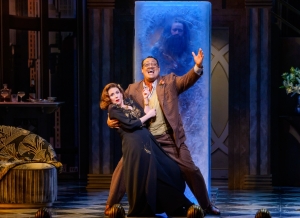
Goodman Theatre’s Iceboy! arrives as a gleefully off the rails musical that blends Broadway glamour, Neanderthal chaos, and theatrical myth making into one of the most delightfully strange premises to hit Chicago in years. It’s a satire, a love letter to showbiz, and a playful reimagining of how Eugene O’Neill might have found inspiration for The Iceman Cometh - if history had taken a wildly different turn.
Set in 1939, Iceboy! (officially and appropriately titled Iceboy! Or The Completely Untrue Story of How Eugene O’Neill Came to Write “The Iceman Cometh”) follows Broadway superstar Vera Vimm, who purchases the newly thawed 40,000‑year‑old Neanderthal after he’s discovered in the Arctic. An orphan herself, Vera risks the last of her money because she sees in Iceboy not just a curiosity, but the possibility of a son. Once he thaws, “Iceboy” unexpectedly becomes a theatrical sensation, charming Manhattan and quickly rising to stardom. His meteoric fame threatens Vera’s own spotlight, creating a comic rivalry as she scrambles to maintain her status.
Meanwhile, playwright Eugene O’Neill becomes fascinated by Iceboy’s sudden cultural impact. In this fictionalized retelling, Iceboy’s presence and persona inspire O’Neill to write The Iceman Cometh, intertwining the Neanderthal’s improbable celebrity with one of American theatre’s most iconic works. The musical plays as a satirical backstage romp - part showbiz fable, part absurdist comedy - where ambition, ego, and theatrical legend collide, all delivered with a cheerful, madcap sensibility that feels straight out of the Mel Brooks playbook. The tone is broad, cheeky, and joyfully irreverent, embracing the kind of anything goes comic mayhem Brooks perfected in The Producers and Young Frankenstein.
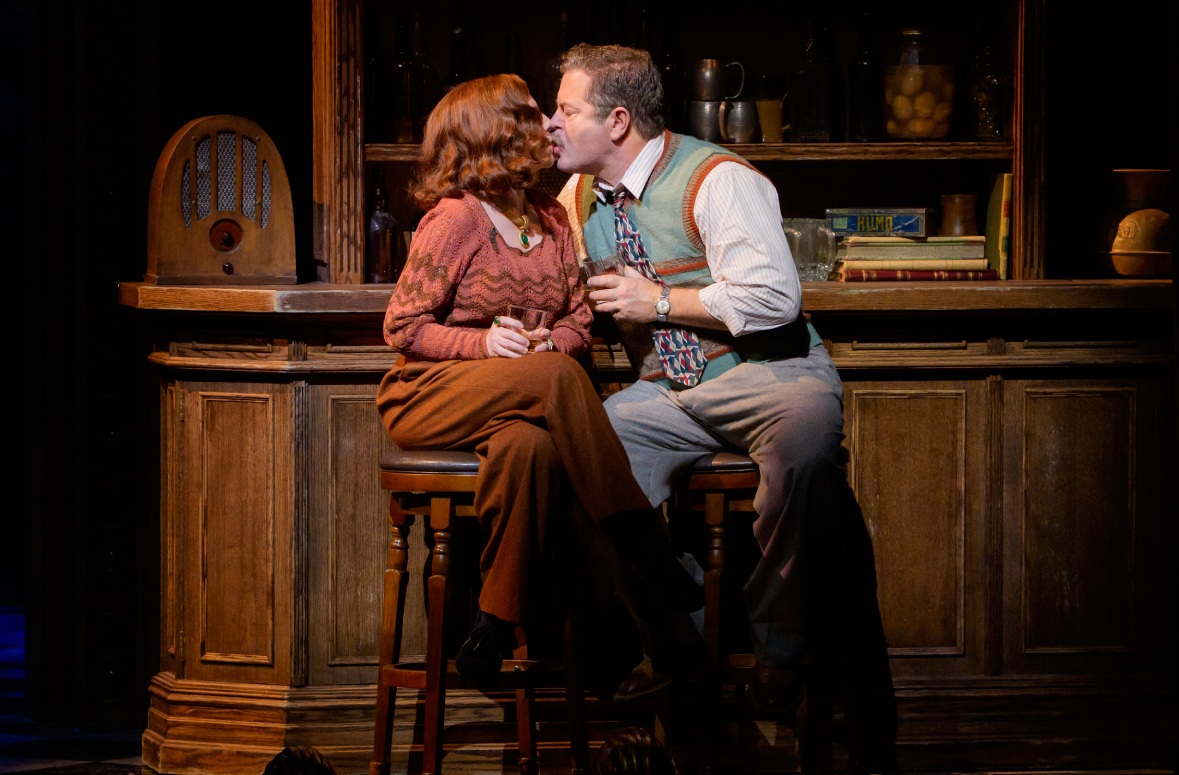
Megan Mullally as Vera Vimm and Nick Offerman as Eugene O'Neill in Iceboy! at Goodman Theatre. Photos by Todd Rosenberg.
To appreciate just how boldly Iceboy! reframes O’Neill’s legacy, it helps to remember what The Iceman Cometh actually is.
O’Neill’s future Pulitzer Prize offering inspired a four-hour film that’s essentially a parade of drunks in a dim bar, each clinging to dreams they’ll never pursue - the bar itself a metaphor for their inability to move forward, trapped in the same place both physically and emotionally. The 1973 film adaptation centers on the down and out patrons of Harry Hope’s saloon in 1912 Greenwich Village. These men - alcoholics, former revolutionaries, disgraced professionals - spend their days drowning in booze and clinging to “pipe dreams” of future redemption.
Their routine is disrupted when charismatic salesman Theodore “Hickey” Hickman arrives - sober, zealous, and determined to force everyone to abandon their illusions. Hickey’s mission to strip the barflies of their comforting fantasies leads to emotional unraveling, bitter confrontations, and ultimately a chilling confession about his own past. The story is a tragic, philosophical exploration of hope, delusion, and the brutal cost of facing reality.
All of that brooding, booze-soaked existentialism makes Iceboy!’s approach even more refreshing. Where O’Neill’s world traps its characters, this musical unleashes its own with joyful abandon - led by an ensemble so charismatic and so sharply funny that the show practically vibrates with life.
Guiding the production is director Marc Bruni, who shapes the show with crisp timing and a clear sense of comic architecture, keeping its wild premise buoyant without letting it unravel. The music by Mark Hollmann gives the story a bright, mischievous pulse, while the lyrics by Hollmann and Jay Reiss sharpen the humor with clever turns and unexpected punchlines. The book by Erin Quinn Purcell and Reiss balances absurdity with emotional undercurrents, giving the characters room to land both jokes and genuine moments. Joann M. Hunter’s choreography adds another layer of invention, using movement to heighten the show’s playful spirit and amplify its theatrical momentum.
It certainly helps that Iceboy! is powered by an outrageously talented and instantly likeable ensemble. Husband and wife duo Nick Offerman and Megan Mullally make a dynamite team - Offerman bringing his signature deadpan charm to Eugene O’Neill, the same understated precision that’s made him beloved in Parks and Recreation, Devs, and The Last of Us. Mullally, best known for her Emmy winning turn as Karen Walker on Will & Grace, her unforgettable Tammy II opposite husband Nick Offerman on Parks and Recreation, and her Broadway run in How to Succeed in Business Without Really Trying, delivers a riotously funny, razor sharp performance as Broadway titan Vera Vimm. She tears into the role with fearless comic bravado and vocal firepower that reminds you she’s a true musical theatre pro - her belt is thrilling, her phrasing wickedly playful, and her comedic musicality is a show in itself. Few performers can detonate a punchline the way Mullally can.
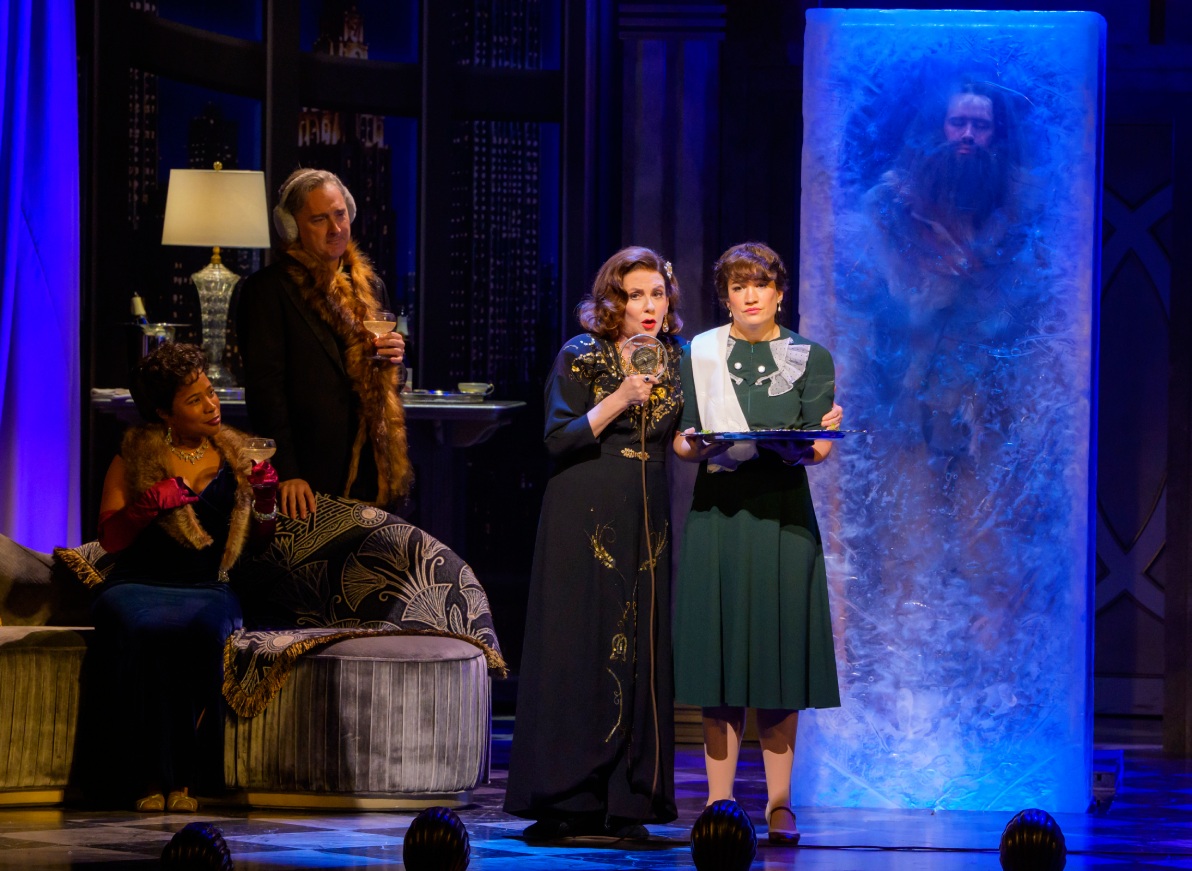
(L-R) Melanie Brezill, Shawn Pfautsch, Megan Mullally, SarahStiles and Grey Henson in Iceboy!
Cedric Yarbrough, best known for Reno 911! and Speechless, is terrific as Floyd Richards, Vera’s devoted lover and perpetually stressed playwright. He brings a warm, rumpled charm to the role, layering Floyd’s desperation with impeccable timing, sly vocal humor, and a steady stream of perfectly landed one-liners. His presence gives the show a grounded comic pulse that keeps the chaos humming - and his baritone is impressive.
Chicago favorite Alex Goodrich is a delight as Frankenstein, one of Vera’s long-suffering caretakers, layering the role with buoyant physical comedy and a wonderfully off-kilter energy that fits the show’s boisterous comic verve.
As Iceboy or “Jeff,” Grey Henson is a revelation - wide eyed, instinctive, and musically explosive. He plays the Neanderthal with such innocence and uninhibited theatrical gusto that the audience can’t help but root for him. He’s a genuine surprise as well, offering several scene-stealing moments that deepen the show’s comic momentum and give its wild energy an extra spark.
And Sarah Stiles, as Lambert, Vera’s whip‑smart, perpetually overwhelmed assistant, makes every appearance count with her explosive comedic instincts and razor‑precise delivery. Her timing is immaculate - every flustered aside, every clipped retort, every moment of mounting panic lands with such clarity and control that she elevates even the smallest beat. Stiles has a way of shaping a line so it hits with both intelligence and impact, turning Lambert’s exasperation into one of the show’s most consistently funny throughlines.
Together, this ensemble - Offerman, Mullally, Yarbrough, Henson, Stiles, Goodrich, and a bench of other strong players rounding out the cast - forms an ecstatically silly comedy machine, a group so talented and irresistibly likeable that the laughs never let up and every performer feels essential to the show’s delirious momentum.
The musical numbers are wonderfully fun. Songs like the opening number “Historic Find,” the gloriously unhinged “Can You Call Me ‘Mama’?,” and the full company showstopper “Hooray for Iceboy!” set the tone for the musical’s raucous spirit. Each one is packed with sharp wit, big Broadway energy, and the kind of gleeful absurdity that keeps the audience laughing long after the button. “Historic Find” opens the show with a clean burst of discovery‑driven momentum, “Can You Call Me ‘Mama’?” leans into Mullally’s sharp comic instincts, and “Hooray for Iceboy!” brings the full company together for a lighthearted, good‑natured celebration. This sample size of songs highlights how musically nimble and consistently funny Iceboy! is - a score that shifts easily between cleverness, silliness, and moments of heightened theatrical play.
One of the funniest musical numbers in the show is “Marry Me,” sung with perfect comic contrast by Grey Henson and Sarah Stiles. In it, Iceboy proposes to Lambert with disarming sincerity, offering what he believes are tender declarations of affection - only to fold in a series of prehistoric “courtship traditions” drawn from his caveman understanding of romance, throughout the song telling her, “I want to take you from behind.” The result is a wonderfully off‑balance duet that lands as one of the show’s most genuinely hilarious moments.
Adding to the show’s irresistible charm is the fantastic Art Deco set designed by Paul Tate Depoo, which instantly places us inside Vera Vimm’s lavish living room - all gleaming lines, bold geometry, and glamorous period detail. Depoo’s design captures the theatrical excess of 1939 Broadway while giving the actors a playground of visual delight. On each side of the stage, Eugene O’Neill’s writing desks sit like dueling stations of inspiration and frustration, a clever touch that keeps his presence woven into the action. And, true to O’Neill’s legacy, there’s always a bottle within reach, a sly nod that becomes both a running joke and a thematic anchor. It’s a smart, stylish environment that supports the comedy while grounding the show in a richly imagined world.
Iceboy! Or The Completely Untrue Story of How Eugene O’Neill Came to Write “The Iceman Cometh” is an outrageously inventive, joy-charged burst of musical comedy that proves Goodman Theatre can still surprise us in the best possible ways. With its fearless cast, sharp writing, and deliriously fun score, it’s the kind of show that sends you out grinning and grateful for the sheer imagination on display. Iceboy! runs through August 9 at Goodman Theatre and stands as one of the most riotously entertaining nights out you’ll find this summer.
Very highly recommended.
For tickets and/or more show information, click here.
Where Identity Slides: Steppenwolf’s Mesmerizing Catch as Catch Can

Mia Chung’s Catch as Catch Can, which premiered with Page 73 in New York in 2018, arrives at Steppenwolf Theatre - one of Chicago’s most dynamic and daring artistic institutions - with a production that immediately embraces the play’s slippery, shape-shifting nature. Chung’s script thrives on emotional volatility and fractured identity, and Steppenwolf’s staging taps into that energy from the outset, preparing the audience for a world where the familiar can tilt, distort, and reassemble without warning.
Catch as Catch Can begins with the familiar comfort of kitchen-table talk between two New England mothers, Roberta Lavecchia and Theresa Phelan. Under Amy Morton’s direction, those early scenes feel lived-in and deceptively ordinary - two longtime friends trading stories, worries, and family updates with the shorthand of people who have known each other for decades. But as the play unfolds, that everyday warmth becomes the launching point for a story that veers into far more disorienting territory. The return of Tim Phelan unsettles the delicate balance between the Lavecchias and the Phelans, stirring up old assumptions, unspoken resentments, and long-dormant family myths. What begins as a simple homecoming slowly reveals itself as a catalyst for emotional slippage, where memories blur, loyalties shift, and the characters’ sense of who they are - and who they have been to each other - starts to fracture. Morton guides this progression from domestic realism to psychological unraveling with remarkable control, allowing the play’s humor, tension, and creeping dread to coexist in the same breath.
The production’s boldest device - three actors portraying all six characters - becomes the heartbeat of the evening. Gary Cole (as Roberta and Robbie Lavecchia), Audrey Francis (as Lon and Daniela Lavecchia), and Tim Hopper (as Theresa Phelan and Tim Phelan) deliver performances that are nothing short of remarkable. Morton directs them with a sculptor’s precision, shaping each transformation through voice, posture, and energy rather than costume changes or props. The actors rarely add so much as an apron, a pair of glasses, or a purse to differentiate roles; instead, they rely on the smallest shifts in breath, cadence, or physical weight. Even the simplest physical actions - threading a needle, folding laundry, lifting a heavy picture onto a wall, or a mother rolling out her famous meatballs - become character markers, subtle cues that signal who is speaking without ever breaking the flow of the scene. At times, it feels as though six fully realized people are occupying the room, even though only three bodies ever stand onstage.
After the opening scene, it took me a few minutes to recalibrate to the production’s rhythm, especially as the actors began switching characters with such speed and minimal visual cues. But that adjustment period is brief. Before long, the doubling feels not only natural but essential, a kind of theatrical language the production teaches you how to read. Once you settle into its cadence, the transformations become thrilling rather than disorienting, sharpening the play’s emotional stakes and deepening its sense of unease.
The rapid-fire switching becomes its own kind of theatrical whiplash. An actor may leap from one character to another every other sentence, often without a single visual clue, and Morton ensures each pivot lands cleanly without losing an ounce of emotional clarity. The play becomes a fault line in constant motion, where identities slide, collide, and splinter beneath the surface.

Gary Cole, Tim Hopper and Audrey Francis (L-R) in Steppenwolf Theatre's Catch As Catch Can. Photo by Michael Brosilow.
All three performers - Gary Cole, Audrey Francis, and Tim Hopper - are longtime Steppenwolf ensemble members, bringing a shared artistic vocabulary that sharpens every transformation onstage.
Cole toggles between Roberta’s brittle warmth and Robbie’s restless bravado with astonishing finesse. This production marks his first return to a Chicago stage in more than 25 years, and it is a triumphant homecoming. He is known to many for Office Space, Talladega Nights, HBO’s Veep, NCIS, and one of my favorite roles - Mike Brady in The Brady Bunch Movie and its sequel. Cole reminds audiences that his stage roots run deep. As Roberta, he carries a soft, fluttering concern that sits right behind the eyes; as Robbie, that same gaze sharpens into something quicker, hotter, and more impulsive. His ability to pivot between those energies with nothing more than a shift in breath or a recalibrated stance makes each transition feel both seamless and startling. It is a performance built on precision, but it never feels mechanical.
Francis brings an equally impressive duality to Lon and Daniela. In addition to being a Steppenwolf ensemble member, she now serves as the company’s artistic director alongside Glenn Davis, a role that underscores her influence on Chicago’s theatrical landscape. Known for standout performances in The Herd, Dance Nation, her work on Chicago Med, and directorial skill in You Will Get Sick, she grounds Lon with a quiet, blue-collar steadiness, a man who absorbs the world before reacting to it. Daniela, by contrast, is all edges and alertness, her movements tighter and her voice pitched with a nervous brightness that hints at deeper cracks. Francis masterfully switches entire gravitational centers. The clarity of her physical vocabulary makes each character instantly legible without a single costume change.
Hopper’s pairing may be the most haunting of the three. With Steppenwolf credits that include The Crucible, The Flick, and Buried Child, he brings a raw, unsettling honesty to both Theresa and Tim. His Theresa is a portrait of unraveling vulnerability, a woman whose emotional seams are beginning to split in ways she can barely articulate. His Tim, meanwhile, carries the quiet desperation of someone trying to hold himself together even as the ground shifts beneath him. Hopper plays both roles with a volatility that feels almost dangerous. The characters mirror and distort one another, creating an emotional echo that deepens the play’s sense of unease. Watching him slip between them is like watching a reflection break apart and reassemble in real time.
Together, these performances form the core of the production’s power. With Morton’s direction guiding every pivot, the trio creates the uncanny sensation that the stage is populated by twice as many people as are physically present. Their transformations are so quick and so clean that the audience must stay alert, tracking identities as they slide, collide, and reform. It is a feat of acting that is both technically dazzling and emotionally resonant, and it is the reason the play’s unstable world feels so alive.
As the story darkens - touching on mental health, racism, cultural tension, and the fragile scaffolding that holds families together - the doubling amplifies the instability. Chung threads moments of racial bias and coded language into the fabric of these families’ interactions, revealing how prejudice can hide inside the most casual exchanges and how easily it can rupture long-standing bonds. Morton understands that the play’s power lies in this slippage, and she allows the actors to push into the unsteady terrain without ever losing emotional truth. The result is a production that feels intimate yet vertiginous, a domestic drama that slowly cracks open into a haunting exploration of identity and the roles we inherit, perform, and sometimes cannot escape.

Andrew Boyce’s scenic design is a quiet marvel, giving the production a sense of dimensionality that feels both naturalistic and subtly disorienting. The main playing space is an open living room, flanked on one side by an entryway and a partial view into the kitchen, and on the other by a long hallway that suggests the deeper interior of the house. Just beyond the living room, another room is visible past a second hallway, creating the impression of a home that extends well beyond the edges of the stage. Boyce’s layout allows the audience to feel as though they’re peering into a fully lived-in environment, one with corners, thresholds, and unseen rooms that hold their own histories. Yuki Nakase Link’s lighting deepens this effect, subtly sculpting each corridor and doorway so the house seems to breathe with possibility - sometimes warm and inviting, sometimes shadowed with tension. It is a multidimensional design that grounds the play’s domestic realism while subtly reinforcing the sense that something inside this home - and inside these families - is evolving.
In their Artistic Director note, Glenn Davis and Audrey Francis frame Catch as Catch Can as a rare convergence of timing, artistry, and ensemble history - a production long delayed, now finally realized with the team that first set out to make it in 2020. They speak to the play’s uncanny pull, describing how Chung’s story has embedded itself in the company’s imagination, refusing to loosen its grip. For them, the doubling is not just a theatrical device but a test of the ensemble’s virtuosity, a chance for Steppenwolf to stretch its actors toward the edges of what performance can hold. And at the heart of their message is the idea that the play’s exploration of identity, home, and the selves we construct makes it a fitting capstone to the theatre’s 50th anniversary season - a reminder of how Steppenwolf’s long-standing commitment to family drama, artistic risk, and shared storytelling continues to shape its legacy.
Catch as Catch Can ultimately lands with the force of a quiet detonation, its emotional aftershocks lingering long after the final blackout. Morton and her trio of actors craft a world that feels both intimate and treacherous, a place where identity slips, refracts, and reforms in ways that are as unsettling as they are compelling. It is the kind of production that rewards close attention and invites conversation long after you’ve left the theatre - about family, perception, and the narratives we inherit without realizing it. Catch as Catch Can runs at Steppenwolf through July 12, with performances throughout the week, and it is very highly recommended for anyone who craves theatre that challenges, unsettles, and stays with you.
For tickets and/ or more show information, click here.
This review is proudly shared with our friends at www.TheatreInChicago.com.
- CATCH AS CATCH CAN
- Steppenwolf Theatre
- Gary Cole
- Audrey Francis
- Tim Hopper
- Glenn Davis
- Mia Chung
- Amy Morton
- chicago theatre reviews
- Andrew Boyce
- Yuki Nakase Link
- chicago theatre
- Chicago events
- Chicago stage
- live theatre
- on stage
- Theatre Ensemble Work
- psychological drama
- Multirole Acting
- theatre community
Bargatze’s Big Dumb Eyes Tour Lands in Rosemont With Subtle Force

Nate Bargatze’s Big Dumb Eyes tour made its stop at the Allstate Arena in Rosemont with the steady, understated presence that has become central to his appeal. Bargatze continues to draw humor from the small missteps and everyday confusions that shape his storytelling, easing the audience into his rhythm rather than pushing for big moments. His unhurried delivery works surprisingly well in a venue of this size, creating a sense of shared focus that settles over the room as he builds each joke with quiet precision.
This powerhouse comedy tour is anchored by host Julian McCullough, whose easygoing charm and quick-hit crowd work set the tone for the night before the headliner ever steps onstage. He’s joined by a sharp trio of comics - Greg Warren, Gary Vider, and Jonnie W - each bringing a distinct comedic style that keeps the momentum building from set to set. Warren’s dry, story-driven humor, Vider’s understated oddball delivery, and Jonnie W’s musical-comedy flair create a well-balanced undercard that feels like a full evening of stand-up on its own. Together, they form a tightly assembled lineup that primes the audience perfectly for the main event.
Julian McCullough, Greg Warren, Gary Vider, and Jonnie W will all be making upcoming appearances at Zanies Rosemont, giving Chicago-area comedy fans several chances to catch them live. McCullough returns to the club on June 5–7, while Greg Warren is scheduled for a special event weekend on May 22–23. Jonnie W will headline Zanies Rosemont on July 26, and Gary Vider’s next Chicago-area dates are at Zanies Chicago on March 27–28, offering multiple showtimes across both nights.
Bargatze has been performing in arenas for some time now, and the format suits him more naturally than one might expect. The in-the-round staging keeps him accessible from every direction, while the large video screens ensure that even the most subtle expressions read clearly throughout the space. It is an effective setup for a comedian whose style relies on nuance rather than volume. In a venue as large as Allstate, laughter does not always erupt all at once - it spreads gradually, section by section, until the entire arena is moving with the same steady momentum.
A significant portion of Bargatze’s material continues to revolve around his family, with stories about parenting, marriage, and the everyday negotiations that come with trying to make sense of the world alongside the people closest to you. But he also branches into the absurdities of modern life, touching on everything from AI to self-driving cars to couples therapy - and even the baffling challenge of buying a horse, because, as he points out, who actually knows the price of a horse? These moments are not exaggerated or heightened for effect. Instead, he treats them with the same calm, observational tone that defines his work. The humor comes from the honesty of the situations and the quiet recognition they spark, especially for audiences who see their own households and daily frustrations reflected in his.
His Rosemont appearance is one stop in a long stretch of dates as the Big Dumb Eyes tour continues across major arenas nationwide. The upcoming schedule includes cities throughout the Midwest, East Coast, and South, each offering a chance for audiences to experience how his understated approach translates to rooms of this scale. At this point, Bargatze stands among the strongest stand-ups touring at the arena level, not because he relies on spectacle, but because his material remains consistent, grounded, and effective no matter the size of the venue.
In the end, the Allstate Arena stop underscored why Bargatze’s rise has felt so steady and assured. His comedy does not demand attention - it earns it through clarity, timing, and a genuine connection to the everyday experiences he describes. For a comedian whose style is built on understatement, filling an arena might seem counterintuitive, yet he makes the space feel surprisingly intimate. It is a testament to his craft and a clear sign that his place on the arena circuit is well deserved.
Whammy, Indeed: Koechner’s Stand‑Up Evolves at The Den

David Koechner stormed into The Den Theatre’s Mainstage this weekend with the kind of unruly, big‑hearted presence that instantly reminded audiences why he had been a comedy fixture for more than two decades. People knew him as the blustering Champ Kind from Anchorman, the delightfully inappropriate Todd Packer on The Office, and from scene‑stealing turns in Waiting…, Talladega Nights, and Krampus. But the Koechner who took the stage here was a comic in full evolution, digging into the raw, strange, deeply human corners of his own story.
His set leaned heavily into his Missouri upbringing, though not in the polished, memoir‑ready way you might expect. Koechner unspooled these memories as if he were rediscovering them in the moment – childhood chaos, family quirks, and the odd rhythms of small‑town life all collided and escalated into full‑tilt comedic spirals. His Second City roots were unmistakable, and the Chicago connection ran deeper than nostalgia; Koechner lived in the city for nine years, and that long stretch of his life seemed to pulse through the performance. He shifted voices, dropped into characters, and built entire scenes out of thin air, giving the night a sense of spontaneity that felt tailor‑made for The Den’s intimate Mainstage.
What defined this chapter of his stand‑up was how much he fed off the room. Koechner treated the audience like co‑conspirators, not spectators. A stray laugh or a bold comment could send him veering off script, and those detours often became the highlight of the night. There was a looseness to the show – a sense that anything could happen – that made the experience feel alive in a way only seasoned improvisers can pull off.
Although he tossed in a quick nod to the roles that made him a household name near the end of the set, he never leaned on them as a crutch. Still, hearing Champ Kind and Todd Packer delivered straight from the source was undeniably fun. The real draw was Koechner himself: messy, generous, unpredictable, and fully engaged. His weekend at The Den Theatre served as a reminder that he was not just a beloved character actor – he was a stand‑up with a singular voice, still sharpening it, still surprising himself, and still finding new ways to bring the audience along for the ride.
Koechner’s Mainstage run was rowdy, personal, and unmistakably his – the kind of night where you walked out buzzing, not because you saw Champ Kind live, but because you saw David Koechner exactly as he was now: a comic still evolving, still swinging big, and still wildly fun to watch.
This review is proudly shared with our friends at www.TheatreInChicago.com.
Spaceman: Into the Quiet Terror of the Void

Spaceman, presented by [producingbody], touches down at The Edge Off-Broadway with a quiet, unnerving force, pulling audiences into the fragile headspace of an astronaut drifting far from home and even farther from certainty. Under Eric Slater’s beautifully calibrated direction, playwright Leegrid Stevens’ one‑woman odyssey becomes less a sci‑fi spectacle than a psychological excavation, using isolation, sound, and the illusion of the vastness of space to illuminate the even vaster, far more treacherous terrain of the human mind. What unfolds is intimate, disorienting, and strangely beautiful - a mission that feels as internal as it is interstellar.
Commander Molly Jennis, played with raw precision by Ashley Neal, anchors the entire piece, and Stevens places her in a cockpit that feels less like a command center and more like a sealed chamber where every thought ricochets back at her. Seven months from Earth and en route to Mars on a mission meant to help establish the first human colony, Molly exists in a liminal space where even the simplest exchange with Houston (a.k.a. Rob, voiced by Slater) arrives with a ten‑minute delay. That communication gap becomes its own form of psychological erosion - a constant reminder of how far she’s drifted from help, from home, and from anything resembling real‑time human connection.
But Molly’s mission is no longer just scientific. It’s personal. In this adaptation, the script’s original husband Harry is affectingly reimagined as Ari, Molly’s wife - also an astronaut - who died in a catastrophic space mishap, a loss that shattered her sense of purpose and left her clinging to a belief that borders on spiritual desperation. Convinced that Mars is the gateway to the afterlife, she pushes forward not only to complete her assignment but in the hope of finding Ari waiting for her on the other side of the red planet’s dust and silence. That longing becomes the engine of the play, fueling her resolve even as it accelerates her unraveling.
Life aboard the ship only intensifies that disintegration. Molly faces a barrage of indignities and challenges that chip away at her humanity: the crushing loneliness of months without touch or immediacy; the numbing boredom of endless routines; the hygiene compromises of sponge baths and wipes in place of a shower; and the messy, often humiliating realities of zero‑gravity bathroom logistics that turn even basic bodily functions into small disasters. These details aren’t played for cheap laughs - they’re reminders of how fragile the body becomes when stripped of comfort, privacy, and gravity itself. Each inconvenience compounds her grief, her remoteness, and her growing conviction that the only meaningful destination left is the one where Ari might be found.
Neal channels all of this with remarkable control. Her Molly is a woman split between duty and delusion, the clipped professionalism of a trained astronaut slowly fraying into paranoia, longing, and hallucinatory hope. Neal’s performance is built on micro‑shifts - the tightening of her jaw, the flicker of yearning behind her eyes, the way her voice strains to maintain authority even as her internal compass spins. She makes Molly’s belief in Ari’s presence feel both irrational and heartbreakingly human.
The plot circles her in increasingly suffocating loops, blurring memory, mission, and metaphysical longing until the audience is never quite sure what’s real and what’s the product of a psyche pushed past its limits. Yet even within that pressure, the play finds brief, unexpected flickers of levity - small human moments that remind us Molly is still fighting to stay tethered to herself. It’s a performance - and a character - shaped as much by silence, distance, bodily strain, and cosmic grief as by the script itself.

Ashley Neal in SPACEMAN from [producingbody] now playing through June 13 at The Edge Off-Broadway.
The production design at The Edge Off‑Broadway becomes an essential partner in Molly’s unspooling, transforming the cozy 50‑or‑so‑seat venue into an airtight capsule that pulls the audience directly into her orbit. A lone captain’s chair sits at the center of the cockpit, surrounded by glowing computer screens that flicker with data like a heartbeat she’s trying desperately to trust. Her only living friend is a small, responsive plant that tilts and bends as though it’s trying to understand her, a fragile tether to something organic in the endless dark. But she also has Jen (Sadieh Rifai) - the ship’s AI voice whose constant presence fills the silence with a companionable, sometimes unsettling intimacy. Throughout the play, the low, constant hum of the rocket engine underscores every moment, a sonic reminder of the machine that keeps her alive even as it isolates her. Lighting is used with surgical precision: tight, concentrated beams that lock onto Molly and amplify her intensity, then suddenly widen into sweeping celestial washes that pull the audience into the vast, indifferent expanse outside her ship. When a meteor strikes the hull, the sound design erupts with visceral force, rattling the space and Molly’s nerves in equal measure. And in one of the production’s most ingenious touches, Allyce Torres - dressed entirely in black and nearly invisible against the cockpit’s shadows - moves objects with ghostlike stealth to create the uncanny illusion of zero gravity. That she also portrays Ari adds an extra layer of resonance, as if her presence is haunting the space even when Molly can’t see her. Every element works in concert to heighten the story’s tension and fragility, making the production not just a backdrop but a powerful, immersive engine driving the narrative forward.
Amy Carpenter, who helps shepherd the production as a producer, also understudies Molly Jennis - a dual role that underscores her investment in the piece’s dramatic and technical precision.
The production’s technical artistry is anchored by a trio of designers whose work deepens the play’s immersive pull. Taylor Dalton (executive producer/set design/costume design), Angela Joy Baldasare (sound designer), and Garrett Bell (lighting designer) craft an environment that feels both meticulously engineered and emotionally charged, each element reinforcing the story’s tautness, precariousness, and sense of cosmic seclusion.

Ashley Neal in SPACEMAN from [producingbody] now playing through June 13 at The Edge Off-Broadway.
Even before the lights go down, Spaceman begins tightening its grip. Audience members are required to seal their phones in Yondr pouches - those soft, magnetic lock bags used at concerts and comedy shows - and the effect is immediate. In such an intimate venue, the simple act of surrendering your device creates a subtle but unmistakable shift: the outside world goes quiet, your digital bind snaps, and a faint echo of Molly’s own isolation settles in. It’s a small, clever pre‑show ritual that primes the audience for the loneliness, disconnection, and suspended‑in‑the‑void feeling that defines her journey. By the time you take your seat, you’re already living in a version of her world - cut off, contained, and waiting for contact that won’t come quickly.
Spaceman is a singular, deeply immersive theatrical experience, the kind that sneaks up on you and refuses to let go. I felt myself drawn in further with each passing minute, the tension tightening and the stakes rising as Molly’s journey pushed deeper into the void. What lingered with me was the sensation of being slowly enveloped - not by spectacle, but by atmosphere. The production creates a kind of emotional gravity, a pull that grows stronger the longer you sit with Molly’s loneliness, her determination, her fraying edges. By the time she reaches the farthest point from Earth, I realized I had traveled with her, carrying the same weight, the same longing, the same fragile hope that something - anything - might answer back.
At just 100 minutes with no intermission - and no re‑entry if you need to leave the theatre - Spaceman demands and rewards full immersion. It’s a tightly calibrated, deeply human piece of sci‑fi storytelling that lingers long after the final blackout, and it comes recommended. Spaceman runs May 19 - June 13 at The Edge Off-Broadway, with tickets priced $15-45. Tickets and additional information are available at www.producingbody.com.
This review is proudly shared with our friends at www.TheatreInChicago.com.
- SPACEMAN
- [producingbody]
- The Edge OffBroadway
- Leegrid Stevens
- Eric Slater
- Ashley Neal
- Allyce Torres
- Taylor Dalton
- Angela Joy Baldasare
- Garrett Bell
- scifi
- space adventure
- interstellar
- psychological drama
- Mars travel
- spacecraft
- Amy Carpenter
- chicago theatre
- live theatre
- on stage
- Chicago events
- Chicago plays
- Now playing
- outer space
- astronaut
Rocky in Concert Delivers a Knockout Night Despite Technical Stumbles

Marking Rocky’s 50th anniversary, Rocky in Concert arrived at the Auditorium Theatre in a highly anticipated Auditorium Philms presentation featuring the Chicago Philharmonic Orchestra performing Bill Conti’s score live. The setup is simple but effective: the film plays above the stage while the Philharmonic brings new clarity and presence to a soundtrack audiences know by heart. What emerges is a familiar story given a fresh sense of scale, where the music’s live energy adds texture without overwhelming the film’s grit, humor, and underdog charm.
At its core, Rocky remains one of the most enduring underdog stories in American cinema. The film follows Rocky Balboa, a small-time Philadelphia boxer and part-time debt collector who drifts through life with more heart than opportunity. When heavyweight champion Apollo Creed needs a last-minute opponent for a New Year's Day exhibition bout, he plucks Rocky from obscurity as a publicity stunt, figuring that "the Italian Stallion" makes for a good headline. What begins as a novelty match becomes a personal turning point: Rocky trains with a new sense of purpose, steadied by the quiet support of Adrian, the shy pet-store clerk who becomes the emotional anchor of his climb. The plot is simple, but its sincerity, its belief in small steps, second chances, and self-respect, has kept it resonant for fifty years.
The film's cast is a major reason it works as well as it does. Sylvester Stallone's performance is unvarnished and deeply human, capturing Rocky's mix of awkwardness, humor, vulnerability, and stubborn grit. Talia Shire brings a gentle, lived-in warmth to Adrian, charting her transformation from withdrawn to self-possessed with remarkable subtlety. Burt Young's Paulie is volatile but never one-note, and Burgess Meredith's Mickey, raspy, relentless, and unexpectedly tender, became one of the most iconic mentors in film history. Carl Weathers, as Apollo Creed, delivers a charismatic, razor-sharp performance that elevates the film's stakes; he is not a villain, but a showman whose confidence forces Rocky to rise to the moment.
Behind the scenes, the story of how Rocky came to be is almost as compelling as the film itself. Stallone wrote the screenplay in just a few days after watching the 1975 Muhammad Ali vs. Chuck Wepner fight, where Wepner, a heavy underdog, managed to knock Ali down and go nearly the full fifteen rounds. United Artists loved the script but wanted a bankable star in the lead; they offered Stallone a substantial sum, with reports ranging from $250,000 to $350,000, for the screenplay alone. At the time, Stallone was nearly broke, living in a small apartment with his wife and dog, and had only a handful of minor acting credits. Turning down that kind of money was, by any rational measure, a terrible idea. But he refused to sell unless he could play Rocky himself. Eventually, the studio relented, slashing the budget to under $1 million and agreeing to cast Stallone on the condition that the production stay lean and fast.
The gamble paid off beyond anything anyone expected. Rocky became a critical and commercial phenomenon, winning three Academy Awards, including Best Picture, and launching Stallone's career. But the deeper truth is that the film's authenticity is inseparable from Stallone's insistence on embodying the character he created. Rocky Balboa was not just a role; he was a reflection of Stallone's own belief that the long shot is still worth taking.

When Rocky reached the 1977 Academy Awards, it proved just as formidable as its title character, earning ten nominations and walking away with three major wins. The film claimed Best Picture, Best Director for John G. Avildsen, and Best Film Editing, beating out heavyweight contenders like Network and Taxi Driver. Sylvester Stallone received nominations for both Best Actor and Best Original Screenplay, a rare double honor that underscored how deeply his creative fingerprints shaped the film. Talia Shire, Burgess Meredith, and Burt Young all earned acting nominations, and Bill Conti’s propulsive score was recognized as well. For a low‑budget production made on less than a million dollars, Rocky’s Oscar run remains one of Hollywood’s most remarkable underdog victories.
The Chicago Philharmonic Orchestra, led by conductor James Olmstead, played Bill Conti’s legendary Rocky score with a precision and vitality that made the music feel newly alive. Those familiar fanfares, string surges, and brass punches carried a thrilling immediacy when performed by musicians you could actually watch working – bows flying, percussionists locking in the heartbeat of the training montages, trumpets cutting cleanly through the hall. Part of the fun for the audience was seeing just how much craft goes into a soundtrack they’ve heard for decades; every cue landed with crisp timing, and the orchestra’s energy fed directly into the crowd’s excitement. What emerged was more than accompaniment – a full‑scale performance that underscored just how essential the score is to the film’s spirit.
For all the strengths of the orchestra and the film, the evening wasn’t without a few technical hiccups. The film wasn’t cued up at the start, so the orchestra began playing before the movie rolled, leading to an awkward pause before things fully got underway, and once the screening began, the movie’s volume sat noticeably low for the first five to ten minutes. The fix came in the opposite direction, with the sound pushed so high that the dialogue became distorted, making it difficult to catch some of the film’s key lines or even hear the ringside announcers clearly calling the big fight finale. The imbalance proved distracting, especially in an otherwise strong presentation. Still, having seen other Auditorium Philms productions, I’m comfortable chalking this up as an outlier. Their track record is solid, and one uneven sound mix doesn’t diminish the ambition or appeal of the series.
Outside of the technical issues, one programming choice stood out as particularly curious: the musical director’s decision to feature “Eye of the Tiger” both after intermission and again at the end of the film. It’s an undeniably crowd‑pleasing anthem, but it belongs to Rocky III, not the 1976 original, and for Rocky loyalists it felt like an odd fit within a celebration of the first film’s legacy. With Bill Conti’s score already doing the heavy lifting, the addition of a theme from a later sequel created a momentary disconnect in an otherwise faithful presentation. However, many audience members cheered on the Survivor hit, so even if purists bristled, the moment still connected with a good share of the crowd.
Bottom line: even with a few mishaps and an unexpected music choice along the way, as someone who counts Rocky among my all‑time favorite films - a movie I revisit a couple of times each year - seeing it paired with a live orchestra was an experience that felt both familiar and entirely new. Hearing the Chicago Philharmonic bring Bill Conti’s music to life in real time added a dimension I didn’t know I was missing, and it made this 50th‑anniversary screening feel genuinely special. Auditorium Philms’ “In Concert” productions have already built a strong track record with their film‑in‑concert events, including recent presentations like Raiders of the Lost Ark and Harry Potter and the Order of the Phoenix. Their upcoming slate is just as appealing, with titles such as Top Gun: Maverick, Edward Scissorhands, and Home Alone 2: Lost in New York on the horizon.
In the end, Rocky in Concert proved that when a timeless film meets a live orchestra, the result is a reminder of why these stories stay with us.
To find out more about upcoming events at The Auditorium Theatre, click here.
This review is proudly shared with our friends at www.TheatreInChicago.com.
- Rocky in Concert
- Rocky Balboa
- Rocky
- Chicago Philharmonic
- Auditorium Theatre
- Boxing
- Oscar Winner
- classic film
- Auditorium Philms
- Sylvester Stallone
- Carl Weathers
- Burgess Meredith
- Talia Shire
- orchestra
- orchestra with film
- movies
- live orchestra
- Bill Conti
- James Olmstead
- Chicago events
- things to do in chicago
Satire With a Sword: City Lit’s Spirited New Musical 'Scaramouche'

City Lit Theatre is currently bringing the swordplay world of Scaramouche to vivid life, offering audiences a rare chance to experience this spirited tale of wit, rebellion, and theatrical daring onstage. With its blend of political intrigue, romance, and commedia‑dell’arte flair, City Lit’s production captures the adventurous sweep of the story while showcasing the company’s signature literary focus. It’s a lively, sharply drawn staging that reintroduces a classic hero to modern audiences with style and verve.
Scaramouche tells the story of André‑Louis Moreau, a quick‑witted young lawyer in pre‑Revolutionary France whose life is shattered when his closest friend is killed in a duel by an untouchable aristocrat. Forced into hiding, André‑Louis slips into a traveling commedia dell’arte troupe as an out‑of‑work actor, where - thanks to the help of Pierre Binet, who immediately takes a liking to him - he quickly rises to lead the company. Donning the mask of Scaramouche, the nimble, sharp‑tongued clown whose satire cuts deeper than any blade, he begins crafting and performing daring political farces that transform him from fugitive to folk hero. His journey winds through romance, duels, disguises, and the rising tide of revolution, all while he uncovers long‑buried truths about his own identity.
Though the story is best known from Rafael Sabatini’s 1921 novel, its most significant early-stage incarnation came through Jean Sibelius’s ballet‑pantomime Scaramouche, written between 1912 and 1913. Sibelius’s adaptation brought the mischievous commedia figure to life through music and movement rather than spoken dialogue, emphasizing the character’s blend of humor, danger, and political bite. The work premiered on May 12, 1922, at the Royal Danish Theatre in Copenhagen, marking the first major performance of Scaramouche as a fully staged ensemble-shaped piece.
A century later, City Lit Theatre’s stage version captures the heart of the tale with clarity and affection, leaning into the story’s text‑centered expressiveness, wit, and emotional undercurrents rather than its spectacle. True to the company’s long‑standing mission of elevating literary works for the stage, City Lit approaches Scaramouche with a storyteller’s precision - honoring Sabatini’s narrative sweep while foregrounding the character‑driven humor and humanity that make the piece endure. Their production bridges the novel’s adventurous spirit and Sibelius’s expressive theatricality, reminding audiences why Scaramouche remains one of literature and theatre’s most enduring trickster heroes - “born with the gift of laughter and a sense that the world was mad,” and destined to turn both into his greatest weapons.
City Lit’s Scaramouche marks a genuine world premiere as a full musical, and what’s remarkable is just how naturally the saga takes to the form. Though Sabatini’s tale has lived for a century in novels, films, plays, and even Sibelius’s ballet pantomime, it has never before been realized as a traditional book musical with a sung score. City Lit recognized that the story’s imaginative DNA - its commedia dell’arte roots, its heightened characters, its blend of satire, romance, and political danger - was already begging for musical expression. That insight became the foundation for this adaptation, with music and lyrics by City Lit Artistic Associate Kingsley Day and book by Day and James Glossman, shaping André Louis’s journey with straightforwardness, wit, and story-forward verve. The result is a surprisingly seamless transformation, one that feels less like an experiment and more like the form the adventure had been waiting for.
What truly sells the concept is the sheer musical ambition of the production. With 30 musical numbers, the show fully commits to musical theatre, using songs to heighten character, hone satire, and propel André‑Louis from out‑of‑work actor to revolutionary folk hero. And the cast meets that challenge with uniformly excellent vocal performances. Ensemble members shift effortlessly between comedic patter, heartfelt ballads, and rousing ensemble pieces, giving the score a richness and variety that continually surprises. The vocal work is strong, expressive, character‑driven, and emotionally grounded, the kind of singing that makes the musical form feel not only justified but essential. City Lit’s gamble pays off: Scaramouche thrives as a musical.

Ethan Smith and Laura Michele Erle in CIty Lit Theatre's Scaramouche.
Ethan Smith anchors Scaramouche with a performance that is as nimble as it is commanding, capturing André‑Louis Moreau’s evolution from wounded idealist to razor‑sharp revolutionary with remarkable definition and charisma. Smith moves through the character’s many transformations - lawyer, fugitive, actor, firebrand - with an ease that makes the journey feel inevitable, even thrilling. His wit lands on point, his emotional beats resonate, and he carries the production with the kind of presence that makes it impossible to look anywhere else. It’s a standout turn that gives the tale its pulse.
Henry Michael Odum brings rich texture to each of the Manager/Gavrillac/Pierre Binet, shifting between roles with a grounded authority that deepens the world around André‑Louis. Laura Michele Erle offers a luminous, heartfelt Aline, playing her with a sincerity that makes her scenes glow. She balances innocence with quiet resolve, giving Aline a sense of inner life that elevates every moment she’s onstage. Conor Ripperger’s Phillipe (among other characters) is equally compelling - earnest, principled, and deeply sympathetic. His early scenes with Smith establish the emotional stakes of the structural arc, and Ripperger’s performance makes Phillipe’s fate feel genuinely affecting. Kent Joseph delivers a taut, formidable De La Tour, embodying the character’s aristocratic menace with razor precision and a chilling sense of entitlement.
The supporting ensemble adds color, humor, and texture throughout. Alicia Berneche brings elegance and sly intelligence to Madame de Sautron (and how she can sing!), shaping each moment with a knowing touch. Shea Lee’s Columbine sparkles with playful charm, her physicality and timing giving the commedia sequences real lift. Ed Rutherford makes Chapelier delightfully sharp‑edged, grounding the satire with controlled delivery. India Huy’s Climene is vibrant and expressive, adding a burst of stage-driven flair whenever she steps into the spotlight. Rushil Byatnal rounds out the troupe with a wonderfully nimble Pierrot, blending innocence and mischief in a way that feels perfectly tuned to the world of the play.
Together, this ensemble creates a dynamic, fully inhabited world - one where satire, romance, and revolution collide with irresistible spirit of invention.
Beth Wolf, a two‑time Jeff nominee, leads the production with a deft, imaginative hand, weaving together its comedy, romance, and revolutionary spirit with remarkable ease. Her direction gives the piece a vibrant pulse that carries through every scene.
City Lit Theatre has spent the past several seasons reaffirming its reputation as Chicago’s home for smart, text‑centered storytelling, offering audiences everything from tightly rendered literary adaptations to rediscovered gems that rarely see the stage. Their recent productions have leaned into that mission with renewed confidence, showcasing the company’s knack for transforming complex narratives into intimate, actor‑driven theatre. In that context, Scaramouche feels like an inspired and perfectly aligned choice - a swashbuckling tale rooted in literature, rich with political intrigue, theatricality, and character depth. It gives City Lit the chance to flex its strengths: crisp ensemble work, narrative coherence, and a love of stories that balance adventure with ideas. As part of their ongoing commitment to bringing literary worlds to life, Scaramouche fits not just well, but exceptionally well.
City Lit’s production is elevated by a design team working in striking harmony to evoke the texture and artistic boldness of late‑18th‑century France. Jennifer Mohr’s costumes - supported by her expertise as a commedia consultant - bring a vivid blend of historical detail and playful character expression, while Meg X. McGrath’s props add tactile richness to every corner of the stage. Jackson Mikkelsen’s lighting sculpts the world with warmth and shadow, shifting effortlessly between intimate moments and broader swashes of adventure. Scenic designer Trevor Dotson provides a flexible, purpose‑built environment that lets the action unfold with clarity and momentum, and Music Director Kevin Zhou does an impressive amount with a limited‑sized band. Maureen Yasko’s violence and intimacy design adds yet another essential layer, shaping moments of danger and vulnerability with precision, safety, and emotional truth. Together, they craft a world that feels cohesive, imaginative, and wonderfully alive.
City Lit’s Scaramouche is an easy production to recommend - a smart, spirited world‑premiere musical that embraces the adventure, satire, and dramatic flair of Sabatini’s plotline with real imagination. The company’s intimate Edgewater home adds to the charm, though audiences should know that parking in the neighborhood can be challenging, especially on weekend evenings. The theatre itself is located on the second floor of the Edgewater Presbyterian Church and is fully ADA accessible via elevator, making the space welcoming to all. For anyone who loves literary adaptations, new musicals, or simply a night of inventive storytelling, Scaramouche is absolutely worth the trip.
For tickets and/or more show information, click here.
This review is proudly shared with our friends at www.TheatreInChicago.com.
- SCARAMOUCHE
- City Lit Theatre
- Rafael Sabatini
- Jean Sibelius
- Ethan Smith
- Henry Michael Odum
- Laura Michele Erle
- Conor Ripperger
- Kent Joseph
- Alicia Berneche
- Shea Lee
- Ed Rutherford
- ndia Huy
- Rushil Byatnal
- Edgewater Presbyterian Church
- Edgewater
- live theatre
- on stage
- Events Chicago
- plays Chicago
- Musical theatre
- Now playing
- Kevin Zhou
- terry mccabe
Asgard Amplified: Loki’s Rock Revolution at Lifeline

Get ready for a cosmic comedy of gods, monsters, and mayhem that refuses to play by the old rules. That’s right - the universe is ending, and apparently it booked a headliner.
In Lifeline’s world premiere Loki: The End of the World Tour, we travel to another universe where Norse gods wrestle with fate, power, and the consequences of welcoming a trickster into their midst. Loki, half‑god and half‑giant, storms into Asgard with the force of a live wire, intent on reshaping his identity and carving out a place in the celestial hierarchy. His charm wins over Odin almost immediately, but the rest of the pantheon isn’t so easily convinced. While gentle Baldur welcomes him with the sunny goodwill he offers everyone, Thor bristles at the sudden competition for his father’s attention, and Freya senses danger in him from the start. Meanwhile, Loki’s three unusual children - Hel, Fenris (a wolfen creature), and the slithery Midgard Serpent - appear in Asgard as the very figures described in the prophecy Odin dreads, the beings destined to spark Ragnarok and bring the realm to its knees. Caught in the middle, Sigyn finds herself drawn to Loki’s restless spirit even as these revelations cast a looming war between gods and giants across their path. Loki’s return from the land of giants sets off a quiet upheaval in Asgard, and it’s clear the realm will never look the same again. Yep, Lifeline Theatre certainly lives up to its “Big Stories, Up Close” tagline in this original creation, transforming ancient myth into a visceral, close‑quarters clash of gods, secrets, and fate.
The show kicks off with a blast of rock‑and‑roll as the onstage trio - guitarist and music director Kelan Smith, keyboardist Kara Alexander, and drummer/bassist Alek Boggio - tears into the opening number. These three performers also serve as the Norns, guiding the audience through the story with a mix of narration, commentary, and musical firepower. Penned by Lifeline ensemble members Christina Calvit and George Howe and directed by Heather Currie, the “World Tour” concept gives the production a playful, concert‑style frame that keeps the energy high from the very first chord. Earplugs are free for anyone who wants them, and even with the show’s solid sound mix, you might be glad to have a pair handy - particularly in Act Two, when Boggio unleashes a drum assault that rattles the room.
Jack Chylinski leads the company with a magnetic, mercurial turn as Loki, slipping between charm, menace, and mischief with the ease of a born shapeshifter. The physicality is sharp and unpredictable, and they ride the rock score with a swagger that makes the trickster god both dangerous and oddly irresistible. Opposite him, Scott Danielson brings a seasoned authority to Odin, grounding the production with a commanding presence and vocals that cut cleanly through the music. Danielson’s All‑Father carries the weight of prophecy and fear in every scene, and the show deepens whenever he steps into the light.

Kelan Smith, Alek Boggio, Kara Olander, Janelle Anabria in LOKI THE END OF THE WORLD TOUR. Photo by Josh Bernaski.
Janelle Sanabria’s Freya is a powerhouse in every sense, her vocals soaring across the theatre with clarity, range, and emotional bite. She plays the goddess with fierce intelligence and a simmering distrust that adds real tension to the pantheon. Keenan Odenkirk, meanwhile, delivers a standout comedic performance as Thor, balancing bluster, jealousy, and impeccable timing. His ability to punch a line, hold a beat, and land a laugh gives the show some of its sharpest moments. Peter Gertas brings a bright, buoyant charm to Baldur, radiating warmth as the god of light and shifting effortlessly into his more grounded work as Mason.
India Renteria offers a luminous, heartfelt Sigyn, grounding the chaos around her with sincerity and emotional clarity. Loki’s three children - Grace Reidenauer as the coolly witty Hel, Anthony Kayer as the feral and unexpectedly tender Fenris (and the delightfully bold Thrym), and Avery Thompson as the playful, serpentine Middy - round out the ensemble with vivid, memorable performances. Each brings a distinct energy to the stage, and together they form a trio that’s as funny as it is thematically essential. The cast as a whole fuels the production with personality, precision, and a rock‑and‑roll spirit that never lets the momentum dip.
The physical world of the production is intentionally spare, yet it feels remarkably tailored to the story thanks to the combined work of scenic designer Lindsay Mummert, props designer Saskia Bakker, and lighting designer G. “Max” Maxin IV. Instead of overwhelming the stage with spectacle, the design team leans into simplicity and lets the atmosphere do the heavy lifting. The band sits off to one side in full view, their presence giving the show the pulse and immediacy of a live concert rather than a traditional musical. Maxin’s washes of purple light bathe the space in an otherworldly glow, transforming the minimalist set into something mythic, shifting, and just a little dangerous.

Anthony Kayer, Jack Chylinski, Grace Reidenauer and Avery Thompson in LOKI THE END OF THE WORLD TOUR. Photo by Josh Bernaski.
This production feels like lightning in a bottle, and the cast - backed by that ferocious onstage band - absolutely tears into it. New, original musicals don’t always find their musical footing right away, but this one arrives with a score that feels confident, catchy, and fully realized. Several numbers grabbed me on first listen, and by the time the show barrels into its final sequence, the music swells into a full‑throttle rock anthem that literally dares the audience to join in. The closing chorus suggests, with a wink and a blast of guitar, that if the world really is ending, we might as well crank the volume and go out in a rockin’ blaze of sound - and honestly, it’s hard to argue with that.
Loki: The End of the World Tour is the kind of original musical that proves, yet again, how fiercely inventive Chicago storefront theatre can be when it fires on all cylinders. Lifeline’s ensemble throws themselves into the chaos with precision, personality, and a rock‑and‑roll fearlessness that makes the whole night feel like a small miracle happening a few feet away. It’s smart, loud, heartfelt, and just strange enough to feel genuinely new - the sort of show you want to tell people about before it closes. And with the production running through June 27th, there’s still time to catch the lightning (or Thor's hammer) for yourself. As for logistics, street parking in the neighborhood remains one of the city’s best‑kept secrets: arrive a little early and you’ll likely snag a spot without the headache of garages or meters. For a show this fun, this fresh, and this full of talent, the trip is absolutely worth it.
For tickets/and/or more information, click here.
This review is proudly shared with our friends at www.TheatreInChicago.com.
- Loki: The End of the World Tour
- Lifeline Theatre
- Loki
- Thor
- Odin
- Asgard
- Ragnarok
- Kelan Smith
- Kara Alexander
- Alek Boggio
- Christina Calvit
- George Howe
- Heather Currie
- World Tour
- Norse gods
- Jack Chylinski
- Scott Danielson
- Janelle Sanabria
- Keenan Odenkirk
- Peter Gertas
- India Renteria
- Grace Reidenauer
- Anthony Kayer
- Avery Thompson
- Musical theatre
- live theatre
- on stage
- plays Chicago
- musicals Chicago
- chicago theatre
- Events Chicago
- world premiere
Rom‑Com Spark and ’80s Verve Light Up Metropolis’ Wedding Singer

The Wedding Singer is currently onstage at Metropolis Performing Arts Centre in Arlington Heights, offering a faithful and upbeat interpretation of the Adam Sandler–Drew Barrymore film. The production leans into the story’s rom‑com roots while making effective use of the Metropolis space, integrating ensemble work, clear character moments, and a series of well‑staged song‑and‑dance numbers to establish its easygoing, ’80s‑infused tone.
Before getting deeper into the production itself, it’s worth pausing to talk about the music. Not being familiar with the stage version - but very familiar with the film - I walked in fully expecting a night filled with Culture Club, The Cars, Depeche Mode, Dead or Alive, Huey Lewis, the B‑52s and, of course, Billy Idol. After all, Broadway has reimagined just about everything, so why not build a soundtrack from these great artists? But that isn’t what the musical sets out to deliver. While the film rolls out one 1980s hit after another, the stage adaptation replaces those songs with an entirely original score. Curious about the shift, and assuming it might be a budget decision, I did some digging - and here’s what I found.
Ok, so The Wedding Singer stage musical wasn’t conceived as a jukebox show. When Chad Beguelin, Tim Herlihy, and Matthew Sklar adapted the film for the stage, they chose to create an original score rather than license the movie’s well‑known pop hits. Securing rights to songs from multiple artists, labels, and publishers would have been enormously complex and prohibitively expensive (I was partially correct), and it would have limited the creative team to a patchwork of pre‑existing material. By writing new music, the creative team could shape songs around character development, pacing, and theatrical storytelling, all while capturing the spirit of the 1980s without relying on specific chart‑toppers. And while it may be a slight letdown for anyone hoping to hear those iconic hits, the production does nod to the film’s soundtrack: many of those artists play over the speakers as audiences enter, setting the mood with a warm wave of ’80s nostalgia before the show even begins.

From left - Cristina Benighoff, Kylie Tollefson, Jamie Dillon Grossman as Holly, Teah Kiang Mirabelli as Julia and Jodi Gage as Angie.
The musical adaptation of The Wedding Singer - with a book and music by the above mentioned Chad Beguelin, Tim Herlihy and Matthew Sklar - premiered at Seattle’s 5th Avenue Theatre on February 8, 2006, following previews that began January 31. It later transferred to Broadway, where it began previews on March 30 and officially opened at the Al Hirschfeld Theatre on April 27, 2006. Now, twenty years later, almost to the day after its Broadway debut, it has arrived in Arlington Heights.
For those anticipating a beat‑for‑beat version of the movie, the stage musical instead embraces a more expansive, stage‑shaped version of the story - exactly what a musical adaptation calls for. The core story and main characters remain, but it’s the show’s original songs, larger ensemble numbers, and broader comedic beats that naturally shift the tone. Certain plot points are streamlined, and some supporting characters are reimagined or expanded, while others, like the over-the-top lounge-singing character Jimmie Moore played by John Lovitz, don’t appear at all. The result keeps the spirit of the film intact, but filters it through the pacing, structure, and heightened style of a full musical.
At the center of the story is Robbie Hart, New Jersey’s go‑to wedding singer whose life unravels after his fiancée, Linda, leaves him at the altar. The musical charts his shift from upbeat crowd‑pleaser to heartbroken mess, blending the film’s familiar humor with a more expansive emotional arc. Robbie’s missteps, meltdowns, and attempts at recovery take on a brighter, more expressive energy onstage, all while staying true to the spirit of the original film.
Julia, the warm‑hearted waitress engaged to the wrong man, grounds the narrative and becomes the catalyst for Robbie’s rediscovery of hope. Their growing connection unfolds through new songs and heightened character moments as the two become closer and closer, surrounded by neon nostalgia and a fizzy sense of fun. By the time the show reaches its finale, it captures the same earnest, feel‑good spirit that made the Sandler and Barrymore film a favorite, now delivered with Broadway‑sized verve and a wink to every ’80s love story that came before it.
The score leans into the show’s 1980s setting with a mix of upbeat pop styles and earnest ballads, and while the songs themselves aren’t the most memorable, they’re delivered with strong vocals and crisp musical direction. Numbers like “It’s Your Wedding Day” and “Saturday Night in the City” bring plenty of energy, and pieces such as “Someday” and “If I Told You” give Robbie and Julia room to explore their emotional arcs. Altogether, the score creates a fun, nostalgia‑tinged atmosphere that supports the story even if the tunes don’t linger long after the curtain.
The Metropolis cast brings The Wedding Singer to life with an easy, infectious force that suits the show’s playful spirit. Abraham Deitz‑Green leads the production as Robbie Hart, offering strong vocals and confident movement throughout. His strength shows most clearly in the musical numbers, where his singing and dancing bring real appeal to the role and highlight where his talents truly land. His rendition of Adam Sandler’s “Grow Old with You” is especially sweet, giving the show one of its most heartfelt moments. There’s a sincerity in his approach that keeps the character engaging and makes it easy to root for him from start to finish. “Casualty of Love” lets Robbie hit rock bottom in spectacular fashion, and Deitz‑Green tears into the collapse with a mix of wild humor and crisp musicality.
Opposite Deitz‑Green, Teah Kiang Mirabelli brings Julia to the stage with a gentle warmth that immediately draws the audience in, and she positively glows as the character’s optimism and sincerity take shape. Her growing connection with Robbie feels effortless and genuine, supported by acting choices that are both clear and confidently delivered. Mirabelli gives Julia a grounded sincerity, a bright sense of humor, and a quiet emotional intelligence that enrich every scene she’s in. It’s a performance that consistently elevates the material and gives the show much of its heart.

Abraham Deitz-Green as Robbie Hart.
Around them, the supporting cast adds plenty of texture and momentum. Peyton Schoenhofer gives Glen just the right amount of slick confidence and the perfect touch of cockiness, while Andres J. DeLeon’s George and Danny Dollase’s Sammy bring sharp comedic timing to Robbie’s inner circle and enjoy several standout moments of their own, turning in multiple scene‑stealing bits that consistently lift the energy onstage. Jamie Dillon Grossman’s Holly brings a spark every time she appears drawing lots of laughs, and her vocals add real lift to the ensemble. Caron Buinis offers a crowd‑pleasing turn as Rosie, finding the humor in the role without tipping into caricature and ultimately delivering one of the show’s funniest performances. As Linda, Katherine Abel delivers a compact but very funny performance that adds just the right jolt of attitude.
The strong ensemble keeps the show moving with crisp choreography by Nich O'Neil and bright character work, giving the production a lively pulse from scene to scene. The airplane scene, packed with gleefully exaggerated celebrity impersonators, brings a burst of chaotic fun and stands out as one of the production’s funniest moments.
Guiding it all is director Amber Mak, whose steady hand shapes the blend of ’80s nostalgia, rom‑com sweetness, and high‑energy musical comedy. Her approach highlights the story’s heart without sacrificing its humor, creating a production that feels both affectionate toward the original film and confidently theatrical in its own right. The production maintains a lively pace from start to finish, striking a rhythm that keeps the story engaging without a single stretch that feels slow.
The glitzy, wedding‑themed set by Milo Blue gives the show a bright visual identity, and the choice to keep the live band visible throughout adds a dynamic, concert‑like presence that energizes every scene. Getting to watch the musicians play in full view is always a big plus for me. The band is beautifully led by Carolyn Brady - not Carol Brady; that would take us back to the ’70s.
One of the pleasures of this production is the steady stream of 1980s references woven throughout. A Mr. Belvedere shout‑out, a five‑pound car‑phone battery, a nod to the “Time to make the donuts” guy, and a perfectly timed “Where’s the beef?” all land with an easy, throwback charm. The show adds plenty of other touches from the era, delivered with just the right touch of silliness. From fashion jokes to pop‑culture moments I’m surely forgetting, each reference lands like a small time‑capsule detail that keeps the audience laughing and taps into the easy lure of the 1980s.
The Wedding Singer at Metropolis ultimately delivers a bright, good‑natured night out with plenty of laughs and well-choreographed musical numbers along the way. It leans into its ’80s nostalgia and rom‑com charm without taking itself too seriously, making it an easy pick for anyone in the mood for something fun and feel‑good. If you’re looking for a show that will lift your spirits and leave you smiling, this one is well worth the trip to Arlington Heights.
Through May 24th at Metropolis Performing Arts Center.
For tickets and/or more show information, click here.
This review is proudly shared with our friends at www.TheatreInChicago.com.
- The Wedding Singer
- Metropolis Performing Arts Centre
- Arlington Heights
- Adam Sandler
- Drew Barrymore
- Robbie Hart
- Chad Beguelin
- Tim Herlihy
- Matthew Sklar
- Abraham Deitz‑Green
- Teah Kiang Mirabelli
- Peyton Schoenhofer
- Andres J DeLeon
- Danny Dollase
- Jamie Dillon Grossman
- Caron Buinis
- Katherine Abel
- Amber Mak
- Carolyn Brady
- on stage
- live theatre
- chicago theatre
- Events Chicago
- plays Chicago
- Musical theatre
- live performance
- live band
A Final Bow: Chicago Theatre Mourns Matt DeCaro

The Chicago theater community is grappling with the sudden loss of Matt DeCaro, whose death early Saturday came as a shock to colleagues and audiences alike. A cause of death has not been made public. Only hours before, he had taken the stage at the Goodman Theatre, performing the role of Sturdyvant in Ma Rainey’s Black Bottom during Friday night’s show. His unexpected passing led to the cancellation of Saturday’s matinee, while the evening performance moved forward as a tribute to his decades of work and the impact he left on the city’s artistic landscape.
DeCaro’s career stretched across more than four decades and reached nearly every major stage in Chicago. His long association with the Goodman Theatre included roles in Heartbreak House, The White Snake, The Cherry Orchard, Night of the Iguana, Boy Gets Girl, Camino Real, Romance, Richard II, Spinning into Butter, and The Play About the Baby. He moved fluidly between companies and styles, portraying Winston Churchill in Drury Lane’s The Audience, stepping into Doc’s role in Marriott Theatre’s West Side Story, and earning a Jeff Award for his performance in Cat on a Hot Tin Roof. His work extended across the region as well, with appearances at Chicago Shakespeare Theater, Victory Gardens, Licoln Center, the Guthrie, and Asolo Rep. Beyond his extensive Goodman history, DeCaro built a substantial body of work across the city, including a standout turn in Steppenwolf’s Men of Tortuga - recognized by the Chicago Tribune as one of 2005’s most memorable performances - and a role in Victory Gardens’ Symmetry, further underscoring his versatility and command as a character actor.
His screen résumé was equally wide-ranging, with roles in Prison Break, The Office, Curb Your Enthusiasm, Chicago P.D., ER, U.S. Marshals, and Richie Rich. Yet for many, it was his presence on Chicago stages that defined him - steady, generous, and deeply rooted in the craft. Among the roles that left a lasting mark on those who followed his work, DeCaro’s Big Daddy in Cat on a Hot Tin Roof at Drury Lane stands out as a personal favorite. The mix of authority and raw vulnerability he brought to the character made the performance unforgettable - the kind that lingers in your mind long after the production has ended.
As tributes continue to emerge, the sense of loss is felt not only by those who worked beside him, but by audiences who witnessed his final performance just one night before his passing - a testament to how fully he remained devoted to the work until the very end.
In losing Matt DeCaro, Chicago loses one of the quiet forces that helped shape its stages for decades. His work was never about spotlight or spectacle - it was about craft, commitment, and the kind of presence that made every production stronger simply because he was in it. Even as the community mourns, the stories he told and the characters he embodied continue to resonate, a lasting reminder of an artist who gave everything he had to the world he loved.


Latest Articles
-
Goodman’s Iceboy! Is a Full‑Tilt Blast of Comic Mayhem
Written by Ken PayneGoodman Theatre’s Iceboy! arrives as a gleefully off the rails musical that blends Broadway glamour, Neanderthal chaos, and theatrical myth making into one of the most delightfully strange premises to hit Chicago in years. It’s a satire, a love letter…
-
 All The World's a Stage and Chicago Merely The Best Player: 'As You Like It' in Chicago Parks this summer
Written by Kendall RoyzenIs there anything more alluring than a summer night in Chicago? The lakefront beaches, the meandering pathways, the festivals and street foods, the hidden gardens where free art productions are staged, whatever you like, you can find it in the…
All The World's a Stage and Chicago Merely The Best Player: 'As You Like It' in Chicago Parks this summer
Written by Kendall RoyzenIs there anything more alluring than a summer night in Chicago? The lakefront beaches, the meandering pathways, the festivals and street foods, the hidden gardens where free art productions are staged, whatever you like, you can find it in the… -
 Opera Festival of Chicago Delivers an Assured, Full‑Hearted La Bohème
Written by Kimberly KatzOpera Festival of Chicago continues its season with two mainstage productions - La Bohème and Adriana Lecouvreur - each featuring the Opera Festival of Chicago Orchestra and Chorus and performed at the George Van Dusen Theatre at the North Shore…
Opera Festival of Chicago Delivers an Assured, Full‑Hearted La Bohème
Written by Kimberly KatzOpera Festival of Chicago continues its season with two mainstage productions - La Bohème and Adriana Lecouvreur - each featuring the Opera Festival of Chicago Orchestra and Chorus and performed at the George Van Dusen Theatre at the North Shore… -
A Quietly Ravishing Night: Marriott’s A Little Night Music
Written by Kimberly KatzMarriott Theatre’s in‑the‑round intimacy turns A Little Night Music - which premiered on Broadway in 1973 and later became a 1977 film - into a quietly seductive swirl of glances, secrets, and second chances, the kind of production where the waltz…
Does your theatre company want to connect with Buzz Center Stage or would you like to reach out and say "hello"? Message us through facebook or shoot us an email at This email address is being protected from spambots. You need JavaScript enabled to view it..
*This disclaimer informs readers that the views, thoughts, and opinions expressed in the text belong solely to the author, and not necessarily to Buzz Center Stage. Buzz Center Stage is a non-profit, volunteer-based platform that enables, and encourages, staff members to post their own honest thoughts on a particular production.