
Displaying items by tag: Dontaye Albert
‘Our Town’ Finds Big Feelings in an Ordinary Small Town
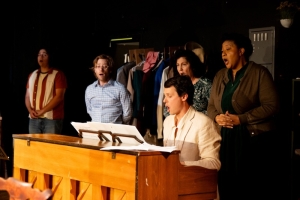
I’ll admit I had never seen, read, or even heard of Our Town before opening weekend. All I knew going in was that it was an old-timey, early 1900s American play with a young love story set in a small Northeast town. I’ve been to the Greenhouse Theater Center before and was looking forward to seeing another production in Lincoln Park. Lazy Susan Theatre Co. kicks off its fourth season with Thornton Wilder’s Our Town, a play Edward Albee called “the greatest American play ever written,” and it turned out to be a quiet, gentle show that sneaks up on you in the final act.
The evening begins before the play does. At the entrance of the theater, there was a map and pins for the audience to pick up and place on the town where they grew up. Naturally, I grabbed one and pinned my hometown of Lincoln, Nebraska. It was a fun touch that fit the play’s idea that Grover’s Corners could be any town, anywhere. Then, as I settled into the cozy upstairs theater, the whole cast gathered and sang John Denver’s “Take Me Home, Country Roads.” It was a warm, welcoming moment that made the small space feel like a front porch, and it flowed right into Act I.
Directed by Matthew Masino, the story takes place in Grover’s Corners, New Hampshire, beginning in 1901. The Stage Manager, played by Dontaye Albert, guides us through the town and the daily routines of the Gibbs and Webb families. Act I opens with a paper boy chatting with Dr. Gibbs (Timothy Griffin) as the town wakes up. Act II jumps ahead three years as neighbors George (Sam Jones) and Emily (Hannah Loessberg) fall in love and prepare to marry. Act III moves to the town cemetery, where the story turns somber.
The set is as simple as it gets: a wood floor, a stabilizing pole in the middle of the stage, two kitchen tables, some chairs, two ladders, a piano, and a little shelving. The actors improvise with imaginary cups, newspapers, plates, and even an invisible horse. This is by design, since Wilder’s script famously asks for “No Curtain, No Scenery” so that the audience focuses on the relationships. As a very visual person, I’ll admit it took some effort. The missing coffee mugs and kitchen set-up asked a lot of my imagination, though I understand the limits of a small-budget production. One of my favorite uses of the minimal set came when George and Emily climbed ladders to talk to each other from their bedroom windows. It was a simple, charming way to show the first sparks of their young love, and I enjoyed seeing how a couple of ladders could stand in for two houses. I later learned that the ladders are a common staple for the set design of this play.
The opening was the hardest part for me. The Stage Manager begins by mapping out Grover’s Corners, from the churches and homes to the farms and stores, and I had trouble picturing the layout and character of the town. Things settled once the story got going, with the paper boy, Dr. Gibbs, and the neighboring families going about their mornings.
Albert’s Stage Manager is the heart of this production. He carries the show with a smooth voice and strong storytelling, and he tosses in just enough comedy to keep the audience engaged. I enjoyed the little facts about the town, from its population to the land to the church denominations. At one point, he and Mr. Webb, the town’s newspaper editor, invite three audience members to ask questions about the town, including whether people drink, whether the town has any culture, and what it plans to do about its injustices. It’s a fun, interactive moment that make the play feel more alive.
Hannah Loessberg is another standout as Emily Webb. She is believable as a curious, bright young girl, with the mannerisms, joy, and excitement for life you would expect, and she looks young and full of promise. Over the course of the play, we watch her mature from a naive teenager to a young woman marrying George, and Loessberg captures that growth well. Then she shifts the mood completely in Act III, with believable anxiety and sadness as Emily faces her death and the life she’s leaving behind. The audience around me was clearly moved, and some were brought to tears.
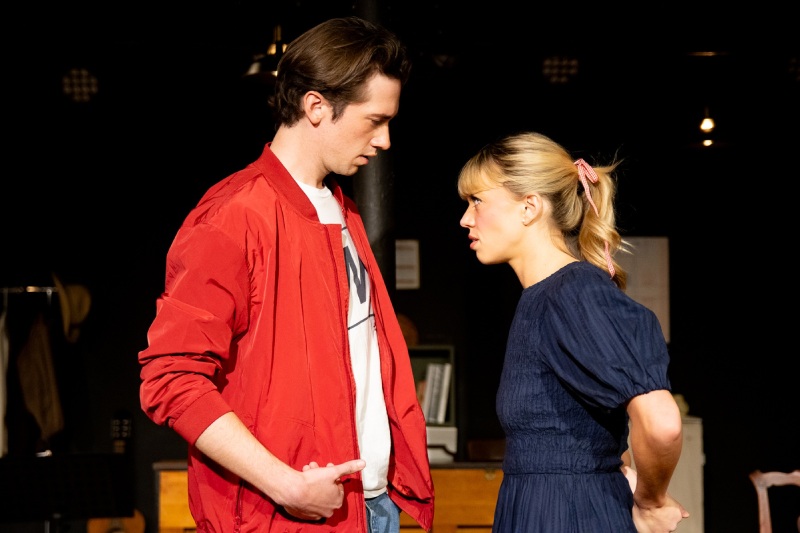
Sam Jones and Hannah Loessberg in Lazy Susan Theatre Co.'s Our Town.
Sam Jones plays George Gibbs, and he’s a good fit for the part. He’s always on cue with his lines and shares strong chemistry with Emily. At times, I wasn’t fully convinced by him as a teenage boy, which may be partly because he’s so tall. He definitely comes across as juvenile, though there were a few moments where I could tell he was acting. In the graveyard scene, however, he cried real tears at the loss of his wife, which added to the emotion of that scene.
Lauren Slone is equally strong as Mrs. Gibbs, George’s mother. She owns her lines and delivers them with passion, and she is a convincing, strong-willed mother who works hard to keep her home running. Her performance takes a sharp turn in Act III. In the graveyard, she is hardened and stone-faced, with little to say and no joy left, which makes the loss of her character hit even harder.
Live music plays between scenes, mostly on piano and guitar. I loved it. It was upbeat and gave the show a charming rhythm as we moved between the Gibbs and Webb homes. The pianist turns out to be Daniel Martin, who also plays Simon Stimson, the town’s organist. Martin is a wonderful pianist and does a great job as a grumpy, pessimistic drunkard.
The lighting and sound design did a lot of work on a bare stage. The lights shifted to show the difference between day and night, and in the graveyard they captured the darkness and unease of the scene. Soft cricket sounds played during the night scenes and in the cemetery, which helped set the mood without any set pieces. This is one reason the graveyard still worked emotionally, even though I wasn’t fully convinced by the setting.
The costumes also didn’t fully match the setting. Some actors were dressed for the early 1900s, while other outfits looked like they came straight out of the 80s. A red windbreaker, jeans, and high-top sneakers felt out of place to me. Even on a tight budget, I wish there had been a little more effort to bring the costumes together.
The pacing was a bit slow for me in the first two acts. The love story builds gradually, and although the wedding was fun to watch, it lacked real drama. The piano transitions and the narrator kept me engaged, and the show picked up speed after the wedding. I do wish we had seen more of the life events leading up to the wedding and then the deaths, since the play skips ahead in time. That is how Wilder wrote it, but it left me wanting more.
The real drama comes in the final act. For most of the show, life in Grover’s Corners is simple and comforting, and no one faces real hardship until Act III. In the cemetery, we learn that Mrs. Gibbs has passed, that Emily has died in childbirth, and that Simon Stimson has taken his own life. The graveyard scene is dark and heavy, with the “dead” sitting still in chairs, and Emily realizes how badly she wants to be alive. The actors did a good job with it. Still, the lack of set design kept me from fully believing the graveyard, and I felt that scene needed more to sell it.
I walked out feeling a bit melancholy. The play leaves you with the dead in the graveyard wishing they had appreciated life more, and with Emily revisiting her own birthday, wanting nothing more than for her parents to really see her. It’s one of those plays that sends you home reflecting on your own life and wanting to be more present and joyful in everyday moments. The pin I placed in Lincoln, Nebraska earlier in the night had me thinking back to my own days growing up. The world around us changes day after day and year after year, and Our Town reminds you to appreciate the present and look around often.
The show runs about 2 hours and 25 minutes with two 10-minute intermissions. I’d recommend it to anyone who loves American history and to anyone who enjoys supporting local theatre companies. If you’re in the mood for an old-time, thought-provoking story about enjoying life in the moment, because it can be unexpectedly taken from us even when everything feels comfortable and normal, this is a good pick.
Content Warning: Our Town contains themes of death and dying, discussions of mortality and the afterlife, and discussions of alcoholism, war, suicide, and death in childbirth. Act III, set in a cemetery, is especially heavy, so please keep this in mind when deciding whether the show is right for you or your family.
Our Town is playing at Lazy Susan Theatre Co. at the Greenhouse Theater Center, 2257 N. Lincoln Ave. in Lincoln Park, through December 13th. Performances are Thursdays through Saturdays at 8:00 p.m. and Sundays at 2:00 p.m. Tickets range from $19 to $34 and are available at lazysusantheatreco.org, with discounted tickets on HotTix.org. There is no late seating, so plan to arrive early.
Gwydion Theatre Delivers More than a Satire in Lynn Nottage’s Por’ Knockers
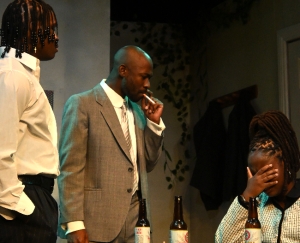
Lynn Nottage is a skilled playwright, and prolific especially considering the high quality of her works: Pulitzer winners Ruined and Sweat. Or the remarkable By the Way, Meet Vera Stark, a kind of All About Eve with the starlet’s Black maid in the Eve role. And then Intimate Apparel, which won wide and very deserved praise. While her scripts vary widely in storyline, they are loaded with very real, authentic characters.
So getting a chance to see an early Nottage work—Gwydion Theatre’s production of Por’ Knockers (1995)—has an especial appeal. It is Nottage’s second play, and it had a turbulent life after premiering Off Broadway in New York at The Vineyard Theatre. Then it went to London. After its London run was cut short, Nottage told The Guardian, “I still remember an audience member ripping up their programme into tiny shreds and throwing it like confetti, saying: ‘I am cancelling my subscription to the theatre!’”
It’s not that the play is bad. In fact it is very good. It was the subject that caused problems: five activists of the imaginary People's Diasporatic Party blow up an FBI building to protest the treatment of African-Americans in the U.S. The play centers on the tension and anxiety within that band of conspirators before and after their destructive venture.
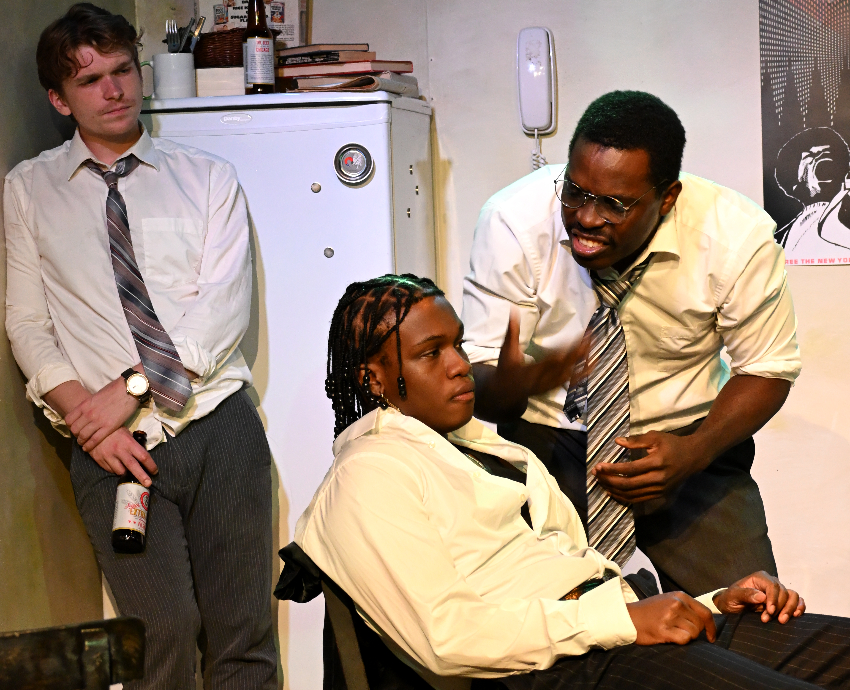
Grayson Kennedy (l-r), Joseph Percy and Dontaye Albert.
Por’ Knockers (the name refers to Guyanese gold panners) was having a successful and well-received run in London until Timothy McVeigh carried out a similar bombing of the FBI building in Oklahoma City. And so the script has been shelved since. Until Gwydion Theatre in Chicago succeeded in mounting this production at Greenhouse Theater.
“This play is so special to us at Gwydion,” says Grayson Kennedy, who is Gwydion Theatre’s Artistic Director. “It was a show that we have wanted to do since our first season.” (Kennedy acts in the show as well.)
Directed for Gwydion Theatre by Makari Robinson-McNeese, Por’ Knockers is widely regarded as a political satire, almost a parody of a “people’s revolutionary army.” But Nottage gives it a level of depth, with five fully-realized characters, each with different backgrounds and motives for the bombing.
In the opening scene of the one act, Nottage establishes the who's who: the mature, grounded Kwami (Kevin Aoussou is astoundingly good); the hyper-kinetic paranoid James (Dontaye Albert is remarkable); a thuggish Ahmed (Joseph Percy); the lone woman in the group, the academic Tamara (Justice Ford); and the lone vacillating white guy, Lewis (Grayson Kennedy is excellent). And then there is this oddly magical entry, Lance (Jimmie Roger III), a machete wielding Guyanese gold prospector visible only to Kwami, whose character happens to be Guyanese-American.
The group’s anxiety is palpable, each expressing it uniquely according to the personalities Nottage has drawn for us. Tempers flare, violence seems to bubble just under the surface as the characters play out their fears. As they leave the apartment for this carefully planned rendezvous with destruction, it is Kwami who exits last, straightening the furniture and quietly telegraphing to the audience a disdain for his fellows.
The passage of time throughout the show is registered by the subtly changing hues of daylight filtering through the window blinds. (Lighting Designer Emma Berry deserves praise for this subtle but important element.)
When they return, hours later, they are filled with excitement over the bombing, and soon enough trepidation builds about what will follow. Tamara offers words of reassurance. “We succeeded,” she says. But only four have returned. That hyper-kinetic paranoid James is nowhere to be seen, further heightening the anxiety in the room. He hasn’t followed the plan. When James does return, having ridden the train to the end of the line and back—“I wanted to make sure I wasn’t followed,” he tells them—he also delivers shocking news: the building was unexpectedly occupied, by children.
A portable radio that was to keep them up to date is malfunctioning because of bad batteries. Lewis delivers a “white man” pronouncement and orders Ahmed to get decent replacement batteries. This doesn’t go down well and violence threatens. Kwami, feeling internal pressure to be the patriarch and the decider on strategy, resists the role, then reluctantly takes it.
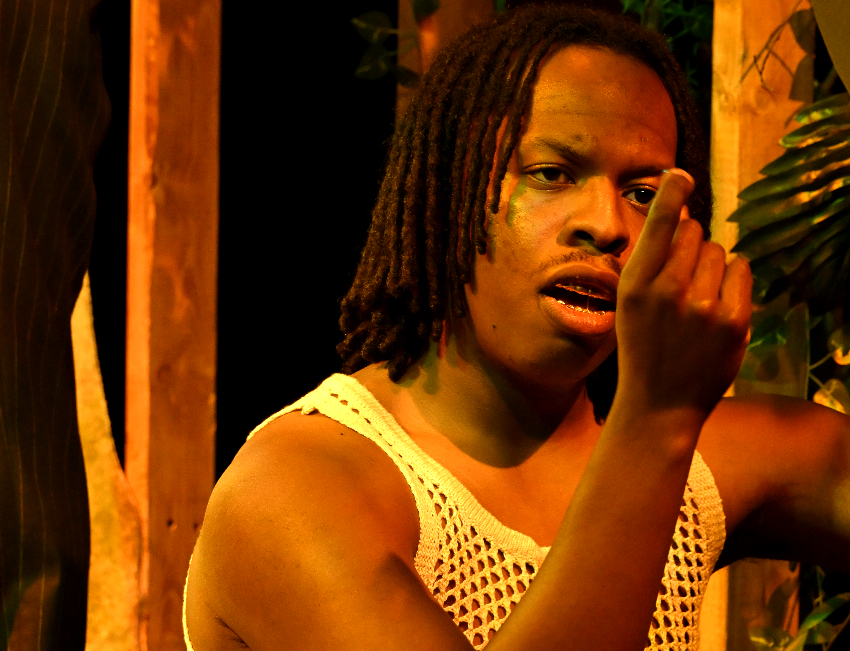
Jimmie Roger III
At this point, the play makes a departure. It remains a parody and these activists do seem inept, but they are also caught in an existential quandary. This takes shape in the lone land line on the wall, a 1990s touch tone wall phone, which will be their means to call the FBI and take claim for the bombing, and make a statement of their motives.
Over the remainder of the play, this brigade of the People's Diasporatic Party swings between ruminations on the morality of their action, or attacking each other. Percy’s Ahmed phrases his sense of their predicament, “I ain't afraid of death. I’m afraid of nobody noticing it. I want my death to be a defining event.”
That phone sits on the wall, a mute expression of the culmination of their destructive act: taking credit for it. Between the tense discussion, the five each take a turn at calling in, when the pressure of the moment drives them to the phone. Yet there is one constraint after another that inhibits them from successfully completing the call: first, they don’t have the number; then they are reluctant to pay 75 cents to “the system” to get directory assistance; after they tear the number from the phone book Lewis calls, and realizes he doesn’t know what to say and hangs up. Tamara calls, but becomes mired in voice mails and transfers and gives up.
Ford’s Tamara seems the most tormented by moral issues of having killed children. Notably, whenever Kwami wants to rally the group, he addresses them as “brothers” then throws in a lagging “and sister,” a low-key running joke for the audience, though not the characters on stage. Eventually the phone call gets through in a resolution of that conceit, which Nottage has used effectively to put each personality on display.
Early works by writers arrive unfettered by reputation and uncontaminated by any self-consciousness with which acclaim may impart. It is my feeling that early writing by authors of any medium allows us a window into that unbridled creative energy.
In Por’ Knockers Nottage inserts that sixth character, the silent, machete wielding Lance, who appears periodically, visible only to Kwami. He prowls the stage front during these brief magical interludes, humming or singing softly. When the other four see Kwami drifting away, he self-consciously explains he is channeling ancestors.
Nottage’s success has not diminished her work, but only affirmed her remarkability. Two subsequent plays like Ruined (its 2008 world premier was at the Goodman, where it returns as part of the next season) and Sweat both won Pulitzers, a first for a woman playwright. Nottage also wrote the book for two Broadway musicals: MJ and The Secret Life of Bees.
Por’ Knockers, which comes recommended, runs through October 4, 2026 at The Greenhouse Theatre.




Latest Articles
-
 ‘Our Town’ Finds Big Feelings in an Ordinary Small Town
Written by Bree Samani-McGrathI’ll admit I had never seen, read, or even heard of Our Town before opening weekend. All I knew going in was that it was an old-timey, early 1900s American play with a young love story set in a small…
-
 Citadel Theatre Captures the Magic of Old-Time Radio in It's a Wonderful Life: A Live Radio Play
Written by Ken PayneThere is something undeniably captivating about witnessing the magic of old-time radio brought to life on stage. In an era long before television dominated living rooms, talented performers relied solely on their voices, sound effects, and the audience's imagination to…
-
 The Latest 'Dante 360' Leads to Paradise, Particularly for Dante-philes
Written by Bill EslerDante 360 Virgil Edition is the latest iteration of a performance work first launched in 2021. Directed by Peggy Garvey, the recurring presentations are billed as an education program, aimed to illuminate 14th century Italian poet Dante Alighieri’s three-part Divine…
-
Genuine Heart Meets Classic Charm in Drury Lane’s Sunny Holiday Revival of Annie
Written by Ken PayneAlmost fifty years after she first sang her way into Broadway history, the sun is still shining bright in Oakbrook Terrace as Drury Lane Theatre brings the beloved holiday classic Annie back to its stage for the first time in…
Does your theatre company want to connect with Buzz Center Stage or would you like to reach out and say "hello"? Message us through facebook or shoot us an email at This email address is being protected from spambots. You need JavaScript enabled to view it..
*This disclaimer informs readers that the views, thoughts, and opinions expressed in the text belong solely to the author, and not necessarily to Buzz Center Stage. Buzz Center Stage is a non-profit, volunteer-based platform that enables, and encourages, staff members to post their own honest thoughts on a particular production.