
Displaying items by tag: Lookingglass Theatre
Lookingglass presents Ice Cream Circus, June 2-7, as part of Night Out in the Parks

Lookingglass Theatre Company presents Ice Cream Circus! 2026, a free, family-friendly theatrical event presented as part of the Chicago Park District's Night Out in the Parks series. Created in association with Actors Gymnasium, Ice Cream Circus! tours parks across Chicago and Evanston June 2 – 7, 2026.
A wordless story of wonder, kindness, and play, Ice Cream Circus! combines dance, clown, and circus arts to tell an original story designed for audiences of all generations and language backgrounds. Performed outdoors in neighborhood parks, the production celebrates the transformative magic of a simple act of kindness.
"Traveling to the parks throughout Chicago these past few summers has been balm for the soul," comments Artistic Director Kasey Foster. "When we can bring a live theatre experience to families, some for the first time, we see why live performance is essential to the human experience. There is awe and there is wonder, yes, but most impactful, there is community."
Ice Cream Circus! is created and directed by Kasey Foster and Sylvia Hernandez-DiStasi, in collaboration with the cast: Kaitlyn Andrews, Alexander D'Amazing, Kat Hoil, Julie Matolo, and Jacinda Ratcliffe. Ice Cream Circus! was inspired by workshops with over 600 Chicago Public School students and community members including Communities in Schools Chicago, Chicago Help Initiative, Boys and Girls Clubs of Chicago, Trumbull Park Line Dancers, Austin Town Hall Cheerleaders, PODER, and students at Dyett High School for the Arts, Solorio Academy High School, and Palmer, Hurley, Tilton, Parker, New Sullivan, Libby, Webster, Mozart, and Earle Elementary.
All performances are free and open to the public, with no RSVP required. Neighborhood ice cream vendors will be present at each performance, with treats available for purchase. Audiences are encouraged to bring blankets and/or chairs for outdoor seating. In the event of inclement weather, performances will move indoors to park fieldhouses at each location. Updates and weather-related announcements will be posted on Lookingglass Theatre Company's social media channels and website. Additional information is available at lookingglasstheatre.org.
Performance Dates and Locations
Tuesday, June 2 at 5:00 p.m. — Seneca Park, 220 E Chicago Ave, Chicago
Wednesday, June 3 at 5:00 p.m. — Trumbull Park, 2400 E. 105th St, Chicago
Thursday, June 4 at 5:00 p.m. — Gage Park, 2411 W. 55th St, Chicago
Friday, June 5 at 5:00 p.m. — Columbus Park, 500 S. Central Ave, Chicago
Sunday, June 7 at 4:00 p.m. — Tallmadge Park, 927 Noyes St, Evanston
Ice Cream Circus is made possible by the generous support of our collaborators and partners Chicago Park District, Actors Gymnasium, ComEd Powering the Arts, and Marc, Maureen, and Elana Schulman.
About Lookingglass Theatre Company
Founded in 1988 by graduates of Northwestern University, Lookingglass Theatre Company is a nationwide leader in the creation and presentation of new, cutting-edge theatrical works and in sharing its ensemble-based theatrical techniques with Chicago-area students and teachers through Education and Community Programs. Guided by an artistic vision centered on the core values of collaboration, transformation and invention, Lookingglass seeks to capture audiences' imaginations leaving them changed, charged and empowered. Recipient of the 2011 Tony Award for Outstanding Regional Theatre, Lookingglass has built a national reputation for artistic excellence and ensemble-based theatrical innovation.
Notable world premieres include Mary Zimmerman's Tony Award-winning Metamorphoses, J. Nicole Brooks' Her Honor Jane Byrne, David Schwimmer's adaptation of Studs Terkel's Race: How Blacks and Whites Think and Feel about the American Obsession, Matthew C. Yee's Lucy and Charlie's Honeymoon, Atra Asdou's Iraq, But Funny, and David Catlin's circus tribute to Lewis Carroll, Lookingglass Alice, which was captured by HMS Media and reached 1.6 million PBS viewers. Lookingglass Alice is now available to more than four million students worldwide through Digital Theatre+. Work created by Lookingglass artists has been produced in Australia, Europe and throughout the United States.
In Lookingglass' White Rooster, Yee Conjures an Intriguing World Where Old and New Collide

White Rooster arrives at Lookingglass Theatre with the kind of wild, genre‑bending confidence that reminds you why this ensemble has always been one of Chicago’s most inventive storytellers. Ensemble member Matthew C. Yee - doubling as writer and director - conjures a darkly funny, legend-steeped ghost story that feels mischievously modern in this world‑premiere production. What begins as a family tale rooted in early‑1900s China unfurls into a surreal, music‑laced journey through a spirit-ridden American town of gold prospectors, where the living and the dead negotiate unfinished business with equal parts tenderness and absurdity.
That sense of slipping between worlds is echoed the moment you enter the space. For two gripping hours, the audience is submerged into a mysterious, rickety mining town - red light seeping through the floorboards as white, flowing curtains above and below the attic sensually breathe with every spectral draft. A mine entrance sits just below the stage; a shadowy passage characters slip into when needed to dig deeply for gold - and climb back out only if they are fortunate.
The theatre is arranged in a bold, innovative configuration that feels unmistakably Lookingglass, and once the lights go down, our surroundings tilt sideways. White Rooster summons a realm of folklore and restless spirits in a spellbound theatrical storm. There isn’t a bad seat in the intimate Lookingglass house.
Yee’s setting brilliantly blends Chinese mythology with timeworn Americana, woven together through Lookingglass’ trademark physicality and vivid visual artistry. Lookingglass builds a set that’s equal parts dusty ghost town and drifting dreamscape, all weathered wood, shifting platforms, and shadow‑hungry corners. Nothing stays still for long. Cloth walls slide softly across the room, lighting tricks the eye into seeing motion, and the entire environment reacts to the characters’ emotional temperature - as if the town itself is leaning in to listen.
The tone in White Rooster swings delightfully between eerie and, at times, hilarious – a fiancé who won’t stay dead, a sister who won’t stay buried, and a rooster whose presence is as oddly ominous as it is absurd. The stage is set for a journey that feels truly singular, a ride unlike anything else audiences will encounter.

Karen Aldridge in Lookingglass' White Rooster. Photo by Justin Barbin.
The story centers on Min (finely played by Sunnie Eraso), a young woman desperate to outrun her past, only to discover that the past travels fast - especially when it’s carrying old curses, stubborn spirits, and grief that refuses to stay buried. As the spirit world starts calling to her, we’re left wondering whether she’ll remain among the living or cross over to the dead.
Min stands at the center of White Rooster like a live wire - restless and, at the same time, determined. I feel that through her, the story becomes something of a tug‑of‑war between who we were raised to be and who we’re trying desperately to become. And every time Min thinks she’s found solid ground, the environment around her shifts - sometimes literally - reminding her that souls from the past don’t just haunt; they negotiate, bargain, and occasionally throw a tantrum in grand fashion.
Maria (fiercely played by Karen Aldridge) and John (vibrantly inhabited by Mark Montgomery) are Min’s parents and June (Noelle Oh – bravo!) her sister. Together they orbit Min with the gravitational pull of family - comforting one moment, complicating everything the next. Maria brings the ancestral weight, the traditions and expectations that shape the supernatural rules of this world – and she can tell a mean ghost story.
Reilly Oh is outstanding as Pong, a mythic wildcard who brings humor, mystery, and a touch of the uncanny. Pong is the character who reminds you that in this universe, what lies beyond the veil isn’t just a threat - it’s a personality, a mood, a powerful force with its own agenda. He and Min develop real, and complicated, feelings for each other, until an unexpected twist shifts the story’s course and ushers the white rooster into a central role.
Through it all, Pong’s parents Judy (Louise Lamson) and Hao (Daniel Lee Smith) are a strong support system for both Min and their son. Their performances, full of humor and tenderness, add texture and tension - the sort of familial presence that renders grief both intimate and unwieldy. In the meantime, June, Min’s ethereal sister residing in the attic, expands the emotional landscape. She gives Min someone who reflects the stakes of staying connected even when everything inside her screams to run. Together, they form a constellation of women whose histories overlap, collide, and echo through the dust of this otherworldly settlement. And in a twist that complicates everything, June’s heart belongs to the version of Pong that no longer exists. Blink and you’ll miss something; the play keeps unfolding in unexpected ways.
Fang, a medicine man and Wu are played by Elliot Esquivel through April 5th and Nik Kmiecik April 8th-26th. The two slip between identities with the fluidity of spirits who’ve long stopped caring about the boundary between the living and the dead. They capture the play’s obsession with inheritance - what we cling to, what we hide away, and what keeps clawing back to the surface no matter how deeply it’s buried. In the process, Esquivel scores a generous share of genuine laugh‑out‑loud moments.
Together, this ensemble of characters creates an atmosphere that’s sinister, hilarious, and deeply human, the kind of emotional tapestry that Lookingglass loves to unravel right in front of you. Though Yee’s approach is thematic rather than didactic, he offers no crystal‑clear moral - instead, June, Min’s spectral sister, delivers the closest thing to one: a deep, aching hunger for something she can’t find, especially heard in the way she screams “I’m hungry! I’m hungry!” It’s a hunger shared by every ghost drifting through this world or the next.

(from left) Noelle Oh, Reilly Oh, Sunnie Eraso in White Rooster at Lookingglass Theatre. Photo by Juston Barbin.
Ghost stories flare to life throughout the play by various characters - crisp, vivid, and wickedly staged - sending me right back to those childhood nights when one good scare made you latch onto the nearest friend. And, like a haunted house, the set and effects amplify it all, bringing this shadow-touched world to life with real ingenuity. Layered with White Rooster’s puppetry, which moves like a shared heartbeat - one force sculpting the landscape, the other lending its phantoms their physical form - the result feels kinetic in the eeriest way.
Yes, the puppetry slips right into this dimension, never as a gimmick but as the show’s beating heart of paranormal logic. From shadow‑puppeted silhouettes rippling across illuminated draperies to Dave and his scene‑stealing pet pig to the white rooster that becomes its own mythic force, the blend of object manipulation and visual animation is an imaginative jolt that feels handcrafted and otherworldly at the same time. Together, the set and puppets create a realm that feels porous and alive, the kind of roguish, immersive ecosystem where even the furniture seems menacingly capable of waking up.
This haunted domain comes to life through the combined minds of Natsu Onoda Power (scenery), Mara Blumenfeld (costumes), Hannah Wien (lighting), Justin Cavazos (sound and score), Amanda Herrmann (props), and Caitlin McLeod (puppets). Their contributions braid together - darkness blooming, objects murmuring, fabrics holding memory - until the world feels less crafted than conjured. The result is a creation that’s tactile, mischievous and emotionally grounded even as it spirals into folklore‑fueled madness. Lookingglass completely immerses us in the supernatural.
Says Artistic Director Kasey Foster on Yee’s offering, “White Rooster has been a thrilling ride from its very first conception in 2020. Matt chooses unique stories to tell, entirely original and fresh, and in his debut role as Director at Lookingglass, he has brought that same originality and "cool" to the staging and design of White Rooster.”
And ‘cool’ is right, with cast members trading off on electric guitar - distortion blazing and ominous percussion driving the suspense. The show’s mix of humor and heartbreak, along with its inventive staging, makes it feel unmistakably like a Lookingglass premiere: collaborative, imaginative, and rooted in personal storytelling.
During the opening night festivities, I chatted briefly with co‑founder and board member David Schwimmer, who was clearly thrilled to discuss the theatre’s refreshed, reimagined space. Lookingglass Theatre’s recent renovation marks a striking reinvention of its public presence. The historic Pumping Station now opens directly onto Michigan Avenue, leading into a bright, flexible lobby that doubles as a café, gathering space, and creative hub. Modular seating, projection surfaces, and expanded rehearsal and education areas turn the venue into an all‑day destination, while warm touches - from celestial‑inspired terrazzo floors to an amber “lantern” box office - give the space its signature glow. More than a facelift, the redesign reshapes how Lookingglass engages its community, creating a welcoming, versatile home for its imaginative spirit.
In the end, in this recently renovated theatre and with this world premiere, White Rooster heralds Matthew C. Yee as a rising playwright‑director with a gift for weaving myth, humor, and heartbreak into something wholly new.
Highly recommended.
White Rooster runs at Lookingglass through April 26, 2026, with performances most Wednesdays through Saturdays at 7:30 p.m. and select matinees at 2:00 p.m. on Thursdays, Saturdays, and Sundays. Tickets through the Lookingglass box office start at $33, while Hot Tix lists discounted seats in the $51–$62 range, and select Lookingglass Class events offer pay‑what‑you‑can options. The run also features several special performances, including Folklore Day on March 22 at 2:00 p.m., a mask‑required show on March 25 at 7:30 p.m., open captioning on April 3 at 7:30 p.m., and AAPI Night on April 9 at 7:30 p.m. For tickets and/or more information, click here.
This review is proudly shared with our friends at www.TheatreInChicago.com.
Review: Iraq, But Funny at Lookingglass Theatre

“Ripe material for a comedy,” chuckles Atra Asdou, writer and star of ‘Iraq, but Funny” now playing at Lookingglass Theatre. Asdou’s new madcap play is part comedy, part history, part family drama. Directed by Dalia Ashurina, this hard-to-define play feels like the kind of thing we absolutely need more of.
If laughter is said to be the best medicine, then it’s surely a good thing for casual educational experiences too. In under three hours, Asdou (in character as a Bugs Bunny-ish British colonizer) provides the entire history of European imperialism in the Middle East–from the perspective of the victor, as most histories are told. The colonizer, or “Actor 5”, condenses decades of complex conflict into a darkly humorous sketch comedy. The play is balanced with vignettes from a multi-generational family riding the wave of current events that ultimately lead them to 1990s Chicago.
History is more likely to repeat itself if nobody knows the history in the first place. “Iraq, but Funny” seeks to inform a mostly Western audience about how Middle Eastern land and culture have been divided and conquered for centuries by exploitative forces. Asdou’s morally slippery character relays a shocking and brutal narrative with such wry humor that you nearly forget very little has changed in the way the West engages with the rest of the world. What’s even more seductive yet is how much fun her character is to watch. Asdou’s Second City background is on full display.
Susaan Jamshidi plays the matriarch character, “Actor 1” and in every era, life is constantly shifting under their feet. She impresses on her daughter, “Actor 2” (Gloria Imseih Petrelli) that their lives are for the next generation. The central relationship between mother and daughter illustrates the real-life effects of colonialism and the people’s lives it shapes. Both actresses deliver powerful performances as they bring to life a century of family members.
Omid Akbari whisks the audience around the world with his minimal, but highly effective set in the historic Water Tower Water Works theater. Costumes by Mara Blumenfeld are also a huge asset for the comedic set-ups, particularly the Uncle Sam get-up Asdou sports at one point.
Lookingglass Theatre’s production of “Iraq, but Funny” belongs among the likes of Cole Escola’s “Oh, Mary!”. The dense and intellectual script along with Asdou’s sidesplitting comedic performance are a special blend you don’t often see. The kind of play that makes you wonder, “how did they come up with this?” Though, there’s an immediacy to this play that can’t be ignored. While it’s written as satire, it’s the kind of thing that’s so tragic if you don’t laugh, you’ll cry. This is a play about empathy. What Asdou has effectively done is what SNL does every week, amuse and inform. In comedy, we find our humanity. And with ‘Iraq, but Funny”, Asdou succinctly relays an ugly past, with enough levity to challenge preconceived notions about world history.
Through July 20 at Lookingglass Theatre. 163 E Pearson St. 312-337-0665
*This review is also featured on https://www.theatreinchicago.com/!
Delightful ‘Circus Quixote’ Marks Lookingglass Triumphant Return to Water Tower

“Don Quixote of La Mancha” is considered the oldest European novel, but it gets a fresh and exciting new treatment in “Circus Quixote." This is Lookingglass Theatre’s inaugural reopening after a year off while it retooled its much loved Water Tower Pumping Station location at Michigan and Pearson in Chicago.
In “Circus Quixote,” Cervantes’ beloved novel and it’s timeless characters—the delusional knight errant Don Quixote; the farmer turned squire Sancho Panza; the target of Quixote's courtly services Dulcinea (Laura Murillo Hart); his niece Antonia (Andrea San Miguel) who burns the books on chivalry that led to his madness—all spring to life.
The script by David Catlin and Kerry Catlin, who share director credits, brings in Spanish and latin-inflected English, but holds to the core of the tale—updated with added visions of quests that are now ever more familiar in our age of the revitalized renderings of Lord of the Rings.
Unlike Broadway’s 1965 musical “Man of La Mancha,” this version incorporates acrobatics, courtesy Evanton’s Actors Gymnasium—circus and movement choreography by Sylvia Hernandez-DiStasi— along with stunning puppetry (remarkable creatures large and small designed by Grace Neediman) and dashes of slapstick. The show includes sword fights aloft on ropes (kudos to Micah Figueroa as
Quixote's frequent adversary Sansón Carrasco), members of the troupe "jousting" with windmills by climbing the blades in arial feats, and riding Don Quixote's famed Rocinante, an engineered baroque steam punk rocking chair which at one point holds seven of the troupe in motion.

Eddie Martinez as Sancho Panza
The newly coined English word “quixotic” (for impractical or foolish causes) was drawn from the novel soon after its publication in 1605. And the cogent notes of this tale of the hopeless aspirations maintains the poignancy as eventually even taking those he loves on a fool's errand, jousting at windmills and battling an imaginary giant.
Eddie Martinez as the faithful but questioning Sancho Panza (and a stand-in for Cervantes) is remarkable.
But the highest accolades must be given to Laura Murillo Hart, an absolutely stunning performer on multiple levels. As Dulcinea, in whose service Quixote launches his quest, Hart casts a spell on the theater whenever she appears, vocalizing in haunting melodic strains (composer Kevin O’Donnell’s music is arresting), sometimes accompanying herself on guitar.
In Act II Hart is transformed into a mustachioed, hoop-skirted clergyman, her clerical garb becomes an elaborate puppet showcase, a half-dozen or more characters appearing variously in a mini stage at the skirt front, and from her billowing sleeves. It’s an endlessly entrancing performance, and Hart demonstrates an incredible range in her many roles. At Lookingglass, a star is born with Hart’s performance.

Laura Murillo Hart
The relaunch of Lookinglass Theatre has provided "Circus Quixote" a generous run through March 30, 2025 at 163 E. Pearson at Michigan Avenue.
Founded in 1988, Lookingglass has been on hiatus for a year while it reset its business model. Founding member David Schimmer of “Friends” fame has joined the board, and appeared last month along with Governor JB Pritzger to dedicate the rejuvenated space, with a redesigned lobby, bar and cafe open for business at 163 N. Pearson. Funding by the Illinois Arts Council and Joan and Paul Rubschlager made possible the return of Chicago’s dreamiest theater that has years of memorable shows under its belt, including (to site just one) director Mary Zimmerman’s 1988 “Metamorphoses” which went on to win her a Tony in its 2002 Broadway transfer, and returned to Lookingglass multiple times.
Lookingglass has over the years offered a balance between inventively staged serious drama such as the 2009 Thornton Wilder’s “Our Town,” the Jackie Robinson story “Mr. Rickey Calls a Meeting” (2012) or “Death Tax” (2014); and more energized spectacles like “The Little Prince” (2013) and “20,000 Leagues Under the Sea” (2018) Lookingglass also develops an in-between type of show embodied in 2016’s “Thaddeus and Slocum” (2016), and like all its work, presented with verve, powerful dramatics, and incisive illumination of our condition as humans.
(Updated Feb. 17, 2025.)
Review: Congo Square Theatre Company's 'What to Send Up When It Goes Down' at Lookingglass Theatre

Described as a play-pageant-ritual-celebration, WHAT TO SEND UP WHEN IT GOES DOWN is both scripted and improvised, participatory and performed – for the purpose of empowering Black People’s response to WHAT GOES DOWN: past, present, and future violence against Black People.
“IT? You know what IT is. IT is that terrible thing that happened, and that is going to keep happening. IT always happened just yesterday and IT just keeps happening again tomorrow”
This review is really hard to write, mainly because I don’t feel qualified to judge the work. WHAT TO SEND UP WHEN IT GOES DOWN is a participatory event, its purpose to generate a place for catharsis, cleansing, and healing … for Black People. The audience is informed, gently but unapologetically, that WHAT TO SEND UP WHEN IT GOES DOWN is by Black People, about Black People, and for Black People – although all who approach with respect are welcome.
And amazingly that’s absolutely true! There were lines / jokes / vignettes that I couldn’t appreciate, that I simply didn’t get, but at no point did I feel excluded. The moments of disconnection were my problem: I, as a white person, couldn’t understand the significance of those lines / jokes / vignettes. The moments of exclusion were deficits in my comprehension; they were in no way generated by the Black People.
BTW, I capitalize Black People because those two words are spoken – shouted, proclaimed, cried, announced, groaned, exclaimed – frequently throughout, and the spoken words are always unmistakably capitalized.
WHAT TO SEND UP WHEN IT GOES DOWN is written by Aleshea Harris, produced by Congo Square Theatre in partnership with LookingGlass Theatre, and directed by Daniel Bryant (Congo Square) and Erika Ratcliff (LookingGlass).
The ensemble includes Jos N. Banks, Chanell Bell, McKenzie Chinn, Alexandria Moorman, Willie “Prince Roc” Round, Joey Stone, and Penelope Walker. Each and every one of this cast are extraordinarily talented at acting, singing, and dancing. Though many of the vignettes are scripted, every word is unmistakably authentic. I can’t begin to imagine how emotionally exhausting each performance must be. I feel honored by their willingness to share it with us.
On the Creative Team are Sarah Grace Goldman (Dramaturg), Sydney Lynne Thomas (Set & Props Designer), Alexis Chaney (Costume/Wig/Makeup Designer), Levi Wilkins (Lighting Designer), and Charlique C. Rolle (Movement Coordinator). Victor Hugo Jaimes is Stage Manager, Estrellita Beatriz Production Manager, and Alexis Carrie designed the costumes.
Together, this team – production and cast – create an awesome and enduring experience. Six days later, I’m still having regular moments of recollection and new insight; I predict these perceptions and inspirations will continue for some time.
WHAT TO SEND UP WHEN IT GOES DOWN is Highly Recommended for all audiences; for people who identify as BIPOC, it’s downright ESSENTIAL.
Lookingglass Theatre’s 'The Steadfast Tin Soldier' A Hans Christian Andersen Holiday Tale for Children of All Ages

Let’s begin with a children’s story. A children’s story about children’s stories, really.
Long, long ago, there lived a boy who could not decide what he would be when he grew up. He might have grown up to sing songs or tally bills, to right wrongs or treat ills, but he just could not decide. Then one day, the boy met a wonderful enchantress — a creator and a raconteur who herself had vowed never to grow up, and who lived her life telling stories for children. She told the boy that he, too, needn’t ever grow up, for he had been placed in this world for the same purpose as her — to tell tales that enchant children, young and old. And so, the boy did just that for many years until one day, as boys sometimes do, he grew up and went on to smaller, lesser things. And while that ageless enchantress still tells stories to children while the tired, graying boy does not, somewhere deep inside him lurks a longing for that storybook world he left behind, a longing let out now and again when he reads or hears or sees a story told truly and lovingly, told for and to those who have yet to grow up.
I begin with that story because Hans Christian Andersen’s fairy tale “The Steadfast Tin Soldier” was always the gold standard when that boy considered what a true and lovely children’s story is. Lookingglass Theatre’s The Steadfast Tin Soldier, written and directed by Mary Zimmerman, is the rare adaptation of a true classic that’s not only worthy and respectful of its source material, but takes it to new and wondrous places.
Show, don’t tell. That’s perhaps the first rule of good storytelling, and Zimmerman’s production adheres to that maxim. From the curious pre-show goings-on that evoke an advent countdown to both Christmastime and the curtain’s rise, to the inspired puppets and streamers and set pieces that create worlds within worlds on the Lookingglass stage, to the powdered wigs (“That’s Mozart!” my six-year-old cried when she spotted music director and arranger Leandro Lopez Varady take his seat at the piano) and classical instruments that arm the four-piece orchestra tasked with playing Andre Pluess and Amanda Dehnert’s exceptional score, a time and a place and a mood have been created before the story even begins.
Show, don’t tell. For the length of the play, not a word is spoken. I imagine that Ms. Zimmerman drew inspiration from silent movies, as her cast tells the story with what they show the audience — with their actions, with their bodies, with their faces, with their eyes.
John Gregorio and Joe Dempsey are the play’s active, madcap jacks of all trades, filling pointed elven shoes as puppeteers, scene-makers and set-movers, and various roles throughout. Dempsey’s Nursemaid is positively Pythonian in her prissy, proper pomp and posture. And Gregorio’s Rat, one of many parts he plays, adds a sense of gnawing doom and gloom.
As the ballerina, tucked away inside a doll’s house into which the audience is soon invited, Kasey Foster enchants both said audience and the titular tin soldier with her grace and her beauty. But she’s equally charming later on as a rambunctious rapscallion wreaking havoc in the Danish streets.
Anthony Irons’ costumes and props — as a wine-buzzed master of the house, as a masked fairyland creature of questionable species, and as a jack-in-the-box goblin who sets the story’s plot in motion — often capture the eye, but it’s his facial gestures I noticed most. From grins to glares to grimaces, Irons harkens character actors like Don Knotts with his oversized expressions that translate from the stage every bit as clearly as his castmates’ bodily movements.
But it’s Alex Stein’s Steadfast Tin Soldier who’s, quite literally by the end of it, the play’s heart. While the others frolic about, Stein’s one-legged plaything is destined to remain static, so it’s his eyes that show us all we need to know. Above, I wondered if Mary Zimmerman was inspired by the silent movies of yesteryear, and I think it’s Stein’s Buster Keaton-esque ability to tell it all with just one look that got me thinking that way, every bit as much as the entire wordless production did. When Stein’s eyes gleamed, brimming with tears, so did mine.
Perhaps he’s as old fashioned as those silent films of yore, but that boy who’s all grown up now is not a crier. Then this holiday play for kids of any age went and brought him to tears, the same as Hans Christian Andersen’s original children’s story always did. And maybe, just maybe, this children’s story told truly and lovingly will also remind that boy that he hasn’t yet grown up all the way and that there are still children’s stories of his own to tell — stories that delight and inspire, that entertain and touch — just like Lookingglass Theatre’s The Steadfast Tin Soldier is doing from now through January 26.
Review: ‘Frankenstein’ at Lookingglass Theatre

Really? Another ‘Frankenstein’? The 2018/19 season was the year of ‘Frankenstein’. To celebrate the 200th anniversary of Mary Shelley’s classic gothic thriller, four theatre companies produced wildly different adaptations of the novel. If you find yourself wondering whether these companies knew of each other’s productions, they surely did. The beauty of the Chicago theatre landscape is that there’s a lot of room for good storytelling. Lookingglass Theatre wraps up their season with a bold adaptation from the same team who brought us ‘Moby Dick’ and ‘Lookingglass Alice’.
Conceived and directed by David Catlin, this take on ‘Frankenstein’ is as visually stunning as it is insightful. The in-the-round staging makes this telling feel more active, as the entire performance space is used throughout. Shifting around in your seat feels like a more engaging way to view the show. Not knowing where the monster or the next loud sound will come from, heightens the sense of terror. Catlin’s production is scary. Many of the other productions discounted that this is a horror story originally intended by Mary Shelley to scare guests at a party.
While nearly all the productions tried to weave Mary Shelley’s personal life into the retelling, Catlin’s version cuts right to the heart. In fluid transitions between Shelley’s life and ‘Frankenstein’, we get to see the range of Cordelia Dewdney’s talents as an actress. The show may be titled after the scientist, but this is a play about Mary Shelley. Dewdney’s dialogue as Mary Shelley is heartbreaking when considering her real life. Cruz Gonzalez-Cadel also turns in a strong performance in a variety of characters, all of which she plays comically large with a faux pregnancy belly.
The balance of good casting, inventive storytelling and arresting staging distinguish this production. Catlin has chosen to frame his version almost as children playing dress up while exchanging ghost stories. And since the characters are adults, there’s a simmering sexiness to this production. Sexy and ‘Frankenstein’ are two words rarely seen in the same sentence, but somehow Lookingglass achieves just that, making this a delicious evening at the theatre. Thrills, chills and titillation, the pillars of entertainment.
Even though we are now 201 years out from the original publication of ‘Frankenstein’, don’t sleep on this striking production at Lookingglass. For those with a grey memory of the novel from high school, or only familiar with the Universal-Boris-Karloff film version, Lookingglass serves up an unforgettable night of scary fun.
*Extended through September 1st
Moments of Excellence, But Act(s) of God Brushes With Cosmic Disaster

Lookingglass Theatre, known for its excellent production values and its incomparable space at the Water Tower pumping station, brings us an intriguing new work, Act(s) of God.
Billed as an existential dark comedy, but really much more of a farce, it is a “guess who’s coming to dinner” tale of cosmic proportions. Written by troupe member and actor Kareem Bandealy and directed by Heidi Stillman, the show spares nothing in quality of effort and has an intriguing storyline, but runs off the rails by the third act.
It opens on a middle-class family home where Father (Rom Barkhordar) and Mother (Shannon Cochran in an outstanding performance) await the homecoming of their boy Middle (Anthony Irons) and his girl Fiancée (Emjoy Gavino). Their two other children will also be arriving soon, a daughter Eldest (Kristina Valada-Viars) and another son, Youngest (Walter Briggs).
Sorting the mail, Mother listens to a radio report on the imminent passage near earth of the asteroid, Apophis, while she and Father reveal in passing that it is April 2029 – a date that gains in significance. Other rather witty exposition tells us how much (and how little) the world has advanced from the present. “Everyone’s driving solar cars, but why do we still have junk mail?” Mother asks.
In the mail pile Mother finds an unusual letter, but she can’t tear the envelope, nor can Father, nor the other children as they each arrive. No one can, that is, until Eldest arrives, disturbing the others who are deep in a stylized, futuristic New Age prayer ritual. (In a droll touch, Bandealy has them ask God not for forgiveness, but to “Help us forgive ourselves.”) As it turns out Eldest is not only an atheist but also a lesbian, things which estrange her from the family. And perhaps to the detriment of this script, Eldest is a writer. But she is able to open the letter, revealing that it contains a message from God: he’s coming for dinner tomorrow night.
The plot thickens promisingly, and great deal of angst and stress accompanies preparations for their guests’ arrival, with Mother begging the rest, “Please don’t embarrass me in front of God.”
But the play takes a turn for the worse, as family tensions and dynamics fill the remainder of a way too-long show (three acts, two intermissions). These scenes are full of drama, but they do not a play make. And while Bandealy’s characters are clearly defined personalities, jousting continuously, they seem only vaguely related to each other. Was it a matter of casting or direction?
Perhaps it’s the script – which is not fully jelled. Much of the dialog is actors reciting lengthy written texts, well stated, but mostly unconvincing as spoken language. This is slightly less of an issue with Mother, Youngest, and Fiancee, but is especially a problem with Eldest, who talks over the other characters in sometimes interminable diatribes and expository essays. Such character types have been known to represent the author.
There are also unconvincing dramatic moments, as when Father falls asleep sitting up in a chair for almost an entire Act, while a wild family wrestling and shouting match surrounds him. Or the siblings and Mother sitting unnaturally rigid and immobile throughout a scene as Father comes and goes from the kitchen, talking a mile a minute.
Bandealy does give each character a moment of glory, with a signal monologue: in the son Middle’s take-down of his sister, Anthony Irons is moving and convincing. In Father’s recitation of an invented religious parable, Rom Barkhordar is flawless. Likewise, Shannon Cochran, who in what might be a ranting soliloquy decrying the raw deal given her by motherhood, instead sings her lines to the accompaniment of a baroque sinfonietta. It’s surpassingly than charming.
Oh yes, and God comes and goes, unseen by us. But we do hear him like a “passing wind” (a nice inside joke for religious folks, he is flatulent on a cosmic scale as well, it turns out). The date of God’s arrival, April 14, 2029, is repeated so frequently in the dialog I looked it up in Wikipedia. It is the day a large asteroid will come within 19,000 miles of the Earth – which clarifies the radio report in the opening minutes of Act(s) of God.
The set by Brian Sidney Bembridge – the living and dining room of a middle-class family home – is wonderfully appointed, and conveys that indeterminate futuristic point in time with a mix of furnishings dating from 1920 deco and ersatz 1950s French provincial, to mid-century modern and contemporary retro, along with futuristic sconces and wall paper.
The set matters, as it must also provide a climactic end to the play. But it was not a particularly satisfying one. The coincidence of a visit from God and an asteroid flyby gives a reasonable platform for an existential dark comedy, but hours of family squabbling didn't seem very existential or funny. There’s some good in Act(s) of God, and some great bits, so it's somewhat recommended if you have the patience for it. It will be at Lookingglass Theatre through April 7, 2019.
Lookingglass Immerses Audience in '20,000 Leagues Under the Seas'

Jules Verne wrote one of the first science fiction novels in 20,000 Leagues Under the Seas, the story of three travelers who find themselves imprisoned on the Nautilus, a submarine captained by the megalomaniacal Captain Nemo. The novel was light on political detail, though Captain Nemo occasionally claimed to use his supremacy in the seas to right wrongs committed on land, especially those perpetrated by colonial powers. Nemo’s reasons were more fully articulated in Verne’s follow-up, The Mysterious Island, elements of which become the framing device for this Lookingglass Production, adapted by David Kersnar, who also directs, and Althos Low (aka Steve Pickering). Ensemble member Kersnar shows a deft hand and strong familiarity with the resources he can muster to bring the undersea world of the novels spectacularly to life, though the attempt to explain Nemo’s vengeful politics weighs the production down.
At its heart, 20,000 Leagues Under the Seas is an entertaining yarn, filled with hair-raising encounters with monsters, encounters made more terrifying by the fact that they take place in the unforgiving confines of the world’s oceans, with their more ordinary terrors. Kersnar and Low have done a remarkable job of bringing this world to the stage, staying true to Verne’s vision while making updates that make the story more accessible to contemporary audiences. One of these is changing the gender of the marine biologist who recounts Nemo’s travels and scientific discoveries. Pierre Aronnax and his aide-de-camp, Conseil, are recast as Morgan Aronnax and Brigette Conseil. This proves to be a strong choice in terms of storytelling, as it makes a little sense of Aronnax’s initial sympathy for Nemo, as both have felt the sting of being underestimated by those in power. The creators have assembled a team of artists and designers who are up to the task of bringing the tour of the seas to the stage. Todd Rosenthal’s set contains a toy-theater proscenium for the wide-angle shots of the ocean, from the sinking of ships to the horrors of the drowning sailors to the view from the windows of the Nautilus. The Nautilus itself is realized as an exterior platform that rises and tilts precipitously as the story demands, and hints at the confinement of the underwater craft that can be accessed only through a small hatch. Costume designer Sully Ratke combines story-telling and function, creating designs that capture the altered states of the characters as their journeys unwind, as well as their backgrounds and social stations. Props by Amanda Hermann avoid getting too steampunk, but capture the Victorian aesthetic of the novel, reminiscent of the original illustrations. However, it is the more ephemeral design elements that really transport the audience to the depths: sound designer Ric Sims and lighting designer Christine Binder immerse the audience in locations from New York City, the decks of various water crafts, to the depths of the seven seas. Floating in this aural and visual landscape are the puppets designed by Blair Thomas, Tom Lee, and Chris Wooten and athletic actors performing Sylvia Hernandez Di-Stasi’s brilliant aerial choreography, which allows the characters to float and dive beneath the waves. The puppets themselves are worth the price of admission: lifelike and magical at once, they float behind and off the stage to invite audience and characters fully into the terrors and wonders of the oceans.
The play begins with a group of refugees from the American Civil War meeting the man who enabled them to survive their escape, Captain Nemo, now older, alone and questioning his prior life as a terror of the seas. It then flashes back to where the book begins, introducing French professor of natural history Morgan Aronnax, who receives a last-minute invitation to join the crew of the USS Bainbridge, under Captain Farragut, who is commissioned to seek and destroy whatever is terrorizing the seas—be it craft or creature. Aronnax postulates a giant narwhal in a scene that brilliantly establishes her character and her position vis-à-vis her male colleagues. Kasey Foster does an admirable job of injecting charm into the generally no-nonsense and humorless professor, who is almost as single-minded in her pursuit of knowledge as Nemo in his pursuit of vengeance and domination. Kareem Bandealy is hampered by a script that does not allow him to fully realize the zealous evil of Nemo—despite his powerful presence and overbearing bluster, he gets bogged down in the scenes that switch to introspection and long-winded revelation. Scenes that allow him to do this while perpetrating acts of terror (the sinking of a naval vessel, for example) serve the plot much better than dinner time polemics and elegiac remembrances of his role in the Great Mutiny of 1847, which led to the losses that spurred his vengeance against imperialism. Rounding out the quartet that forms the center of the narrative are Walter Briggs as the cheeky Ned Land, a harpooner brought on board the Bainbridge to help destroy the monster responsible for the deaths of so many sailors, and Lanise Antoine Shelley as Conseil. Briggs brings the right balance of swagger and empathy to his role, and Shelley makes a good audience foil for the occasionally delusional professor, pointedly and humorously reminding her of the realities of their positions as women in a male world, and then as prisoners (not guests) of the mad Captain Nemo. Nemo’s “guests” also prove themselves to be up to the physical challenges of taking on human and cephalopod foes (Shelley has a brilliant and harrowing encounter with the latter). The rest of the cast—Thomas J. Cox, Joe Dempsey, Micah Figueroa, Edwin Lee Gibson and Glenn-Dale Obrero--provide some of the most striking moments of the evening and fill the stage with a multitude of supporting characters. Cox anchors the crew of Civil War wanderers and helps flesh out the alternate narrative. Joe Dempsey makes an impression as Pencroff, whose gratitude towards Nemo fuels his understanding and as the surprisingly open-minded and humorous Captain Farragut. Edwin Lee Gibson brings stalwart nobility to Cyrus Smith, one of the men who encounters Nemo in the first scene, and a roguish pragmatism to the self-serving constable who allows Ned Land to board the U.S.S. Bainbridge with a little persuasion from the Captain. Micah Figueroa and Glenn-Dale Obrero also fill the ranks of the Civil War escapees (with a humorous turn from Figueroa as the naïve Harbert), as well as handling the bulk of the fighting and diving, including an amazing sequence of pearl diving that captures the best of Lookingglass’s take on Verne’s novel—providing spectacle and social commentary in a seamless melding of physical theater, puppetry and characterization.
It’s not perfect, but 20,000 Leagues Under the Seas has enough to satisfy young (tweens and up) and old. Though it tries valiantly and not always successfully to engage with the political themes of human rights and colonization, ultimately it is buoyed by a strong sense of good old-fashioned story-telling. The breathtaking special effects, aerial dance, puppet magic, and a committed and capable cast who can match the acting and physical demands of the spectacle more than make up for some ponderous philosophical ballast. There is enough food for thought to inspire conversation, but the focus, as it should, remains mostly on the undersea journeys of the Nautilus and its willing and unwilling crew members’ battles with Kareem Bandealy’s power-hungry Nemo and the natural perils of the seas. It is well worth hopping on board to witness the sea battles, sea spiders, fish, squid and other undersea wonders dreamed up by Lookingglass’s team, under the assured direction of David Kersnar.
20,000 Leagues Under the Seas runs through August 19, 2018, at Lookingglass Theater, 821 N. Michigan. Performances are Wednesdays-Sundays at 7:30 pm, and Sundays at 2:00 pm. For tickets and more information, visit www.lookingglasstheatre.org or call 312-337-0665.
*Extended through August 26th
Plantation! is Woke and Funcomfortable

On a beautiful plantation in the modern day South, a mother asks her three daughters what they would change in the world, if they could. After rattling off some Miss America-esque answers – including "giving a croissant to a homeless person" – the girls go back to their own self-interests, i.e. taking recreational painkillers and prepping for a reality show audition.
Their world gets turned upside down when their mother announces that they will be hosting, and gifting the deed of the family plantation to, three black women, women who are descendants of a slave who worked on the plantation and had relations with the family's great-great-grandfather. Although with very different backgrounds, upbringings, and access to privilege due to skin color, these seven women are family.
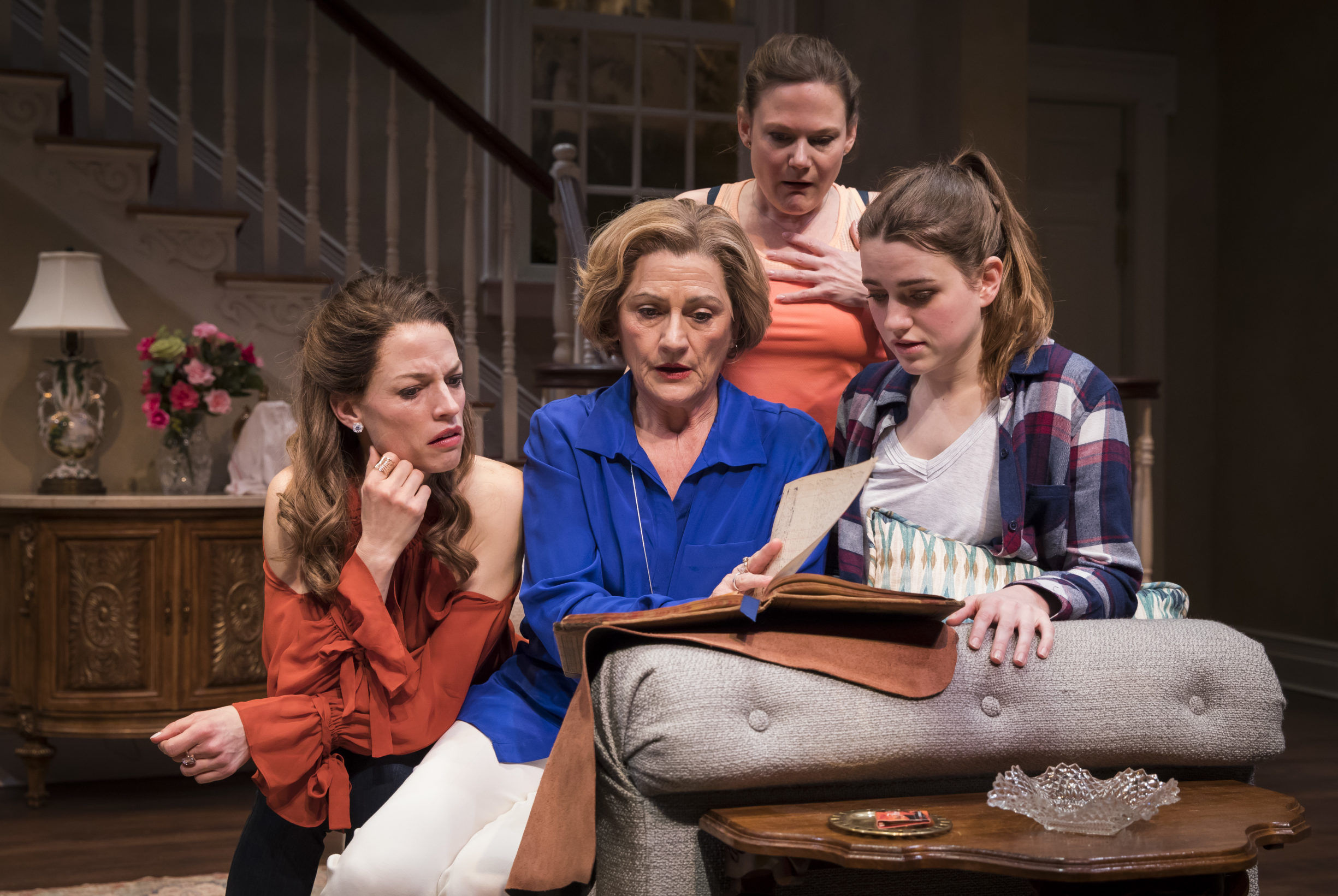
Not to get all "Webster's Dictionary defines..." but I have to say it a little louder for the All Lives Matter folks in the back: A privilege is a special advantage or benefit available only to a particular person or group of people. A benefit, for instance, like a big, beautiful plot of land that your family forced slaves to maintain. Or, for instance, a thriving business that has clothed, fed, and housed generations of white descendants for centuries while providing nothing to the black descendants of the people without whom there wouldn't be a business. The slaves did the work, yet it's the family of the slaveowners who reap the benefits.
This 21st century answer to reparations is inspiring and brilliantly funny, with a fast-paced and clever script by Kevin Douglas and superb directing by David Schwimmer. Plantation! is both a conversation starter and high quality entertainment. Chaos and comedy ensue while the six girls try to make nice and get to know each other, all while griping beyond each others' backs about who really deserves the plantation. The play is a hilarious send-up of well-meaning white people; who sincerely want to help, yet do nothing when presented with the chance to do so; who swear up and down they aren't racist, yet date a member of the KKK because he doesn't go to "all" of the meetings.

In one scene, the girls are all Southern-Belle'd out in big, old-fashioned dresses for a fancy dinner on the estate. When the black girls turn on some music and start dancing, one of the white girls yells that it's like they have Beyonce in the house. Her sister admonishes her, "That's racist."
"No, it's not. That's a compliment," one of the black girls replies, high-fiving her sisters. The white sister who thought she was rightly calling out racism shakes her head, "You people are confusing." The black sisters share a glance. "That's racist," they say. Case in point, maybe listen to what people who experience racism have to say about it before defining racism for them. (Also, rule of thumb, don't make black people explain Black Lives Matter to you – which, naturally, plays out onstage here. Google is your friend.)
Finally, the cast of eight women knocked it out of the park with their chemistry and comedic timing. Besides the fabulous poofy dresses, it seemed to me that this play could've been cast with either men or women and the story would be the same. Props to Lookingglass and Douglas for not setting the default to "male." And for not being afraid to have a mixed race cast discuss race and make everyone in the audience, to use the playwright's own word, a little "funcomfortable".
Plantation is playing at Lookingglass Theatre Company through April 22nd. Tickets on LookingglassTheatre.org.


Latest Articles
-
 Poetry in Motion: Joffrey's Eugene Onegin enraptures at the Lyric Opera
Written by Kendall RoyzenThere’s something magical about stories. Stories have the power to transcend time, reaching across the centuries to share their thoughts, ideas, and emotions. Tales of heartbreak, anguish, squandered youth, and missed chances written in the 1800s have a way of…
Poetry in Motion: Joffrey's Eugene Onegin enraptures at the Lyric Opera
Written by Kendall RoyzenThere’s something magical about stories. Stories have the power to transcend time, reaching across the centuries to share their thoughts, ideas, and emotions. Tales of heartbreak, anguish, squandered youth, and missed chances written in the 1800s have a way of… -
 Collaboraction Theatre announces June shows and events in its new House of Belonging in Humboldt Park
Written by Buzz Center StageNow fully activated, Collaboraction Theatre Company’s new House of Belonging in the Kimball Arts Center, 1757 N. Kimball Ave in Humboldt Park, is a sleek, 4,000-square foot space featuring a new 99-seat flexible studio theater and a 50-seat cabaret with…
Collaboraction Theatre announces June shows and events in its new House of Belonging in Humboldt Park
Written by Buzz Center StageNow fully activated, Collaboraction Theatre Company’s new House of Belonging in the Kimball Arts Center, 1757 N. Kimball Ave in Humboldt Park, is a sleek, 4,000-square foot space featuring a new 99-seat flexible studio theater and a 50-seat cabaret with… -
Redtwist Theatre presents Anatomy of A Suicide August 12-30
Written by Buzz Center StageProduced in partnership with JunkHeart, The Metal Shop Performance Lab is proud to announce the cast and creative team for Anatomy of a Suicide, August 12 - 30, at Redtwist Theatre, 1044 W Bryn Mawr Ave, Chicago, written by Alice Birch and directed by Alex Mallory. Previews are Wednesday, Aug. 12 and Thursday,…
-
Juneteenth Prelude: Celebrating Freedom and Black Expression, an evening of entertainment and community
Written by Buzz Center StageBlack Ensemble Theater Founder and Executive Director Jackie Taylor proudly announces Black Ensemble's Juneteenth Prelude: Celebrating Freedom and Black Expression, as part of the series Another Night @ BET. This celebratory evening, curated by Bernard Lilly, Jr., engages the Black Ensemble community with performances from BE…
Does your theatre company want to connect with Buzz Center Stage or would you like to reach out and say "hello"? Message us through facebook or shoot us an email at This email address is being protected from spambots. You need JavaScript enabled to view it..
*This disclaimer informs readers that the views, thoughts, and opinions expressed in the text belong solely to the author, and not necessarily to Buzz Center Stage. Buzz Center Stage is a non-profit, volunteer-based platform that enables, and encourages, staff members to post their own honest thoughts on a particular production.