
Items filtered by date: November 2007
Rich Dialog Brings to Life the Denizens of Detroit Stamping Factory as Shutdown Approaches

In Skeleton Crew, playwright Dominique Morisseau hits close to home, presenting an event that still profoundly impacts America: the 2008 economic meltdown. It is captured here in the form of an imminent Detroit car plant closure.
Our memories are still fresh from that time, and wounds to our social fabric not fully healed from a period when millions lost their homes and savings, and we careened to the brink of a global depression, nearly bankrupting U.S. auto makers.
As Skeleton Crew opens, this tumultuous crash is still unfolding and American were living through early phases of what would befall us. At the plant, management has been whittling away at the employee headcount, raising workloads for those remaining, even as rumors abound that this auto body metal stamping plant may close.
The action plays out entirely in the break room, from which massive industrial gantries and cranes are visible overhead. The clamor of the production line permeates the set as we meet Faye, a senior factory veteran and United Auto Workers Union steward (Jacqueline Williams delivers a dynamic performance); Dez, an aspiring young entrepreneur just finding his in life and work (Bernard Gilbert is excellent); and Shanita, an expectant mom who is also model employee. (AnJi White offers a richly textured performance). A supervisor, Reggie (Kelvin Rolston, Jr.) who has risen through the ranks, represents management in the unfolding drama.
I suspect these characters also stand as archetypes, symbolizing familiar types and generational shifts – each carries also a large measure of personal baggage and backstory. We learn that Reggie’s late mom was very close to Faye, and that Faye was like a second mother to him. We see Dez mapping out plans to open a small business – a car repair and restoration shop - but sense the incursions of rising crime and social dissolution. Dez is jumped by two thugs at a convenience store, and with the perspective of today's #BlackLivesMatter sensibilities, see another young black male at risk. Dez begins to carry a gun, and perhaps Morisseau means to foreshadow the tribulation of inner city violence today.
The more circumspect Shanita represents self-reliance and maturity. Perhaps just a little older than Dez, she fends off his less-than-serious amorous advances, until shifting gears when she becomes pregnant. Faye is the establishment, the UAW go-between to management negotiating secretly with Reggie over how workers will be affected by the shutdown. We learn the circumstances of her personal life are crumbling - as is the auto industry, and perhaps Morisseau is suggesting, social norms.
Morisseau’s earlier installments in her trilogy of plays, Detroit 67 (at Northlight in 2013) and Paradise Blue at Chicago’s Timeline Theatre in July 2017 – also displayed her facility for rich dialog, and an eye for character and dramatic trajectory. All three have been directed by Ron O.J Parsons (formidably well in Paradise Blue and Skeleton Crew; I missed Detroit 67). Parsons is also a frequent interpreter of August Wilson’s dramas at Court Theatre, where he is an artist in residence, and around the country. That is a fit for Morisseau, who says she aspires to give voice to Detroit (she uses the word “griot” for her role here) just as August Wilson was for Pittsburgh in his cycle of plays set there.
Northlight Theater's high production values have given a fine expression to this show, with Scott Davis (scenic design), Samantha C. Jones (costumes), Keith Parham (lighting), and Ray Nardelli (sound). Rita Vreeland is Production Stage Manager. The show is highly recommended, especially so since you are well advised to watch for revivals of the rest of Morisseau's trilogy. Skeleton Crew runs through March 3 at Northlight's home, the Northshore Center for the Performing Arts in Skokie.
Review: "Time Stands Still" at McIninch Art Center

Buffalo Theatre Ensemble presented a two act play at the McIninch Art Center in Glen Ellyn titled Time Stands Still this past weekend and I was fortunate enough to see the opening night performance. The entire play is set in a Brooklyn loft apartment that really serves well in creating a New York feel. The cast is power packed though small as four actors take on the roles of two couples in this story that mostly centers around the pair living in the loft though the other couple is still strongly placed in the story line.
As the story is described, Sarah, a photo journalist, is recovering in the Brooklyn apartment she shares with her foreign correspondent boyfriend James after being injured by a roadside bomb while covering the Iraq war. When they receive a visit from their photo editor friend Richard and his young new girlfriend Mandy, it forces Sarah and James to re-examine their relationship, and address the ethics of journalism in a world torn by conflict and suffering.
Times Stand Still is powerful and comes with acting is of very high caliber, each actor as impressive as the next. I never actually felt like I was watching actors, which in itself is testament to the players’ convincing performances. This play provides four very believable characters, and all decidedly different. It is also thought-provoking a play that prompts some very interesting conversations going on during the intermission. Written by Donald Margulies with Connie Canaday Howard serving as the production and artistic director, Time Stands Still is well-produced in every way. College of DuPage alumni Chris Kriz handles the play’s original music as sound composer and designer while Michael W. Moon does a fantastic job with scenic design, and Claire Chrzan with lighting design.
The central character, if you could say there was one, was Sarah Goodwin, played by Lisa Dawn, who has done work with BTE before. I found her character the most controversial in many ways. Having said that, the audience may have disagreed. In talking to, and overhearing, audience members afterward it appeared many had differences of opinions, the play encouraging some good conversation – always the mark of a good script.
Amanda Raudabaugh, played by Mandy Bloom, is also a provocative character. She is the new wife of Richard Ehrlich, played by another BTE veteran, Kurt Naebig. Brad Lawrence played James Dodd, who was the other half of the couple with Goodwin.
I don’t think two people could walk away with the same description of what they took from this play. Personal and moral values are questioned by the characters in the cast, as well as the audience. There are also some light-hearted moments, though the subject matter was anything but light. The story really makes you think and really puts into question your own thinking. How would you handle yourself if you were put in the position of the central character?
If you are looking for something light and funny, check out another play. If you do enjoy pondering over real issues, get yourself a ticket. Actually, go see it for yourself. Not everyone is going to walk away with the same perspective of this engaging story. The talented Buffalo Theater Ensemble does yet another a great job with this one. Time Stands Still show will be at The MAC on the grounds of the College of DuPage until March 4th and comes highly recommend. It just might make you think.
For more info on this play visit http://www.atthemac.org/.
Review: I Puritani at Lyric Opera of Chicago

There are fewer things in theatre more exciting the curtain going up on the first act of an opera. Often there’s no ceremony or pre-recorded note from management. The lights dim and the overture begins. How enchanting to take your first look at the sumptuous sets and costumes Lyric Opera has created for this production. Pilgrim-chic you might call it. Tradition and form make opera a unique theatrical experience. On a snowy Sunday afternoon, the curtain came up on Bellini’s ‘I Puritani’, signaling to its audience, get comfortable.
Eric Einhorn’s production of Bellini’s drama runs just under four hours with two intermissions. The first act is the longest at eighty minutes. ‘I Puritani’ concerns a Puritan hamlet in which a young princess Elvira (Albina Shagimuratova) chooses another suitor, Arturo, over the pre-arranged marriage to Riccardo (Anthony Clark Evans). Just before the wedding, Arturo obliges himself to save condemned Queen Enrichetta (Lauren Decker). While he’s smuggling her out of the country, word returns to Elvira that her fiancé has run off with another woman. She is devastated and the army pursues him.
Yeah, that’s the plot. Nearly four hours to convey that relatively simple story along with Bellini’s beautiful score. This is why opera is special, because for four hours, we really don’t care what the plot is. For centuries opera was performed without the super script translations, leaving the audience to presume based on summaries in their playbills. Projected translations are used sparingly in this production of ‘I Puritani’ – maybe because the plot is so uncomplicated, they’re not necessary. In any case, they’re certainly not missed and would likely be distracting. What should be paid attention to are these beautiful singers and the gorgeous orchestra.
A significant difference between musical theatre and opera is that the leads are not expected to be great actors. Voice is most important in these roles, especially in Bellini’s works. He believed that a beautiful voice is what stirs audience emotions. He’s not wrong. Though, Russian soprano Albina Shagimuratova is a good actress. She’s not heard until the second scene, but her performance is easily the most accessible aspect of this production. Her heartbreak is palpable in voice and gesture regardless of language. Act II is worth the entire afternoon.
As always, the costumes and sets are overwhelmingly beautiful. Haunting imagery is captured by the large cast numbers and soaring melodies. ‘I Puritani’ may lose the attention of its audience during the lengthy solos, but will quickly recapture focus when the whole ensemble fills the stage. Just as exciting as the curtain going up, is the curtain coming down. Opera enthusiasts scream “brava” and beg for more curtain calls, a truly opera-specific tradition. In opera, the energy of the experience sustains the art itself.
Through February 28 at Lyric Opera of Chicago. 20 N Wacker Drive. 312-827-5600
Marriott's "Ragtime" Well Worth the Wait

Marriott Theatre’s Ragtime might just be one of the best adaptations to make its way through the Greater Chicago Area - ever. E.L. Dotorow wrote the novel in 1975, which has stormed theatre stages since 1996, snagging thirteen Tony Awards in 1996.
With lyrics by Lynn Ahrens, music by Stephen Flaherty and a book by Terrence McNally, the highly-acclaimed musical follows three very dissimilar families beginning in 1906 New York. One family is a white, advantaged and wealthy, one consists of an immigrant Jewish father and his young daughter while the other is a young African-American couple following the birth of their new child. Throughout the story, the families become intertwined with each other as the story paints a vivid picture of privilege versus the struggles of those less fortunate. Ragtime is a moving story of hard times, prejudices and the will to survive by those who have been dealt a much tougher hand in life and also the understanding – and lack of understanding – that is had by those more prosperous. It is also the ultimate story of determination.
Beautifully directed by Nick Bowling, the story includes several colorful characters that really make a strong impact such as Tateh, the Jewish immigrant from Latvia, played impeccably with much intensity by Benjamin Magnusun. Tateh, a portrait artist, is inspired to succeed in America after watching the great Harry Houdini (Alexander Aguilar), another immigrant, make his rise to fame. Marriott Theatre veteran and actor/singer extraordinaire Nathanial Stampley once again rises to the challenge this time as Colehouse Walker Jr. the show’s champion and pioneer of “ragtime” piano-driven music. Katherine Thomas compliments Stampley well as Walker’s fiancé, Sarah, her role as powerful as any in the story that holds such a political relevance in today’s current state.
Ragtime was a long time coming for Marriott and this staging is well-worth the wait. Bowling decides to change the play’s ending, a decision for audience members to take home and ponder.
Chicago favorites Larry Adams and James Earl Jones II this time find themselves leading a highly gifted ensemble, adding even more punch to this influential musical. Brilliant performances run rampant in this production with riveting work from Jonathan Butler-Duplessis as Booker T. Washington and Kirsten Hodgens, known only as “Sarah’s Friend” in the program. Hodgens has show-stopping vocals that are certainly highlighted in this production.
With a running time of two hours and forty minutes, the production’s high engagement level from beginning to end without lull is testament to its quality. For those who have seen the musical before, just seeing it from another perspective, that of its in-the-round staging, is entertaining in itself. With spot on costume and set design, moving musical numbers and tremendous acting and vocal efforts, Marriott’s Ragtime should be in line for a Jeff Award nomination.
Highly recommended - a perfect piece of musical theatre.
Ragtime is being performed at Marriott Theatre through March 18th. For tickets and/or more show information visit www.marriotttheatre.com.
Brodsky/Baryshnikov at Harris theater: Poetry in Motion in the Truest Sense

In association with the Harris Theater for Music and Dance, The Cherry Orchard Festival, a leading presenter of international artists, theater companies and orchestras, presented the Chicago premiere of “Brodsky/Baryshnikov,” this past weekend. Chicago is one of three limited engagements of this production, including stops in Boston and Toronto earlier this year. This New Riga Theater and Baryshnikov Productions co-produced this piece, based on the poems of Russian Nobel Laureate Joseph Brodsky, which is performed in Russian by accomplished dancer and performer Mikael Baryshnikov. Inspired by the poetry of his long-time friend and with encouragement of director Alvis Hermanis, this entrancing play made its premier at the New Riga Theater, in Latvia on October 15th, 2010 and began its North American debut in 2016. We count ourselves lucky in Chicago, that the intimate setting of the Harris Theater is where “Brodsky/Baryshnikov” decided to make its premiere.
Commanding the stage against the backdrop of a moonlit sky and the haunting stillness of crickets in a still night (Jim Wilson’s “God’s Chorus of Crickets”), Baryshnikov enters through the rear doors of a train station vestibule. He is dressed in a dark suit, brown shoes and carrying a blue briefcase this character that enters the stage is a weary traveler, awaiting a slow arriving train. Emptying a few of the contents in his bag, he prepares for his next leg of travel with an alarm clock, books of poetry and a bottle of Jameson.
Maybe it is the solitary sense of the character, alone at the station, or the eerie stillness of the night. The haunting stillness continues to entrance you as Baryshnikov begins to mumble and whisper some of the poetry he is reading aloud. In this very personal interpretation of what can only be described as, an understanding of art and artist, could only have been done by a true friend. And it is done in a truly captivating fashion, even for those who don’t speak Russian. As the English translations scroll across the awning of the train station, it almost seems unnecessary to focus your attention entirely on the poetry, as he expresses himself with interpretive dance, subtle facial nuances, and Japanese kabuki style movements. As Baryshnikov speaks, his voice washes over the once chatty and unsettled crowd, which has drawn them into silence to witness this internal conversation of men discussing life, aging, death, change and one’s own fatality amongst the flutter of butterfly wings, the ripples of water or the cries of one’s struggles. Nothing more so, emphasizes this exchange than about thirty minutes into the show when Baryshnikov begins to recite Brodsky’s poem “May 24, 1980” — a poem written on his fortieth birthday; the radio on the opposite bench starts to play. Brodsky’s voice fills the theater, overtaking that of Baryshnikov’s. It’s a somber reunion, to hear the voice of Brodsky reciting his poetry.
The effect this conversation has on friends is eloquent and thought provoking. The images that Baryshnikov portrays defy the image we have of him, revealing a man of seventy-years-old. However, the control of his performance, the beauty in his grace, and the feeling emanating from each movement, has the audience reveling in the depth of the poetic arrangements and the emotions they evoke with such intensity that the audience leaves in quiet murmurs – we leave with pensive faces and contemplative stares. This moving performance is one, not to miss, but to experience.
Review: "Nice Girl" at Raven Theatre

Having been wanting to check it out for quite a while, I was excited to go see Nice Girl at the Raven Theatre, the theatre’s latest offering, this one by Melissa Ross and directed by Lauren Shouse. Upon entering the Edgewater located venue, I walked into the warmth and was greeted by two friendly gentlemen. It is an unassuming, no thrills theatre, and unfortunately was missing a bar. As I went to find a seat, I noticed the sense of community at Raven Theatre. It was clear the staff was close-knit and well-connected in the theatre community.
I was immediately transported to Massachusetts as they play started. Both Josephine, played by Lucy Carapetyan, and her mother Francine, who is played by Lynne Baker, show fantastic chemistry from the get go and the banter between the two is strong, to say the least. In fact, their repartee is so realistic at times as they both pushed each other's buttons it made me uncomfortable.
The premise of the play is that Josephine is 37, single, and living with her mother. She befriends a coworker named Sherri (Stella Martin) who happens to be the saving grace of this play. She brings a much-needed energy to the sad life that Carapetyan so convincingly brought to her character. As the play progresses we are introduced to Donnie (Benjamin Sprunger) who is an old classmate of Josephine and they start to build a budding romance. But the characters prove to be bland.
There is a twist in the second half of the play in which I missed completely, most likely due to the lack of interest in the play’s characters. I truly struggled with the play and what it offers to its audience. It is sad and without much hope until the end of the show. What I yearned for was the steady, noticeable growth of Josephine throughout the challenges of her relationship with her mother but again, some changes occurred at the end.
Nice Girl is a bit hard to watch but it does have some humor breaks here and there, albeit on the more minor side – not enough to salvage the play. I struggled with feeling much hope for the main character. If seeing the play, be prepared to be sad and have a lot of hurt in your heart. However, when walking out of the Theatre many patrons commented that they enjoyed Nice Girl, obviously appealing to the taste of several theatre goers. Who’s to say who will enjoy what so, as always, check it out and make your own opinion.
Nice Girl is being performed at Raven Theatre where it is running until March 11th. Tickets available at www.raventheatre.com.
Make Musicals Great Again! We the People: The Anti-Trump Musical

Unlike the preamble to the constitution, you – the people – won't find any established justice or domestic tranquility in Trump's America. Enter the Anti-Trump Musical.
Last Saturday, Flying Elephant Productions premiered We the People, a new musical featuring a cast of six singing original songs with music and lyrics by Leo Schwartz and book by Sean Chandler. In a little over an hour, the show revisits the Democratic and Republication national conventions, election night 2016, the immediate morning after, and the dawning chaos of what it means to live under a President Trump.
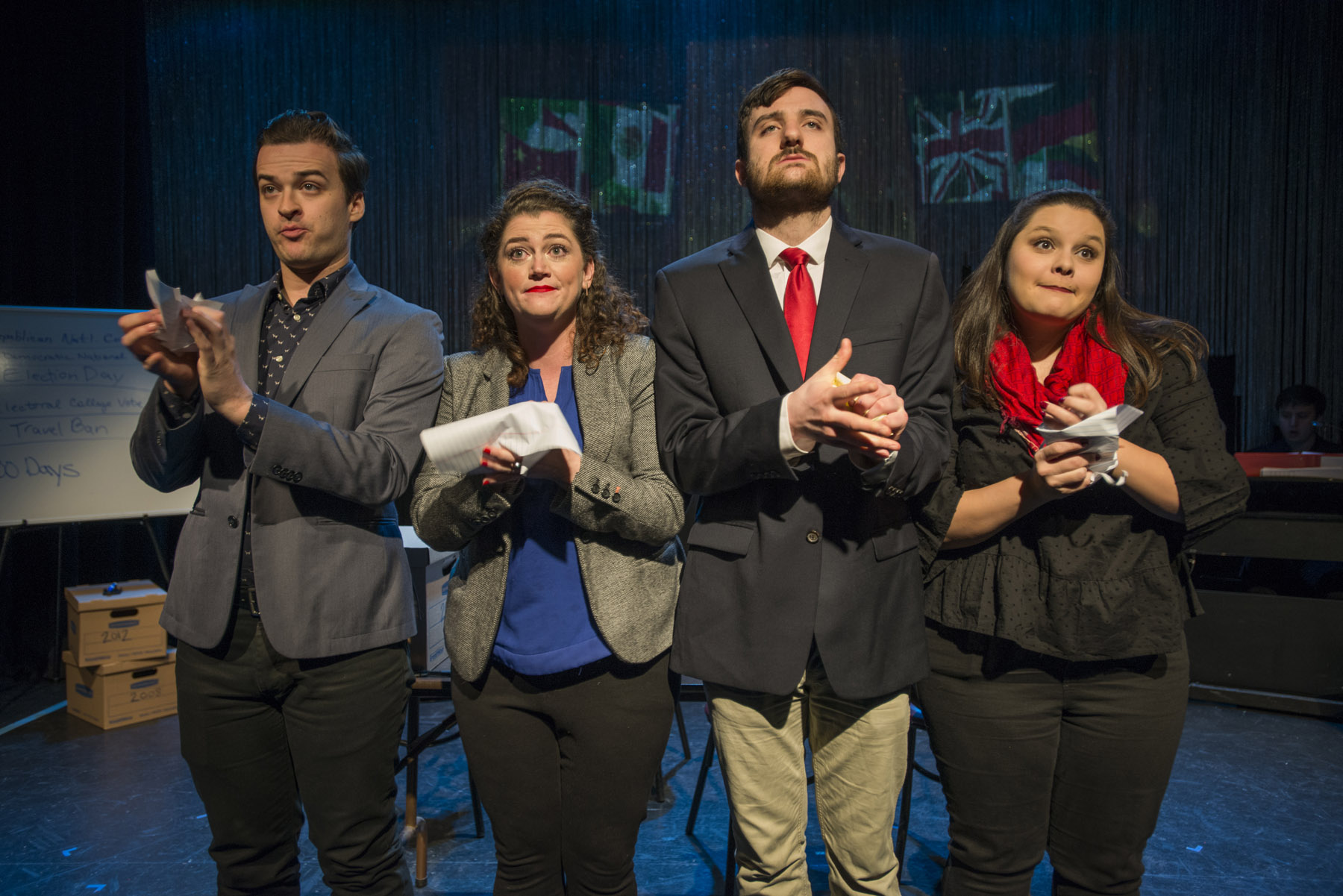
The musical serves as a warning of sorts, but it is too little too late. If anything, it would likely inspire people to vote in the midterm elections, and just VOTE in general so we don't wind up in this "unpresidented" (to use a term from our current president) situation again.
Part of me wanted the show to be harsher on Trump, but I can see where too abrasive of an approach would potentially turn people off. Another part of me wanted it to be funnier, because what's more of a joke than a highly unqualified reality television star becoming one of the most powerful politicians on the planet? But the reality of that is truly frightening far more than funny. The songs convey anger, and yes, some humor, but what the show does best is present the facts and give intelligent, level-headed commentary – something our country is in vast shortage of these days.
We the People is playing at Stage 773 at 1225 W Belmont Ave through February 10th.
Review: Blind Date at Goodman Theatre

Who’d have thought a Cuban-born playwright could endear an auditorium of liberals to Ronald Reagan. Rogelio Martinez’s new play ‘Blind Date’ is a fictionalized account of the very real first meeting between Soviet general secretary Mikhail Gorbachev (William Dick) and President Ronald Reagan (James D. Farruggio). Robert Falls returns to the Goodman to direct this world premiere.
Billed as a comedy, some will wonder what could be funny about a world on the brink of nuclear war? As it turns out, quite a bit. ‘Blind Date’ is basically a drawing room comedy. Most of the scenes are two-person conversations between the various historic players of the time. Beginning with US Secretary of State George Schultz (Jim Ortlieb) and Soviet foreign minister Eduard Shevardnadze (Steve Pickering) all the way up to the fateful meeting between Gorbachev and Reagan in Geneva.
The narrative structure of this piece is interesting. In some cases, cast members speak their opinions directly to the audience. In other instances, there’s narration by way of British biographer Edmund Morris (Thomas J. Cox). The narration serves the playwright’s thesis that even his own biographer didn’t really understand Reagan. The asides are more often a conveyance for one-liners. Though, they do provide insight into the mindset of the Soviets and Americans in these meetings.
It’s no surprise that Falls has assembled some of Chicago’s foremost actors for this new play. Deanna Dunagan plays Nancy Reagan, in a nearly perfect likeness no less, while Goodman favorite Mary Beth Fisher plays Raisa Gorbachev. The two first ladies share a scene in which almost nothing of consequence is discussed, but the slight backhanded compliments and fuss made over tea bags versus loose leaf underscore how tenuous relations between the super powers were. Each thinking themselves superior in domesticity and political ideology. Scenes featuring Dunagan and Fisher are the most engaging as the dialogue sharpens to a point. What few may consider is how much influence these two women had over their husbands. Despite contradicting opinions, both sides desperately wanted to see an end to the nuclear arms race. A noble idea that has unfortunately taken a wrong turn since the mid-80s.
There’s danger in glorifying Ronald Reagan as an innocuous savior from nuclear war. His optimism regarding the Soviets was certainly helpful but in the end, the Soviet Union collapsed from a failing economy, not Reagan’s pro-Democracy initiatives. And yes, it’s easy to look at Reagan and think, at least he’s not our current president, but let’s not forget the homophobic blind eye his administration turned toward the AIDS crisis, and the lasting effects of the unsuccessful war on drugs.
This play is a lot like an average Oscar-bait movie. You know the type: polished historical drama about a specific section of history, usually starring high profile British actors like Judi Dench. Ones that you know you should see, but probably won’t. It’s okay for a play to be ephemeral. In this case, the global nuclear stakes are so high right now that it’s vital for Americans to understand how serious even the tiniest miscommunication could be. It’s important for Americans to remember what diplomacy looked like. Think of the current president’s impulsive behavior on Twitter. Rogelio Martinez’s play may make you giggle at Reagan’s loveable weirdness, but the gravity of this meeting with Gorbachev in 1986 should frighten us all. These were poor leaders who made a very smart decision. It’s a terrifying shame our current leaders would rather go back in time.
At Goodman Theatre through February 25th. 170 N Dearborn. 312-443-3811
Hatfield and McCoy is not for the faint of hearts

Loosely based on a true story of the two infamous feuding families- Hatfield and McCoy – and inspired by Shakespeare’s Romeo and Juliet, the namesake musical takes place circa 1865 in West Virginia.
McCoy family loves to stage home plays and write poetry, while Hatfields spend most of their time drinking whiskey and planning revenge against McCoys. It’s mostly un-clear what started the hostility between the two families, but both parties are very much into it. The families occasionally take a break from killing each other for the annual talent competitions. There is a 3-piece live band on stage consisting of Matthew Muniz (Music Director/ Keyboard), Jake Saleh (Upright Bass), and Jess McIntosh (Fiddle). Actors sing, play acoustic guitars and mandolins. New music created for the play (Shawn Pfautsch and Matt Kahler) represents Americana styles across generations, from bluegrass to 2017 pop.
During one of such competitions, McCoys’ young daughter Rose Anna (sweet-voiced Haley Bolithon) accidentally falls in love with Hatfields’ young son Sam (Bradley Grant Smith); the two love birds immediately conspire to get married and thus reconcile their families once and for all. But the other family members do not trust each other, so things don’t exactly go as planned.
Interesting choreography bordering on dance combined with great period costumes (by Emily McConnell) makes for a visually enticing show. Director Matt Hawkins, who is also a fight choreographer and movement director, incorporated several dance-like fight scenes into the play with terrifying outcomes, and those are some of the highlights of the show.
Lengthy monologues peppered with Bible quotes, as both patriarchs are fond of searching Bible for quotes to justify their actions - the play has a strong Christian presence. But despite many great passionate performances, most memorably by Robert D. Hardaway as “Devil” Anse Hatfield, Marika Mashburn as Levicy Hatfield and Stacy Stoltz as Sarah McCoy, it is vaguely reminiscent of a high school play as it lacks certain emotional maturity, especially considering the horrifying subject matter.
Rivers of fake blood, loud guns and violent knife stabbings – Hatfield and McCoy takes no prisoners, quite literally. Tragic ending serves as a cautionary tale: “There ain’t no winning in war”.
The House Theatre Company’s Hatfield and McCoy is being performed at Chopin Theatre through March 11th. For more show information visit www.chopintheatre.com.
First Folio's "Women in Jeopardy" a delightfully rich comedy

Simply said, First Folio’s latest production hits on all cylinders. Women in Jeopardy, currently performed at Mayslake Peabody Estate in Oakbrook, is a sharp comedy that successfully lands a very high percentage of its humor with the audience thanks in part to its funny script with plenty of the credit going to the play’s dynamic cast that makes good comic timing look much too easy. Written by Wendy MacLeod, who penned The House of Yes, Schoolgirl Figure and Things Being What They Are, Women in Jeopardy grabs the audience within minutes and refuses to let go.
The story revolves three forty-something women, Mary, Jo and Liz, who, having been longtime best friends, have supported each other during their divorces and now look out for each other – like best friends should. Perhaps it would have been just another day, but when a dental hygienist goes missing from the parking lot of Liz’ new boyfriend, Jackson’s, dental practice, Mary and Jo quickly piece together a series of circumstantial evidence and jump to their own conclusion. Suspecting Jackson as the abductor, Mary and Jo still need to exercise caution not wanting to outright accuse him in front of Liz while, at the same time, wanting to protect her. When Liz’ daughter and her spacey boyfriend get into the mix, the story jumps to another level of hilarity. Women in Jeopardy is a whodunnit that keeps you laughing as much as guessing.
Amy Montgomery (Mary), Lydia Berger Gray (Jo) and Melanie Keller (Liz) are dynamite – and very funny - as the three besties, displaying strong chemistry together making their friendship highly believable. Hayley Burgess puts forth a strong performance as Amanda while Chris Vizurraga is also well cast as Amanda’s dopey snowboard shop-working boyfriend, Trenner, who hilariously crushes badly for Mary. Stealing many well-deserved laughs is Joe Foust, who doubles as both Jackson and the town sheriff, Kirk. Women in Jeopardy goes to the perfect height of comedy without go so over the top that witty humor becomes sheer silliness.
Fiercely directed by Janice L. Blixt, Women in Jeopardy is a finely-crafted and superbly-acted comedy that delivers consistent laughs and just the right amount of intrigue. If you're looking for a great way to spend a delightfully entertaining evening during the Valentine's season, look no further.
Highly recommended.
Women in Jeopardy is being performed at Mayslake Peabody Estate through February 25th. For tickets and/or more show information visit www.firstfolio.org.



Latest Articles
-
 3Arts distributes $860,000 in unrestricted grants to Chicago artists at 3Arts Awards, surpassing $10M in lifetime funding
Written by Buzz Center Stage3Arts, the Chicago-based nonprofit grantmaking organization, awarded $860,000 to Chicago artists and announced the recipients of its 3Arts Next Level Awards—$50,000 unrestricted awards given to past 3Arts awardees—during a festive celebration held last night at the Harris Theater for Music…
3Arts distributes $860,000 in unrestricted grants to Chicago artists at 3Arts Awards, surpassing $10M in lifetime funding
Written by Buzz Center Stage3Arts, the Chicago-based nonprofit grantmaking organization, awarded $860,000 to Chicago artists and announced the recipients of its 3Arts Next Level Awards—$50,000 unrestricted awards given to past 3Arts awardees—during a festive celebration held last night at the Harris Theater for Music… -
Guarneri Hall announces two-day series REVOLUTIONS on the intersection between music, politics, and social change November 11-12, 2026
Written by Buzz Center StageThe nonprofit Guarneri Hall, a state-of-the-art, custom-built classical music venue in the heart of downtown Chicago at 11 E. Adams St., proudly announces Revolutions, a two-day music series exploring the intersections of political, social, technological, and musical change at two…
-
The Front Theatre announces casting for the North American Premiere of Sap February 25 - March 27, 2027
Written by Buzz Center StageThe Front Theatre announces casting for the North American premiere of Rafaella Marcus's highly acclaimed play Sap, directed by Charles Riffenburg. Sap is a timely and poetic thriller, in which a woman's lie to her girlfriend threatens to grow out of control when…
-
Hyde Park School of Dance presents annual performances of The Nutcracker December 11–13 at Mandel Hall
Written by Buzz Center StageHyde Park School of Dance, now in its 33rd year of training, performance, and community, welcomes families and dance enthusiasts to its annual, one-of-a-kind presentation of The Nutcracker. Performances are December 11–13 at Mandel Hall on the University of Chicago…


Does your theatre company want to connect with Buzz Center Stage or would you like to reach out and say "hello"? Message us through facebook or shoot us an email at This email address is being protected from spambots. You need JavaScript enabled to view it..
*This disclaimer informs readers that the views, thoughts, and opinions expressed in the text belong solely to the author, and not necessarily to Buzz Center Stage. Buzz Center Stage is a non-profit, volunteer-based platform that enables, and encourages, staff members to post their own honest thoughts on a particular production.