
Items filtered by date: November 2007
Tale as Old as Time—Broadway in Chicago Presents ‘ Disney's Beauty and the Beast’

While I might have been born too late to experience Beatlemania or Woodstock or the Jazz Age in real time, I’ve been fortunate enough to live through plenty of moments that have already become milestones in our cultural consciousness. One of those was what’s now called “The Disney Renaissance.” I can still remember sitting in late 20th-century theaters and experiencing The Little Mermaid and Aladdin and The Lion King and being blown away by the songs and the characters and the worlds that that particular generation of Disney creatives imagined. Now that I think about it, those movies were perhaps the biggest inspiration for my own career in children’s books.
Maybe the best of those movies was Beauty and the Beast—it was bigger and more beautiful than about any other movie I can think of, animated or not. Its songs and its moments have been and are still referenced just about everywhere. And I still remember sitting there, experiencing all of it on the big screen.
So it was a real treat to experience that very same wonder all over again, all these decades later, on the stage of Broadway in Chicago’s Disney's Beauty and the Beast: The Musical at the Cadillac Palace Theatre. And it was just as thrilling to watch my youngest daughter and so many others who missed out on the original movie’s theatrical run experience it, too. The songs, the characters, and the whole world they build are right there, like it’s 1700s France (via 1990s America), for 21st-century children of all ages to hear and see and visit.
The talented cast of this touring production—directed and choreographed by Matt West—bring the songs and characters and world to life and to the stage. Of course we have the titular beauty and beast. Kyra Belle Johnson’s every bit the Belle the audience came to see—independent and animated and confident and tender. Fergie L. Philippe is a fine Beast, too—fearsome when he must be and princely when the story allows.
But, just like the film, it’s the populace of Belle and Beast’s world who make it so magical. It’s Danny Gardner’s Lumiere, the flashy and flirty candlestick. It’s Cameron Monroe Thomas’ giggling, wiggling Babette. It’s Kathy Voytko and Levi Blaise Coleman as sweet Mrs. Potts and her charming little Chip. It’s Stephen Mark Lukas grotesquely strong-jawed Gaston and Harry Francis’ slapstick sidekick, Lefou.
And it’s the impressive—in size and especially in talent—ensemble who really do the heavy lifting of the world building. Whether it’s Belle’s provincial village or the Beast’s fantastical castle, the cast become villagers and cups. They tap-dance and cancan and waltz. And they bring the show’s songs to life, making me appreciate them every bit as much as the first time I heard them, the bawdy barroom singalong “Gaston” wowing me, only to be immediately eclipsed by “Be Our Guest” (one of the few times in all of my theatergoing that a performance had to pause for a standing ovation during the show).
So, if like my daughter you didn’t get to experience the magic of Disney's Beauty and the Beast when it originally happened, you’ll get to experience it now. And, if like me, you want to feel the same way you did when you first heard Menken and Ashman’s classics brought to life by Disney’s renaissance men and women, check out Broadway in Chicago’s Disney's Beauty and the Beast at the Cadillac Palace Theatre, now through August 2.
*This review is also featured on https://www.theatreinchicago.com/!
Review: In 'White Rabbit Red Rabbit,' the Audience Becomes the Play

"White Rabbit Red Rabbit" isn’t your typical night at the theater. It’s unscripted, unpredictable, and unlike anything you’ve seen before. Performed cold by a different actor each night, it’s a play that blends humor, vulnerability, and a quiet kind of bravery—both from the performer and the audience.
There are plenty of ways to spend a Sunday or Monday evening, such as relaxing on the couch, cooking something ambitious (or just heating up leftovers), maybe taking a stroll through the park. I, however, choose to spend my Monday night at one of the most surprising and engaging plays I’ve ever experienced. I head over to TUTA Theatre to see White Rabbit, Red Rabbit by Iranian-German playwright Nassim Soleimanpour. Safe to say, I have absolutely no idea what I’m getting myself into.
"White Rabbit Red Rabbit" is an experimental play performed “cold” by a different actor at every show. The catch? The actor has never seen the script beforehand. There’s no rehearsal, no director, and barely even a set. It’s theatre stripped down to the bones: one actor, one script, one shot. Unable to leave his home country, Soleimanpour offers a deeply personal glimpse into his life in Iran and the complex power dynamics at play, not just there, but everywhere.
As the show begins, the actor for the night, Huy Nguyen, opens a sealed envelope containing the script. He introduces himself, then asks the small audience to count off. It’s Soleimanpour’s way of making sure we all know how many people are about to go on this strange little journey together. Final headcount: 30.
Right from the start, it’s clear Nguyen is a gifted performer. He delivers each line with power and clarity, pausing just enough to let the weight or the weirdness of the words sink in. Through his performance, he brings Soleimanpour’s voice to life, striking a balance between humor, tension, and vulnerability with impressive ease.

TUTA company member Huy Nguyen (left) with audience member Robert Bry Hunter.
Those numbered seats aren’t just for counting heads. Nguyen, following Soleimanpour’s instructions, pulls audience members into the performance. Like it or not, we aren’t just watching the play, we become part of it. Each person is assigned a number, a role, and, weirdly enough, a sense of shared responsibility. Before long, the stage fills with everyday people acting out a strange and quietly heartbreaking tale about a rabbit trying to get into a circus. It feels whimsical at first, but the deeper metaphors quickly surface. These surreal moments offer a glimpse into the constraints Soleimanpour faces, using allegory to explore themes of power, obedience, and isolation.
As the performance continues, it becomes clear that "White Rabbit Red Rabbit" is more than just a theatrical experiment. It creates a deeply personal connection with Soleimanpour as he reaches out to share his trauma and vulnerability with the audience. The play explores what it means to lose power not only as a citizen but also as a performer and audience member. Soleimanpour expresses his strong desire to travel and meet the people watching, to connect fully through shared experience. Throughout the show, Nguyen beautifully captures the deep emotions and longings at the heart of Soleimanpour’s story.
One of the wildest things about "White Rabbit Red Rabbit" is how it keeps you laughing. . .until it doesn’t. One minute, Nguyen is running around the stage pretending to be an ostrich. The next, he’s calmly listing ways people commit suicide. It’s emotional whiplash in the best (and most jarring) way. That sudden shift from comedy to darkness really shows the inner chaos Soleimanpour must have been dealing with. He’s clearly trying to make sense of heavy stuff while still holding on to humor and hope.
This was my first time seeing a “cold read” performance, where the actor hasn’t seen the script before stepping on stage. I was genuinely impressed. The whole thing felt unpredictable, not just for the audience but for the actor too. It created this weirdly intimate vibe where we were all discovering the story together. Surprisingly, nothing felt awkward or forced. Nguyen handled it all like a total natural, even in the most bizarre moments. The rawness of the format made everything feel immediate, real, and kind of thrilling.
I highly recommend "White Rabbit Red Rabbit" to anyone who’s spontaneous and looking for something completely different. It’s a one-of-a-kind experience that keeps you guessing. That said, I’d think twice about bringing kids or anyone who might be uncomfortable with sensitive subjects, especially suicide. The show does dive into some heavy themes that may not be for everyone.
The show has a fast runtime of about 70-90 minutes without any intermissions. Make sure to eat dinner before as the small theatre doesn’t have any concessions but do offer drinks in exchange for a theatre donation.
The production is presented by TUTA Theatre, a company known for its bold and experimental approach to theater in Chicago. The show is brought to life by TUTA’s Co-Artistic Director, who also serves as the Artistic Producer for "White Rabbit Red Rabbit."
TUTA Theatre is located at 4670 N Manor Ave in Chicago’s Ravenswood neighborhood. It’s an intimate space, with the show staged in a small back auditorium through a garage entrance. The venue seats about 30 people, which makes the whole experience feel up close and personal.
"White Rabbit Red Rabbit" runs from July 6 through August 11, with shows on Sunday and Monday evenings at 7:30 p.m. Tickets range from $20 to $60. You can grab yours at tutatheatre.org.
*Extended through September 29th
So if you’re free on a Sunday or Monday night, skip Netflix and take a chance on something different. You might walk away thinking a little deeper…and may even begin looking at rabbits a little differently, too.
*This review is also featured on https://www.theatreinchicago.com/!
Seeing Purple: Goodman Theatre’s Stunning Revival Honors Alice Walker’s Vision

In the Goodman Theatre’s stirring new production of The Color Purple, director Lili-Anne Brown delivers a version of Alice Walker’s landmark novel that feels both stripped down and soulfully expansive. Forgoing spectacle in favor of raw emotional clarity, Brown places the story’s heart—female resilience and love—center stage, and the result is a deeply moving, musically rich, and spiritually resonant experience.
Performed on a minimalist wooden set, this production doesn’t rely on lush visuals or elaborate scenery. Instead, it trusts in the power of storytelling, character, and song to carry the audience through Celie’s journey. And Brittney Mack, as Celie, is a revelation. Her performance is layered and honest, tracing Celie’s transformation from a silenced, abused girl to a self-possessed, radiant woman with astonishing depth and grace. Mack’s voice, vulnerable and strong in equal measure, anchors the production emotionally and thematically.
What sets this Color Purple apart is Brown’s unflinching loyalty to the spirit of Walker’s novel. Where some adaptations have diluted or sidelined the central theme of same-sex love, this one centers it. Celie and Shug’s relationship is not a footnote—it’s the story’s spiritual awakening. Aerie Williams as Shug Avery brings magnetic charm and fierce tenderness to the role, particularly in the aching duet “What About Love,” which becomes a quiet act of liberation for Celie. In this production, purple is not just a color—it’s a symbol of the love between women, of beauty that exists even in suffering, and of a life finally chosen on one's own terms.
Nicole Michelle Haskins brings fierce humor and unbreakable will to Sofia, commanding the stage with her booming presence and crystal-clear purpose. Her scenes with Gilbert Domally’s affable and conflicted Harpo pulse with humor and tension. Evan Tyrone Martin as Mister and Sean Blake as Ol’ Mister embody the failure of patriarchy to extinguish women’s light. The men here, barely even named, are forces to resist rather than understand—an intentional move that mirrors Walker’s narrative framing.
Musically, the show is a triumph. Jermaine Hill’s musical direction allows the score—by Brenda Russell, Allee Willis, and Stephen Bray—to soar. From the quiet yearning of “Somebody’s Gonna Love You” to the exuberant defiance of “Push the Button” and “Big Dog,” every number drives the story forward with emotional precision. Breon Arzell’s choreography adds joy to even the darkest moments, reminding us that Black joy, even amidst oppression, is a radical act.
By centering the relationships between women—mothers, sisters, lovers—and embracing the spiritual and sexual awakenings that shape Celie’s story, this Color Purple finds new life and renewed purpose. Brown doesn’t simply direct this musical; she honors it, restores it, and reminds us why this story still matters. It’s not just about surviving trauma—it’s about reclaiming beauty, pleasure, and love on your own terms.
In a world that often asks Black women to be strong for others, this Color Purple says: be soft, be bold, be free. And be seen—in all your brilliance.
Top of Form
Highly Recommended
When: Through Aug. 3
Where: Goodman Theatre, 170 N. Dearborn St.
Tickets: $33-$143
Run time: 2 hours, 50 minutes
Info: goodmantheatre.org
*This review is also featured on https://www.theatreinchicago.com/!
'Dhaba on Devon Avenue' a Local Story with Universal Meaning

In its world premiere at Writers Theatre in Glencoe, “Dhaba on Devon Avenue” is a strong play, from a promising writer, Madhuri Shekar, winner in 2020 of the Lanford Wilson Playwriting Award. A TimeLine Theatre production, it is directed by Chay Yew.
Another of Shekar’s plays, “A Nice Indian Boy,” produced by Chicago’s Rasaka Theater Company in 2015, was adapted to a 2024 film released theatrically (now streaming) —a kind of “Guess Who’s Coming to Dinner” crossed with “My Big Fat Greek Wedding” set in India and with a gay white American boy as the surprise fiance.
“Dhaba on Devon Avenue” is in that vein, but a more serious drama: the widower Neeraj (Anish Jethmalani), patriarch of the struggling Dhaba Canteen, a South Asian restaurant on Chicago’s Devon Avenue, is coaching his sous chef daughter Rita (Tina Muñoz Pandya) on the eve of the restaurant’s 30th anniversary banquet. As Neeraj reveals his secrets of Sindhi cooking (Sind is a region of what is now Pakistan) we move into “The Bear” territory—a bit of demanding “Yes Chef” performance as Rita never seems to get the sauce up to Neeraj’s expectation—despite having made it for years.
We suspect Neeraj is tasting with his emotions rather than his palate, and indeed this proves to be the case. Neeraj is one of those old timers that thinks if we can just get things back to exactly where they were in the old days, the problems will go away. But that’s complicated by a diagnosis of Parkinson’s, with early symptoms just beginning to show.
Though she is frustrated by her father’s demands - Rita has been successfully making these dishes for years - she submits to Neeraj’s demands, starting dishes over multiple times to get the flavors just right. The pressure for this “Big Night” banquet is seasoned with urgent calls between Neeraj and his bank, with a deadline for satisfying his loan closing in. When Rita suggests forestalling foreclosure may be more important than perfecting the meal, Neeraj is dismissive. “We always have money problems,” but we can’t serve “substandard food,” in a cruel slight to his daughter Rita.
While the dramatic force plays between father Nareej and daughter Rita, it is the supporting roles that provide color and flair to “Dhaba on Devon Avenue.” Enter Neeraj’s daughter Sindhu (Arja Daire is terrific), an emancipated married professional living the upper middle class life in Seattle. She tries to connect with her dad, and could advise him well, if Neeraj would only give her the chance. He won’t.
Enter brother-in-law Adil (Muheen Jahan, in an excellent comedic performance), who is inspired to invest in Dhaba Canteen. Reluctant to admit his impending failure, Neeraj responds with a wall of “No,” even as the pressure builds. To add more fuel to the dramatic fire, Rita has struck up a romantic tryst with the line cook, Luc Fuentes (Ina Arcinegas in a solid performance), the one non-South Asian character.
All these components add a lot of baggage to the core of the drama - Neeraj’s resistance to the changes necessary for the business to survive. Or more broadly, a man facing the end of the road by doubling down on the past, and with little grace.
How all this gets resolved is nicely packaged in a 90-minute, no-intermission show. But I couldn’t help feeling that keeping the focus on the patriarch, making it more like Lear or Death of a Salesman, might have made for better drama.
The set (Lauren M. Nichols) with a fully equipped kitchen—commercial range, stainless work surfaces, under counter coolers, even tiled floors—was spot on, but props seemed scant for a truly working kitchen. Transition music between scenes was rather too loud. And in certain scenes—such as Rita rummaging around in a file box for a long lost recipe book—she finds it in seconds. It should have taken longer, perhaps, with more stuff in that box.
Definitely worth seeing, if only to get on the track to follow Madhuri Shekar’s next work, “Dhaba on Devon Avenue” runs through July 27, 2025 at Writers Theatre in Glencoe, IL.
*This review is also featured on https://www.theatreinchicago.com/!
Angels in America Soars at Chicago’s Invictus Theatre

New York City in the 1980s—marked by Reagan-era conservatism and the devastating effects of the AIDS epidemic—was in decline. This is the backdrop for Tony Kushner’s Angels in America, a sweeping two-part epic that earned the Pulitzer Prize, multiple Tony Awards, and a lasting place as one of the most influential works in modern theatre. Invictus Theatre Company, known for fearless storytelling and bold, intimate productions, meets the challenge with conviction. Their staging not only honors Kushner’s towering vision but also transforms it into something urgent and immediate. The result: an experience that speaks powerfully to our present moment.
Directed with striking clarity by Charles Askenaizer and assisted by Kevin Rolfs—who also designed the production’s remarkable set—this version of Angels doesn’t merely revisit America’s past; it interrogates it. Rolfs’ design, echoing the collapse of once-sacred institutions, transforms hospitals, apartments, courtrooms, and Central Park into ghostly battlegrounds for justice, truth, and redemption. Brandon Wardell’s extraordinary lighting heightens the effect—especially one cue so immersive and thunderous, you might think the ceiling is about to cave in. (Seriously—OMG.)
The cast of eight delivers fearless, multidimensional performances, with each actor covering several of the play’s 28-plus roles. Joe Bushell (Joseph Pitt), Grant Carriker (Louis Ironson), Michael D. Graham (Roy Cohn), Ryan Hake (Prior Walter), Miguel Long (Belize), Nicki Rossi (The Angel), Renae Stone (Hannah Pitt), and Anne Trodden (Harper Pitt) all impress. Ryan Hake brings heartbreaking vulnerability and wit to Prior Walter—a bold, beautiful performance—while Miguel Long’s Belize is grounded, magnetic, and gloriously biting. Michael D. Graham’s Roy Cohn is monstrous and mesmerizing, a chilling embodiment of American power and denial. Nicki Rossi’s Angel is both ethereal and commanding—an apocalyptic herald with real presence.
That presence feels especially relevant in 2025. In many ways, we are living Roy Cohn’s dream—a world where power is prized above truth, image eclipses integrity, and accountability is reserved for the powerless. In Angels in America, Cohn embodies a ruthless, transactional politics that weaponizes fear, denies reality, and elevates self-interest at all costs. Today, those tactics are no longer confined to courtrooms—they dominate headlines, social media feeds, and entire political ideologies. The erosion of public trust, the glamorization of cruelty, and the refusal to reckon with systemic failure all echo the legacy he helped forge. Roy Cohn may be long dead, but his playbook is alive and thriving.
Jessie Gowens’ costume design dazzles—otherworldly when needed, sharply evocative when grounded—capturing the period while fully embracing the show’s surreal, metaphysical edge. Every design element contributes to a visual world that is both haunting and theatrical, elevated by bold creative choices and performances that are deeply cohesive.

From PART ONE: MILLENNIUM APPROACHES. Michael D. Graham (left) as Roy Cohn, Joe Bushell (right) as Joe Pitt.
Invictus Theatre remains one of the true treasures of Chicago’s storefront theatre scene. Known for consistently punching above their weight, they once again surpass expectations. With Angels in America, they reach an artistic pinnacle—ambitious, fearless, and heartfelt. This production is a testament to what’s possible when daring meets discipline and vision is matched by talent.
There’s something truly transcendent about experiencing both parts of Angels in America—Millennium Approaches and Perestroika—on the same day. The emotional arc deepens, the themes resonate more fully, and the epic sweep of Kushner’s vision unfolds without interruption. It becomes not just a play, but a full-day journey through love, loss, politics, and prophecy. Invictus Theatre offers this rare opportunity only on Saturdays during the run, and it’s absolutely worth carving out the time. That said, each part stands powerfully on its own. Whether you see them together or separately, the momentum and emotional impact remain firmly intact.
A final word of thanks to the front-of-house team. The warm, welcoming experience begins the moment you walk through the door. Theatre doesn’t start onstage—it starts in the lobby. And Invictus gets it absolutely right.
A triumph.
Highly Recommended
When: Through September 6
Where: Invictus Theatre @ Windy City Playhouse, 3014 W Irving Park Rd, Chicago
Tickets: $25 - $38
Info: Invictustheatreco.com
PART ONE: MILLENNIUM APPROACHES will play Fridays at 7 p.m., Saturdays at 12 p.m., and alternate Mondays at 7 p.m., starting Monday June 30.
Additional performances of PART ONE will be presented Sunday, July 6 at 12 p.m., and Thursday August 28 and September 4 at 7 p.m.
Final performance Saturday, September 6 at 12 p.m.
PART TWO: PERESTROIKA will play Saturdays at 7 p.m., Sundays at 12 p.m., alternate Mondays at 7 p.m. starting Monday, July 7.
Additional performances of PART TWO will be presented Thursday, July 3 and Friday, August 29 at 7 p.m.; and Friday, September 5 at 7 p.m. Final performance Sunday, September 7 at 12 p.m.
Each part has two intermissions.
There are no performances on June 29, July 4 or 5, or on August 30, 31 or September 1.
*Extended through September 21st
*This review is also featured on https://www.theatreinchicago.com/!
Sensational Musical Salutes an Unparalleled Trio of Living Legends

Taking part of its title from a defining song that drew attention to the AIDS crisis in the mid 80s, That’s What Friends Are For: Gladys, Dionne and Patti combines thoughtful storytelling and fantastic music to honor the cultural contributions of three outstanding artists. Currently playing at Black Ensemble Theater (BE) through late July, it also highlights how the three women referenced, now each in their eighth decade, have been able to sustain a close and abiding friendship for over fifty years. That BE fulfilled its mission to offer a fresh look back on the careers and discography of Gladys Knight, Dionne Warwick and Patti LaBelle so brilliantly is more refreshing than it is surprising. Proving that even when you’ve honed your craft expertly for nearly half a century, you can still innovate and discover new approaches to offer the theater going public something novel and tremendously exciting.
Written and directed by Daryl D. Brooks, the theater’s Producing Managing Director, the musical’s more dramatic elements take place in the Green Room of a leading Vegas nightclub where the three legends will be headlining a performance. Chic and relaxingly plush, it reads as a fitting setting for a reunion of luminaries. Acting as their tender who’s indubitably accomplished at what he does and has a history serving at least one of the women in the past, ensemble member Dennis Dent dials up the comedy quotient by compulsively oversharing some of the racier parts of his own love life while accommodating their every desire. It doesn’t take long to become comfortably acquainted with who’s who and embrace the authenticity of the high regard the women hold for one another.
We’re initially introduced to the three stars in their fully formed and mature personas. Rose Marie Simmons portrays the contemporary Gladys Knight and Sybyl Walker and Tamara Batiest play the mature versions of Dionne Warwick and Patti LaBelle respectively. Later, as the play progresses, different actors will represent the younger fledgling versions of each of them.
What appears to be a chance comment by one of the trio early in the show launches Gladys, Ms. Simmons, into a rendition of Oh Happy Day that’s so rousing it makes you sit up straight and causes your eyes to widen. Captivating your attention with its power, conviction, ingenious arrangement and artistic mastery, a classic is transformed into something splendidly new. You soon learn singing and blue-chip musicality on that level would be the standard for the entire performance.
As the women reminisce about their early years, how they all started out as backup singers whose distinctiveness eventually took them to the standalone mic at the center of the stage, the music and sound that led to their discovery and fame was brought back to the fore. This was done most effectively when focused on Dionne Warwick’s career.
Anyone faintly familiar with Warwick’s rise knows how pivotal her association with Burt Bacharach was in fueling her fame and it’s the scene with the young Dionne (Brianna Buckley) and Mr. Bacharach, played by Michael Santos, that riveted for its realism and resonance. When the mature Dionne states she’s always been a “no-nonsense black woman who knows her worth”, it’s Buckley who brings the depth of that conviction to blazing life. Unyielding in her indignation when she learns her mentor and partner has given a song written expressly for her to another artist, her fury, its intensity made more potent because it was so contained and focused, reverberated like shock waves through the theater. With the steely ardor Buckley brought to it, the power of that scene could have been used to inspire and spawn an entirely new companion play. Its real-life outcome was to provide the seed for one the biggest hits Bacharach would write for Warwick, Don’t Make Me Over.
Similar insights about pivotal moments and crucial intersections that would go on to define the trajectory of each of their lives swirled through the production; giving each of their lives fuller dimension and engendering greater respect for what they all eventually accomplished. Fame and fortune have no impact on how well Cupid shoots his arrow and all three women knows, as the play recounts, the sting that comes when it strikes badly.
Reflecting on how their careers overlapped and remembering the friendships they shared with others in the industry, unexpected delicacies were woven into Brooks’ tight illuminating script. When some of “ReeRee’s” (Aretha Franklin’s) idiosyncrasies were playfully and lovingly recalled, her music was also resurrected with a sensational rattle-the-rafters medley of a few of her signature masterworks, Respect, Think and Ain’t No Way.
Similar delights lay in wait when Luther’s name entered the conversation. Characteristically suave, another ensemble regular, Dwight Neal, can always be counted on to nudge the bar to impressive new heights; but his vocal interpretations of Mr. Vandross, in tandem with the outstanding musicianship of BE’s rock-solid band, were remarkable. Adding another layer of excellence to an already break-out show. And as wonderful as it was, his performance was not its highlight. That distinction goes unequivocally to Tamara Batiest in her role as Patti LaBelle. When you consider Ms. LaBelle’s vocal range, outsized charisma and the signature theatrics she’s been known to exhibit on stage, filling her shoes would seem like an intimidating task. Batiest’s take on Patti makes the challenge look trivial, becoming an avatar who’s as realistic and enthralling, if not more so, than the original. Garnering her a standing ovation every time she sang. Seeing Batiest commanding a Chicago stage more often, in addition to Ms. Simmons and Ms. Walker, would be a boon to the cultural vitality of the city.
Also adding to the production’s luster, Tanji Harper’s choreography included a dash of smooth sophisticated elegance to the steps she devised for the Spinners and Ms. Knight’s faithful Pips. Complemented by Keith Ryan’s polished costume designs, That’s What Friends Are For’s visual pleasures ideally framed a night of marvelous music.
That’s What Friends Are For: Gladys, Dionne and Patti
Through July 27, 2025
Black Ensemble Theater
4450 N. Clark Street
Chicago, IL 60640
https://blackensembletheater.org
Highly Recommended
*Extended through August 10th
*This review is also featured on https://www.theatreinchicago.com/!
Sweet Dreams and Steel Guitars: Drury Lane’s Tender Tribute to Patsy Cline

Always...Patsy Cline is a poignant and entertaining jukebox musical that honors the legacy of iconic country singer Patsy Cline through the heartfelt story of an unexpected friendship, which is currently beautifully staged at the Drury Lane Theatre in Oakbrook. Conceived and written by Ted Swindley, the production is inspired by the real-life bond between Cline and Louise Seger, a devoted fan from Houston who first heard Cline on the radio in the late 1950s. Their connection sparked in 1961 when Seger met Cline before a performance, marking the beginning of a sincere pen-pal friendship that continued until Cline’s untimely death in a plane crash on the way to Nashville on March 5th, 1963. Patsy Cline was just 30 when her life was cut short, right as she stood on the brink of what many believe could have been a long and illustrious career. Her star was still rising, leaving us to wonder just how far her extraordinary talent might have taken her.
Framed through Louise’s vivid recollections, the musical interweaves narrative and music, featuring over twenty of Cline’s signature songs such as “Crazy,” “Walkin’ After Midnight,” and “Sweet Dreams.” As Louise shares their story, Cline takes the spotlight to perform, offering a touching blend of live music and personal storytelling. The show captures not only the spirit of Cline’s music but also the deep emotional bond that fans can forge with their idols, making it a heartfelt homage to lasting friendship and musical legacy.
There’s a spark of something special from the moment Louise—punctual as ever—spots Patsy Cline sitting alone before the show. Summoning her trademark blend of boldness and charm, she approaches, introduces herself, and warmly invites Patsy to join her table with her family and boss. Cline’s easy reply, “Well, why don’t I just join you?” becomes the turning point that launches an unforgettable evening and the beginning of a heartfelt friendship.
From the moment Louise steps into the neon-soaked nightlife of Houston, Texas, Louise reveals she’s no mere admirer—she’s a woman with grit, savvy, and a spine of steel. That very night, she’s floored to find that country music icon Patsy Cline has arrived entirely on her own—no agent, no assistant, not even a friendly face in sight. It’s a glaring oversight, and Louise isn’t about to let it slide.
The real kicker? Cline is booked to sing for four uninterrupted hours. Outraged, Louise takes charge. She marches straight into the manager’s office, Cline trailing behind, clearly unaccustomed to someone going to bat for her. Louise doesn’t mince words. She calmly but firmly asks: at what time is Patsy expected to start each of her two sets? Her meaning is unmistakable—this isn’t one continuous gig; it’s two full shows, and the artist deserves to be treated—and paid—as such.
The bold move pays off. Cline walks away with double the fee and something just as valuable: a chance to rest her voice and spirit between sets.
But Louise’s backstage hustle doesn’t end there. By sunrise, she’s already secured Cline a slot on a local radio broadcast, giving the singer a quick burst of publicity in the regional market. And when it’s time for Cline to catch her flight, Louise is the one who sees her off, driving her to the airport like a trusted friend. In just 24 hours, Louise proves she’s more than a fan—she’s a fixer, a fierce protector, and someone who understands exactly what it means to lift up another woman.
Aja Alcazar takes center stage as the legendary Patsy Cline, and she doesn’t just step into the role — she owns it. With the grace of a seasoned storyteller and the vocal firepower to match, Alcazar channels the spirit of the Virginia-born country icon in a performance that’s nothing short of electric. Her portrayal is steeped in authentic country warmth, infused with a lively sense of sass and vulnerability that makes Cline feel both larger than life and achingly real.
From the moment she launches into the opening notes of “Walkin’ After Midnight,” Alcazar captivates the room, weaving through a powerhouse setlist that also includes timeless classics like “Your Cheatin’ Heart,” “I Fall to Pieces,” “She’s Got You,” and many more. Each song becomes a showcase not only of her vocal skill but of her ability to emotionally inhabit Cline’s journey — turning beloved hits into deeply personal moments. It’s a performance that doesn't just honor Cline’s legacy; it breathes new life into it.
Bria Sudia is equally impressive as boisterous uber fan Louise Sefer. Sudia is adorable, adding a ton of charisma and energy to the role is - and she is damn funny. Louise serves as the heart and storyteller of the production, guiding the audience through her memories with warmth and wit. Though she doesn't perform full songs, she livens the stage with colorful narration, sharp comedic instincts, and the occasional burst of humming or playful singing - especially in moments when Patsy's music stirs something deep within her.
Collette Pollard’s set design at Drury Lane conjures a warm, inviting honky tonk atmosphere, where a live band dressed in classic western attire strums away in the background. This rustic charm seamlessly blends with the intimate setting of Louise’s small-town kitchen, creating a space that feels both nostalgic and personal. Even before the first note plays, the allure sets in—with strands of vintage string lights draped above the stage, casting a nostalgic glow that instantly invites the audience into the world of the show.
Always… Patsy Cline offers a warm, nostalgic window into the golden era of late 1950s country western music, capturing the charm, grit, and heart of the time. But beyond the rhinestones and twangy guitars, the musical is a heartfelt tribute to one of the most iconic voices in American music history—a woman whose star burned brightly and far too briefly.
At its core, the show is also a celebration of human connection. It tells the improbable, yet true story of a friendship that bloomed between a legendary performer and an ordinary fan, offering audiences a touching reminder of how music has the power to bridge worlds. For anyone who has ever dreamed of meeting their idol, sharing a laugh, or swapping stories over coffee, Always… Patsy Cline is a beautiful, funny, and emotionally rich journey that brings that dream to life.
Always…Patsy Cline is being performed at Drury Lane Theatre through August 3rd. For tickets and/or more show information, click here.
This delightful musical is highly recommended for all ages.
*This review is also featured on https://www.theatreinchicago.com/!
Unimaginably Good: “An Iliad” Is the Best Show I Have Ever Seen

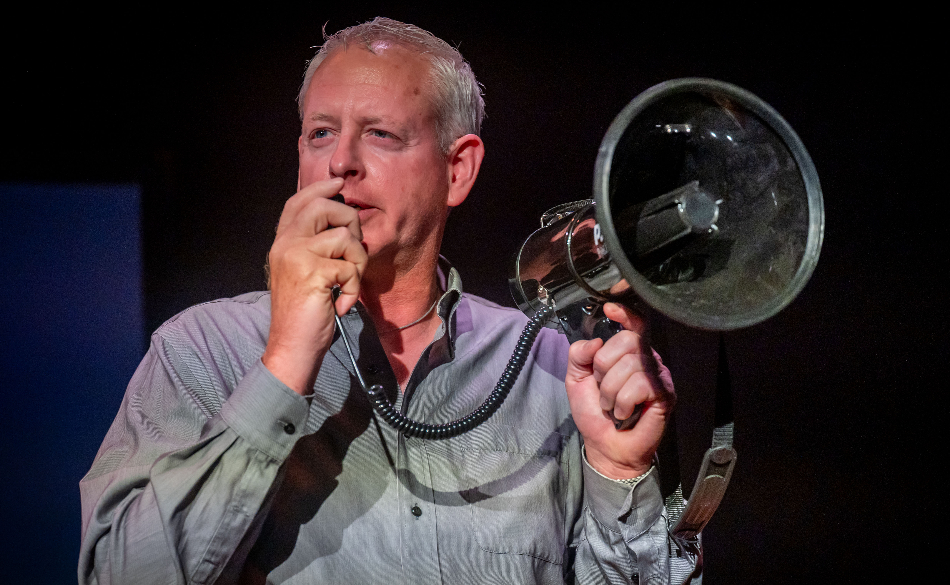
Court Theatre has brought back to its stage “An Iliad,” a surpassingly wonderful riff on Homer’s ancient Greek poem, “The Iliad.” Starring Timothy Edward Kane in a reprise of his sensational one-man performance as The Poet, it is directed by Charles Newell.
This is the fourth time Court has staged the work, its most requested remount, according to the producers. But I knew none of this when I attended Saturday night, knowing Homer’s work, of course—the Greeks rally to retrieve Helen from the Trojans—and having a vague recollection of positive buzz around "An Iliad." What I found was the most spellbinding 90 minute display of virtuosic acting that I have ever experienced.
Expecting a stentorian delivery of something from “The Iliad,” instead I found a captivating retelling of the work, contemporized inventively by playwrights Lisa Peterson and Denis O’Hare. Their accomplishment, along with Kane’s incredible performance, may be truer to conveying what audiences experienced in Homer’s time, when poets were star entertainers in the public arena and at banquets.

Kane’s highly energized performance had me asking whether he himself had written this work. Similarly, audiences in Homer’s time may have recognized familiar epic scenes, but knew the poet before them was doing his interpretation of the source. The playwrights relied on an English translation by Robert Fagles, and indeed, at a number of points we seem to be hearing bits of Fagles' language, and even samples of the original Greek, in which the meter and rhyme are identifiable.
But the vast majority of words delivered by Kane, describing the Iliad's key plot points and players, and the emotional underpinnings of what transpired in Homer’s original epic, are all done in contemporary, accessible language. For example, in naming the wide range of areas of Greece that fielded militias for the assault on Troy, The Poet recites the list of towns and regions, which sounded so unfamiliar spoken aloud. He quickly translates this to comparable American locations gathered to form the Union army. It brought it home.
The Poet also describes the way Greek soldiers felt after nine years at the front (my rough notes): “You go away and you come back and your wife is fat, or had three affairs and two kids—your father is dead.”
Lighting (Heith Parham), music (Andre Pluess) and stage design (Todd Rosenthal) conspire to bring us from battle scenes to intimate moments. Kane as The Poet traverses the stage athletically, scaling and descending inclines and stairs audaciously.
And we are ever reminded of the power of rhetorical prowess of The Poet. “I wish,” he says, “I could show you a picture of Troy.” As that line settles in our ears, realizations unfold for us: of course there were no photos, but could an artist’s rendering or a ruin be shown? But no, resoundingly no: this is an oral history, an aural experience, and “An Iliad" properly lives within that constraint—Homer didn’t do Powerpoint.
Trying to convey what Kane’s performance of “An Iliad” is like, the closest comparable would be a stand-up, not the jokester type running through punchlines, but the type like Dave Chappell who develops a story over the course of the show. Kane as The Poet is like a gripping conversationalist, in a lengthy monologue from which you cannot tear your attention.
But even more than that, much more. For the playwrights have given the script a weight and depth that can carry dramatic scenes. The recounting of Troy’s leader Priam as he pleads with Achilles for the return of his son Hector’s body, is recounted with such compelling urgency it brings tears.
The playwrights also build in a show stopper—The Poet recites a litany of major wars, naming each through history. It is a tour de force among many of Kane’s astonishing accomplishments on stage, and raises “An Iliad" from the particular to the universal, bringing an underlying message against the waste and suffering of war with crystalline clarity.
At the end, as The Poet exited and the lights came up, I told my companion, “I can’t imagine him ever doing this performance again.” And yet he has, in the previous Court Theatre production, and he will. (Jason Huysman, who has understudied the role for the past three iterations and again this time, will be featured in the evening performances on June 15 and June 22.)
Highly recommended, “An Iliad” runs at Court Theatre at the University of Chicago through June 29, 2025. Do not miss it.
Review: You Will Get Sick at Steppenwolf Theatre

If ever given the chance to see Amy Morton on her home stage at Steppenwolf–take it. She stars in the Chicago premiere of Noah Diaz’s ‘You Will Get Sick’ alongside fellow ensemble members Cliff Chamberlain, Namir Smallwood, Jordan Arredondo and Sadieh Rifai. Steppenwolf Theatre Artistic Director Audrey Francis directs this inventive new production with theatricality and compassion.
‘You Will Get Sick’ comes from writer and screenwriter Noah Diaz. It was previously seen at The Roundabout Theatre in which the late Linda Lavin starred to rave reviews. It’s the oddball story of a man with a secret (Namir Smallwood) who pays a woman (Amy Morton) to have uncomfortable conversations with the people in his life. At first the woman seems only motivated by money, but in time she becomes his unlikely confidant. The woman is preoccupied with her own dreams of starring in a local production of ‘The Wizard of Oz’. As his condition worsens, they live under the constant threat of attack from giant birds overhead.
The list of things that make this play unique is much longer than the list of things that make it familiar. On one hand, it’s not hard to draw a connection between the man’s wasting illness and his new friend’s obsession with being Dorothy Gale in ‘The Wizard of Oz’. This a story about a queer man and the illness that he will eventually succumb to. All the while, an off-stage narrator gives the internal stage directions for how the man feels. Each actor embodies several other unnamed characters that revolve around him in some way.
Sadieh Rifai portrays a handful of zany characters from nurses to new age theatre teachers, but as his sister receives bad news from Amy Morton’s character, her fury is electrifying. Rifai makes the most of Diaz’s gallows humor. Amy Morton’s performance is the centerpiece of the play though. As with her co-stars she wears a few unnamed character’s hats throughout the show, but as what’s described as “an older woman” who’s both a profit-driven jerk and a reliable caregiver–she’s complex and utterly realistic.
Diaz makes a point with ‘You Will Get Sick’ that illness in our society is seen as a moral failing. The man is ashamed for people to know he’s ill, but he’s even more embarrassed of his failing limbs. Namir Smallwood is heartbreaking as a man so lonely he has to pay people to be kind. Conversely, Cliff Chamberlain hilariously plays a swirl of toxically positive characters that seem to only exist to annoy those dealing with traumatic reality.
There’s something hard to define about ‘You Will Get Sick’, but instead of wondering what it’s about, perhaps Diaz wants you to feel what it’s about. Between the dreamy dialogue and Audrey Francis’ sumptuous vision for this production, there’s an emotional energy on stage that is quite literally magic in some parts. Even though there is tragedy in life, what this play explores is what can grow out of that and what parts of people do we carry with us after they’re gone?
Through July 20 at Steppenwolf Theatre Company. 1650 N Halsted St. 312-335-1650
*This review is also featured on https://www.theatreinchicago.com/!
Don't Wait Until It's Too Late: Kimberly Akimbo a Must See at CIBC Theatre

I like to think that I am hip and with it (insert millennial Gif here). I like to think that I am knowledgeable about the latest trends even if I don’t participate in them myself; not so much fashion and viral TikTok challenges, but more the books that everyone wants to read, the song of the summer, the concerts and shows that have digital queues a mile long. I like to think I keep up with it all. But every now and then a show comes along that throws me for a loop and makes me question if I’m Principle Skinner telling myself it’s the kids who are out of touch. Am I out of touch? Because I don’t know how I ever slept on the celebrated and award-winning Broadway show Kimberly Akimbo, now playing at the CIBC theatre in Chicago.

A musical about growing up and growing old (in no particular order), Kimberly Akimbo tells the story of a 16-year-old girl named Kimberly who ages at a rapid rate due to a rare genetic condition, causing her to appear much older than her age. The musical follows Kimberly as she navigates the challenges of adolescence, including dysfunctional family dynamics, a first crush, and a potential felony charge. Kimberly's condition and her family’s struggles add layers of complexity to this coming-of-age story, but ever the optimist, she is determined to find happiness against all odds.

How did I not know about Kimberly Akimbo? Am I out of touch? No summaries or synopses can truly capture how wonderful this musical is. Even describing the play to friends and family fails to capture how funny, charming, and simply heartwarming this play is. From the summaries you can find the story seems like it would be too difficult to follow, like there is too much going on in the story. What the summaries cannot do is tell you how each song captures the awkwardness and awe of adolescence, perfectly hallmarks the heartbreak of a disease, and brings levity to a storyline that could easily segue into something too preachy, too heavy, too depressing. What summaries cannot do is illustrate how easy it is for the audience to drop into New Jersey and follow Kimberly; to learn about her life, root for her, laugh with her, and somehow love her quirky and dysfunctional family as much as she loves them. Despite one of the primary storylines of the play being Kimberly’s disease, it doesn’t dominate or overshadow any character or any message because it’s not the true message of the play. The true message slowly unfolds, told through hilarious and heartfelt songs such as "Make a Wish," "This Time," “Hello, Baby," and "Our Disease" (trust me, the last one is the nerdiest, funniest song in the entire musical). First time viewers of this musical might walk into the theatre skeptical, but you’ll leave this musical feeling as though you shared a kiss with your first crush, like you were hugged by a beloved aunt, and that you talked and laughed for hours with a best friend. Said simply, Kimberly Akimbo is heartwarming.

If there is one show you see this Pride month, let it be Kimberly Akimbo. After getting “with it” and seeing this musical, it’s no wonder to me how it won 5 Tony Awards including Best Musical. It is unique and original, sweet and charming, and absolutely hilarious. The songs are being added to my showtunes rotation, and I am re-reading this review shaking my head because I don’t think I’m conveying just how wonderful this musical is. For once, it’s not the kids who are wrong, it’s me who was out of touch. So don’t be a Skinner like me and go experience the nationwide tour of Kimberly Akimbo while it is here in Chicago, and while you still have time.
Kimberly Akimbo is now playing at the CIBC Theatre in Chicago (18 W Monroe St, Chicago, IL 60603) through June 22nd. The runtime is 2 hours and 30 minutes. Tickets are available for purchase at www.broadwayinchicago.com.




Latest Articles
-
 3Arts distributes $860,000 in unrestricted grants to Chicago artists at 3Arts Awards, surpassing $10M in lifetime funding
Written by Buzz Center Stage3Arts, the Chicago-based nonprofit grantmaking organization, awarded $860,000 to Chicago artists and announced the recipients of its 3Arts Next Level Awards—$50,000 unrestricted awards given to past 3Arts awardees—during a festive celebration held last night at the Harris Theater for Music…
3Arts distributes $860,000 in unrestricted grants to Chicago artists at 3Arts Awards, surpassing $10M in lifetime funding
Written by Buzz Center Stage3Arts, the Chicago-based nonprofit grantmaking organization, awarded $860,000 to Chicago artists and announced the recipients of its 3Arts Next Level Awards—$50,000 unrestricted awards given to past 3Arts awardees—during a festive celebration held last night at the Harris Theater for Music… -
Guarneri Hall announces two-day series REVOLUTIONS on the intersection between music, politics, and social change November 11-12, 2026
Written by Buzz Center StageThe nonprofit Guarneri Hall, a state-of-the-art, custom-built classical music venue in the heart of downtown Chicago at 11 E. Adams St., proudly announces Revolutions, a two-day music series exploring the intersections of political, social, technological, and musical change at two…
-
The Front Theatre announces casting for the North American Premiere of Sap February 25 - March 27, 2027
Written by Buzz Center StageThe Front Theatre announces casting for the North American premiere of Rafaella Marcus's highly acclaimed play Sap, directed by Charles Riffenburg. Sap is a timely and poetic thriller, in which a woman's lie to her girlfriend threatens to grow out of control when…
-
Hyde Park School of Dance presents annual performances of The Nutcracker December 11–13 at Mandel Hall
Written by Buzz Center StageHyde Park School of Dance, now in its 33rd year of training, performance, and community, welcomes families and dance enthusiasts to its annual, one-of-a-kind presentation of The Nutcracker. Performances are December 11–13 at Mandel Hall on the University of Chicago…


Does your theatre company want to connect with Buzz Center Stage or would you like to reach out and say "hello"? Message us through facebook or shoot us an email at This email address is being protected from spambots. You need JavaScript enabled to view it..
*This disclaimer informs readers that the views, thoughts, and opinions expressed in the text belong solely to the author, and not necessarily to Buzz Center Stage. Buzz Center Stage is a non-profit, volunteer-based platform that enables, and encourages, staff members to post their own honest thoughts on a particular production.