
Items filtered by date: November 2007
'Trial In the Delta' not about Trauma – Sadly, It’s American History

The start of the civil rights movement was not Rosa Parks refusal to leave her seat on a bus. The civil rights movement started when the photo of 14-year-old Emmett Till, laying in his coffin beaten beyond recognition was graphically published on the cover of Jet Magazine for the world to bear witness. He was the victim of a heinous attack by brothers Roy Bryant and J.W. Milam.
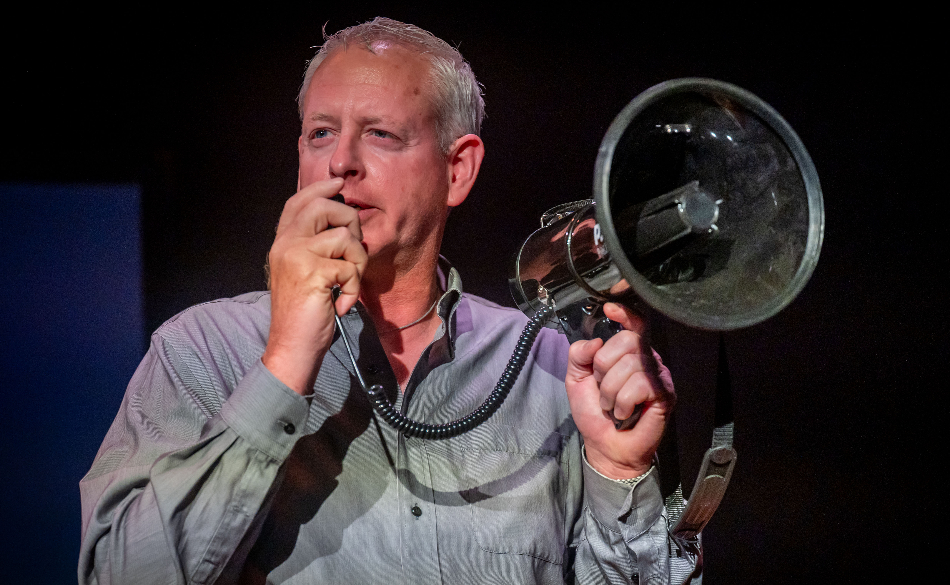
“Trial in the Delta” is a reenactment of the trial held at the Tallahatchie County courthouse in Sumner, Mississippi on September 23, 1955. This reenactment took 2 hours thanks to the laborious job of paring down 5 days of actual court transcripts into a cohesive 2-hour production. The adaptation by G. Riley Mills and Willie Round was sharp and concise making the arguments of both sides extremely clear.
It had to be difficult directing a production where everyone knows the outcome and keep it fresh and new, yet this is exactly what the directing team of Dana N. Anderson and Anthony Moseley accomplished. They made the audience spectators to this miscarriage of justice. They never took the easy road of playing on emotions. They went for words that were spoken they went for intent. They were aided by a spectacular cast.
Although their backs were to the audience most of the time, the body language of JW Milam (Matt Miles) and Roy Bryant (Tyler Burke) spoke volumes. There were times I couldn’t take my eyes off them. Prosecutor Gerald Chatham (Andy Luther) pushed and pleaded knowing it was all in vain while Defense Atty. JJ Breland (Steve Silver) played verbal gymnastics with the witnesses knowing he had the upper hand. All the witnesses that took the stand had different perspectives. I felt the fear of Moses Wright (Darren Jones) as he pointed. Undertaker Chester Miller (Lyle Miller) was dignified as his profession required. The testimony that gripped me was Carolyn Bryant (Maddy Brown). It was alarming. The work that Carolyn Bryant put into that story and the way Maddie Brown brought that story to life made me pinch myself. I realized this is a tactic that’s been around forever, and it still works. The way Bryant/Brown weaponized her tears broke my heart. It was evident this trial was over, and these men would be free. Mamie Bradley (Kayla Franklin) remained stoic thru all the proceeding even when was her turn to take the stand. Her last speech is powerful.
Looking at the program for this production, I noticed there are major people in the theatre community associated with this production and it shows. DuSable Museum, while not my favorite place to see a play, made this production work. The set is a maple wood courtroom. To the left of the witness box are 12 empty seats. The Jury…..12 White men. Whenever the jury came or left the courtroom, we see a projection of 12 white men entering of leaving and we hear their footsteps. There are maple bannisters separating the Attorneys from the spectators.
Witnesses are seated throughout the audience and as they are called walk up to the witness stand and are sworn in.
This production is an example of how systemic racism works and as such would not be shown in Florida. Governor Ron DeSantis has signed into law the Stop-Woke (Wrongs to Our Kids and Employees) Act, which prohibits educational institutions and businesses from teaching students and employees anything that would cause anyone to feel guilt, anguish or any form of psychological distress due to their race, color, sex or national origin. I’m sure this production was not created to cause any undo harm or guilt. This is not only African American history, but also American History.
When: Through February 19th - 7 p.m. Thursday-Saturday, 3 p.m. Sunday
Where: DuSable Black History Museum and Education Center, 740 E. 56th Pl.
Tickets: $30-$55
Info: Collaboraction.org
Review: Dramatic Road to a Historic Oscar Win in ‘Boulevard of Bold Dreams’

Sometimes a deceivingly "small" story can pack a wallop, and that is the case with LaDarrion Williams’ ‘Boulevard of Bold Dreams,’ premiering at TimeLine Theatre before it moves on to Boston.
Set in 1940, this finely crafted script quickly establishes fully fleshed out characters Arthur (Charles Andrew Gardner), a bartender at Los Angeles’s Ambassador Hotel, and his friend, Dottie (Mildred Marie Langford), who is a maid there.
Both are recent arrivals from Alabama, friends since they were two. Arthur, an unapologetic optimist, came to pursue a dream of directing movies, while the more cynical Dottie, who is a singer, is fleeing more pain-filled circumstances back home.
This is a night like no other. It is February 29, 1940, the evening ‘Gone With the Wind’ will win a slew of Oscars and Hattie McDaniels will become the first Black actor to receive the award. But McDaniels (Gabrielle Lott-Rogers), as she enters the bar to avoid the press, only knows she has been nominated.
When she hesitantly appears at the doorway to the bar, it is clear McDaniels has goose-bump inducing star power. Credit director Malkia Stampley for the cadence of this entrance, the spotlighting, the costuming, and Lott-Rogers’ acting skills. It’s not overdone, just the right touch, to let us know a power player has arrived. And indeed, that was the case with McDaniels, whose dad put her on the stage beginning at 10, for his traveling minstrel shows.
The plot turns around McDaniel’s ambivalence about accepting the award at all. In the white world, the Oscar nomination looked like progress. (Ethel Waters had been nominated the year before.) But in the black community, there were mixed feelings: the NAACP felt the role of the step-n-fetch-it slave Mammy was a demeaning stereotype. Others felt “grin and bear it” for the value to future generations of a Black breakthrough. (This territory was covered in Alice Childress’ 1955 backstage drama, ‘Trouble in Mind,’ suppressed from wide exposure in its day and remarkably cogent in its TimeLine Theatre production in November.)
McDaniels also was sequestered to a table hidden in the ballroom corner of the ordinarily segregated Ambassador Hotel with her Black friends. She was not allowed to sit with Olivia de Havilland, Vivien Leigh, Clark Gable and the rest of the cast. She was given a prepared speech expressing the hope that she would remain “a credit to her race.” Ugh.
We know how McDaniels decided, and the footage of her acceptance is played. What playwright Williams gives us is the nuanced dimensions of the internal struggle within Daniels’ heart, and within the Black community. The interweaving of exposition and dramatic interchange is artful at an exceptional level. In an epilogue scene we hear the speech the playwright imagines McDaniels might have delivered, and it’s standing-ovation stuff.
A must-see show, ‘Boulevard of Bold Dreams’ runs through March 19 at TimeLine Theatre, 656 W. Wellington Ave. in Chicago.
Goodman's 'Toni Stone' – Big League Production for a Big-League player

Decades before the enactment of Title IV, famous for its impact on expanding opportunities for women and girls in sports and well before the inaugural game of the WNBA, an African American women became the first to play for a professional baseball team.
“Toni Stone”, written by award winning playwright Lydia Diamond is receiving a rip-rousing production at the Goodman Theatre. Arguably, this is Lydia Diamond’s finest work, and that is saying a mouthful. She has consistently written engaging, thought-provoking work, adding beauty and depth to the American theatre canon.
We meet Toni Stone as she introduces herself and her teammates in a circus like atmosphere. She narrates the story of her life with The Indianapolis Clowns, a baseball team much like the Harlem Globetrotters. Although they play baseball and are darn good at it, their main job is to entertain. This was before African Americans were allowed to play in the all-white baseball leagues. We meet a cast of characters that are the most interesting characters I’ve seen on stage in a very long time.
Diamond wrote Stone as a beautifully complex, conflicted character. I don’t believe Toni Stone ever saw herself as sexual. She knew she wasn’t a man, but she also knew she was so much more than what was expected of a woman. She saw herself simply as a baseball player. She expected everyone to see her as a baseball player. When she meets Alberga, a male suitor that falls in love with her, she is thrown a curveball. Along with her only woman friend Millie, she navigates life as a baseball player and wife. Baseball came easy, being a wife was a bit more challenging.
This is Toni’s story, but it couldn’t be told without the assistance of a team of rambunctious, opinionated, athletic men. Under award-winning director Ron OJ Parsons’ assured and exuberant direction we are transported back to the late 1940’s.
With the help of movement director, Cristin Carole, Parson’s has his cast dancing, singing, juggling and doing acrobatics as if by second nature. This is a fun show to watch. The Actors morph into a variety of characters with striking ease.
It would be unfair not to mention some of the uniformly excellent the cast by name. Tracey Bonner is a joy as Toni Stone. Her warmth and enthusiasm are evident in this role. It’s hard to think of another actress embodying this character. The outrageously talented Edgar Miguel Sanchez plays a bookish Spec with steely resolve. Kai A. Ealy fresh off the Court stage in “The Island” gives us an energetic King Tut. Travis A. Knight goes from team bus driver Stretch to team owner Syd Pollock effortlessly. Chike Johnson brings a tender effect to Alberga, Toni’s admirer/husband. It was good seeing Chike on stage in Chicago again. Jon Hudson Odom plays a drunk ballplayer and Millie, Toni’s friend and confidant. The character of Millie could have gone too many ways of wrong, but for the writing of Diamond, the direction of Parsons and the acting expertise of Odom. Odom played Millie so understated that it was sublime and never caricature.
Todd Rosenthal’s set of a dugout with bleachers is masterful. This set has lots of surprises, with projections by Mike Tutaj it becomes the team bus, a boardroom, a bar but mostly a baseball playing field. Keith Parham’s lighting design was as high energy as the set, blinding white lights reminiscent of a summer day in the ballpark, quiet country roads at midnight.
Toni Stone was honored by the Baseball Hall of Fame in 1991 and was inducted into the Women’s Sports Hall of Fame in 1993. Although we have made inroads in sports, to date there are no women playing professional major league baseball.
Not only is this an entertaining piece of theatre, it’s also an important piece of theatre. How often does that happen?
When: Through Feb. 26
Where: Goodman Albert Theatre, 170 N. Dearborn
Tickets: $25 - $45
Info: goodmantheatre.org
Skokie Theatre's "The Book of Merman" Sings Out Praises to Be Your Own Star!

The Book of Merman is a delightful musical theater piece that beautifully spins the popular Broadway hit, The Book of Mormon.
When doing home-to-home missionary work, I’m sure no one can predict how the day will go. So many different situations can present themselves whether the expected or least expected. From slammed doors to willing listeners to who knows what, each house approached is certainly a new adventure. Well, this day was no exception as our fearless and faith-led Mormons arrive upon a house only to get the surprise meeting of a lifetime. Elder Braithwaite (Alex Iacobucci) and Elder Schumway (Danny Ferenczi) play the two Mormon missionaries who are doggedly going door to door trying to make converts when they discover that the house they have been welcomed into belongs to none other than the legendary Ethel Merman! After being invited inside by Merman (who mistakes the two as salesman), the story soon evolves into an unconventional, but effective journey that takes us down the path of self-acceptance – a path that in many ways teaches us to embrace every part of ourselves. And this path is often hilarious thanks to a very funny script along with a host of original songs that work incredibly well.
Julie Peterson, who was the understudy for this role in the off-Broadway production, really steals the show as the leading character with her lively personality and spot on singing in that wonderful powerhouse style that the grand dame Ethel Merman was famous for.
Although the two missionaries played with great energy by Iacobucci and Ferenczi had to wear their missionary suits the whole show, the period costumes by designer Patti Halajian for Merman kept upping the ante on glamour throughout the almost two-hour show and were so much fun to see Peterson perform in.
I really enjoyed this show produced by MadKap Productions at the lovely, intimate - yet airy and comfortable - Skokie Theater. The set design worked nicely with lighting by Pat Henderson and sound designer Kevin J. Mell.
The Book of Merman was written by Leo Schwartz and D.C. Cathro, with music and lyrics by Leo Schwartz and I absolutely adored the message of all the songs in this especially "A Little Bit of Me" and "Because of You".
The underlying message of this show has to do with so many current issues regarding loving oneself, success and failure at midlife and how getting the encouragement from even one good friend or true fan of your work can revitalize an entire life whose heart has been broken by loneliness and what one may perceive as failures in an otherwise illustrious past.
"A Little Bit of Me" is a tremendous number for Peterson to shine in vocally which urges the audience to remember that their uniqueness is of the greatest value in life, that being yourself fully in your art and life, no matter what society or even your fans of your quirky style or belief system, is the best way to fulfillment and happiness on earth.
It’s clever, it’s entertaining and it’s FUN. Keenly directed by Ty Perry with brilliant Musical Direction by Jeremy Ramey, I highly recommend this production for audiences of all ages who will enjoy the lively song and dance numbers and strong messages of positivity. Also, the Skokie Theatre was a great place to see a show with ample free parking right next to the theater and comfortable modern seating.
The Book of Merman is being preformed at Skokie Theatre through February 26th. For tickets and/or more show information, click here.
What We Do For Love; A Chorus Line at Drury Theatre

Like most things in our lives, what once was old can be new again (looking at you wannabe fanny packs). But some things can stand the test of time and find a resurgence, not to be duplicated but merely rediscovered by a new generation. A Chorus Line, now playing at the Drury Theatre, is just the thing that proves that, without duplication or manipulation, the themes exuded throughout the musical and its numbers speak across generations and stand the test of time and political correctness.
In A Chorus Line, hundreds of hopefuls congregate at a cattle call for Broadway dancers. A sour director and his assistant whittle down the ranks until they're left with 16 dancers (“head up, headband!”). All tell their life stories -- some tragic, some comic -- and explain their love of dance. Tension mounts when Cassie, once both a big star and the director's lover but now desperate for a part, auditions. But Zach must choose only the best for his show.
So what is it about A Chorus Line that gives it such staying power?
Maybe it’s the relateability of putting yourself on the line; working for years and years for a single moment, a single audition. The opening sequence of the musical “I Hope I Get It,” performed by the ensemble cast, brings the audience into the electrifying, heartpounding, anxiety-inducing audition. Aren't we all auditioning for the chorus? From job interviews to dating, we are always putting our best foot forward hoping against all the odds someone chooses us. We can prepare for years, memorize the steps, not miss a single beat, and still not get the part. With each hopeful cast member singing “I really need this job. Please God, I need this job. I've got to get this job,” resonates throughout the audience, and hits hard no matter the decade.
Perhaps it's the theme of understanding where you have come from to accept where you are today, no matter your background. As Zach interviews the cast, we begin to learn about the backgrounds of each hopeful auditioner, as they recall hilarious experiences and share embarrassing details such as “I really couldn't – Sing! I could never really – Sing! What I couldn't do was– Sing!” While recounting where they were, we learn that everyone on that stage dreamed of something bigger than them and we see an homage to youth and overcoming those awkward and challening years with "Hello twelve, hello thirteen, hello love!” Nostaligia can be sweet and innocent or bitter and sad, but they are our formative years. The number really highlights the humor, awkwardness, and tribulations of youth and celebrates it as the necessary path toward becoming who we are today.
It could be the relatability of fighting imposter syndrome, believing that you aren’t good enough. Or when we’re slowly unmasking, realizing you were being encouraged andpushed towards a life and dream that you didn’t really want. When Cassie takes the stage and expresses her only love was not to be a star but to dance, and as she dances her heart out in “The Music and the Mirror” we feel every kick, every headsnap, every spirit finger of emotion. For a single moment we’re all Cassie, wanting to just do what we love without fear, or judgement, or interpretation. To just dance and be allowed the freedom and autonomy to do just that.
For me, it’s the simple honesty of knowing that you tried; regardless of the outcome and if you never truly make it, at least you put yourself out there, and tried. “What I Did for Love” is the perfect balance of bittersweet gratitude, not regretting what you did in pursuit of a dream. It’s this theme that is the most prominent throughout the musical from the opening audition to the closing, glittering kick line.
Drury Lane is quickly becoming my favorite theatre in the Chicagoland area. It continues to deliver incredible performances under the glittering chandeliers of their venue and their 2023 line up is sure to draw even more suburban theater goers to Oak Brook instead of Chicago. A Chorus Line runs through March 19th, get your tickets today at https://drurylanetheatre.com/a-chorus-line/.
Review: Andy Warhol Was in Tehran. This recount is Both Funny and Moving

‘Andy Warhol in Tehran’ is a delight, an incisive comedy packaged with a serious exploration of art, history, and political values.
Rob Lindley as Warhol captures the artist exactly as he was seen in his public persona, somewhat vapid, seemingly desultory, with a passion for attaching to others’ fame, while amplifying his own. The script by Persian-American playwright Brent Askari gives a knowing monologue delivered with droll deadpan humor by Lindley, providing an entertaining overview of Warhol’s background and his work.
Warhol, who died in 1987 and coined that timeless phrase “15 minutes of fame,” rose to a far more lasting version of it by turning the mundane—Campbell’s Soup Cans, celebrity photos, a five-hour film of someone sleeping—into highly coveted and admired pop art.
Cultivating his own celebrity, he leveraged that as well to boost the price tags on his canvases, his access to well-heeled collectors and famous personalities, ultimately driving demand for commissioned work—which is where the play opens.
Having tapped out other gambits, Warhol in his late career took aim at portraiture of world leaders, reasoning they would need numerous versions of portraits for multiple public spaces. It is just such a commission, for the Empress of Persia, that finds Warhol in Tehran. Lindley’s Warhol, as voiced by the script, keeps us engaged throughout this fast-paced disquisition on Warhol’s background when there comes a knock on the door: room service.
Enter Farhad (Hamid Dehghani), in a gold braided bellhop jacket rolling a cart laden with caviar—and to Warhol’s delight, just $10 a serving. A few moments in, we find this is not just any hotel staffer, but a dissident impersonating a staffer. He aims to take Warhol hostage, in an effort to draw attention to the Iranian dissidents' efforts to remove the repressive Shah of Iran—placed in office by Western governments when the very popular and democratically elected president tried to nationalize Iranian oil, particularly Anglo-Persian Oil.
Warhol, as an artist and particularly with his focus on capturing ephemeral moments and celebrities, had no awareness or even interest in politics in Iran, or anywhere else. Farhad, holding a gun, declares, “We are going to announce we have kidnapped the famous Andy Warhol.”
“Why me?” Warhol says, suggesting Farhad kidnap another hotel guest, Barry Goldwater. “He’s very handsome.”
“What does that have to do with anything,” Farhod snaps back, seemingly infuriated by Warhol’s nonchalance and disengagement with the seriousness of his situation. Warhol was chosen, “Because you’re the most decadent artist alive. You see, Andy Warhol, we want our 15 minutes of fame.”
As the two wait for the getaway van, the playwright uses the dialog to reveal the characters. While the fictional kidnap attempt never happened, everything else about Warhol’s background, including the visit to Tehran, and everything that Farhad describes about Iranian politics and history, is factual.
Hamid Dehghani’s performance as Farhad is surely informed by his background as an award-winning actor and director in Iran. And likewise the script carries an authenticity that comes from intimacy with, and passion about Iran. Northlight’s production of ‘Andy Warhol in Tehran’ is a unique expression from those who know, and comes highly recommended. It runs through February 19, and hopefully even longer.
‘The Birthday Party’—A Comedy of Menace from a Master of the Genre

CityLit Theater’s ‘The Birthday Party’ opens with a load of laughs, seducing the audience with its low-key humor, then shaking us up as sinister overtones are gradually revealed.
We are introduced to the middle-aged operators of a British seaside boarding house: Meg (Elaine Carlson is delightfully comedic) and her dead-pan husband Petey (Linsey Falls in a flawless regional accent). Meg is all in a dither all the time—think 'All in the Famiily’s' Edith Bunker—just able to serve breakfasts of cornflakes and keep the larder filled.
WIth a naturalistic style that is reminiscent of David Mamet’s work (though written by Harold Printer decades before him) this play will leave you smitten by the characters, and the way repetitive, everyday speech is mined for its humor. And as with great comedy, it’s all in the timing, which the cast and director handle beautifully.
Meg and Petey's very down-on-its-heels establishment has had but one guest for the past year, Stanley (David Fink) and we soon see that the relationship with this lone customer has devolved to an enmeshed co-dependency between Meg and Stanley. She mothers, teases, and fauns over Stanley, who returns the excessive attention with a withering derision and acidic jokes that fly over the good natured Meg’s head.
Fink is perfect as the dissolute Stanley, a failed musician who sleeps in, and stays perpetually in pajamas and robe. Soon arrives the vivacious, self-assured Lulu (Sahara Glasener-Boles), a comely lass about Stanley’s age, who chides him for not bathing or going out of doors.
Things turn ominous when two new guests arrive in a big black limo—the erudite Goldberg (James Sparling is pitch perfect) and his towering thug McCann (Will Casey). Now Pinter takes the action to a darker level, as the titular birthday party for Stanley unfolds, despite his disinclination to attend. Fink ably registers Stanley’s discomfort with strangers entering the household, and Stan moves from suspicious to paranoid, desperately demanding (to no avail) that Goldberg and McCann find other accommodations. The play can be taken literally, but its many enigmatic and contradictory twists place it firmly in the absurdist camp.
‘The Birthday Party’ was Harold Pinter’s first full length play, and it broke the mold, launching a genre: it is a ”comedy of menace” (as opposed to comedy of errors or of manners). Perhaps because it is so out-of-the-box, it closed after just eight performances following its 1957 premiere. But a positive review secured attention for Pinter, and ‘The Birthday Party’ is now recognized as a masterwork.
City Lit distinguishes itself in the selection of this play, and in an absolutely wonderful production. Highly recommended on the basis of casting alone, artistic director Terry McCabe deserves kudos. Don’t miss a chance to see this live production of a Printer classic, running at CityLit Theater through February 26, 2023.
Pools of emotions spoken and unspoken in Goodman’s “the ripple, the wave that carried me home”

Like Christina Anderson, the Tony award nominated playwright of “the ripple, the wave that carried me home” I too was naively unaware of the history of segregation of public pools.
Growing up in Brooklyn, NY, at the same time as the play’s timeline, public pools were more likely segregated by class than by race. Besides, beaches were the preferred pastime on a hot summer day in NYC. The play gave me a new perspective and made me think outside my sheltered world. It is highly recommended.
As water fills the space it finds itself in, this play has many themes and ideas filling the hour and forty-five-minute running time. Themes of patriarchy, access, racial justice, family dynamics, legacy and forgiveness are all marinating together. If it doesn’t come out in the wash, it will come out in the rinse.
The play opens in 1991 with unanswered phone calls to Janice, (Christiana Clark) a recruitment officer at an Ohio University. The calls are from a Young Chipper Ambitious Black Woman (Brianna Buckley) who is representing an African American Recognition Committee in Beacon, Kansas, her hometown. They are renaming a pool in honor of her father, who was instrumental in desegregating the public pools in Beacon. They would like her to attend and participate. She takes issue, her mother was just as involved in this fight as her father. Why is she not honored?
“ripple..” is a memory play and according to Janice, some of those memories are best left at the bottom of a deep pool. Janice narrates her time growing up starting in the early 60’s as the daughter of Edwin (Ronald Connor) and Helen (Aneisa Hicks). We learn Janice’s father is from the necessity class and her mother, the thinking class. These distinctions meant very little to the white majority, but these distinctions helped the audience understand how her parents approached life.
Between scenes of narration, we see this family in action. We see a teenage Edwin demonstrate how he covertly integrated a public pool and the resulting fallout. We see the sacrifices made by Helen, so her daughter and other children can learn the mechanics of swimming.
Todd Rosenthal’s set consist of the inside of a public pool building complete pool and trophy case. To change scenes the trophy case slides out and a household scene slides in. It is a nice and clean set change. While Janice doesn’t change costumes in the 30 years of the play, the other characters change from late 50’s to the 90’s. Montana Levi Blanco caught the essence of the time period with his costume choices. Cookie Jordan did an excellent job in hair and wig design. Until I read the program, I didn’t know Aunt Gayle and Young Ambitious Black Woman were played by the same actress (Brianna Buckley). It was clearly a testament to costume, hair, wig and performance.
Jackson Gay captured the feel and energy of family life in the 60’s and 70’s. The play moved smoothly from narration to action, from joy to tears and back again.
It is interesting Anderson chose to place her play in 1991 and work backwards. 1991 was the year of the “Rodney King Riots” when the officers that beat King within an inch of his life were acquitted. King survived the beating only to die in 2012 of …. you guessed it, drowning.
When: Through February 12th
Where: Goodman Owen Theatre, 170 N. Dearborn
Tickets: $15-$45
Info: www.goodmantheatre.org
It's delightful, it's funny, it's Oil Lamp's 'Almost, Maine'!

Have you ever fallen in love – or out of love? Have you ever lost the love of your life only to find the new love is waiting for you right around the corner at just the perfect moment? Have you ever found love when you weren’t even looking for it? In John Cariani’s play, Almost Maine, the audience follows a series of several vignettes that revolves around these questions, each taking place in a small out of the way Maine town that sits under the Northern Lights. Skillfully directed by Susan Gorman, the stories we are presented with are touching, charming and often very funny. While some scenes are more direct in their nature a few are intended for the audience to interpret – leaving myself in a healthy conversation on the way home on where we felt the writer was going. The nice thing about this play is that it relates to just about everyone who has been in a relationship in one way or another, so throughout the performance it was easy to say to myself on a few occasions, yep, I’ve been there…
To successfully pull off its nine heartfelt sketches, this talented cast of four take on the daunting task of playing five-plus roles each – and they absolutely nail it. Cast members, Eileen Dixon, Zach Kunde, Whitney Minarik and Rio Ragazzone each get to show off their wide ranges, particularly impressing with their spot-on comedic timing. The casting couldn’t have been more perfect as all four leave notable performances – and to be fair, I caught the final preview just before opening night.
The creative team does a fine job in staging this production. The set is simple – not much more than a few pine trees thoughtfully moved around a home or establishment entrance for each scene – but it works well thanks to an engaging script that really keeps our focus on each actor so that the set works more as a subtle background that leaves the actors with a wide open, nearly blank canvas, leaving the deeper details of its scenes up to the imagination of the audience.
In all, I found Almost, Maine an irresistible collection of quaint love stories that touched on every end of the spectrum. Delightful and often laugh out loud funny, Oil Lamp Theater kicks off 2023 with a sure-fire winner that is sure to capture the hearts of so many. Almost, Maine runs through February 26th. For tickets and/or more show information, click HERE.
Recommended!
*On a side note, it was my first time attending an Oil Lamp production in their Glenview home. Just a short (and easy) drive from Chicago, I found the theater space perfectly sized for an intimate, yet roomy, experience and there isn’t a bad seat in the house. I’d suggest arriving to a show early to check out the charming bar/lounge area that includes loads of comfy seating and the added nice touch of providing cookies for its guests. And with parking just next to the theater, it couldn’t have been a better all-around experience.
Review: 'Cabaret' at the Ruth Page Center for the Arts

Fewer theatrical experiences are more thrilling than a Kander and Ebb musical done well. Porchlight’s revival of ‘Cabaret’ delivers the exact kind of razzle-dazzle audiences expect when they think of the Kit Kat Club. Directed by Artistic Director Michael Weber and choreographed by Brenda Didier, this production scrubs off some of the grit that’s become a hallmark of the iconic Rob Marshall Broadway revival. By using the same script, and borrowing some of the aesthetic, there’s a really satisfying buoyancy about Porchlight’s approach to this essential musical.
The success of any production of ‘Cabaret’ hinges on the actors playing the Emcee and Sally Bowles. This cast has two strong leads in the respective roles. Josh Walker channels neither Joel Grey nor Alan Cumming, but instead something more playful, adding a little mirth to the eerie Kit Kat Club host. Sally Bowles the character may only have minimal talent, but Erica Stephan has the soaring vocals songs like “Maybe this Time” and “Mein Herr” were made for. It’s a joy to watch her embody the part in every lithe movement and manic quip.
Part of what makes Kander and Ebb musicals like ‘Cabaret’ and ‘Chicago’ so infectious are the catchy songs and jazzy dance numbers. By now they’re almost inseparable from Fosse’s sexy choreography. The ensemble numbers in this production create thoroughly satisfying versions of some of the most beloved Broadway music of all time. Brenda Didier cuts through the dark currents of the script and gives audiences of both the Kit Kat Club and Porchlight exactly what they crave—beautifully distracting spectacle.
Based on the classic novella ‘The Berlin Stories’ by Christopher Isherwood, ‘Cabaret’ is an eternally relevant story about apathy during political crisis. The musical numbers are toe-tapping fun, but yet there’s something uneasy about ‘Cabaret.’ It’s a celebration of being “other”. Since the original 1966 Broadway production and the subsequent Liza Minnelli film, it’s become a landmark of queer culture. At its heart, it’s a play that reminds its audience not to take the right to be different for granted.
Despite the darkness on the fringes of ‘Cabaret’, Porchlight’s production injects some roaring 20s opulence into their version. Costumes by Bill Morey are styled in flapper-chic that seem more historically accurate and frankly, more attractive. The costumes move well with Didier’s Charleston-flavored choreography which also seems more authentic to the time period.
‘Cabaret’ gives the audience a sense that they’ve been whisked away somewhere exotic for two and a half hours. Every member of the cast is perfectly at home in their world and the come-hither physicality with which they beckon their audience is impossible to decline. Michael Weber reminds us again why Porchlight is a destination for contemporary musical theatre in Chicago. This production is every bit as good as the Broadway revivals that too often rely on stunt casting. Instead, Porchlight sheers away some of the overly morbid overtones and replaces them with a purer sense of escapism. After all, in here life is beautiful.
Through February 12 at Porchlight Music Theatre at the Ruth Page Center for the Arts. 1016 N Dearborn St. www.porchlightmusictheatre.org
*Extended through March 19th




Latest Articles
-
 3Arts distributes $860,000 in unrestricted grants to Chicago artists at 3Arts Awards, surpassing $10M in lifetime funding
Written by Buzz Center Stage3Arts, the Chicago-based nonprofit grantmaking organization, awarded $860,000 to Chicago artists and announced the recipients of its 3Arts Next Level Awards—$50,000 unrestricted awards given to past 3Arts awardees—during a festive celebration held last night at the Harris Theater for Music…
3Arts distributes $860,000 in unrestricted grants to Chicago artists at 3Arts Awards, surpassing $10M in lifetime funding
Written by Buzz Center Stage3Arts, the Chicago-based nonprofit grantmaking organization, awarded $860,000 to Chicago artists and announced the recipients of its 3Arts Next Level Awards—$50,000 unrestricted awards given to past 3Arts awardees—during a festive celebration held last night at the Harris Theater for Music… -
Guarneri Hall announces two-day series REVOLUTIONS on the intersection between music, politics, and social change November 11-12, 2026
Written by Buzz Center StageThe nonprofit Guarneri Hall, a state-of-the-art, custom-built classical music venue in the heart of downtown Chicago at 11 E. Adams St., proudly announces Revolutions, a two-day music series exploring the intersections of political, social, technological, and musical change at two…
-
The Front Theatre announces casting for the North American Premiere of Sap February 25 - March 27, 2027
Written by Buzz Center StageThe Front Theatre announces casting for the North American premiere of Rafaella Marcus's highly acclaimed play Sap, directed by Charles Riffenburg. Sap is a timely and poetic thriller, in which a woman's lie to her girlfriend threatens to grow out of control when…
-
Hyde Park School of Dance presents annual performances of The Nutcracker December 11–13 at Mandel Hall
Written by Buzz Center StageHyde Park School of Dance, now in its 33rd year of training, performance, and community, welcomes families and dance enthusiasts to its annual, one-of-a-kind presentation of The Nutcracker. Performances are December 11–13 at Mandel Hall on the University of Chicago…


Does your theatre company want to connect with Buzz Center Stage or would you like to reach out and say "hello"? Message us through facebook or shoot us an email at This email address is being protected from spambots. You need JavaScript enabled to view it..
*This disclaimer informs readers that the views, thoughts, and opinions expressed in the text belong solely to the author, and not necessarily to Buzz Center Stage. Buzz Center Stage is a non-profit, volunteer-based platform that enables, and encourages, staff members to post their own honest thoughts on a particular production.