
Items filtered by date: June 2026
Hubbard Street Dance Takes On The Nature of Consciousness

Returning to the Auditorium Theatre after a long 20-year absence is Hubbard Street Dance Chicago with its 40th Anniversary Spring Series. This edition spotlights Spanish born Resident Choreographer Alejandro Cerrudo, who joined Hubbard Street Dance Chicago in 2005, and was named Choreographic Fellow in 2008 and became the company’s first Resident Choreographer in 2009. He’s a recipient of multiple awards, including prestigious Rudolf Nureyev Prize for New Dance.
The show is a progression of Cerrudo’s works, from old to new. It has a pleasant start with his earliest piece, Lickety Split, originally performed in 2006 at the Harris Theater as part of the Inside/Out Choreographic workshop. Celebrating athletic femininity and confident masculinity and set to music by renowned songwriter Devendra Banhart, Lickety Split is about modern love and romantic relationships. It’s very beautiful and has well balanced energies.
But then something completely unexpected happens. The spotlight is on a balcony where a captivating, extravagantly dressed and coiffed female (Rena Butler) is seated, casually talking to the audience about the nature of reality. She is smoking a pipe, while blowing our minds with [Alan Watts’] philosophical concepts. Amazing.
And so the drama begins. More new age philosophy is injected into the show when David Schultz walks out on stage, wearing a cane and delivering another serving of food for thought. The following piece, Off Screen, though highly theatrical, doesn’t take itself too seriously. Inspired entirely by film, it makes lighthearted mockery of Italian musicals and romantic European movies. The music is comprised of 16 passages from various movie scores. Off Screen features seven dancers layering gorgeous fluid movements as if in a dream, their dancing defying gravity and somehow helping to get across the spiritual points introduced earlier. Off Screen was Cerrudo’s third work created for Hubbard Street back in 2009.
After the intermission, it’s the energetic Silent Ghost that originally premiered in 2015 at the Aspen Santa Fe ballet. It feels tribal yet romantic, despite the monochromatic costumes.
The grand finale of the evening is the world premiere of Out of Your Mind. This piece brings everything together: the mysterious monologues earlier in the show, the flow and progression of the pieces, the dreamy dancing. What makes it futuristic is the pulsating energy, and the shapes and configurations of the dancers. At some point, orderly chaos ensues on stage, dancers moving in waves [and somehow particles]. Set to the soundtrack of the soothing voice of the contemporary philosopher Alan Watts, it’s a breathtakingly beautiful and uplifting experience. The piece was inspired by Alan Watts’ lectures called “Out of Your Mind”; Cerrudo borrowed the music that was used in the audio of the lectures and used it in this piece. I’d say contemplating God possibly never looked more spectacular.
On Your Feet! Great Songs, Dance, and a Story Make It So Much More Than a Juke Box Musical

On Your Feet! is the compelling rags to riches tale of Emilio Estefan and Gloria Fajardo Estefan’s odyssey - from dreaming Cuban immigrants, to stars who brought a fresh Latin flavor to the American song book.
It’s also a love story, and a musical journey. It wasn’t painless, either. And the story line – they flee the island as the Communists rise to power, they fight against great resistance by recording studios to allow them to cross over to general audiences - provides sufficient grist for a dramatic mill that makes this much more than a juke box musical.
The Estefans’ music, popularized through their band, the Miami Sound Machine, in the 1980’s, may be less a fixture of our contemporary music scene – Shakira, from Columbia, is now better known as a Latin music star and alone has sold more albums than Gloria. But without question the Estefans’ songs are embedded in our collective culture.
At first, producers refused to release their music outside the traditional Latin markets, thinking it couldn't sell to "ordinary" Americans. In the show, Emilio goes nose to nose with the record label executive, telling him, “This is the face of an American!”, a line that won healthy applause from the Cadillac Theatre audience.
The Estafans resorted to guerrilla marketing, bringing records directly to dance clubs and pop stations, and performing for free at bar mitzvas and a Shriners convention. The strategy worked, launching the 1985 hit, “Conga,” to the top of the charts While nowadays YouTube, Vimeo and Facebook would do the trick.
To tell their story, the two developed On Your Feet! With its creative team and the rich vein of Gloria Estefan’s music, On Your Feet! made for a likely slam dunk, and indeed it is. The road show is directed by Jerry Mitchell – he won a Tony for Kinky Boots - with choreography by Sergio Trujillo (you saw his work in Jersey Boys). And the book is Alexander Dinelaris, who received an Academy Award for the movie Birdman (about a Broadway play, by the way).
Excitement comes from the moment the curtain rises on the big orchestra, which plays from back stage. The scene soon moves to Miami’s Little Havana, where the dutiful young Gloria Estefan is doing laundry, and singing traditional songs. In fact, the varieties of music - from renditions of street songs, to a fully orchestrated and choreographed night club act from pre-revolution Havana (starring Gloria’s mother, played with panache by Nancy Triotin - shades of Chita Rivera!) - enrich this show musically.
The quality and precision of the choreography is also worth noting. These highly expressive yet disciplined dancers are among the best I have seen in any musical, anywhere.
In addition to featuring the best-of songs (“Rhythm is Gonna Get You,” “Conga,” “Get On Your Feet,” “Don’t Want To Lose You Now,” “1-2-3” and “Coming Out of the Dark”) the Estefan’s added some new transitional pieces for the show. Some familiar greats, such as “Words Get In the Way,” aren’t included in the show.
The drama crescendos when a severe bus accident nearly paralyzes Gloria, and her struggle to recover. In a fresh approach, Emilio (Mauricio Martinez) solos on, “I Don’t Want to Lose You Now,” one of Gloria’s most beautiful singles. It is a real showcase for Martinez, Mexico’s telenovela heart throb, who commands the stage and dominates his scenes. It also turns out he can dance really well.
While Gloria Estefan’s lovely contralto can’t be matched, she is said to have hand selected Christie Prades to play her character for this road show. Prades delivers a great performance both in song and dance, and she is a good actress to boot.
On Your Feet! originated here in Chicago in 2015 before making its celebrated Broadway run, and then returning to a road tour across the country and around the world. (It opened again in Chicago at the Cadillac Palace Theatre on March 23 and runs through April 8.)
Review: Court Theatre's 'Guess Who’s Coming to Dinner'

By now we all know who’s coming to dinner. Based on the 1967 film starring Sidney Poitier and Katharine Hepburn, Court Theatre presents a new stage adaptation of ‘Guess Who’s Coming to Dinner.’ Written in 2013 by Todd Kreidler, this fresh look points at the progress America has made regarding interracial marriage, as well as the progress that still lies ahead.
Marti Lyons directs this quickly-paced comedy-drama. The scenes are trimmed with a sweeping score that recalls the golden era of 60s television. The mid-century mod set by Scott Davis drops us square into 1960s suburban San Francisco. A solid white house on a hill, obvious symbolism. Kriedler’s script begins on an impossibly rosy note, a sure sign that trouble is afoot for these fine looking white folks.
Christina (Mary Beth Fisher) and Matt Drayton’s (Tim Hopper) upper middle class, pseudo-liberal lifestyle is upended when their adult daughter Joanna (Bryce Gangel) brings home an acclaimed African American doctor, John (Michael Aaron Pogue). The two naïve lovers wish for their parents’ blessing before they proceed with a hasty marriage. In asking, Joanna and John call into question everything they’ve known about their so-called progressive parents.
In today’s world, some may see an interracial marriage as no big deal. And largely, for most parts of America, it’s not a big deal. That’s what’s so interesting about this script. The characters don’t spend much time debating if it’s right or wrong for races to intermarry. What’s at stake for them is how the world will perceive their coupling and whether it’s actually putting them in danger.
This is a prickly little play about the nuances of race. That is not to say it’s not funny. In fact, it’s the sit-com style set-up of jokes and physical humor that make this show so fun to watch. Mary Beth Fisher is a gifted physical comedian. It’s a real treat to see her quickly twisting facial expressions, she’s able to get so much across without dialogue. Working off her is Sydney Charles in the role of the Drayton’s maid, Tillie. Sydney Charles has some of the best one-liners of the evening and really brings her character to the focal point.
The young lovers portrayed by Bryce Gangel and Michael Aaron Pogue are what this show comes down to. There’s so much chemistry between these two and that is key. The audience has to believe in this love in order to believe in the parent’s eventual coming around. Gangel so aptly captures the stubborn optimism of her character through an almost lilting speech pattern. In her final monologue, Gangel goes from school girl crush to a woman seriously in love.
The Court Theatre’s area premier of Todd Kriedler’s stage adaptation of ‘Guess Who’s Coming to Dinner’ is very cute. It’s strange to say a play about tense race relations is cute, but it’s a play about love. It’s also incredibly sleek. The costumes and sets are like an episode of Mad Men. While the direct themes may not be entirely relevant in a post Marriage Equality world, there are still indirect themes that must be discussed. This play is making a bigger point about the subtler forms of racism that are present in even the most liberal minded places.
Through April 15th at Court Theatre. 5535 S Ellis Avenue. 773-753-4472
Review: Women Laughing Alone with Salad

Women Laughing Alone with Salad from Theater Wit is a funny mess. Based on the popular meme of stock photos of women who always seem to be having the time of their lives while eating a bowl of tasteless raw vegetables, the play tries to satirize this concept. The concept being that only stringently healthy and active women can be happy, and the only happy women are stringently healthy and active. As if the hysterical laughing accompanying the salad in the photo will trick us into loving the most boring meal known to humankind.
The best scene might have been when the four person cast did exactly what it says on the tin: they smiled and laughed and eventually full-out boogied while eating salad. The satire here was on point, and I loved the straight-up mocking of ridiculous advertisements aimed toward women. Look at how much FUN we're having depriving ourselves of any carbohydrates - a thing our bodies *need*, by the way!

As far as the actual storyline goes, it was, like the lettuce confetti that rained down onstage at one point, all over the place. Many things were trying to be said, I think, but the play never makes a clear point. Nobody learns anything, characters or audience. The audience is led to believe that all skinny women are annoying and bulimic and "real" women are confident in their voluptuousness, until the rug is pulled out from under us and we learn that, surprise, the "real" woman is a slave to salad, too.
There were a lot of elements that, on the surface, give this play an edge: nudity, a threesome scene, an Oedipal complex, some gender-swapped roles, which were entertaining, but to me seemed like folderol distracting from the fact that the story was haphazard.
I appreciated the bravery of the actors and playwright Sheila Callaghan for taking the leap -- the acting was well-done and the script did shine through occasionally with some great, funny lines -- but this play was anything but salad: Big, flashy empty calories. Fun to eat, but with little nutritional value.
Women Laughing Alone With Salad is playing at Theater Wit through April 29th. Tickets at TheaterWit.org.
*Extended through May 2nd!
Point Taken - Red Tape's “Round Heads and Pointed Heads”

At The Ready, a small theatre on Chicago’s Northside is currently hosting the classic parable play “Round Heads and Pointed Heads”. Penned by Bertolt Brecht in 1936, its current Chicago run is being brought to you by Red Tape Theatre - a fine theatre company I would urge one to become familiar with. The play is a sardonic anti-Nazi tale that takes place in in the made-up land of Yahoo where its leaders explore maintaining and strengthening their control by pitting “round heads” against “pointed heads” which replaces racial relations for their aggressive class relations.
Composed of 11 scenes in prose and poetry and 13 songs, the story unfolds in two acts that include an intermission. I found the play a bit long-winded but very well done. Multiple plot lines intertwine throughout and is sometimes quite a bit to digest in one sitting, but its overall message is quite poignant. Having said that, the play is very entertaining.
Several actors in this extremely well-acted production successfully take on more than one role, showcasing a wide variety of talent. Despite the fact that “Round Heads’ is not really a musical per se, there were a good handful of interesting songs that helped tell the story in a unique way.
Social issues like racism, revolution and prostitution made up some of the plot lines. Like I said, it was a lot to digest. As much as I enjoyed the play, the fact so many serious topics are brought to the table and are condensed into a couple hours, can overwhelm one’s attention span at times. However, the story ties together nicely.
Directed by Max Truax, the cast features Maryam Abdi, Ambrose Cappucio, Ben Chang, Casey Chapman, Nora King, Peter Laughlin, Diana Lee, Felix Mayes, Emily Nichelson, Brandon Rivera, Caleb Roitz, Kelsey Shipley, Stephanie Shum, and Ann Sonneville.
What I really like about productions like this set in intimate settings, is that the audience feels they become part of the scenes taking place. I guess having a powerful play so rich and meaningful presented up close and personal is not much of a surprise with a group like Red Tape Theatre. I felt some on the audience consisted of fellow thespians who were there to support the theatre community. Works for me. I like that idea.
Small theatre in Chicago has a lot to offer. There is much to see, and the price of admission is generally reasonable…in this case, free but they do appreciate donations. This production is well worth your time to see, and I look forward to checking out more Red Tape productions. These actors are not doing this to be rich, although it may be a stepping stone to greater things. So, go give them the lift they need…it all comes back to you.
Red Tape's “Round Heads and Pointed Heads” is being performed at At the Ready (4546 N Western Ave, Chicago) through April 21st. https://redtapetheatre.org/
Stanley Clarke at City Winery - All About That Bass

I was 16 years old, digging through a used record bin at a flea market. I came across an album by a Fusion band named Return to Forever. I had heard of the guitar player, Al DiMeola, so I bought the used LP for a dollar. It was money well spent. At that time, I was a relatively new guitar player and I was already getting onto Progressive bands like Yes. At first that is how I saw Fusion. It was kinda like “Prog Rock” sans vocals. It was at that time I first heard Stanley Clarke. The man’s name translates to the word bass in some language. I am sure of that. I know of very few players that have the kind of command over the instrument the Clarke does.
Stanley Clarke just hit Chicago on his latest tour and his performance at City Winery was top notch from beginning to end. His lineup included two keyboardists, drums, electric violin and Clarke on electric and upright bass. What, no guitar player? Blasphemy! I was devastated. Not exactly. There was no void in the music by the lack of having a guitar player that evening. With such a large ensemble of musicians, I’m not sure that there would have been room on the stage anyway. Needless to say, Clarke was already playing through one of the largest bass rigs I have seen in a venue of that size. It really wasn’t even all about that bass either, all the musicians were of the highest caliber.
Beka Gochiasvill and Cameron Graves were the two keyboardists, and both were outstanding. Beka is from Georgia, not the state, the nation that formerly belonged to the USSR. Only 22 years old, his playing reflected someone with much more maturity. Graves is a West Coast cat who has a reputation of his own and is also known for a lot of his own music.
Drummer Mike Mitchell was a solid groove machine, really holding down the fort with Stanley’s melodic monster bass lines. I love jazz drummers, they are never boring, and Mitchell was no exception. The art of being creative without showing off is another level of performance that takes time to achieve. There is an old joke: “A drummer is a person who follows musicians around”. When the drummer is really a musician, it makes all the difference in the world. It really does.
Last but not least in the lineup was the electric violinist. I feel terrible that I cannot recall his name and was unable to find out at the time of this writing! Ugh! I’ll just say that his performance was fantastic and that he was a very animated person. He gave the music a serious melodic boost, and almost upstaged Clarke yet his name is not listed in the band line up.
I say this in all my reviews, but go see live music! I am especially adamant about this when it comes to jazz. Clarke at age 66, is one of the younger players from back in the day. The newer generation does have the talent, no doubt about it, but it’s very educational to see the legends that were so influential in the genre. Thanks to venues like City Winery, this is still a tangible thing that is greatly available for people to seek out. City Winery also gets a great review from me, once again. They have a great staff and the sound there is always amazing. The wine is also fine.
Cheers!
'An Enemy of the People' not your average period piece

"In real life, you're exploited by the moneyed class and then you die." says Petra in Robert Falls' new production of 'An Enemy of the People' at Goodman Theatre. His adaptation of Ibsen's 1882 play, spends two and a half hours exploring the theme of freedom.
"An Enemy of the People" is set in an ambiguous time and place but the highly conceptualized world in which this production exists is familiar. In it, idealistic small-town Doctor Stockmann (Philip Earl Johnson) discovers the water supply is poisoned. Hoping to save the town, he's politically thwarted by his brother the mayor (Scott Jaeck).
Robert Falls adapted the script from a translation by Eleanor Marx-Aveling and it's got some teeth. As Arthur Miller adapted Ibsen's play in 1950 to fit the McCarthy era, Falls aims his at Trumpism. Despite some occasional lapses in subtlety, this version chugs along at an urgent pace. Some liberties are taken with Ibsen's script but, given the current political climate, the topical dialogue fuels the thrilling intensity. Even 130 years later, this play is still a warning.
The square-off between Philip Earl Johnson and Scott Jaeck for the town's soul is all too relevant. Johnson physically exhausts himself trying to scream the truth while a calm and dignified Jaeck lulls the townspeople into submission. They're both so convincing you're almost able to see both sides, which is precisely the danger. Many of the most provocative lines come from Petra played by Rebecca Hurd. Her performance is sincere and brings more depth to the character than just what's in the dialogue.
It's an event when Robert Falls produces a classic at Goodman. 'Enemy of the People' lives up to the hype. As he's done with Chekhov, Falls has a vision for these plays that is far from the faithful productions of yore. It's essential for directors to reinterpret these classics for new eras. It's how a younger generation will connect with Ibsen. This version is well designed and brightly colored. Almost too cheerful for the subject matter. The costumes will leave you unsure of the time period, but that's the point. Whatever the era, the costumes are chic and the sets are memorable. This isn't your average period piece melodrama.
This production is exciting from beginning to end. There's not a moment of dead air. The dialogue is fresh and mirrors the absurd hypocrisy of our times. There's a lot of lightness in this play, and it's not until afterward that the darkness of its themes settle in. That might be one of it's strongest assets, it's so engaging you forget how bleak the conclusion is. If you don't leave this play angry, there's probably something wrong with you.
Through April 15th at Goodman Theatre 170 North Dearborn. 312-443-5151
"The Brink or Nobody's Ever Kissed Me like That" A Stunning work of Surrealism Overflowing with Sensual and Romantic Images of Modern Love

Each week as I sort through the invitations to theater and concert events taking place in Chicago, it’s rare that I find a title as intriguing and inviting as this one - "The Brink or Nobody's Ever Kissed Me like That".
Walkabout Theater Company described this show in their press release as "experimental cabaret" set in "a cafe at the edge of the world." And that would be a very accurate description.
“The Brink” contains a variety of beautiful, recognizable songs, like “Sunshine, Lollipops, and Rainbows,” "Beyond the Sea” and "You Don't Own me," along with some classic Jazz and Motown standards. Colorful, erotic and avant-garde, each number is performed with a uniqueness that makes this play a true original. What the company does with some of the songs is quite amazing and sometimes a little scary to watch. Many of the songs are slowed down or sped up mid-number, as one of the ensemble members appears to control the delivery of each song with an old radio tuner.
“The Brink’s” talented cast includes Nigel Brown, McCambridge Dowd-Whipple, Cooper Forsman, Dana Murphy, Katie Mazzini, Thom Pasculli, Alex Rodriguez. The three women in the cast have accomplished singing voices, yet each of these standards is sung with the most interesting variety of twists and turns. For example, "You Don't Own Me" is sung by a female ensemble member who begins by standing in a tin water tub while another male member of the troupe pours water over her head from a tin garden watering can until her long, shiny black hair is wet and her beautifully applied makeup and mascara are running down her face like black tears. She then dance/ crawls her way over to a piano and sings the rest of the song in halting bits to an invisible suitor warning him not to try and change her with the following lyrics, but then tells him to kiss her over and over again.
You don't own me
I'm not just one of your many toys
You don't own me
Don't say I can't go with other boys
Don't tell me what to do
And don't tell me what to say
Please, when I go out with you
Don't put me on display
You don't own me
Don't try to change me in any way
The full effect of this number is stunning and sexy, yet sad and lonely all at the same time.
The play is fair to both sexes when it comes to describing how hearts are easily toyed with and broken, yet there is a decidedly feminist and therefore humanist bent to the whole piece which I enjoyed immensely. With original text by Nigel Brown, quotes from renowned feminists Gertrude Stein and Ann Carson are scattered about like prose poetry and fall off the lips of the ensemble like rose petals off a dying rose instead of being shouted at the audience rally style.
At one point a female cast member says something to the effect of: All men lie, they cannot stop telling lies. I must leave this place as I am becoming bitter and hard from the thought that the basis of a woman's entire life is only about enduring humiliation. I will run and skip to find a new place to escape this one.
This is a feminist statement that really rings true with many women and got a lot of sympathetic nods of recognition from women and men in the audience.
I really enjoyed studying the delicately made and cut costumes and makeup in this show. Each costume is fitted to each ensemble member to perfection and is made of a variety of beautifully colored silks and linen, which grace the whole show with a decidedly French couture or, at times, Italian couture feeling. The brilliant costumes by Myron Elliott-Cisneros undoubtedly enhance the many, many beautiful images created by the cast in each scene or vignette.
I highly recommend this bewitching and enchanting ensemble production for anyone seeking a night of thought provoking romantic idealism, dance and song in a surrealistic atmosphere that will allow you to explore new places in your own minds memories of love you have lost or found with new insight.
The production is coming off previews in Cricoteka Centre in Krakow, Poland, and continue its journey to India for the 8th International Theatre Olympics in Mumbai and New Delhi following its three-week Chicago run.
"The Brink or Nobody’s Ever Kissed Me Like That" is being performed at Links Hall through March 31st. More information on this amazing show can be found at http://walkabouttheater.org.
Comical Moments and Absurdist Riffs Almost Enough To Save Hang Man

It’s an unsettling opening scene: actor Gregory Fenner silently dons a noose strung from a tree in as he steps into the role of Darnell. When the spotlight hits him, he lifts his head to speak, and Stacy Osei-Kuffour’s Hang Man takes flight as a play.
Darnell is hanging from a tree in rural Mississippi - a repugnant image that has been seared into our national consciousness. But he is really two characters: Darnell, the corpse, and, when he lifts his head and opens this mouth to address the audience, he becomes Darnell the commentator, letting us know that there is more to this story than what we might surmise. Along the way, he hands out clues to keep us off track. “Can’t a black man just commit suicide?” he suggests at one point. (But it’s not that, either.)
Hang Man can touch this “third rail” image because of Osei-Kuffour’s fearless artfulness. The character Darnell and Fenner’s performance are among the highlights of the play. Notably, Darnell speaks sparingly, occasionally addressing the audience, and carrying on lengthier conversations with his young niece.
At one point, opening his eyes, Darnell lifts his head and says, “I like living in Mississippi. It’s pretty.” Then he resumes his corpse-ly repose. I wished that we had heard even more from him.
In fact, Darnell is on stage throughout the play – though the spotlight is not always on him. He goes back into the character of corpse after he has his say, or speaks lovingly to his favorite young niece, G (Mariah Sydnei Gordon is excellent). And G is the play’s Everyman.
To avoid a spoiler, we won’t want to give more away on Darnell’s story, but suffice it to say Osei-Kuffour has packed this character, and the play, with ironic commentary, giving us characters that are parodies of types, some of them ripped right out of the news pages. Because they are largely inept, we don’t take them too seriously.
There are black types: Sage (Jennifer Glass), hard bitten and tough (and G’s stern but loving mom) who has adopted a cowgirl persona and dances in a local country bar. And Jahaad (Martel Manning is terrific), recently converted to Islam, and just released from incarceration (he was jailed for stealing Beany Baby’s!). Jahaad, is tracking down Darnell to collect a gambling debt, falls for Sage, who holds him at bay: “I ain’t bringing no ghetto Muslim to a honty tonk with me!” she tells him.
There are white types: Paul D’Addario, as Archie, displays the mean-spirited emotional and physical cruelty through which white racism is expressed. Andy Fleischer, as his sidekick Wipp, a deputy sheriff, is an unrestrained send-up of white yokels. Archie and Wipp also share both a bro mentality, and a love interest in Margarie.
And finally there is an outlier, a trans-racial type, Margarie, played with complete abandon by Angela Morris. Margarie is a bit unhinged, and becomes progressively more so as the action progresses. Embodying white guilt (“Sorry!” she says in recompense for slavery), Margarie is redolent of a real life character, Rachel Dolezal, who rose to prominence two years ago when she was outed as actually white, despite posing as an African-American woman in her role as an as a regional NAACP director and an Africana studies director.
With this stew, the Hang Man provides rich terrain for farce, and we get a lot of that. But as the mayhem escalates, something unravels, and playwright seems to be struggling to tie up the strands. We eventually get to the curtain, but a gun is discharged multiple times. And I couldn’t help thinking of comedic writer Michael O’Donohue’s advice to authors struggling with an ending: "Observe how easily I resolve this problem: Suddenly, everyone was run over by a truck."
The string of scenes forms a cohesive, if loosely knit, plot, and a lot of worthy ground is covered in the skit-like parodies. But at a certain point, I found myself hoping it would end soon, and not sure where what could or should have made that happen.
Nonetheless, serious followers of the theater will want to see this provocative work. Hang Man runs through April 29 at The Gift Theatre.
Plantation! is Woke and Funcomfortable

On a beautiful plantation in the modern day South, a mother asks her three daughters what they would change in the world, if they could. After rattling off some Miss America-esque answers – including "giving a croissant to a homeless person" – the girls go back to their own self-interests, i.e. taking recreational painkillers and prepping for a reality show audition.
Their world gets turned upside down when their mother announces that they will be hosting, and gifting the deed of the family plantation to, three black women, women who are descendants of a slave who worked on the plantation and had relations with the family's great-great-grandfather. Although with very different backgrounds, upbringings, and access to privilege due to skin color, these seven women are family.
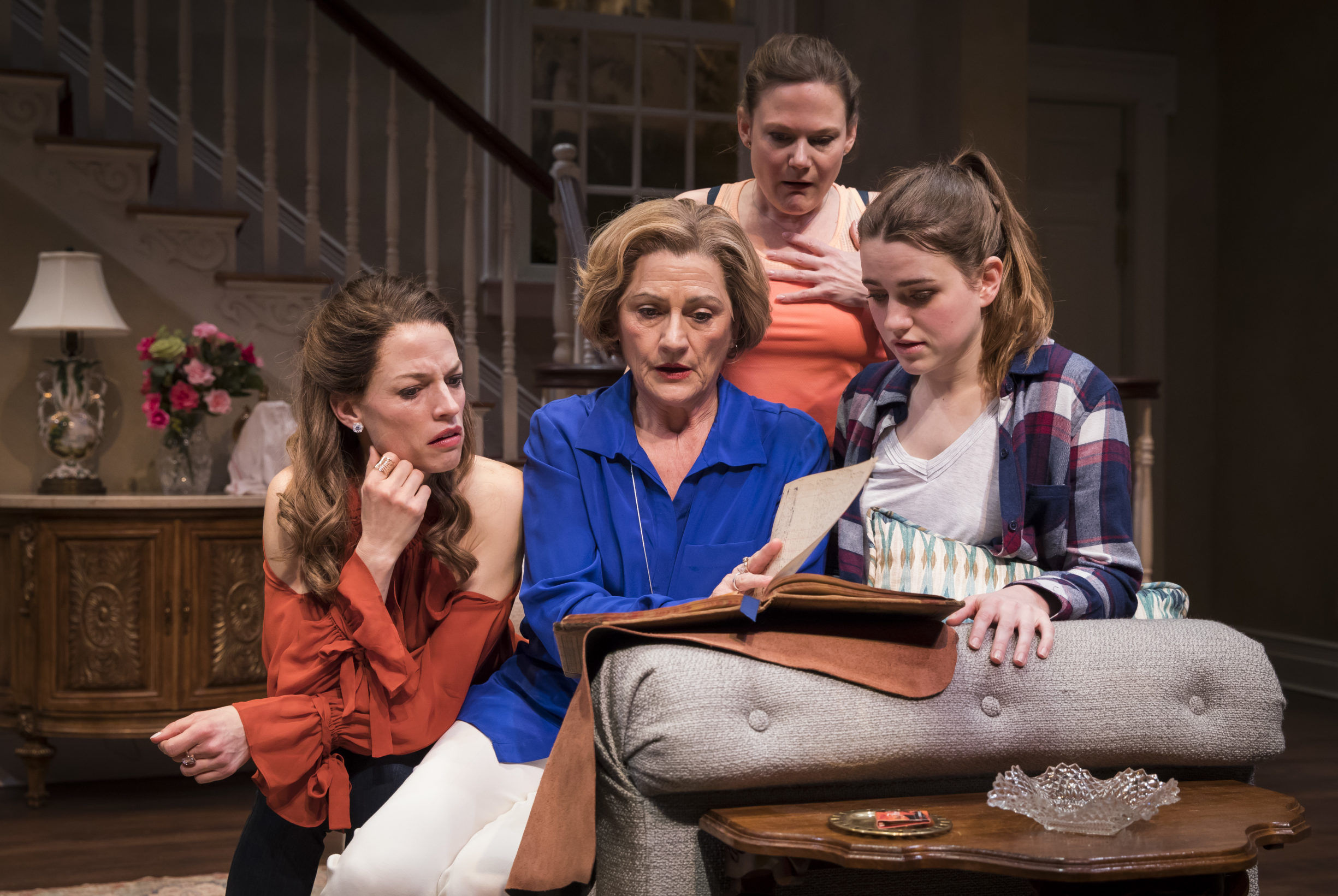
Not to get all "Webster's Dictionary defines..." but I have to say it a little louder for the All Lives Matter folks in the back: A privilege is a special advantage or benefit available only to a particular person or group of people. A benefit, for instance, like a big, beautiful plot of land that your family forced slaves to maintain. Or, for instance, a thriving business that has clothed, fed, and housed generations of white descendants for centuries while providing nothing to the black descendants of the people without whom there wouldn't be a business. The slaves did the work, yet it's the family of the slaveowners who reap the benefits.
This 21st century answer to reparations is inspiring and brilliantly funny, with a fast-paced and clever script by Kevin Douglas and superb directing by David Schwimmer. Plantation! is both a conversation starter and high quality entertainment. Chaos and comedy ensue while the six girls try to make nice and get to know each other, all while griping beyond each others' backs about who really deserves the plantation. The play is a hilarious send-up of well-meaning white people; who sincerely want to help, yet do nothing when presented with the chance to do so; who swear up and down they aren't racist, yet date a member of the KKK because he doesn't go to "all" of the meetings.

In one scene, the girls are all Southern-Belle'd out in big, old-fashioned dresses for a fancy dinner on the estate. When the black girls turn on some music and start dancing, one of the white girls yells that it's like they have Beyonce in the house. Her sister admonishes her, "That's racist."
"No, it's not. That's a compliment," one of the black girls replies, high-fiving her sisters. The white sister who thought she was rightly calling out racism shakes her head, "You people are confusing." The black sisters share a glance. "That's racist," they say. Case in point, maybe listen to what people who experience racism have to say about it before defining racism for them. (Also, rule of thumb, don't make black people explain Black Lives Matter to you – which, naturally, plays out onstage here. Google is your friend.)
Finally, the cast of eight women knocked it out of the park with their chemistry and comedic timing. Besides the fabulous poofy dresses, it seemed to me that this play could've been cast with either men or women and the story would be the same. Props to Lookingglass and Douglas for not setting the default to "male." And for not being afraid to have a mixed race cast discuss race and make everyone in the audience, to use the playwright's own word, a little "funcomfortable".
Plantation is playing at Lookingglass Theatre Company through April 22nd. Tickets on LookingglassTheatre.org.


Latest Articles
-
 Poetry in Motion: Joffrey's Eugene Onegin enraptures at the Lyric Opera
Written by Kendall RoyzenThere’s something magical about stories. Stories have the power to transcend time, reaching across the centuries to share their thoughts, ideas, and emotions. Tales of heartbreak, anguish, squandered youth, and missed chances written in the 1800s have a way of…
Poetry in Motion: Joffrey's Eugene Onegin enraptures at the Lyric Opera
Written by Kendall RoyzenThere’s something magical about stories. Stories have the power to transcend time, reaching across the centuries to share their thoughts, ideas, and emotions. Tales of heartbreak, anguish, squandered youth, and missed chances written in the 1800s have a way of… -
 Collaboraction Theatre announces June shows and events in its new House of Belonging in Humboldt Park
Written by Buzz Center StageNow fully activated, Collaboraction Theatre Company’s new House of Belonging in the Kimball Arts Center, 1757 N. Kimball Ave in Humboldt Park, is a sleek, 4,000-square foot space featuring a new 99-seat flexible studio theater and a 50-seat cabaret with…
Collaboraction Theatre announces June shows and events in its new House of Belonging in Humboldt Park
Written by Buzz Center StageNow fully activated, Collaboraction Theatre Company’s new House of Belonging in the Kimball Arts Center, 1757 N. Kimball Ave in Humboldt Park, is a sleek, 4,000-square foot space featuring a new 99-seat flexible studio theater and a 50-seat cabaret with… -
Redtwist Theatre presents Anatomy of A Suicide August 12-30
Written by Buzz Center StageProduced in partnership with JunkHeart, The Metal Shop Performance Lab is proud to announce the cast and creative team for Anatomy of a Suicide, August 12 - 30, at Redtwist Theatre, 1044 W Bryn Mawr Ave, Chicago, written by Alice Birch and directed by Alex Mallory. Previews are Wednesday, Aug. 12 and Thursday,…
-
Juneteenth Prelude: Celebrating Freedom and Black Expression, an evening of entertainment and community
Written by Buzz Center StageBlack Ensemble Theater Founder and Executive Director Jackie Taylor proudly announces Black Ensemble's Juneteenth Prelude: Celebrating Freedom and Black Expression, as part of the series Another Night @ BET. This celebratory evening, curated by Bernard Lilly, Jr., engages the Black Ensemble community with performances from BE…


Does your theatre company want to connect with Buzz Center Stage or would you like to reach out and say "hello"? Message us through facebook or shoot us an email at This email address is being protected from spambots. You need JavaScript enabled to view it..
*This disclaimer informs readers that the views, thoughts, and opinions expressed in the text belong solely to the author, and not necessarily to Buzz Center Stage. Buzz Center Stage is a non-profit, volunteer-based platform that enables, and encourages, staff members to post their own honest thoughts on a particular production.