
Displaying items by tag: powerful plays
ETA’s for colored girls Honors the Enduring Power of Ntozake Shange
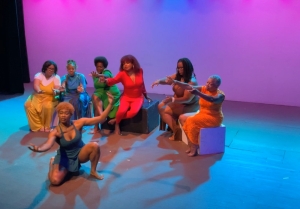
Nearly fifty years after its groundbreaking premiere, Ntozake Shange's for colored girls who have considered suicide / when the rainbow is enuf remains one of the most important works ever written for the American stage. Neither conventional play nor musical, Shange called her work a "choreopoem," a seamless fusion of poetry, dance, music, and theatrical ritual that forever changed the landscape of Black theatre.
When the work premiered in 1976 it shattered theatrical conventions. The original production gave Black women something rarely afforded on the American stage: the authority to tell their own stories without apology, through language that was lyrical, raw, sensual, political, and deeply personal. At a time when Black women were often relegated to supporting roles in theatre, Shange centered their voices, their pain, their joy, and ultimately, their survival. The production earned multiple Tony Award nominations and cemented itself as a cornerstone of the American theatrical canon.
Its relevance today is perhaps even more striking. In an era shaped by conversations surrounding gender-based violence, mental health, reproductive autonomy, identity, and the ongoing struggle for Black women to be fully seen and heard, Shange's words continue to resonate with astonishing clarity. The emotional truths embedded in her poetry refuse to age.
ETA Creative Arts Foundation's production, directed by Donn Carl Harper, wisely understands that the strength of for colored girls lies in trusting Shange's language. Harper resists the temptation to over-direct or impose unnecessary concepts upon the material. His direction is careful, respectful, and largely unobtrusive, allowing the poetry to remain the undeniable centerpiece.
The production, however, begins on an unfortunate note. Opening night started approximately thirty minutes late, a delay that inevitably affected the audience's energy. Compounding that issue was the decision to open with Nina Simone's haunting "Four Women." While Simone's anthem is unquestionably a masterpiece and shares thematic kinship with Shange's work, its placement here felt somewhat gratuitous. After already waiting half an hour, the audience was asked to spend another five minutes listening to a recorded song while nothing occurred onstage. Rather than heightening anticipation, the extended prelude tested the audience's patience before the choreopoem had the opportunity to speak for itself.
Once the production settles into Shange's text, however, it finds its rhythm.
Levi Wilkins' abstract scenic design provides an uncluttered visual landscape that allows the performers to inhabit both literal and emotional spaces. His lighting effectively supports the shifting moods of the evening, although both scenic and lighting concepts occasionally seem content to complement the material rather than challenge it. Given the limitless theatrical possibilities inherent in a choreopoem, I wish he would have made bolder visual choices that embrace the work's dreamlike qualities.
Markene Peavy's costume designs honor the play's iconic color symbolism, a safe choice, but it doesn't distinguish each woman as individuals, a missed opportunity. Peavy's choreography becomes the production's most compelling storytelling device. Rather than serving as decorative movement between monologues, the choreography extends Shange's language into the body, allowing emotion to continue flowing.
Among the ensemble, Madison Savannah (Lady in Purple) emerges as an exceptional physical storyteller. Her dancing possesses remarkable precision, grace, and emotional transparency, making every movement feel deeply connected to the poetry. She consistently commands attention without disrupting the ensemble's collective balance.
The performances throughout demonstrate a clear understanding that these women are not individual characters so much as facets of a shared experience.
Tina Marie (Lady in Red) delivers her poetry with commanding authority and emotional maturity. Margo Harper (Lady in Blue) brings quiet dignity and introspection, while Deborah Ross (Lady in Green) grounds her moments with warmth and humanity. Tracey Renee (Lady in Orange) finds welcome humor amid the heartbreak, providing necessary moments of emotional release. L.A. Holts (Lady in Yellow) infuses her work with youthful vitality and infectious spirit. Kennedi Coleman (Lady in Brown) offers moments of thoughtful restraint that contribute beautifully to the ensemble's collective voice.
Opening night also presented an increasingly familiar frustration that falls outside the production itself but nonetheless affected the theatrical experience. The persistent glow of cell phones and repeated audience distractions proved difficult to ignore. Theatre remains one of the few art forms built upon a shared agreement between artists and audience to be fully present in the moment. When that agreement is repeatedly broken, everyone in the room loses something.
Even with its uneven opening and a few missed opportunities for greater theatrical imagination,
ETA's production succeeds where it matters most: it trusts Shange.
That trust is ultimately enough.
Nearly fifty years after its premiere, for colored girls who have considered suicide / when the rainbow Is enuf continues to remind audiences that Black women's stories are not peripheral to the American experience - they are central to it. Their pain, laughter, sensuality, vulnerability, resilience, and joy remain as urgent today as they were in 1976.
Shange did more than write a play. She created a language for survival.
ETA Creative Arts Foundation honors that legacy with sincerity, sensitivity, and respect, reminding us that some masterpieces require no reinvention- only artists willing to listen deeply enough to let them speak.
Recommended
When: thru August 31
Where: 7558 South Chicago Ave Chicago
Tickets: $30 - $50 general admission
Redtwist’s Sobering ‘night Mother Asks Us to Look for the Unseen

Mother-daughter relationships are somehow deemed different. More seminal than the bond between a father and son. More instinctive than between sisters. When trust is broken, all bets can certainly be off. But that doesn’t seem to be the case for Thelma and Jesse, a mom and her daughter who live together in Marsha Norman’s magnificent ‘night Mother, just opening at Redtwist Theatre in Edgewater. They have a balance and flow that suggests a seasoned understanding. A harmonic acceptance of their lives together.
Thelma, played so fully by Redtwist ensemble member, Kathy Ruhl, is a pleasing mix of pragmatism and discreet earnestness. A woman who’s lived a long life, withstood a lot and is making the most of the years in her final season. Knitting on her well-cushioned sofa, cell phone dangling from her lanyard, TV playing in the background, she’s thinking about how she’s going to satisfy her sugar fix. And settles on a snowball before contemplating many other options as the evening passes.
Thanks to the prodigious thought and scrupulous detail Bobbie Buie poured into the set design, Thelma’s modest home has the soft glow of easy unpretentious comfort. Everywhere there are signs that point to a contentment that’s been well earned. The world she created, along with Harper Justus’s precise and subtle sound design, saturated you in place.
Anne Sheridan Smith in the role of her daughter, Jesse, is much more wired; frenzied in an organized way. When she shoots out of her bedroom door, she’s clearly a woman on a mission to get a lot of things done. Quickly. As she settles down, she’s simply determinedly methodical and impressively so. There’s some light haggling with her mother. It seems like something they just occasionally do. Normal. Tonight, giving her mother a manicure is high on Jesse’s to do list. It’s not long before they settle down at the kitchen table and normal goes away.
A small cloud of foreboding drifted in when Jesse began looking for some things in their makeshift attic. One of them is a gun. When her mother keeps pressing her on why she wants or needs one, she forces her daughter’s hand. Jesse declares to her mother, not coldly but matter-of-factly, that tonight she’s going to use it to kill herself.
It’s the kind of statement that instantly triggers incredulity. And automatically, by reflex, Thelma’s “mom” response zooms past tilt. Even though she may not initially believe Jesse, she hears her. And intuitively she wants to fix it as she struggles to even comprehend the magnitude of what she’s been told. ‘night Mother soon becomes a push and pull with Jesse always exhibiting the greater strength against a formidable opponent. She has the inner conviction to see this grim task through. You can sense that when she first told her mother what she was going to do. Like her mother, we too want to know why.
A dissection of one person’s why is what this intricate and intimate story is all about. And the way Smith inhabits her character, she functions as an outstandingly plausible stand-in for many of us. People who not only have had enough but also look at themselves and don’t see enough.
Her mother doesn’t really understand. Not at first. It’s as the tandem airing of their lives that reveals how it’s come to this.
Well into this gripping one act performance, wonderfully directed by Redtwist’s Artistic Director, Dusty Brown, Thelma describes herself as a “plain country woman”. Life for her is something you just did. It’s the kind of existence where naivete and ignorance may thrive in abundance, but neither carries an especially detrimental cost. When it came to Jesse’s early childhood rearing of Jesse though, perhaps it did. Thelma and her husband discovered late in their daughter’s development that the fits she experienced as a child were epileptic. Undiagnosed and untreated for far too long, Jesse internalized them as manifestations of a personal flaw. A flaw that inevitably, in her mind, produced terrible consequences.
She never directly states it, but it’s clear she blames herself for the way her son, Ricky, is turning out. A thief, drugs, regularly in run-ins with the police. Thelma says it’s just a phase. He’ll grow out if it and be a “fine young man”. But through a haze that’s draped in quiet anguish, Jesse senses otherwise. It’s the same with her ex-husband. In Cecil’s case, he was there and then he was gone. The man her mother found for her, who she came to love and who chose not to stay.
They’re all hard blows. Jesse has weathered them. Now it sounds like she’s tired. Sick of it all. Living with her mother. Lonely present. Lonely future. She’s felt this way for so long that she’s used the last 10 years to plan for this night. She’s gotten it so fine-tuned, she can give her mother detailed instructions on who to call when after the deed is done, and why.
For this compassionate plunge into the unthinkable, Marsha Norman won the Pulitzer Prize for drama in 1983. A native of Kentucky, you can hear a faint sound of the south in the way Thelma and Jesse talk to one another. The weight of the subject matter, the care in which these two women are drawn and portrayed, the way every argument Thelma raises against this tragic decision is rebuffed by unswayable conviction, keeps you rapt. A sliver of life captured beautifully and unforgettably on the stage.
‘night Mother
Through May 24, 2026
Redtwist Theatre
1044 W. Bryn Mawr Ave.
Chicago, IL 60660
For tickets and more information: https://www.redtwisttheatre.org
Highly Recommended
This review is proudly shared with our friends at www.TheatreInChicago.com.



Latest Articles
-
 ETA’s for colored girls Honors the Enduring Power of Ntozake Shange
Written by Wesley DavidNearly fifty years after its groundbreaking premiere, Ntozake Shange's for colored girls who have considered suicide / when the rainbow is enuf remains one of the most important works ever written for the American stage. Neither conventional play nor musical,…
ETA’s for colored girls Honors the Enduring Power of Ntozake Shange
Written by Wesley DavidNearly fifty years after its groundbreaking premiere, Ntozake Shange's for colored girls who have considered suicide / when the rainbow is enuf remains one of the most important works ever written for the American stage. Neither conventional play nor musical,… -
 Grammy-Nominated Premiere Anchors 9th NEXUS Chamber Music Festival This August 12-14
Written by Mitchell OldhamChamber music may be one of music’s most misunderstood children. An early form of classical music, it has always been open to a huge spectrum of emotions and moods and can swing instantly from the softly reflective to the boldly…
Grammy-Nominated Premiere Anchors 9th NEXUS Chamber Music Festival This August 12-14
Written by Mitchell OldhamChamber music may be one of music’s most misunderstood children. An early form of classical music, it has always been open to a huge spectrum of emotions and moods and can swing instantly from the softly reflective to the boldly… -
 Love and Time On Our Side: The Notebook: The Musical at Broadway in Chicago
Written by Kendall RoyzenIn times of stress, we often turn to familiar and comforting things: a favorite song, a dog-eared book, a movie we’ve seen twenty-seven times. We’re drawn back to the things we know because they have a certain salve to the…
Love and Time On Our Side: The Notebook: The Musical at Broadway in Chicago
Written by Kendall RoyzenIn times of stress, we often turn to familiar and comforting things: a favorite song, a dog-eared book, a movie we’ve seen twenty-seven times. We’re drawn back to the things we know because they have a certain salve to the… -
 Remy Bumppo Theatre Company Announces Mud Row October 15 - November 15 at Theater Wit
Written by Buzz Center StageRemy Bumppo Theatre Company is pleased to announce the cast, creative and production teams for the first production in its 2026 - 2027 season, Mud Row, written by Dominique Morisseau and directed by Malkia Stampley, October 15 - November 15, in Theater One at Theater Wit, 1229 W.…
Remy Bumppo Theatre Company Announces Mud Row October 15 - November 15 at Theater Wit
Written by Buzz Center StageRemy Bumppo Theatre Company is pleased to announce the cast, creative and production teams for the first production in its 2026 - 2027 season, Mud Row, written by Dominique Morisseau and directed by Malkia Stampley, October 15 - November 15, in Theater One at Theater Wit, 1229 W.…


Does your theatre company want to connect with Buzz Center Stage or would you like to reach out and say "hello"? Message us through facebook or shoot us an email at This email address is being protected from spambots. You need JavaScript enabled to view it..
*This disclaimer informs readers that the views, thoughts, and opinions expressed in the text belong solely to the author, and not necessarily to Buzz Center Stage. Buzz Center Stage is a non-profit, volunteer-based platform that enables, and encourages, staff members to post their own honest thoughts on a particular production.