

Maddie Burroughs
The Dancing Delivers What the Dialogue Doesn’t in Dirty Dancing: The Musical
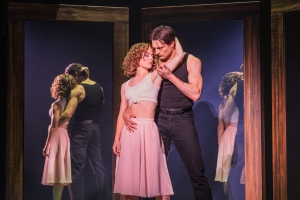
In a world of theatrical adaptations, there really are two kinds: some reinvent their source material, becoming their own “new” art, while others understand that the real pleasure they provide is in the audience seeing some beloved thing from the past brought back to life. Dirty Dancing: The Musical falls firmly into the second category. Is it a great musical? Not quite. But that’s not its purpose. As a pop-culture ritual connecting a multigenerational audience over their shared love of a movie (which never tried to be “great” cinema, either), it is undeniably effective. And with Dancing with the Stars returning next week (surely a favorite for this musical’s audience), the timing of this particular Broadway in Chicago production’s exceptional ballroom dancing could not have been better.
With original screenplay and book by Eleanor Bergstein and direction by Lonny Price, the adaptation recreates the film largely through its familiar soundtrack, supplemented by a handful of original songs. It quickly becomes clear that the production was cast with dancing as its first priority. That choice pays off whenever the music takes over: the cast members are remarkably skilled dancers, and the show’s most kinetic sequences capture the sensuality and excitement audiences expect from Dirty Dancing. Much of that impact comes from choreographer Darrell Grand Moultrie, whose work channels the film’s sensuality and athleticism with precision.
That energy largely disappears, though, when the dancing stops. Unfortunately, dialogue is often delivered with a stiffness that makes the performances feel robotic, leaving little sense of genuine connection between the characters. The chemistry missing from Baby and Johnny’s romantic scenes is just as absent from the story’s confrontations, friendships, and family relationships.
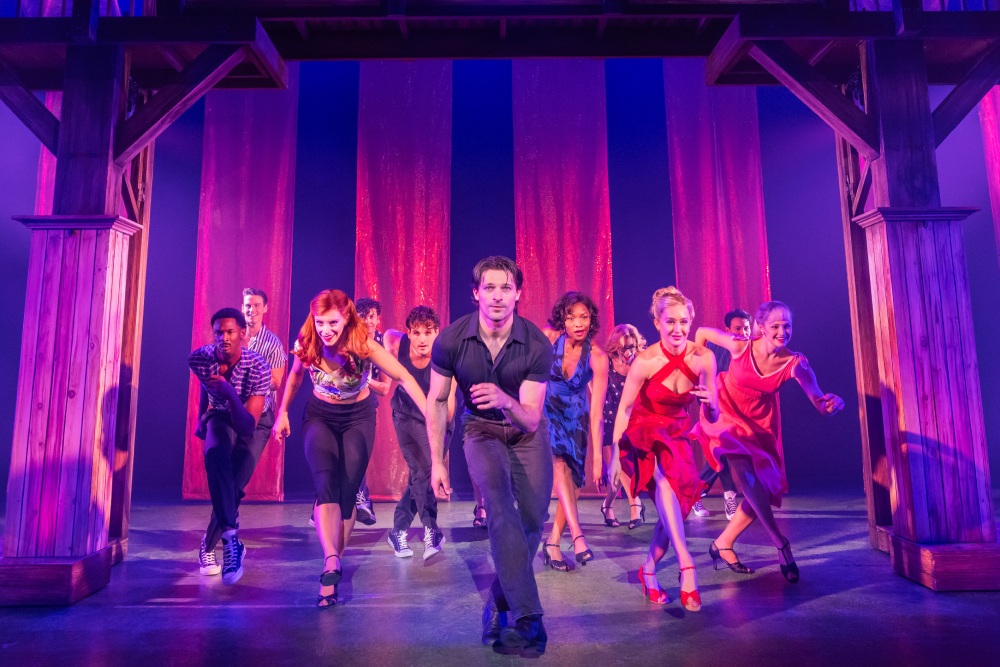
Blake Zelesnikar (Johnny Castle) and the DirtyDancing: The Musical Company. Photo by Matthew Murphy.
Almost as noticeably, the ensemble rarely displays the tight-knit community that should exist among Kellerman’s dance staff. These characters live and work together within the same rigid system; their relationships should feel immediate and deeply established. Instead, much of the large cast feels underutilized, when not simply crowded on the stage. The exception is the final number at the end-of-season talent show, when everyone suddenly moves with the same electric energy. It sends the audience out on an undeniable high, while also revealing how much more vibrant the entire production could have felt with that sense of spirit throughout.
Vocally, the cast is professional and polished, with two extraordinary exceptions: Ethan Peterson as Billy Kostecki and Ashley LaLonde as Elizabeth. Their voices are absolutely stunning. Nearly every pin-drop emotional moment in the production comes not from the dramatic plot, but from one of them singing.
Alongside its dancing among the production’s greatest triumphs is its scenic design, which transports us to the 1960s Catskills. The work of scenic designer Brett J. Banakis, costume designer Linda Cho, and lighting designer Japhy Weideman is central to creating that world. The set does not rely on spectacle or theatrical magic but is astonishing because it’s so perfectly planned and constructed to hold every corner of Kellerman’s – from polished guest spaces to humbler staff quarters, indoors and out. Seamless transitions allow locations to shift smoothly without interrupting the story’s momentum. I only wish the choreography had taken greater advantage of that flexibility, using the architecture to create more breakout moments for an ensemble overflowing with talented dancers.
Ultimately, Dirty Dancing: The Musical succeeds at recreating the movie onstage but rarely explores what live theatre could add to it.
But despite any limitations, this production provides exactly what its audience desired: an enjoyable night powered by nostalgia, tremendous dancing, and a finale worth waiting for – even if it never becomes an exceptional musical independent of the film audiences already love.
Dirty Dancing: The Musical runs at the James M. Nederlander Theatre through September 20th. Tickets are available at https://www.broadwayinchicago.com/shows/dirty-dancing-the-musical/.
yo ho. Delivers Queer Pirate Chaos, Big Laughs, and Fierce Swordplay

A quick history lesson: Anne Bonny and Mary Read are two of history’s most famous female pirates. Both women disguised themselves as men and sailed under the command of Captain Calico Jack Rackham, where they became part of the same crew. There has long been speculation that they may have had a romantic relationship, though there is no widely accepted historical evidence to support it.
That essentially sums up the history covered by yo ho., SMJ’s original play which reimagines Anne and Mary’s story in a very queer, very explicit way. Described as “equal parts historical fantasy and introspective sexual and gender exploration,” the production has far more interest in the latter than the former. It uses these historical figures less as a subject to interrogate than as a launching point for a silly, raunchy, gay pirate adventure.
This is not inherently a bad thing – director JD Caudill’s production is clearly committed to creating both queer joy and comedic sexual exploration on stage, and for queer artists to come together to make something. yo ho. may not be as historically based or polished as it markets itself to be, but with accurate marketing, there is definitely an audience to love the show.
The cast is the heart of the production. The outrageous script makes room for the entire cast to throw themselves into spicy, raunchy, hilarious, and sometimes sacrilegious moments for multiple characters, whether that be ensemble playing multiple roles or one character with two alter egos. Two particular standouts were William Delforge (Chad/James) and Brittani Yawn (Vanessa) – both cast members carried the production, playing multiple roles with great comedic timing and execution, and larger-than-life physical comedy. Funny on their own, Delforge and Yawn only became more powerful when playing off of each other.

(L to R) Rachel Sleek Bañuelos and Sierra Bryn in the world premiere of yo ho.
This constant-humor approach does limit the nuance of character relationships that can be developed; however, it does not mean that the show was void of emotionally moving moments. Rachel Sleek-Banuelos’ eleventh-hour monologue is stunningly moving; despite the moment feeling a bit out of place in the script overall, Banuelos temporarily silences the theatre and lands it perfectly regardless. However, in the end, the play’s ending unfortunately does lean into a gimmick that feels more abrupt than satisfying.
For a company called Babes with Blades, though, the clearest strength is exactly where it should be: the fighting. The stage combat is consistently impressive, but the swordplay in particular is fast, dynamic, and genuinely intimidating from only a few feet away. Even when the choreography is visibly choreographed, it never becomes mechanical. Carly “CB” Carson’s fight choreography has momentum and danger, nearly intimidating to be sitting mere feet from.
The technical production also feels surprisingly considered for the polish of the show. The set creates a convincing pirate-world atmosphere within The Edge’s black-box space, though some scene changes feel more complicated than the material requires. In general, yo ho. can feel disproportionately unserious compared with its technical ambition: the energy is closer to an enthusiastic college-theater production than the fully realized historical fantasy its marketing material promises.
Still, there is an audience for this show. The theatregoer who wants a messy, high-energy night of queer pirate smut – perhaps with friends after a nearby Edgewater happy hour – may have a genuinely great time. For everyone else, yo ho. is best approached with the understanding that it is not a sweeping historical drama, but an overwhelmingly unserious fantasy which features strong sword fighting and a few flashes of something more.
yo ho. is running Thursdays through Sundays at The Edge Off-Broadway through August 29th. Tickets are available at BabesWithBlades.org
Suffs and the Women Who Refused to Wait

Suffs is a musical about history, yes, but more importantly, it is a musical about momentum: who creates it, who resists it (and why), who gets left behind by it, and what it costs to keep pushing it forward.
Set during the height of the women’s suffrage movement in the 1910s, the show follows a group of young suffragists led by Alice Paul, the real-life founder of the National Woman’s Party. Together, they organize, protest, clash with political leaders, become political prisoners, and (spoiler alert) eventually help gain women the right to vote through the 19th Amendment. But Suffs is not content to frame that victory as clean or uncomplicated, or to pretend that, even a century later, the battle is anywhere near over. The musical is just as interested in the fractures within the movement itself: the younger, more aggressive activists pushing against the older, more “respectable” wing of the Suffrage movement, and the women of color forced to fight for a movement that still asks them, again and again, to wait their turn.
That is where Suffs feels most relevant. It is not only a story about the past, but about the way progress still happens now: through generational disagreement, imperfect coalitions, strategic compromises, moral failures, and the constant fear that too much change too quickly might provoke as much backlash as liberation. Shaina Taub’s book, music, and lyrics do an incredible job balancing real history with theatrical fiction, making the politics legible without flattening the people involved into saints or symbols.

Marya Grandy (Carrie Chapman Catt) and company in SUFFS.
Under director Leigh Silverman, the first national tour’s production is just as anchored by its remarkably talented cast as it is by history; the entirely female company takes on both women and men throughout the story. Maya Keleher is excellent as Alice Paul, bringing both vocal strength and exactly the right kind of young, audacious drive to the role. Her Alice has the spunky determination of a character like Newsies’ Katherine, but grown up: sharper, more self-assured, and driven by something deeper than ambition. She is unabashedly devoted to her cause and makes it clear that, no, it’s not just because she’s young.
Playing opposite her are historical figures Carrie Chapman Catt (Marya Grandy), the mature and strategically tactful leader of NAWSA, and President Woodrow Wilson (performed by u/s Merrill Peiffer). Grandy’s dynamic with Alice Paul is one of the production’s strongest relationships, the two women foiling each other beautifully as they reveal different forms of conviction, compromise, and care. Peiffer’s handling of the presidential role was especially smart: funny and pointed, but never so exaggerated that it breaks the world of the show.
A special shoutout also has to go to the trio of Ida B. Wells (Danyel Fulton), Mary Church Terrell (Trisha Jeffrey), and Phyllis Terrell (Victoria Pekel). Multiple times, the energy in the theatre seemed to shift the moment the three of them took the stage together. Their scenes carried a stillness and gravity that made the room go quiet in the best possible way.

Brandi Porter (Dudley Malone) and Jenny Ashman (President Woodrow Wilson) in the First National Touring Company of SUFFS.
Suffs, which premiered Off‑Broadway in 2022 before its award‑winning 2024 Broadway run, continues to prove its power throughout its highly anticipated national tour. The score delivers some of the musical’s most defining moments, from the sharp, scene‑setting opener “Let Mother Vote” to the driving protest energy of “The March (We Demand Equality).” The emotional weight lands beautifully in “I Was Here,” a moving tribute to Ida B. Wells and Mary Church Terrell, while “Keep Marching” rises as the show’s breakout anthem, capturing the spirit of persistence that fuels the entire production.
If I have a critique, it’s that the show leans a bit too heavily into the idea of the production’s scale growing in tandem with the movement’s momentum. Conceptually, I love that choice. In practice, however, especially within the limits of a touring production, the early restraint makes the show take a long time to feel truly sweeping. The first act is good, but it was not until the second half of the second act that I found myself thinking, “Why haven’t they been singing like that, and dancing like that, the whole time?” The choreography has similar highs and lows: effective in moments, but not always as polished as it needs to be for the more intricate sections to feel truly stunning.
Still, by the end, Suffs lands exactly where it needs to. It leaves the audience empowered without pretending that empowerment is the same as change. The show understands that history is not something we revisit for comfort, but something we return to for instruction. Its final message, “your ancestors are all the proof you need / That progress is possible, not guaranteed,” is both a warning and a call to action. Suffs reminds us that the march is not over - and that the responsibility to keep moving belongs to all of us.
Recommended.
Presented by Broadway In Chicago, Suffs is running at CIBC Theatre through July 19th. Tickets are available here.
- Suffs
- CIBC Theatre
- Broadway in Chicago
- Musical theatre
- Suffrage
- Suffragette
- National Womans Party
- Alice Paul Ida B Wells
- Leigh Silverman
- Carrie Chapman Catt
- Marya Grandy
- Maya Keleher
- Woodrow Wilson
- Merrill Peiffer
- Danyel Fulton
- Trisha Jeffrey
- Victoria Pekel
- live theatre
- on stage
- chicago theatre
- Chicago events
- Chicago plays
The Art of Awe: Water for Elephants Balances Spectacle and Soul

The musical Water for Elephants, presented by Broadway In Chicago and based on Sara Gruen’s 2006 novel, is the rare touring Broadway production that feels like two forms of live entertainment fused perfectly. It is a sweeping musical, yes, but it is also a full-blown circus spectacle – and, more impressively, it manages to blow you away on both fronts.
Told through the memories and ghosts of an elderly Jacob Jankowski, Water for Elephants follows a young Jacob who, under unfortunate circumstances, follows the age-old childhood dream of running away with the circus. The show brings to life the complicated realities behind that fantasy: the idea of stumbling into a secret, self-contained world where danger, wonder, chosen family, and reinvention all exist under one big top. From the moment Jacob enters that world, the audience is drawn in with him.
Particular standouts in the principal cast were Zachary Keller as Jacob Jankowski, whose vocal talent and charisma are matched only by Robert Tully as Older Jacob – the perfect pairing across time. As Marlena, Helen Krushinski commanded the theatre like a pure-of-heart ringmaster, capturing our attention both on trapeze and vocally. However, no one made the audience laugh harder than Tyler West as Walter, the gritty, spunky clown and knife-thrower whose physical comedy was unmatched, projecting every larger-than-life expression to the backs of the theatre.
The show’s creative engine fires on all cylinders: a soaring score from the acclaimed PigPen Theatre Co. (The Tale of Despereaux), a sharply crafted book by four‑time Tony Award nominee Rick Elice (Jersey Boys, Peter and the Starcatcher), and tour direction by Ryan Emmons, faithfully re‑creating Jessica Stone’s Tony‑nominated original staging (Kimberly Akimbo).

(left-right) Connor Sullivan, Helen Krushinski, and Zachary Keller in Water for Elephants. Photos by Matthew Murphy for MurphyMade.
The most immediately astonishing element of this production is, unsurprisingly, the circus work. The show features a truly impressive range of skills, including aerial hoop and silks, Spanish web, trapeze, and dozens of genuinely death-defying acrobatic tricks and stunts. These sequences are not treated as decorative flourishes or occasional spectacle breaks; they are woven directly into the fabric of the show, pulling us behind the scenes of how the circus breathes, moves, celebrates, and survives.
Aside from their incredible acrobatic talent, it is the ensemble’s acting and collective presence that really bring the Benzini Brothers Circus to life. They do not just perform like a group of talented individuals; they feel like a community. Their presence gives the spectacle a lived-in quality, as if we are getting a glimpse into a strange, beautiful little village that existed long before Jacob arrived and will continue on after he leaves. The choreography only deepens that feeling, filling the stage with constant motion that still somehow feels purposeful, like the well-oiled machine behind a traveling circus, rather than chaotic. Even in the busiest moments, there is a sense of shared rhythm and collective trust among the ensemble that’s impossible to fake.
That trust extends beyond performance and into the technical construction of the show itself. Throughout the production, the cast quite literally assembles and dismantles the world around them. The big top is built, broken down, reconfigured, and rebuilt in front of us, using artistry to turn scene transitions into their own kind of performance. For a concept that presents so many obvious challenges – live animals, circus-scale theatricality, and the limitations of a traveling production, to name a few – Water for Elephants meets each obstacle with remarkable creativity and a steady grounding force.

The touring cast of Water for Elephants.
The production design is especially successful because it knows when to lean into abstraction. Rather than attempting to make every element literal, the show often suggests the world of the circus through movement, fabric, shadow, structure, the bodies of its performers, and some of the most beautiful puppets I’ve seen on stage. The amount of thought that went into creating something cohesive, theatrical, and fully transportable - without dulling any of its magic - feels less like standard Broadway stagecraft and more like a feat pulled off by a traveling chosen family.
All of this authenticity, however, at times feels at odds with the musical’s book and score. The ensemble feels so natural, so physically and emotionally connected to one another, that a few of the more dramatic scenes begin to feel noticeably staged by comparison. That is not a question of the principal cast’s talent, but rather a limitation of translating this story from novel to musical. There are moments when the circus – and even the puppets – feels startlingly real, and moments when you are reminded that you are very much watching a musical. Neither approach is inherently wrong, but the gap between them can be jarring. Still, that critique feels small compared to the scale of what the production accomplishes. It is also worth noting how vocally balanced the ensemble remains despite the wide range of performers on stage. In a show that combines musical theatre performers with circus and acrobatic artists, maintaining that level of cohesion is both a performance achievement and a technical one.
Water for Elephants captures the exact feeling it is chasing: awe. It is dangerous, romantic, inventive, and deeply theatrical, with a company that makes the impossible look effortless.
For anyone who has ever wanted to run away with the circus – or simply be reminded of what live performance can do when artists push it to its limits – Water for Elephants is running at James M. Nederlander Theatre through July 5th. Tour information and tickets are available at https://waterforelephantsthemusical.com/.
Champions of Magic Captures the Thrill of Live Performance

One of the things I have always thought that concerts and other live events had over theatre is the energy of the crowd afterward. While people certainly leave plays and musicals moved, impressed, or deep in conversation, there is often a certain reserve to the way theatre audiences spill out onto the sidewalk. That was not the case after Champions of Magic at Studebaker Theater.
Leaving the theatre, the crowd was electric. People of all ages and backgrounds were in full childlike awe, excitedly recounting their favorite tricks, debating the moments that scared or shocked them most, and trying (mostly unsuccessfully) to understand how any of it could have been done. At one point, while my friend and I were part of the herd heading toward the train, an older man turned to us mid-discussion and said, “Usually, I see tricks and, even if I don’t know exactly how they did it, I can wrap my head around it just being an illusion. That was true magic.” And it was – that’s the only explanation.
That reaction captures the biggest strength of the night: it makes magic feel genuinely special again. In an age when so much of our entertainment is filtered through screens, clips, and behind-the-scenes explainers, it is easy to think you have already “experienced” these kinds of illusions through television or YouTube. But seeing them live, in a room full of people gasping, laughing, screaming, and turning to strangers in disbelief, is a completely different kind of experience – one you can only get from the Champions of Magic, themselves.
The large-scale magic show runs upwards of 2.5 hours, including one intermission, and is loosely structured as a rotation between three featured acts: Young & Strange (Richard Young, Sam Strange), Liberty Laren, and Fernando Velasco. While each performer brings their own style and specialties, the show works best when it feels like a shared, collaborative spectacle. There is something especially exciting about seeing different magicians combine their individual strengths to create an experience that feels bigger, stranger, and more theatrical than a traditional magic show.

The company of Champions Of Magic - photo by Bill Axell.
The variety of tricks is especially impressive. Champions of Magic includes everything from classic illusions, like the classic woman-sawed-in-half, to large-scale and death-defying stunts, to more intimate pieces of sleight of hand with audience interaction. Some tricks are quick and funny; others are story-driven and beautiful. The show also includes bits of magic history, particularly through fourth-generation magician Liberty Larsen’s family history as the founders of the Magic Castle. This was one of the most interesting threads in the evening, and I found myself wishing there had been even more of that magical history woven throughout the show.
The production is also extremely audience - and family-friendly, with plenty of built-in participation. Volunteers are selected in playful ways, such as by launching ping-pong balls into the audience, and several children are brought onstage as assistants. That said, parents should be warned before intermission: the glowing “red light, green light” magic toy promoted during the show costs $30 in the lobby – much more than I expected and not advertised until kids were already next in line for their new toy.
Aside from the occasional product placement, the show’s biggest issue was with pacing. I understand that a production of this scale needs slower, smaller tricks for both budget and timing reasons, and not every moment can or should be a massive illusion. Still, for a show pushing two and a half, there were stretches that felt extensively padded with smaller-scale filler. Ironically, the grand finale had the opposite problem. It was packed with multiple incredible tricks, but they came so quickly - back-to-back - that there was barely time to absorb one astonishing moment before the next was already underway. A little more breathing room there would have made the ending feel even more satisfying, without risking exposing the secrets at play.
Even with those pacing issues, Champions of Magic is a very fun, very unique night out. It is bigger, more surprising, and more communal than I expected, and it reminded me how powerful live spectacle can be when experienced with an audience fully willing to believe in what they are seeing. Whether or not it was “true magic,” it certainly felt like it.
Originally scheduled to run through July 5th, Champions of Magic was extended before opening due to popular demand – now running at Studebaker Theater through August 23rd. Tickets are available at https://championsofmagictour.com/.
*Extended through September 2nd
Raven Theatre Delivers a Revelatory, Unmissable Octet

There’s a rare kind of theatrical experience that transcends personal taste. Even if a genre is not typically your first choice, the sheer level of artistry on display is impossible to deny. That is exactly what director Keira Fromm’s production of Octet accomplishes: a vocally astonishing, emotionally resonant, and meticulously staged production that leaves you in complete awe of the performers.
Centered around a support group for people struggling with various forms of internet and technology addiction, Dave Malloy’s 2019 chamber choir musical somehow feels even more relevant now. Octet explores the strange, funny, isolating, and deeply human ways people use the internet to cope, connect, and self-destruct. Each member of the eight-person ensemble embodies a different facet of online dependency, from social media obsession to gaming to pornography to niche internet rabbit holes.
While the characters are intentionally heightened at times, what makes the show so effective – and a little scary – is how recognizable they still feel. The humor comes easily, but it is the moments of uncomfortable self-recognition you experience with each and every character that linger long after the show ends.
The production is, above all else, a staggering vocal achievement – made even more impressive by this marking Raven Theatre’s first musical production. Performed almost entirely through a cappella and chamber-style music, Octet demands an unbelievable level of precision, memorization, and endurance from its cast. The eight performers remain onstage for the full show, seamlessly moving between emotionally vulnerable monologues, intricate harmonies, comedic ensemble numbers, and soaring solo ballads without ever losing momentum. The result is one of the most impressive live vocal performances I have seen in quite some time.
What makes the cast especially remarkable is not just the technical perfection of the singing – though there genuinely was not a single noticeable missed cue, stumble, or musical lapse throughout the performance – but the way every performer remains completely locked into their character while executing extraordinarily difficult material. The ensemble operates like a perfectly synchronized machine, yet never sacrifices emotional authenticity for precision.
Two particular standouts were Teressa LaGamba (Paula), whose warmth and compassion radiated through every interaction and whose vocals carried extraordinary emotional clarity, and Sam Shankman (Henry), whose flamboyant humor and painfully relatable awkwardness made him both hilarious and unexpectedly touching. Shankman’s chemistry with the rest of the ensemble elevated nearly every scene he was part of, reinforcing the deeply interconnected energy that makes the show work so well.
Technically, Octet is relatively minimalist, but Raven Theatre’s production proves how impactful thoughtful simplicity can be. Utilizing the backstage area of the company’s black box theatre to create the atmosphere of a sparse church basement, scenic designers Milo Bue and Wynn Lee embrace an intentionally unpolished environment that perfectly suits the material. Every design choice feels purposeful.
The true technical standout, however, is Maximo Grano De Oro’s lighting design (with Ruby Lowe and Emmitt Socey as Master Electricians). Great lighting often goes unnoticed because of how seamlessly it integrates into a production, but the work here is impossible not to appreciate once you begin paying attention. Countless meticulously timed lighting cues transform otherwise ordinary fluorescent fixtures into an incredibly dynamic storytelling device, adding depth, tension, warmth, and unease in ways that subtly shape every moment of the show. The precision of the programming and cue choreography demonstrates an extraordinary level of care and intentionality, elevating the entire production without ever distracting from it.
With a newly announced film adaptation directed by Lin-Manuel Miranda and featuring an all-star cast already generating major excitement, Raven Theatre could not have picked a better time to stage Octet. Their production captures everything that makes the musical so singular: its humor, its humanity, its discomfort, and its breathtaking musicality. It is a deeply modern show presented with extraordinary care, and it sets an incredibly high bar for any future stagings.
Octet is running at Raven Theatre through June 7th. Tickets are available at https://www.raventheatre.com/stage/octet/.
This review is proudly shared with our friends at www.TheatreInChicago.com.
A Night of Honesty and Humor: Isabel Klee Talks Dogs, Boys, and Growing Up

Successful storytelling – the kind that makes you laugh, cry, feel empathy, and, most importantly, inspires you to get involved in making change – is difficult to pull off in any medium. Despite this, advocate, content creator, and now New York Times No. 1 bestselling author Isabel Klee has somehow managed to do it in several ways: through social media, writing, and now live and in person.
Organized by one of Chicago’s most beloved independent bookstores, The Book Cellar, and hosted offsite at Everybody’s Coffee, Klee stopped by on her book tour for her new memoir, Dogs, Boys, and Other Things I’ve Cried About. The evening felt less like a formal author talk and more like the world’s most wholesome and energizing girls’ night… hosted by an independent bookstore! What could be better?
The event – moderated by Klee’s longtime friend and fellow New York-based (and Chicago-native!) activist and content creator Maddie Guy – was designed for both longtime followers of hers on social media and those new to Klee’s work. Attendees received a signed copy of the book upon arrival, and the discussion largely avoided spoiler-heavy deep dives in favor of broader conversations about the themes behind the book. That choice made the evening feel especially accessible, creating the rare book-tour stop that worked equally well for devoted fans and curious first-timers.

What makes Klee such a compelling speaker is the same quality that has made her social media presence so successful: radical candor. Throughout the discussion, she spoke openly about removing shame and stigma from animal welfare conversations, particularly around pet surrender and irresponsible ownership. Rather than encouraging online pile-ons or moral superiority, Klee advocated for education, transparency, and compassion – arguing that, once a mistake is made, fear of judgment often prevents people from making better decisions for the animals involved.
Some of the evening’s most fascinating moments came from unexpected discussions about the memoir-writing process itself. Klee spoke about everything from balancing honesty with privacy to the surprisingly complex legal realities of writing nonfiction about real people. It was a reminder that the event was not simply promotional, but genuinely conversational – the kind of discussion where tangents often became the most memorable parts.
The audience Q&A only reinforced the warmth of the evening. Questions ranged wildly from ethical fostering advice to designing a Bravo-themed Mount Rushmore to naming beagles recently rescued from research labs, but somehow every tangent perfectly contributed to the messy, funny, compassionate humanity of the evening.
One of the audience questions Klee was asked, and said that she often receives, is what advice she would give to people considering fostering, and her answer was refreshingly simple: stop saying “I could never” before you’ve tried just once. Klee discussed the joys of watching a dog learn to be a dog – watching a senior dog play with toys for the first time or seeing a shutdown puppy go from terrified to begging for cheese. There is so much joy to gain from helping not one, but many animals find their forever homes, and, although saying goodbye can hurt, as Klee says, “fostering dogs is the most positive, fun addiction. You won’t want to stop!”
Though Klee’s appearance was a one-night event, Dogs, Boys, and Other Things I’ve Cried About is out now and available for purchase at The Book Cellar in Lincoln Square.
The Book Cellar continues to host the kind of thoughtful, community-driven programming that reminds audiences why independent bookstores matter. Whether through author discussions, book clubs, or writing events, spaces like this create something increasingly rare: genuine connection between strangers who showed up simply wanting to hear a good story.
Review: The Movement You Need: An Evening with Brendan Hunt at Steppenwolf Theatre

A show somewhere between a play, standup act, memoir, and PowerPoint presentation. A show so chaotic you think it could never work. A show only Brendan Hunt could so perfectly pull off. Hunt’s solo performance is as hilarious as it is unexpectedly emotional, striking a balance between humor and trauma that only a child of divorce could pull off.
Hunt begins in 2022 with the story of the impromptu opportunity he had to meet Paul McCartney. Despite getting the opportunity by virtue of being a celebrity himself, Hunt – a lifelong, second-generation Beatles fan – was starstruck and wanted to tell Paul everything. He refrained, however, and thus The Movement You Need was born: a show where, instead, Hunt tells you everything he wanted to tell Paul. What unfolds is less a traditional narrative and more a kind of extended, often chaotic, and retrospective confession that uses that near-miss encounter as a framing device. It’s a clever but risky structure that gives the show both direction and elasticity, allowing Hunt to bounce between stories, timelines, and emotional registers (as well as lean into his personal neuroticism) without ever letting us forget that he’s fangirling to Sir Paul McCartney.
Loosely structured like a memoir, the show traces Hunt’s life from his earliest memories through adulthood and into fatherhood. Along the way, he paints a picture of growing up as a child of divorce and the son of an addict, filtering those experiences through humor that feels both self-aware and disarmingly honest. The performance leans into its rough edges in a way that works in its favor – featuring remarkably bad impressions, authentically cringey home videos, and stories that range from deeply processed to intentionally brushed past. Often, the line between curated and embarrassing is difficult to walk well (and such is the risk of making art) but as both a writer and performer, under the incredible direction of Ashley Rodbro, Hunt does so perfectly.
The evening, however, actually included more than one Brendan: Brendan Hunt, an avid Beatles fan, and an audience member who we will refer to as Brendan #2 – the lone, brave audience member who admitted to not being a Beatles fan at all. Centering a play around a fandom, even one of the largest of all time, is a premise that, on paper, might seem limiting. And yet, while Hunt’s love for the Beatles is the backbone of the piece, it’s not the barrier to entry you might expect. The show ultimately isn’t about encyclopedic knowledge of the band; it’s about memory, identity, and the stories we carry with us, as well as the way that we use something – anything – to form connections with those around us, even in the hardest of circumstances.
Technically, the production is just as thoroughly considered as the writing. The set strikes a careful balance between cozy realism and subtle nostalgia, creating a space that feels lived-in without becoming cluttered. Design elements – from Meredith Ries’s scenic work to Nick Solyom’s lighting, Kate Marvin’s sound, and Stefania Bulbarella’s projections – support the storytelling without overpowering it. Under the direction of Ashley Rodbro, everything feels intentional, giving Hunt the space to carry the show while ensuring the world around him remains fully realized and reflects his theatrical background, but never overpowering his performance.
Brendan Hunt’s one-man play-comedy-memoir hybrid is, from its writing to acting to production, one of the most cohesive and well-executed pieces of art I have seen in a long time. One big creative risk, the result is a show that feels less like something you watched and more like something you experienced alongside him. It’s funny, yes, and often wildly so – but it’s the emotional honesty underneath that gives it weight, turning what could have been a niche concept into something far more universal.
The Movement You Need: An Evening with Brendan Hunt is running at Steppenwolf Theatre through May 10th. More information and tickets are available at https://www.steppenwolf.org/tickets--events/seasons-/2025-26/the-movement-you-need/.
This review is proudly shared with our friends at www.TheatreInChicago.com.
A Wondrous Production of Oscar Wao at The Goodman Theatre

Based on the novel by Junot Díaz, The Brief Wondrous Life of Oscar Wao follows neurodivergent and perpetually lovelorn college student Oscar as he fixates on the fukú – a generational curse he believes has haunted his family’s love lives for decades. Oscar’s college roommate and his sister Lola by his side, the trio journeys to Santo Domingo, uncovering more about Oscar and Lola’s family history and the fukú than none of them bargained for.
At the heart of the story is the trio of Oscar (Lenin D’Anthony Izquierdo), Yunior (Kelvin Grullon), and Lola (Julissa Calderon), who are as messy, spirited, and loving as three college kids can be. Their chemistry feels genuinely lived-in: the easy humor, the sharp edges, the quiet loyalties. Their dynamic perfectly captures the complexities of chosen family, blurred boundaries, and sibling devotion, all while keeping the audience constantly laughing.
While often sharp and funny, Oscar and Lola’s mother, Beli (Yohanna Florentino), delivers the production’s most devastating performance. She embodies the tension of someone trying – fiercely, desperately – to do right by her children, yet repeatedly falling short. Florentino’s performance is astonishingly intimate; even in a full theatre, she makes it feel as though her pain is being shared one-on-one with each audience member.
The show – especially in its first act – is funny, self-aware, and unabashedly camp. Although set among college-aged characters in the 1990s, Director Wendy Mateo has made the show feel timeless and accessible to audiences of all ages. The script incorporates a significant amount of Spanish, most often through colloquial phrases and biting insults, yet the cast’s physicality and clarity ensure that no translation is required to follow the emotional stakes. It’s a compelling reminder that audiences don’t need to speak Spanish to fully appreciate bilingual storytelling when the performances are this grounded.
Where the production occasionally stumbles is in its visual storytelling, particularly once the setting shifts to Santo Domingo. The scenic design’s abstract, college-forward aesthetic serves the first half well, but meshes less cohesively with the production’s second act shift into heightened spiritual and video game-inspired imagery. This evolution also introduces more disruptive set transitions – unlike the fluid, almost invisible shifts of Act One, several Act Two changes require full stops in the action, interrupting momentum and dampening the pacing. At its best, the projections and gaming motifs cleverly mirror Oscar’s inner grasp of reality and the story’s mythic foundation. At their weakest, however, they overtake the truly human stakes at the center of the narrative.
One moment in particular – a key story from Beli’s past – is partially rendered through animation and projection rather than live performance. Given the emotional precision already established onstage, the stylistic shift feels jarring and unintentionally distances the audience from what should be an intimate revelation. The production’s reliance on heightened, game-like aesthetics resurfaces in later confrontations as well, occasionally pushing character choices toward exaggeration at moments that call for gravity. The result is a tonal imbalance that slightly undercuts the weight of the story’s final turns.
While the stage adaptation diverges in notable ways from the novel, the production stands strongest when viewed as its own interpretation rather than a strict retelling. That said, the emotional core of Oscar’s story remains intact and, by the final moments, the theatre is silent enough to hear a pin drop – a testament to the emotional weight the cast ultimately earns.
The Brief Wondrous Life of Oscar Wao is running in The Goodman’s Owen Theatre through April 12th. Tickets are available at https://www.goodmantheatre.org/show/the-brief-wondrous-life-of-oscar-wao/.
This review is proudly shared with our friends at www.TheatreInChicago.com.
Black and Highly Flavored Ignites Second City’s UP: A Joyride of Wit, Warmth, and Wild Energy

As a longtime comedy fan, seeing a show at Second City has been on my bucket list for years, so when the opportunity to attend Black and Highly Flavored came up, I jumped at it. That excitement, however, was paired with some hesitation: I questioned whether I was the right person to review a show rooted in experiences I do not personally share. By the end of the night, after laughing until I cried, those concerns were completely put to rest.
At a time when diversity in comedy too often comes at the expense of BIPOC performers rather than celebrating their lived experiences, Black and Highly Flavored stands out as a rare gem. Now in its fourth year as Second City’s Black Excellence Revue, the show is a sharp and joyful two-act performance that blends sketch comedy, improv, music, and dance to uplift Black artists while remaining accessible, engaging, and enjoyable – and even relatable – for everyone in the audience.
Jam-packed from start to finish, this comedy show includes upwards of 20 sketches, ranging in length from a few minutes to as short as 15 seconds. The content of the skits is just as wide-ranging, pulling from everything from 70s laugh-track sitcoms to ChatGPT, and from John Steinbeck to Janet Jackson. With such varied material, it’s inevitable that not every joke lands with every audience member; however, the lightning-fast pacing of the show means that even if a joke doesn’t land for you, the show has already moved on to its next laugh.
Not only are the scripted parts of the show hilarious, but it also features improvisation at many points throughout the night. Black and Highly Flavored is particularly smart about how and where improv is incorporated, utilizing the famously divisive style of comedy to connect with the audience through tailored, rapid-fire one-liners, maintaining the polish of the longer, scripted skits.
Under the direction of Julia Morales, the six-person cast is stellar, and each actor truly brought their own distinct charm to the show. Tyler Vanduvall delivers off-the-charts physical comedy to the stage, throwing himself – sometimes literally – into every role, human or not. Kimberly Michelle Vaughn wears her heart on her sleeve on stage, exuding talent and joy, as she sings, dances, and laughs like no one is watching. Lauren Walker’s characterization is unmatched, making every one of her (many, many) roles just as animated and memorable as the last. EJ Cameron engages with the audience like no other, skyrocketing the intimacy of the show through his charisma alone. Jillian Banks is spunky and larger-than-life, adding both laughs and layers to any scene she’s in. Last, but certainly not least, is Jason Tolliver: the improv king of the night. Tolliver is sharply funny – and he knows it – allowing his genuine self-amusement to shine through on stage, making you laugh first at the joke, and then again at his reaction to himself.
Although not technically complicated, Black and Highly Flavored’s production was incredibly well planned and curated. Every lighting cue, sound effect, prop, and costume felt perfectly curated to the skit without overwhelming the show. The use of screens on stage was balanced well to be additive, rather than taking away from the joys of real-life theatre by being overbearing. The production from start to end was incredibly well-paced, void of any painful transitions or dead moments. This is undoubtedly a team effort but could not have been accomplished without Music Director and live musical performer Cesar Romero, who both beautifully and comedically underscored the whole evening. Add to that an in-your-seat food and drink menu, and Second City’s UP Comedy Club might just have it all!
Black and Highly Flavored is running at Second City’s UP Comedy Club on Thursdays and Fridays through March 20th. Tickets are available at www.secondcity.com/shows/chicago/the-second-city-black-excellence-revue-chi.



Latest Articles
-
The Dancing Delivers What the Dialogue Doesn’t in Dirty Dancing: The Musical
Written by Maddie BurroughsIn a world of theatrical adaptations, there really are two kinds: some reinvent their source material, becoming their own “new” art, while others understand that the real pleasure they provide is in the audience seeing some beloved thing from the…
-
 Divergent Viewpoints Distract: The Birth of the Pill at Timeline Theatre
Written by Kendall RoyzenThere are always two sides to every story. The writer or playwright will tell a story offering key details and scenes that move the story forward in the way that leads the audience to a message or conclusion the writer…
Divergent Viewpoints Distract: The Birth of the Pill at Timeline Theatre
Written by Kendall RoyzenThere are always two sides to every story. The writer or playwright will tell a story offering key details and scenes that move the story forward in the way that leads the audience to a message or conclusion the writer… -
 GDC Premieres New Work by Al Blackstone in "untamed passion" at the North Shore Center November 6th and 7th
Written by Buzz Center StageGiordano Dance Chicago (GDC), America's original jazz dance company, returns to the North Shore Center for the Performing Arts in Skokie, 9501 Skokie Blvd. at 7:30 p.m. Friday, Nov. 6 and Saturday Nov. 7. The engagement, part of GDC's 64th season, features the…
GDC Premieres New Work by Al Blackstone in "untamed passion" at the North Shore Center November 6th and 7th
Written by Buzz Center StageGiordano Dance Chicago (GDC), America's original jazz dance company, returns to the North Shore Center for the Performing Arts in Skokie, 9501 Skokie Blvd. at 7:30 p.m. Friday, Nov. 6 and Saturday Nov. 7. The engagement, part of GDC's 64th season, features the… -
Dance Theatre of Harlem returns to Chicago for first time in 10 years at The Auditorium October 17th
Written by Buzz Center StageThe Auditorium (Chicago's landmark stage at 50 E. Ida B. Wells Drive) begins its 2026-27 Dance Season titled North American Dance with a highly anticipated performance by the acclaimed American ballet company Dance Theatre of Harlem (DTH). The evening marks the company's first…


Does your theatre company want to connect with Buzz Center Stage or would you like to reach out and say "hello"? Message us through facebook or shoot us an email at This email address is being protected from spambots. You need JavaScript enabled to view it..
*This disclaimer informs readers that the views, thoughts, and opinions expressed in the text belong solely to the author, and not necessarily to Buzz Center Stage. Buzz Center Stage is a non-profit, volunteer-based platform that enables, and encourages, staff members to post their own honest thoughts on a particular production.