
Displaying items by tag: Trap Door Theatre
No Dialog, Yet Strongly Affecting, Trap Door's 'Le Bal' Is Like Nothing You've Seen

Can you have a play run 90 minutes with no dialog? Indubitably, as Trap Door Theatre demonstrates with its new production, “Le Bal.”
Adapted to the stage by Stephen Buescher, it is inspired by a 1983 French film of the same title. Of the absence of dialog, one Trap Door company member told me “Actors love it.” With no lines to memorize, the audience gets to see more clearly all the other things actors do to bring characters and scenes to life—and that is amazing to witness. Like the film, sans dialog scenes in “Le Bal” on stage are set against a backdrop of sound and music that captures the sweep of history, each reflecting those moments in time.
The film follows 50 years in the life of a Parisian dance hall, and the characters are drawn entirely from the patrons and employees as it evolves from from the 1930s through the war years, German occupation, into present day. Trap Door’s version which was commissioned to the playwright, Buescher (he also directs), shows a longer sweep of time—nearlya century—and we move in reverse chronological order from the current times back to the 1930s.
A pastiche of skits reflects the period of the music, and evokes not just the passage of time, but the feel and spirit of those moments. Unlike the film, which sticks with dancing, Buescher gives us dynamic vivant tableaus, opening with music, drugs and sex then coursing backward through powerful settings expressing post-war grief, or the shocking onslaught of COVID. As corpses are shrouded by masked nurses, I was moved and the melancholy that enveloped us in those days arose for me. And the unvisited sorrow at the deaths.

We witness the incredulity and unchained anger of younger generations as the Black Lives Matter movement sweeps the nation. In this, Buescher allows for a departure, as the cast gasps George Floyd's words: “I can’t breathe!” We see the tumult of the 1960s political revolt against Viet Nam, the 1950s housewives awaiting their men’s return from the Korean War, and back and back through WWII and the formalized grief that met millions of deaths. Then through the pre-WWII Depression accompanied by a Franklin Roosevelt inaugural address. And back further to the bursting bubble of speculation that brought on the Great Depression, with its breadlines, soup kitchens, and hard times. All of it shown, including the thundering oppressiveness of the factory lines that fueled the riches, with risky working conditions that could be dangerous, even deadly, and that spawned the sometimes violent labor movement.
Two recurring themes Buescher brings forth are the fragmentation of social frameworks, and the recurring response of Americans to unite and demonstrate for justice and a better life. In insightful Dramaturgy Notes, these listings of recurring unrest and mass demonstrations have touched so many areas: that labor unrest of the 1930s, through demands for racial equality arising in the 1950s, the political and anti-war unrest of the 1960s (though it’s not called out in the notes I detected it on the stage), ACTUP’s demand for support during the AIDs crisis, Occupy Wall St. in the early 2000s, then Black Lives Matter, rising Gay Pride visiblity, MAGA rallies, women’s and immigrants rights marches, and much more.
It is not just music accompanying the major timeframes on stage, but sounds - Dany Rockett, sound technician, does a remarkable job working in real-time with the cast. The costumes designed by Rachel Sypniewski, are just enough to create the impressions needed, from sailor suits, to poodle skirts. Quick changes, usually onstage, are handled with minimal fuss, as the scenes of epochs elide one to another.
Buescher's vision for "Le Bal," and the work of the amazing cast at Trap Door—Dan Cobbler, Genevieve Corkery, Cat Evans, Emily Nichelson, Gius Thomas, Jasz Ward and Carl Wisniewski—stretch the bounds of what theater can be.
“Le Bal,” adapted and designed by Steven Buescher comes recommended; a unique theatre experience and another example of why Trap Door is a treasure. “Le Bal” runs through June 20, 2026 at Trap Door Theatre 1655 W. Cortland in Chicago.
This review is proudly shared with our friends at www.TheatreInChicago.com.
A Farcical Feverdream that Works: Trapdoor Theatre's 'The Cuttlefish'

Trapdoor Theatre’s “The Cuttlefish” ought to be confounding, but somehow this 1920’s surrealist play from Poland is clear as a bell. Though ostensibly about the philosophical struggle between art and politics, the audience easily recognized echoes of the present-day overall fix in which society finds itself.
Before any dialog, even before house lights go down, “The Cuttlefish, or the Hyrcanian Worldview” (its full title) opens somewhat bewilderingly on a stage with four characters: a masked, gold-clad Statue of Alice D’Or (Keith Surney), whose postures beside a short classic stone column suggest a Greek sculpture. Further backstage is a high ranking church cleric in mitre and liturgical robes, gesturing spiritually—Pope Julius II (Emily Lotspeich), patron of Raphael and Michelangelo. Stage left, a figure in a suit slouches and periodically collapses against a wall, the artist Pavel Rockhoffer (Nicole Wiesner). And a woman wanders, hands outspread—the Mother (Venice Averyheart) of Rockhoffer, who settles into a seat and manages percussion.
What is going on? The audience puzzles through these characters, trying to make sense of the silent tableau, and the lights go down and dialog begins. Rockhoffer has become pessimistic about his creative works, which we learn have been condemned by a government council. “My art is a lie, a carefully planned hoax,” says Rockhoffer.
“Even prisoners serving a life sentence still want to live,” the Statue offers. Along the way Julius remarks, “A man without a worthy adversary is like God without Satan,” and leaving, offers “I wish you a short and unexpected death.” With very little naturalism or conventional exposition, these snippets reveal the conflict that is to be resolved by the end of “The Cuttlefish.”
But it is with the arrival of King Hyrcan IV (David Lovejoy) when the story comes alive. A villainous despot, he smooth-talks Rockhoffer, coaxing him to abandon his dedication to absolute artistic ideals, and come on over to pragmatic freedom of Hyrcania, the land he rules.
Lovejoy is an energetic force on stage, and brings the play to life. “I am a superman, or ‘an uber mensch’” King Hyrcan declares, convincingly. He offers to unchain the artist from historic patronage of entities like Julius, and to have full freedom.
“What do you believe in?” queries Rockhoffer.
“In myself,” King Hyrcan shoots back, and as inexorably as the manosphere today sucks in its lost, wandering adherents, Rockhoffer, after a bit of resistance, falls under his spell. He obeys when Hyrcan tells him to jettison his fiance Ella (Gus Thomas), as unfitting for the new Hyrcanian order. King Hyrcan works his wiles on a weakened Julius, who admits to doubt and crumbles too.
As the action unfolds and the plot thickens, it becomes clearer that the times prophesied by “The Cuttlefish,” which unfolded in the rise of fascist Germany, offer parallels to today —when cultural centers are being expropriated and renamed, arts funding cancelled, and freedom of expression curtailed.
The magic of Trap Door is its penchant for mining an obscure work of 1920s playwright Stanislaw Witkiewicz (translated by Daniel Gerould) to find a work that is regarded as a precursor to later absurdist and expressionist stage works in the 1930s. Under the direction of Nicole Wiesner, what might have been an inscrutable drama instead is intuitively understandable. As we laugh with relief at the line, “One can only hope” (the Mother’s interjection about the end of such terrible times), we may be reminded of Kurt Vonnegut’s advice: “The arts are not a way to make a living. They are a very human way of making life more bearable.”
“The Cuttlefish, or the Hyrcanian Worldview” runs through April 25 at Chicago’s Trap Door Theatre and comes recommended.
This review is proudly shared with our friends at www.TheatreInChicago.com.
Spectacular and Mesmerizing, Trap Door’s ‘A Devil Comes To Town’ Is Must-See Theater

With the mesmerizing hold of a Moth Hour radio story and the visual creativity of the (late, lamented) Redmoon Theatre show, Trap Door Theatre’s production of “A Devil Comes To Town,” is so incredibly good that I urge you to stop reading this review and just get a ticket.
Here’s why.
First: there is the source material., adapted and directed by Jeremy Ohringer from a novel by Italian author Paolo Maurensig from his elegantly crafted 2018 page-turner (from the English translation by Anne Milano Appel). This gripping yarn and its magnetic charm is distilled creatively into Ohringer’s script - maintaining the dramatic tension of the original book, concentrating it into a 60-minute elixir of a story that moves with compelling interest to its satisfying resolution. The promotional thumbnail captures its well: “In a town obsessed with writing, the arrival of a mysterious devilish publisher sets off a sinister chain of events, as literary ambition turns feral.”
Second: The tiny Trap Door Theatre becomes, through ingenious stagecraft, a magical window to one delightful scene after another - sometimes worlds away. Simple practical effects with lighting, puppetry, scale models, and even a shadow lantern delight in their simplicity, pulling our attention despite our surfeit of exposure to perfect CGI recreations in film and gargantuan stage machinery on Broadway. Credit Ohringer in his direction, Karen Wallace for lighting design, Saskia Bakker for puppet design, Finnegan Chu for costumes, and Oskar Westbridge on sound design and as stage manager.

The play, like Maurensig’s novella, is set in Switzerland, opening at a conference in Kusnacht for professional psychologists at which a parish priest, Father Cornelius, delivers a paper on the prevalence of human manifestations of Satan. Afterward he returns to his home village of Dichtersruhe, population 1,000, where indications of an inordinate interest begin to appear among many townsfolk - the butcher, the baker, children, shopkeepers, a senescent cleric - all begin writing manuscripts for publication by major book publishers.
A subplot on a rise of rabid foxes adds zest to the storyline, and a shadowy past for Father Cornelius adds intrigue. The fixation by the townsfolk with being published mirrors in so many ways the passion for TikTok influencer status, while the presentation of the publishing storyline reminds us of the cunning self-publishing hucksters that abound.
In the stage adaptation of the book, Ohringer gives us five actors playing Father Cornelius, with Shail Modi in a stunning performance as the principle one. Ohringer has inventively choreographed the performances of these Father Cornelius characters, at times having them march and prance in lockstep together. The four other Father Cornelius figures (Dina Berkeley, Juliet Kang Huncke, Lydia Moss, and Y’vonne Rose Smith) serve as a kind of chorus that doubles as the author’s omniscient voice and general exposition. These four at various points take on other roles as well, Y’vonne Rose Smith particularly notable as the devilish publisher, Dr. Fuchs, and Lydia Moss as the decrepit cleric Father Christoforo. Dinah Berkeley is a manic delight in several roles.
Indescribably good, really, “A Devil Comes To Town” comes highly recommended and has already had its run extended, playing through December 6 at Trap Door Theatre, 1655 W Cortland St in Chicago. Don’t miss it.
Riding the Ghost Train: Trap Door’s Dutchman Reimagines Baraka’s Curse

Amiri Baraka’s Dutchman remains one of the most incisive allegories in American drama—a modern tale in which seduction, power, and racial history collide in the confined space of a subway car. Trap Door Theatre’s production, directed with precision and calculated risk by Keith Surney, resurrects the play’s mythic and political undercurrents, deepening its resonance as both ritual and warning.
Baraka titled his 1964 play after the legend of the Flying Dutchman, the ghost ship doomed to sail the seas forever, unable to find port. In Baraka’s interpretation, a subway car becomes that ship—an eternal vessel circling the underworld of American consciousness. The passengers are ghosts of history; the cycle of desire and destruction never ends. Surney underscores the play’s endless cycle of seduction and destruction by dividing Lula among three actresses—Carolyn Benjamin (white dress), Genevieve Corkery (red dress), and Ali Foley (blue dress)—each embodying a different facet of America’s recurring racial performance. Together, they form a chorus of seduction and menace, representing the shifting faces of white America—erotic, violent, and self-possessed. Their presence before the play begins, prowling the stage like sirens holding apples, transforms the theatre into a space of temptation and foreboding.
Surney himself plays Clay, the young Black intellectual aboard this spectral train unaware of his fate. His Clay is both composed and vulnerable—buttoned suit, tie, but no shirt—an image that literalizes the illusion of assimilation stripped of safety. Lula, one at a time, approaches him with the ferocity of predators, their sexuality exaggerated to the edge of discomfort. Surney embraces that discomfort deliberately, making it clear that the erotic tension in Baraka’s play is not merely physical—it is historical, rooted in the dangerous seductions of American liberalism and white desire.
The production’s design reinforces the tension between abstraction and reality. Viscaya Wilson’s bare stage of metal poles offers a skeletal suggestion of a subway car, though it lacks the oppressive grit that defines the New York underground. For a native New Yorker, the environment may not fully convince, yet its sparseness allows the actors’ physical and emotional choreography to dominate the space. Gary Damico’s lighting cuts through the minimalism - isolating bodies in sharp contrast. The uncredited sound design fills in what the set omits. The deep metallic rumbles immerse the audience in a world both real and hallucinatory, the jazz soundscape itself becoming the heartbeat of Baraka’s infernal train.
At moments, Surney allows erotic interplay to linger past its breaking point, delaying the eruption of Clay’s righteous fury. Yet when that fury finally arrives, the scene ignites with the same volatility that scandalized audiences in 1964. The words still wound; the violence still feels inevitable.
One critic described Baraka’s original Dutchman as “an explosion of hatred,” a reflection of a truth white America could barely confront. Trap Door Theatre’s version does not soften that explosion—it contextualizes it. Baraka’s play is a parable of historical repetition. The subway, like the ghost ship, circles endlessly, carrying the same sins and the same souls. In this staging, Dutchman becomes a ritual exorcism—a reminder that America’s voyage through its own darkness is far from over.
Baraka would soon transform from LeRoi Jones, the bohemian poet of downtown New York, into Amiri Baraka, the militant architect of the Black Arts Movement. Dutchman marks that turning point—a theatrical bridge between personal identity and collective consciousness. Surney’s production captures this moment of awakening, reminding us that Baraka’s rage was never chaos but clarity: a demand that America look into its mirror and recognize the ghost at its shoulder. Trap Door Theatre’s Dutchman sails that ghost ship again, not to escape the curse, but to make us hear, once more, the hum of its unending voyage beneath our feet.
That clarity also defines Keith Surney’s directorial debut, a bold and fearless entry that takes genuine risks—some raw, some revelatory— announcing a director unafraid to challenge both text and audience. If Dutchman is a voyage into the heart of America’s contradictions, Surney steers it with both daring and intellect. I’ll be looking to see more of him in the future.
Highly Recommended
Where: Trapdoor Theatre, 1655 W Cortland St, Chicago
Running time: 50 minutes
Tickets: $22
Review: Ghost Fetus at Trap Door Theater

Opening Trap Door Theatre’s 32nd season as part of the Trap Open Series with its world premiere, Suz Evans’ Ghost Fetus is a rough-edged, bold original work that delivers a performance as both humorous and cathartic as it is unexpected.
With a small, five-person cast, the play centers on two queer teenage girls, Whitney and Sarah Jane, as they navigate their relationship and identities within their church community. While turning to Pastor Craig for guidance, the trio encounters a ghost fetus and must also confront the more personal “ghosts” within themselves.
The play, experimental and unpolished, tells a timeless coming-of-age story, creating space for the audience to laugh both with the characters and, at times, at them, and the absurdities that may accompany a strict religious upbringing. Evans’ script balances wry, biting humor with a keen sense of the dissonance between belief and lived experience. Sprinkled throughout are bursts of original music (by Laila Eskin) – hymn-like chants with absurd lyrics – that heighten the satire and draw frequent laughter from the audience.
Under the direction of Anna Klos, the 45-minute production radiates a raw, communal energy. It was clear that the full cast was committed to the show entirely: even without mics, the cast filled the theater with every line delivery, and took up the whole space with every movement, at times even invading the audience. Although not polished in the traditional sense, the acting aligned with the unvarnished vibe of the production perfectly. While Ghost Fetus is truly an ensemble show, Tia Pinson (playing Ghost Fetus) was a particular standout, with emotional delivery and physicality that feel almost otherworldly.
The production’s design further reflects the overall feeling of raw authenticity, with a modest but impressively constructed set mainly consisting of a scaled-up picnic basket full of surprises. The lighting (which includes one prolonged instance of heavy strobing, a fair warning to sensitive audience members) and sound were fitting and understated, tying the show together without being a primary focus. Adding to the spirit of the production, the program arrives in the form of a zine, an inventive touch that sets the playful, offbeat tone before the first line is spoken.
Ghost Fetus may not offer the polish of a mainstage production, but its rawness – feeling more like a communal act of introspection than a neatly packaged play – is precisely what makes it compelling. The audience responded in kind: laughter bubbled up at obvious jokes and, just as often, at the uncomfortable truths the characters voiced. That shared reaction—half amusement, half recognition—was part of the evening’s quiet power. It captures the messy, often contradictory feelings of grappling with faith, sexuality, and loss, and it does so with a mix of audacity and heart. For those willing to embrace its unvarnished energy, the play offers a uniquely personal – and unexpectedly healing – experience.
Ghost Fetus is running at Trap Door Theatre through October 27th. Tickets are available at https://trapdoortheatre.com/ghost-fetus/.
Trap Door's 'Galileo,' Beautifully Produced, Is a Knowing Parable for Our Times

“Galileo” written in 1938 by German playwright Bertolt Brecht, tells the straightforward story of the 17th century physicist and astronomer’s run-in with church authorities for asserting that the earth revolved around the sun. For this Galileo, played with Brechtian finesse by Trap Door’s David Lovejoy, was hauled before the Roman Inquisition, and threatened with torture until he recanted.
Brecht’s play centers on how this conflict played out in Galileo’s personal and professional life, and his final years under house arrest under the watchful eyes of the authorities. Galileo was torn between unfettered scientific assessment of the world, and his need to make a living. Even before the play opens, director Max Truax has Lovejoy’s Galileo seated, nearly naked, facing away from the audience posing in contemplation, reminiscent of Rodin’s famous sculpture. Throughout the scenes that follow, Galileo’s nakedness seemed to represent the periods when he was thinking most freely. He seemed to be dressed when he was engaging the public or the authorities.
But the style of Brecht’s script for “Galileo” is not naturalistic - this version of the script was the second, written in English with Charles Laughton who starred in it in 1947 - and the audience is distanced from the characters who dwell with him: Galileo’s daughter Virginia (Genevieve Corkery), his protege Andrea (Shail Modi), his student Ludovico (Caleb Lee Jenkins), and a character, the Inquisitor, who is present throughout. Brecht wanted audiences to be unattached to the emotions of the characters, so they could focus intellectually on the story and the social values he wanted to convey, a style known as Epic.
Lines are repeated multiple times with different emphases. At certain points, the actors address the audience directly, breaking the fourth wall, said to be another technique favored by Brecht. The Inquisitor (Joan Naid) who is blindfolded in early scenes, at times seems more like a spouse to Galileo in the household.
Lovejoy’s performance of Galileo is described by Trap Door as “a humanizing portrait,” and he is in this respect distinct from the other characters on stage. One example: when his daughter Virginia’s betrothal is threatened by Galileo’s branding as a heretic for his work, she registers no emotion. We simply hear the facts of the matter. Lovejoy’s performance is intense, and a remarkable achievement overall: and he is on stage every minute of the two hour show. Also notable is Modi as Andrea, a character with whom I was able to connect.
I can’t say I am a fan of Brecht, and am always surprised that he continues to be popular among troupes and actors. For me Brecht takes a lot of work to appreciate and enjoy. But “Galileo” has remarkable currency for our times, as the retreat from modernism finds factual science and the age of reason under attack by the authorities. For this concern alone the Trap Door production of “Galileo” is valuable. Kudos to Merje Veski for stage design and Jonathan Quigley for projection design that gives us synopses of historical contexts at key moments.
“Galileo” runs through June 14, 2025 at Trap Door Theatre, 1655 W Cortland St. inChicago. Tickets are now on sale at trapdoortheatre.com
*Extended through June 28th
Emile Zola Adaptation 'Nana' Is a Triumph at Magical Trap Door Theater

For the final show of its 30th anniversary season, Trap Door Theatre—the little company that could—has selected a sure-fire hit with a production of “Nana,” a play based on the 19th century melodrama about an actress and bordello courtesan, Nana, by French author Emile Zola.
Adapted for the stage by the late Olwen Wymark, and co-directed by choreographer Miguel Long and managing director Nicole Weisner, this reimagining of the original 2002 production at the tiny theater—tucked away behind a restaurant at 1655 W. Cortland—was flawless on opening night. It’s a cabaret style musical, and the premise of the story gives us a Parisian cabaret that doubles as a bordello, allowing occasions for song and dance that fit the storyline perfectly.
As the audience arrives, the actors are already in character, welcoming us as patrons of the establishment. At curtain time, the anticipation builds among onstage patrons—mostly emotionally overwrought, palavering males—all hoping for a glance of recognition from Nana when she arrives.
After this artful build-up, which heightens the expectation of the audience as well, drapes are snapped opened for the big reveal: Nana (Maryam Abdi is miraculous) emerges on a swing as a vision of Venus—long blonde tresses, and a gossamer robe opened to barely cover her breasts, minimally hidden by glittery clamshell pasties. It’s all very nineteenth century, and the men fit exactly in our expectations of swooning romantic gestures salted with salacious innuendo.

Amber Washington in "Nana"at Trap Door Theatre through May 19.
We also meet the coterie of sophisticated ladies in orbit around Nana. There is Sabine (Amber Washington) just too too, all wrapped in a gorgeous gown and chapeau, waving a cigarette holder while delivering bon mots and pithy observations. And her dresser Zoe (Emily Lotspeich), who carefully manages the arrivals of suitors, parceling them out to every room until Nana’s apartment is filled. And Satin (Emily Nicholson), Nana’s BFF and occupying the same role, just at a lower echelon than our diva.
The song and dance numbers were quite good, and flawlessly performed.

Dan Cobbler, Emily Nichelson, and Emily Lotspeich in "Nana" at Trap Door Theatre through May 18, 2024.
Always in need of cash, Nana is pursued by a chorus of snarling creditors, who snarl in unison, to powerful effect on stage.Yet there is a substantial core to Zola's story: Nana, as she rises in stature as the object of desire for wealthy men, extorts them in their ardor, then walks all over them when their funds are depleted. She does this with greater rapidity, yet their generosity never falters. For example, Steiner (David Lovejoy is terrific) has given her a country retreat amid a high society and royal enclave, yethe never receives thanks or very much of Nana’s attention, who only escalates her demands for cash and orders this paramour to surrender his own key to the house he bought for Nana.
Indeed, Nana plays all her many suitors to the limit, relenting only enough when she senses she has pushed too far, an incredibly adept dominatrix.
Yet amid all this, Nana has a private life, and we learn where her earnings go. She retains her maiden aunt (Tia Pinson is the essence of propriety) to care for her infant. And she also has a significant other, Fanton (Caleb Lee Jenkins is the playful, yet mercenary scoundrel). We soon see that Fanton does to Nana what she does to her suitors, though far worse, as he is also physically abusive.
Nana, whose reputation has preceded her, is rejected by the "polite" society around her country home, though local suitors visit surreptitiously. And ultimately, Nana meets her fated downfall in full expression of melodramatic justice.
Costumes (Rachel Sypniewski) are spectacular, as are wids (Igor Shashkin) and make-up (Zsofia Otvos). Most amazing in this Trap Door Theatre production is the performance of Maryam Abdi as Nana. Abdi dominates her suitors, and the stage. She is fully in the role, inhabiting Nana’s character in a star-is-born delivery that would fit comfortably in an Off-Broadway, or even Broadway. So too for the entire cast. The Trap Door Theatre has outdone itself with “Nana,” a jewel in its 30th season celebration. “Nana” runs through May 19 at Trap Door Theatre, 1655 W. Cortland St. in Chicago.
*Extended through May 25th
Trap Door Excels in Skillful Production of Brecht’s 1939 Anti-war Themed ‘Mother Courage and her Children’

“Mother Courage and her Children,” written in 1939 by German playwright Bertolt Brecht has been a challenging play for me, and having seen it prior to this Trap Door Theatre production, I wondered why, along with “Threepenny Opera” (1928), it is so popular among theater companies and actors.
But I figured if anyone could make this thing work, it would be Trap Door, and I am delighted to report that they have, in the production which opened this week at their magical space on Cortland Avenue. Directed by Max Truax in a translation by Eric Bentley, “Mother Courage” is accessible, intelligible, entertaining and compelling.
Holly Cerny gives a tour de force performance as Mother Courage, on stage continuously and called to sing, dance, and haul a canteen wagon. Her character is based on a real-life operator of a canteen supplying soldiers in the 30 years war in Europe in the 17th century. More than 4.5 million soldiers died in the prolonged religious conflict, but for Mother Courage and her young adult children, the war means their livelihood. Her two sons, Swiss Cheese (Rashaad A. Bond) and Eilef (Bill Gordon) are conscripted, further entrenching Mother Courage in the battles.
Eventually as peace dawns, Mother Courage is distressed that her means of income will be ended. She has lost a son who was court-martialed for stealing army funds at her behest. Another dies after killing a leader whose death reignites the war. In other words, she is a contemptible character - but the audience bears witness to this chicanery without empathy for Mother Courage or her brood, an approach in this style of Epic absurdist plays that Brecht intended.
Instead, Brecht is asking the audience to hear a statement about war, and the economics that underpin the interests of participants. All this, with song and dance - more macabre than delightful; and sung with the wry humor of cabaret. All the cast is notably good in adopting the non-naturalistic style Brecht intended: Kevin Webb is the cook; Joan Nahid as Mother Courage’s mute daughter Katrin; Caleb Jenkins as the Chaplain; Nena Martins as Yvette; and Tricia Rogers as a Soldier/Officer. We connect with these characters as totems for the forces of war they represent.
Set design by J. Michael Griggs, lighting by Richard Norwood, sound design by Dan Poppen, props by David Lovejoy and music by Jonathan Guillen combine to give an expressive force to the production. Periodically, supra titles let us know where we are in Mother Courage’s adventure - a really good touch, though they were sometimes obscured by the actors on stage. Perhaps they could be placed higher on the backdrop.
Trap Door Theatre, squeezed behind a Mabel’s Table restaurant at 1655 W. Cortland in Chicago (near Ashland Avenue), has over its 30 years taken on the most venturesome and challenging absurdist plays, and that makes it a true treasure. “Mother Courage and her Children” runs through February 24 at Trap Door Theatre.
*Extended through March 9th
Trap Door Turns Absurdist Fantasy into Sexy 3-Ring Circus

Should a tiger take up residence in your bathroom, Trap Door Theater’s new production presents an entertaining selection of likely scenarios to follow. In a fresh translation of an absurdist play by Polish playwright Sɫawomir Mrożek—Poland’s Ionesco—director Nicole Wiesner turns 'The Martyrdom of Peter Ohey' into a highly entertaining, high energy production that feels as though PT Barnum had decided to produce ‘Cabaret.’
This obscure farce by Mrożek was intended to poke fun at contemporary mores and life in the 20th century in communist-dominated Poland. Mrożek probably penned it as a critique of an overweening government seeking too much control over the individual, constraining freedom. Delivering it straight up as Mrożek would have intended it would risk giving us an artifact of historical interest, but not much fun to watch.
Instead, Wiesner has boiled the message down to its essence, and the forces of conformity seem to be not the government, but social expectations. We see the thoughtful, individualistic Peter Ohey (Dennis Bisto) driven to accept a ridiculous proposition—that his bathroom has a tiger hiding in it—and he is forced into a submission of belief by outside forces.
His son is bribed by self interest into asserting the tiger’s existence by an Official (Carl Wisniewski), and his daughter and wife (Venice Averyheart) accept the story in a rapid group think. Ohey is suddenly alone in rational view, and vulnerable, as the Official, then a Tax Collector (Natara Easter) declare the tiger's presence to be incontrovertible fact.
But it is when the Scientist appears (Keith Surney is magnificent) Peter Ohey has met his match. He soon capitulaes, and is transformed into the tiger, under the Scientist’s lashing whip, in a scintillating leather and fishnet encounter with distinct BDSM overtones. All hope is lost for Ohey. Soon another ominous force appears, The Old Hunter (Bob Wilson) who seems hauntingly reactionary and powerful.
After this the show descends into a circus act under The Circus Manager; Matty Robinson gives an exceptional performance in this role.
Whatever serious themes this work addresses are unimportant, really. Trap Door has produced a remarkable show, and it is very highly entertaining. It runs through March 3, at Trap Door Theater on Thursdays, Fridays and Saturdays at 8 PM and comes highly recommended.
Offbeat, Grim: How People Cling to Power, Except When Faced With 'The White Plague'

As Chicago stages turn to Dickens and Tchaikovsky, you can find darker but equally fun fare in Trap Door Theatre’s high-flying production, The White Plague. This imaginative, high-energy show brings us the black-gowned denizens of a futuristic nation in the throes of a plague, with rising fascism and an imminent war as backdrop.
The story is drawn from “The White Disease,” Czech author Karel Capek’s 1937 play (it was also a film by Hugo Haas), sometimes characterized as an absurdist work.
What Trap Door does with this the material is rather miraculous – with the ethos of Terry Gilliam’s "Brazil," it conjures an engrossing tale of a leprosy-like flesh-eating plague afflicting those 45 and older. Terms like "Pandemic" and "Peking Virus" are shouted among the populace. "Death follows in three months - mainly from sepsis," intones one expert solemnly, calling it the "Leprosy of Licentiousness." I had to remind myself this is long before AIDs, because public reactions to its spread were strikingly similar.

The action takes place in a fascist state (Germany?) where Sigelius (Dennis Bisto) has been running a clinic that is treating the well-to-do as the disease spreads. But he treats just their symptoms, salving their pus-filled sores with ointments that mask the putrid smells, while his minions continue research on a real cure in the laboratory. In a nod to Capek’s robots, Sigelius’s aids, First Assistant (David Lovejoy) and Second Assistant (Emily Nicholson) are Cyborg-like automatons who must dock to recharge when emotions overwhelm them.
Then arrives Dr. Galen (Keith Surney), who has developed a real cure, which he is ready to test on a broader basis. Sigelius, fearful of losing this well-heeled clientele to a real cure, allows Dr. Galen to test his life-saving meds only on the indigent patients, housed, as one might expect, in Ward XIII. Dr. Galen also provides a moral center for the play's action, as he has been asking himself why, as a doctor, he treats people only to see them wounded and killed in war. He is angry about the complicity of his medical profession in war efforts in general. "Preaching against war is against our national interest," Sigelius advises him, but Dr. Galen is unconvinced.

The play also brings us a more middle-class family, and we meet Mother (Robin Minkens, above) and Father (Michael Mejia) and their children who have more conventional struggles with the disease. Minkens and Mejia have developed believable characters who are also caricatures. Mejia does double duty as the conflicted and compromised Commissar, who is loathe to leave his high stature post, even though it will help spread the cure. Likewise, Minkens becomes someone else altogether, as the dictator Baron Krug, and resists giving up her office for the same reasons.
Soon enough we encounter the powerful leather-clad Marshal (Marzena Bukowska), in steampunk choker and flare collar, riding roughshod over the land, readying the nation for war. Bukowska and Bisto deliver inspired performances, as surely Jeff-worthy as anything I have seen this season. Marshal is the military apparatchik of the dictator Baron Krug. Both drive the war machine.
This rendering of The White Plague is liberally adapted from the spirit of Capek’s script, by director Nicole Wiesner, who says presenting a literal translation would be difficult to follow. Unlike Western Europe and North America, “In Eastern Europe, the director is freer to adapt,” Wiesner says. Capek with his brother Josef were known as science fiction authors, and claim fame for originating the word “Robot” in their other play, a 1920 work called R.U.R. (Rossum’s Universal Robots).
Such works, along with a focus on other European scripts, are the métier of Trap Door – which is celebrated for its wide-ranging dramaturgy (credit to Milan Ribisic for this show). The scene design, Plexiglas and voile partitions by J.Michael Griggs, is intentionally minimalist, but director Wiesner amps up the show by keeping actors on stage throughout (80 minutes, no intermission). Each character periodically retreats behind these see-through partitions, and becomes part of the set, creating a mosaic, miming and mugging in their multiple character roles. Also notable - the sound design by Danny Rockett, who rehearsed assiduously with the cast to achieve precision timing to match blocking and scene changes. Rockett's sound score is on par with the best.
The character’s on stage are individual personalities, but some like Sigelius and Dr. Galen represent archetypes. These two joust with each other not just verbally, but in psychic power struggles where each bests the other in telekinetic trials much like Dr. Strange - a theatrical expression of role-play type board games.
Highly recommended, The White Plague runs through January 11 at Trap Door Theatre, 1655 W. Cortland in Chicago.

American Blues Theater names Nia Akilah Robinson the recipient of the 2026 Blue Ink Award for her play Overnight at the Museum and announces featured finalists Benjamin Benne and Claire Crowley
07 August 2026 in Theatre BuzzAmerican Blues Theater, under the continued leadership of Executive Artistic Director Gwendolyn Whiteside, announces the recipient of the 2026 Blue Ink Award is Nia Akilah…

Love and Time On Our Side: The Notebook: The Musical at Broadway in Chicago
06 August 2026 in Theatre in ReviewIn times of stress, we often turn to familiar and comforting things: a favorite song, a dog-eared book, a movie…

Grammy-Nominated Premiere Anchors 9th NEXUS Chamber Music Festival This August 12-14
06 August 2026 in Upcoming TheatreChamber music may be one of music’s most misunderstood children. An early form of classical music, it has always been…

Remy Bumppo Theatre Company Announces Mud Row October 15 - November 15 at Theater Wit
05 August 2026 in Upcoming TheatreRemy Bumppo Theatre Company is pleased to announce the cast, creative and production teams for the first production in its 2026…

Victory Gardens Theater presents the World Premiere of Zayd Ayers Dohrn's The Humanities beginning September 10th
05 August 2026 in Upcoming TheatreVictory Gardens Theater (2433 N. Lincoln Avenue), an historic incubator for new play development, proudly announces the World Premiere staging of The…

Goodman Theatre Presents Dead Girl's Quinceañera September 26th Through November 1st
05 August 2026 in Upcoming TheatreSecrets, sisterhood and solving crime take center stage this fall in the world premiere co-production of Dead Girl's Quinceañera by Miami native…

Steppenwolf Theatre Presents ADIRONDACK CHAIR CIRCLE – October 22 – December 6, 2026 – World Premiere!
04 August 2026 in Upcoming TheatreSteppenwolf Theatre Company, the nation's premier ensemble theater company, is pleased to continue its 51st Season with the world premiere of Chicago playwright Stephanie…

Writers Theatre celebrates record-breaking 2025/26 Season with artistic growth and unprecedented ticket sales
04 August 2026 in Theatre BuzzWriters Theatre, under the leadership of Executive Director Kathryn M. Lipuma and Alexandra C. and John D. Nichols Artistic Director Braden Abraham, concluded its 2025/26…

Chicago City Opera presents a Mozart double feature of The Impresario and Bastien and Bastienne August 15th & 16th
04 August 2026 in Upcoming TheatreChicago City Opera (CCO) presents an evening of two one act Mozart operas The Impresario and Bastien and Bastienne combined…

The Notebook - James M. Nederlander Theatre - Through August 16th
04 August 2026 in Now PlayingProducers Kevin McCollum and Kurt Deutsch, along with Broadway In Chicago are thrilled to announce THE NOTEBOOK, a new musical based…

Harris Theater Presents return of Chicago Black Dance Legacy Project, Aug. 28
04 August 2026 in Upcoming DanceFollowing last year’s smashing sold-out engagement, the Joan W. and Irving B. Harris Theater for Music and Dance proudly presents the return…

Guarneri Hall Launches 2026/27 Season with NEXUS Festival: Music for 8 and Two Premieres August 12-14, 2026
04 August 2026 in Upcoming TheatreGuarneri Hall, an intimate state-of-the-art, custom-built classical music venue in the heart of downtown Chicago, proudly opens its 2026/27 season…

Chicago Magic Lounge Welcomes Back David Parr as Fall Artist in Residence with Time Traveler October 7 – December 16
04 August 2026 in Upcoming TheatreChicago Magic Lounge welcomes back acclaimed magician David Parr as its Fall Artist in Residence with David Parr: Time Traveler, a new theatrical experience…
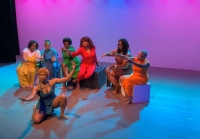
ETA’s for colored girls Honors the Enduring Power of Ntozake Shange
04 August 2026 in Theatre in ReviewNearly fifty years after its groundbreaking premiere, Ntozake Shange's for colored girls who have considered suicide / when the rainbow…

yo ho. Delivers Queer Pirate Chaos, Big Laughs, and Fierce Swordplay
03 August 2026 in Theatre in ReviewA quick history lesson: Anne Bonny and Mary Read are two of history’s most famous female pirates. Both women disguised…

The Outsiders - Cadillac Palace - Through August 16th
03 August 2026 in Now PlayingThe Tony Award® winning Best Musical, THE OUTSIDERS, based on the seminal novel by S.E. Hinton and Francis Ford Coppola’s landmark motion picture, returns to Chicago…

Chicago Shakespeare Theatre to present Play On! September 11–October 18
01 August 2026 in Upcoming TheatreChicago Shakespeare Theater (CST) announces the cast and creative team for Play On!, which opens the Theater's 40th Anniversary Season. This jazz musical tells…

Iceboy! Sets New Goodman Box Office Record
31 July 2026 in Theatre BuzzToday, Goodman Theatre achieves a new milestone in its 100th anniversary season: Walter Artistic Director Susan V. Booth and Executive…

First National Tour of OH, MARY! Announces Chicago's Mary Todd Lincoln
30 July 2026 in Upcoming TheatreKevin McCollum & Lucas McMahon and Mike Lavoie & Carlee Briglia, along with Broadway In Chicago announced today that Tony…

Citadel Theatre announces EUREKA DAY, playing September 9 – October 11
30 July 2026 in Upcoming TheatreLake Forest’s Citadel Theatre has announced the full cast and crew for its season opener - the satirical comedy EUREKA…

Rivendell Theatre Ensemble presents the third World Premiere in its 30th Anniversary Season Bonnie's Last Flight
30 July 2026 in Upcoming TheatreRivendell Theatre Ensemble, Chicago's only professional theater that seeks to advance women through the power of storytelling, announces the cast for…

Definition Theatre presents How We Got On by Idris Goodwin Sept 11-27
29 July 2026 in Upcoming TheatreDefinition Theatre is proud to present How We Got On, a mix-tape for the stage by playwright Idris Goodwin and directed by Tyrone Phillips. How We…

3Arts Awards Celebration uplifts Illinois' artistic community, Oct 26 at Harris Theater
29 July 2026 in Theatre BuzzThe nonprofit service organization 3Arts announces the date for its annual 3Arts Awards Celebration, a festive evening of dynamic performances by Chicago artists and the…

Mike Bartlett’s ‘An Intervention’ Zings in Chicago Premiere
28 July 2026 in Theatre in ReviewA new company, Heart of Gold Theatre, is presenting the Chicago premiere of Mike Barlett’s An Intervention. Bartlett is a…

Carmela misses her papi, because papi is missing some of his papers: Carmela Full of Wishes returns Oct. 25-Nov. 15 at Chicago Children’s Theatre
28 July 2026 in Upcoming TheatreCarmela misses her papi, because papi is missing some of his papers.Chicago Children’s Theatre presents Carmela Full of Wishes, a…

Promethean Theatre Ensemble to stage BLOOD OF THE LAMB at The Den, September 3 -October 3
28 July 2026 in Upcoming TheatrePromethean Theatre Ensemble announced today it will stage the Chicago premiere of BLOOD OF THE LAMB, by Arlene Hutton, a gripping two-woman,…

Metropolis’ Wizard of Oz Rekindles Pure Childhood Wonder
26 July 2026 in Theatre in ReviewMetropolis Performing Arts Centre’s new staging of The Wizard of Oz sends audiences down the yellow brick road with a…

Jackalope Theatre Company Announces Plays, Playwrights and Casts for THE 17th LIVING NEWSPAPER FESTIVAL, August 20 - 24
24 July 2026 in Upcoming TheatreJackalope Theatre Company is proud to announce the schedule for the 17th Annual Living Newspaper Festival, August 20 - 24, at the Jackalope Theatre…

Cerqua Rivera Dance Theatre Announces 2026-2027 Season
24 July 2026 in Upcoming DanceCerqua Rivera Dance Theatre (CRDT), the Chicago-based dance company, is proud to announce its 2026 - 2027 season. In the coming year,…

Love Actually In Concert at Cadillac Palace Theatre Saturday, December 12th - One Night Only!
24 July 2026 in Upcoming TheatreIt may be the middle of summer, but for fans of Universal’s “Love Actually,” Christmas comes early this year. GEA…



Latest Articles
-
 Steppenwolf Theatre Presents ADIRONDACK CHAIR CIRCLE – October 22 – December 6, 2026 – World Premiere!
Written by Buzz Center StageSteppenwolf Theatre Company, the nation's premier ensemble theater company, is pleased to continue its 51st Season with the world premiere of Chicago playwright Stephanie Alison Walker's biting satire Adirondack Chair Circle, directed by Tony Award winner Pam MacKinnon (Downstate, Edward Albee's Who's Afraid of Virginia Woolf?), playing October 22 — December…
Steppenwolf Theatre Presents ADIRONDACK CHAIR CIRCLE – October 22 – December 6, 2026 – World Premiere!
Written by Buzz Center StageSteppenwolf Theatre Company, the nation's premier ensemble theater company, is pleased to continue its 51st Season with the world premiere of Chicago playwright Stephanie Alison Walker's biting satire Adirondack Chair Circle, directed by Tony Award winner Pam MacKinnon (Downstate, Edward Albee's Who's Afraid of Virginia Woolf?), playing October 22 — December… -
Writers Theatre celebrates record-breaking 2025/26 Season with artistic growth and unprecedented ticket sales
Written by Buzz Center StageWriters Theatre, under the leadership of Executive Director Kathryn M. Lipuma and Alexandra C. and John D. Nichols Artistic Director Braden Abraham, concluded its 2025/26 season by shattering box office, attendance, and fundraising records, and cementing its position as a premier national hub for theatre excellence…
-
American Blues Theater names Nia Akilah Robinson the recipient of the 2026 Blue Ink Award for her play Overnight at the Museum and announces featured finalists Benjamin Benne and Claire Crowley
Written by Buzz Center StageAmerican Blues Theater, under the continued leadership of Executive Artistic Director Gwendolyn Whiteside, announces the recipient of the 2026 Blue Ink Award is Nia Akilah Robinson for her play Overnight at the Museum. As part of the award, Robinson receives a $3,000 cash prize and a staged reading…
-
 ETA’s for colored girls Honors the Enduring Power of Ntozake Shange
Written by Wesley DavidNearly fifty years after its groundbreaking premiere, Ntozake Shange's for colored girls who have considered suicide / when the rainbow is enuf remains one of the most important works ever written for the American stage. Neither conventional play nor musical,…
ETA’s for colored girls Honors the Enduring Power of Ntozake Shange
Written by Wesley DavidNearly fifty years after its groundbreaking premiere, Ntozake Shange's for colored girls who have considered suicide / when the rainbow is enuf remains one of the most important works ever written for the American stage. Neither conventional play nor musical,…


Does your theatre company want to connect with Buzz Center Stage or would you like to reach out and say "hello"? Message us through facebook or shoot us an email at This email address is being protected from spambots. You need JavaScript enabled to view it..
*This disclaimer informs readers that the views, thoughts, and opinions expressed in the text belong solely to the author, and not necessarily to Buzz Center Stage. Buzz Center Stage is a non-profit, volunteer-based platform that enables, and encourages, staff members to post their own honest thoughts on a particular production.