
Displaying items by tag: Dontaye Albert
Gwydion Theatre Delivers More than a Satire in Lynn Nottage’s Por’ Knockers
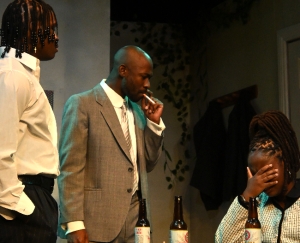
Lynn Nottage is a skilled playwright, and prolific especially considering the high quality of her works: Pulitzer winners Ruined and Sweat. Or the remarkable By the Way, Meet Vera Stark, a kind of All About Eve with the starlet’s Black maid in the Eve role. And then Intimate Apparel, which won wide and very deserved praise. While her scripts vary widely in storyline, they are loaded with very real, authentic characters.
So getting a chance to see an early Nottage work—Gwydion Theatre’s production of Por’ Knockers (1995)—has an especial appeal. It is Nottage’s second play, and it had a turbulent life after premiering Off Broadway in New York at The Vineyard Theatre. Then it went to London. After its London run was cut short, Nottage told The Guardian, “I still remember an audience member ripping up their programme into tiny shreds and throwing it like confetti, saying: ‘I am cancelling my subscription to the theatre!’”
It’s not that the play is bad. In fact it is very good. It was the subject that caused problems: five activists of the imaginary People's Diasporatic Party blow up an FBI building to protest the treatment of African-Americans in the U.S. The play centers on the tension and anxiety within that band of conspirators before and after their destructive venture.
Por’ Knockers (the name refers to Guyanese gold panners) was having a successful and well-received run in London until Timothy McVeigh carried out a similar bombing of the FBI building in Oklahoma City. And so the script has been shelved since. Until Gwydion Theatre in Chicago succeeded in mounting this production at Greenhouse Theater.
“This play is so special to us at Gwydion,” says Grayson Kennedy, who is Gwydion Theatre’s Artistic Director. “It was a show that we have wanted to do since our first season.” (Kennedy acts in the show as well.)
Directed for Gwydion Theatre by Makari Robinson-McNeese, Por’ Knockers is widely regarded as a political satire, almost a parody of a “people’s revolutionary army.” But Nottage gives it a level of depth, with five fully-realized characters, each with different backgrounds and motives for the bombing.
In the opening scene of the one act, Nottage establishes the who's who: the mature, grounded Kwami (Kevin Aoussou is astoundingly good); the hyper-kinetic paranoid James (Dontaye Albert is remarkable); a thuggish Ahmed (Joseph Percy); the lone woman in the group, the academic Tamara (Justice Ford); and the lone vacillating white guy, Lewis (Grayson Kennedy is excellent). And then there is this oddly magical entry, Lance (Jimmie Roger III), a machete wielding Guyanese gold prospector visible only to Kwami, whose character happens to be Guyanese-American.
The group’s anxiety is palpable, each expressing it uniquely according to the personalities Nottage has drawn for us. Tempers flare, violence seems to bubble just under the surface as the characters play out their fears. As they leave the apartment for this carefully planned rendezvous with destruction, it is Kwami who exits last, straightening the furniture and quietly telegraphing to the audience a disdain for his fellows.
The passage of time throughout the show is registered by the subtly changing hues of daylight filtering through the window blinds. (Lighting Designer Emma Berry deserves praise for this subtle but important element.)
When they return, hours later, they are filled with excitement over the bombing, and soon enough trepidation builds about what will follow. Tamara offers words of reassurance. “We succeeded,” she says. But only four have returned. That hyper-kinetic paranoid James is nowhere to be seen, further heightening the anxiety in the room. He hasn’t followed the plan. When James does return, having ridden the train to the end of the line and back—“I wanted to make sure I wasn’t followed,” he tells them—he also delivers shocking news: the building was unexpectedly occupied, by children.
A portable radio that was to keep them up to date is malfunctioning because of bad batteries. Lewis delivers a “white man” pronouncement and orders Ahmed to get decent replacement batteries. This doesn’t go down well and violence threatens. Kwami, feeling internal pressure to be the patriarch and the decider on strategy, resists the role, then reluctantly takes it.
At this point, the play makes a departure. It remains a parody and these activists do seem inept, but they are also caught in an existential quandary. This takes shape in the lone land line on the wall, a 1990s touch tone wall phone, which will be their means to call the FBI and take claim for the bombing, and make a statement of their motives.
Over the remainder of the play, this brigade of the People's Diasporatic Party swings between ruminations on the morality of their action, or attacking each other. Percy’s Ahmed phrases his sense of their predicament, “I ain't afraid of death. I’m afraid of nobody noticing it. I want my death to be a defining event.”
That phone sits on the wall, a mute expression of the culmination of their destructive act: taking credit for it. Between the tense discussion, the five each take a turn at calling in, when the pressure of the moment drives them to the phone. Yet there is one constraint after another that inhibits them from successfully completing the call: first, they don’t have the number; then they are reluctant to pay 75 cents to “the system” to get directory assistance; after they tear the number from the phone book Lewis calls, and realizes he doesn’t know what to say and hangs up. Tamara calls, but becomes mired in voice mails and transfers and gives up.
Ford’s Tamara seems the most tormented by moral issues of having killed children. Notably, whenever Kwami wants to rally the group, he addresses them as “brothers” then throws in a lagging “and sister,” a low-key rnning joke for the audience, but not the characters on stageEventually the phone call gets through in a resolution of that conceit, which Nottage has used effectively to put each personality on display.
Early works by writers arrive unfettered by reputation and uncontaminated by any self-consciousness with which acclaim may impart. It is my feeling that early writing by authors of any medium allows us a window into that unbridled creative energy.
In Por’ Knockers Nottage inserts that sixth character, the silent, machete wielding Lance, who appears periodically, visible only to Kwami. He prowls the stage front during these brief magical interludes, humming or singing softly. When the other four see Kwami drifting away, he self-consciously explains he is channeling ancestors.
Nottage’s success has not diminished her work, but only affirmed her remarkability. Two subsequent plays like Ruined (its 2008 world premier was at the Goodman, where it returns as part of the next season) and Sweat both won Pulitzers, a first for a woman playwright. Nottage also wrote the book for two Broadway musicals: MJ and The Secret Life of Bees.
Por’ Knockers, which comes recommended, runs through October 4, 2026 at The Greenhouse Theatre.



Latest Articles
-
 Kokandy Productions Concludes 2026 Season with A CLOCKWORK ORANGE: A PLAY WITH MUSIC November 5, 2026 – January 10, 2027 - Full Casting Announced!
Written by Buzz Center StageKokandy Productions is pleased to conclude its 2026 Season with A Clockwork Orange: A Play with Music, a live adaptation of Anthony Burgess's dystopian novel that brings the cult-classic "horrorshow" to visceral, pulsing, terrifying life. Directed by Producing Artistic Director Derek Van Barham, with music…
Kokandy Productions Concludes 2026 Season with A CLOCKWORK ORANGE: A PLAY WITH MUSIC November 5, 2026 – January 10, 2027 - Full Casting Announced!
Written by Buzz Center StageKokandy Productions is pleased to conclude its 2026 Season with A Clockwork Orange: A Play with Music, a live adaptation of Anthony Burgess's dystopian novel that brings the cult-classic "horrorshow" to visceral, pulsing, terrifying life. Directed by Producing Artistic Director Derek Van Barham, with music… -
Identity Performing Arts Celebrates 5 Years with Gala Performance at MCA's Edlis Neeson Theater October 18th
Written by Buzz Center StageIdentity Performing Arts celebrates five years as a dance company embracing artistic innovation, collaboration and community at their Fifth Anniversary Gala at MCA Chicago's Edlis Neeson Theater, 220 E. Chicago Ave., 3-7:30 p.m. Sunday, Oct. 18. The event will begin with a performance…
-
Go Behind The SCREAM: A Live Conversation with David Arquette following a 30th Anniversary screening of SCREAM, one-night-only at Aurora’s Paramount Theatre, Saturday, October 24 at 8 p.m.
Written by Buzz Center StageBe part of a night filled with suspense, stories, and special moments this Halloween season when David Arquette goes Behind the SCREAM, a thrilling live conversation including a special 30th anniversary screening of the iconic horror film SCREAM. Legendary actor David Arquette,…
-
 BIRDS OF NORTH AMERICA - Do we listen to each other as much as birdsongs?
Written by Mary Beth EukerBirds of North America, written by Anna Ouyang Moench, is a story of a father daughter relationship spanning a decade and weathering personal and worldwide conflicts while sharing their love of birdwatching. Admittedly family relationships can be tricky at best. …
BIRDS OF NORTH AMERICA - Do we listen to each other as much as birdsongs?
Written by Mary Beth EukerBirds of North America, written by Anna Ouyang Moench, is a story of a father daughter relationship spanning a decade and weathering personal and worldwide conflicts while sharing their love of birdwatching. Admittedly family relationships can be tricky at best. …
Does your theatre company want to connect with Buzz Center Stage or would you like to reach out and say "hello"? Message us through facebook or shoot us an email at This email address is being protected from spambots. You need JavaScript enabled to view it..
*This disclaimer informs readers that the views, thoughts, and opinions expressed in the text belong solely to the author, and not necessarily to Buzz Center Stage. Buzz Center Stage is a non-profit, volunteer-based platform that enables, and encourages, staff members to post their own honest thoughts on a particular production.