

Kimberly Katz
Metropolis’ Wizard of Oz Rekindles Pure Childhood Wonder
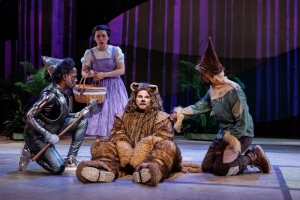
Metropolis Performing Arts Centre’s new staging of The Wizard of Oz sends audiences down the yellow brick road with a production that balances classic nostalgia with a warm, community centered spirit. Before the story unfolds, it’s worth remembering the legacy behind it: L. Frank Baum’s 1900 novel first introduced readers to Dorothy and the fantastical land of Oz, but it was the landmark 1939 MGM film that transformed the tale into a cultural touchstone. Judy Garland’s performance, the Technicolor world, and the Oscar winning score cemented the story’s place in American imagination. The film’s success inspired decades of stage adaptations, culminating in the Royal Shakespeare Company’s 1987 musical version by John Kane, which became the foundation for most modern theatrical productions, including Metropolis’ interpretation.
Under Tor Campbell’s direction and choreography, the familiar tale unfolds with clear narrative focus: Dorothy Gale’s unexpected journey from Kansas to the magical land of Oz, where she meets the Tin Man, Scarecrow, and Cowardly Lion and joins them on a quest to reach the Emerald City and seek help from the great and powerful Wizard of Oz. Along the way, the group navigates enchanted forests, poppy fields, and the looming threat of the Wicked Witch, discovering courage, heart, and the strength of friendship as their path winds toward home.
This stage version also introduces several comedic moments you won’t find in the classic film, a choice that gives the production a fresh, playful spirit. Campbell sprinkles in light audience interaction, small winks to the crowd, and character specific jokes that open up the world of Oz in ways only live theatre can. These additions never undermine the story’s sincerity; instead, they create a sense of shared fun between the performers and the audience, reminding viewers that Oz is not just magical - it’s delightfully unpredictable when experienced onstage.
While the larger roles across the cast are played with skill and presence, three performers emerge as the evening’s defining performances: Nora Wragg’s Dorothy, Jake Elkins’ Cowardly Lion, and Genevieve Thiers’s Wicked Witch. Wragg stands at the heart of the evening, offering a Dorothy shaped by sincerity, emotional clarity, and a vocal warmth and control that give her songs an effortless lift. Her speaking voice is particularly striking, at times uncannily reminiscent of Judy Garland, deepening the role’s authenticity without ever tipping into imitation. Elkins bursts onto the stage with bold humor and irresistible personality, turning the Cowardly Lion into a crowd-pleasing force of nature. Thiers brings commanding theatrical bite to the Wicked Witch, leaning into the character’s menace with sharp timing, confident presence, and seasoned comedic instincts that add a delicious flair to her villainy.
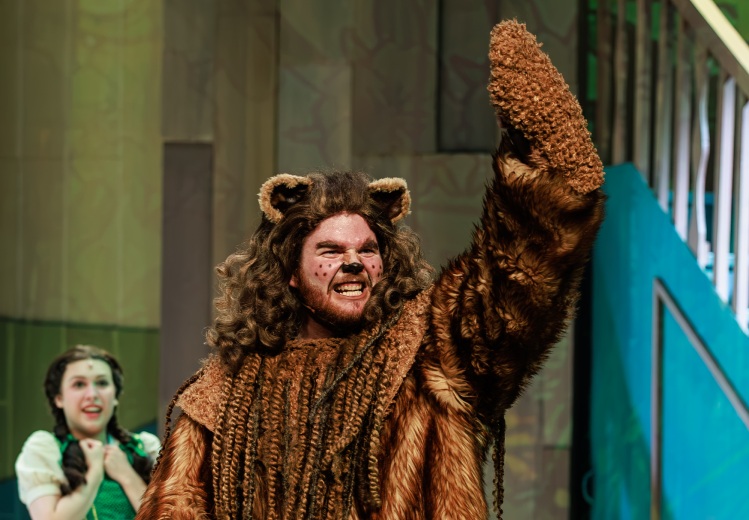
Nora Wragg as Dorothy Gale and Jake Elkins as Cowardly Lion in THe Wizard of Oz at Metropolis Performing Arts Centre. Nora Wragg as Dorothy Gale and Jake Elkins as Cowardly Lion. Photography by Jennifer Heim.
Around them, Gabriel Fries provides steady, grounded work in his dual roles as the Wizard and Professor Marvel, shifting between Marvel’s warmth and the Wizard’s bluster with ease. David Omari’s Tin Man adds soft vulnerability that complements the ensemble, and Corey Barlow, stepping in for Nolan F. Robinson II as the Scarecrow in the performance I saw, brings relaxed, playful movement and an easy charm that keeps the character loose-limbed throughout. Adding to the production’s appeal is Caliban Marie Spence, a real-life little dog who plays Toto and becomes an instant audience favorite with every appearance, a lovely touch of authenticity that heightens the show’s sense of wonder. Caliban was trained for the role by Danielle Spence, who is delightful onstage as Glinda the Good Witch, exuding kindness, confidence, and the gentle assurance that everything will be all right. Together, these performances guide the audience through Oz with warmth, personality, and a touch of real magic.
Two of the strongest forces pulling Dorothy toward home are the deep bond she shares with her dog Toto - whom she feels is her only true companion on the lonely Kansas farm and is threatened with being destroyed by the stern, vindictive neighbor Miss Gulch, who later appears in Oz as the Wicked Witch of the West - and the steadfast love of her hardworking Aunt Em, who has stepped into the role left vacant by Dorothy’s late mother. The Wizard of Oz is also one of the few films of its era to make a four‑legged companion feel like a true co‑star, and it’s always striking to me how naturally the actors work with Toto and how deeply he’s woven into Dorothy’s emotional world. In many ways, the entire story is set in motion because of him: Dorothy finding her inner self by rescuing Toto.
Metropolis’ use of a lightly trained dog reinforces that bond beautifully, grounding the story in something real and tender. Seeing an actual dog onstage makes the audience instantly understand Dorothy’s desperation to protect him from Miss Gulch’s threat, and her fierce devotion to Toto remains a surprisingly radical idea for a story of its time. He’s the companion who saved her from loneliness, and her determination to keep him safe becomes the catalyst for her entire journey - willing to leave everything she knows behind if it means preserving the friendship, love, and life of her dog.
As of 2026, animal abuse - especially toward domesticated dogs and cats - remains a heartbreaking problem around the world. That’s part of why stories like The Wizard of Oz still matter: they show a young person treating her pet with genuine love, loyalty, and protection, reminding audiences how powerful and important that bond can be.
Shifting back to the company, Metropolis Performing Arts Centre’s Youth Ensemble brings the Munchkins to life with fun energy and crisp character work- along with other roles played, enriching every scene they step into. Their musical numbers sparkle with bright, unified group vocals, and their choreography is impressively sharp, full of buoyant movement and clean formations that give Munchkinland its joyful pulse.
The production’s technical storytelling reaches an early high point with the tornado sequence, staged with impressive clarity and imagination. Dancers swirl across the stage, waving billowing grey scrims that evoke churning storm clouds, while Forrest Gregor’s sound design layers convincing wind roars, rattling impacts, and atmospheric rumble. Tony Churchill’s projection design adds spiraling debris and sweeping gusts that intensify the chaos, culminating in a striking moment when Alyssa Mohn’s scenic design reveals Dorothy’s house splitting cleanly in half. Once Dorothy lands in Oz, the creative team transforms the stage from plain Kansas farmland into a magical, richly colored world through Sierra Walker’s strategic lighting, Churchill’s dynamic projections, and Theresa Ham’s vivid, whimsical costumes. The projections also allow both the Wizard and the Wicked Witch to appear larger than life, giving their scenes an added theatrical punch that heightens the story’s sense of wonder.
All of this visual ingenuity supports the larger emotional themes at the center of Metropolis’ interpretation. As director Tor Campbell notes, “At its heart, The Wizard of Oz is not about a destination. It is about resilience,” and “After every storm comes the possibility of a rainbow,” a pair of reflections that beautifully frame the production’s spirit and its enduring message.
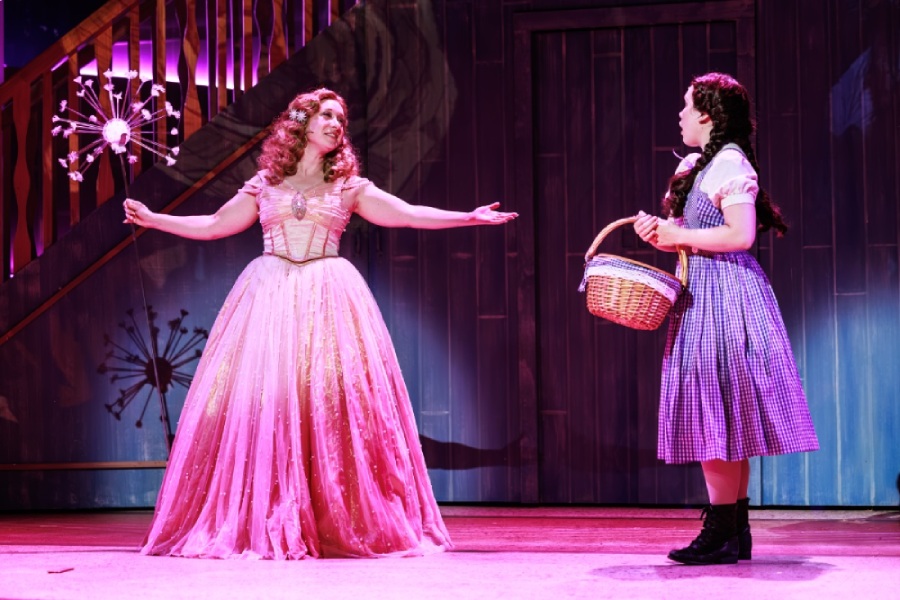
Danielle Spence as Glinda and Nora Wragg as Dorothy Gale in The Wizard of Oz at Metropolis Performing Arts Centre.
One of the joys of this production is hearing the show’s classic songs delivered with such affection. Metropolis keeps all the musical touchstones that audiences expect, from the sweeping simplicity of “Somewhere Over the Rainbow” (beautifully sung by Wragg) to the buoyant charm of “We’re Off to See the Wizard,” “If I Only Had a Brain,” “If I Only Had a Heart,” and “If I Only Had the Nerve.” The familiar melodies land with an easy warmth, and Sharon Mason’s music direction ensures each number feels both lovingly preserved and freshly energized. Whether you grew up with the film or are discovering Oz for the first time, the score remains one of the production’s most delightful anchors, offering moments of nostalgia, humor, and pure musical joy.
This staging taps into the broad, welcoming appeal that has kept The Wizard of Oz alive for generations, offering a family friendly experience that works just as well for first‑timers as it does for lifelong fans. Young audiences get the magic, color, and adventure, while adults appreciate the faithful storytelling, classic score, and standout character work. With its beloved characters, recognizable songs, and heartfelt performances, Metropolis’ production celebrates courage, companionship, and the reminder that home is never as far away as it seems. Most of all, it rekindles that unmistakable childhood wonder the story has carried for decades, letting audiences feel like kids again as they’re swept up in bright colors, familiar melodies, and the simple joy of watching Dorothy and her friends discover who they are. It’s the kind of show where adults smile at memories they haven’t visited in years and younger audiences fall in love with Oz for the first time, a blend of fun, heart, and theatrical playfulness that sends you out of the theatre lighter than you walked in.
What also stands out in revisiting The Wizard of Oz is how much strength Baum gave his female characters, especially considering the story’s early 20th century origins. Dorothy may be young, but she drives the narrative through her choices, her compassion, and her determination to return home. Glinda’s calm authority and the Wicked Witch’s fierce, commanding presence form a striking contrast - two powerful women shaping the world of Oz in very different ways. Even within a fantasy framework, there’s symbolic weight in that dynamic: Dorothy’s journey becomes a quiet assertion of agency, resilience, and moral clarity at a time when female protagonists were rarely allowed such depth. Metropolis’ production highlights that legacy, reminding audiences that beneath the magic and spectacle lies a story where women hold the narrative’s heart, its danger, and its wisdom.
Audience logistics at Metropolis are refreshingly convenient. A free, multi-level parking garage sits just around the corner, making arrival and departure remarkably easy, and the surrounding streets offer a wide range of restaurants only steps from the theatre for pre- or post-show dining. Inside, the venue’s cozy seating creates an intimate viewing experience, and while the concessions stand offers a fine assortment of drinks, snack options are extremely limited. Patrons may want to bring their own munchies for intermission, though outside food is prohibited inside the theatre, making a quick bite before or after the show the most practical choice.
With the practicalities so thoughtfully handled, what remains is the simple joy of being swept into a world where imagination leads the way. In the end, this Wizard of Oz proves that the road to Emerald City is still paved with imagination, heart, and just enough whimsy to make you believe in magic all over again.
Recommended.
For tickets and more show info, visit https://www.metropolisarts.com/.
- Metropolis Performing Arts Centre
- The Wizard of Oz
- L Frank Baum
- Tor Campbell
- Nora Wragg
- Jake Elkins
- Genevieve Thiers
- Judy Garland
- Gabriel Fries
- David Omari
- Corey Barlow
- Nolan F Robinson II
- Caliban Marie Spence
- Danielle Spence
- live theatre
- classic
- on stage
- Arlington Heights
- Chicago events
- Chicago stage
- Musical theatre
- family theatre
& Juliet Turns Shakespeare Upside Down in a Burst of Pop Brilliance
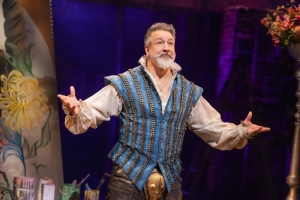
Broadway in Chicago’s latest offering at the Auditorium Theatre, & Juliet, bursts onto the stage with the kind of vibrant confidence that makes it clear this isn’t your high school Shakespeare. The production arrives as a full-throttle pop spectacle, gleefully mashing up Elizabethan trappings with late ’90s and early 2000s chart-toppers from Max Martin’s hit factory. It’s a show that knows exactly what it is: a glitter-soaked, self-aware remix of a classic that wastes no time inviting the audience into its playful rebellion against the tragic ending we’ve all been taught to accept. Since its 2019 world premiere in Manchester, & Juliet has evolved into an international hit, and this touring production carries that same electric swagger.
So, what is & Juliet? The musical tosses out the tragic final pages of Romeo and Juliet and launches into a sparkling, beat-driven alternate timeline where Juliet decides her story isn’t over. Shakespeare strides in ready to unveil his masterpiece, only to be challenged by his wife, Anne Hathaway, who argues that Juliet deserves more than a death scene. Their creative tug-of-war becomes the show’s framing device, with the couple rewriting the narrative in real time as Juliet, newly widowed, furious, and independent, sets off for Paris. Joined by the steadfast Nurse, Angélique, and May, a tender, nonbinary friend navigating their own romantic complications, Juliet begins carving out an identity that isn’t tethered to Verona’s star-crossed expectations.
Once Juliet arrives in Paris, the musical fully embraces its jukebox identity. Max Martin’s catalog - Britney Spears, Backstreet Boys, Katy Perry, Robyn, and more - becomes the emotional architecture of the plot, each anthem amplifying Juliet’s bursts of confidence, heartbreak, and rebellion. A new love interest, a handful of identity mix-ups, and the inconvenient reappearance of a very alive Romeo keep the story spinning with lively drive. Beneath the glossy sheen, the show’s core is Juliet’s reclamation of her narrative: she challenges every man, myth, and playwright who tries to script her life. Much like Greta Gerwig’s Barbie, & Juliet reframes a familiar figure by handing her the agency she was never originally given. By the final number, the musical has transformed a centuries-old tragedy into a neon-bright celebration of autonomy, reinvention, and the exhilarating freedom of choosing your own ending.
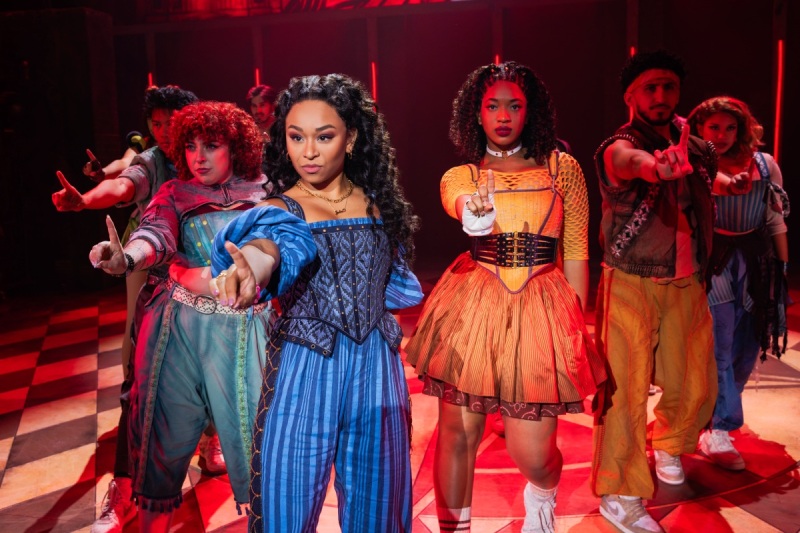
Fabiola Caraballo Quijada and the company of the North American Tour of & JULIET - Photo Credit Evan Zimmerman for MurphyMade.
Riding the show’s high-voltage spark, Joey Fatone slides into the role of Lance with an easy, self-aware charm that fits perfectly with & Juliet’s playful spirit. As a founding member of *NSYNC and a frequent Max Martin collaborator, Fatone is woven into the DNA of the musical’s soundtrack, giving his performance an extra layer of authenticity. His résumé stretches from Broadway to television to his memorable turn in My Big Fat Greek Wedding, but it’s his work here that stands out: he brings crisp, confident vocals and an easy comedic charm that consistently lifts the charge onstage. Fatone proves he’s far more than a nostalgic casting choice, emerging as one of the production’s most charismatic assets.
Fabiola Caraballo Quijada leads the company with a performance that feels like the show’s beating heart, delivering Juliet with a thrilling mix of vocal firepower and emotional nuance. She tears into Max Martin staples like “...Baby One More Time” and “Since U Been Gone” with bright, commanding vocals, then pivots into moments of vulnerability that make Juliet’s journey feel genuinely earned. Her presence centers the production, funny, fierce, and fully in control.
The supporting cast matches her drive with sharp, engaging work across the board. CJ Eldred’s Shakespeare brings a sly, lightly exasperated charm, leaning into the playwright’s ego without overplaying it, while Crystal Kellogg’s Anne Hathaway counters him with warmth, clean comic timing, and an easy wit. Together, they turn their marital back-and-forth into a steady, engaging thread that helps anchor the show’s driving rhythm and provides some of its funniest moments. Nico Ochoa’s May delivers one of the evening’s most affecting performances, especially in “I’m Not a Girl, Not Yet a Woman,” sung with disarming honesty. Joseph Torres dives gleefully into Romeo’s chaotic bravado, Noah Marlowe’s François adds irresistible comedic sparkle, and Kathryn Allison’s Angélique unleashes powerhouse vocals that stop the show in its tracks. Together, they form a tight, dynamic ensemble that amplifies Juliet’s story and keeps the production pulsing with life.
The show also finds touching emotional beats in Fatone’s Lance, whose scenes with Marlowe’s François carry a gentle, fatherly warmth that echoes the same kindness in François’s growing bond with Ochoa’s May.
Fatone and Allison’s duet on “Overprotected” is a standout, giving Lance and Angélique’s reunion a burst of humor and genuine warmth, and it’s just the start of Fatone’s musical impact throughout the night. His biggest showcase, “Teenage Dream,” becomes a warm, gently comic surprise as he embraces the Katy Perry hit with earnest, velvety vocals that give the number a sweetness you don’t see coming. Fatone may play Lance as the show’s affable comic relief, but his pop pedigree shows; every musical moment feels relaxed, lived in, and delivered with the kind of easy charisma that lifts the entire stage. It would have been nice to hear another number or two from him, especially since he proves he can still bust a move in the big ensemble dance feature “Everybody (Backstreet’s Back).”
The ensemble deserves its own praise, offering crisp harmonies, sharp choreography, and a lively spirit that keeps the show’s force surging. They match Fatone’s charisma beat for beat, creating a lively backdrop that makes each of his musical moments land even more effectively. Their collective precision and enthusiasm elevate the production, giving the score the full, joyful lift it needs.
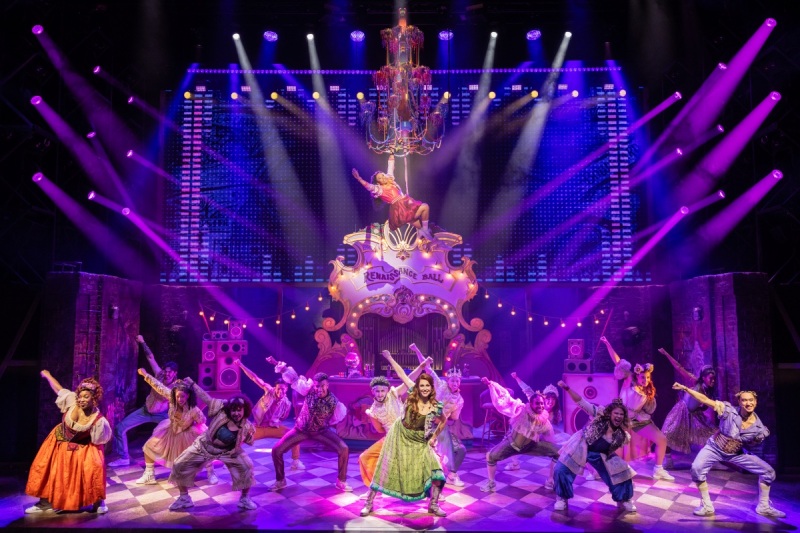
The company of the North American Tour of & JULIET (1) - Photo Credit Evan Zimmerman for MurphyMade.
If there’s anything I’d tweak, it’s that a few of the show’s narrative threads resolve a bit quickly in Act II, especially once Romeo crashes back into the story and the plot starts juggling multiple character arcs at once. The momentum never falters, but you can feel the show accelerating to tie up loose ends, which leaves certain beats landing faster than they need to. Like many jukebox musicals, a handful of emotional moments feel shaped more by the song than the situation, and a couple of supporting journeys wrap up a bit neatly compared to Juliet’s richer, more fully realized arc. These aren’t flaws so much as brief soft spots in an otherwise confident production, but they do create moments where the storytelling feels slightly compressed next to the show’s usual clarity, wit, and spark.
Even with those brief pacing dips, the production stays remarkably unified, and much of that cohesion comes from the creative team’s razor-sharp vision and assured hand. With a book by David West Read, the Emmy-winning writer behind Schitt’s Creek, the show’s humor lands with a cheerful, contemporary snap that is clever without ever feeling smug and heartfelt without tipping into sentimentality. Luke Sheppard’s direction keeps the pace brisk and the tone delightfully self-aware, guiding the audience through rapid-fire shifts between Shakespearean parody and pop-musical exuberance. Jennifer Weber’s Emmy-winning choreography is the engine that keeps the whole thing pulsing, layering crisp, high-impact movement over Max Martin’s hits in ways that feel both nostalgic and freshly inventive. Together, they shape a production that is as smart as it is spectacular, proving that & Juliet succeeds because its creative foundation is every bit as strong as its glittery, radio-hit exterior.
What I love is how much the show feels like a full-tilt party. Throughout the night, the musical keeps slipping into irresistible, disco-bright bursts of celebration - confetti, fireworks, and bouncy dance numbers - the kind that wash over the Auditorium Theatre with a buoyant, communal energy. Even the live band, tucked out of sight, delivers with such punch that the show takes on a concert-like charge at times. By the end, the audience is on its feet, cheering as if they’ve been part of the celebration all along.
The design team behind & Juliet gives this touring production its glossy, high-octane finish, each element snapping together with precision. Soutra Gilmour’s scenic design provides a playful, ever-shifting backdrop, while Howard Hudson’s lighting drenches the stage in radiant color and concert-style intensity. Paloma Young’s costumes amplify the show’s turn-of-the-millennium exuberance, blending Shakespearean silhouettes with modern pop flair to mirror the musical’s playful collision of eras, and Gareth Owen’s sound design keeps Max Martin’s hits punchy and impeccably balanced. Add Andrzej Goulding’s video and projection work, and you get a production that feels polished, cohesive, and irresistibly alive.
& Juliet continues to light up Chicago with glitter, heart, and high-voltage joy, and this touring production proves itself an outright delight. Running July 22 through August 2, 2026, the Broadway in Chicago engagement at the Auditorium Theatre delivers a vibrant, tightly crafted experience that never loses sight of its emotional core. With a knockout lead performance, a dynamic ensemble, and a creative team working at peak imagination, this tour shows exactly why & Juliet has become one of the most irresistible modern musicals. It is a jubilant, neon-bright celebration of rewriting your own story and absolutely worth catching before it dances out of the city.
Highly recommended.
- Juliet
- Broadway in Chicago
- Auditorium Theatre
- JOEY FATONE
- Max Martin
- Brittany Spears
- NYSNC
- Katy Oerry
- Romeo and Juliet
- Shakespeare
- Musical theatre
- chicago theatre
- Chicago events
- Chicago stage
- on stage
- live theatre
- Fabiola Caraballo Quijada
- CJ Eldred
- Crystal Kellogg
- Nico Ochoa
- Kathryn Allison
- oseph Torres
- Noah Marlowe
- Backstreet Boys
- David West Read
- Jennifer Weber
- Luke Sheppard
- 90s pop music
A Thoughtful Evolution of Her Own Making: Overshadowed Theatrical Productions’ My Fair Lady
Overshadowed Theatre Productions brings fresh energy to one of musical theatre’s most enduring classics, offering a spirited and thoughtful take on My Fair Lady. This production leans into the story’s sharp contrasts - class and aspiration, control and independence - and invites audiences to see Eliza Doolittle’s transformation with new clarity. It’s a familiar tale, but Overshadowed’s staging makes it feel newly engaged and unexpectedly resonant.
Taking place in 1912, Edwardian London, My Fair Lady is the story of Eliza Doolittle (Kimberly Nicolosi), a resilient young woman who sells flowers for tuppence and whose Cockney accent marks her as invisible to the upper-class Londoners who pass her by. When she crosses paths with Henry Higgins (John Hacker), a brilliant but insufferably arrogant linguist, he boasts that he can remake her into someone society will accept - someone who can pass as a duchess at an embassy ball. What begins as a bet between scholars becomes a transformation that neither fully anticipates.
As Eliza endures Higgins’ relentless drills and dismissive temperament, she begins to outgrow the very mold he tries to force her into. Her ascent exposes the absurdity of class performance, the fragility of male ego, and the uncomfortable truth that respectability often demands erasing the people who need it most. By the time Eliza steps into high society, she is no longer Higgins’ creation but her own person - one who refuses to be spoken for, spoken over, or spoken down to.
The musical’s enduring tension lies in the question it never answers neatly: whether transformation is liberation or simply another form of confinement. My Fair Lady may dazzle with its elegance, but its heart beats in Eliza’s insistence that dignity is not something granted by others - it’s something claimed.
Lerner and Loewe’s My Fair Lady entered the musical theatre canon in 1956, following its development in 1955–56 and a Broadway premiere led by Julie Andrews and Rex Harrison. The story later reached an even wider audience with the 1964 film adaptation, starring Audrey Hepburn as Eliza and Rex Harrison reprising his stage role as Higgins, released on October 21, 1964.
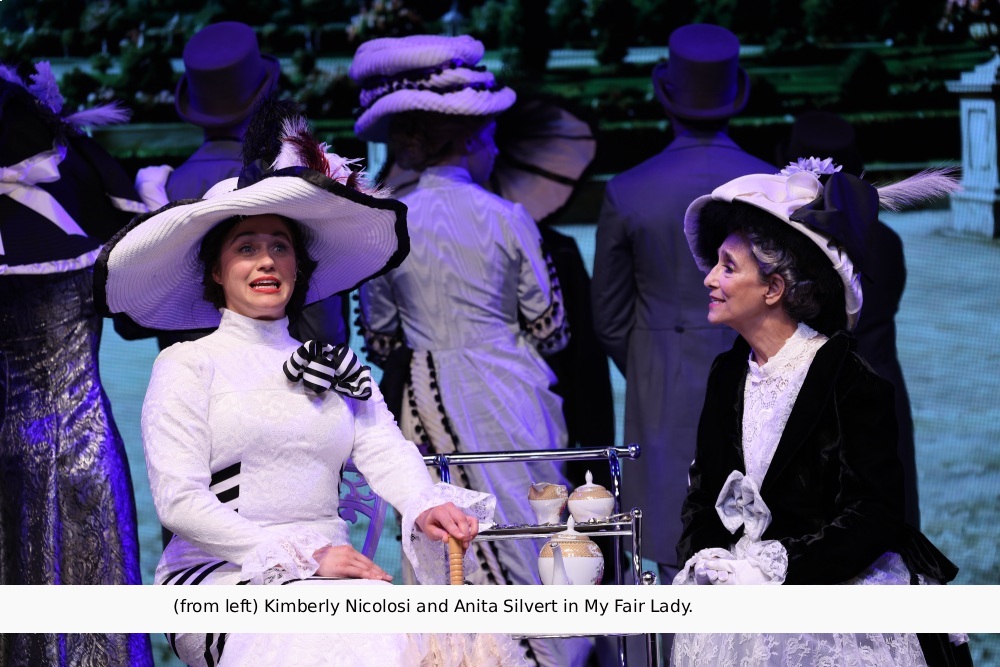
Overshadowed’s current production of this defining musical is anchored by Kimberly Nicolosi, whose Eliza Doolittle grows with steady assurance and a clear emotional arc that makes her transformation feel genuinely earned. Nicolosi is an absolute whirlwind of conviction, with vocals that match her intensity beat for beat, and a charm that makes her Eliza impossible to resist. Opposite her, John Hacker offers a thoughtfully restrained Henry Higgins, capturing both the character’s intellectual rigidity and the subtle shifts that reveal his dependence on Eliza, and his performance brings a compelling, understated complexity to the role. They shape the show’s strongest and most engaging dynamic. Surrounding them, Glen Lindemann brings gentle dignity to Colonel Pickering, while Madeline Frederick’s composed Mrs. Pierce adds welcome stability to Higgins’ household. Brad Holloman provides lively humor as Alfred P. Doolittle, and the Eynsford-Hill family - Sharon Lindemann as Mrs. Eynsford-Hill and Aren Dawson as Freddy - adds a touch of sweetness and refinement. Anita Silvert’s poised Mrs. Higgins offers a calm counterbalance to her son’s bluster, and she delivers a few of the play’s most pointed one-liners with crisp, knowing precision. Under Reba Hervas’ direction, the ensemble works together with easy cohesion, and Hervas guides the production with a steady, confident hand that keeps the storytelling clear, warm, and consistently engaging.
Though wrapped in Edwardian charm, My Fair Lady carries a clear feminist undercurrent, rooted in Eliza’s fight for self-determination. Her journey is not simply one of refinement but of agency - choosing to reshape her life, challenge the limitations imposed by class and gender, and ultimately assert her independence from Higgins’ control. The production highlights how her transformation belongs to her alone, not to the men who presume to mold her, allowing the story’s critique of patriarchal entitlement and its celebration of female autonomy to resonate beneath the musical’s elegance.
The production’s musical backbone shines through beloved highlights such as “Wouldn’t It Be Loverly,” “The Rain in Spain,” “I Could Have Danced All Night,” and “On the Street Where You Live,” each handled with care under Karen Archbold’s attentive music direction. The staging moves with an easy flow thanks to Katy Smith’s well-shaped choreography, which keeps the transitions light and the ensemble well-coordinated. These elements honor the classic craftsmanship of Alan Jay Lerner, who penned the book and lyrics, and Frederick Loewe, whose score remains one of musical theatre’s most enduring treasures.
The set design stands out as one of the production’s most impressive achievements, delivering a level of polish that will surprise audiences unfamiliar with Overshadowed’s work. Thoughtfully constructed and visually cohesive, it creates an environment that supports the storytelling without ever overwhelming it. This marks the first production by the company to utilize a massive video board, and its use is highly successful - enhancing the world of the play with vivid, effective projections that expand each location with striking clarity. The video board works in concert with well-crafted props and scenic pieces that are seamlessly brought in when needed, creating transitions that feel both fluid and purposeful. The scenic and projection work by Yohannan Lee adds depth and atmosphere, giving each setting a sense of place and intention. Complementing the world onstage, Megan Wilburn’s costume design brings the period to life with authenticity, from the tailored silhouettes to the women’s elaborate Edwardian picture hats, which add a flourish of social detail and visual charm. All of these design choices elevate the production with a craftsmanship that feels both ambitious and warmly inviting.
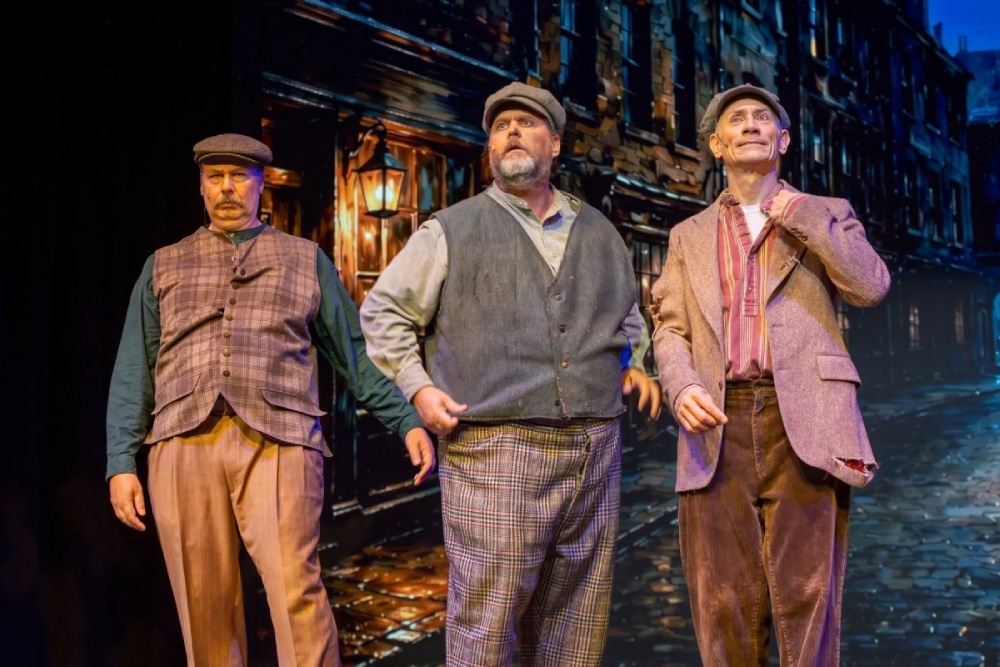
(from left) - Al Gorr, Brad Holloman and Tony Lopez in My Fair Lady.
Stepping back from the production itself, Overshadowed Theatre reveals a company with a purpose that complements the kind of storytelling seen on their stage. I was struck by how deeply rooted their mission is in creating a welcoming, family-friendly space where storytelling and community go hand in hand. Their history reflects a commitment to mentorship and faith-centered values, with an emphasis on giving young performers a place to grow while offering audiences productions that uplift rather than overwhelm. Overshadowed cultivates an environment built on encouragement, accessibility, and shared experience. The company resides within Jubilee Bible Church in Medinah, IL, and the theatre is fully ADA accessible, with vast and easy parking, spacious corridors, and plentiful concessions that make the audience experience comfortable from the moment you arrive.
Audiences can also look forward to a whimsical shift in tone as the company prepares to stage A Midsummer Night’s Dream, bringing Shakespeare’s mischievous magic, tangled romances, and fairy-filled forest to life. Following that, their upcoming season offers a wide range of titles: Flame of Fire (Sep 18–Oct 10, 2026), an original play written and directed by Artistic Director Reba Hervas. Based on the true 1956 story of Operation Auca, the production recounts the lives of missionaries Jim Elliot, Nate Saint, Pete Fleming, Ed McCully, and Roger Youderian, who were killed while attempting peaceful contact with the isolated Huaorani tribe in Ecuador. The play also explores the extraordinary aftermath, as their wives chose to return to the jungle to forgive the tribe and continue living among them. The season continues with It’s a Wonderful Life (Nov 27–Dec 19, 2026), James and the Giant Peach (Jan 22–Feb 6, 2027), The Stranger by Agatha Christie (Mar 12–20 and Apr 1–10, 2027), and Titanic the Musical (July 9–31, 2027). It’s an ambitious slate that blends classic storytelling, family favorites, and dramatic intrigue, promising a season with something for every kind of theatre-goer.
Overshadowed Theatre’s My Fair Lady emerges as a thoughtful production with a clear point of view, delivered with care both onstage and behind the scenes.
Recommended.
For more show information and tickets, visit https://www.overshadowed.org/.
Opera Festival of Chicago Delivers an Assured, Full‑Hearted La Bohème
Opera Festival of Chicago continues its season with two mainstage productions - La Bohème and Adriana Lecouvreur - each featuring the Opera Festival of Chicago Orchestra and Chorus and performed at the George Van Dusen Theatre at the North Shore Center for the Performing Arts in Skokie.
I had the chance to see Giacomo Puccini’s La Bohème, directed by Festival General Director Sasha Gerritson and conducted by Sir Emanuele Adrizzi, and it proved to be an outstanding, deeply felt evening of music and drama.
Giacomo Puccini’s La Bohème unfolds in the chilly garrets and bustling cafés of 1830s Paris, where a group of young artists survive on charm, wit, and the fragile hope that beauty might be enough to sustain them. The opera begins in a drafty attic shared by the poet Rodolfo and the painter Marcello, whose playful banter masks the hunger and hardship of their bohemian life. Everything shifts when Mimì, a shy, dreamy seamstress with a failing candle and failing health, knocks on their door. Her tender connection with Rodolfo ignites instantly, carrying them into the vibrant chaos of Café Momus, where Marcello’s fiery former lover Musetta steals the spotlight with her flirtations and razor‑sharp instincts.
But as winter settles in, the opera’s warmth gives way to harsher truths. Only the rich are safe and well fed in this cold bleak landscape of artistic poverty. Mimì’s illness worsens, and Rodolfo’s fear of losing her fractures their love, even as they cling to moments of sweetness. Both Mimì and Rodolfo are swept up in the sudden, poetic rush of feeling that sparks between them during their first meeting over her extinguished candle, a moment Puccini shapes with irresistible warmth. Their ensuing duet, “O soave fanciulla,” is written as a rush of idealized, almost dreamlike love - sung here with such radiance that it feels too perfect to endure, and tragically it doesn’t, as the briefness of their time together becomes one of the opera’s most heartbreaking truths.
By the final act, the bohemians reunite in their attic, trying to conjure laughter out of scarcity, until Musetta arrives with the gravely weakened Mimì. What follows is one of opera’s most devastating endings: a quiet, intimate vigil as Rodolfo realizes too late that the love he tried to protect has slipped beyond saving. Puccini shapes this world with music that aches, soars, and ultimately reminds us how fiercely we hold on to joy, even as life insists on its fragility. Puccini also paints a world in which artists of every stripe are routinely exploited by the comfortable classes - the dull rich, who commission work and then pay only sporadically, as if deprivation were somehow a necessary ingredient of genius. In reality, it is the indifference of these wealthy patrons that forces the bohemians into constant hardship, driving them to beg, borrow, and even steal simply to keep food on the table and have their housing bills covered.
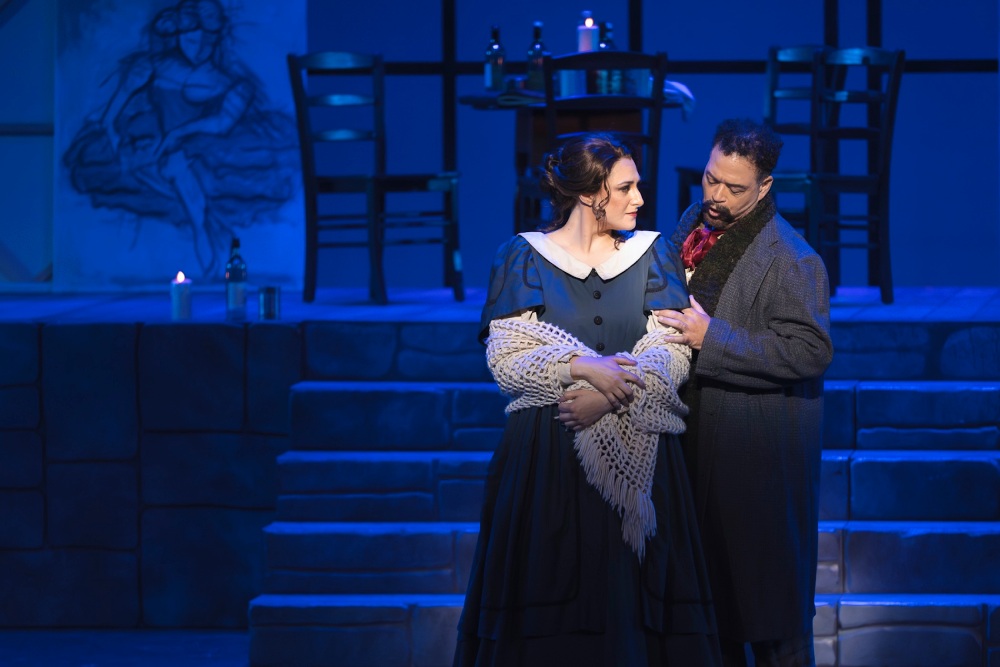
(L to R) Alexandra Razskazoff, “Mimi” and Nathan Granner, “Rodolfo” in LA BOHÈME. Photos by A.Deran Photography.
This La Bohème features a cast whose vocal and dramatic instincts sharpen Puccini’s world into something immediate and deeply felt. Alexandra Razskazoff’s Mimì is nothing short of luminous - her soprano glowing with warmth yet edged with delicacy, embodying a young woman whose softness hides a life lived perilously close to the margins. A rising artist with an increasingly international footprint, Razskazoff traces Mimì’s arc with such emotional transparency that her final moments land with quiet, devastating force. Opposite her, tenor Nathan Granner brings a beautifully burnished tone and an instinctive musicality to Rodolfo. Long admired for his expressive phrasing and crossover versatility, Granner sings with a poet’s sensitivity; his Rodolfo is impulsive, romantic, and heartbreakingly human, especially as love and fear begin to pull him apart.
Catherine Antonia Samartin lights up the stage as Musetta, her bright, agile soprano and irresistible charisma making every entrance feel like a spark catching fire. Musetta is also the victim of this us versus them world where her beauty and charms are commodified on the older wealthy man she is forced to keep company with in order to receive her beautiful wardrobe and warm home to live in. Her scenes with Kenneth Stavert’s Marcello are especially electric. Stavert, with his rich, grounded baritone and wonderfully lived‑in ease, brings both humor and heart to the painter whose bravado barely conceals his vulnerability. Anthony Reed’s Colline provides a beautifully resonant counterweight to the lovers’ volatility - his “Vecchia zimarra” delivered with a quiet, dignified ache that speaks volumes about loyalty and sacrifice. Jonathan Wilson brings quicksilver energy and crisp comedic timing to Schaunard, shaping the role with warmth and buoyancy, while veteran bass William Powers steals scenes with effortless charm as both Benoit and Alcindoro, reminding audiences why he remains one of American opera’s most reliable character treasures. David Greene adds a welcome burst of color as Parpignol, enriching the Act II bustle with a touch of whimsy. This ensemble shapes a Bohème that feels vividly inhabited and emotionally true, a testament to what Puccini’s world becomes when every performer contributes with such specificity, generosity, and heart.
One of the production’s most striking assets is its massive, 50‑plus‑member chorus, whose sheer presence reshapes the entire world of La Bohème. Their sound adds a thrilling sweep to Puccini’s score, amplifying the emotional stakes and giving the bustling Parisian scenes a vivid, lived‑in texture. In Act II especially, the sheer size and vocal richness of the ensemble create a sense of overwhelming festivity, making the Christmas Eve Café Momus tableau feel like a city bursting with life. But the chorus also deepens the opera’s more intimate moments, surrounding the central lovers with a sonic landscape that underscores both the joy and the fragility of their world. It’s a rare gift to hear a chorus of this scale in a production of Bohème, and here it elevates the performance into something grander, more immersive, and undeniably unforgettable.
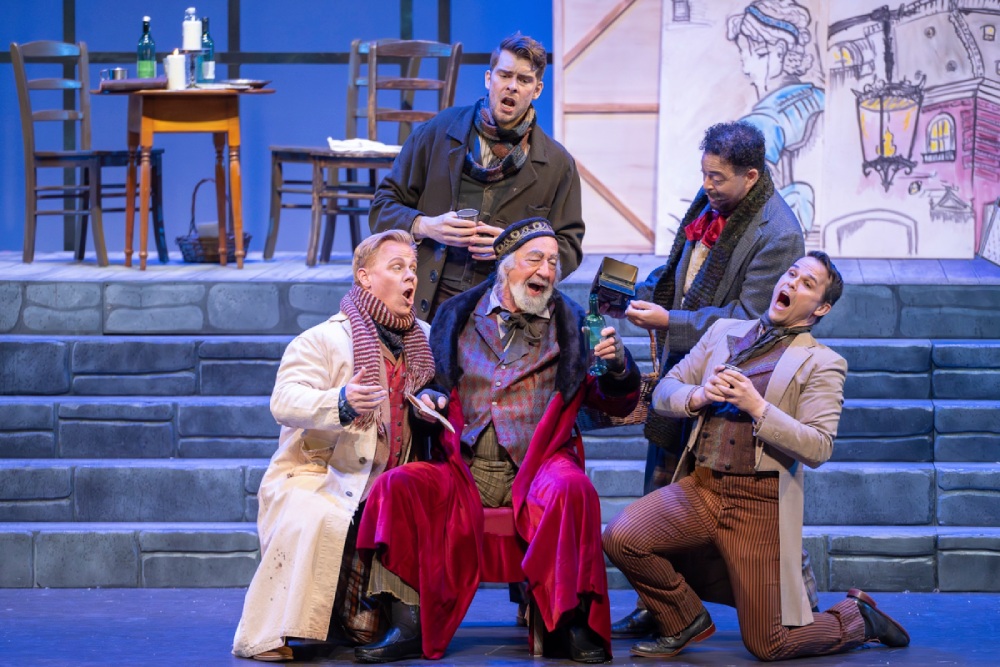
(L to R) Kenneth Stavert, “Marcello;” Anthony Reed, “Colline;” William Powers, “Benoit;” Nathan Granner, “Rodolfo” and Jonathan Wilson, “Schaunard” in LA BOHÈME from Opera Festival of Chicago. Photos by A.Deran Photography.
The set itself is perfectly workable and the large video boards truly animate the space, supplying shifting imagery of snowfall and other atmospheric touches throughout the evening. Because the opera is sung in Italian, overhead supertitles - crisply projected and easy to follow - add a modern presentational layer that supports the storytelling without ever competing with Puccini’s world.
This La Bohème resonates with honesty, heart, and thrilling musicality, carried by a cast and chorus performing at the height of their powers. It’s a standout achievement for Opera Festival of Chicago - and a compelling reason to experience not only this production but also their Adriana Lecouvreur, by Francesco Cilea, directed by Shifra Werch and also conducted by Sir Emanuele Andrizzi, which promises its own dramatic and musical rewards.
Recommended.
Performances are held at the North Shore Center for the Performing Arts in Skokie.
La Bohème - Friday, June 26 at 7:30 p.m., Wednesday, July 1 at 7:30 p.m., and Sunday, July 5 at 2 p.m.
Adriana Lecouvreur - Sunday, June 28 at 2 p.m. and Friday, July 3 at 7:30 p.m.
Tickets range from $25 to $150 and are available at www.OperaFestivalChicago.org.
- La Boheme
- Adriana Lecouvreur
- Opera Festival of Chicago Orchestra and Chorus
- North Shore Center for the Performing Arts
- Giacomo Puccini
- Sasha Gerritson
- Sir Emanuele Adrizzi
- Alexandra Razskazoff
- Nathan Granner
- Catherine Antonia Samartin
- Kenneth Stavert
- Jonathan Wilson
- William Powers
- David Greene
- Shifra Werc
- Chicago opera
- Opera
- chicago theatre
- Chicago events
- on stage
- live theatre
- Opera Festival of Chicago
A Quietly Ravishing Night: Marriott’s A Little Night Music

Marriott Theatre’s in‑the‑round intimacy turns A Little Night Music - which premiered on Broadway in 1973 and later became a 1977 film - into a quietly seductive swirl of glances, secrets, and second chances, the kind of production where the waltz feels like its own character. Under the soft glow of perpetual twilight, Sondheim’s lovers and liars circle one another with equal parts longing and restraint, and the space itself heightens every stolen look and half‑spoken truth. It’s a show built on emotional undercurrents, and Marriott’s staging lets those currents ripple right through the audience.
Stephen Sondheim’s A Little Night Music unfolds like a slow-turning dance that keeps tightening its circle, drawing its characters closer to the truths they’ve been avoiding. Set in a turn‑of‑the‑century Sweden where manners are crisp but desires run hot, the story follows lawyer Fredrik Egerman, a man trying to convince himself he’s content. He’s recently married Anne, a porcelain‑delicate young bride who’s still clinging to her innocence, while his son Henrik broods in the corner, nursing both a cello and an unspoken crush.
Everything tilts when Fredrik reconnects with Desiree Armfeldt, the actress he once loved and never quite got over. Desiree, ever the pragmatist, is juggling her own complications - namely Count Carl‑Magnus Malcolm, a swaggering dragoon whose jealousy burns hotter than his intellect. When Desiree attempts to untangle her romantic knots, she invites everyone to her mother’s country estate for a “quiet weekend,” which of course becomes anything but.

Alan H. Green in Marriott Theatre's A Little Night Music.
What follows is a weekend of mismatched couples, misread signals, and emotional truths finally spoken aloud. Under the glow of the perpetual Nordic twilight, partners shift, illusions crack, and the characters discover that love - in all its foolishness and ache - is rarely tidy but often exactly what they need. By the time the final waltz resolves, hearts have realigned, old wounds have softened, and the night has delivered its promised wisdom.
Sondheim’s score remains the production’s quiet spellbinder - a latticework of turning phrases, reprises, and melodic ironies that reveal as much about the characters as the book does. Songs like “Now,” “Soon,” and “Later” braid together with clockwork precision, exposing the emotional stalemates everyone is too polite to name, while “A Weekend in the Country” bursts with layered wit and rising chaos. And when the music finally slows into the aching simplicity of “Send in the Clowns,” the entire evening seems to exhale. Marriott’s staging lets these songs land not as showpieces but as confessions, each one circling closer to the truths the characters have been dancing around all night.
Under Nick Bowling’s beautifully calibrated direction, A Little Night Music moves with a clarity, elegance, and emotional intelligence that allows every waltz, glance, and confession to land with quiet precision.
Marriott’s production finds its center of gravity in Alexandra Silber, whose Desirée Armfeldt glows with the practiced sparkle of an actress slightly past her prime who knows exactly how she’s perceived and used by the married men who adore her - and the bruised vulnerability of someone who’s finally tired of the performance. Silber calibrates every beat with care: the sly asides, the brittle composure, the ache that flickers just beneath the surface. When she reaches “Send in the Clowns,” it doesn’t arrive as a grand gesture but as something far more intimate - a truth about the “bread crumbing” type of love she’s accepted as a traveling working actress that she’s been circling and battling for years. Opposite her, Andrew Samonsky gives Fredrik Egerman a beautifully worn‑in charm, the kind of man who hides his longing behind polite smiles and a touch of self‑mockery. His Fredrik isn’t a fool; he’s a man quietly unraveling, caught between the mature love he’s built and the young carefree one he still imagines he can achieve with his much younger bride. Samonsky’s performance is both sensual and frustratingly narcissistic. One example of this is when Fredrik apologizes to Desiree - as he leaves her heartbroken yet again - for confessing the tempting truth that her very presence is his safe haven… even though he has no intention of ever being saved by her.
I absolutely adored every delicate moment between lovers, friends, and husbands and wives in this gracefully performed piece, which reveals how men and women are still, even now, navigating the ever‑shifting moods of the partners in their lives in order to sustain lasting relationships.
Alan H. Green makes a vivid impression as Count Carl‑Magnus Malcolm, swaggering through the role with puffed‑up bravado and razor‑sharp comic instinct. Veronica Garza matches him effortlessly as Charlotte, her barbed wit and impeccable comedic timing turning bitterness into something unexpectedly funny and deeply human. Addie Morales gives Anne a shimmering, anxious innocence that feels grounded, while Eldon Warner‑Soriano lets Henrik’s turmoil simmer until it finally breaks open into something raw and affecting.
The singing voices of every single member of this talented and attractive cast are of true opera quality, and paired with the astoundingly modern, lyrical poetry of Sondheim’s evergreen script, I found myself leaning in to catch every word from their lips like a bee sipping nectar from flowers. Across the board, the vocals are rich, expressive, and beautifully attuned to the intricacies of Sondheim’s score.
From there, Carmen Roman anchors the evening with a magnetic, unhurried authority as Madame Armfeldt, delivering Sondheim’s sharpest observations with the cool precision of someone who has cataloged every shade of heartbreak and delicious, luxurious romance from men of great standing throughout her long life. She brings down the house with superbly dry one‑liners like, “Don’t serve them the best champagne - I’m saving that for my funeral!”

Veronica Garza, Andrew Samonsky and Carmen Roman (rear) in A Little Night Music at Marriott Theatre. Photos by Justin Barbin.
Madison Uphoff brings Petra a bold, earthy vitality - a reminder that desire belongs to everyone, not just the elegantly miserable. Together, this ensemble moves through Sondheim’s bittersweet waltz with nuance, confidence, and a clear understanding of the emotional architecture beneath the score.
Scenic Designer Regina García shapes the evening with a clean, elegant visual world that proves how little is needed to conjure an entire emotional landscape. The stage remains mostly bare - a chaise lounge here, a writing desk there - yet the details she chooses carry real poetic weight: a graceful two‑person swing drifting down from the rafters like a shared memory, a balmy moon casting its soft glow across the space, and strands of hanging lights and flowing ribbon that give the in‑the‑round theatre the feeling of a summer night suspended in time.
Associate Choreographer Katie Johannigman threads movement through this environment with a light, intuitive touch, while under Brad Haak’s baton, Sondheim’s score unfurls with clarity and warmth. Sally Dolembo’s costumes superbly wrap the production in period elegance. Dolembo’s designs resemble modern ballet costumes and express the unique sensuality and sexuality of both the male and female characters in a most tasteful and expressive way that makes your eye want to follow their every move especially the graceful way they make love to one another. The delicate, mostly pastel costumes emote a subtle erotic beauty without overwhelming each character’s emotional and comedic shifts as the night deepens and the whirl tightens its hold.
Marriott Theatre’s A Little Night Music unfolds on the perfectly intimate size of their theatre in the round stage, and the production’s emotional reach is anything but small. What emerges over the course of the evening is a circling dance of sensual longing, unrequited love and unexpected grace - a reminder of how Sondheim’s work can pierce straight through the heart when handled with this level of care. By the time the final notes fade and the lovers step back into the soft glow of twilight, the production has delivered something quietly luminous: a story about desire and forgiveness told with wit, tenderness, and a deep understanding of the ways men and women walk the tightrope of love and pride, playing love like a game of egos until they realize true love is the one thing they truly cannot live without.
Highly recommended.
For tickets and/pr more show information, click here.
A People: A Sweeping, Soul‑Stirring Journey That Celebrates Jewish Identity
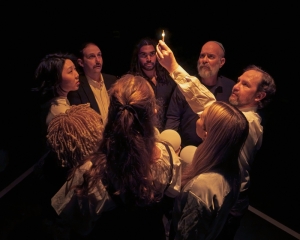
An extraordinary eight-person ensemble fuels the sweeping storytelling of A People - a production presented collaboratively by Arts Judaica and YI Love Jewish - shifting through nearly 80 characters across generations and geographies. Though only one cast member is Jewish, playwright LM Feldman intentionally assembled a diverse ensemble to reflect the many ways Jewish identity manifests - across culture, theology, race, queerness, and lived experience - underscoring that there is no single way to be part of a people.
The performance thrives on the versatility of this cast, featuring standout contributions from Douglas Levin, who provides an authentic and anchoring sincerity, and Charity Schultz, who illuminates her roles with magnetic charm. Daniel Boughton moves with ease between sharp humor and striking emotional depth, and Jin Ai anchors the production’s stillest moments with a quiet power, enriched by her beautifully integrated guitar work. Zach Kunde cuts through the space with sharp intellect and a commanding vocal presence, while Haley Schenk turns a single, piercing glance into some of the production’s most potent dramatic beats, and she even threads in flute playing that adds a surprising, delicate texture. The momentum never falters thanks to Xavier Mattison’s vibrant energy and tenderness, while Freya Churchwell rounds out the ensemble with impressive, wide‑ranging versatility and delivers some of the play’s genuine laugh‑out‑loud exchanges. Together, they weave a unified and deeply affecting tapestry of human survival.
This remarkable stage chemistry is guided by director Avi Hoffman, an acclaimed figure in global Jewish theater who recently directed and starred in a historic Yiddish production of Death of a Salesman in Bucharest, Romania. Having previously earned a Drama Desk nomination for playing Willy Loman in New York, Hoffman injects this local production with masterful artistic insight. Under his careful guidance, the non-linear, fragmented script by L. M. Feldman avoids confusion, gaining immense clarity and striking a perfect balance between epic historical weight and intimate human connection.
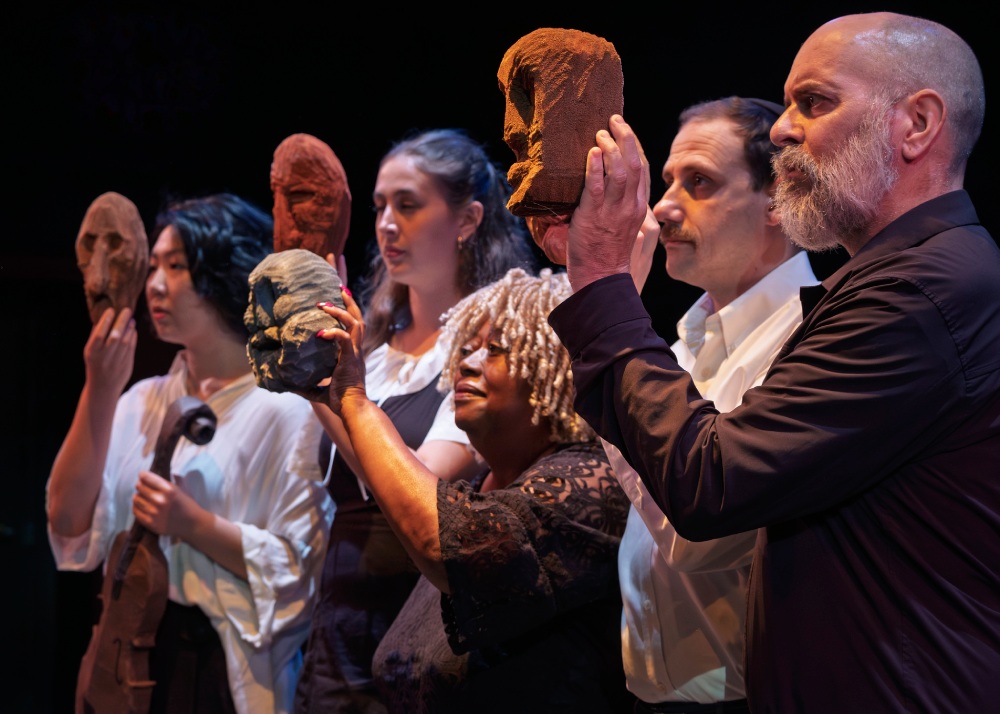
L-R: Jin Ai, Charity Schultz, Freya Churchwell, Zach Kunde, Douglas Levin. Photos by Logan and Candice Conner, Oonphotography.
Starting with the diaspora of the Jewish people that have become scattered throughout the world, the production explores several expressions of Judaism while ultimately reinforcing the idea that, despite their differences, they remain one people - and a remarkable people at that. It touches on beautiful threads of Jewish history, including the teaching that Moses received not only the written Torah referred to as “The Hand” at Mount Sinai but also the Oral Torah referred to as “The Tongue,” which was an interesting fact that I did not ever learn about the Torah in Hebrew school. I was also unaware of another phenomenon that members of the Jewish community called “tonals” actually memorized whole portions of the Torah to recite and sing so that the Torah portion could be performed for groups of students/scholars etc., to discuss and watch. The important thing that came out of this discussion of the Torah and the essential thing that makes Judaism different from other religions is that Jews learned and passed on the teachings of the Torah and the Talmud for the purpose of discussing them and learning from them and interpreting them and re-interpreting them -so as not to force them down anyone’s throat to be followed with blind faith.
As a Jew, I appreciated how the piece pokes gentle fun at our tradition of spirited debate - a trait that can be both energizing and, at times, hilariously counterproductive.
They are so intelligent at debating with each other that sometimes they nitpick each other to the end of a discussion that could otherwise forward the family or community or couple in a more positive way.
One of the production’s most profound scenes comes when a character asks a 90‑year‑old what history lives in the wrinkles of their face - how an entire lifetime, nearly a century of memory, can be held within one fragile human body. Another moment that stayed with me was the gentle but urgent insistence that nurturing future generations is vital to the continuity of the Jewish people.
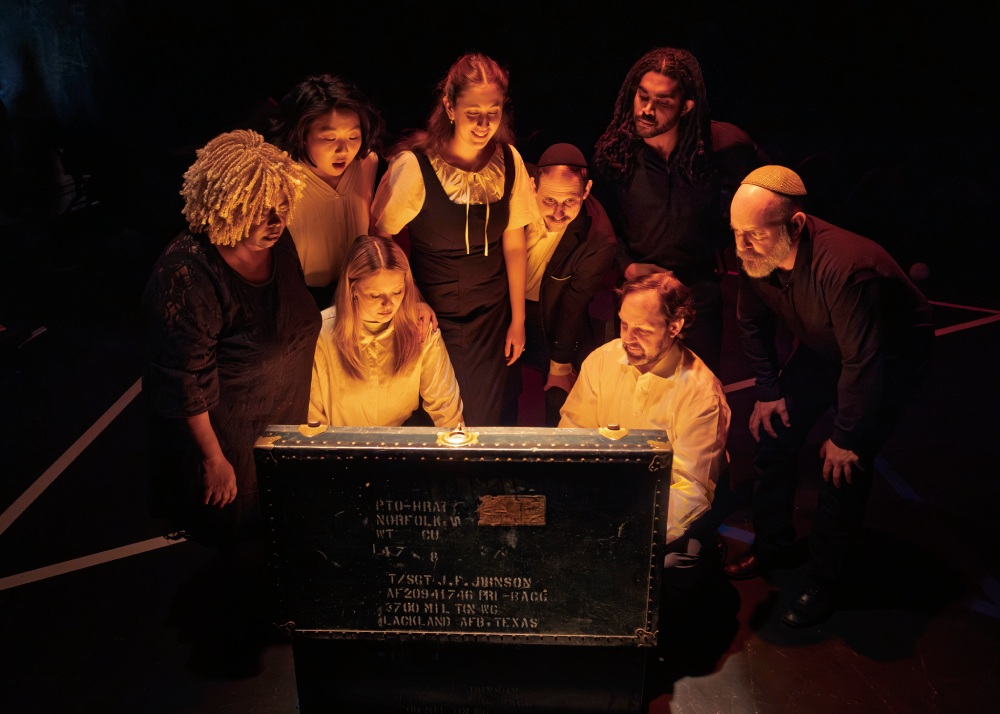
Back row L-R: Freya Churchwell, Jin Ai, Charity Schultz, Xavier Mattison, Zach Kunde, Douglas Levin. Front L-R: Haley Schenk, Daniel Boughton.
The differences among them are many, yet a shared thread still binds them together. One character argues passionately for a two‑state solution, while another hopes her girlfriend will one day be fully embraced by her community. A rabbi even confronts a group of Jewish Christmas carolers, shouting, ‘Why are you doing this?’ as the story considers how and why some Jews celebrate Christmas - a reflection of how the holiday’s overwhelming cultural presence in America can blur the line between religious observance and simple seasonal participation. And still, beneath all these disagreements and divergences, the play returns to the same essential truth: that despite their varied beliefs, identities, and practices, they remain part of one people.
This production was perfect for me as a Reform Jew who has been struggling in recent years with the current rise in antisemitism and my own childhood feelings of being a “self-hating Jew”. I remember being told as a teenager by my talent agent applying for theater roles that I needed to change my last name from Katz to Cates, implying that I would not be cast with a Jewish last name.
The work also reminded me that many young women today - queer and straight alike - continue to push back against the patriarchal elements of Judaism. It echoes the long history of restrictions found in early texts, where girls as young as 12 years old were defined by their childbearing potential and barred from studying sacred writings.
On the plus side, it brought me back to the beauty of the Yiddish language and how I hunger for the sounds of my great grandmother Fanny’s voice and my grandmother Lillian’s voice saying, ‘Have a little nosh!’ and, ‘We love you so much we’re kvelling!’”
The set is intentionally simple: a large Star of David stretches across the floor of Theater Wit’s intimate in‑the‑round space, immediately grounding the production in its cultural and spiritual roots. A few risers punctuate the stage, giving actors elevated platforms for defining moments, while small prop boxes at either end glow when opened, revealing modest but striking items that carry surprising emotional weight. Puppets appear briefly as well, echoing the woodworking projects referenced in the story and adding a tactile, handmade quality to the world. It’s an effective setup for this play - the open space becomes essential as the ensemble moves fluidly around the stage, frequently breaking the fourth wall to bless a volunteering audience member, pass out challah, ask questions, or coax the crowd into clapping along.
By luck, I chose the seat that happened to be in the spotlight for participation, and I was delighted when one actor asked me to be his ‘bubbe’ - his grandmother. When I said, ‘Yes! I will be your grandma!’ He gently took my hand, giving me a grateful squeeze. At another point, one of the actors - dressed as a bride - asked if he could give one of the audience members a blessing. I immediately said, ‘Yes!’ and he came over and placed his hands gently on my head - he was wearing the traditional lace head covering the bride on her wedding day - and he wished me great life blessings of joy and to find a wonderful husband. It was a delightful, intimate moment, and I hope that everyone who sees the show volunteers to experience that.
Throughout much of the play, the actors also wear small placards hanging from their necks, each bearing a single word such as “wrestle,” “struggle,” and “legacy.” These signs become a quiet but potent visual motif, suggesting the burdens, questions, and inheritances each character carries across time. They function almost like distilled themes of Jewish history itself - reminders that to be part of a people is to wrestle with identity, to struggle for continuity, and to consider what legacy one leaves behind. Other words appear as the ensemble shifts through eras, each one offering a compact window into the emotional or spiritual weight of the moment.

Back row L-R: Douglas Levin, Jin Ai, Xavier Mattison. Front row L-R: Freya Churchwell, Daniel Boughton, Charity Schultz.
My only note - and this is for the author, not the cast or director - is that of all the various types of Jews included in this piece - Reform, Conservative, queer, self‑hating, Orthodox, even atheist - the one type of Jew that was not represented was the Messianic Jew, of which I am one.
Messianic Jews (not to be confused with the organization Jews for Jesus) are Jews who believe that Jesus is the Messiah spoken of in the Old Testament - the ‘Christed One,’ meaning the one anointed with the oil of blessing. In those same scriptures, this figure is described as the blessed one who would be ‘pierced through his hands and feet,’ yet ‘whose bones would not be broken.’
Messianic Jews also believe that, regardless of his lineage - whether Yeshua was a descendant of King David or not - his purpose in allowing himself to be publicly killed, and then healing his own body three days later, was to show that this world is made of spirit, or ‘shimmering motes,’ as he called them. This was long before molecular structure or the effects of consciousness on physical matter were even theorized. All of his miracles were mitzvahs - acts of goodness - centered on healing and feeding the poor, the sick, and the disabled.
At the very least, Jesus was a respected, super advanced, rabbi, rebel and healer who introduced the idea that women were worthy of learning the Torah and receiving healing from his touch whether they were Jewish or not. This Feminist thought alone was a very radical and world changing idea that women of all nations and all religions are eternally grateful for.
Given all that Yeshua represents historically and spiritually to many Jews, I was surprised that his name never surfaced in a piece that explores so many branches of Jewish identity, its factions, and its many splintered paths. I compare his omission from Jewish studies when debating this with my friends to discussing basketball history without mentioning Michael Jordan or discussing physics without ever mentioning Albert Einstein - not a judgment, just an observation about the scope of the narrative.
In any case, author LM Feldman has created a marvelously complex and deliciously enjoyable reminder of all the different expressions of Judaism, and of the lush intelligence and grace of Jewish people around the globe caught up in the current battle to stay alive and well. Le Chaim!
A People was a very deeply inspiring and delightful experience for me, especially at this unprecedented time in history. This heartfelt production of A People helped this Jewish girl from Miami, Florida remember so many of the great things about my Jewish heritage; the sights, the sounds, the heated discussions, the music, the fabulous food, the funny family dinners, my own bat mitzvah… just so many things that make me proud to be a Jew today.
With its blend of live music and rapid-fire storytelling, the production compresses five thousand years of Jewish history and cultural inheritance into a brisk, engaging evening. A People stands out as essential summertime theater, honoring its deep historical foundations while resonating powerfully with contemporary audiences.
Mazel Tov and Highly Recommended!
Running through July 5 at Theater Wit.
- A People
- Arts Judaica
- YI Love Jewish
- LM Feldman
- Douglas Levin
- Charity Schultz
- Daniel Boughton
- Zach Kunde
- Haley Schenk
- Xavier Mattison
- Freya Churchwell
- Jin Ai
- Avi Hoffman
- Jewish Identity
- Jewish
- heritage
- rabbi
- Jesus
- live theatre
- on stage
- Chicago events
- Chicago plays
- Chicago stage
- Now playing
- Jewish history
- Yeshuah
- Yiddish
- Hebrew
BrightSide’s intimate staging of The Producers shines with Broadway-sized power

BrightSide Theatre’s The Producers storms into Meiley Swallow Hall with the kind of swagger only Mel Brooks can inspire: brash, brazen, and blissfully unconcerned with good taste. From the moment the lights rise, the show charges ahead with a manic momentum that feels both affectionately old school and sharply self-aware. It knows exactly what it’s here to do: go big, go bold, and never apologize for the mayhem.
Under the confident direction of Artistic Director Jeffrey Cass, this staging taps directly into Brooks’ outrageous, boundary-poking sensibility and never loosens its grip. Cass understands that The Producers thrives when its humor teeters on the edge, and he captures that gleeful imbalance with remarkable control. The original film premiered in 1967, the musical exploded onto Broadway in 2001, and if anyone wonders whether that brand of audacity still lands in 2026, the answer is an unequivocal yes. The Naperville audience laughed steadily from the first scene to the curtain call, proving that Brooks’ anarchic wit remains timeless.
BrightSide’s version brings the show’s wild premise to life with full comic force: washed-up Broadway producer Max Bialystock (Scott Kelley) and anxious accountant Leo Bloom (Michael Metcalf) concoct a get-rich-quick scheme to stage the biggest flop in theatre history. If the show collapses on opening night, they can pocket the investors’ money and disappear. Their hunt for guaranteed failure leads them to the worst script imaginable, the most misguided director in town, and a cast so spectacularly wrong that success seems impossible. But in classic Brooks fashion, the plan detonates in the most unexpected way, turning their surefire disaster into an accidental triumph and leaving the pair scrambling to survive the fallout.
That spirit of intentional ruin pulses through the musical numbers, each one another attempt to engineer catastrophe. “Springtime for Hitler,” the show-within-the-show’s notorious centerpiece, is crafted as an overblown, tasteless pageantry meant to repel audiences instantly. “Der Guten Tag Hop Clop” and “Haben Sie gehört das Deutsche Band?” push the absurdity even further, spotlighting a playwright and director whose delusions should have doomed the project. Even “Keep It Gay,” with its flamboyant insistence on excess, is part of Max and Leo’s strategy to stack the deck with choices so misguided they can’t possibly succeed. Ironically, the songs are so bold, so shamelessly theatrical, and so cleanly executed that the very elements meant to sink the show end up turning it into the hit they never wanted.
Scott Kelley’s Max Bialystock and Michael Metcalf’s Leo Bloom make a terrific duo, striking a lively balance between showmanship and panic. Kelley barrels through the role with larger-than-life bravado, while Metcalf’s tightly coiled nervousness plays off him beautifully. Their timing is crisp, their rapport effortless, and together they elevate every scheme, meltdown, and misstep.

Max Bialystock (Scott Kelley) and Company.
Amelia Tam is outstanding as Ulla, the blonde bombshell Max hopes to lure to his “casting couch”. She is an amazing dancer with an equally outstanding voice, commanding attention the moment she steps onstage with a blend of radiant charm and razor-sharp comedic instinct. Her Ulla rises far above the familiar Swedish ditzy-blonde trope, becoming a spark of vitality who shifts the temperature of every scene she enters. Tam mixes wide-eyed innocence with sly intelligence, making each line land with extra bite. Whether stretching a vowel for comedic payoff or launching into “When You Got It, Flaunt It” with fearless gusto, she turns Ulla into a character who is not only irresistible but essential to the show’s rhythm.
The supporting cast is uniformly strong, powered by an ensemble that moves with clarity (credit to choreographer Mary Grace Martens), hits its jokes cleanly, and fills the stage with infectious confidence. Cheryl Newman shines as one of Max’s elderly ‘investors,’ delivering sharp comedic work while also contributing behind the scenes as costume designer - a pair of responsibilities she handles with impressive finesse. Michael John Lynch brings delicious flair to Carmen Ghia, the impeccably mannered yet cutting assistant whose every gesture blends elegance and threat. Myles Mattsey is memorable as Franz Liebkind, the unhinged playwright whose patriotic fervor is both alarming and hilarious, while John B. Boss transforms director Roger DeBris into a gleaming spectacle of theatrical excess. Together, they form a gallery of eccentrics who keep the show’s momentum high and its humor constant.
All the while, Phil Videkis provides excellent musical leadership, guiding the orchestra with crisp pacing and keeping the score bright, tight, and perfectly attuned to the show’s comic sensibility while supporting Thomas Meehan’s book with well-judged musical choices.
The staging makes clever use of an economical but highly effective set designed by Ariel Mozes, shifting smoothly from location to location without ever feeling limited. What the physical scenery lacks in large-scale opulence, it compensates for with smart configuration and adaptability, allowing the story to move quickly while keeping the focus on the performers. Enhancing that versatility is a programmable LED backdrop that becomes one of the production’s most dynamic tools, transforming into windows, rainbows, bursts of color, or even spelled-out words that heighten key moments. Together, Mozes’ resourceful design and the vivid LED wall create a surprisingly rich visual world that expands far beyond the modest footprint.
BrightSide Theatre once again demonstrates a sharp eye for material, adding The Producers to its growing list of savvy, crowd-pleasing selections. This staging delivers everything a Mel Brooks musical should: big laughs, confident performances, and a joyful sense of mischief that never lets up. It’s a lively, high-spirited evening that embraces the show’s outrageous personality while still finding its own clever touches along the way. This musical comedy is highly recommended, playing through June 28th at the Theater at Meiley Swallow Hall, an ideal summer outing for anyone craving a night of bright, unapologetic fun.
For tickets and/or more show information, visit https://brightsidetheatre.com/producers/.
- Brightside Theatre
- the producers
- mel brooks
- Meiley Swallow Hall
- Scott Kelley
- Michael Metcalf
- Amelia Tam
- Mary Grace Martens
- Jeffrey Cass
- Cheryl Newman
- Michael John Lynch
- Myles Mattsey
- John B Boss
- musical comedy
- live theatre
- on stage
- chicago theatre
- Naperville THeatre
- Chicago events
- broadway musical
- comedy
- Phil Videkis
- Ariel Mozes
- tap dance
- dance numbers
- Musical theatre
Paramount's Lush and Spectacular South Pacific Brings Island Love to Life!

Rogers & Hammerstein’s South Pacific has long been one of my favorite musicals, not just for its sweeping romance and unforgettable score, but for the way it tackles big ideas with such touching honesty. Set on a remote island during World War II, the show blends sunlit escapism with the very real tensions shaping its characters’ lives, creating a story that’s as heartfelt as it is enduring.
South Pacific follows two intertwined love stories set against the backdrop of World War II, each colored and strained by the racial prejudices of the era. The musical centers on Nellie Forbush, an American nurse from Arkansas, who falls for Emile de Becque, a French plantation owner living on a South Pacific island. Their romance is warm, hopeful, and immediate, but Nellie falters when she learns that Emile has mixed-race children, forcing her to confront the biases she didn’t realize she carried. Meanwhile, a young Marine lieutenant, Joseph Cable, falls in love with Liat, a Tonkinese woman, only to recoil from the social consequences of marrying her. These parallel stories expose the poignant cost of prejudice, a theme the musical tackles directly and candidly.
The show’s creators - Richard Rodgers (music), Oscar Hammerstein II (lyrics and co-book), and Joshua Logan (co-book) - adapted the musical from James A. Michener’s Pulitzer Prize-winning Tales of the South Pacific. Their adaptation blends romance, wartime tension, and social critique, using songs like “Some Enchanted Evening,” “Younger Than Springtime,” and the pointed “You’ve Got to Be Carefully Taught” to deepen the narrative’s resonant and political stakes. The hit 1958 film version, starring Mitzi Gaynor and Rossano Brazzi, helped cement South Pacific as a cultural landmark and carried its most iconic songs to an even wider audience. South Pacific debuted on Broadway in 1949, where it became an immediate hit and went on to win the Pulitzer Prize for Drama, and now the beloved musical has found a temporary home at Paramount Theatre’s massive stage in Aurora's thriving downtown theater district.
Paramount’s production is anchored by a cast that brings both freshness and passionate sharpness to this classic musical.

Strong pecs are de rigueur for a troop of World War II U.S. Navy seabees stationed on a tropical island in Rodgers and Hammerstein’s South Pacific, playing now through June 14 at downtown Aurora’s Paramount Theatre. For tickets, visit ParamountAurora.com or call (630) 896-6666.
Allsun O’Malley brings a bright, grounded sincerity to Nellie Forbush, making her Paramount debut with a turn that feels fully lived-in rather than broadly sketched. Her Nellie is warm, funny, and emotionally accessible, and she brings each of her songs to life with bright, expressive vocals - especially “A Wonderful Guy,” which she delivers with pure joy, and a buoyant optimism that never obscures the character’s underlying complexity. O’Malley also reveals Nellie’s internal contradictions with clear, intentional choices, letting the audience see the exact moments when her optimism collides with what she calls an inherited prejudice. Playing opposite, Devin Archer delivers a commanding and deeply felt Emile de Becque. Archer’s rich velvety voice has the kind of effortless power that makes “Some Enchanted Evening” land with full romantic weight. Also, the quiet, wounded dignity he brings to Emile’s past gives the role its human spine. The chemistry of the two is undeniable. Archer and O’Malley form a partnership that feels real, tender, and the kind of connection every couple hopes for.
Cindy Chang’s Bloody Mary is a standout from her first entrance, played with sharp wit and a knowing edge that never slips into stereotype. Chang gives the character agency and intelligence, making her both a shrewd survivor and a mother navigating impossible circumstances. Anthony Maggio, as Lt. Joseph Cable, delivers a performance that balances youthful idealism with the crushing weight of societal expectation. His later scenes - especially his deeply felt rendition of “You’ve Got to Be Carefully Taught,” the song that argues hate is learned, not innate - give Maggio’s work real force and heartfelt depth.
Matthew Michael Janisse is absolutely wonderful as Luther Billis, perfectly cast and firing off some of the evening’s sharpest comedic timing. He brings a mischievous ease to every entrance, shaping the humor with character-driven precision rather than broad antics, and his presence reliably lifts the energy of each scene he touches. Louisa Darr’s Liat offers a gentle, luminous counterbalance, shaping the role with quiet grace. Esteban Ortiz‑Villacorta (Professor) and Chris Khoshaba (Stewpot) add texture and humor to the ensemble, while Joshua L. Green’s Captain George Brackett and David Rossetti’s Commander William Harbison provide crisp, authoritative counterpoints. Young performers Evelyn Dorough and Elle Laroco (Ngana) and Bennet Angsurat and Vin Laroco (Jerome) bring charm and authenticity to their scenes, rounding out a talented cast that feels cohesive, committed, and fully engaged in the world of the production.
The ensemble is exceptional across the board, moving with a unified energy that enriches every scene. Their vocal blend, character detail, and fantastic dancing give this interpretation its heartbeat, making the world of the island feel alive with youthful energy.

Nellie Forbush (Allsun O'Malley) admits to her fellow nurses she’s in love with a wonderful guy in Rodgers and Hammerstein’s South Pacific, the 2025-26 Broadway Series finale at downtown Aurora’s Paramount Theatre.
One of my favorite South Pacific moments comes when Cindy Chang steps into “Bali Ha’i,” singing with a hypnotic calm and quiet urgency that makes the number seem both inviting and faintly mysterious, as if she’s revealing a world only she can fully see. That spell is followed by the sailors’ showstopping “There Is Nothin’ Like a Dame,” a riot of comic bravado and tight choreography that electrifies the stage. And just when the energy peaks, the nurses answer with a gleeful, splashy rendition of “I’m Gonna Wash That Man Right Outa My Hair,” led by Allsun O’Malley and complete with real water cascading from onstage showers - a burst of theatrical fun the audience clearly loved.
Co-directors Devon Hayakawa and Trent Stork guide this Rodgers and Hammerstein masterpiece with a confident, contemporary touch, shaping a presentation that honors the show’s sweeping romance while sharpening its sincere and thematic edges. Their staging is purposeful and fluid, allowing humor, heart, and tension to coexist without competing. Choreographer Morgan DiFonzo adds another vital layer, crafting movement that feels organically rooted in character while giving the staging its rhythmic pulse. Together, the trio delivers a revival that respects the classic while infusing it with fresh perspective and simplicity.
The set and costumes are nothing short of breathtaking, with projections that expand the already majestic environment into a fully realized island in the South Pacific. Jeffrey D. Kmiec’s scenic design features towering, densely layered trees that rise beyond the height of the stage, using every inch of space with intention and beauty. Izumi Inaba’s costumes enrich the world with texture and authenticity, while Greg Hofmann’s magical lighting bathes the stage in shifting moods that deepen the sense of place. Adam Rosenthal’s sound design adds precision and atmosphere, and Mike Tutaj’s projections provide some of the production’s most magical touches - most memorably a stunning firefly-filled night scene that seems to shimmer in the air. As a unit, the design team created a world that feels immersive, transportive, and alive with the beauty of island nature.
Under the baton of Music Director and Conductor Kory Danielson, the orchestra sounds vibrant, balanced, and enthusiastically attuned to the storytelling. Danielson shapes the score with clarity and warmth, giving the big ensemble numbers buoyant lift while letting the more intimate moments breathe. His leadership keeps the musical pulse steady and expressive, ensuring the show’s soulful arcs land with full impact.
This South Pacific is a richly imagined, beautifully performed revival that captures the sweep, humor, and emotional punch of the Rodgers and Hammerstein defining musical while giving it a revitalized, contemporary pulse. From the stunning design work to the standout performances and thoughtfully shaped direction, every element comes together with definition and heart. It’s a staging that invites you in, holds you close, and stays with you long after the final notes fade. Rogers & Hammerstein’s South Pacific runs through June 14th, and it’s absolutely worth catching before it sails away.
I highly recommend this breathtaking and deeply romantic beloved musical.
For tickets and/or more show information, click here.
This review is proudly shared with our friends at www.TheatreInChicago.com.
- Paramount Theatre
- South Pacific
- World War II
- Rogers and Hammerstein
- Joshua Logan
- James A Michener
- Tales of the South Pacific
- Some Enchanted Evening
- Bali Ha'i
- Allsun O’Malley
- Devin Archer
- Cindy Chang
- Anthony Maggio
- Matthew Michael Janisse
- Louisa Darr
- Esteban Ortiz‑Villacorta
- Chris Khoshaba
- Joshua L Green
- David Rossetti
- Devon Hayakawa
- Trent Stork
- Morgan DiFonzo
- Kory Danielson
- Musical theatre
- live theatre
- chicago theatre
- Aurora theatre
- Events Chicago
- Events Aurora
- on stage
- Now playing
- Musical
Fault Shakes Up Chicago Shakespeare Theater with Fierce, Funny Chaos

Dark comedies built around relationship dynamics have always drawn me in because they reveal conflict with a kind of honesty that feels both familiar and unpredictable. When couples clash, the humor isn’t just situational; it’s rooted in history, habit, and the tiny emotional landmines only long-term partners know how to trigger. Fault fits squarely into that tradition, taking the everyday rhythms of a long marriage and pushing them just far enough to expose the raw, funny, and uncomfortable truths beneath the surface. That blend of recognition and surprise is exactly what makes this kind of comedy so compelling, and why Fault lands with such a specific charge.
That sense of intimate volatility is exactly what Jason Alexander explores in his return to Chicago Shakespeare Theater. With Fault, he brings the sharp directorial instinct he showed in his earlier CST production Judgment Day and applies it to a far more contained emotional landscape. In this world premiere written by Scooter Pietsch, he shapes the play’s tightening grid of tension and moral uncertainty with a touch that feels both precise and unexpectedly humane. The result is a tightly focused piece driven by tension that sparks almost instantly - less an explosive outburst than a controlled shift in the room - with the personal fractures between the characters steering the story toward its breaking point.

Pictured are Enrico Colantoni (Jerry), Playwright Scooter Pietsch, Rebecca Spence (Lucy), Nick Marini (Shaun), and Director Jason Alexander. April 18– May 24, 2026, in The Yard at Chicago Shakespeare. Photo by Justin Barbin.
In Fault, the night detonates the moment Jerry Green walks in expecting to celebrate a career defining merger and instead finds his wife, Lucy, in an intimate moment with a young man she has just met, Shaun. What could have ended in a single, stunned confrontation instead becomes the spark for a long, spiraling night in which no one is allowed to leave, and nothing stays contained. The shock of the discovery quickly gives way to a volatile mix of accusations, shifting alliances, and long suppressed grievances, turning their home into a closed-door standoff where every truth feels like a trap and every explanation opens a deeper wound. Jerry and Lucy have long operated as a high functioning power couple, relying on professional unity to keep their marriage steady; once that balance collapses, the cracks at home widen just as quickly. It is interesting that Pietsch also underscores the irony that Jerry’s career‑defining merger has just made the couple newly minted billionaires after a long string of failures, and yet - proving that all the money in the world can’t change some people - they still behave like high‑achieving narcissists, turning their blame and abuse on each other and on the young stranger they’ve invited into their lavish home.
As the hours stretch on, the situation tilts from chaotic to revealing, exposing the fractures that have been quietly shaping this marriage for decades. Jerry’s need for control, Lucy’s hunger for something unspoken, and Shaun’s unexpected presence collide in ways that force each of them to confront what they’ve been avoiding. What begins as a moment of betrayal becomes a full-scale excavation of loyalty, resentment, and the stories couples tell themselves to stay intact. The play’s dark humor emerges from this escalating tension - how quickly a single mistake can unravel a life, and how a marriage can be tested most brutally not by the act itself, but by everything it brings to the surface. And just to remind you, this is a comedy - and a hilarious one at that.
Jerry even admits at one point that arguments never really have winners, a truth he delivers with the weary certainty of someone who has spent years circling the same conversational battlegrounds. Yet the play understands something deeper and more uncomfortable: that couples can become strangely addicted to the very banter that exhausts them. The back‑and‑forth may bruise, but it also affirms a shared language, a familiar rhythm, a way of feeling alive inside a relationship that has otherwise gone quiet. In Fault, that warped need becomes both a source of comedy and a mirror held up to the audience, revealing how easily love and combat can blur when two people know each other too well.
For all its blistering comedy, Fault is threaded with the quieter, more unsettling realizations that come with aging - what it means to feel your desirability slipping, to lose track of the person you married, or to crave the parts of yourself you fear have vanished. The betrayals at the center of the play aren’t just about infidelity; they’re about the desperate need to feel seen, wanted, and alive again. Beneath the chaos and sharp-edged humor runs a steady pulse of vulnerability, as each character confronts the version of themselves they’ve been avoiding. And just when the night seems like it can’t twist any further, the play barrels into a smash bang ending that lands with real force - the kind that sends audiences out buzzing, debating, and replaying the final moments long after the curtain comes down.

Presenting the world premiere dark comedy Fault, by Scooter Pietsch and directed by Jason Alexander. Featuring Enrico Colantoni (Jerry) and Nick Marini (Shaun). Photo by Justin Barbin.
The cast of Fault features three principal performers, each driving a different charge in the play’s volatile, rapidly escalating night. Enrico Colantoni gives Jerry Green a grounded, lived in presence, letting decades of pent up frustration surface through tightly controlled physical choices and a dry comic timing that makes his smallest shifts register. Opposite him, Chicago favorite Rebecca Spence shapes Lucy Green with a blend of wit, restraint, and emotional clarity; her sharp physical beats and instinctive timing keep each exchange taut while still allowing the humor to flicker through. Shaun, whose chance encounter with Lucy at the bar leads him into the Green household, played by Nick Marini, adds a destabilizing charge to the night, using quick, reactive movement and an agile sense of timing to tilt the dynamic just enough to expose the deeper fractures beneath the couple’s carefully maintained surface.
Their combined work is strengthened by the breadth of experience each actor brings to the stage. Colantoni’s long career in film and television, including standout turns in Veronica Mars and Galaxy Quest, gives his performance a steady, lived in weight. Spence, a Chicago mainstay with a Jeff Award and recent visibility in The Madison, brings sharp focus and emotional clarity to Lucy. Marini adds a younger charge to the trio, drawing on credits like Cobra Kai and Dropout TV to shape a presence that subtly disrupts the relationship dynamic.
The action unfolds inside a tastefully appointed luxury home crafted by scenic designer Paul Tate DePoo III, who gives the Greens a space that gleams with success without ever feeling sterile. A streamlined bar sits at the rear of the room, and the warm finishes, refined furnishings, and subtle touches make the environment inviting rather than ostentatious - a polished retreat that still feels lived in. It’s the kind of setting that should radiate comfort and control, yet under Alexander’s direction it gradually sharpens, its clean lines and curated surfaces taking on a quiet tension as the night begins to break down.
Alexander’s own trajectory mirrors that same level of craft, extending far beyond the stage. Although Jason Alexander is widely known for his television work on Seinfeld and film roles ranging from Pretty Woman to Shallow Hal, he brings none of that celebrity shorthand to Fault. Instead, his decades in front of the camera seem to refine his instincts behind the table. His sense of timing, character shaping, and emotional pacing reflect the precision of someone who has lived inside stories of every scale. It’s a résumé that could easily overshadow a production, yet here it deepens his approach, grounding the play’s volatility in choices that feel thoughtful rather than showy.
Running just ninety minutes without an intermission, Fault maintains a tight, steady pulse that matches the tightening chamber of its late-night unraveling. Chicago Shakespeare Theater presents the world premiere through May 26, offering audiences a sharply observed look at a marriage pushed past its breaking point. What stays with you isn’t only the tension or the humor, but the clarity of the production itself, which recognizes how a single, seismic domestic shift can rattle everything a couple has built, sending shockwaves through a foundation that once seemed unshakeable.
Highly recommended.
For tickets and/or more show information, click here.
This review is proudly shared with our friends at www.TheatreInChicago.com.
Marriott’s Heartbreak Hotel: The Rise, the Rebirth, the Return

Marriott Theatre’s Heartbreak Hotel takes on the tricky task of charting Elvis Presley’s early ascent, walking the line between the mythic figure we think we know and the unpolished young man still figuring out who he was becoming. What emerges is a brisk, music‑driven portrait that leans into the volatility of those formative years - the industry pressures that boxed him in, the personal crossroads that pushed him forward, and the creative sparks that hinted at the cultural earthquake to come. It’s a show less interested in polishing the legend than in capturing the restless drive of a talent on the verge of rewriting American music.
Heartbreak Hotel traces Elvis Presley’s early rise with a pace that stays brisk without ever feeling hurried, using a clever device: a ’68 Comeback‑era Elvis looking back on his younger selves. At times the man, the teen, and the 11‑year‑old boy share the stage simultaneously - singing, reminiscing, harmonizing - embodying a life moving faster than any one version of him can fully grasp. The musical follows Elvis from the tentative spark of his Sun Studio sessions into the glare of national attention, tracing how each new opportunity brings both momentum and complication. Producers, handlers, and well‑meaning advisors orbit him constantly, each with a different vision of who he should become, and the show uses those interactions to underline just how precarious his initial ascent really was.
As the demands of fame tighten around him, the story frames Elvis’s evolution as a series of choices - some instinctive, some imposed, all shaping the performer he’s still learning to be. Rather than digging for psychological depth, the plot focuses on the push‑and‑pull between artistic hunger and commercial pressure, capturing the uneasy transition from raw talent to cultural commodity. It’s a portrait of a young man standing at the edge of a seismic career, long before the iconography calcifies and the legend overtakes the life.
At the center of Heartbreak Hotel is Tyler Hanes playing Elvis Presley, who carries the show with a mix of youthful swagger and genuine vulnerability. His performance hinges not just on vocal accuracy but on capturing the restless, slightly bewildered energy of a young man being swept into stardom. His renditions of “Blue Suede Shoes” and “Heartbreak Hotel” land with the right mix of polish and rawness, and his quieter moments - particularly the early Sun Studio sequences and those paired with Priscilla - give the production its emotional grounding.
The show’s Colonel Tom Parker, portrayed by Rob Lindley, is the necessary counterweight: charming, calculating, and always two steps ahead. Lindley brings a slick, almost Vaudevillian charisma that keeps the character from slipping into caricature (although Parker may have been a caricature of himself anyway). His scenes pop with tension, especially in numbers where he orchestrates Elvis’s next move with a smile that never quite reaches his eyes.

Tyler Hanes as Elvis Presley (center) with ensemble in Heartbreak Hotel at Marriott Theatre.
The Sun Studio ensemble - the musicians, producers, and collaborators - provide some of the production’s most engaging textures. Jackson Evans, as Sam Phillips, is heavily featured in the first act and delivers one of the show’s standout performances, offering a steady, clear‑eyed presence that anchors the opening chapters with real artistic purpose. The play digs into Phillips’s instinct for raw talent - his uncanny ability to spot greatness beforehand - and makes clear that his relentless championing of Elvis is what first carried the young singer’s sound across Memphis and into the broader South. His work with the band digs deep and gives us an idea of Phillips’s impact in shaping a new kind of rock ‘n’ roll sound. Their group numbers in the studio, including “That’s All Right,” have an infectious looseness that contrasts sharply with the more commercialized performances later in the show.
The supporting cast adds essential color. Colton Sims offers a sharp, unaffected turn as Teen Elvis, capturing the raw spark before the polish sets in, and Charles Adler Bischoof, as young Elvis, brings a bright, unguarded innocence that reminds the audience just how early the legend began.
Elizabeth Telford lends Gladys Presley a quiet emotional weight, centering the story whenever she’s onstage. Anna Louise Bramlett brings an earnest warmth to Dixie, while Amanda Walker gives Priscilla a steady, grounded presence that subtly deepens the story.
In one of Heartbreak’s most exciting moments, Alexandra Palkovic takes control of the stage delivering a sleek, charismatic jolt as Ann-Margret, hinting at the whirlwind to come. Palkovic dances with real fire, echoing Ann‑Margret’s signature style with crisp precision and an infectious burst of energy. Palkovic later joins Hanes in one of the most touching moments when the two perform a beautiful rendition together of “You’re the Boss.” The addition of a full Ann‑Margret song‑and‑dance number feels especially meaningful, since her on‑screen chemistry with Elvis has always struck me as one of the high points of his physical and emotional vitality.

Tyler Hanes as Elvis Presley and Alexandra Palkovic as Ann-Margret.
Karl Hamilton gives Vernon Presley a quiet, understated presence, and Naiqui Macabroad stands out in his multi‑role track - Johnny Bragg, Chuck, Jackie Brenston, and the producer for both Steve Allen and Ed Sullivan - slipping between characters with crisp versatility and welcome bursts of personality. Fredrick Webb Jr. also makes a strong impression in multiple roles, notably as Roy Brown, Otis Redding, Fats Domino, and throughout the ensemble.
Going back to the musicians, the live band is one of the show’s more memorable assets. With Jake Busse as Bill Black, Zac Richey as Scotty Moore, and Trevor Lindley Craft as Ronnie (pre-DJ Fontana days) forming the tight onstage trio, the musicians anchor the production with a sound that feels both authentic and freshly charged. Lindley Craft doubles as Frank Sinatra. He and Hanes deliver one of the evening’s highlights as they recreate the famous duet from Elvis’s post‑Army appearance on The Frank Sinatra Show - a stylish medley of “Love Me Tender” and “Witchcraft” that lands with effortless charm.
Melanie Brezil also brings a radiant spark to Sister Rosetta Tharpe, delivering her featured moment with bright, joyful command on both vocals and guitar.
Together, the band’s instrumental work and the ensemble’s rich harmonies elevate the musical landscape. A mid‑show gospel sequence of “Peace in the Valley” – another one of this staging’s big moments - showcases the ensemble’s vocal power and reminds the audience of the musical traditions that shaped Presley long before fame did.
Marriott’s in‑the‑round setup gives Heartbreak Hotel an expansive energy, with action unfolding on all sides. The cast’s aisle work draws the audience in, creating a surprisingly immersive sense of scale, and the smart use of media and projections amplifies that impact even further. A staging in this intimate space gives the storytelling room to gather real thrust. That quality becomes especially clear as the sequences build toward the emotional high point, when Elvis finally sheds the cookie‑cutter movie image he’d long outgrown and reclaims his artistry in the ’68 Comeback Special, reestablishing his place as the King of Rock ’n’ Roll.
I’ve always been drawn to stories orbiting Elvis Presley, and Heartbreak Hotel earns its place among them by honoring the legend without embalming him in nostalgia. Elvis wasn’t just a chart‑topper; he was a cultural accelerant, the artist who fused gospel, blues, country, and rhythm‑and‑blues into a sound that detonated across America and permanently rewired its musical DNA. His influence stretched far beyond the stage - reshaping fashion, performance style, youth identity, and the very idea of what a pop star could be. Productions like this one matter because they keep that seismic legacy in motion, passing it from one generation to the next not as a museum relic, but as a living, breathing force that still shapes the music we hear today.
When referring to rock 'n' roll, John Lennon said it himself, “Before Elvis, there was nothing.” Heartbreak Hotel echoes that sentiment.
Directed and choreographed by Deidre Goodwin, this musical bears the imprint of an artist who understands how to propel a story without letting the spectacle swallow it. Her direction shapes the evening with a steady, purposeful rhythm, keeping the focus tight even as the musical numbers expand outward. Goodwin’s fantastic choreography blends period flavor with a clean, contemporary precision, giving the show a kinetic pulse that feels both rooted in its era and alive in the present. It’s her sense of balance - between nostalgia and freshness, between narrative drive and musical release - that ultimately gives the production its lift.
Elvis devotees will find plenty to appreciate in Heartbreak Hotel, which treats the King’s formative years and artistic rebirth with genuine affection and a clear understanding of his musical legacy. But the show’s appeal stretches well beyond Presley fandom; anyone who loves American music - from gospel and blues to early rock and soul - will recognize the joy in hearing these sounds brought to life by a superbly talented cast and band. Heartbreak Hotel runs through June 2nd at Marriott Theatre and is an exciting musical experience well worth attending.
For tickets and/or more show information, click here.
This review is proudly shared with our friends at www.TheatreInChicago.com.
- Heartbreak Hotel
- Marriott theatre
- Elvis Presley
- Gladys Presley
- Vernon Presley
- Priscilla Presley
- AnnMargret
- ’68 Comeback Special
- Tyler Hanes
- Rob Lindley
- Jackson Evans
- Sam Phillips
- Colton Sims
- Elizabeth Telford
- Anna Louise Bramlett
- Amanda Walker
- Alexandra Palkovic
- Karl Hamilton
- Naiqui Macabroad
- Fredrick Webb Jr
- Jake Busse
- Zac Richey
- Trevor Lindley Craft
- Melanie Brezil
- Deidre Goodwin
- Scotty Moore
- Bill Black
- Fats Domino
- Ed Sullivan
- Frank Sinatra
- rock 'n' roll
- live theatre
- on stage
- chicago theatre
- Lincolnshire
- Now playing
- Chicago arts
- Performing Arts
- Musical theatre


Latest Articles
-
Metropolis’ Wizard of Oz Rekindles Pure Childhood Wonder
Written by Kimberly KatzMetropolis Performing Arts Centre’s new staging of The Wizard of Oz sends audiences down the yellow brick road with a production that balances classic nostalgia with a warm, community centered spirit. Before the story unfolds, it’s worth remembering the legacy…
-
 Cerqua Rivera Dance Theatre Announces 2026-2027 Season
Written by Buzz Center StageCerqua Rivera Dance Theatre (CRDT), the Chicago-based dance company, is proud to announce its 2026 - 2027 season. In the coming year, CRDT will join the historic Ruth Page Center for the Arts as an in-resident company. The season will also include…
Cerqua Rivera Dance Theatre Announces 2026-2027 Season
Written by Buzz Center StageCerqua Rivera Dance Theatre (CRDT), the Chicago-based dance company, is proud to announce its 2026 - 2027 season. In the coming year, CRDT will join the historic Ruth Page Center for the Arts as an in-resident company. The season will also include… -
Black Ensemble Theater continues its 50th Anniversary Season with the free outdoor concert series Fridays on the Green August 14, 21 and 29, 2026
Written by Buzz Center StageBlack Ensemble Theater continues its 50th Anniversary Season with the return of its outdoor musical celebration Fridays on the Green. The concert series is free and open to the public on theater's front lawn at the corner of Clark and Sunnyside from 6:30pm-8pm. Guests…
-
Refracted Theatre Company presents the Chicago Premiere of I’M GONNA MARRY YOU TOBEY MAGUIRE, Sept 18 - Oct 31
Written by Buzz Center StageAward-winning Refracted Theatre Company is proud to announce the cast and creative team of I’m Gonna Marry You Tobey Maguire, written by Samantha Hurley and directed by Tyler Struble, September 18 - October 31, at the Bookspan Theatre at Den Theatre, 1331 N Milwaukee Ave. Previews…
Does your theatre company want to connect with Buzz Center Stage or would you like to reach out and say "hello"? Message us through facebook or shoot us an email at This email address is being protected from spambots. You need JavaScript enabled to view it..
*This disclaimer informs readers that the views, thoughts, and opinions expressed in the text belong solely to the author, and not necessarily to Buzz Center Stage. Buzz Center Stage is a non-profit, volunteer-based platform that enables, and encourages, staff members to post their own honest thoughts on a particular production.