
Items filtered by date: November 2007
Funny ‘Prayer Circle’ Is Loaded With Laughs

Erik Gernand is resident playwright at Redtwist Theatre, and his Prayer Circle is absolutely laugh-out-loud funny. The strength of this script is the characters—who are clearly defined and familiar types—and the performances, directed by Dusty Brown, are uniformly outstanding.
Set in the cramped loft of a church (with stained glass and roof vaults dominating a well-detailed set by Jeff Bain), we will meet the five members of the Prayer Circle (they call themselves “prayer warriors” for reasons that later become apparent) as they gather one by one for their spiritual endeavor. Doug (Kevin Waters) is already there when the lights come up, at the piano, singing carefully, spiritually (a snippet of the hymn "Blessed Assurance" I believe) with a beauty and intensity that suggests the conviction of the group we are to meet.
Waters’ singing is so good, conveying that his character Doug is intensely immersed in this vocal invocation. So much so he is caught off guard by the arrival of the irreverent Addy (Andi Muriel), who also happens to be his high school student in daily life.

From left: Andi Muriel, Phillip C. Matthews, Kevin Waters, Macaria Chaparro Martinez, and Jaqueline Grandt in Redtwist Theare's Prayer Circle.
Muriel is a very good comedic actor, and her Addy dispels the possibility of too much seriousness as she conveys the quick-witted slapdash humor that can spring forth when young people have discovered the absurdity of the adults governing them. We also meet Carol (Macaria Chaparro Martinez), a 30-something enveloped in a cloud of earnestness: “You can call me Bible lady just don’t call me late for prayer circle.”
Soon enough Marilyn (Jaqueline Grandt) lands, that familiar church matron who is far more powerful than she should be, perfectly coiffed and clad with a designer bag. There is still one seat vacant, a result of the tragic death by cancer of a young mother DeeDee, who we learn was the wife of Pastor Evans (Phillip C. Matthews).
Marilyn is all in a dither, because the president declared a war last night in a televised speech. Marilyn tells the circle that she has summoned Pastor Evens to address the matter with the prayer circle, calling him from his bereavement leave, and the care of his motherless children. What could possess her to do such a thing?
We soon discover this prayer circle wields unusual powers with its prayers and hopes to enlist the involvement of the pastor in its spiritual work. Gernand’s script stumbles a bit in its structure, with a tad more procrastination in the plot reveals than a screwball comedy like this warrants.
We also don’t see the moral analysis that the playwright seems to want to make the characters face. The playwright seems uncertain about how seriously we are to consider morality when he brushes against serious concerns encountered by these faithful.
Nevertheless, the tremendous comic performances, especially by Jaqueline Grandt and Andi Muriel, make this a show worth seeing. Prayer Circle, running through November 8, 2026 at Chicago's Redtwist Theatre, comes recommended.
Steppenwolf Presents GRACEFUL WARRIOR: AN EVENING WITH GARY SINISE - Tuesday, November 24, 2026

Steppenwolf Theatre Company, the nation's premier ensemble theater company, is pleased to present Graceful Warrior: An Evening with Gary Sinise on Tuesday, November 24, 2026 at 7:30 pm in Steppenwolf's Downstairs Theater, 1650 N. Halsted St. in Chicago.
On the tails of Steppenwolf's celebrated 50th Anniversary Season, Co-Founder Gary Sinise joins Artistic Director Audrey Francis for this one-night-only conversation that bridges generations of Steppenwolf's ensemble. In addition to speaking about Steppenwolf's history, Sinise will share reflections from his upcoming memoir Graceful Warrior: The True Story of a Son, a Father and a Family Who Carried Each Other Through, which honors the life and legacy of his son Mac. All tickets include the purchase of an autographed copy of Graceful Warrior, signed by Sinise.
Tickets cost $70* (includes autographed book). A special Steppenwolf member pre-sale begins Wednesday, September 23, 2026 at 12 pm. Tickets go on sale to the general public on Friday, September 25, 2026 at 12 pm at steppenwolf.org/warrior or by calling the Box Office at (312) 335-1650. *Pricing includes a $10 handling fee
About Graceful Warrior:
On November 10, 2026, McCanna "Mac" Sinise would have celebrated his 36th birthday. Instead, on that day, his father Gary Sinise, will honor Mac's extraordinary life by sharing the story that forever changed his own. Graceful Warrior is Sinise's most personal book to date. More than a memoir, it is a father's tribute to a remarkable young man whose faith, creativity, humor, compassion, and quiet strength inspired everyone around him. While the journey includes Mac's battle with an ultra-rare form of bone cancer, Gary makes clear from the opening pages that this is not a book about cancer. It is a story about hope, perseverance, unwavering love, and the grace to keep moving forward together.
About the Artists:
Gary Sinise's distinguished career in film, television, theater and philanthropy spans across five decades, marked by a deep commitment to storytelling, service and purpose. His journey began in 1974 when at just 18 years old, he co-founded Chicago's Steppenwolf Theatre Company, which has become recognized as one of the premier theater companies in the world. He is a three-time Tony Award nominee, twice for acting in Steppenwolf's productions of One Flew Over the Cuckoo's Nest and The Grapes of Wrath, and once for Best Director of Buried Child. His many acting credits at Steppenwolf include A Streetcar Named Desire, The Caretaker, Loose Ends and Balm in Gilead. Gary has also directed some of Steppenwolf's most notable productions, including Orphans, the Vietnam veteran drama Tracers and Sam Shepard's True West, which he also performed in with John Malkovich Off Broadway at the Cherry Lane Theatre and received an Obie award for Best Director.
Sinise is best known for his iconic portrayal of wounded Vietnam War veteran Lt. Dan Taylor in the award-winning film Forrest Gump that brought him widespread acclaim and deepened his connections within the military community. Sinise earned Academy Award, Golden Globe and Screen Actors Guild nominations and was recognized with the National Board of Review Award for Best Supporting Actor. His extensive film credits include Apollo 13, Ransom, The Green Mile, Of Mice and Men, Mission to Mars, The Human Stain, I Still Believe and Joe Bell.
On television, for nine seasons Sinise starred as Detective Mac Taylor on CSI: NY, symbolizing his support, affinity and appreciation for first responders. Recent television work also includes Criminal Minds: Beyond Borders and the Netflix series 13 Reasons Why. With multiple award nominations to his credit, Sinise is an Emmy, Golden Globe and two-time Screen Actors Guild Award winner for his performances in Truman and George Wallace.
In 2011, Sinise founded the Gary Sinise Foundation, with a mission to serve our country by honoring our nation's defenders, veterans, first responders, their families and those in need. The Foundation provides critical support including building specially adapted mortgage free smart homes for our nation's most severely wounded heroes, providing equipment grants to fire and police departments around the country, educating the next generation through trips to the National WWII Museum, National Medal of Honor Museum, Flight 93 Memorial, 9/11 Memorial and Museum and the Pentagon, supporting the families of our fallen through community programming, hosting free concerts with Gary Sinise & the Lt. Dan Band, which for nearly 25 years has been uplifting our veterans, first responders, families of our fallen heroes and much more.
Audrey Francis currently serves as Artistic Director of Steppenwolf Theatre, alongside Glenn Davis, where she has been an Ensemble member since 2017. Audrey directed You Will Get Sick in Steppenwolf's 2024/25 season and POTUS in the 2023/24 season. She has performed on stage in Catch as Catch Can. Noises Off, The Thanksgiving Play, The Herd, Between Riverside and Crazy, The Fundamentals, The Doppelgänger (an international farce) and Dance Nation. TV and film credits include Justified: City Primeval, Chicago Med, Chicago Fire, Empire, Perpetrator, Knives and Skin and Later Days. Audrey is an acting coach for NBC, Fox, Showtime and Amazon. She is also the co-founder of Black Box Acting and the co-creator of Steppenwolf's corporate training program, Steppenwolf IMPACT.
Accessibility:
Steppenwolf is committed to making the theatergoing experience accessible to everyone. Assistive listening devices are available for every performance and all our spaces are equipped with an induction hearing loop. Our building features wheelchair accessible seating and restrooms, push-button entrances, a courtesy wheelchair and all-gender restrooms, with accessible counter and table spaces at our bars. For additional information regarding accessibility, visit steppenwolf.org/access. If you have questions or would like to make a specific request, email This email address is being protected from spambots. You need JavaScript enabled to view it. or call our box office at (312) 335-1650.
Sponsor Information:
United Airlines is the Official and Exclusive Airline of Steppenwolf. Steppenwolf is also grateful for the significant season support from lead sponsors Allstate Insurance Company, Paul Angell Foundation, Bloomberg Philanthropies, Crown Family Philanthropies, Caroline and Keating Crown, Julius Frankel Foundation, Lefkofsky Family Foundation, Northern Trust, Anne and Don Phillips, John Hart and Carol Prins, Shubert Foundation, Inc, and Zell Family Foundation. Steppenwolf also acknowledges generous support from premier sponsors Anonymous, Andrew and Amy Bluhm, Michael and Cathy Brennan, Ann and Richard Carr, Chicago Community Trust, Rich and Margery Feitler, FROST CHICAGO, Lloyd A. Fry Foundation, Jessica and Dominic Green Family Fund, John D. and Catherine T. MacArthur Foundation, The Orlebeke Foundation, Sacks Family Foundation, Gary Sinise Foundation, Harold and Mimi Steinberg Charitable Trust, Thoma Bravo, and Bryan Traubert and Penny Pritzker. Steppenwolf also acknowledges support from the National Endowment for the Arts, Illinois Arts Council, and the City of Chicago Department of Cultural Affairs and Special Events.
About Steppenwolf Theatre Company:
Steppenwolf Theatre Company is the nation's premier Ensemble Theater with 51 members who are among the top actors, playwrights and directors in the field. Thrilling, powerful, groundbreaking productions have made this theatre legendary. From the early phenomenon of Balm in Gilead, to The Grapes of Wrath, August: Osage County, Downstate, The Brother/Sister Plays, and more recently, the Pulitzer Prize and Tony Award-winning Purpose, Steppenwolf Theatre has had a long-running and undeniable impact on American Theatre and Chicago's cultural landscape. Founded in 1974 by Terry Kinney, Jeff Perry and Gary Sinise, Steppenwolf started as a group of friends in their teens and early 20s performing in the basement of a school in Highland Park, Illinois. Today, the company's artistic force remains rooted in the original vision of its founders: an artist-driven theatre, whose vitality is defined by its appetite for bold and innovative work. Every aspect of Steppenwolf is rooted in its Ensemble ethos, from the intergenerational artistic programming to the multi-genre performance series LookOut, to the nationally recognized work of Steppenwolf Education and Engagement which serves nearly 15,000 teens annually. While grounded in the Chicago community, more than 40 original Steppenwolf productions have enjoyed success nationally and internationally, including Broadway, Off-Broadway, London, Sydney, Galway and Dublin. Steppenwolf also holds accolades that include the National Medal of Arts, 14 Tony Awards, two Pulitzer Prize-winning commissions and more. Led by Artistic Directors Glenn Davis and Audrey Francis, Executive Director E. Brooke Flanagan and Board of Trustees Chair Keating Crown — Steppenwolf continually redefines the boundaries of live theater and pushes the limits of acting and performance.
Steppenwolf's Mission: Steppenwolf strives to create thrilling, courageous and provocative art in a thoughtful and inclusive environment. We succeed when we disrupt your routine with experiences that spark curiosity, empathy and joy. We invite you to join our ensemble as we navigate, together, our complex world. steppenwolf.org, facebook.com/steppenwolftheatre, twitter.com/steppenwolfthtr and instagram.com/steppenwolfthtr.
Acclaimed Mexodus musical makes Chicago premiere November 7-21 at Studebaker Theater

Studebaker Theater, P3 Productions and Audible, in collaboration with Teatro Vista Productions, present the Chicago premiere of the groundbreaking, award-winning new hip-hop musical Mexodus, written and performed by Brian Quijada and Nygel D. Robinson, choreographed by Tony Thomas, and directed by David Mendizábal. Mexodus plays a limited three-week run at Chicago's historic Studebaker Theater at the Fine Arts Building, 410 S. Michigan Avenue, from November 7 to November 21, 2026.
Tickets for the Chicago premiere of Mexodus, November 7–21, 2026, are now on sale starting at $36, with discounted student tickets for $20, at FineArtsBuilding.com/Mexodus.
Told through live looping, bold storytelling and sick beats, Mexodus reimagines the Underground Railroad heading south to Mexico—unearthing a powerful, untold chapter of American history. Called an "electrifying theatrical experience" by The New York Times, "thrilling" by The Washington Post and "genius in motion" by the San Francisco Chronicle, this is theater you feel in your body and your bones. Created and performed by Brian Quijada and Nygel D. Robinson, this groundbreaking musical follows a freedom seeker and an unlikely ally as they forge a remarkable bond that transcends borders.
This year Mexodus won four Lucille Lortel Awards including Outstanding Musical, four Outer Critics Circle Awards including Outstanding New Off-Broadway Musical, three Drama Desk Awards including Outstanding Music, one Off Broadway Alliance Award for Best Musical, and one Drama League Award for Outstanding Production of a Musical—the first Off-Broadway musical to win the award in 30 years.
The Chicago premiere follows the musical's critically acclaimed twice-extended run at Audible's Minetta Lane Theatre in New York in 2025 and return Off-Broadway engagement at the Daryl Roth Theatre earlier this year. Mexodus is now available as an Audible Original, featuring the entire musical recorded in immersive Dolby Atmos sound design and extending its reach to millions of listeners around the world.
The Studebaker Theater engagement of Mexodus represents a homecoming for Brian Quijada and Nygel D. Robinson. Quijada is from the Chicago area, and Robinson previously called the city home. An early workshop and developmental performances of the musical were held in Chicago in 2021 and 2023.
"We couldn't be more excited to bring Mexodus to Chicago," said Brian Quijada and Nygel D. Robinson. "Not only do we both have connections to the city, but much of the development of Mexodus happened there. Chicago, pull up!"
Ben Holtzman, Sammy Lopez, and Fiona Howe Rudin of P3 Productions added, "After building such a strong community around the show in New York City, we're thrilled to now bring this bold, original musical to Chicago audiences, especially at the historic Studebaker Theater. It's an honor to continue sharing the show's joy, energy, and message of solidarity with a city that feels so deeply connected to the spirit of Mexodus."
Kate Navin, Audible Head of Creative Development for North America, said: "It has been an honor to share Mexodus with the world, through the Audible Original release and on stage in New York, where it once again took the city by storm. We can't wait to present Brian and Nygel's groundbreaking musical in Chicago, where this work was nurtured during its development. As the production reaches more cities across the United States and listeners globally through Audible, we're continuing to broaden and honor this important story for audiences both in the theater and beyond."
Fine Arts Building and Studebaker Theater Proprietor Erica Berger said, "We are beyond proud to be a Co-Producer on Mexodus, one of the most exciting new musicals in recent memory. Brian Quijada and Nygel D. Robinson are two exceptional artists with strong ties to Chicago. The Studebaker Theater has been a creative home to innovative theater artists for more than 125 years, and bringing Mexodus home to Chicago further emphasizes our commitment to that legacy." Managing Artistic Director Jacob Harvey added, "We're actively building new pathways for how commercial productions can find a home in Chicago. Mexodus is our first co-producer credit on an Off-Broadway production, but it won't be the last. This is a new era for the Studebaker, cementing us as the premier Chicago venue for developmental and acclaimed productions alike."
Artistic Director Wendy Mateo of Teatro Vista Productions said, "Teatro Vista Productions cultivates the telling of stories that accurately reflect our community and increase the authentic representations of us on stage and screen. We are extremely honored to have been a part of the world premieres of Brian's Where Did We Sit on the Bus? and Somewhere Over the Border. So this is a full circle moment for us to help bring Brian and Nygel back to Chicago and to share the story of Mexodus with our audiences."
Mexodus was developed in previous productions at New York Stage and Film (2021), Baltimore Center Stage & Mosaic Theater Company of DC (Spring 2024), and Berkeley Repertory Theatre (Fall 2024).
The creative team for Mexodus includes Riw Rakkulchon (Scenic Design), David Mendizábal (Costume Design), Mextly Couzin (Lighting Design), Mikhail Fiksel (Looping Systems Architecture and Sound Design), Johnny Moreno (Video/Projections Design), Tony Thomas (Choreographer), and Claire Yenson, C.S.A. (Casting). Hope Villanueva is the Production Stage Manager, and theatrical supervision is by Cath Bates with general management by Pemberley Productions.
TICKETS
Tickets for the Studebaker Theater performances of Mexodus are now on sale starting at $36, with discounted student tickets for $20, at FineArtsBuilding.com/Mexodus.
PERFORMANCE SCHEDULE
Saturday, November 7 at 3 p.m. and 7:30 p.m. (press opening)
Sunday, November 8 at 1:30 p.m. and 6:30 p.m.
Tuesday, November 10 at 7:30 p.m.
Wednesday, November 11 at 7:30 p.m.
Thursday, November 12 at 2 p.m. and 7:30 p.m.
Friday, November 13 at 7:30 p.m.
Saturday, November 14 at 3 p.m. and 7:30 p.m.
Sunday, November 15 at 1:30 p.m. and 6:30 p.m.
Tuesday, November 17 at 2 p.m. and 7:30 p.m.
Wednesday, November 18 at 2 p.m. and 7:30 p.m.
Thursday, November 19 at 11 a.m. (student matinee)
Friday, November 20 at 2 p.m. and 7:30 p.m.
Saturday, November 21 at 3 p.m. and 7:30 p.m.
ABOUT P3 PRODUCTIONS
P3 Productions is an award-winning producing team led by Ben Holtzman, Sammy Lopez, and Fiona Howe Rudin, dedicated to uplifting new voices and communities. Broadway productions include CALL ME IZZY, HOW TO DANCE IN OHIO, and JOB. In addition to MEXODUS, upcoming productions include WANTED, INTER ALIA, and THE NINTH WOMAN. Recent co-producing credits include EVERY BRILLIANT THING, ART, SUNSET BLVD., JUST FOR US, and A STRANGE LOOP on Broadway, as well as INTER ALIA, KINKY BOOTS, 1536, SUGAR DADDY, THE IMPORTANCE OF BEING EARNEST, NEXT TO NORMAL, and ORLANDO in London's West End. Learn more at www.p3.productions.
ABOUT AUDIBLE THEATER
Audible Theater makes outstanding performances and powerful storytelling available to live audiences in New York City and millions of people all over the world. Since founding in 2018, Audible Theater's dynamic mix of live and audio theater productions have been praised as "trailblazing" (Variety), "illuminating" (Forbes), and "an exemplary use of the medium" (The Observer).
Audible Theater productions have garnered more than 60 nominations and 14 wins across the theater awards landscape. More than 120 audio theater titles have released on Audible. Audible Theater has produced the multi-award-winning and seven-time Tony Award-nominated musical Dead Outlaw, with music and lyrics by David Yazbek and Erik Della Penna, book by Itamar Moses, conceived by David Yazbek, and directed by David Cromer; Hannah Moscovitch's play Sexual Misconduct of the Middle Classes starring Ella Beatty and Hugh Jackman; Sorry for Your Loss written by and starring Michael Cruz Kayne; Laura Benanti: Nobody Cares written by and starring Laura Benanti; Alex Newell and the Gospel of a Diva written by and starring Alex Newell; Nostalgia: A Love Letter to NYC written by and starring Eva Noblezada; Girls & Boys starring Carey Mulligan; Harry Clarke starring Billy Crudup; and many others at Audible's Minetta Lane Theatre in New York City. Audible Theater has also produced audio adaptions of acclaimed plays including Colman Domingo's Wild with Happy starring Domingo, Oprah Winfrey, Sharon Washington, Alex Newell, and Tyler James Williams; David Henry Hwang's Yellow Face starring Daniel Dae Kim and Jason Biggs; David Auburn's Summer, 1976 starring Laura Linney and Jessica Hecht; and many more.
In May 2018, Audible announced that the Minetta Lane Theatre in Greenwich Village would serve as its creative home for live performances in New York, with Audible members receiving exclusive access to discounted tickets and related audio content. Since then, Audible has hosted and produced a wide variety of live performances at the Minetta Lane including dramatic plays, comedic shows, original musical performances, and more.
Since June 2017, Audible has commissioned 50 playwrights to receive support from its $5 million Emerging Playwrights Fund dedicated to developing innovative English-language works from around the globe. The initiative enables the creation of original plays driven by language and voice, keeping with Audible's core commitment to elevate listening experiences through powerful performances and extraordinary vocal storytelling. Emerging Playwrights commissions have included Evil Eye by Madhuri Shekar, The Half-Life of Marie Curie by Lauren Gunderson, Good Enemy by Yilong Liu, and more.
ABOUT AUDIBLE, INC.
Audible, Inc., an Amazon.com, Inc. subsidiary (NASDAQ:AMZN), is the leading creator and provider of premium audio storytelling, offering global audiences a powerful way to enhance and enrich their lives through extraordinary content. Audible's catalog includes more than 1,000,000 audio titles, including Audible Originals as well as audiobooks and podcasts from leading studios, print, audio and magazine publishers and world-renowned entertainers.
ABOUT THE STUDEBAKER THEATER
Located inside Chicago's landmarked Fine Arts Building, the Studebaker Theater is one of the city's most historic performance venues, led by Erica Berger and Jacob Harvey. Since its curtain first rose in 1898, the Studebaker stage has been graced by luminaries including Bob Hope, Peter O'Toole, Mae West, Ethel Barrymore, Geraldine Page, Vincent Price and many more. Following a major multi-million-dollar renovation led by Berger Realty Group and completed in 2022, the Studebaker has been home to NPR's popular news quiz show "Wait Wait... Don't Tell Me!" and has hosted performances from new musicals including 44: The Obama Musical, Roald Dahl's The Enormous Crocodile, and Jim Henson's Emmet Otter's Jug-Band Christmas. Other recent productions include Ava: The Secret Conversations starring Elizabeth McGovern and Manual Cinema's Christmas Carol. Learn more at fineartsbuilding.com.
ABOUT TEATRO VISTA PRODUCTIONS
When the Chicago theater world wasn't ready for us, Teatro Vista Productions made space. For 35 years, we've told true stories that reflect our community. We're not just building on this amazing legacy; we are strengthening and expanding it for the future. Today we continue to actively engage in advocacy that seeks to increase the authentic representations of us on stage and screen. Teatro Vista Productions is led by Lorena Diaz (Executive Director), Wendy Mateo (Artistic Director) Cruz Gonzalez-Cadel (Associate Artistic Director) and Carina E. Sanchez (Board President).
Teatro Vista Productions believes artists of color are inherently genius across disciplines, experiences, media and diaspora. We center our collective of artists at the heart of everything we do. We empower them to create with their own voice by providing the tools and resources they need to thrive in the industry. Our work is timely, relevant and reflects our community. Now, as always, We Are Theater With A View. Join us across online channels at @teatrovista to experience the multidisciplinary talents of our Artistic Collective and visit teatrovista.org to stay connected to all things TVP. Pa'lante Juntos. Forward Together.
Definition's How We Got On: A Mixtape for the Stage

What happens when three young people discover hip-hop and realize they might have something to say? Idris Goodwin’s How We Got On, directed by Definition Theatre Artistic Director Tyrone Phillips, answers that question with rhythm, humor, attitude and plenty of heart. Think of it as a mixtape for the stage - a collection of voices, beats, dreams and memories that takes us back to the 1980s, when hip-hop was still growing and figuring out what it could become.
Jamal Turner’s Hank is ambitious, curious and hungry to find his place. He’s a young guy who discovers that writing rhymes gives him a voice and a way to express what he may not always be able to say out loud. Turner makes Hank likable, funny and real. You can see the excitement in him as he begins to realize that maybe he has something special.
Tony Garcia’s Julian brings a completely different flavor. He is confident, competitive and determined to prove himself. Garcia gives Julian plenty of swagger, but there is vulnerability underneath it. His chemistry with Turner makes their friendship and competition fun to watch.
And then there’s Luann, played by Anuoluwa T. Awolola. Luann is a talented rapper who has almost everything under control. She has the confidence, the skills and the flow. Her one problem is that she’s a girl trying to make it in a male-dominated hip-hop world. Awolola gives Luann the confidence of someone who knows exactly what she can do - and isn’t waiting for anyone’s permission to do it.
Maya Vinice Prentiss is a standout as the Selector, shifting effortlessly between narrator, DJ and several different characters. She is our guide through this musical journey, constantly reminding us that this isn’t just a story being told - it’s a story being spun.
Sydney Lynn Thomas’s set design gets the vibe right from the start. A wall filled with different beatboxes immediately transports us into the world of early hip-hop. It feels like walking into someone’s bedroom, record shop or neighborhood hangout where the next great track might be created.
Adding another visual dimension is Chicago artist John Vergara’s art installation. His colorful work, influenced by graffiti, portraiture and Chicago’s street culture, fits naturally alongside the production’s celebration of hip-hop and self-expression.
The show does have some pacing issues. There are moments when the energy drops, but once the rhythm kicks back in, How We Got On is hard not to enjoy.
This is a mixtape for the stage - a lively blend of music, memories, friendship and youthful ambition. It reminds us that before hip-hop became a worldwide cultural force, it was young people with something to say, a beat to work with and the courage to get on the mic.
RECOMMENDED
When: through September 27th
Where: Definition Theatre@55th, 1160 E. 55th Street., Chicago, Il.
Running time: 90 minutes no intermission
Tickets: Start at $25
312-469-0390
BEFORE WE ARE HISTORY - Open Space Arts - Through November 8th

Open Space Arts presents BEFORE WE ARE HISTORY, a three-week theatrical exploration of LGBTQ+ theater created during and in response to the AIDS crisis, running October 23 through November 8, 2026, at Open Space Arts, 1411 W. Wilson Ave. in Chicago.
The project brings together plays that captured the lives, relationships, sexuality, fear, humor, friendship and resilience of gay men as AIDS transformed their communities, alongside work by artists whose lives and writing continue to carry the history of the epidemic into the present. It grew from a desire to revisit theatrical works that were once urgently connected to LGBTQ+ audiences but are now seldom produced.
While a small number of AIDS-related plays have become firmly established within the theatrical canon, many other plays — along with the artists, small theaters and communities that created them — risk disappearing from cultural memory.
BEFORE WE ARE HISTORY asks what happens when these works are heard again, forty years later.
The title reflects the urgency behind the project: an opportunity to revisit this work while many of the artists, activists, audience members and community members who experienced this period are still able to share their memories and perspectives — and while a new generation of LGBTQ+ artists can encounter the people and work that helped blaze the trail before them.
Selected performances will be followed by conversations involving artists, activists, historians and community organizations, connecting the plays with both the history of the AIDS epidemic and the continuing realities of HIV today.
Additional panelists, community partners, casting and special programming will be announced.
Tickets and complete performance information are available at OpenSpaceArts.org.
BEFORE WE ARE HISTORY includes a one-weekend double bill of Jeff Hagedorn's ONE and Lee Raines' BLOOD SPILL; a two-weekend run of Robert Chesley's JERKER, OR THE HELPING HAND; and a special one-night staged reading of Robin Swados' A QUIET END.
The project marks the 40th anniversary year of both JERKER and A QUIET END, two important works created as American theater began confronting the AIDS epidemic directly.
A portion of ticket revenue and additional donations from BEFORE WE ARE HISTORY will benefit Chicago Black Men's Caucus, Vivent Health + TPAN, and Season of Concern.
DOUBLE-BILL OF "ONE" AND "BLOOD SPILL"
October 23–25, 2026
Friday, October 23 at 7:30 p.m.
Saturday, October 24 at 7:30 p.m.
Sunday, October 25 at 3 p.m.
Tickets $30 General Admission, $25 students and seniors, on sale now at www.openspacearts.com
ONE
by Jeff Hagedorn
Directed by Rory Brady
BEFORE WE ARE HISTORY opens with a double bill of ONE and BLOOD SPILL. ONE is Jeff Hagedorn's groundbreaking solo play about a young man attempting to understand and confront his AIDS diagnosis at a time when the disease itself was still frighteningly new.
First produced in Chicago by Lionheart Gay Theatre Company in 1983, ONE is recognized as one of the earliest publicly produced theatrical works about AIDS.
Milwaukee-born Jeff Hagedorn relocated to Chicago in the early 1980s and became a founding member and resident playwright of Lionheart Gay Theatre. He went on to write numerous plays addressing gay life and the effects of AIDS on the community. His later work included THE LAYMAN'S GUIDE TO SAFE SEX, which combined humor and education at a time when providing accurate information about safer sex had become a matter of life and death. Hagedorn also formed the production company SYZYGY, which helped revive Chicago's pub-theater tradition. He died of an AIDS-related illness in 1995.
Rory Brady (he/him, pictured left)) is an up-and-coming theatre creative. Born in Erie, Pennsylvania, he first became involved in theatre at the age of five, appearing as an Oompa Loompa. Now, he teaches children that same age.
Rory's work was last seen at Open Space Arts when he directed the staged reading of LIVING THE DREAM. He is very excited to return to OSA and to work on such an important historical piece.
Rory has been enlightened by this play, as well as by other queer media that has introduced him to the people who blazed the trail for his generation.
BLOOD SPILL
by Lee Raines
Directed by Byron Stewart
Presented with ONE, Lee Raines' BLOOD SPILL brings another AIDS-era voice into the conversation.
Set in New York in 1992, the play follows HIV-positive playwright Kenny King as he confronts Angela Turner, an old college friend who has become the
artistic director of a major theater company. Kenny arrives with a deeply personal AIDS play, only to discover that Angela's theater has chosen work it considers safer and more accessible to its audience.
Their reunion becomes an increasingly heated confrontation over art, AIDS, institutional responsibility and who gets to decide which stories are acceptable for the stage. Beneath the argument lies Kenny's experience caring for a dying friend — and the anger, guilt and helplessness that fueled the work he has written.
BLOOD SPILL was developed through Write It Out!, the playwriting program for writers living with HIV founded by Donja R. Love. Raines was a member of the program's first cohort and has continued working with the organization in artistic programming and outreach.
Lee Raines is a playwright, theater artist, former ACT UP member and longtime HIV survivor who was diagnosed in 1989. His participation gives BEFORE WE ARE HISTORY a living connection between the artists who experienced the AIDS era and the effort to preserve those stories for audiences today.
Byron Stewart (left) is a Chicago director, actor and educator. He is co-founder and Artistic Director of A Real Read and has also served as Artistic Director of Sex Police. His work in Chicago theater has encompassed directing, performance and the development of work centered on Black and LGBTQ+ voices.
JERKER, OR THE HELPING HAND
40th Anniversary Production
by Robert Chesley
Created and performed by Jason Bowen and Joshua Bowen
October 29-November 8
Thursdays-Saturdays and Monday November 2 at 7:30 pm, Sundays at 3:00pm
Tickets $30 General Admission, $25 students and seniors, on sale now at www.openspacearts.com
At the center of BEFORE WE ARE HISTORY is Robert Chesley's JERKER, OR THE HELPING HAND, one of the most provocative and enduring theatrical works to emerge from the AIDS crisis.
The play follows J.R. and Bert, two gay men who develop an increasingly intimate relationship entirely through telephone calls. What begins with anonymous sexual fantasy slowly becomes affection, friendship and emotional dependence as AIDS reshapes the world around them.
Robert Chesley (1943–1990) was a playwright, composer, critic and advocate for gay sexuality at a time when AIDS increasingly associated sex with fear, illness and death. Trained as a musician, Chesley composed extensively before turning to theater and wrote criticism and essays for gay publications as well as plays centered on gay men, desire and AIDS.
His NIGHT SWEAT, produced in New York in 1984, was among the earliest full-length plays to confront AIDS. In 1986, excerpts from JERKER were broadcast by Los Angeles radio station KPFK. The explicit sexual language triggered a major censorship dispute involving the Federal Communications Commission, placing the play at the center of a national debate over sexuality, artistic expression and broadcasting.
Chesley died of an AIDS-related illness in San Francisco in 1990 at age 47. His work remains striking for its refusal to portray gay sexuality as something shameful or incidental, even in the midst of an epidemic.
Open Space Arts presents JERKER in recognition of the play's 40th anniversary, created and performed by brothers Jason Bowen and Joshua Bowen.
A QUIET END
Special 40th-Anniversary Staged Reading
Tuesday, November 3 at 7:30 p.m.
by Robin Swados
Director to be announced
Pay-what-you-can
BEFORE WE ARE HISTORY also includes a special pay-what-you-can staged reading of A QUIET END, Robin Swados' deeply human drama about three gay men living together during the early years of AIDS.
The play examines friendship, chosen family, anger, illness, love and mortality as the men confront an epidemic rapidly reshaping their lives and relationships.
A QUIET END is Robin Swados's first play. It has received wide praise for productions including Theater-off-Park, New York; International City Theater, Los Angeles; Offstage Theater Center, London; American Repertory Theater, Amsterdam (which he also directed); Repertory Theater of St. Louis (Best New Play 1987, St. Louis theater critics); and the Weekend Theater, Little Rock, among others.
A QUIET END has been included in BEST MONOLOGUES FOR MEN; BEST SCENES FOR MEN; anthologized in GAY & LESBIAN PLAYS TODAY; and is the focus of an entire chapter of Robert Vorlicky's ACT LIKE A MAN: CHALLENGING MASCULINITIES IN AMERICAN DRAMA (University of Michigan Press, 1995).
Robin Swados lives in Amherst, Massachusetts.
Open Space Arts presents A QUIET END during its 40th anniversary year.
ABOUT OPEN SPACE ARTS
Open Space Arts is a Chicago-based arts organization presenting theater, film, readings and special cultural events with a particular commitment to LGBTQ+ artists and stories.
From its intimate Uptown storefront, Open Space Arts creates opportunities for artists and audiences to encounter new work as well as significant works that might otherwise disappear from Chicago stages.
Northlight Delivers a Headline-Making, Hilarious Front Page

Northlight Theatre opened its new venue with Jeffrey Hatcher’s smart, rejuvenated adaptation of The Front Page. Commissioned by Artistic Director BJ Jones, this world-premiere production is the first play to be performed in their new Evanston home and proves to be the ideal piece to launch the company’s exciting new era. Built at a cost of roughly $32 million, the modern and sleek new facility looks beautiful inside and out, featuring an intimate 285-seat theater space alongside dedicated rehearsal rooms and gathering spaces. Classic chandeliers hang gracefully inside, while wide-open windows showcase its elegant new design and invite the outside world in.
Set in the high-stakes press room of 1930s Chicago, The Front Page follows the chaotic, fast-talking world of newsroom journalists scrambling to cover the impending execution of Earl Williams, convicted for killing an officer. When Williams unexpectedly escapes police custody, the press room explodes into a frenzy of rival reporters and corrupt politicians desperate to save face before an election. At the center of the storm is Hildy Johnson, an ace journalist who intends to quit the business in order to marry. However, her relentless editor - and ex-flame - Walter Burns has no intention of letting his best reporter walk away.
The Front Page was originally penned by playwright Ben Hecht alongside his frequent collaborator and fellow former reporter Charles MacArthur. Together, they mined real-life experiences covering the rowdy police beats and Chicago pressrooms to write the play. The piece has been adapted several times, including its most famous screen adaptation, His Girl Friday, starring Cary Grant and Rosalind Russell, which was the first to change the gender of Hildy Johnson into a female lead. Hatcher’s sharp adaptation draws inspiration from His Girl Friday and services the original text while still carving a path of its own. In this version, Hildy also has a romantic history with her boss, but while there are sparks, this Hildy is wise enough to look for commitment rather than be carried away by emotion. Hatcher weaves in several clever nods to Chicago, making it feel like this rejuvenated piece has found its perfect home.
The production itself is a masterclass in ensemble comedy, anchored by real-life married couple Kate Fry and Timothy Edward Kane. Fry is excellent as Hildy Johnson because she is able to blend in with her tough journalist equals while still retaining her femininity and moral core. She delivers lines with sizzle and wins the audience over with her charm and wit. Kane plays Burns with fantastic energy, riding the line perfectly between a meddling boss and a sly, emotionally manipulative pal. The newsroom reporters played by Mark David Kaplan, Guy Van Swearingen, Kelan Smith, and Joe Dempsey each add a different flavor to the room - flavors that blend together well and build the framework for the comedy to succeed. John Drea adds gentle humor to his mixed-up criminal Earl Williams, playing the unstable, confused man with hilarity, especially as he falls for Mollie, portrayed by Rae Gray, whose husky voice was made for this role. Tim Kazurinsky plays Pincus, a courier, and while it’s a minor role, his meek, overly literal character steals every scene he’s in. Cindy Gold also delivers comedy gold as the stern mother-in-law-to-be.
Another exquisite element of this magnificent show is the beautiful set crafted by Jeff Kmiec. It wonderfully captures the vintage feel of the press room with its warm tones set against hints of Chicago in the background.
The Front Page is a thoroughly fun time. This show is not to be missed and is the perfect inaugural production for Northlight’s beautiful new space.
Through October 25th - https://northlight.org/series/the-front-page/
Chicago Shakes' Play On!: With a Syncopated Harlem Beat

There are some productions you watch, and then there are productions that make your heart swoon and your toe tap. Sheldon Epps’ Play On! is definitely the latter. Now playing at Chicago Shakespeare Theater, this exuberant musical takes Shakespeare’s Twelfth Night, moves it to 1930s Harlem, adds the extraordinary music of Duke Ellington, and transforms the story into a celebration of love, ambition, identity and music.
The magical kingdom of Illyria becomes Harlem, where aspiring songwriter Vy (Hailee Kaleem Wright) arrives with dreams of making it in show business. To get close to the legendary bandleader known as The Duke (Edred Utomi), Vy disguises herself as a man. Complications quickly follow when Lady Liv (Krystal Joy Brown) becomes attracted to Vy's alter ego. Shakespeare's mistaken identities remain at the heart of the story, but Cheryl L. West's book gives the familiar comedy a distinctly African American cultural identity.
West's script is hot and popping, filled with rhythm, humor and personality. She understands that the language of Shakespeare can be transformed without losing the comic machinery that makes Twelfth Night work. The characters may come from Shakespeare, but they walk, talk and move to the syncopated Harlem beat of the 1930s.
And that Harlem beat is everywhere.

The company of Chicago Shakespeare’s production of Play On! Photo by Kyle Flubacker.
The production's exciting choreography by Edgar Godineaux captures the elegance, sophistication and exuberance of the big-band era. The ensemble - Marquez Linder, Selena Robinson, Dylan C. Smith, Joey Stone, Shelbi Voss and Danny Dwaine Wells II - keeps the stage alive with movement and energy. The choreography doesn't simply accompany the music; it becomes part of the storytelling.
The Duke Ellington score is the production's heartbeat. Under the musical direction of Theodis Rodgers Jr., with beautiful orchestrations by Luther Henderson Jr., the music has both sophistication and swing. Ellington's compositions give the characters another way to express what they sometimes cannot say in words.
For me, the Harlem setting brought back a very personal theatrical memory. Play On! reminded me of the very first show I ever worked on, Bubbling Brown Sugar by Loften Mitchell, from a concept by Rosetta LeNoire (my theatre Godmother), in New York City. That experience introduced me to the power of Black theatre, music and storytelling existing together onstage. Watching Play On! brought some of that same feeling back—the excitement of seeing Black history, Black music and Black theatrical expression become one living theatrical experience.
That connection makes Play On! particularly meaningful. This isn't simply Shakespeare with jazz added to it. It is a conversation between William Shakespeare and Duke Ellington, two artists separated by centuries but connected through their understanding of human behavior, love, comedy and the power of performance.
The cast embraces that world beautifully. James Earl Jones II brings comic energy and warmth to Sweets, while Alanna Lovely gives Miss Mary a strong and engaging presence. James Harkness brings charm and theatricality to Jester. Alan H. Green gives Rev authority and comic flair.
At the center, Wright's Vy captures the vulnerability and determination of a young artist trying to discover who she is and where she belongs. Brown's Lady Liv brings glamour and emotional power, while Utomi's Duke possesses the commanding presence of a bandleader who has created his own musical kingdom.
Epps understands that the success of Play On! depends upon allowing Shakespeare's story and Ellington's music to breathe together. The result is a production that feels celebratory without becoming superficial, and contemporary without abandoning its literary foundation.
Play On! is Shakespeare filtered through the cultural richness of 1930s Harlem, propelled by Duke Ellington's music and driven by a syncopated Harlem beat.
It is a joyous reminder that great stories can travel across centuries - and sometimes, when the right music is added, they can still make us want to dance.
Highly Recommended
When: Through Oct. 18
Where: The Yard at Chicago Shakespeare Theater on Navy Pier, 800 E. Grand Ave.
Running time: 2 hours, 20 mins.
Tickets: $55-150
312-595-5600
Overshadowed's Flame of Fire Finds Humanity, Strength, and Forgiveness in a Tragic Chapter of Missionary History
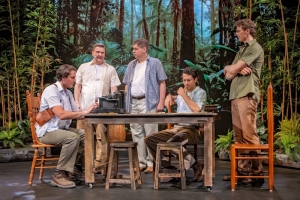
Overshadowed Productions’ Flame of Fire revisits one of the most polarizing true stories in mid‑century missionary history, and the result is a tense, deeply human portrait of faith, conviction, and consequence. Written by Artistic Director Reba Hervas, the play draws not only from the well‑known documentary Beyond the Gates of Splendor and Elisabeth Elliot’s landmark book Through Gates of Splendor, but also from factual accounts, personal testimonies, and historical insights provided by Wheaton College scholars. The play traces the 1956 Operation Auca mission, in which five young missionaries - Jim Elliot, Nate Saint, Pete Fleming, Ed McCully, and Roger Youderian - travel into the Ecuadorian jungle determined to make peaceful contact with the isolated Huaorani tribe. Their optimism is met with tragedy when all five men are killed, an event that reverberated across the world and became a defining moment in evangelical culture. But Flame of Fire doesn’t stop at the violence. It follows the wives and families who later returned to the same tribe, choosing forgiveness over fear and reshaping the narrative into one of radical grace. Hervas frames the story with a clear‑eyed awareness of its complexities, allowing audiences to sit with both the aspiration and the cost. The production leans into the emotional weight of the material without sensationalizing it, offering a thoughtful, layered retelling of a chapter that still resonates today.
The play opens in 1945, grounding the audience in a postwar world where hope and hardship collide, and where five young men feel an urgent, almost electric calling to spread the gospel to places untouched by Western faith. Flame of Fire takes its time introducing each missionary as he meets the woman who will become his partner in life and in purpose, framing these courtships not as sentimental detours but as the emotional backbone of the story. Their marriages are depicted with sincerity and momentum, fueled by a shared passion to carry Christianity into remote corners of the world no one in their circles had ever seen. It’s a gentle beginning that underscores the idealism, devotion, and innocence that will later be tested, making the eventual tragedy feel all the more profound.
Though Jim Elliot is often the first name associated with this story - largely due to Life Magazine’s coverage that reached 30 million readers at the time - Hervas centers the narrative on pilot Nate Saint, portraying him as the driving force behind Operation Auca, its planner, organizer, and steady motivator. By the early 1950s, the missionaries had already arrived in Ecuador and were serving in various regions, ministering to other Indigenous communities and building relationships that laid the groundwork for the efforts that would eventually become Operation Auca. Their work during these years established the practical experience, cultural understanding, and collaborative momentum that shaped the mission long before contact with the Huaorani was ever considered.
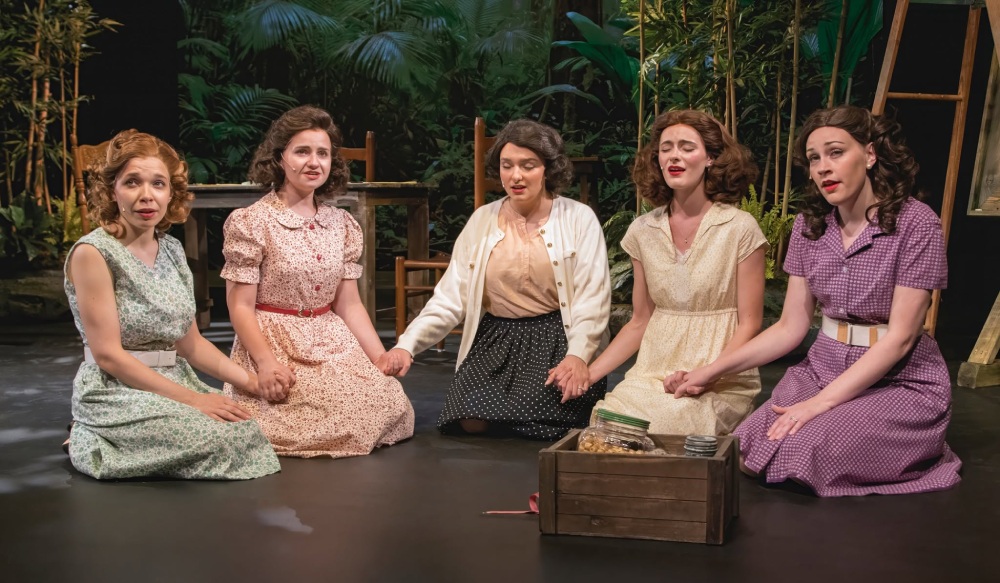
That operation truly begins in 1955 after Saint spots an isolated Indigenous community during one of his flights, a discovery that sets everything that follows into motion. The Huaorani tribe, known for both hostility and intense internal warfare that threatened their own survival, had a population of only about 500 when the missionaries first attempted contact. Their initial introduction came through gifts dropped from Saint’s plane, a cautious gesture meant to build trust from a distance.
Though Saint emerges as the central figure of the mission, Elliot’s influence is still woven throughout the narrative, especially in his declaration that he is God’s “flame of fire,” a metaphor for his calling to spread the gospel with absolute conviction. The play also incorporates several of Elliot’s writings, later collected by his wife Elisabeth after his death, including his well‑known line: “He is no fool who gives what he cannot keep to gain that which he cannot lose.” In the context of the story, the quote underscores Elliot’s belief that sacrificing one’s earthly life in service of faith is not a loss, but an exchange for something eternal - a sentiment that becomes hauntingly resonant as the mission unfolds.
Overshadowed’s ensemble brings sincerity and cohesion to Flame of Fire, with each missionary paired thoughtfully with the woman who shares his calling. Justin McHugh and Leah Johansen anchor much of the story as Jim and Elisabeth Elliot, while Jacob Starr and Emily Starr bring warmth and resolve to Nate and Marjorie Saint. Andrew Dille and Madelyn Jones portray Pete Fleming and Olive Ainslie with gentle conviction, and Alex Kretschmer and Olivia Orsag give Ed and Marilou McCully a grounded, earnest presence. Benjamin Nelson and Betsy Richman round out the group as Roger and Barbara Youderian, offering a steady, heartfelt partnership. Together, the cast forms a unified portrait of faith, devotion, and the human ties that shaped this historic mission.
Jacob Starr’s portrayal of Nate Saint is especially striking. From his first entrance, standing across the stage with the other missionaries, he flashes a wide, earnest smile that feels genuine, full of promise, and quietly selfless. Even though Saint is known as “the man who could fix anything” and often carries himself with a no‑nonsense, mission‑first focus, that smile keeps returning, reminding us of his deep excitement and unwavering joy in the work he feels called to do. And in the moments after his death, when he appears again among the group, the smile remains - a subtle, moving reassurance that he died doing exactly what he believed in most: sharing God’s work with those who had never heard it.
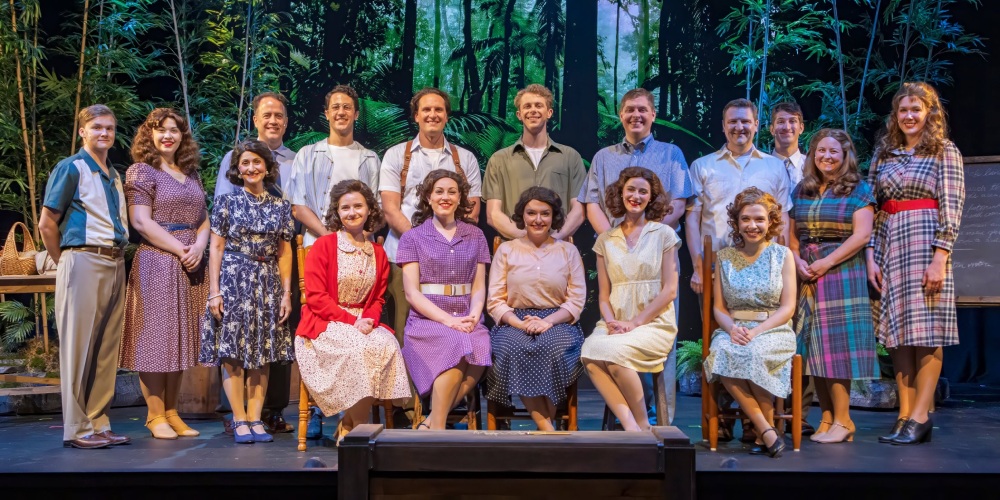
The cast of Flame of Fire by Reba Hervas by Overshadowed Theatrical Productions.
The set design, led by Scenic, Projection, and SFX Designer Yohannan Lee, adds an impressive layer of storytelling to Flame of Fire. Act I moves fluidly through key locations, beginning at Wheaton College where Jim and Elisabeth first meet, then shifting to other formative moments in the missionaries’ early lives. These transitions are made seamless by a massive video board at the rear of the stage, which Lee uses to create crisp, immersive backdrops that keep the narrative visually anchored. But it’s Act II that truly transports the audience: once the story reaches Ecuador, the stage blossoms into a lush rainforest environment. Towering exotic trees, dense shrubs, and textured greenery surround the missionaries’ campsite, blending physical foliage with atmospheric projection work to evoke the depth and isolation of the jungle. The result is a vivid, enveloping world that makes the shift from American college life to the Amazon feel both dramatic and authentic.
Though criticisms have been brought to light in recent years, particularly in cases where missionary work aligned with power, assimilation, or cultural disruption through colonial empires, governments, or corporations, Flame of Fire shows that another side of missionary history exists, revealing a contrasting perspective defined not by dominance but by unselfish people driven by a sincere passion to share the gospel and help communities in need. The missionaries in this story are portrayed as embracing and appreciating Huaorani culture rather than seeking to overwrite it. Their stated purpose, “We are not here to impose, but to show them a new way,” reflects a posture of humility rather than dominance. The production underscores the practical support they offered as well: medical care for infections and injuries, assistance with childbirth, treatment for illnesses, and help navigating crises that had long gone unaddressed. In this telling, their faith is expressed through service as much as through preaching, and their motives are framed as deeply personal rather than political.
The play also widens its scope to reveal the larger forces threatening the Huaorani people in the 1950s. The courage of the wives is made unmistakably clear, returning to the very people who speared their husbands to death with a resolve that feels almost unimaginable. Big oil companies, working with the Ecuadorian government, coveted Huaorani land for new oil fields and expected the tribe’s internal conflicts to wipe them out - and if not, planned to forcibly remove them. That trajectory changed when the missionaries’ wives returned after the killings, some choosing to live among the Huaorani. Their presence helped foster peace, reduce violence, and stabilize the community in ways the play presents as lifesaving. Anthropological research often confirms that the Waodani (the tribe’s self‑name) spearing feuds were unsustainable and that the tribe actively chose to end the killings once introduced to the concept of forgiveness. The population grew instead of disappearing. And in one of the story’s most powerful arcs, the very men who killed their husbands later became Christians themselves, forming lifelong bonds with the missionaries’ families, relationships depicted as genuine, mutual, and rooted in grace. In Flame of Fire, the positive motives of these missionaries are made unmistakably clear, offering a portrait of faith expressed through compassion, reconciliation, and enduring human connection.
Flame of Fire is a moving, meticulously crafted production that balances historical weight with heartfelt storytelling, offering audiences a rare look at the compassion, conviction, and humanity behind a famously tragic chapter of missionary history. Overshadowed Productions brings sincerity, artistry, and emotional clarity to every corner of the stage, creating a piece that resonates long after the final scene. This is a powerful, beautifully rendered play that deserves to be seen, discussed, and remembered. Flame of Fire runs through October 10th and can be experienced at Jubilee Bible Church in Medinah, and comes recommended.
The Attic at Goodman Theatre Redefines Memoir Through Breathtaking Physical Storytelling

At intermission, I sent Ken, Buzz Center Stage’s managing editor, a text: “So thankful I made it!! It’s intermission, and if there’s one show anyone sees it should be this.” By the time the lights came up at the end of The Attic, I couldn’t have agreed with intermission-me more.
The idea behind lifelong circus artist Shana Carroll’s autobiographical play began inside a CT scanner. Watching its bridge move in and out of sight above her, Carroll realized how much of her life could be told through the things she had seen while lying on her back. From her childhood bed to her mother’s and her child’s, from motel rooms to hospital rooms, each view from below held another piece of the story she now wanted to tell.
That story became The Attic: Things I’ve Seen While Lying on My Back, Carroll’s onstage memoir now receiving its world premiere in Goodman Theatre’s Albert Theatre. Carroll, a cofounder of Montreal circus collective The 7 Fingers, the company behind the production, also serves as its writer, director and choreographer.
The Attic perfectly walks the line between abstract and concrete storytelling. The pivotal events and overarching themes of Carroll’s life remain clear and accessible, while circus arts and contemporary dance explore the smaller details and dynamics that traditional narration could never fully capture. This is not a play with circus tricks added to it; it is a singular piece of theatre that replaces conventional blocking with a breathtaking physical language.
Tyler Meredith serves as Carroll’s onstage stand-in, carrying nearly the entire narration while moving alongside – and frequently flying among – the rest of the ensemble. Even within such a heavily collaborative production, Meredith deserves special recognition for the sheer feat of guiding the audience through Carroll’s life with such emotional depth, physical precision, and clarity, all while taking part in the circus work herself.

(Top) Anna Kichtchenko. (L-R, bottom) Melvin Diggs, FranAlvarez, Lucy Tan, Santiago Rivera Laugerud and Eduardo De Azevedo Grillo in The Attic at Goodman Theatre.
Still, The Attic cannot have only one star. Every one of its ten performers is essential to creating the world onstage. The remaining nine rarely leave the audience’s sight, and I defy you to find a moment when any of them is truly still. Rather than waiting at the edges of a scene, they continually ebb and flow with Carroll’s memories, moving like a single current that stretches across the entire stage while remaining connected at every point.
Nothing feels like a transition or choreographed scene change, even though every minute contains (no exaggeration) hundreds of precise decisions, from the subtlest shift in focus to a death-defying catch. If every movement executed by just one performer over ten minutes were written down, the resulting document would be longer than this entire review. The level of detail, polish, and commitment is staggering. Live theatre constantly reaches toward the seemingly impossible goal of appearing this intricate and effortless; The Attic achieves it.
Among an ensemble overflowing with talent, Nancy Luna is especially impossible to look away from. A fearless and mesmerizing flyer, she repeatedly launches herself – or is effortlessly launched by Fran Alvarez – into the air with a freedom that makes even the production’s most difficult feats feel instinctive.
The technical elements are equally precise. Projections, lighting and scenic movement distinguish and layer Carroll’s memories without overwhelming the physical storytelling. Even as performers soar and tumble in the background, the production carefully directs the audience’s focus, allowing the spectacle to strengthen the story rather than distract from it.
Although its explorations of illness, motherhood and mortality are geared more toward adults, The Attic offers enough acrobatics, movement and theatrical imagination to captivate nearly anyone. Carroll’s memoir is the beautiful thread connecting each mesmerizing scene, but every individual sequence is remarkable enough to stand on its own.
Plenty of shows claim to keep audiences on the edge of their seats. Shana Carroll’s The Attic earns that phrase in nearly every possible sense. The Attic: Things I’ve Seen While Lying on My Back runs at Goodman Theatre through October 4. Tickets are available at goodmantheatre.org/show/the-attic.
*Extended through October 11th
Class is back in session with Victory Gardens’ World Premiere of The Humanities
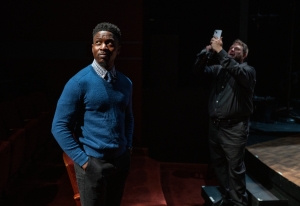
Coincidentally (or not), Victory Gardens’ new play about a controversial campus speaker opens just days after the one-year anniversary of Charlie Kirk’s assassination. Returning from a lengthy hiatus, Victory Gardens once again lights up the Biograph Theater with the world premiere of Zayd Ayers Dohrn’s new play “The Humanities”.
This thrilling play takes place on an American college campus where an opinionated voice is scheduled to speak. At the top level, an intellectual battle brews between professors and the college administration, while the students openly revolt.
Jonas (Ernest Bently) is a new professor on campus, hand selected by the department chair Martin (Steve Pickering) and his professor wife Margot (Naomi Evans). Jonas is young and ambitious, unwilling to get involved in the petty troubles of students and faculty. Martin and Naomi have other ideas. When Martin invites Luka (Daniil Krimer), an ultra-right-wing speaker on campus he kicks off a series of events that could lead the college, and Jonas, to ruin.
Carole (Sabine Wan) straddles the line between education and commerce as the dean while trying to appease the students and queer professor Milta (Isa Arciniegas). On the ground, students Hampton (Derrick Sanders III) and Xander (Piper Murphy) are taking action into their own hands.
Zayd Ayers Dohrn’s script is densely packed, structured in parts much like a college lecture. Each professor has their own somewhat incomprehensible monolog that speaks to how people can say so little with so many words. That’s not to say these passages are empty, and that’s the point. What college student could actually follow these verbal gymnastics though? Perhaps these speeches say more about how some educators are afraid to share their real opinion. Afterall, feelings aren’t facts.
“The Humanities” is a riveting exploration of the cost of free speech. Of course, our first amendment protects it, but it doesn’t account for good taste. Luka is played so smooth and charmingly by Daniil Krimer that you almost forget he’s a neo-Nazi, until he starts his speech. And that’s the unsettling part; under the law he’s just as entitled to hate speech as to tolerance messaging. And that those who criticize him in this play aren’t exactly perfect themselves.
Dohrn paints a rather cynical portrait of higher education, but in other ways he has a lot of faith in youth. Without the radical intentions of Xander and Hampton, there would be no point in rehashing the systematic problems of American academic institutions. In many ways it’s what makes this play so unique.
For those wondering if Victory Gardens has been restored to its former glory under new leadership, “The Humanities” proves they’ve still got it. Edward Torres directs a great cast. While originally billed as starring SNL alum Nora Dunn, British American actress Naomi Evans seems better fit for the role. She has a sleekness about her that makes some of the sexual plotlines a bit more palatable. Steve Pickering embodies that stodgy professor in this era almost as pitifully as Albee’s George was to the 1960s. There’s a certain tragedy in his performance.
While maybe a bit of trimming could help file this play down to a finer point, Victory Gardens choosing Dohrn’s script as their season opener is a brave choice. Almost an admission of self-awareness in an ever-dividing world in which institutions are no longer held on the same pedestals.
Through October 4 at Victory Gardens Theater. 2433 N Lincoln Ave. (773) 871-3000)



Latest Articles
-
 3Arts distributes $860,000 in unrestricted grants to Chicago artists at 3Arts Awards, surpassing $10M in lifetime funding
Written by Buzz Center Stage3Arts, the Chicago-based nonprofit grantmaking organization, awarded $860,000 to Chicago artists and announced the recipients of its 3Arts Next Level Awards—$50,000 unrestricted awards given to past 3Arts awardees—during a festive celebration held last night at the Harris Theater for Music…
-
Guarneri Hall announces two-day series REVOLUTIONS on the intersection between music, politics, and social change November 11-12, 2026
Written by Buzz Center StageThe nonprofit Guarneri Hall, a state-of-the-art, custom-built classical music venue in the heart of downtown Chicago at 11 E. Adams St., proudly announces Revolutions, a two-day music series exploring the intersections of political, social, technological, and musical change at two…
-
The Front Theatre announces casting for the North American Premiere of Sap February 25 - March 27, 2027
Written by Buzz Center StageThe Front Theatre announces casting for the North American premiere of Rafaella Marcus's highly acclaimed play Sap, directed by Charles Riffenburg. Sap is a timely and poetic thriller, in which a woman's lie to her girlfriend threatens to grow out of control when…
-
Hyde Park School of Dance presents annual performances of The Nutcracker December 11–13 at Mandel Hall
Written by Buzz Center StageHyde Park School of Dance, now in its 33rd year of training, performance, and community, welcomes families and dance enthusiasts to its annual, one-of-a-kind presentation of The Nutcracker. Performances are December 11–13 at Mandel Hall on the University of Chicago…


Does your theatre company want to connect with Buzz Center Stage or would you like to reach out and say "hello"? Message us through facebook or shoot us an email at This email address is being protected from spambots. You need JavaScript enabled to view it..
*This disclaimer informs readers that the views, thoughts, and opinions expressed in the text belong solely to the author, and not necessarily to Buzz Center Stage. Buzz Center Stage is a non-profit, volunteer-based platform that enables, and encourages, staff members to post their own honest thoughts on a particular production.