
Items filtered by date: November 2007
Announcing Goodman's 22nd New Stages 2026 Festival Line-Up

From a "Kung Fu rom-com" to a witchy new musical, The Goodman's popular New Stages Festival in its 22nd year continues to offer a first glimpse at the latest works by a handful of the hottest contemporary playwrights. This year's four-play line-up includes Bruceploitation by Qui Nguyen (Vietgone); House Gyalz by Abigail C. Onwunali (Blood Be Sweet); Shook by Mike Lew (A Beat of Our Own) with music and lyrics by Zoe Sarnak (Galileo) and Wonderland by Will Eno (Thom Pain). Under Walter Artistic Director Susan V. Booth and Director of New Works Kat Zukaitis, this annual offering showcases works-in-progress in the intimate 400-seat Owen Theatre. Theater industry professionals are invited to Professionals Weekend (December 11-13), which includes special events and opportunities for networking. This year, Professionals Weekend includes readings of new works by The Goodman's 2026 New Stages Residency playwrights: Black-Eyed Peas & Collard Greens by Lachrisa Grandberry and The Last Time We Saw Them by William Glick. New Stages appears December 5-13; tickets are free and available starting October 30 at 10am at the Box Office (170 N. Dearborn), at 312.443.3800 or online at GoodmanTheatre.org/NewStages. Theater professionals interested in Professionals Weekend should RSVP by November 30 at GoodmanTheatre.org/Professionals. The Goodman is grateful for the support of The Joyce Foundation (Major Support for Diverse Artistic and Professional Development).
22nd NEW STAGES FESTIVAL LINE-UP | Owen Theatre
Bruceploitation
By Qui Nguyen
Directed by May Adrales
Readings: December 5 at 7pm and December 12 at 7:30pm
After Bruce Lee's death, a struggling Asian American actor gets his big Hollywood break... by replacing the legend... despite not knowing a lick of kung fu. Sparks fly when he meets the badass Black stuntwoman hired to train him, who's tired of making everyone else look like a hero while she stays out of frame. Turns out learning to throw a punch is way easier than keeping their hands off each other. A Kung Fu rom-com.
Qui Nguyen is an Emmy-Award winning tv writer, filmmaker, playwright, and co-founder of the pioneering geek theatre company, Vampire Cowboys. Notable plays include Vietgone, Poor Yella Rednecks, Bike Wreck, and the acclaimed Vampire Cowboys productions of She Kills Monsters (recently awarded a 2024 Kennedy Center College Theatre Festival Gold Medallion Award), Revenge Song, Soul Samurai, The Inexplicable Redemption of Agent G, Alice in Slasherland, Fight Girl Battle World, and Living Dead in Denmark. For TV/Film, he's written for Marvel Studios, Netflix, AMC, SYFY, PBS. He most recently penned Disney's Raya and the Last Dragon (nominated for a 2022 Academy Award for Best Animated Feature) and co-directed and wrote Disney's Strange World. Qui is a proud member of the WGA and a board member of New Dramatists.
House Gyalz
By Abigail C. Onwunali
Directed by Lili-Anne Brown
Readings: December 8 at 7pm and December 13 at 11am
House Gyalz follows two Nigerian housemaids as they spiral into dangerous roleplay, examining class, power, and womanhood. When unexpected news raises the stakes of their games, they will pull out all the stops to survive. Blending sharp satire with explosive theatricality, Abigail C. Onwunali's dark comedy is a contemporary take on Jean Genet's classic The Maids.
Abigail C. Onwunali is a Nigerian-American storyteller working across playwriting, performance, and poetry. Her plays have been developed with New York Theatre Workshop, Red Bull Theater, Ensemble Studio Theatre, Liberation Theater Company, Fault Line Theatre, and Yale Cabaret. Her play Blood Be Sweet will be part of New York Theatre Workshop's 2026–27 season. She is a 2025 New Harmony Project Fellow and recipient of the 2025 Irons in the Fire Residency, 2026 La MaMa Experiments in Playwriting Fellowship, 2026 Page 73 Writers Group, and 2025–26 NYTW 2050 Artistic Fellowship. She is a member of EST's Obie Award-winning Youngblood collective.
Shook
Book by Mike Lew
Music and Lyrics by Zoe Sarnak
Directed by Moritz von Stuelpnagel
Reading: December 11 at 7:30pm
Something is rotten at Camp Avon, the prestigious Shakespeare summer camp for teens. Is it the star-crossed lovers facing a stage kiss? The stage management intern who wants a chance to perform so badly that she disguises herself as a camper? Or the fact that there are actual witches in the woods? All the woods a stage and all the campers merely players in this angsty musical ode to the eternal power of theatre.
Mike Lew's plays include tiny father (Geffen, Barrington/Chautauqua, Audible); Teenage Dick (Donmar Warehouse, Ma-Yi/Public, Wooly Mammoth, Huntington, Artists Rep); Tiger Style! (TheatreWorks, SCR, Olney, Huntington, La Jolla, Alliance); Bike America (Ma-Yi, Alliance); microcrisis (Ma-Yi, InterAct); Alpha Asians; and How To Manong. His plays are currently in rep at Profile Theater. Musicals: A Beat of Our Own with Sam Willmott and Rehana Mirza (McCarter, La Jolla, Birmingham Rep); Shook with Zoe Sarnak (Northern Stage/Goodman commission); and Love Somebody with Betty Who and Rehana Mirza. Awards/Fellowships: Guggenheim, Mellon, PEN, Dramatists Guild Council/Tony Voter, New Dramatists, EST, Venturous, NYFA, MAP, Richard Rodgers, Kleban, Lanford Wilson, Helen Merrill, Weissberger, Kendeda, Heideman. Education: Juilliard, Yale.
Zoe Sarnak is a Drama Desk–nominated and Larson Award–winning composer, lyricist, writer and orchestrator, as well as a finalist for the Ebb and Kleban Awards. Upcoming and recent works include: Galileo (with Danny Strong and Michael Weiner) opening on Broadway in 2026; NY Times Critic's Pick The Lonely Few (with Rachel Bonds) at MCC and Geffen Playhouse; Empire Records (with Carol Heikkinen) at McCarter Theatre; Particle Fever (with David Henry Hwang and Bear McCreary) premiering at La Jolla Playhouse in February 2027; A Beautiful Mind (with Sarah Treem); The Invisible Line (with Christopher Oscar Peña and Mark St. Germain) and others soon to be announced. Her work has been developed and produced at Second Stage, The Public, Roundabout Theatre Company, New York Theatre Workshop, Williamstown Theatre Festival, Geffen Playhouse, and MCC, among others. Her music has been featured by NY Times Live and the Guggenheim.
Wonderland
By Will Eno
Directed by Susan V. Booth
Reading: December 12 at 2pm
After a punishing decade-long exile in Europe, Orson Welles returns to Hollywood for a one-night only reading of Lewis Carrol's Alice in Wonderland. The borders between fiction and real life—and between his outward wants and inner demons—begin to break down, as Alice's journey becomes hopelessly entangled with Orson's past, and the evening takes a wild turn into the present. From Obie-Award winning playwright Will Eno, Wonderland paints a hopeful, tender, and at times surreal portrait of humanity and reality in the modern age.
Will Eno lives in Brooklyn and is a Pulitzer Finalist in Drama and winner of the Obie, Lortel, and Drama Desk awards. He wrote the book for the massively successful Skittles Commercial: The Broadway Musical, which won 7 Golden Lion awards at Cannes and 9 Clio Awards. Will teaches playwriting, most recently at Princeton University, and he mentors students at Columbia and elsewhere. His daughter Albertine acted in a workshop of her dad's new play The Green Room at the Gate Theatre in Dublin in 2025. Will was thrilled and honored to work for several years with the late and much-missed documentary film director Frederick Wiseman, who oversaw the French translation of his play The Realistic Joneses and was preparing to direct its premiere on the Paris stage in 2026. In addition to plays, Will also writes for television and film.
PROFESSIONALS WEEKEND READINGS | Alice Center for Education and Engagement
Black-Eyed Peas & Collard Greens
By Lachrisa Grandberry
Directed by J. Nicole Brooks
Reading: December 11 at 3pm
In a West Side Chicago apartment building, three families prepare to welcome the New Year with the beliefs, strategies, and secrets they've relied upon for generations. But what happens when our traditions no longer align with our reality? Black-Eyed Peas & Collard Greens is a multi-generational ensemble dramedy about inheritance and what happens when those inherited truths stop serving us. Funny, heartfelt, and deeply human, Lachrisa Grandberry's newest play explores how tradition comforts us, when it confines us, and what remains when we're finally brave enough to choose something new.
Lachrisa Grandberry is a Milwaukee-born, Chicago-based playwright, lyricist and poet whose work holds space for healing, liberation and joy. Her stories are a tapestry woven from the voices and experiences of many—especially black women and girls navigating the weight of inherited patterns and unspoken truths. A 2024 Dramatists Guild Foundation National Musical Theater Fellow, she also serves as Director of NOVA Programming at Northern Sky Theater, where she curates safe spaces for writers to explore and amplify their voices. In 2022, she was named one of Wisconsin's 52 Most Influential Black Leaders. Whether through her published poetry (Shredding Rugs) or her theatrical works, Lachrisa believes that storytelling is a way to learn, unlearn, release and heal. "I know that my stories are not my own," she writes. "They belong to all of us." More at lachrisagrandberry.com
The Last Time We Saw Them
By William Glick
Directed by Jessica Fisch
Reading: December 12 at 10am
In 1983, Tess, Sasha, and Amelia are young writers hoping to make their marks on Ronald Reagan's Washington. As the years pass, their lives—and the Conservative Movement that brought them to power—are made unrecognizable by wars abroad and division at home. Spanning four turbulent decades, from the fall of the Berlin Wall to the beginning of the second Trump administration, The Last Time We Saw Them tells the story of three exceptional women whose ideals, rivalries and love of country and each other help forge the America of the 2020s.
William Glick is a Chicago-based playwright who was born and raised in Pompano Beach, Florida. His plays include The Last Time We Saw Them, Felt (Clubbed Thumb Emerging Writers Group), The Bigot (UT New Theatre), Kin Folk (World Premiere, The New Colony), the libretto for the children's opera Cry Wolf (Crane Prize for Performing Arts), and The Winter Farm (House Theatre Performance Lab). His work has been a finalist for the Bay Area Playwrights Festival and the Heideman Award and shortlisted for the Relentless Award, the Ojai Playwriting Conference, and PlayPenn. He received his BA in Political Science from the University of Chicago and his MFA in Writing from the Michener Center at the University of Texas-Austin.
ABOUT THE GOODMAN
Since 1925, The Goodman has been a theatrical home for artists and a gathering space for Chicagoland, where bold stories spark connection, conversation and change. Now, as it enters its second century, The Goodman builds on that legacy with an eye toward the future. Under the leadership of Walter Artistic Director Susan V. Booth and Executive Director John Collins, the theater continues to champion new work—following hundreds of plays developed and a national reputation for commissioning and premiering original stories by living writers—while reimagining classics and produce large-scale musicals.
But The Goodman's reach today extends beyond its home in the heart of the Loop. From the intimate magic of The Magic Parlour, now in its third year, to the boundary-pushing world of Theater of the Mind—an immersive experience that blurs the lines between science, storytelling and sensation—and from citywide initiatives like 100 Free Acts of Theater to partnerships with artists and companies across Chicago and around the world, The Goodman is expanding what theater can be, and where it can live.
At its core, The Goodman is driven by a belief that a more empathetic, more connected city is built one story at a time. Generation-spanning productions and programs offer theater for a lifetime—from babies and young children to teens, adults and seniors—including Theater for the Very Young (ages 0–5) and the beloved annual A Christmas Carol, which has welcomed audiences for five decades. Education and Engagement programs, led by Clifford Director Jared Bellot and based in the Alice Rapoport Center, use the tools of theater to spark imagination, reflection and belonging—reaching thousands each year, the majority from underserved communities.
With nearly 200 world or American premieres, two Pulitzer Prizes, 22 Tony Awards and nearly 200 Joseph Jefferson Awards, The Goodman remains a defining force in American theater—and the first to produce all 10 plays of August Wilson's American Century Cycle. The theater also frequently serves as a production partner—from national and international companies to Chicago's Off-Loop theaters—to help amplify a wide range of theatrical voices.
Founded by William O. Goodman and his family in memory of playwright Kenneth Sawyer Goodman, the theater carries forward a legacy of artistic ambition and civic generosity. With the help of Mr. Goodman's descendants—Albert Ivar Goodman and his late mother, Edith-Marie Appleton—that spirit continues to shape its future as The Goodman expands its impact across Chicago and beyond. Marsha Cruzan is Chair of the Goodman Theatre Board of Trustees; Diane Landgren is Women's Board President; and Christopher Way is president of the Scenemakers Board for Young Professionals.
The Goodman stands on the unceded homelands of the Council of the Three Fires—the Ojibwe, Odawa, and Potawatomi Nations—and acknowledges the many other Nations for whom this land now called Chicago has long been home, including the Myaamia, Ho-Chunk, Menominee, Sac and Fox, Peoria, Kaskaskia, Wea, Kickapoo, and Mascouten. The Goodman is proud to partner with the Gichigamiin Indigenous Nations Museum (Gichigamiin-Museum.org) and the Center for Native Futures (CenterForNativeFutures.org)—organizations devoted to honoring Indigenous stories, preserving cultural memory, and deepening public understanding.
TIMELINE THEATRE’S 100TH PRODUCTION, THE CHICAGO PREMIERE OF LAURA WADE’S HOME, I’M DARLING, DIRECTED BY MECHELLE MOE, SATIRIZES THE SEDUCTIVE FANTASY OF A “SIMPLER PAST,” NOVEMBER 11 - DECEMBER 13

|
|
|
LOCATION/PARKING/TRANSPORTATION
TimeLine’s new home is located at 5035 N. Broadway (at Argyle) in the heart of Chicago’s Uptown community.
TimeLine Theatre is easily reached via public transportation, located steps away from the CTA Red Line stop at Argyle. The #36 Broadway bus stops at Broadway and Argyle, the #151 Sheridan stops three blocks east at Argyle, and the #81 Foster stops at Broadway and Foster, just two blocks north.
Convenient parking is a new hallmark for TimeLine Theatre. The self-park garage at 5051 N. Broadway, two doors north of the theatre, offers up to 6 hours of parking for $10, with validation. Ask for a validation sticker from TimeLine’s Audience Services staff. The self-park surface lot at 5017 N. Winthrop in the heart of Asia on Argyle also offers discounted parking for up to 6 hours for just $7 via an app and QR code.
Nearby street and metered parking is available but limited. Please note some streets are zoned for resident parking only. Visit timelinetheatre.com/venues/timeline-theatre for additional information, including driving directions and nearby dining recommendations.
|
|
|
|
|
Court Theatre announces America@250 - Now is the Time: Artists Go to Work

Under the leadership of Marilyn F. Vitale Artistic Director Avery Willis Hoffman and Executive Director Angel Ysaguirre, Court Theatre proudly presents America@250 – Now is the Time: Artists Go to Work, a curated set of events programmed in partnership with The Toni Morrison Foundation, Illinois Humanities, Reva and David Logan Center for the Arts, Smart Museum of Art, and UChicago Arts. Programming also includes events presented by the University of Chicago Division of Arts & Humanities, Arts + Public Life, Institute of Politics, UChicago Presents, and the Graham School. Events in the series will run from October through December at venues throughout Chicago.
Spanning theatre, visual art, music, public conversations, workshops, and community gatherings, America@250 – Now is the Time: Artists Go to Work brings together artists, cultural leaders, scholars, and audiences to explore the meaning of America's 250th anniversary through the lens of art and civic life. Taking place at cultural institutions and venues across Chicago, the series examines the nation's history, the complexities of its founding ideals, and the ongoing pursuit of freedom, identity, and belonging. Through exhibitions, performances, artist-led discussions, and opportunities for public participation, the program highlights the role of artists in challenging established narratives, fostering dialogue, and imagining what America's next 250 years might look like.
On July 4, 2026, America turned 250 years old. To reckon with the 250th anniversary of the Declaration of Independence is to reckon with freedom declared in words long before it was lived in practice, and grapple with a history that has constantly faced erasure.
Toni Morrison taught that the measure of a nation is not in its monuments, but in the stories it has the courage to face. In the face of all the forces daunting the spirit, she famously wrote: "This is precisely the time when artists go to work. There is no time for despair."
A collective of institutions and organizations from across the University of Chicago—along with Illinois Humanities, in partnership with The Toni Morrison Foundation—have partnered to curate a suite of events that respond to Morrison's charge and amplify the deeply inspirational and vital creative work produced by Chicago-based artists working at the intersection of art and civic life.
In convening artists, thinkers, and communities, we invite you to collectively reflect on and illuminate the unfinished work this anniversary makes so strikingly apparent. All events are open to the public.
Attendees are encouraged to curate their experience from a menu of offerings:
- Ongoing: Illinois Voices 250 (Illinois Humanities)
- Ongoing: Nina Chanel Abney: Between Us (Smart Museum of Art)
- Ongoing: Charles White Across Media: A Visual Archive (Reva and David Logan Center for the Arts)
- October 17: Family Day: Proud to Be Me (Smart Museum of Art)
- October 28: "The Pursuit": A People's Salon (Illinois Humanities)
- October 29: Unfixed: Identity, Expression & Creative Freedom, a Workshop with Jenn Freeman | Po'Chop (UChicago Arts)
- November 4: Threshold: Conversations on the Stoop, featuring Candace Hunter and Cathy Coen (Arts+Public Life)
- November 5: Court Convening 1: America@250 (Court Theatre)
- November 6: Arts and America at 250: We Stand at the Intersection of Creativity and Politics (Keynote Conversation) (Court Theatre and the Institute of Politics)
- November 6: Artists Go to Work (Keynote Conversation)
- November 6: Artists Go to Work (Breakout Sessions)
- November 6: Exhibition Opening of Charles White Across Media: A Visual Archive (Reva and David Logan Center for the Arts)
- November 6: Craig Taborn Trio (UChicago Presents)
- November 7: University of Chicago Arts & Humanities Day (University of Chicago Division of Arts & Humanities)
- November 10: Rear View Mirror Session with Duane Powell (Arts+Public Life)
- November 11: Could AI Put Our Democracy at Risk? (University of Chicago Graham School)
- November 18: Reflecting through Objects A Logan CenterWorkshop Led by Emily Hooper Lansana and William Estrada (Reva and David Logan Center for the Arts)
- December 10-20: Tituba, by Winsome Pinnock (Court Theatre)
- December 14: Tituba: Artist Talk Featuring esperanza spalding and Josephine Lee in Conversation with Avery Willis Hoffman (Court Theatre)
All events are open to the public. Tickets can be obtained from the respective venues presenting each program, or via the links on courttheatre.org.
ABOUT THE EVENTS
Illinois Voices 250
A statewide time capsule of conversations with people in all 102 Illinois counties, this project celebrates and preserves the voices of everyday Illinoisans: who we are, what we care about, and what we think is important about this moment in our country's history.
Dates: Ongoing
Presented by: Illinois Humanities
Nina Chanel Abney: Between Us
Experience Abney's large-scale mural that takes the most familiar images of American life—drawn from children's diagrams, advertising, sports, cartoons, and the news—and turns them against themselves.
Dates: Ongoing through July 2027
Presented by: Smart Museum of Art (Threshold Series)
Charles White Across Media: A Visual Archive
Bringing together album covers, book jackets, magazines, film stills, photographs, prints, and other ephemera featuring the work of Charles White (1918-1979), this exhibition examines the expansive cultural life of his imagery.
Date: November 6, 2026 - January 31, 2027
Presented by: Reva and David Logan Center for the Arts
Family Day: Proud to Be Me
Create a colorful self-portrait collage with guidance from exhibiting artist Nina Chanel Abney. Free participation; registration is requested.
Date: Saturday, October 17, 2026
Time: 10:00am - 1:00pm
Location: Smart Museum of Art (5550 S Greenwood Ave, Chicago, IL 60637)
Presented by: Smart Museum of Art
"The Pursuit": A People's Salon
Featuring commissioned work from Lisa Beasley, INSÉKTA, Mark Turcotte, avery r. young, and Ariel Zetina.
Date: Wednesday, October 28, 2026
Time: 6:00pm - 9:00pm
Location: Ramova Theatre (3520 S Halsted St, Chicago, IL 60609)
Presented by: Illinois Humanities
Unfixed: Identity, Expression & Creative Freedom, a Workshop with Jenn Freeman | Po'Chop
Through movement, reflection, improvisation, and collaborative exercises, participants will consider how identity shapes and informs how we express ourselves, how we are seen by others, and what we believe is possible. Participants should wear comfortable clothing they can move in and bring materials to write with.
Date: Thursday, October 29, 2026
Time: 4:00pm - 6:00pm
Location: Harris Studio, Green Line Performing Arts Center (329 E Garfield Blvd, Chicago, IL 60637)
Presented by: UChicago Arts
Threshold: Conversations on the Stoop, featuring Candace Hunter and Cathy Coen
Threshold: Conversations on the Stoop is a series of public talks that take place on the front porch within the Intentionality, 1960: Whose Dreams? exhibition. Candace will be in conversation with a host of scholars, artists, archivists and neighbors around questions of race, residential space, displacement, memory, and belonging.
Date: Wednesday, November 4, 2026
Time: 6:00pm - 8:00pm
Location: Arts Incubator Gallery (301 E Garfield Blvd, Chicago, IL 60637)
Presented by: Arts+Public Life
Court Convening 1: America@250>
Date: Thursday, November 5, 2026
Arts and America at 250: We Stand at the Intersection of Creativity and Politics
Keynote Conversation
Artists, curators, and journalists explore America@250 through the cultural, political, and aesthetic lens of now.
Date: Friday, November 6, 2026
Time: 12:30pm - 1:45pm
Location: Penthouse, Reva and David Logan Center for the Arts (915 E 60th St, Chicago, IL 60637)
Presented by: Court Theatre and the Institute of Politics at the University of Chicago
Artists Go to Work
Keynote Conversation
Continuing our artist-centered examination of America@250, our second keynote features a conversation between Chicago-based artists who work at the intersection of art and civic life, nominated through a partnership between Illinois Humanities, Court Theatre, UChicago Arts, Smart Museum of Art, and the Reva and David Logan Center for the Arts.
Date: Friday, November 6, 2026
Time: 2:30pm - 4:00pm
Location: Penthouse, Reva and David Logan Center for the Arts (915 E 60th St, Chicago, IL 60637)
Presented by: Court Theatre, UChicago Arts, the Smart Museum of Art, the Reva and David Logan Center for the Arts, and Illinois Humanities.
Artists Go to Work (Breakout Sessions)
Interactive breakout sessions hosted by Chicago-based artists who work at the intersection of art and civic life, nominated through a partnership between Illinois Humanities, Court Theatre, UChicago Arts, Smart Museum of Art, and the Reva and David Logan Center for the Arts.
Date: Friday, November 6, 2026
Time: 4:30pm - 6:00pm
Location: Penthouse, Reva and David Logan Center for the Arts (915 E 60th St, Chicago, IL 60637)
Presented by: Court Theatre, UChicago Arts, the Smart Museum of Art, the Reva and David Logan Center for the Arts, and Illinois Humanities.
Exhibition Opening of Charles White Across Media: A Visual Archive
Bringing together album covers, book jackets, magazines, film stills, photographs, prints, and other ephemera featuring the work of Charles White (1918-1979), this exhibition examines the expansive cultural life of his imagery. Join our partners for this exciting opening!
Date: Friday, November 6, 2026
Time: 6:00pm - 8:00pm
Location: Reva and David Logan Center for the Arts
Presented by: The Reva and David Logan Center for the Arts, South Side Community Art Center, UChicago Arts, the Division of The Arts & Humanities.
Craig Taborn Trio
A frequent collaborator with Tomeka Reid and Vijay Iyer, Taborn and his Trio create a sound that is immersive, audacious, and unequivocally jazzy.
Date: Friday, November 6, 2026
Time: 7:30pm
Location: Performance Hall, Reva and David Logan Center for the Arts (915 E 60th St, Chicago, IL 60637)
Presented by: University of Chicago Presents, in partnership with the Logan Center for the Arts, Chicago Jazz Magazine, DownBeat, Jazz Institute of Chicago, and WDCB 90.9 FM.
University of Chicago Arts & Humanities Day
Now in its 46th year, UChicago Arts & Humanities Day 2026 celebrates the writers, artists, and public intellectuals grappling with the questions and concerns that shape our world.
Date: Saturday, November 7, 2026
Time: Various times
Location: Various locations
Presented by: University of Chicago | Division of Arts & Humanities and Chicago Humanities
Rear View Mirror Session with Duane Powell
Since 2017, the Quintessential Listening and Lecture Series led by music historian and DJ Duane Powell has taken audiences on a journey through the lives of musical legends and heroes. The series continues with a special celebration of Marvin Gaye, the Prince of Motown. Musical guest to be announced soon!
Date: Sunday, November 10, 2026
Time: 6:00pm - 9:00pm
Location: Performance Hall, Reva and David Logan Center for the Arts (915 E 60th St, Chicago, IL 60637)
Presented by: Arts+Public Life and the Reva and David Logan Center for the Arts, in partnership with Soundrotration and Brain Trust Management. Artist and event support provided by The Toni Morrison Foundation.
Could AI Put Our Democracy at Risk?
As AI reshapes nearly every aspect of modern life, how will it impact our democracy?
Date: Monday, November 11, 2026
Time: 5:45pm - 7:30pm
Location: The University of Chicago Gleacher Center (450 Cityfront Plaza Dr, Chicago, IL 60611)
Presented by: The University of Chicago's Graham School
Reflecting through Objects A Logan Center Workshop Led by Emily Hooper Lansana and William Estrada
A blend of oral storytelling and visual response, this interactive workshop is an opportunity to examine the connection between objects and memory.
Date: Monday, November 18, 2026
Time: 5:30pm - 8:30pm
Location: Penthouse, Reva and David Logan Center for the Arts (915 E 60th St, Chicago, IL 60637)
Presented by: Reva and David Logan Center for the Arts
Tituba, by Winsome Pinnock
A multidisciplinary theatrical spectacle in an iconic location featuring original music by Grammy Award-winner esperanza spalding. A bonfire of laughter. A shift in perspective that fundamentally alters how we view an American classic. She will make the Reverend pay.
Date: December 10 - 20, 2026
Time: Various times
Location: Rockefeller Memorial Chapel (5850 S Woodlawn Ave, Chicago, IL 60637)
Presented by: Court Theatre
Tituba: Artist Talk Featuring esperanza spalding and Josephine Lee in Conversation with Avery Willis Hoffman
A special artist talk exploring the vibrant sonic world, melodies, and rhythms of Court Theatre's Tituba.
Date: Monday, December 14, 2026
Time: 6:00pm - 7:30pm
Location: Performance Hall, the Reva and David Logan Center for the Arts (915 E 60th St, Chicago, IL 60637)
Presented by: Court Theatre
Winner of the 2022 Regional Theatre Tony Award, Court Theatre reimagines classic theatre to illuminate our current times. In residence at the University of Chicago and on Chicago's historic South Side, we engage our audiences with intimate and provocative experiences that inspire deeper exploration of the enduring questions that confront humanity and connect us as people.
JK Entertainment presents WHEN WE WERE YOUNG AND UNAFRAID at Greenhouse Theater Center November 12 – 29, 2026

JK Entertainment has released first look rehearsal photos for WHEN WE WERE YOUNG AND UNAFRAID, the first production of the company's second season. JK Entertainment's production brings this story to Chicago audiences November 12–29, inviting audiences to consider how far the fight for women's autonomy has come—and how much remains unresolved.
In a time before Roe v. Wade and the Violence Against Women Act, Agnes has transformed her quiet bed and breakfast into a refuge for women escaping domestic violence. But when Mary Anne, a new arrival, begins to influence Agnes's college-bound daughter, Penny, the carefully maintained boundaries of Agnes's world begin to shift. As ideas of freedom and independence take hold beyond the walls of her home, Agnes must confront her own assumptions about the women she has dedicated her life to helping.
Through intimate relationships and generational tensions, WHEN WE WERE YOUNG AND UNAFRAID examines the complexities of protection, independence, and what it means to determine one's own future. Though set more than five decades ago, the play raises questions that continue to resonate today.
JK Entertainment will donate $1 of every ticket sold to Connections for Abused Women and their Children, a Chicago organization that provides aid and resources for survivors of domestic violence.
Performances begin November 12, 2026, with tickets available now at jkentertainment.org/theatre/when-we-were-young-and-unafraid.
WHEN WE WERE YOUNG AND UNAFRAID is presented by arrangement with Concord Theatricals on behalf of Dramatists Play Service. www.concordtheatricals.com
TICKET INFORMATION
Individual tickets priced from $36 - $41 and group sales for 5 or more are available now. This production is a part of the full season subscription starting at $70. For additional information and to purchase tickets, visit jkentertainment.org/theatre/when-we-were-young-and-unafraid.
Greenhouse Theater Center 2257 N Lincoln Ave. Chicago, IL 60614 November 12 – 29, 2026
ABOUT JK ENTERTAINMENT
JK Entertainment is a Chicago-based nonprofit producing theatre, film, music, and other media for audiences who think differently. Founded by Jonathan James, Kyle Reid Hass, and Olivia Kaye Da Silva, in the wake of a sold-out Chicago run of The Outsiders, the company champions bold, boundary-pushing work at the intersection of art and activism.
To learn more about JK Entertainment and keep up with future projects visit jkentertainment.orgFollow JK Entertainment on Instagram, TikTok, and Facebook #jkentertainment
Trap Door Theatre Presents the World Premiere of OH, BUDDY, by Hal Cosentino. Opening November 12th, 2026

Trap Door Theatre is thrilled to continue its 33rd season with a Chicago Premiere of Oh, Buddy, written by Hal Cosentino and directed by Jeremy Ohringer. Oh, Buddy will play November 12th – December 19th, 2026 at Trap Door Theatre, 1655 W Cortland St. in Chicago. Tickets are now on sale at trapdoortheatre.com or by calling (773)-384-0494.
It's hard to be the New Guy in the world's most generic office. It's even harder to be the New Guy when you're the New Guy because you came out as transgender. And has anybody noticed that the boss is a Big Furry Monster? OH, BUDDY is a dark, absurdist comedy about how the bizarre demands of binary gender affect the way we take on roles in the workplace and beyond.
PRODUCTION DETAILS:
Title: Oh, Buddy
Author: Hal Cosentino
Director: Jeremy Ohringer
Cast (in alphabetical order): Jack Bowes (New Guy), Haven Crawley (Emery), Mackenzie Jones (Lady), Shail Modi (Buddy), and Dustin Valenta (Dude).
Location: Trap Door Theatre, 1655 W. Cortland St. Chicago, IL 60622
Regular Run: Thursday, November 12th –Saturday, December 19th, 2026 (No performances on 11/26-28)
Curtain Times: Thursdays, Fridays, and Saturdays at 8:00 pm. Sundays 12/6 and 13 at 3:00 pm. With a special performance on Sunday, December 6th at 3:00 pm including a talk back after the performance with the playwright.
Tickets: $25. Tickets are currently available at https://our.show/oh-buddy or by calling (773) 384-0494.
Announcing the Cast of the 49th A CHRISTMAS CAROL

Tis the season, in spite of today's unseasonable temps, as A Christmas Carol begins rehearsals for The Goodman's 49th annual production of Charles Dickens' classic favorite. This year, a new Scrooge—Tim Hopper, acclaimed longtime Chicago actor—joins the production, directed by BOLD Artistic Producer Malkia Stampley for her second year. In addition, 11-year-old Sanjana Suraj (City of Lights Theatre's Annie) makes her Goodman debut as Tiny Tim, plus newly cast ghosts—Ghost of Christmas Past Rae Gray (Graveyard Shift), Ghost of Christmas Present Lachrisa Grandberry (The Color Purple) and the Ghost of Jacob Marley Gavin Lawrence (Dartmoor Prison). Other new faces among the 34-member company include Chad Bay (Remy Bumppo's Art), Sunnie Eraso (Lookingglass Theatre's White Rooster), Joryhebel Ginorio (Raven Theatre's Octet), Jyreika Guest (Definition Theatre's Cypress Bayou), Jourdan Lewanda (Steep Theatre's Our Dear Dead Drug Lord) and Amy Vargas Rivera (Wolf at The Door). Young performers Austin Hartung and Rio Lewis make their Goodman debuts, joined by three returning young performers: Ella Boparai—last year's Tiny Tim—Viva Boresi and Henry Lombardo. Rom Barkhordar (Yasmina's Necklace) joins the company as Scrooge for 10 performances. A Christmas Carol runs November 13 through December 31 (opening night is November 23) in the 856-seat Albert Theatre. For tickets ($34 - $188, subject to change), visit the Box Office (170 N. Dearborn), call 312.443.3800 or purchase online at GoodmanTheatre.org/Carol. The Goodman is grateful for the support of PNC (Major Corporate Sponsor).
Millions have rediscovered Dickens' classic at The Goodman over the past five decades—and know why it's "the best Christmas story ever told!" (Time Out Chicago). Follow the miserly Ebenezer Scrooge (Tim Hopper) as ghostly intervention transforms his holiday disdain into delight one fateful Christmas night. This timeless production, long heralded for its "first-rate cast and marvelous staging" (Chicago Sun-Times), is not to be missed.
ABOUT THE ARTISTS
Tim Hopper (Ebenezer Scrooge) last appeared at The Goodman in 2017 as Vanya in Uncle Vanya. He is a Steppenwolf Theater Company ensemble member and has appeared in many plays there, most recently Catch As Catch Can. He will be appearing in the upcoming A24 film Enemies, and also in Trash Mountain. Other films credits include School of Rock and To Die For. Television credits include Chicago Fire, Amazon's Utopia, Emperor of Ocean Park and Fargo, among others.
Rom Barkhordar's (Alternate Ebenezer Scrooge) Goodman Theatre credits include: Yasmina's Necklace, Ruined. Chicago credits include: A Prayer for the French Republic (Northlight); A Lie of the Mind (Raven Theatre); White Christmas (Marriott Theatre); The Band's Visit, A Distinct Society, Wife of a Salesman (Writer's Theatre); Mosque4Mosque (About Face Theatre); Acts of God, Around the World in 80 Days (Lookingglass Theatre); The Elephant Man, Homebody/Kabul (Steppenwolf Theatre Company); Pravda, Halcyon Days, Not About Nightingales (Timeline Theatre). Regional credits include: The Band's Visit (TheatreSquared); The Art of Burning (Huntington).
Sanjana Suraj (Tiny Tim) is thrilled to make her Goodman Theatre debut in A Christmas Carol! Her recent stage credits include Young Fiona in Shrek and Lash in Dragon Jr. (Theater on the Hill); Orphan in Annie (City of Lights Theatre); and Young Krishna in Krishna Dance Ensemble (Samskriti). A dedicated musician and performer, Suraj trains in classical Indian music and dance, sings with her school's Honors Chorus, and is currently learning the flute. Offstage, you'll find her jamming to new tunes or immersed in her latest creative art project.
Malkia Stampley (Director) is a three-time Jeff-nominated director from Milwaukee and The Goodman's BOLD Artistic Producer since 2021. Goodman Theatre directing credits: Covenant, A Christmas Carol, BUST (associate director), Primary Trust, In My Granny's Garden, New Stages' This Part of His Life Blooms and Cephianne's Reflection. Additional directing: Remy Bumppo, Rivendell, Raven, Definition, Congo Square, TimeLine, Court, Chicago Shakespeare, Stage Left, Kansas City Rep, Orlando Shakespeare, Milwaukee Rep, Milwaukee Chamber, Skylight Music, Black Arts MKE, Northern Sky, American Players, Farmers Alley, Northwestern, First Stage, Inc. Malkia is a facilitator with Civic Actors Studio at Court Theatre and a teaching artist with Remy Bumppo.
Company of A Christmas Carol
By Charles Dickens
Adapted by Tom Creamer
Directed by Malkia Stampley
Rom Barkhordar...Alternate Ebenezer Scrooge
Ella Boparai...Emily Cratchit/Ignorance
Viva Boresi...Belinda Cratchit
Tatiana Bustamante...Belle/Ensemble
Amira Danan...Frida
Elleon Dobias...Musician/Felicity
Arash Fakhrabadi...Young Scrooge/Ensemble
Sól Fuller...Martha Cratchit/Fan
Joryhebel Ginorio...Ensemble
Brian Goodwin...Musician
Lachrisa Grandberry...Ghost of Christmas Present/Charwoman
Rae Gray...Ghost of Christmas Past
Jyreika Guest...Maxine Fezziwig/Abigail
Austin Hartung...Gregory Cratchit/Turkey Child
Benjamin Heppner...Musician
Gregory Hirte...Musician/Topper
Tim Hopper...Ebenezer Scrooge
Anthony Irons...Ortle/School Official/Old Joe
Chris Khoshaba...Dick Wilkins/Ensemble
Gavin Lawrence...Young Marley/Ghost of Marley
Helen Joo Lee...Mrs. Cratchit
Henry Lombardo...Peter Cratchit/Boy Scrooge
Jon Hudson Odom...Bob Cratchit
Robert Schleifer...Mr. Fezziwig
Anne Sheridan Smith...Ensemble
Sanjana Suraj...Tiny Tim/Want
Austin Tichenor...Crumb
Penelope Walker...Mrs. Fezziwig/Ensemble
Understudies include Chad Bay, Sunnie Eraso, Jordan Golding, Jourdan Lewanda, Rio Lewis and Amy Vargas Rivera.
Creative Team
Choreographer and Associate Director...Breon Arzell
Composer...Andy Hansen
Music Director...Gregory Hirte
Fly Director...Andrea Gentry
Voice & Dialect Coach...Shadana Patterson
Costume Designer...Heidi Sue McMath
Lighting Designer...Keith Parham
Set Designer...Todd Rosenthal
Sound Designer...Pornchanok "Nok" Kanchanabanca
Associate Lighting Designer...Brian Elston
Assistant Director/Choreographer...Christopher Michael Richardson
Assistant Sound Designer...Daniella Brown
Young Performer Supervisors...Nihan Baysal and Habby Olusesi
Line Producer...Lena Romano
Second Line Producer...Sarah Slight
Casting by Lauren Port, CSA. Jennifer Gregory is the Production Stage Manager. Beth Koehler and Duncan McMillan are the Stage Managers.
ENHANCED AND ACCESSIBLE PERFORMANCES
Visit GoodmanTheatre.org/Access for more information about The Goodman's accessibility efforts.
ASL-Interpreted...December 4 at 7:30pm – An ASL interpreter signs the action/text as played.
Audio-Described...December 5 at 2pm; Touch Tour; 12:00pm – Action audibly enhanced via headset.
Open-Captioned...December 6 at 2pm – LED sign presents dialogue in sync with the performance.
Spanish-Subtitled...December 6 at 7pm – Spanish-translated dialogue via LED sign.
Sensory-Friendly...December 27 at 2pm – Softer lighting and sound; sensory items available for use.
ABOUT THE GOODMAN
Since 1925, The Goodman has been a theatrical home for artists and a gathering space for Chicagoland, where bold stories spark connection, conversation and change. Now, as it enters its second century, The Goodman builds on that legacy with an eye toward the future. Under the leadership of Walter Artistic Director Susan V. Booth and Executive Director John Collins, the theater continues to champion new work—following hundreds of plays developed and a national reputation for commissioning and premiering original stories by living writers—while reimagining classics and produce large-scale musicals.
But The Goodman's reach today extends beyond its home in the heart of the Loop. From the intimate magic of The Magic Parlour, now in its third year, to the boundary-pushing world of Theater of the Mind—an immersive experience that blurs the lines between science, storytelling and sensation—and from citywide initiatives like 100 Free Acts of Theater to partnerships with artists and companies across Chicago and around the world, The Goodman is expanding what theater can be, and where it can live.
At its core, The Goodman is driven by a belief that a more empathetic, more connected city is built one story at a time. Generation-spanning productions and programs offer theater for a lifetime—from babies and young children to teens, adults and seniors—including Theater for the Very Young (ages 0–5) and the beloved annual A Christmas Carol, which has welcomed audiences for five decades. Education and Engagement programs, led by Clifford Director Jared Bellot and based in the Alice Rapoport Center, use the tools of theater to spark imagination, reflection and belonging—reaching thousands each year, the majority from underserved communities.
With nearly 200 world or American premieres, two Pulitzer Prizes, 22 Tony Awards and nearly 200 Joseph Jefferson Awards, The Goodman remains a defining force in American theater—and the first to produce all 10 plays of August Wilson's American Century Cycle. The theater also frequently serves as a production partner—from national and international companies to Chicago's Off-Loop theaters—to help amplify a wide range of theatrical voices.
Founded by William O. Goodman and his family in memory of playwright Kenneth Sawyer Goodman, the theater carries forward a legacy of artistic ambition and civic generosity. With the help of Mr. Goodman's descendants—Albert Ivar Goodman and his late mother, Edith-Marie Appleton—that spirit continues to shape its future as The Goodman expands its impact across Chicago and beyond. Marsha Cruzan is Chair of the Goodman Theatre Board of Trustees; Diane Landgren is Women's Board President; and Kelli Garcia is president of the Scenemakers Board for Young Professionals.
The Goodman stands on the unceded homelands of the Council of the Three Fires—the Ojibwe, Odawa, and Potawatomi Nations—and acknowledges the many other Nations for whom this land now called Chicago has long been home, including the Myaamia, Ho-Chunk, Menominee, Sac and Fox, Peoria, Kaskaskia, Wea, Kickapoo, and Mascouten. The Goodman is proud to partner with the Gichigamiin Indigenous Nations Museum (Gichigamiin-Museum.org) and the Center for Native Futures (CenterForNativeFutures.org)—organizations devoted to honoring Indigenous stories, preserving cultural memory, and deepening public understanding.
NOVA ENTERTAINMENT CURRENT AND UPCOMING 2026 CIRCA PINTIG UPDATES

Nova Entertainment is pleased to announce the upcoming performance schedule and updates for CIRCA Pintig, with a visual rebrand and productions playing from October through December at the Rizal Center, 1332 W. Irving Park Road, plus a touring production traveling across various Chicago venues. The visual rebrand will be shared early October and the CIRCA Pintig performance schedule includes: Not Alone Anymore: Asian American Solo Show Festival, at the Rizal Center, from October 17 - 18 and a touring production of Debut: Coming of Age in Filipino America by Nate Cozens at Filament Theatre, 4041 N. Milwaukee Ave., Bughouse Theater, 1910 W. Irving Park Rd. and Rizal Center, 1332 W. Irving Park Rd.. Tickets are currently on sale both productions at CIRCAPintig.org. Ticket prices range from $15 - $100. For more information about upcoming CIRCA Pintig shows visit CIRCAPintig.org.
Updates & Schedule for CIRCA Pintig Events Include:
Circa Pintig's Visual Rebrand
To be shared in early October, CIRCA Pintig's updated brand will reflect the refreshed focus on Filipino American Theatre. With Hail Mary/Maria playwright, RJ Silva, as Artistic Director and Producer Noel Henry stepping in as Artistic Producer, CIRCA Pintig aims to continue to successfully gather a strong Filipino American audience and share more with those who want to support stories like Hail Mary/Maria.
Not Alone Anymore: Asian American Solo Show Festival
October 17 - 18 at the Rizal Center, 1332 W. Irving Park Road
Festival Schedule: Saturday, Oct. 17 and Sunday, Oct. 18 from 2 - 8 p.m.
Tickets: on sale now; community ticket (per show): $15, general admission (per show): $20, festival funder (per show): $30, festival pass (access pass for all shows): $100
Co-produced with Asian American Arts Chicago, Not Alone Anymore Festival celebrates Asian American solo plays and is the first of its kind in Chicago. The festival is programmed during Filipino American History Month, and closes on October 18 — the date that marks the first documented Filipino presence in the continental United States in 1587. Not Alone Anymore runs at the Rizal Center, home of the Filipino American Council of Greater Chicago since 1974 and named for the Philippine national hero José Rizal. Asian Americans remain among the least visible groups on American stages, especially in Chicago. Solo performance addresses this issue more directly than any other theatrical form. One artist in their own words, using their own body, in a room with people who came to hear them.
Saturday, Oct. 17
2 p.m. - Lauren Kee
5 p.m. - Huy Nguyen
7 p.m. - Workshop "How to Make A Solo Show" led by the festival artists
Sunday, Oct. 18
2 p.m. - CIRCA Pintig Artistic Director & Hail Mary/Maria Playwright RJ Silva presenting his solo show, You Eat So Well!
5 p.m. - Lani Montreal
6:30 p.m. - Festival Closing Party with Dinner, Mocktails and Meet the Festival Artists
Debut: Coming of Age in Filipino America
Touring November - December
Written by Nate Cozens
Directed by Artistic Director RJ Silva
Filament Theatre, 4041 N. Milwaukee Ave., Bughouse Theater, 1910 W. Irving Park Rd. and Rizal Center, 1332 W. Irving Park Rd.
Performance Schedule:
Filament Theatre: Thursday, Nov. 5 at 7:30 p.m. (preview), Friday, Nov. 6 at 7:30 p.m., Saturday, Nov. 7 at 2 and 7:30 p.m. and Sunday, Nov. 8 at 2 p.m.
Bughouse Theater: Thursday, Nov. 12 - Friday, Nov. 13 at 7:30 p.m. and Saturday, Nov. 14 at 2 p.m.
Rizal Center: Thursday, Dec. 3 - Friday, Dec 4 at 7:30 p.m.
Tickets: on sale soon
29-year-old Filipino drag queen Jomar is at a crossroads, so he decides to throw himself a Filipino "debut," a celebration traditionally for Filipina girls when they turn eighteen into womanhood, as a way to give himself a new start into his thirties. And while his family is supportive, they struggle to keep up with their diva's demands. But as the venue falls through, and the lechon is nowhere to be found, ultimately Jomar finds that the love given to him by his family is all he needs in order to love himself. Get hyped as CIRCA Pintig brings the loud, fun and flamboyant energy of a Filipino party in this one-act production that will tour Debut across multiple theaters in its fall run.
Debut's cast includes AJ Lingad (Jomar); Stephanie Fongheiser (Ysabel); Larry Leopoldo (Regino); Ginger Leopoldo (Gloria); Nina Mae Vidal Howard (Lola Corazon); Steven Cristi (Zack); Rich Adrian Lazatin (U/S Jomar/Zack); Mari Joy (U/S Ysabel) and Jill Raz (U/S Gloria/Jill).
ABOUT CIRCA PINTIG
For 34 years, CIRCA Pintig has been at the forefront of Filipino American theatre in Chicago, creating powerful, socially relevant productions that educate, entertain and inspire. The company remains committed to amplifying diverse voices, developing new works and addressing pressing social issues through the power of theatre.
ABOUT NOVA ENTERTAINMENT
Nova Entertainment is a Chicago-based production company founded from the success of the podcast "Boys Love Boys Love." Husbands Adam Reed and RJ Silva have centered their enthusiastic and lively brand of storytelling and content to other media, always leading with their passion for witty, warm and genuine connections as they venture into theatre, film and digital content. Nova has produced the web series "Eat Cute" on YouTube, and the solo play You Eat So Well!The-Novas.com and contact us at This email address is being protected from spambots. You need JavaScript enabled to view it..
Nova Entertainment is pleased to announce the upcoming performance schedule and updates for CIRCA Pintig, with a visual rebrand and productions playing from October through December at the Rizal Center, 1332 W. Irving Park Road and a touring production traveling across various Chicago venues. The visual rebrand will be shared early October and the CIRCA Pintig performance schedule includes Not Alone Anymore: Asian American Solo Show Festival, at the Rizal Center, from October 17 - 18 and a touring production of Debut by Nate Cozens at Filament Theatre, 4041 N. Milwaukee Ave., Bughouse Theater, 1910 W. Irving Park Rd. and PrideArts, 3656 N. Halsted St. Tickets are currently on sale both productions at CIRCAPintig.org. Ticket prices range from $15 - $100. For more information about upcoming CIRCA Pintig shows visit CIRCAPintig.org.
Steppenwolf Theatre Announces "ha ha ha ha ha ha ha" January 13 – February 7, 2027

The blurb is: hahahahahahahahahaha hahahahahahaha hihihi hahahahahahaha hoho hahahhahaha hehe hahahahahahahahahaha.
Julia Masli's award-winning solo phenomenon ha ha ha ha ha ha ha (a New York Times Top Pick of the Year) arrives at Steppenwolf Theatre Company for a four week engagement January 13 – February 7, 2027 in Steppenwolf's Ensemble Theater, 1646 N. Halsted St. in Chicago. A special Steppenwolf member pre-sale begins Tuesday, October 13, 2026 at 12 pm. Tickets go on sale to the general public on Thursday, October 15, 2026 at 12 pm at steppenwolf.org/hahahahahahaha or by calling the Box Office at (312) 335-1650.
Performer Julia Masli creates a hilarious, yet moving and unpredictable live experience at the intersection of comedy and performance. What begins as playful improvisation evolves into a collective ritual of vulnerability, care and unexpected humor. Masli explores the subtle boundary between a laugh and a tear, proving that one lies very close to the other.
Utterly unlike anything else onstage, this is a completely different experience every night that keeps audiences coming back again and again.
ha ha ha ha ha ha ha arrives in Chicago following critically acclaimed and sold-out runs at The Public Theatre, Yale Repertory Theatre, Pasadena Playhouse, Woolly Mammoth Theatre Company, SoHo Playhouse in New York City, the Melbourne International Comedy Festival, London's Soho Theatre and the Edinburgh Fringe Festival.
Steppenwolf's Creative Producer Patrick Zakem shares, "There's nothing quite like this remarkable, wholly indescribable show. After I first saw the show, bleary-eyed in the early morning hours at the Edinburgh Fringe Festival, I immediately knew I had to tell everyone I know to see it. We're thrilled to finally bring this acclaimed performance to Chicago, and Steppenwolf is excited to collaborate with Julia for the first in-the-round presentation of this work that has built a sea of fans across the world."
What the critics are saying:
"Masli's breakthrough, poignant show has its audience in stitches. So, that's how cults are born."
–The New York Times
ha ha ha ha ha ha ha is "a great unexpected carnival of mutual care, ring-led with a featherlight touch by a clown whose mischief is matched only by her compassion."
–The Guardian
"New York's wildest show" –New York Magazine
"A comedy masterpiece" –The Guardian
"An experiment in collective consciousness." –LA Times
"A jaw-dropping delight." –The Times
About Julia Masli and the show:
Julia Masli is an award-winning clown from Estonia, based in London. All she wants to do is solve people's problems and eventually win the Nobel Prize, presented to those who have conferred the greatest benefit to humankind. But this plan keeps going wrong as she continually wins prizes for comedy. It was bad enough when she was the winner of the Malcolm Hardee Award for Comic Originality in 2019 and her debut show CHOOSH – about a migrant's struggles in the USA – was one of the most acclaimed comedy shows of the Edinburgh Fringe in 2022.
But in 2023, things spiraled when she set out to help audience members in ha ha ha ha ha ha ha, which you can read about in the New York Times here. This serious, important event was nominated for Edinburgh's top prize for Best Comedy Show and named number one comedy show of the year by The Guardian, before being invited for a four-week, completely sold-out run at London's Soho Theatre. Despite the seriousness of Julia's intentions, the show was once more shortlisted for Most Outstanding Show at the Melbourne International Comedy Festival, nominated for Edinburgh's top prize of Best Comedy Show and the SKY Arts Best Comedy Award, and declared number one comedy show of the year by The Guardian.
ha ha ha ha ha ha ha is a Woolly Mammoth Theatre Company touring production.
Creative Team:
Created and Performed by Julia Masli
Directed by Kim Noble
Sound Design conceived by Alessio Festuccia
Lighting Design conceived by Lily Woodford
Co-Lighting Design by Jennifer Fok
Live Sound Design by Sebastián Hernández
Live Lighting Design and Stage Management by Sarah Chapin
Costume Design by Alice Wedge, Annika Thiems and David Curtis-Ring
Production Details:
Dates: Previews: Wednesday, January 13 and Thursday, January 14, 2027 at 7:30 pm
Opening: Friday, January 15, 2027 at 7:30 pm
Regular run: Saturday, January 16 – Sunday, February 7, 2027
Curtain Times: Tuesdays, Wednesdays, Thursdays and Fridays at 7:30 pm; Saturdays at 3 pm & 7:30 pm; and Sundays at 3 pm. Please note: there will not be a 3 pm performance on Saturday, January 16, 2026.
Tickets: Previews: Pay-what-you-want ($15 - $60). Regular run: ($37.50* - $85.00*). Single tickets go on sale to the general public on Thursday, October 15, 2026 at 12 pm at steppenwolf.org/hahahahahahaha or by calling the Box Office at (312) 335-1650. *Ticket prices include processing fees.
'Sanctuary Stories' Ventures Into Emotional Drama Behind the News on Immigration

Sanctuary Stories plumbs the line between theater and journalism, and the powerful human dramas both can depict. Funded by a Northwestern Medill School of Journalism grant to create a verbatim-based theatrical documentary, it is produced, directed and narrated by Craig Duff, a professor there. Duff’s background as a video journalist includes CNN, The New York Times, and Time magazine. Sanctuary Stories premiered for a limited run at Northwestern’s McCormick Foundation Center in November 2025, reappeared for a limited run at Windy City Playhouse in Chicago in January 2026, was presented at John F. Kennedy High School in April, during the Printer’s Row Lit Fest in June, and now has a return run at The Athenaeum Center for Thought and Culture through October 18.
Conventional journalism has its limits, as intensely emotional events are reduced to a factual presentation. In the stories surrounding current immigration crackdowns in Chicago, there is a risk that individuals will have no voice. And that the constraints of style, word counts and approach can leave out the story-behind-the-story, the real lives of the immigrants and their supporters.

Caonguyen Vu plays Rohingya immigrant, The Citizen. Photo ©Amy Boyle Photography
How are journalists affected by hearing these stories and witnessing the news they cover?
“It’s a question we grapple with at Medill and in our careers,” Duff told Buzz Center Stage. “I think it’s similar to the last line of the Pastor Beth Brown piece (she is played by Amber Dow), where she says, ‘And part of the stress is you become a holder of the stories. You know, you are a container for the stories in some ways. And I'm fortunate in that I've been a pastor for long enough that I've developed some tools for how to be that container."
Sanctuary Stories tries to break the boundaries of standard journalism, going beyond the words to include a wealth of graphics, framing videos, and live musical interludes. It is also drawn from verbatim stories as told to Borderless Magazine writer Stephen Franklin, who conducted some 70 interviews for the effort. These were distilled into a set of verbatim monologues for individual characters, including three immigrants—The Businesswoman (Gabriela Barrios), The Dreamer (Lori Navarrate), and Rohingya immigrant The Citizen (Caonguyen Vu)—composite characters.
Other real-life characters include Rev. Dr. Beth Brown, lead pastor at the Lincoln Park Presbyterian Church (Dow), Father Brendan Curran (George Dougherty), 91-year-old Sister JoAnn Persch (Jean Marie Koon), and Evanston Mayor Daniel Biss (Matt Specht). Specht also plays a composite immigration judge who resigns in the throes of Trump administration changes to the roles of judges, and Federal actions at the Broadview, IL ICE holding facility.
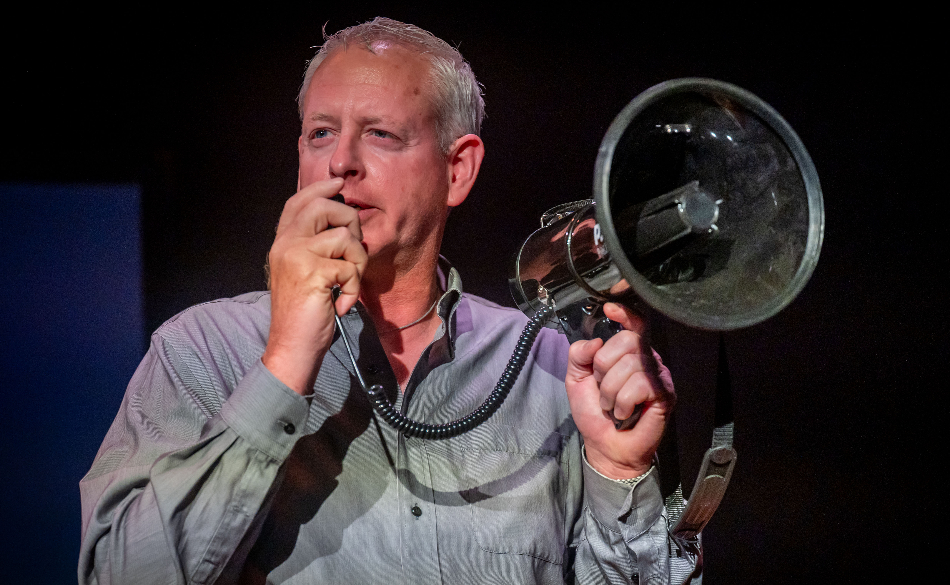
George Doughtery performs a monologue made from a verbatim interview with Father Brendan Curran, a Dominican friar and Catholic priest. Photo ©Amy Boyle Photography
“My reporting partner Steve Franklin has covered a lot of traumatic events as a foreign correspondent,” Duff says. “And I’ve seen my fair share in places like Iraq and Lebanon.” Franklin and Duff did a series together for MSNBC about gun violence in Chicago.
“We have developed similar tools to Pastor Beth's. You have to have empathy as a reporter, but you also need to compartmentalize the emotion and trauma that you witness. Often, under deadline pressure, you don’t live with the material very long because you move on to the next story the next day. On a longer form piece like a documentary, you are spending months with the material, and you sit with it more. For Sanctuary Stories, I am feeling it more deeply because we’re working with the words and rehearsing and then watching the stories unfold each night. And allowing myself to be an artist as well as a journalist allows me to bring more of my full self to the storytelling, and be more affected by it.”
Chicago has a hallowed history of welcoming immigrants. The city began codifying legal sanctuary protection in 1985, as Reagan-era Federal crackdowns increased on undocumented immigrants seeking asylum after feeling violence in Central America.
Duff says Sanctuary Stories is his way of experimenting with new ways of presenting journalism. The project was inspired by a number of things.
“First and foremost, it was a desire to connect in person and not via screens/TV/phones,” Duff says. He plays The Narrator in the show, a continuous presence through the performance, and singing and playing in the opening song.
“A few years back I re-emerged as a performing artist after 35 years away from theater,” Duff says. “My first role was as the Duke in a raucous production of Measure for Measure, and the audience was on fire—roaring with laughter and then gasping at the cruelest moments—and I knew then that I wanted to bring my visual journalism work into that kind of room. There is great power in hearing these stories presented live and in person. It’s not that the stories weren’t getting out. Father Brendan appears on TV regularly, and Sisters JoAnn and Pat were once interviewed on Samantha Bee’s TBS show. But combining the actor’s performance with real footage of events (I tried to show the real people with my camera when we could name and reveal them) and letting the actors present the ‘truth’ of the emotion, allows for a more connected — and affecting — experience.‘’
The script for Sanctuary Stories is dynamic, changing with each set of performances. Though the eight verbatim stories remain the same, different casts of actors have performed them. “I rewrite the narration so that it remains current,” Duff says. “I was rewriting up until our preview last Thursday." A new bit was added to the middle of the script for this run— interviews Duff did with photojournalists who’ve been covering the immigration beat. This placeholder section of the script was designed to be updated, with different journalists performing live interviews in that space.
As a reviewer, the show was certainly compelling, though I came to it with expectations of the more familiar dramatic arc. The actors were uniformly good, while the journalistic-styled script let the facts stand in for ordinary drama. The multi-media aspects of the show (Peter Wahlbäck is sound designer; Riley Bulson is stage manager) includes original songs by Flo Estes—“They Don’t Even Know it” written especially for the show—the whole really bringing home experiences such as the melee around the Broadview, IL ICE facility a vivid, emotional encounter, nothing like we see in the news. The story of the Rohingya immigrant, The Citizen, delivered in a restrained monologue by Caonguyen Vu, was incredibly striking. We are reminded of this displaced people—unwanted by the Myanmar and driven from their homes, taken advantage of by immigrant traffickers and sold into and endless loop of immigration.
Since Northwestern also has a rather notable Theatre Department, it would be interesting to see them incorporated in future development of this journalism foray on stage. Recomended and running through October 18, 2026, get tickets here to Sanctuary Stories at Chicago's Athenaeum Center.
Inside Six Strange Worlds: Exquisite Corpse VI: LULLABIES

For its sixth Halloween season, Rough House Theater Co. has transformed Steppenwolf’s Merle Reskin Garage into a spectacular puppet haunted house. Last year I visted House of the Exquisite Corpse V: BLOOD & PUPPETS, and this year’s installment feels familiar in form but distinct in approach. The experience unfolds across six short puppet performances, each about seven minutes long and staged in its own small, enclosed box. Instead of sitting in seats, audience members peer through peepholes and listen through headphones, becoming voyeurs of a series of strange, self-contained worlds.
Last year’s “Blood & Puppets” theme offered a direct prompt. This time, LULLABIES gives its six creative teams a more abstract one, and they take it in folkloric, tall-tale directions. The stories draw on the uneasy promise at the heart of a lullaby: sleep, and you’ll be safe; stay awake, and you’re powerless. The audio narration felt especially full and impactful this year, adding texture to the stories and pulling listeners further into each room.

Jumping Jack Money. Photos by Greg India.
Exquisite Corpse's unique format gives each team room to experiment and draw on personal or cultural connections to lullabies. This variety is one of the production’s greatest strengths. Puppetry appears in many forms, often layered together: shadow puppets, hand puppets, and full-body puppets all share these small spaces. You’re close enough to notice the details in the figures and the mechanics of their movement, while the peepholes keep you just outside the worlds you’re watching.
That close-up view, combined with each team’s total freedom to construct an original world, raises expectations and makes the weaker moments more noticeable. There are always limits in live theater, but it’s disappointing when a story sets up a moment and then declines to stage it. “Jumping Jack Money” is a hilarious, cheeky piece, and its audience interaction is among the evening’s most charming. All the more frustrating, then, is that when the central conflict arrives, the piece avoids the playful challenge of staging a puppet fight and opts for a blackout that isn’t even dark enough to make the absence feel intentional. Another piece introduces a tornado—a chance for an intricate, dynamic effect alongside its many forms of puppetry, then buries the moment under a simple projected animation. Both left me wishing the production had followed through on the possibilities it had deliberately established.

don’t you want to live it? don’t you want to live your dream?
My favorite stories show what the format can do when its ideas and staging work in tandem. Designed by Caitlin McLeod, “Hushaby hush, you’re not going with them,” performed by Finn Bradley, Eddy Barber-Rozema, Rachel Hartmann and Emilie Wingate, uses an angled castle set with meticulous detail. From all angles, the perspective gives the scene the feeling of a storybook illustration, making it an especially apt fit for a show about the tales we tell to get children to sleep.
The final piece, “don’t you want to live it? don’t you want to live your dream?,” created by J. Felix and Abby Palen and performed by Mallory Limbrell and Shannon Twenter, makes memorable use of its floating, moving set. The performers move around it, giving the puppets space to transform along with the scene. It’s a playful, visually inventive take on lullabies and a strong finish to the sequence.
The experience design has also become more cohesive since last year. Each performance space’s exterior peepholes now feel connected to the story inside, and the paths between each story, between and around the boxes, carry a more unified atmosphere, giving the six distinct rooms a shared setting: an eerie, wonderful night of lullabies and puppets!
House of the Exquisite Corpse VI: LULLABIES runs at Steppenwolf’s Merle Reskin Garage through November 1. Tickets are available at roughhousetheater.com/tickets.


Latest Articles
-
 3Arts distributes $860,000 in unrestricted grants to Chicago artists at 3Arts Awards, surpassing $10M in lifetime funding
Written by Buzz Center Stage3Arts, the Chicago-based nonprofit grantmaking organization, awarded $860,000 to Chicago artists and announced the recipients of its 3Arts Next Level Awards—$50,000 unrestricted awards given to past 3Arts awardees—during a festive celebration held last night at the Harris Theater for Music…
3Arts distributes $860,000 in unrestricted grants to Chicago artists at 3Arts Awards, surpassing $10M in lifetime funding
Written by Buzz Center Stage3Arts, the Chicago-based nonprofit grantmaking organization, awarded $860,000 to Chicago artists and announced the recipients of its 3Arts Next Level Awards—$50,000 unrestricted awards given to past 3Arts awardees—during a festive celebration held last night at the Harris Theater for Music… -
Guarneri Hall announces two-day series REVOLUTIONS on the intersection between music, politics, and social change November 11-12, 2026
Written by Buzz Center StageThe nonprofit Guarneri Hall, a state-of-the-art, custom-built classical music venue in the heart of downtown Chicago at 11 E. Adams St., proudly announces Revolutions, a two-day music series exploring the intersections of political, social, technological, and musical change at two…
-
The Front Theatre announces casting for the North American Premiere of Sap February 25 - March 27, 2027
Written by Buzz Center StageThe Front Theatre announces casting for the North American premiere of Rafaella Marcus's highly acclaimed play Sap, directed by Charles Riffenburg. Sap is a timely and poetic thriller, in which a woman's lie to her girlfriend threatens to grow out of control when…
-
Hyde Park School of Dance presents annual performances of The Nutcracker December 11–13 at Mandel Hall
Written by Buzz Center StageHyde Park School of Dance, now in its 33rd year of training, performance, and community, welcomes families and dance enthusiasts to its annual, one-of-a-kind presentation of The Nutcracker. Performances are December 11–13 at Mandel Hall on the University of Chicago…


Does your theatre company want to connect with Buzz Center Stage or would you like to reach out and say "hello"? Message us through facebook or shoot us an email at This email address is being protected from spambots. You need JavaScript enabled to view it..
*This disclaimer informs readers that the views, thoughts, and opinions expressed in the text belong solely to the author, and not necessarily to Buzz Center Stage. Buzz Center Stage is a non-profit, volunteer-based platform that enables, and encourages, staff members to post their own honest thoughts on a particular production.