
Items filtered by date: November 2007
Chicago Shakespeare Makes Winter’s Tale a Story Worth Telling

Chicago Shakespeare Theater’s production of The Winter’s Tale delivers a compelling evening of theater, showcasing an exceptional company of actors working at the top of their craft. Under the direction of Artistic Director Edward Hall, this staging marks an exciting experiment for the theater as the troupe performs in repertoire, set to follow this production with A Midsummer Night’s Dream in November. Though The Winter’s Tale remains one of Shakespeare’s lesser-known plays, Hall breathes fresh vitality into the work, framing it like a classic fairy tale. Playing a child, Felicia Oduh begins the show opening a picture book in view of a toy ship and a teddy bear, foreshadowing what is to come.
The piece opens with a joyous celebration as King Leontes tries to convince his childhood best friend, King Polixenes, to remain a little longer in his company. But the homesick royal denies every plea, until the beautiful Queen Hermione persuades him to stay. At her success, Leontes is suddenly possessed by jealousy, wondering why her efforts worked. His wild imagination corrodes his sanity quickly, and in no time, he’s envisioned a forbidden affair between his pregnant wife and his most loyal friend. His nobles fail to reel him in, and his madness drives him to forsake everything, even banishing his newborn daughter, only to discover his accusations had no merit. His only hope now rests in a prophecy and the hope that he’ll be reunited with his child one day.
This production thrives as a true ensemble piece, with the majority of the cast adeptly tackling dual roles. Demetrios Troy plays the maddened Leontes with fierce conviction, delivering an inspired portrayal of a ruler’s terrifying mental unraveling. Opposite him, Jessica Dean Turner brings raw emotion to Queen Hermione, grounding her betrayal in a profound, heartbreaking depth. Issy van Randwyck is a force to be reckoned with as Paulina. She commands the stage with a presence capable of calling down fire from heaven or piercing with her witty remarks dipped in uncompromising truth. Providing comedic relief, Kevin Gudahl and Dan Haller share delightful chemistry as the simple-minded shepherd and his son. Later, Sean Fortunato’s turn as the rogue Autolycus provides an absolute audience treat, creating a larger-than-life, hilarious scoundrel infused with a playful rock edge. His playful French accent was especially hilarious.
While the cast excels, the production’s main hurdles stem from the disjointed nature of Shakespeare's text. Act One functions as a powerful, high-stakes drama, illustrating how a poisoned mind can devastate love and life. Act Two, however, pivots sharply, opening with upbeat musical numbers, including a sequence featuring the cast as “baahing” sheep (one even relieves himself on stage). The second half feels in many ways like an extended tangent from the primary plot, as we’re promised a return to Leontes’ court. Still, while it’s a diversion, it is an entertaining one.
Also, no production of The Winter’s Tale would be complete without addressing the play's most famous stage direction, "Exit, pursued by a bear," and Chicago Shakespeare’s iteration does not disappoint. They unleash a creature that is truly the stuff of nightmares.
Despite the script's structural awkwardness, Hall has crafted an enjoyable and emotionally resonant piece of theater powered by artists who elevate every moment. The ensemble brings richness and warmth to these complex characters, capturing the audience’s heart while delivering laughter throughout.
Overall, this presentation stands as another triumph for Chicago Shakespeare Theater, proving that even Shakespeare's lesser-known works can shine brilliantly in the hands of a gifted company.
The Winter's Tale runs until December 12.
https://www.chicagoshakes.com/productions/2627-winters-tale/
Steppenwolf Theatre Presents JESSIE MUELLER WITH SETH RUDETSKY – December 18 & 19, 2026

Steppenwolf Theatre Company and Mark Cortale are pleased to announce the return of Tony Award-winning Broadway star Jessie Mueller (Beautiful: The Carole King Musical, Carousel, Waitress) playing three performances only December 18 & 19, 2026 in Steppenwolf's Downstairs Theater, 1650 N. Halsted St. in Chicago. The evening promises a seamless mix of intimate, behind-the-scenes stories prompted by funny, insightful and revealing questions from SiriusXM Radio star Seth Rudetsky (on piano) with music from Mueller's stellar career, plus a sprinkling of holiday favorites.
Tickets cost $89* – $149*. A special Steppenwolf member pre-sale begins Tuesday, October 20, 2026 at 12 pm. Tickets go on sale to the general public Thursday, October 22, 2026 at 12 pm at steppenwolf.org/jessiemueller or by calling the Box Office at (312) 335-1650. *Pricing includes $10 handling fee
Performance schedule:
Friday, December 18, 2026 at 7:30 pm
Saturday, December 19, 2026 at 3 pm & 7:30 pm
About the Artists:
Jessie Mueller was most recently seen on Broadway in Tracy Letts' The Minutes. Previously, Jessie starred on Broadway in the revival of Carousel (Drama Desk Award, Tony, Grammy nominations). She originated the roles of Jenna in Waitress (Tony, Drama Desk, Grammy nominations) and Carole King in Beautiful: The Carole King Musical (Tony, Drama Desk, Grammy Awards). Other Broadway credits include Nice Work If You Can Get It and On a Clear Day You Can See Forever. She will be returning to the Kennedy Center this Fall in Guys and Dolls. TV/film: Patsy & Loretta, Madam Secretary, Blue Bloods, Evil, Candy, Chicago Voices (Chicago Emmy nomination), Steven Spielberg's The Post, A Good Person and Secret Headquarters.
Seth Rudetsky spent many years on Broadway as a pianist and/or conductor on shows like Les Misérables, Ragtime and Phantom of the Opera, as well as two years as a comedy writer on The Rosie O Donnell Show (three Emmy nominations with his co-writers) which led to him writing two opening numbers for the Tony Awards. He is now the afternoon deejay on the SiriusXM Broadway channel, as well as the host of his own talk show, Seth Speaks. He has performed his show, Deconstructing Broadway in London, Boston (Irne award) and L.A. (with Barbra Streisand in the audience!). He co-wrote and co-starred in Disaster!! (a New York Times Critic's Pick) on Broadway, which was licensed by Music Theater International and is being performed all over the country. After the Pulse Nightclub shooting, James Wesley Jackson told Seth an idea he had of doing an all-star "What The World Needs Now Is Love" and they recorded it with around 50 stars including Carole King, Idina Menzel, Gloria Estefan, Bernadette Peters, Jessie Mueller ('natch!) and more. The single went to number one on iTunes, has raised over $100,000 for the Pulse nightclub victims and families, as well as the Trevor Project and they performed it at the 2016 Democratic National Convention. When the COVID lockdown began, Seth and James started the twice-a-day livestream Stars In The House with reunions of original casts of Broadway shows like Ragtime, A Chorus Line and Cats, as well as TV shows like Grey's Anatomy, Taxi and Frasier. The livestream raised over $1,000,000 for the Actors Fund and over $100,000 for other charities like NAACP LDF and "You Gotta Believe" for foster youth. Seth has published numerous books including "The Rise And Fall Of A Theatre Geek" (Random House) and the recent "Musical Theatre For Dummies". After October 7, 2023, Seth founded The Jewish Broadway Alliance which is now a 501(c)3. He also runs Seth's Broadway Cruise and will soon be sailing with some of his favorite stars to the Caribbean, Bermuda, The Greek Isles and the ABC Islands. You can get more info on his cruises and see tons of his videos at SethRudetsky.com.
Accessibility:
Steppenwolf is committed to making the theatergoing experience accessible to everyone. Assistive listening devices are available for every performance and all our spaces are equipped with an induction hearing loop. Our building features wheelchair accessible seating and restrooms, push-button entrances, a courtesy wheelchair and all-gender restrooms, with accessible counter and table spaces at our bars. For additional information regarding accessibility, visit steppenwolf.org/access. If you have questions or would like to make a specific request, email This email address is being protected from spambots. You need JavaScript enabled to view it. or call our box office at (312) 335-1650.
Sponsor Information:
United Airlines is the Official and Exclusive Airline of Steppenwolf. Steppenwolf is also grateful for the significant season support from lead sponsors Allstate Insurance Company, Paul Angell Foundation, Bloomberg Philanthropies, Crown Family Philanthropies, Caroline and Keating Crown, Julius Frankel Foundation, Lefkofsky Family Foundation, Northern Trust, Anne and Don Phillips, John Hart and Carol Prins, Shubert Foundation, Inc, and Zell Family Foundation. Steppenwolf also acknowledges generous support from premier sponsors Anonymous, Andrew and Amy Bluhm, Michael and Cathy Brennan, Ann and Richard Carr, Chicago Community Trust, Rich and Margery Feitler, FROST CHICAGO, Lloyd A. Fry Foundation, Jessica and Dominic Green Family Fund, John D. and Catherine T. MacArthur Foundation, The Orlebeke Foundation, Sacks Family Foundation, Gary Sinise Foundation, Harold and Mimi Steinberg Charitable Trust, Thoma Bravo, and Bryan Traubert and Penny Pritzker. Steppenwolf also acknowledges support from the National Endowment for the Arts, Illinois Arts Council, and the City of Chicago Department of Cultural Affairs and Special Events.
About Steppenwolf Theatre Company:
Steppenwolf Theatre Company is the nation's premier Ensemble Theater with 51 members who are among the top actors, playwrights and directors in the field. Thrilling, powerful, groundbreaking productions have made this theatre legendary. From the early phenomenon of Balm in Gilead, to The Grapes of Wrath, August: Osage County, Downstate, The Brother/Sister Plays, and more recently, the Pulitzer Prize and Tony Award-winning Purpose, Steppenwolf Theatre has had a long-running and undeniable impact on American Theatre and Chicago's cultural landscape. Founded in 1974 by Terry Kinney, Jeff Perry and Gary Sinise, Steppenwolf started as a group of friends in their teens and early 20s performing in the basement of a school in Highland Park, Illinois. Today, the company's artistic force remains rooted in the original vision of its founders: an artist-driven theatre, whose vitality is defined by its appetite for bold and innovative work. Every aspect of Steppenwolf is rooted in its Ensemble ethos, from the intergenerational artistic programming to the multi-genre performance series LookOut, to the nationally recognized work of Steppenwolf Education and Engagement which serves nearly 15,000 teens annually. While grounded in the Chicago community, more than 40 original Steppenwolf productions have enjoyed success nationally and internationally, including Broadway, Off-Broadway, London, Sydney, Galway and Dublin. Steppenwolf also holds accolades that include the National Medal of Arts, 14 Tony Awards, two Pulitzer Prize-winning commissions and more. Led by Artistic Directors Glenn Davis and Audrey Francis, Executive Director E. Brooke Flanagan and Board of Trustees Chair Keating Crown — Steppenwolf continually redefines the boundaries of live theater and pushes the limits of acting and performance.
Steppenwolf's Mission: Steppenwolf strives to create thrilling, courageous and provocative art in a thoughtful and inclusive environment. We succeed when we disrupt your routine with experiences that spark curiosity, empathy and joy. We invite you to join our ensemble as we navigate, together, our complex world. steppenwolf.org, facebook.com/steppenwolftheatre, twitter.com/steppenwolfthtr and instagram.com/steppenwolfthtr.
Remy Bumppo’s Mud Row: A Family Haunted by the Past

Remy Bumppo opens its 30th anniversary season with Mud Row, a play by Tony Award nominee and MacArthur “Genius” Grant recipient Dominique Morisseau. Expertly directed by Malkia Stampley, this production is a sublime examination of family, inheritance, and the difficult choices that determine what we pass on to the next generation.
Set in Mud Row, a historically Black neighborhood in West Chester, Pennsylvania, the play moves between the early 1960s, during the Civil Rights era, and the contemporary period. The earlier scenes follow sisters Elsie (Alexis Janae) and Frances (Toccara Castleman) as they navigate young adulthood, unaware that the decisions they make will reverberate through generations. In the present-day scenes, granddaughters, Regine (Ayanna Bria Bakari) and Toshi (Tiffany Renee Johnson), must confront the family legacy they have inherited.
Stampley has created a living family album, particularly in the scenes set in the 1960s. We watch Elsie and Frances move through their lives with the innocence of people who cannot yet see the long shadow their choices will cast. They are carrying wounds of their own, shaped by the circumstances in which they grew up. Without necessarily recognizing it, they risk passing that trauma to Elsie's unborn child and, eventually, to their grandchildren.
Morisseau's central question is both intimate and universal: What do we do with the past? Do we escape it, hoping that distance will free us from its burdens, or do we reclaim it, confront its painful truths, and find a way to transform what it means?
The family home becomes the physical embodiment of that question. Scenic designer Sydney Lynne creates a house that seems to possess a life of its own. In the 1960s scenes, it feels inhabited, furnished with the details of a home where people live, argue, dream, and make plans to change the future. In the contemporary scenes, the same space can appear abandoned, almost as if the house itself is yearning for someone to return and breathe life into it.
Yet even when the house is occupied, it never feels entirely free of its ghosts. Stampley makes those unseen presences palpable through breathtaking scene changes. The transitions are more than technical accomplishments; they reinforce the sense that the past is never entirely gone. It lingers in the rooms, in the silences, and in the relationships of those who remain.
The uniformly excellent cast gives Morisseau's dialogue its necessary emotional grounding. Her writing can, in less assured hands, occasionally sound like a discussion panel, with characters articulating ideas about history, race, and family rather than simply living through their circumstances. That is not the case here. These actors make the emotional intensity feel organic. Their conflicts emerge from recognizable human needs: the desire to belong, the longing to escape, the fear of repeating a parent's mistakes, and the hope that life might offer another chance.
Jabari Khaliq as Tyriek and Jamaque Thomas as Davin contribute to the ensemble, while the performances of Janae, Castleman, Johnson, and Bakari give the family history its emotional continuity. The younger women are not simply repeating the lives of those who came before them; they are struggling to determine what their inheritance means and whether they must remain bound by it. The emotional weight of that struggle comes into sharp focus in a second-act scene between Toshi and Regine that brought me to tears.
Levi Wilkins' lighting design deepens the atmosphere, while Evelyn Danner's costumes establish the distinct periods without distracting from the characters. Christopher Kriz's original musical composition and sound design help sustain the production's sense of memory, place, and time.
Morisseau examines two generations separated by decades but connected by patterns of family behavior, unspoken pain, and the consequences of choices made long before the next generation was born. The earlier generation belongs to the Silent Generation; the contemporary characters reflect a different set of expectations and possibilities. The contrast underscores how the world changes while certain family wounds remain stubbornly familiar.
But Mud Row is not simply a lament about the persistence of trauma. Its deeper concern is whether that inheritance can be interrupted. History may explain the circumstances in which people find themselves, but it does not have to dictate every choice they make. Somewhere in the cycle, a child—or an adult who finally recognizes the pattern—must be willing to say that things can be different.
That possibility gives the play its emotional force. The past cannot be erased, and neither can the damage it leaves behind. But understanding where the pain began may be the first step toward refusing to pass it along.
With this production, Remy Bumppo offers more than a beautifully staged family drama. Mud Row becomes a house of memories, inhabited by the living and haunted by the choices of the dead. Stampley's sensitive direction and the cast's compelling performances make those ghosts feel immediate, reminding us that every family inherits a history—but no family is necessarily doomed to repeat it.
HIGHLY RECOMMENDED
When: Through Nov. 15
Where: Theater Wit 1229 W. Belmont Avenue
Tickets: $38 - $54
A Joe & Melanie Thing Theatre Company announces The Hanukkah Humbug at Greenhouse Theater Center - December 3-6

The world premiere of The Hanukkah Humbug brings ghosts, history, tradition, and a whole lot of family fun to the Greenhouse Theater Center just in time for the holidays, Melanie Ann Apel promises a lively, family-friendly experience with this new play co-written by Melanie Ann Apel and Hayden Seth Apel.
A Joe & Melanie Thing Theatre Company is proud to announce its production of The Hanukkah Humbug, on stage at the Greenhouse Theater Center, 2257 North Lincoln Avenue, Chicago, 60614, December 3rd to December 6th. Tickets are on sale at www.greenhousetheater.org.
This production of The Hanukkah Humbug is directed by Melanie Ann Apel and features a cast of Chicago area actors. Set in modern-day Chicago, the kids in Ms. Ben’s class are tired of the same old Christmas stories; they want to hear a story about Hanukkah! Alas, Ms. Ben doesn’t have a Hanukkah story to read to her class. "That's ok," says Rusty, "we can make up our own story, but Jewish!" And so begins a classic tale with a Hanukkah twist.
“We have created a delightful retelling of a classic, featuring the ghosts of Hanukkah past, present, and future; a brief history of the Jewish people; the traditions of Hanukkah; and a healthy dose of Yiddish,” says Director Apel. “We want to share the joyful traditions of Hanukkah with everyone, not just with Jewish families.”
Performance Schedule:
Wednesday, December 2 – 6:30 P.M. – Dress Rehearsal/Press Night
Thursday, December 3 – 6:30 P.M. – Opening Night (December 3)
Friday, December 4 – 6:30 P.M
Saturday, December 5 – 2:30 P.M. & 6:30 P.M.
Sunday, December 6 – 2:30 P.M Tickets: General Admission – $21
About A Joe & Melanie Thing Theatre Company:
We are Chicago-based artists who seek to bring original works to the stage. We are overly dramatic types who cannot resist the call of Muses. Since 2024 we have produced works of satire (Accidental Election of an Anarchist, 2024, and Vulcan Sleeping, 2025), familyfriendly fare (Hanukkah, Shmanukkah! 2025) and drama (Marbled, 2026).
Identity Performing Arts' Fifth Anniversary Gala: Movement That Keeps Becoming

Five years is an important milestone for any arts organization, but for a contemporary dance company it also marks an artistic coming of age. Identity Performing Arts celebrated its fifth anniversary at the Edlis Neeson Theater at the Museum of Contemporary Art with a program of three works - Enliven, Muted, and the premiere of Untitled Identity - that reflected both how far the Chicago-based company has come and where it is headed.
Founded as an organization dedicated to dance education, Identity Performing Arts transitioned into a full-season contemporary dance company in 2021, presenting its inaugural live concert that fall. This anniversary gala demonstrated how that evolution has expanded into a confident repertory of original work.
I had the privilege of sitting with Rehearsal Director Mollyanne Nunn during the performance, and her insights helped me better understand what I was seeing. Contemporary dance often communicates through gesture rather than narrative, and Nunn's perspective revealed how intention, relationships, and emotional shifts were woven into the choreography.
The afternoon opened with Enliven, choreographed by Founder and Artistic Director Ginny Ching-Yin Lo, a vibrant celebration of energy in motion that blends Eastern and Western artistic influences. Performed by a nine-member ensemble, the piece moved effortlessly through an eclectic musical landscape, from delicate instrumental passages to expansive contemporary compositions.
What stood out was the company's sense of connection. Rather than presenting individual showcases, the dancers created a shared momentum, with movement passing organically from one performer to another. It was easy to see why this work earned a place at the 2024 Seattle International Dance Festival.

Identity Performing Arts in Muted. Photo by Peter Hinsdale.
The mood shifted dramatically with Muted, Lo's deeply personal exploration of silence and communication. The work examines what it means to be muted, to silence another person, and to experience connections that exist beyond words.
The seven dancers gave physical form to emotions that are difficult to articulate. Gestures of distance, hesitation, and reconciliation suggested that our most significant conversations often happen without speech. The score, culminating in a reimagining of Samuel Barber's Adagio for Strings, reinforced the work's emotional weight without overwhelming it.
The evening concluded with Untitled Identity, the program's premiere and its most ambitious work. Featuring a twelve-member cast, the piece explores how identity continually shifts between our inner understanding of ourselves, and the perceptions imposed by others.
The expanded ensemble created striking visual patterns, while cinematography by Cem Koc, visual effects by Simon Parfrement, and Hannah Wien's expressive lighting design gave the performance an added theatrical dimension. The varied musical score carried the dancers through moments of tension, release, and transformation, suggesting that identity is never static but always evolving.
Seen together, the three works formed a thoughtful progression - from celebration to introspection to self-discovery. Lo's choreography provided a consistent artistic voice while allowing each piece to inhabit its own emotional landscape.
Anniversary galas often look backward, celebrating past accomplishments. Identity Performing Arts chose instead to use the occasion to look forward. By pairing established works with a compelling premiere, the company demonstrated that its greatest strength is not simply what it has already created, but its continued willingness to explore new ideas through movement.
Five years after becoming a full-season contemporary dance company, Identity Performing Arts has found a distinctive voice. This gala made one thing clear: like the identities it explores, the company remains beautifully in motion.
Music Theater Works Pours a Beachy Cocktail with Escape to Margaritaville
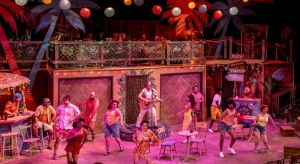
A gentle, tide‑easy current settles in right from the start, immediately signaling the kind of story this musical wants to tell. Rather than relying on big, splashy moments, it settles into a warm, beach-side rhythm, inviting the audience into a world where the pace is slower, the mood is lighter, and the soundtrack does most of the lifting. It’s a straightforward setup that frames the show’s island‑styled escapism - and Jimmy Buffett fans, the devoted Parrotheads, are the ones most likely to find the deepest enjoyment in the sunny, good‑natured spirit of Escape to Margaritaville, now playing at North Shore Center for the Performing Arts in Skokie.
The plot is about as simplistic as it gets, and the musical makes no attempt to complicate it - and wisely doesn’t try. This is a tropical resort fantasy through and through. Greg Garcia and Mike O’Malley’s book embraces the unhurried appeal of Jimmy Buffett’s catalog, following Tully, an unassuming island singer who’s perfected the art of keeping life simple. His routine of strumming for tourists and dodging commitment gets disrupted when Rachel, a driven, no‑nonsense researcher collecting soil samples for her environmental research, arrives with no interest in island romance. Their unlikely connection sets off a laid‑back, free‑wheeling story about unwinding, taking risks, and discovering that paradise has more to do with perspective than palm trees.
Music Theater Works’ production, directed and choreographed by Brenda Didier with co-direction from Sarafina Vecchio and choreography support from Clayton Cross, embraces the show’s escapist spirit with bright staging and a playful sense of fun. Linda Madonia’s music direction anchors the evening from above, leading a band perched atop the set and sending out a steady stream of easy-going, gentle sound. The placement and style add to the show’s illusion of an oceanfront getaway, as if the music itself were drifting in from somewhere just beyond the shoreline. The plot may be light, but that’s the point - this is a feel good, cocktail in hand comedy where the stakes are low, the energy is high, and the journey is as mellow as the island wind the characters keep singing about.
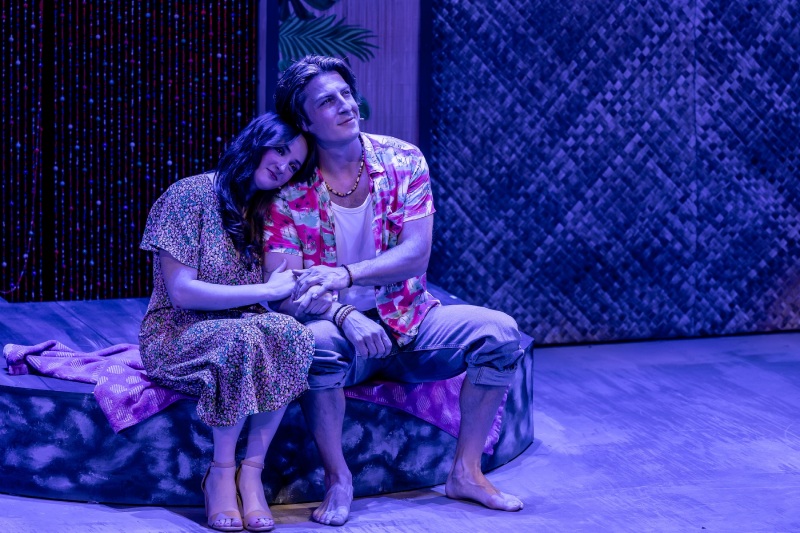
(L to R) Kate McQuillan and Brian Acker in JIMMY BUFFETT’S ESCAPE TO MARGARITAVILLE. Photos by Brett Beiner Photography.
Brian Acker brings a loose, sun-warmed charm to Tully, giving the beach-town, guitar-slinging singer enough sincerity to keep the character from drifting into pure caricature. His vocals land with clarity and confidence, especially in Buffett staples like “Margaritaville,” where he captures the relaxed swagger that defines the show’s tone. He’s immediately likable and effortlessly engaging. Acker’s performance makes Tully feel like the steady breeze that holds the spirit of the musical, and he dives into the character’s aesthetic with full commitment. He’s the quintessential casual beach guy - flip flops, baggy shorts, feathered hair, and a Hawaiian shirt that looks like it’s logged more sunsets than most vacationers.
Kate McQuillan’s Rachel is a sharp, engaging counterbalance, grounding the story with her focused energy and bright, assured voice. She shines in numbers like “It’s My Job” and “Fins,” bringing humor and heart to a character who could easily be played too straight. Together, Acker and McQuillan create an appealing opposites attract dynamic, especially in their duet “Coast of Marseilles,” where their voices blend with an ease that makes their connection feel genuine.
If Rachel is heading to a coastal destination for work, it makes perfect sense that she’d bring her best friend, Tammy along for the ride. Khaki Pixley’s Tammy is one of the production’s brightest assets, delivering buoyant humor with razor-sharp timing and a sweet, outgoing personality that consistently lifts every scene she enters. Her reactions, comedic beats, expressive voice, and kind presence land so well that her arc quickly becomes one of the show’s most enjoyable threads. When Chase Grabowski’s Brick (local bartender) eventually joins her storyline, his endearing, slightly hapless charm pairs beautifully with Pixley’s energy, giving their subplot an energetic, goofy momentum that often feels more engaging than the central romance.
The humor in Escape to Margaritaville often lands on the simpler side - broad, predictable, and occasionally so contrived that a few jokes slip past without much impact. It’s not unexpected, though. This is a Jukebox musical built from Jimmy Buffett’s sun-drenched catalog, and the story exists mostly as a loose framework for beach living, easy flirtations, and the reminder to stop taking life so seriously. The show rarely aims beyond that, and for many theatergoers, it doesn’t need to. Buffett fans in particular seemed fully dialed in; several audience members chimed in word for word when prompted, and a few even jumped in unprompted, turning certain moments into an impromptu Parrothead sing-along. It’s clear the musical resonates most with those already attuned to Buffett’s drifting tunes. And that connection wasn’t limited to the songs themselves.
And while the music is plentiful, a few musical numbers stand out more than others, especially when the show leans into its unapologetic silliness. “Why Don’t We Get Drunk & Screw” becomes a cheeky ensemble hand off, passed around with just enough sly irreverence to keep the moment playful rather than crude. “Cheeseburger in Paradise” delivers the burst of high spirited, indulgent fun audiences expect, and it also marks a personal breakthrough for Tammy, who finally lets herself enjoy something without the undeserved guilt her controlling fiancé has inflicted upon her. These numbers aren’t subtle, but they’re performed with a knowing grin - and they capture the musical’s willingness to jump into the louder, lighter corners of Buffett’s catalog.
Music Theater Works surrounds its leads with a spirited supporting cast that keeps the wave-easy antics humming. Tamara Batiest’s Marley offers strong vocals, grounded wit and a steady presence at the resort, providing a nice balance to the show’s more free-wheeling characters. Brian James’ J.D. brings an unforced, confident energy whenever he appears, adding texture without pushing beyond what the material calls for. The full ensemble delivers solid work throughout, particularly in the larger song and dance numbers, where their precision and coordination give the production some of its cleanest moments. Together, they help shape a world that feels carefree, lightly free-flowing, and appropriately tuned to Margaritaville’s unhurried atmosphere.
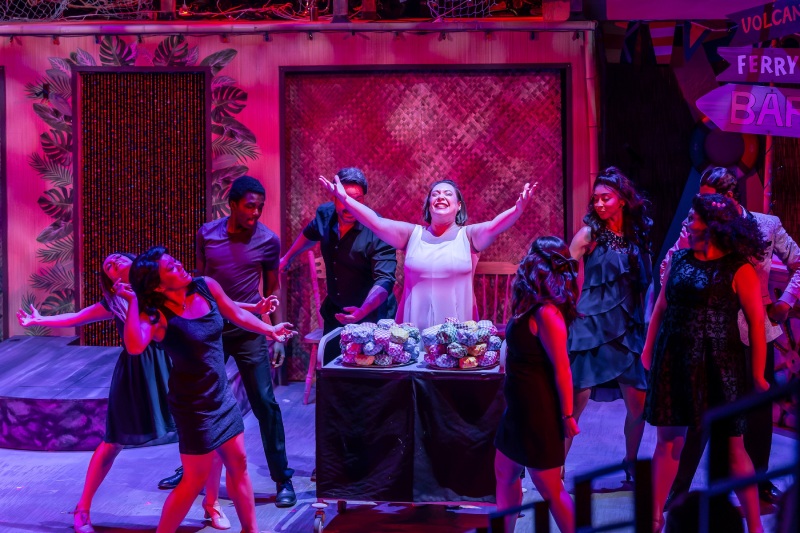
(center) Khaki Pixley with members of the cast in JIMMY BUFFETT’S ESCAPE TO MARGARITAVILLE from Music Theater Works.
Bob Knuth’s scenic design instantly drops the audience into a daylight‑washed island resort, complete with weathered wood, bright, beach‑toned colors, and the kind of relaxed bar setup that practically begs for a frozen drink. It’s the classic Margaritaville environment: part seaside hangout, part vacation fantasy, and just spirited enough to feel genuinely alive. Ab Rieve adds personality throughout with props that make the space feel lived‑in - cocktail blenders, beach gear, and all the little touches that sell the idea of a resort where anything can (and usually does) happen. Clare McKellaston’s costumes keep the surf-side energy high, dressing the cast in vibrant prints, light‑spirited resort wear, and vacation‑ready looks that pop under the lights, while Kristen Brinati ensures every wardrobe detail stays crisp from scene to scene. I truly enjoyed the set, which effectively transported the audience into the moment and grounded the shore-soft atmosphere. The production team does a fine job in building a getaway that feels like a ticketed trip to paradise.
October in Chicago has a way of nudging everyone indoors - gray skies, damp sidewalks, and that first hint of winter settling in. All the more reason to duck into a theater and spend a couple of hours somewhere warmer, brighter, and blissfully carefree. Escape to Margaritaville offers exactly that: a coastal reset button when the city insists on being chilly and unpredictable.
When Escape to Margaritaville made its pre-Broadway stop at the Oriental Theatre in 2018, I was tucked into a rear seat when a persistent glow kept flickering to my right. Someone was typing away on their phone mid show, pausing every so often to chat with the person beside him like he was running a private commentary track. After a few minutes, I leaned over and politely asked if he wouldn’t mind putting his phone away. He looked up, and I told him I was reviewing the show for Jimmy Buffett. Without missing a beat, he smiled and said, “I am Jimmy Buffett.” He was taking notes, whispering observations, and generally behaving like a man watching his own musical while conducting field research. Only Jimmy Buffett could turn mid-show multitasking into part of the entertainment.
He laughed, I laughed, and he explained he was jotting down notes on the show and the audience’s reactions. After the curtain call, we chatted, and in true Buffett fashion, he casually invited me to the post‑performance reception. It was the kind of easy, friendly gesture one wouldn’t necessarily expect from a major star - unless it was Jimmy Buffett. Jimmy was actually a little shy surrounded by his Parrotheads at the packed, island‑themed afterparty, until I invited him to join the celebration and led him by the hand into a circle of fans dancing to “Cheeseburger in Paradise.” He danced for some time, and while doing so, he beamed at me from the center of that exuberant moment, delighted in a way that felt almost childlike.
I didn’t realize at the time how much that passing exchange would matter. After his passing in 2023, I smiled to myself at the memory of how touching and important our chance encounter in the back of his theater premier really was.
In staging Escape to Margaritaville, Music Theater Works pays genuine tribute to Jimmy Buffett’s legacy, channeling the warmth, playfulness, and island‑spirited generosity that defined both his music and the man himself. At two hours and twenty minutes (including intermission), the Buffett musical is a light, good-natured escape that provides an unruffled evening - an inviting couple of hours of coastal fun.
Recommended.
Escape to Margaritaville runs through November 1st at North Shore Center for the Performing Arts. For tickets and/or more show information, click here.
Overshadowed Theatrical Productions Brings Beloved Holiday Classic It’s a Wonderful Life to the Stage

This holiday season, Overshadowed Theatrical Productions is thrilled to present the timeless holiday classic, It’s a Wonderful Life, live on stage. As Frank Capra’s legendary film celebrates its 80th anniversary, this stage adaptation offers the perfect way for families and the community to celebrate the Christmas season together.
Adapted by Jason LeBlanc from the film by Frank Capra—which was based on Philip Van Doren Stern’s short story The Greatest Gift—this stage version stands as the most faithful adaptation of the iconic movie. Audiences can expect the very same humor, warmth, and emotion that have made the story a beloved holiday tradition for generations.
"I'm so excited to put this story on stage in a time that you might need hope or you might like to give hope. It'll be a wonderful reminder of the Christmas season," said Reba Hervas, Director and Artistic Director of Overshadowed Theatrical Productions.
Performance Schedule:
- Opening Night: Friday, November 27
- Performance Days & Times:
- Thursdays: 7:30 PM
- Fridays: 7:30 PM
- Saturdays: 2:00 PM (Matinee) and 7:30 PM
- Special Event: Friday evening performances will feature an exclusive post-show talk-back session with the cast and crew, giving audience members a behind-the-scenes look into the production.
Cast:
Angelo Campos ... George Bailey
Danielle Spence ... Mary Hatch Bailey
Mike Larsen ... Mr. Potter
Brad Holloman ... Clarence Oddbody
Jerry Wiel ... Uncle Billy
Mimi Sagadin ... Ma Bailey
Rob Valentine ... Ernie/Pa Bailey
Pete Aylward ... Bert
Jessica Means ... Violet Bick
Jacob Starr ... Harry Bailey
Emily Starr ... Ruth Dakin Bailey
Betsy Thompson ... Jo
Rex Nyquist ... Gabriel
Vincent Prisco ... Mr. Gower
Aiden Cox ... Sam Wainwright
Kelly Zea ... Jane Wainwright
Madelyn Jones ... Cousin Tilly
Ryan Marrano ... Cousin Eustace
Sharon Lindemann ... Annie/Mrs. Davis/Ensemble
Tina Wiethege ... Mrs. Hatch
Steven Dexheimer ... Mr. Martini
Anneri Burgos ... Mrs. Maria Martini/Ensemble
Wesley White ... Marty Hatch/Mr. Welch
Nick Koss ... Mr. Carter/Bouncer/Ed
Steven Mantel ... Tom Schult/Dr. Campbell/Nick
Steve Bond ... Board Director/Driver/Randall
Jim Falcone ... Grumpy Old Man/Board Director
Jordan Reed ... Mickey Dunwood/Board Member/Joe Hepner
James Thompson ... Freddie/Tollkeeper/Board Director/Bank Teller
Declan White ... Young George
Bella Lee ... Young Mary
Brooke Means ... Young Violet
Zeke White ... Young Harry
Annika Rosas ... Janie Bailey
Clementine Milburn ... Zuzu Bailey
Molly Versosky ... Zuzu Bailey
Spencer Schillinger ... Pete Bailey
Oliver Schillinger ... Tommy
Ethily Hancock ... Ensemble
Sarah Kwan ... Ensemble
Lauren Szymkowicz ... Ensemble
Christy White ... Ensemble
Hannah Voss ... Martini Child
Leah Voss ... Martini Child
Maeve Burns ... Martini Child
Josephine Milburn ... Martini Child
Willow Milburn ... Martini Child
About Overshadowed Theatrical Productions Overshadowed Theatrical Productions has provided quality, family-friendly drama that entertains, inspires, and promotes a biblical message for over 20 years. Along with providing a positive community experience, Overshadowed has also sought to train and encourage the next generation of theater performers and crew.
Dance Theatre of Harlem fills Auditorium Theatre with fire and funk

Projecting a vibe that felt more homecoming party than ballet presentation, Dance Theatre of Harlem returned to Chicago on October 17th after a 10-year absence. The Auditorium Theatre audience took a while to assemble itself largely because people were having so much fun. DTH devotees and newbies, ballet connoisseurs and dabblers, parents and children, lithe young dancers and cane-wielding seniors all came to celebrate.
Executive Director Anna Glass, followed by Artistic Director Robert Garland, greeted the crowd. They gave shoutouts to folks in the audience with various connections to DTH and, at the same time, warmly drew everyone else into the ballet company’s extended family.
Garland went on to discuss DTH’s origins, a reminder for some, an introduction for others. When Arthur Mitchell, the first African American to achieve principal dancer status with a major company, retired from the New York City Ballet, he headed to Brazil to establish a new company. But upon learning of Martin Luther King Jr.’s assassination, he pivoted to Harlem, launching the troupe in 1969 to showcase African Americans as gifted exponents of classical ballet.

Dance Theatre of Harlem. Photo by Jose Calvo.
Case in point is the program’s first piece, Return, blending classicism and contemporary black culture. Choreographed by Garland and set to music by James Brown, Aretha Franklin and others, Return brings toe-shoe funk to a series of what could best be described as sketches. Twelve dancers go from bit to bit, snaky in movement and cheeky in attitude, setting the tone with Franklin’s Baby, Baby, Baby and hitting a high with Brown’s Superbad. A little hodgepodge-y overall, the work nonetheless sparked audible laughter and gasps with each virtuoso move from the dancers.
Next came Donizetti Variations, a Balanchine work premiered 66 years ago by New York City Ballet and recently mounted by DTH. The performance was a fitting, if not remarkable, interlude between Return and Firebird. As Garland noted earlier, George Balanchine discovered, trained and developed roles for Arthur Mitchell. The choreography’s exacting structure and Donizetti’s lively Romantic score demonstrate Balanchine’s 20th century fusion of European tradition with American swiftness and minimalism.
Closing the program was Firebird, composed by Igor Stravinsky for Michel Fokine’s 1910 work for the Ballets Russes. In 1982, John Taras choreographed a version for Dance Theatre of Harlem. Based on a Russian folk legend, Taras set the story in the Caribbean with lush sets and costumes by Geoffrey Holder.
DTH principals Alexandra Hutchinson in the titular role and Derek Brockington as the Young Man brought both technical and psychological precision to their initial pas de deux. The Firebird captivates and instructs rather than seduces, making her gift of a protective red feather a noble gesture. Romance comes later when the Young Man falls for the Princess of Unreal Beauty, danced by Kamala Saara, and uses the feather to vanquish Jhaelin McQuay’s Prince of Evil. Masterful soloists and an equally skilled ensemble built the legend gradually into a triumphant finish that brought the audience to its feet.
More information on the company can be found at Dance Theatre of Harlem.
“A Strange Loop” Lets the Intrusive Thoughts Win at Raven Theatre in partnership with About Face Theatre

A musical, but it’s just the voices in your head. Sounds just crazy enough to win the 2020 Pulitzer for Drama. “A Strange Loop” by Michael R. Jackson finally makes its Chicago premiere at Raven Theatre in a co-production with About Face Theatre. Mikael Burke directs a fantastic production with a knock-out cast.
Not many musicals are awarded a Pulitzer for Drama. Only 10 in fact. So, when one is selected (before it plays Broadway), there’s a lot of curiosity. “A Strange Loop” is the best kind of new musical—in that it’s hard to explain. In the era of an abundance of movie-turned-musical adaptations, it’s refreshing to see something entirely unique.
In this seven-person, one-man show, Usher (Eddie Weaver) is working as an usher at a Broadway theater while writing a musical about an usher who works at a Broadway theater. In a series of songs spurned on by his intrusive thoughts, (played by a delightful cast of six) Usher’s creative process is laid bare, and we see the playwright struggling with his identity as a black gay man.
Ever at odds with his “Internal white girl”, Usher spends his life stuck ruminating on his relationship with his parents, his sexuality, his gender, his race and his place in the world. In cleverly written, but firmly R-rated songs, we learn about his troubled relationship with his unintentionally cruel parents and his discomfort in his own skin.

John-Payne, Michael Turrentine, Eddie Weaver, Mattheus Barbee and Christopher Wayland. Photo by Joe Mazza / Brave Lux.
Weaver’s voice and sheer vulnerability as a performer make this 95 minute show a highly concentrated emotional experience. Usher’s internal monologue is brought to life by a wildly talented ensemble of six with character names like “Thought 1” and “Though 2” played by Micah Mixon, Matheus Barbee, Christopher Wayland, Michael Turrentine, John-Payne and Naphtali Curry.
“A Strange Loop” is a show that plays against the norms of traditional musical theatre in almost every aspect, yet it borrows so effortlessly from a lot of what likely inspired Michael R. Johnson. Instead of being driven by plot, Johnson goes full meta with a concept musical like “Company” meets “for colored girls who have considered suicide / when the rainbow is enuf” but with the playfulness of “Rent”. Each song is an exploration of a life that files down to a heartbreaking raw nerve.
This show never wallows in sadness though. As is often the case, comedians mask a great deal of pain. Johnson plays up the surreal absurdity of Usher’s life. In one song alone the audience is clapping along to a church choir beautifully belting “AIDS is God’s punishment!” all the while Usher is grappling with the trauma of being raised in a strict religion that his parents still belong to. This show is dark comedy about a man finding acceptance with himself, which is highly relatable for those who chronically overthink.
There’s something really special happening in this production. This cast fills the theater to the rafters with soaring vocals and brings the house down with roaring laughter. Michael Turrentine plays Usher’s mother in a way that anybody with a mother can chuckle at. His performance taps into a near constant sense of energy that make “A Strange Loop” highly satisfying to watch and listen to. You’ll be singing some of the unsettling lyrics right out the door.
Now through November 22 at Raven Theatre. 6157 N. Clark Street. 773-338-2177.
BTE Opens New Season with Gunderson's "Louisa May Alcott's Little Women" Nov. 12-Dec. 13

Buffalo Theatre Ensemble (BTE), the professional Equity theater company
in residence at the McAninch Arts Center (MAC), opens its 2026-27 three-play season with "Louisa May Alcott's Little Women," by Lauren Gunderson, directed by BTE Managing Artistic Director Daniel Millhouse+*. Performances run Nov. 12-Dec. 13. There will be a preview performance at 7:30 p.m., Thursday, Nov. 12.
In Gunderson's fresh and heartfelt adaptation of Alcott's classic novel "Little Women," the four March sisters step onto the stage with new vitality and emotional clarity. As Jo, Meg, Beth and Amy navigate growing up during the Civil War, they chase dreams, confront loss and discover the fierce power of family. Splash Magazine calls it, "an absolute delight from start to finish." "Ideal for a multigenerational theatrical outing," says Pioneer Press. Chicago Stage and Screen hails it as, "a heartwarming experience perfect for the holiday season."
In this play, Gunderson uses novelist Alcott as the narrator who melds into the character Jo, illustrating how the author's own life shaped the story. She incorporates prose and non-dialogue narration from the classic novel, an approach sure to resonate with fans of the book. Yet, those not familiar with the book will easily savor this heartwarming tale.
Gunderson has been recognized by TCG's American Theatre Magazine as America's most produced living playwright (2025-26). She is also the co-writer of the popular Austen-esque "Christmas at Pemberley" trilogy that ran sequentially over the course of BTE's past three holiday seasons. "Louisa May Alcott's Little Women" was originally co-commissioned by Northlight Theatre (Skokie, Ill.), City Theatre Company (Pittsburgh Pa.), People's Light (Malvern, Pa.) and TheatreWorks Silicon Valley (Palo Alto, Calif.) and premiered at, Northlight on Nov. 29, 2024.
"There's always something special about opening a new season, and "Little Women" is the perfect story to begin with: a celebration of family, resilience and the dreams that carry us forward," says Millhouse. "BTE has a proud tradition of bringing together exceptional established artists, and this production is no exception, with costumes by 2026 Jeff Award winner and BTE Ensemble member Aly Greaves Amidei and original music and sound design by Ensemble member Christopher Kriz. BTE is equally committed to supporting new talent, and I'm thrilled that this cast features a new generation of gifted young performers, most of whom are making their MAC debut."
The cast for "Louisa May Alcott's Little Women," features Valerie Martire (Louisa/Jo), Carol Kelleher (Meg), Marina Jokanovic (Beth), Adrianne Cury* (Marmee/Aunt March), Alexander Wisniewski (Laurie) and Ari Ford Golin (John, Mr. Laurence, Mr. March, Friedrich).
Director is Daniel Millhouse+*. The rest of the design team includes Caitlyn Girten (scenic design), Aly Greaves Amidei+^ (costume design), Garrett Bell (lighting design), Christopher Kriz+^ (composer and sound design), Paloma Locsin (properties design) and Amber Wuttke (fight and intimacy director/coordinator). Caitlin I. Quinn* is stage manager. Nicholas Washington is Assistant Stage Manager. Harry Smith is Student Assistant Stage Manager.
Tickets
Buffalo Theatre Ensemble presents "Louisa May Alcott's Little Women" at the McAninch Arts Center, 425 Fawell Blvd. on the campus of College of DuPage ,Nov. 12-Dec. 13. Performances are 7:30 p.m. Thursdays, Fridays and Saturdays; 3 p.m. Saturday, Nov. 28 and Sundays. The is no performance Thursday, Nov. 26. Tickets are $46. For tickets or more information, visit AtTheMAC.org.
There is an ASL performance at 7:30 p.m., Thursday, Dec. 3
Related Events:
• Pre-show Discussion: 6:45 - 7:15 p.m. Thursday, Nov. 12
• Post-show Discussion Friday, Nov. 20
About Buffalo Theatre Ensemble
The mission of Buffalo Theatre Ensemble is to provide a forum in which artists, scholars, writers, students and community members explore new ideas and provocative issues through the production of quality theater for the enjoyment of its audiences. Celebrating their 40th anniversary, BTE has staged more than 125 productions. The Artistic Staff for BTE includes Daniel Millhouse+* (Managing Artistic Director), Stephen Schellhardt*~ (Associate Artistic Director) and Bryan Burke+* (Business Manager).
BTE Ensemble members are Aly Greaves Amidei^, Robert Jordan Bailey*, Amelia Barrett*, Bryan Burke*, Connie Canaday Howard*, Rebecca Cox, Lisa Dawn, Nick DuFloth, Jon Gantt, Christopher Kriz^, Daniel Millhouse*, Laura Leonardo Ownby, Michael W. Moon, Kurt Naebig*, Galen G. Ramsey*, William "Sandy" Smillie* and Kelli Walker. For more information about BTE, visit btechicago.com.
+ Denotes BTE member. *Denotes member of Actors' Equity; ^Denotes member of United Scenic Artists .
~Associated Actors and Artistes of America
Buffalo Theatre Ensemble is partially supported and funded by generous grants from Choose DuPage, College of DuPage Foundation, The Norm Woodel Inspiration Fund, Arts DuPage – a DuPage Foundation Initiative, Benevity and the Illinois Arts Council Agency.
About The MAC
McAninch Arts Center at College of DuPage is located 25 miles west of Chicago near I-88 and I-355. It houses three indoor performance spaces (the 780-seat proscenium Belushi Performance Hall; the 186-seat soft-thrust Playhouse Theatre; and the versatile black box Studio Theatre), the outdoor Lakeside Pavilion, plus the Cleve Carney Museum of Art and classrooms for the college's academic programming. The MAC has presented theater, music, dance and visual art to more than 1.5 million people since its opening in 1986 and typically welcomes more than 1117,000 patrons from the greater Chicago area to more than 388 performances each season. For more information visit AtTheMAC.org.
Share the Spirit of the Holiday
From Nov. 13 - Dec. 20, the MAC Giving Tree (located in the MAC lobby) is accepting food donations for COD Student Fuel Pantry and People's Resource Center.



Latest Articles
-
 3Arts distributes $860,000 in unrestricted grants to Chicago artists at 3Arts Awards, surpassing $10M in lifetime funding
Written by Buzz Center Stage3Arts, the Chicago-based nonprofit grantmaking organization, awarded $860,000 to Chicago artists and announced the recipients of its 3Arts Next Level Awards—$50,000 unrestricted awards given to past 3Arts awardees—during a festive celebration held last night at the Harris Theater for Music…
3Arts distributes $860,000 in unrestricted grants to Chicago artists at 3Arts Awards, surpassing $10M in lifetime funding
Written by Buzz Center Stage3Arts, the Chicago-based nonprofit grantmaking organization, awarded $860,000 to Chicago artists and announced the recipients of its 3Arts Next Level Awards—$50,000 unrestricted awards given to past 3Arts awardees—during a festive celebration held last night at the Harris Theater for Music… -
Guarneri Hall announces two-day series REVOLUTIONS on the intersection between music, politics, and social change November 11-12, 2026
Written by Buzz Center StageThe nonprofit Guarneri Hall, a state-of-the-art, custom-built classical music venue in the heart of downtown Chicago at 11 E. Adams St., proudly announces Revolutions, a two-day music series exploring the intersections of political, social, technological, and musical change at two…
-
The Front Theatre announces casting for the North American Premiere of Sap February 25 - March 27, 2027
Written by Buzz Center StageThe Front Theatre announces casting for the North American premiere of Rafaella Marcus's highly acclaimed play Sap, directed by Charles Riffenburg. Sap is a timely and poetic thriller, in which a woman's lie to her girlfriend threatens to grow out of control when…
-
Hyde Park School of Dance presents annual performances of The Nutcracker December 11–13 at Mandel Hall
Written by Buzz Center StageHyde Park School of Dance, now in its 33rd year of training, performance, and community, welcomes families and dance enthusiasts to its annual, one-of-a-kind presentation of The Nutcracker. Performances are December 11–13 at Mandel Hall on the University of Chicago…


Does your theatre company want to connect with Buzz Center Stage or would you like to reach out and say "hello"? Message us through facebook or shoot us an email at This email address is being protected from spambots. You need JavaScript enabled to view it..
*This disclaimer informs readers that the views, thoughts, and opinions expressed in the text belong solely to the author, and not necessarily to Buzz Center Stage. Buzz Center Stage is a non-profit, volunteer-based platform that enables, and encourages, staff members to post their own honest thoughts on a particular production.