
Items filtered by date: June 2026
Thunder and Lightning with a Chance of Suuns

There are some nights that the weather truly sets the mood. Never was that more true than last Tuesday when I went to experience the minimalistic, avant-garde band Suuns. With thunder streaking through the purple night sky, I entered the fabulous Lincoln Hall, where beer prices leave you with an awkward amount of change, and every male, including me, has facial hair. I had never heard of Suuns, and had no idea why there was an extra “u” in the name, but I was ready for something weird. The small stage was set, and I prepared myself to hear something new and awesome.
And I was not disappointed. Montreal based Suuns, formally known as Zeroes, came on stage and delivered a performance for the crowd, but more importantly for themselves. They legitimately seemed to be having a great time, and who could blame them? With music that involved incredibly fast guitar riffs, intense solos that went beyond the fret board, and music you just can’t help but brood to, Suuns delivered everything I wanted on that stormy Tuesday night. It was the perfect venue and soundtrack to match my mood; dark, intense, questioning, transitional and mind expanding. Under the disco balls and upside down Devo hats of the Lincoln Hall stage, I could just sit in the back, nod my head, and say hell yeah.
Suuns cannot be compared to any one band. Sure their music has dozens of influences, but they can’t be categorized into just one style. Part dance mix, part rave, part rock, part metal, this band doesn’t fit into a genre, but transcends them all. Opener “Arena”, available for download here, (http://www.scjag.com/mp3/sc/arena.mp3) is the perfect introduction to the band. Upbeat and cyclical, it completely surrounds you and invites you in. The kind of music that makes you feel high just by listening to it.
Several songs of the four-manned Suuns had no bass, which didn’t diminish the feel at all, but solidified the fact that this was a band that can’t be classified. Every member of the band was multi-talented, switching from bass, to guitar to keyboards mid-set. They even tricked me several times, leading into a false ending where I began to clap, right before popping right back into a subterranean pop beat.
While most of the show had a brooding, too-cool-for-the-mainstream-scene feel, there was one moment that caught me completely off guard. About halfway through their set, they switched gears by playing a two minute long head banging, speed metal song that felt out of place an unwelcome at the predominately laid back, experimenting college crowd.
At the end of the night, as the weather cleared, the thunder settled and I walked home, it felt like I had truly witnessed something special. So may times I’ve gone to a show to see a mainstream band, or a blockbuster movie that is so bloated trying to please a mass audience, that it loses all creativity and originality it once had. This cannot be said for the completely inventive Suuns, who love throwing in extra vowels when appropriate, shredding to experimental electronica influenced rock, and playing for whoever will come to listen. So get out there, go to great places in Chicago and see bands you’ve never heard before. Take advantage that we all live in Chi-town where new, hip, music is as much a part of our city as our shitty winters.
Learn more about Suuns, and download free tracks at http://secretlycanadian.com/artist.php?name=suuns
*photo by Eric Gasca
Foals at Lincoln Hall

They say that pets look like their owners, and maybe fans look like their favorite bands. Based on the audience at Foal’s Lincoln Hall show, the average fan is an identikit of lead singer Yannis Philippakis ; often quite short, overwhelmingly male and wearing a checked shirt. That’s no complaint. I’m a big Lady Gaga fan, so this explains why I am wearing a baloney bra and hat shaped like a pterodactyl as I type this review.
Oxford University drop-outs Foals hadn’t visited Chicago for a while, and the crowd are beside themselves with excitement. From the first chord of opening song “Total Life Forever”, the fans are carried along by the sinuous guitars and tribal rhythms of Foals. Touring their well-received second album “Total Life Forever”, Foals played a mix of old and new, to a rapturous audience.
Foals are all business and after a quick “Hi Chicago, we’re happy to be here” it’s heads down, heads banging, fingers flying. Questions about whether or not they are actually a math rock band fly out of the window as they present their complex punk rock, trancy, tribal beats. This is music to dance to; juddering bass lines (reminiscent of The Cure), filled in with jagged guitars and intricate drumming. The crowd chants along, arms aloft. Yannis crowd surfs and climbs the speakers, like a cool Bono who has come to take your head off with songs like “Two Steps, Twice” and “Olympic Airways.” He once said he wanted “to fucking destroy the music industry from the inside out”. Based on tonight’s performance, I don’t doubt Foals could do it.
"Detroit", a new play by Lisa D’Amour

The titular city is shorthand for the decline of the American dream these days, and so the audience comes prepared to “Detroit”, the new play by Lisa D’Amour that kicks off Steppenwolf’s 2010/2011 season.
The play opens with an American scene; two back yards, one a Michigan-style brick build, the other a more precarious wooden frame. We meet Ben and Mary, two middle-class suburbanites dealing with a modern reality. Ben (Ian Barford) has just been laid off from his financial services job and Mary (Laurie Metcalf) is coping by drinking a little too much. Into this disharmony step Kenny (Kevin Anderson) and Sharon (Kate Arrington, fresh from her great performance in “A Parallelogram”), two recovering addicts, fresh from a stint in rehab. Or are they?
Steppenwolf’s new season explores theme of public/private self, how the public and private aspects of our lives unfold in an increasingly complex world. “Detroit” offers up a view of two marriages, where circumstances mean that physical proximity is no guarantee of connection.
Medcalf, as Mary, is the heart of the play and she turns in a nuanced, powerful performance. We see her recalibrating her place in the world as she develops an unlikely friendship with Sharon, the feisty, self-confessed “white trash” stranger next door. D’Amour repeatedly sets up oppositions for them, my favorite being the cheese they serve at their getting-to-know-you suppers. Mary serves hers with a sprinkle of pink Himalayan salt. Sharon unapologetically offering Cheez Whiz. It’s moments like these that give the play its American heart.
Director Austin Pendleton gets committed performances from all of his actors, especially as the relationships take an odd turn towards the end. I cannot say that I entirely believed the backyard bacchanal of the finale, mainly because the set up, the creation of humdrum normalcy was so well pitched. D’Amour has an ear for the rhythms and pattern of day to day speech, capturing that to and fro of getting to know someone new, as people reveal themselves to one another. This isn’t quite carried through as the party gets out of hand, with life-changing consequences.
This is another strong showing from Steppenwolf, a theatre company that is unafraid to explore modern, middle-class America. This world premiere shows that they still have a great ear for the modern American dream.
Detroit is at the Steppenwolf theatre until November 7th 2010. Tickets are available at www.steppenwolf.com
Review of Roger Waters: The Wall Live
As an ardent, obsessive fan of Pink Floyd, you can imagine how excited I was sitting on my stiff, metal stadium seat, gazing out into the vast space of the United Center arena, where the beginning constructions of a wall stood on either side of the stage, waiting for those explosive opening chords of "In the Flesh?" to blast through the speakers and for Mr. Roger Waters to grace us with hi s presence. My ticket read "8 PM, PROMPT" for the show's starting time. Since my friend and I had arrived a few hours early -- just to have a beer, and to check out the $45 t-shirts (which we each bought, thank you very much) -- we hoped it would start promptly at 8. We didn't want to wait a minute longer.
Well, we did have to wait a minute longer. Twenty minutes longer, in fact. And all the seats in the stadium had just about filled up. I thought I might slip from the edge of my seat and off the balcony into the crowd below in my jittery excitement. The lights went out. Camera flashes and the blue glow of cell phones were the only things illuminating the pitch black arena. The room screamed and cheered. The very air was bristling with energy. Oh my god. This was it. It was happening.
A blue spotlight revealed a lone sax player in the middle of the stage, solemnly warbling out the slow, sad opening tune -- the same melody that ends the show -- as we yelled our elation into the stadium and waited with tingling limbs for what was to come. The audience would grow quiet, then scream again, then quiet again, then scream once more. We didn't know when it was coming, when the sorrowful melody would be bombarded with heavy guitar chords out of the blue, thus truly starting the show. There suddenly was a lull in the music, we all yelled and screamed, and then BA-NUM! BA-NUM! DUN, DUN DUN DUN! The stage was a blinding flash of fire and light and the room erupted. It was already a climactic moment of the show and it had only just started. My friend and I sang along to all the guitar parts until Roger Waters, in all his Roger Waters glory, (because there is glory in simply being Roger Waters), took his place center stage to welcome us with his opening lyrics: "So you thought you might like to go to the show?" Screams. Applause. Whistles. Yes, Roger. We did indeed think that we'd like to go to the show. We did, indeed.
And what a show it was.
Although keeping to the traditions of the original Wall tour from 1980, with the wall being built across the stage as the show progressed, with enormous moving puppets of the school teacher, the mother, and the wife creepily lurking and, seemingly, peering at the audience from the sides of the stage, and with the final tearing down of the wall before the very last song of the show, there was much modernization. The wall itself served as a screen for projecting elaborate, ever-changing images, animations, and quotes, as well as the signature Pink Floyd circular screen that hung behind the stage. These technological advances helped to drive home a message that is deeply relevant to our time.
The anti-war theme of the album was brought to life with such clarity throughout the show; for instance, at the end of "Vera," a clip was shown on the wall of a little girl sitting in a classroom when she gets a look of surprise on her face, then disbelief, then an overwhelming flood of emotion and tears as she sees her dad, a soldier who has come home, walking through the door as she runs to embrace him. I was teary-eyed at this, and even more so when the pulsing drumrolls, triumphant horn section, and Roger Waters's pleading vocals burst into the air for "Bring the Boys Back Home."
There were also messages to be wary of the government and large corporations. During "Run Like Hell," logos of gas companies and car companies washed over the wall amidst the words "You Better Run!", and these same logos were being dropped by military planes during the animation on "Goodbye Blue Sky." Other corporations were attacked as well, one of the most obvious being Apple, with mock iPod ads being projected onto the wall alongside phrases like "iBelieve", "iFollow", "iProfit", "iLose". However, the most prominent and blunt theme was clear as glass: The lyric "Mother, should I trust the government?" was met with "boo!"s all around, and then euphoric cheers and applause when the projection on the wall answered the question itself with the words "No Fucking Way."
The pungent smell of marijuana hung heavy in the air during "Comfortably Numb," and I would have had it no other way. We stood up in our seats and swayed side to side as we sang along, and I never wanted that guitar solo to end. After "The Trial," in which it is decided that the wall must be torn down, the room chanted louder and louder "TEAR DOWN THE WALL!!" as the music built. The music then died away and the first few tiers of white bricks fell forward and onto the stage floor accompanied by booming sounds of explosions and falling rubble. We screamed and screamed as row upon row collapsed until only the sides of the wall remained standing. A light illuminated the front of the stage and the band was revealed, with Roger Waters joining them amongst the debris.
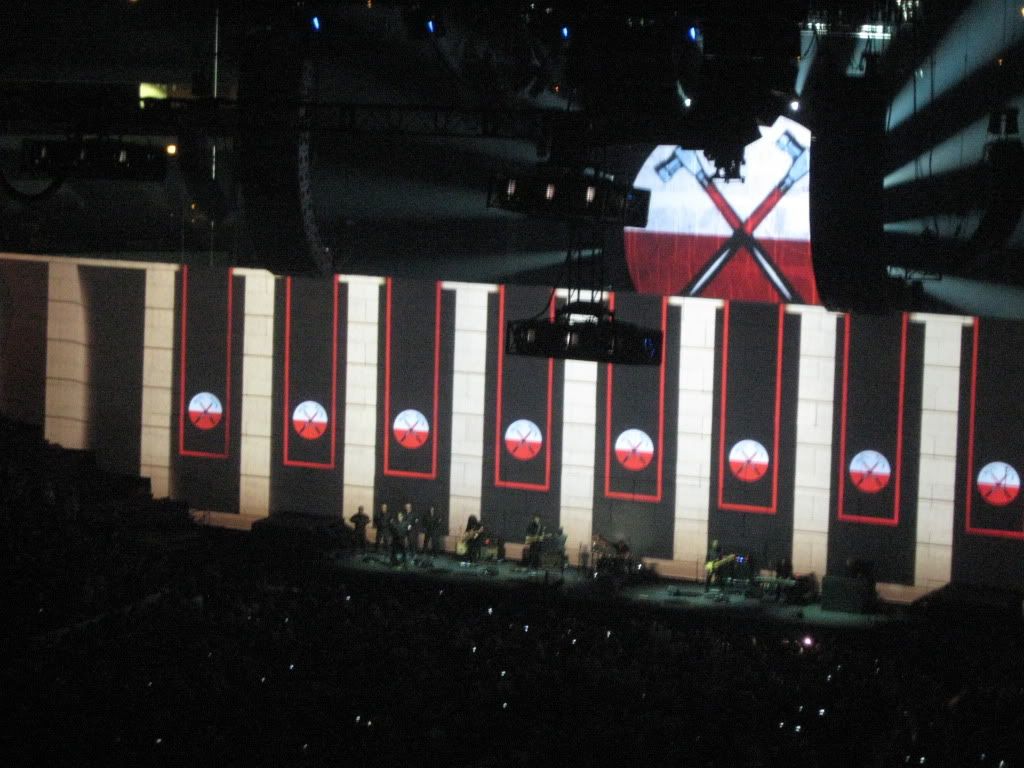
After a long while of cheering and applause, the noise of the crowd abated somewhat and Roger went into the last song, repeating the final line twice, "After all, it's not easy banging your heart against some mad bugger's wall." The room erupted once more and this time we wouldn't stop until the house lights came on and forced us to leave. Over the shouting and clapping and screaming, Roger addressed the crowd, saying, "Thank you, from the bottom of my heart! You've been a fantastic audience!" My friend and I proceeded to repeatedly bow with oustretched arms yelling "Roger! Roger! Roger!" We were still ecstatic, but also bereft, now that it was over. We had waited for this our whole lives; Pink Floyd is in our blood! It runs in our very veins! We didn't want this to be the end. After Roger waved and walked offstage and the house lights went on, everyone made a scramble for the nearest exit as the two of us remained in our seats yelling "Dark Side! Do Dark Side!" at the stage.
All in all, ticket prices may have been steep, but if you like this music and you're going to spend money on anything extraneous, like at a fancy restaurant or on $11 movie tickets or to buy food for your kids, do yourself a favor and spend it on a ticket to Roger Waters instead. He may not be in Chicago anymore, but he's around, and this is your last chance to see him before the wall comes down forever. All in all, it's all so much more than just a brick in the wall.
The Prince Experience - Live at Hammond’s Horseshoe Casino

Hammond, Indiana’s Horseshoe Casino is the place to be to have a good time and see some of the best musical performers. The Venue, an auditorium inside the casino, was the setting for one of the best impersonation acts to come about in a long time. The Prince Experience came in presenting all the best works of Prince bringing you back into the 1980’s for a walk down memory lane. What an impressive show!
Gabriel Sanchez was in the lead spot impersonating one of the most fabulous entertainers to ever exist. His ability made you feel like you were actually watching Prince. He sang the parts with perfection, dancing in a way that impeccably mimicked the pop music icon. His strut across the stage, the voice, and everything within his appearance made you believe that ‘the artist formerly known as’ was right in front of you. “It’s Prince!” a young lady shouted. And she was right.
Sanchez danced on the stage in erotic movements that kept the interest of the ladies in the room as he performed exactly like his royal badness. Awesome musical ability was being displayed for the show and was completely beyond belief. The musicianship in everything he did was overwhelming. The guitar work that he pulled off was a strong duplication of the multi-instrumentalist. The authentic reproduction of Prince was done to perfection right down to his signature guitar. He wasn’t just an awesome performer covering someone else’s music. Gabriel Sanchez actually becomes the man that developed the Minneapolis sound.
Some of the songs that were played were: “1999,” “When Dove’s Cry,” “Raspberry Beret,” and “Little Red Corvette.” Definitely the smoothest and coolest musical spot of the show was during “Purple Rain.” The band came in nice and slow during the intro, gradually moving forward into the body of the song. What a monumental performance.
The show was not limited to just Prince Songs. A video clip played from the smash hit movie Purple Rain. When the clip had finished, out walked a classy gentleman, David “Mor-ess Day” Gonzalez. He came out in the roll of Morris Day and stole the show for two songs, “Jungle Love” and “The Bird.” It was an amazing time. He had the look, the sly dance, and the voice down pat. Nobody was there to bring this guy his mirror and from the reaction of the women in the room, he didn’t need it either. Oh EE Oh EE Oh!
Gabriel sat down behind the drums for the song “The Glamorous Life” as one of the background singers, Jennifer Shafer, took the lead for the role of Sheila E. The vocalist that had been hiding in the back came forward and sounded like the real McCoy. The voice was so close to the original cut it was amazing. She has such an awesome vocal ability and tone.
During the pop masterpiece, drummer Junior Gamaz, stepped to the front of the stage while his kit was kept warm for him. At the front of the stage was a set of timbales. He proceeded to nail the Latin percussion parts within the song. Then, without stopping, Junior and Gabriel switched spots on drums without missing a beat. They were simultaneously playing the six piece kit as Gamaz regained his throne. Gabriel may have been Prince, but Junior Gamaz was the king of the kit.
During the entire show Gamaz held down the clock with precision. His hard hits and flash was so perfect for this group. When it came time for his drum solo it wasn’t like any other show boating that has been seen by other drummers. His original technique was refreshing to see and was quite clear that this man has rehearsed. There was a drum trigger that he would hit to get other sounds and accompaniment during his outing of becoming one with the audience. The drum rolls would run around the kit with such finesse captivating the onlookers.
The other half of the dynamic duo of background singers, Tracy Sparks, came forward to sing a duet with Gabriel. The song “Nothing Compares 2 U” was done flawlessly. During the entire show, Tracy’s voice could be heard, but she finally had her moment to shine. It was really a shame to not hear this angelic voice more in the lead.
The sax player, Peter Neumer, was a tremendous feature of the show. The solos were incredible to hear. The prolific player created some of the best sounds of the evening and kept hitting high notes that made everyone smile. This player was no amateur. A seasoned professional could only pull off the parts he played. He was amazing in everything he did. The show would not have been the same without him.
G Money filled in the bottom end on bass with funky lines that you could feel within your soul. Amazing slapping techniques came from the mighty hands of this bassist that helped to move the feet of the concert goers. The ace of the thick gauged strings definitely did more than hold the root of the chord; he rose to the level of supremacy.
Andrew “Droopy” Walker brought his guitar skills forward and it was sweet. The man brought his six string out to play and he tore it up. Unbelievable guitar parts were strummed, picked, plucked, and flaunted so effortlessly. He played the parts so well leaving a lasting impression for everyone that paid the price of admission for the show.
Mitch “the doctor” Cooper played the ebony and ivory keys providing the perfect sounds on every ditty that was duplicated. His fingers ran up and down the boards quickly. Nothing was less than superb when he played and he was on fire. The sounds obtained were just like the original recordings. One word describes Mitch. Fantastic!
All of the incredible performers during this show pulled together their talents and made everyone believe they had just seen Prince. Gabriel Sanchez played the part so well it could’ve fooled the biggest fans. This is definitely a must see show if you are now or ever have been a fan of Prince.
As the show came to a close in Hammond, everyone wanted to hear more music from The Prince Experience. The impersonators took you for a trip back to the 1980’s for a ride amongst hit songs. Gabriel Sanchez led the audience and the pack of musicians on a triumphant journey through these magical numbers. He danced with the ladies in the audience, charming his way through the performance. This was truly the place to be.
Alice In Chains Leaves Chicago Black and Blue
 Even in the post-Lane Staley era, Alice in Chains continues to establish themselves as one of the best and most durable bands from the Seattle grunge explosion. Now, with singer William DuVall taking the reigns, the band takes on a new identity while at the same time staying true to form. Though DuVall’s voice is similar to Staley’s, he offers a completely different presence – a presence that has not only been accepted by hard core Alice in Chains fans, but one that also works with the band’s chemistry. DuVall is not just a replacement singer, he is now Alice in Chains, and he proved that last weekend as the band headlined Charter One Pavilion in downtown Chicago with the support of The Deftones and Mastodon.
Opening with “Them Bones”, Alice in Chains was off to a thunderous start. Guitarist and founder (along with Staley), Jerry Cantrell, blasted away with low, gut-grabbing tones that seemingly shook the ground. Though an outdoor arena with Lake Michigan on one side and skyscrapers on the other may not have been as ideal as the Riviera or Aragon Ballroom, the band made it work quite well. A set containing roving spotlights faced out from the smoke-filled stage with rings of blinking lights appearing around the beams on occasion. Cantrell and DuVall switched back and forth from center stage to a microphone stand placed on a riser adjacent to Sean Kinney manning the drums, as leads vocals occasionally changed and just for the sake of variety.
Alice in Chains is a fantastic live act. DuVall and Cantrell’s harmonies were warm and haunting. Overall, the sound of the band was dominant, precise, trancelike and forceful when it needed to be, while their presence was dark and commanding. Like any band with so many great songs in their repertoire, they couldn’t play every song demanded by the fans, but it was a fully satisfying set nonetheless. Included in their Chicago performance was “Acid Bubble” and “Check My Brain” from their latest release When Black Gives Way to Blue a handful of songs from Dirt such as “Dam That River”, “Angry Chair” and “Rooster”. The band also played “Again”, but did suffer technical difficulties during the first half of the song as DuVall’s microphone failed to work. Finally, they ended with encores “Man in the Box” and “Would?”.
The Alice in Chains age with DuVall has begun and, with no disrespect to the late, great Layne Staley, it is apparent it will be a good one.
I Saw "Thee Oh Sees" At Shipshape Lincoln Hall
Lincoln Hall is, hands down, the weirdest concert venue I’ve ever set foot in.
And I’ve been to The Fireside Bowl.
I made my L.H. debut last Wednesday night for Thee Oh Sees, a garage pop outfit from San Francisco, about whom my roommate had said, “I think I’ve heard they’re pretty much pretty good.”
They were just so.
Lincoln Hall, too, was a pretty much pretty good place to see music performed. Opened in 2009 by the owners of Southport Ave.’s Schuba’s, L.H. is the renovated Fullerton Theatre of 1912, which most recently housed the 3 Penny Cinema. It’s on Lincoln, just north of Fullerton in Lincoln Park. The venue feels like it’s on Lincoln, just north of Fullerton in Lincoln Park. Which is not a bad thing, exactly, but it makes seeing punk performed there a little weird.
It was almost too nice a venue.
First things first: I headed for the men’s room – little did I know that I’d be micturating in the most pristine bathroom that a music venue about to put on a punk-ish show has ever presented to the world. It was . . . weird. The urinals themselves, for instance, were shaped like 1960’s mod chairs, the shape and color of massive eggs inset into the wall, with each egg missing what could only be termed its front hatch. Why would you make a urinal look this way?
Furthermore, and perhaps more noteworthy - there was not a drop of graffiti in the joint. Not one mark in the bathroom of a concert venue. Not an exploded pens worth of hieroglyphics. Zilch. Nada. There were some flyers put up on the door, but they were arranged tastefully in columns and rows, all of them advertising the upcoming Margot and the Nuclear So and So’s show (Sept. 19). Conspicuously, nobody had torn any of the flyers down, nor desecrated them with blasphemy, awful song lyrics, or phone numbers and the reasons one might be prevailed upon to call them. It was pure Twilight Zone, I tell you. I got out of there as soon as I could.
Lincoln Hall is divided into two sections: there’s an antechamber with tall circular tables set on crane legs resting under soft lighting. There's full bar featuring two smiling bartenders and a kitchen lurks somewhere nearby because there are lots of food scraps left on the tall tables. And then there’s the second room: the stage room. The stage room’s walls are exposed brick until they meet intricate metalwork that spins and curls up to the stage room bar, a bar with plenty of on-tap beer options and built-in wood-paneled shelves that hold bottles of expensive-looking liquor, each bottle backlit by a little light fixture in a way that renders the bottle’s contents into highly desirable shades of gold.
Let it be known that I’m not trying to paint L.H. in hoity-toity pen-strokes. I don’t actually think it is very pretentious or haughty, and I think that most people who might claim to feel that way are simply reacting to the unexpected. L.H. is actually quite warm, both temperature-wise and in the feelings it evokes. Unzipping my hooded sweatshirt, I took in a crowd of mostly thirty-something alternative types dressed in plaid shirts and tight to semi-tight jeans or Dockers. Almost everybody drank beer either out of plastic cups or glasses, chatting amicably in clusters, apologizing when they bumped into one another during a particularly demonstrative retelling of a story. It’s a warm place that just happens to be nice.
The first band of the evening is Paul Cary. I think. They never actually say their name, and they’re a three-piece group, Possibly Paul Cary is - guitar-keys-drums - with a lead singer/guitar player whose gravelly vocals crack in all the right places as it's transmitted through old-school ribbon microphone effects. P.P.C.’s sound is bluesy and melodic, like a more melancholy version of some The Strokes’s songs. The keyboard sounds good when you can hear it, which isn’t often enough. The lead singer (possibly Paul Cary himself?) should annunciate better. I caught maybe every third word. And the guitar playing trends towards the simple - especially the solos, which were not understated so much as casual, and far from the blues-driven self-expression I’d been hoping to hear.
Up next is Hot Machines, who thankfully identify themselves as such. They’re a really fun band, a jump-around squawking punk band that’s mostly upbeat. They employ both a male and a female singer, and Hot Machines are at their best when the two of them overlap voices, the melodies and arpeggios commingling, her chirps bisecting his microphone-effected crooning. The lady singer, Miss Alex-White (according to MySpace), has a great, rangy voice that’s smoky and seductive on their one slower song, and I wish we could have heard her full range more often. As it was, she stuck mostly to chirping. She also has great, massive hair, billowing curly hair that’s red or gold or American cheese yellow, often all three shades in one song when the stage lighting flickers back and forth across the color spectrum. Like this evening’s openers, Hot Machines are largely indecipherable. I believe I heard not infrequently the words, “Fire” and “Go,” but can offer little more than that in regard to their lyrical selections. And I was listening. My lamentations about understanding words might make me come off like a hearing aid-straddling octogenarian, but, man, let me at least a little bit into what you’re trying to do lyrically. Slurring ninety-five percent of its lyrics makes a band sound insecure, not indifferent. Likewise, like a lot of punk bands, Hot Machines are musically repetitive. After twenty minutes it all starts to blend together, I think, feeling again like an out of touch old-person, though I might be the youngest guy here. Music should take risks, and surely Hot Machines took one in their determination to play this music of fire and go, but the risks seem to have faltered there, confined to choices of style and tone instead of exotic instrumentation. Deviate and be rewarded. As is, however, they’re still barrels of fun.
Thee Oh Sees go on last. They’re a San Francisco outfit once known as Orange County Sound, which doesn’t make too much geographical sense, but who knows? Live music can be wonderful because just when you’ve fallen in love with an opening act, when you’ve determined that they’ve got a great sound, decided that they should go places far and wide, the headliner comes on and reminds everybody in attendance about how inventive, poppy music can really sound. The headliner tells us what it’s like to own true showmanship; they let us see for certain how a band’s cleverly crafted dynamic can play out on stage before our very eyes. Thee Oh Sees perform twangy, slippery punk songs with surfeit energy and verve. They craft catchy melodies to be sung over by lead singer John Dwyer, whose stage presence is phenomenal. He whirls around and kicks his legs, dancing, holding his guitar high on his chest like a machinegun or placing it headstock down on the ground while drummer Mike Shoun unleashes a vicious, five-minute drum solo. Dwyer has so much life in him that he cannot help but end nearly every poppy line with a “Whoop!” or a “Yip!” and by the end of the night those whoops and yips feel trademarked to him and to him alone, and I will think of Thee Oh Sees when I hear a dog yip or a crane whoop for a long time to come. Dwyer has so much stage presence that half the time it feels like he is up there performing by himself while the eyes of his comparatively humdrum band mates follow him around, distractedly playing their instruments, taking in the show as an on-stage audience.
Thee Oh Sees’ sound is hard to describe with anything approaching a realized fullness, but that’s because they’re originals. There are traces of Devo in the melodies, I suppose, and particles of surf rock, too. When Dwyer solos it sounds like he’s improvising, and he might be, taking off whole bars at a time between notes, then returning with a flurry up the guitar neck and back down it again before rediscovering the melody. The solos, and virtually everything about Thee Oh Sees, feels patient, in spite of their fast tempo. Patience welded to experimentation sounds like inspiration, even if its all been hashed out ahead of time. They just sound alive - eagerly alive – playing the same three chords in every charming song.
On my weirdest nights, it is nice to know that I have, at least, been charmed.
http://www.myspace.com/ohsees
http://www.myspace.com/hotmachines
http://www.lincolnhallchicago.com/
The American Dream topples in Steppenwolf's "Detroit"

The trappings of the “American Dream” and suburban life have been explored in every artistic medium for decades. But what do the age-old questions about the hunger for upward mobility and its attendant isolationism mean when asked during our current economic and socio-political conditions? Kicking off the 2010-2011 season for the Steppenwolf Theatre Company, Detroit, written by Lisa D’Amour and directed with purposeful ambiguity by ensemble member Austin Pendleton, manages to stimulate new questions about suburban decay with a suitably comic touch.
While the setting of Detroit is more a metaphorical than literal device in the play, it sets the tone of things falling apart: American cities, homes (“first-ring” suburban houses built in the ‘60s), ideals, marriages, individuals… All we once thought we knew and wanted for ourselves as Americans quickly turning on itself. No more safe havens, particularly from our own humanity. These are heady, eternal issues, but one of the triumphs of Detroit is the deceptively light presentation of this material.
The outward plot of Detroit is paper-thin: a “settled” suburban couple named Ben and Mary (played pitch-perfect by Ian Barford and Laurie Metcalf of Roseanne fame) throw a barbeque to welcome their new neighbors Kenny (a hilarious Kevin Anderson) and Sharon (a fiery Kate Arrington, coming off a star turn in A Parallelogram) who have moved into the empty house next door. What starts out with the usual forced and highly-socialized pleasantries soon unravels as back-stories and secrets are revealed and as the two couples begin to exert an indeterminate influence on each other.
The choice of playing an older and younger couple “against” one another is inspired: the older couple shaken out of their torpor and loneliness as the younger couple is provided with a window into their own potential future. And there is ample, though cleverly underplayed subtext sprinkled throughout the play: the dream of suburbia a parallel for the dream of America, both built on ideals that soon inverted; private vs. public selves; fear of the “other”; the suppression of our primal (and hedonistic) selves. As with most stories dealing with the dark underbelly of suburban life, sexual frustration (and its reckless release) is never too far below the surface (though again, in Detroit it is but one of many threads woven into the story more for provocation than resolution). Even a late turn by longtime ensemble member Robert Breuler, which on the surface seems designed to provide some closure, only manages to raise more questions.
As with so many of Steppenwolf’s productions, Detroit is supremely engaging and provocative. The set design by Kevin Depinet is superb, the writing and direction artful, and the ensemble cast thoroughly likeable and winning throughout. By the time Detroit reaches its pointedly post-9/11 (and post-apocalyptic?) conclusion with Ben and Mary facing either re-birth or ruin, you will have laughed in empathy and recognition of self and be left with many questions about the uncertain future awaiting us all.
Above photo:(counterclockwise from upper left) - Ensemble members Kate Arrington, Ian Barford, Kevin Anderson and Laurie Metcalf in Steppenwolf Theatre Company's production of Detroit by Lisa D'Amour (playing through November 7th), directed by ensemble member Austin Pendleton. Photo by Michael Brosilow.
One Singular Sensation: A Chorus Line keeps in step with 30 years of musical gold
As a writer I am younger than one of the longest running musicals in history, but “A Chorus Line” still glitters and shines with the same fervor since its premiere on Broadway in 1975. This timeless play about a talented group of dancers going through the grueling, challenging, and emotional tryouts to make it in the chorus is one that everyone can relate to, whether they have two left feet or not.

A Chorus Line follows an ensemble cast of aspiring dancers throughout three stages of cuts on their way into the chorus. The opening scene begins with the dancers practicing a complicated choreography routine while being criticized and judged by the director and his assistant; “How many Broadway shows?” “Keep your head up.” “Arms up on the fourth count not the third.” The ensemble cast has all the caricatures and stereotypes of dancers during the audition process; you have the standouts that shine and completely steal the spotlight, like the outgoing and overly-confident Val, played by Nina Fluke; you have the dancers who struggle with their confidence such as Paul, played by Bryan Knowlton, dancers who are battling nerves like Judy, played by Laura E. Taylor, the sassy veteran dancer like Sheila, played by Anika Ellis, and funny and flamboyant-like Bobby, played by Drew Nellessen. The entire cast was phenomenal with voices that carried the weight of desire and passion for dancing. The only exception the outstanding performances was the solo dancing sequence featuring Mara Davi as Cassie; her solo “The Music and the Mirror” was a spotlight number in which two way mirrors dropped from the ceiling adding a stunning visual backdrop for the actress, but Davi, who is an experienced Broadway performer, lacked the fluidity and grace the number required. The dance needed to embody Cassie’s passion and hold up to her statement, “God, I’m a dancer!” Her number, which should have been the crowning piece in the second half of the play, was lackluster and slowed the play, particularly following the hilarious and entertaining “Dance: Ten, Looks: Three” number by Val.

'The Invasion Of Skokie' Can Be Widely Eye-Opening

Did you know innocent people were "forcibly tattooed... for the identification system of them in Nazi concentration camps during the Holocaust?" So, "In modern times the association of tattoos with Nazi concentration camps and the Holocaust" has caused some Jewish people to be against the practice of tattooing of any kind (http://en.wikipedia.org 2010.)
The more folks expose themselves to truths about different cultures and religions than their own, and can understand where they are coming from, the better the chances of peace and harmony in a world of too many minds misunderstood and divided.
"The Invasion of Skokie" is a play partially intended to be a comedy about a Jewish family during the 1970s. Whopping whacked-in-the-head-Nazis may have said or say laughing gas should have been filled into the theatre since not all the punch lines spit out by the characters were laughed at by the audience of mostly middle-aged-men and ladies.
However, in all fairness the production had such non-comical heavy-weight themes with one being about the Holocaust, which is not to be taken shallowly due to its extreme emotional costs on Jewish human beings. The "Invasion of Skokie's" main character, Morry, played by Mick Weber, executed quite well how the Jewish have been hit by the evil blows of the Nazis, and how it can, understandably, still be painful for them to think of the unjustifiable torturous acts and killings of grandparents, moms, dads, sons, daughters, siblings...
To elaborate, the play was set during the time the Nazis of Illinois, in real life, beat the Village of Skokie in the U.S Supreme Court when they had fought to march in the town to throw their political existence in the face of victims and survivors of the Holocaust (which comprised of 40 percent of the residents there!) As one could imagine, some Jewish people around while the fight had taken place had said "This isn't just a free speech matter. This is an assault on a community," what a nightmare (Petlicki M. Chicago Dramatists marches into 'Invasion of Skokie' Pioneer Local. 2010 Aug 26.) Since Chicago Dramatists Network Playwright of "The Invasion of Skokie," Steven Peterson, had his deceased father and a lot of his friends as victims of the march it was something he wanted to share (Petlicki M. Chicago Dramatists marches into 'Invasion of Skokie' Pioneer Local. 2010 Aug 26.)
An additional theme of "The Invasion of Skokie" is about a Jewish couple (Morry and Sylvia ) struggling to keep their daughter (Debbie) from marrying a man (Charlie) from another faith, even though he has been tight with the family ever since he was a young child. But, Sylva's and the family's close friend (Uncle Howie's) reactions toward the Nazi's march and the possible walking of a gentile into their unit, compared to Morry's, was mild. That is, Morry firmly believes in using violence against the Nazis who are to invade Skokie, whereas, Sylvia, Debbie and Charlie are adamantly opposed to resorting to measures that dangerous, radical and wild.
The Director, Richard Perez, as well as all of the characters played by Mick Weber (Morry Kaplan), Cindy Gold (Sylvia Kaplan), Tracey Kaplan (Debbie Kaplan), Michael Joseph Mitchell (Howie Green) and Bradford R. Lund (Charlie Lindal) have respectable credentials, and the acting seemed convincing thru and thru, especially Mick Weber's, while Steven Peterson's writing was not to my liking until 10 minutes or so into the production.
To close the curtain on the review, I will lastly say there is a tremendous throw-you-off-your-rocker part in the play which combined with its other themes, I did not mention, have the depth and importance for you to excitingly argue back and forth with someone about them.
"The Invasion of Skokie" (a finalist in the Dorothy Silver Playwriting Competition) plays at the Chicago Dramatists, 1105 W.Chicago Ave. Chicago, IL. 8 p.m. Thursdays-Saturdays, 3 p.m. Sundays, September 15th-October 10th. $32 Tickets; www.chicagodramatists.org; (312) 633-0630.
Above photo:
(L-R) Bradford Lund, Mick Weber, and Michael Joseph Mitchell star in Steven Peterson's world premiere production of The Invasion of Skokie, at Chicago Dramatists, 1105 W. Chicago Ave., running 09/2-10/10/10, Thursdays through Saturdays at 8 PM and Sundays at 3 PM. Photo by Jeff Pines.


Latest Articles
-
 Poetry in Motion: Joffrey's Eugene Onegin enraptures at the Lyric Opera
Written by Kendall RoyzenThere’s something magical about stories. Stories have the power to transcend time, reaching across the centuries to share their thoughts, ideas, and emotions. Tales of heartbreak, anguish, squandered youth, and missed chances written in the 1800s have a way of…
Poetry in Motion: Joffrey's Eugene Onegin enraptures at the Lyric Opera
Written by Kendall RoyzenThere’s something magical about stories. Stories have the power to transcend time, reaching across the centuries to share their thoughts, ideas, and emotions. Tales of heartbreak, anguish, squandered youth, and missed chances written in the 1800s have a way of… -
 Collaboraction Theatre announces June shows and events in its new House of Belonging in Humboldt Park
Written by Buzz Center StageNow fully activated, Collaboraction Theatre Company’s new House of Belonging in the Kimball Arts Center, 1757 N. Kimball Ave in Humboldt Park, is a sleek, 4,000-square foot space featuring a new 99-seat flexible studio theater and a 50-seat cabaret with…
Collaboraction Theatre announces June shows and events in its new House of Belonging in Humboldt Park
Written by Buzz Center StageNow fully activated, Collaboraction Theatre Company’s new House of Belonging in the Kimball Arts Center, 1757 N. Kimball Ave in Humboldt Park, is a sleek, 4,000-square foot space featuring a new 99-seat flexible studio theater and a 50-seat cabaret with… -
Redtwist Theatre presents Anatomy of A Suicide August 12-30
Written by Buzz Center StageProduced in partnership with JunkHeart, The Metal Shop Performance Lab is proud to announce the cast and creative team for Anatomy of a Suicide, August 12 - 30, at Redtwist Theatre, 1044 W Bryn Mawr Ave, Chicago, written by Alice Birch and directed by Alex Mallory. Previews are Wednesday, Aug. 12 and Thursday,…
-
Juneteenth Prelude: Celebrating Freedom and Black Expression, an evening of entertainment and community
Written by Buzz Center StageBlack Ensemble Theater Founder and Executive Director Jackie Taylor proudly announces Black Ensemble's Juneteenth Prelude: Celebrating Freedom and Black Expression, as part of the series Another Night @ BET. This celebratory evening, curated by Bernard Lilly, Jr., engages the Black Ensemble community with performances from BE…


Does your theatre company want to connect with Buzz Center Stage or would you like to reach out and say "hello"? Message us through facebook or shoot us an email at This email address is being protected from spambots. You need JavaScript enabled to view it..
*This disclaimer informs readers that the views, thoughts, and opinions expressed in the text belong solely to the author, and not necessarily to Buzz Center Stage. Buzz Center Stage is a non-profit, volunteer-based platform that enables, and encourages, staff members to post their own honest thoughts on a particular production.