
Displaying items by tag: Chicago plays
Goodman’s Iceboy! Is a Full‑Tilt Blast of Comic Mayhem
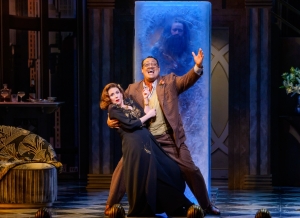
Goodman Theatre’s Iceboy! arrives as a gleefully off the rails musical that blends Broadway glamour, Neanderthal chaos, and theatrical myth making into one of the most delightfully strange premises to hit Chicago in years. It’s a satire, a love letter to showbiz, and a playful reimagining of how Eugene O’Neill might have found inspiration for The Iceman Cometh - if history had taken a wildly different turn.
Set in 1939, Iceboy! (officially and appropriately titled Iceboy! Or The Completely Untrue Story of How Eugene O’Neill Came to Write “The Iceman Cometh”) follows Broadway superstar Vera Vimm, who purchases the newly thawed 40,000‑year‑old Neanderthal after he’s discovered in the Arctic. An orphan herself, Vera risks the last of her money because she sees in Iceboy not just a curiosity, but the possibility of a son. Once he thaws, “Iceboy” unexpectedly becomes a theatrical sensation, charming Manhattan and quickly rising to stardom. His meteoric fame threatens Vera’s own spotlight, creating a comic rivalry as she scrambles to maintain her status.
Meanwhile, playwright Eugene O’Neill becomes fascinated by Iceboy’s sudden cultural impact. In this fictionalized retelling, Iceboy’s presence and persona inspire O’Neill to write The Iceman Cometh, intertwining the Neanderthal’s improbable celebrity with one of American theatre’s most iconic works. The musical plays as a satirical backstage romp - part showbiz fable, part absurdist comedy - where ambition, ego, and theatrical legend collide, all delivered with a cheerful, madcap sensibility that feels straight out of the Mel Brooks playbook. The tone is broad, cheeky, and joyfully irreverent, embracing the kind of anything goes comic mayhem Brooks perfected in The Producers and Young Frankenstein.
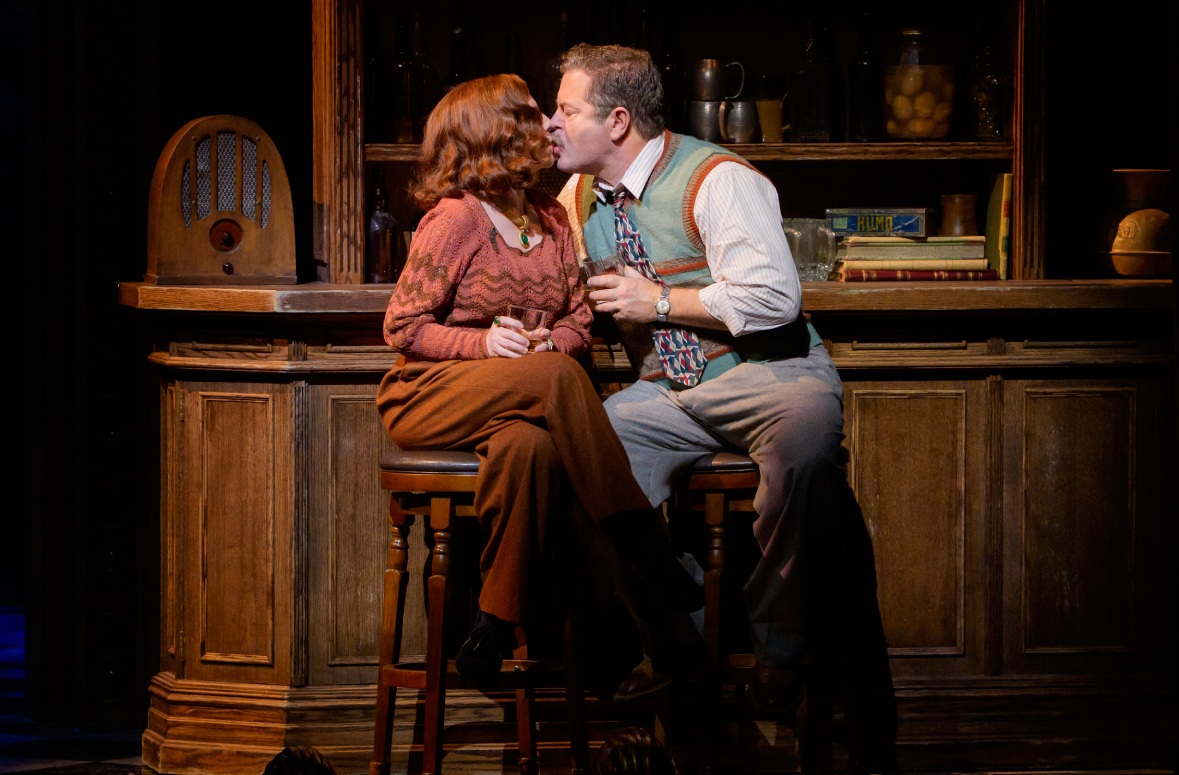
Megan Mullally as Vera Vimm and Nick Offerman as Eugene O'Neill in Iceboy! at Goodman Theatre. Photos by Todd Rosenberg.
To appreciate just how boldly Iceboy! reframes O’Neill’s legacy, it helps to remember what The Iceman Cometh actually is.
O’Neill’s future Pulitzer Prize offering inspired a four-hour film that’s essentially a parade of drunks in a dim bar, each clinging to dreams they’ll never pursue - the bar itself a metaphor for their inability to move forward, trapped in the same place both physically and emotionally. The 1973 film adaptation centers on the down and out patrons of Harry Hope’s saloon in 1912 Greenwich Village. These men - alcoholics, former revolutionaries, disgraced professionals - spend their days drowning in booze and clinging to “pipe dreams” of future redemption.
Their routine is disrupted when charismatic salesman Theodore “Hickey” Hickman arrives - sober, zealous, and determined to force everyone to abandon their illusions. Hickey’s mission to strip the barflies of their comforting fantasies leads to emotional unraveling, bitter confrontations, and ultimately a chilling confession about his own past. The story is a tragic, philosophical exploration of hope, delusion, and the brutal cost of facing reality.
All of that brooding, booze-soaked existentialism makes Iceboy!’s approach even more refreshing. Where O’Neill’s world traps its characters, this musical unleashes its own with joyful abandon - led by an ensemble so charismatic and so sharply funny that the show practically vibrates with life.
Guiding the production is director Marc Bruni, who shapes the show with crisp timing and a clear sense of comic architecture, keeping its wild premise buoyant without letting it unravel. The music by Mark Hollmann gives the story a bright, mischievous pulse, while the lyrics by Hollmann and Jay Reiss sharpen the humor with clever turns and unexpected punchlines. The book by Erin Quinn Purcell and Reiss balances absurdity with emotional undercurrents, giving the characters room to land both jokes and genuine moments. Joann M. Hunter’s choreography adds another layer of invention, using movement to heighten the show’s playful spirit and amplify its theatrical momentum.
It certainly helps that Iceboy! is powered by an outrageously talented and instantly likeable ensemble. Husband and wife duo Nick Offerman and Megan Mullally make a dynamite team - Offerman bringing his signature deadpan charm to Eugene O’Neill, the same understated precision that’s made him beloved in Parks and Recreation, Devs, and The Last of Us. Mullally, best known for her Emmy winning turn as Karen Walker on Will & Grace, her unforgettable Tammy II opposite husband Nick Offerman on Parks and Recreation, and her Broadway run in How to Succeed in Business Without Really Trying, delivers a riotously funny, razor sharp performance as Broadway titan Vera Vimm. She tears into the role with fearless comic bravado and vocal firepower that reminds you she’s a true musical theatre pro - her belt is thrilling, her phrasing wickedly playful, and her comedic musicality is a show in itself. Few performers can detonate a punchline the way Mullally can.
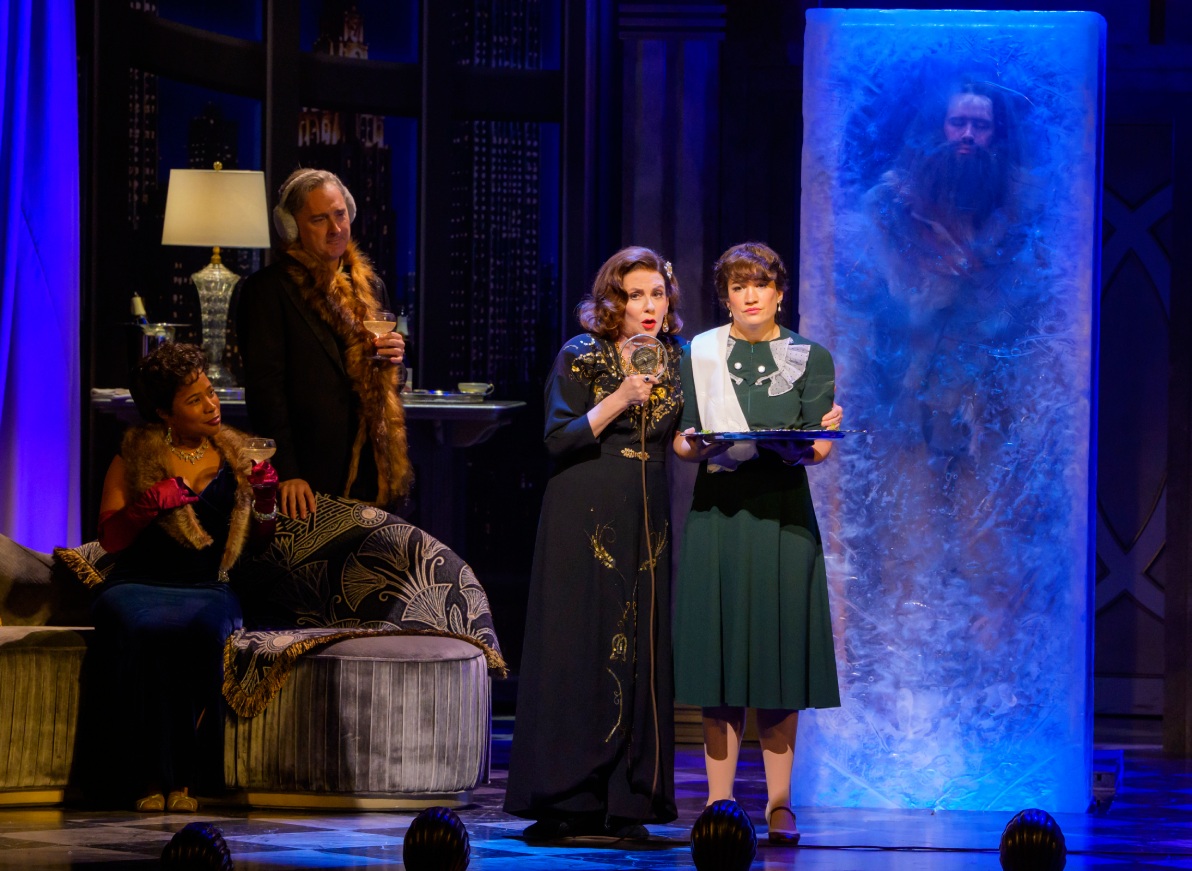
(L-R) Melanie Brezill, Shawn Pfautsch, Megan Mullally, SarahStiles and Grey Henson in Iceboy!
Cedric Yarbrough, best known for Reno 911! and Speechless, is terrific as Floyd Richards, Vera’s devoted lover and perpetually stressed playwright. He brings a warm, rumpled charm to the role, layering Floyd’s desperation with impeccable timing, sly vocal humor, and a steady stream of perfectly landed one-liners. His presence gives the show a grounded comic pulse that keeps the chaos humming - and his baritone is impressive.
Chicago favorite Alex Goodrich is a delight as Frankenstein, one of Vera’s long-suffering caretakers, layering the role with buoyant physical comedy and a wonderfully off-kilter energy that fits the show’s boisterous comic verve.
As Iceboy or “Jeff,” Grey Henson is a revelation - wide eyed, instinctive, and musically explosive. He plays the Neanderthal with such innocence and uninhibited theatrical gusto that the audience can’t help but root for him. He’s a genuine surprise as well, offering several scene-stealing moments that deepen the show’s comic momentum and give its wild energy an extra spark.
And Sarah Stiles, as Lambert, Vera’s whip‑smart, perpetually overwhelmed assistant, makes every appearance count with her explosive comedic instincts and razor‑precise delivery. Her timing is immaculate - every flustered aside, every clipped retort, every moment of mounting panic lands with such clarity and control that she elevates even the smallest beat. Stiles has a way of shaping a line so it hits with both intelligence and impact, turning Lambert’s exasperation into one of the show’s most consistently funny throughlines.
Together, this ensemble - Offerman, Mullally, Yarbrough, Henson, Stiles, Goodrich, and a bench of other strong players rounding out the cast - forms an ecstatically silly comedy machine, a group so talented and irresistibly likeable that the laughs never let up and every performer feels essential to the show’s delirious momentum.
The musical numbers are wonderfully fun. Songs like the opening number “Historic Find,” the gloriously unhinged “Can You Call Me ‘Mama’?,” and the full company showstopper “Hooray for Iceboy!” set the tone for the musical’s raucous spirit. Each one is packed with sharp wit, big Broadway energy, and the kind of gleeful absurdity that keeps the audience laughing long after the button. “Historic Find” opens the show with a clean burst of discovery‑driven momentum, “Can You Call Me ‘Mama’?” leans into Mullally’s sharp comic instincts, and “Hooray for Iceboy!” brings the full company together for a lighthearted, good‑natured celebration. This sample size of songs highlights how musically nimble and consistently funny Iceboy! is - a score that shifts easily between cleverness, silliness, and moments of heightened theatrical play.
One of the funniest musical numbers in the show is “Marry Me,” sung with perfect comic contrast by Grey Henson and Sarah Stiles. In it, Iceboy proposes to Lambert with disarming sincerity, offering what he believes are tender declarations of affection - only to fold in a series of prehistoric “courtship traditions” drawn from his caveman understanding of romance, throughout the song telling her, “I want to take you from behind.” The result is a wonderfully off‑balance duet that lands as one of the show’s most genuinely hilarious moments.
Adding to the show’s irresistible charm is the fantastic Art Deco set designed by Paul Tate Depoo, which instantly places us inside Vera Vimm’s lavish living room - all gleaming lines, bold geometry, and glamorous period detail. Depoo’s design captures the theatrical excess of 1939 Broadway while giving the actors a playground of visual delight. On each side of the stage, Eugene O’Neill’s writing desks sit like dueling stations of inspiration and frustration, a clever touch that keeps his presence woven into the action. And, true to O’Neill’s legacy, there’s always a bottle within reach, a sly nod that becomes both a running joke and a thematic anchor. It’s a smart, stylish environment that supports the comedy while grounding the show in a richly imagined world.
Iceboy! Or The Completely Untrue Story of How Eugene O’Neill Came to Write “The Iceman Cometh” is an outrageously inventive, joy-charged burst of musical comedy that proves Goodman Theatre can still surprise us in the best possible ways. With its fearless cast, sharp writing, and deliriously fun score, it’s the kind of show that sends you out grinning and grateful for the sheer imagination on display. Iceboy! runs through August 9 at Goodman Theatre and stands as one of the most riotously entertaining nights out you’ll find this summer.
Very highly recommended.
For tickets and/or more show information, click here.
The Art of Awe: Water for Elephants Balances Spectacle and Soul

The musical Water for Elephants, presented by Broadway In Chicago and based on Sara Gruen’s 2006 novel, is the rare touring Broadway production that feels like two forms of live entertainment fused perfectly. It is a sweeping musical, yes, but it is also a full-blown circus spectacle – and, more impressively, it manages to blow you away on both fronts.
Told through the memories and ghosts of an elderly Jacob Jankowski, Water for Elephants follows a young Jacob who, under unfortunate circumstances, follows the age-old childhood dream of running away with the circus. The show brings to life the complicated realities behind that fantasy: the idea of stumbling into a secret, self-contained world where danger, wonder, chosen family, and reinvention all exist under one big top. From the moment Jacob enters that world, the audience is drawn in with him.
Particular standouts in the principal cast were Zachary Keller as Jacob Jankowski, whose vocal talent and charisma are matched only by Robert Tully as Older Jacob – the perfect pairing across time. As Marlena, Helen Krushinski commanded the theatre like a pure-of-heart ringmaster, capturing our attention both on trapeze and vocally. However, no one made the audience laugh harder than Tyler West as Walter, the gritty, spunky clown and knife-thrower whose physical comedy was unmatched, projecting every larger-than-life expression to the backs of the theatre.
The show’s creative engine fires on all cylinders: a soaring score from the acclaimed PigPen Theatre Co. (The Tale of Despereaux), a sharply crafted book by four‑time Tony Award nominee Rick Elice (Jersey Boys, Peter and the Starcatcher), and tour direction by Ryan Emmons, faithfully re‑creating Jessica Stone’s Tony‑nominated original staging (Kimberly Akimbo).

(left-right) Connor Sullivan, Helen Krushinski, and Zachary Keller in Water for Elephants. Photos by Matthew Murphy for MurphyMade.
The most immediately astonishing element of this production is, unsurprisingly, the circus work. The show features a truly impressive range of skills, including aerial hoop and silks, Spanish web, trapeze, and dozens of genuinely death-defying acrobatic tricks and stunts. These sequences are not treated as decorative flourishes or occasional spectacle breaks; they are woven directly into the fabric of the show, pulling us behind the scenes of how the circus breathes, moves, celebrates, and survives.
Aside from their incredible acrobatic talent, it is the ensemble’s acting and collective presence that really bring the Benzini Brothers Circus to life. They do not just perform like a group of talented individuals; they feel like a community. Their presence gives the spectacle a lived-in quality, as if we are getting a glimpse into a strange, beautiful little village that existed long before Jacob arrived and will continue on after he leaves. The choreography only deepens that feeling, filling the stage with constant motion that still somehow feels purposeful, like the well-oiled machine behind a traveling circus, rather than chaotic. Even in the busiest moments, there is a sense of shared rhythm and collective trust among the ensemble that’s impossible to fake.
That trust extends beyond performance and into the technical construction of the show itself. Throughout the production, the cast quite literally assembles and dismantles the world around them. The big top is built, broken down, reconfigured, and rebuilt in front of us, using artistry to turn scene transitions into their own kind of performance. For a concept that presents so many obvious challenges – live animals, circus-scale theatricality, and the limitations of a traveling production, to name a few – Water for Elephants meets each obstacle with remarkable creativity and a steady grounding force.

The touring cast of Water for Elephants.
The production design is especially successful because it knows when to lean into abstraction. Rather than attempting to make every element literal, the show often suggests the world of the circus through movement, fabric, shadow, structure, the bodies of its performers, and some of the most beautiful puppets I’ve seen on stage. The amount of thought that went into creating something cohesive, theatrical, and fully transportable - without dulling any of its magic - feels less like standard Broadway stagecraft and more like a feat pulled off by a traveling chosen family.
All of this authenticity, however, at times feels at odds with the musical’s book and score. The ensemble feels so natural, so physically and emotionally connected to one another, that a few of the more dramatic scenes begin to feel noticeably staged by comparison. That is not a question of the principal cast’s talent, but rather a limitation of translating this story from novel to musical. There are moments when the circus – and even the puppets – feels startlingly real, and moments when you are reminded that you are very much watching a musical. Neither approach is inherently wrong, but the gap between them can be jarring. Still, that critique feels small compared to the scale of what the production accomplishes. It is also worth noting how vocally balanced the ensemble remains despite the wide range of performers on stage. In a show that combines musical theatre performers with circus and acrobatic artists, maintaining that level of cohesion is both a performance achievement and a technical one.
Water for Elephants captures the exact feeling it is chasing: awe. It is dangerous, romantic, inventive, and deeply theatrical, with a company that makes the impossible look effortless.
For anyone who has ever wanted to run away with the circus – or simply be reminded of what live performance can do when artists push it to its limits – Water for Elephants is running at James M. Nederlander Theatre through July 5th. Tour information and tickets are available at https://waterforelephantsthemusical.com/.
A People: A Sweeping, Soul‑Stirring Journey That Celebrates Jewish Identity
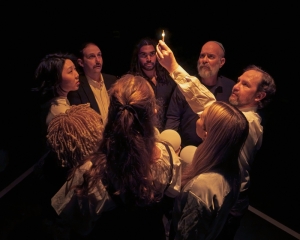
An extraordinary eight-person ensemble fuels the sweeping storytelling of A People - a production presented collaboratively by Arts Judaica and YI Love Jewish - shifting through nearly 80 characters across generations and geographies. Though only one cast member is Jewish, playwright LM Feldman intentionally assembled a diverse ensemble to reflect the many ways Jewish identity manifests - across culture, theology, race, queerness, and lived experience - underscoring that there is no single way to be part of a people.
The performance thrives on the versatility of this cast, featuring standout contributions from Douglas Levin, who provides an authentic and anchoring sincerity, and Charity Schultz, who illuminates her roles with magnetic charm. Daniel Boughton moves with ease between sharp humor and striking emotional depth, and Jin Ai anchors the production’s stillest moments with a quiet power, enriched by her beautifully integrated guitar work. Zach Kunde cuts through the space with sharp intellect and a commanding vocal presence, while Haley Schenk turns a single, piercing glance into some of the production’s most potent dramatic beats, and she even threads in flute playing that adds a surprising, delicate texture. The momentum never falters thanks to Xavier Mattison’s vibrant energy and tenderness, while Freya Churchwell rounds out the ensemble with impressive, wide‑ranging versatility and delivers some of the play’s genuine laugh‑out‑loud exchanges. Together, they weave a unified and deeply affecting tapestry of human survival.
This remarkable stage chemistry is guided by director Avi Hoffman, an acclaimed figure in global Jewish theater who recently directed and starred in a historic Yiddish production of Death of a Salesman in Bucharest, Romania. Having previously earned a Drama Desk nomination for playing Willy Loman in New York, Hoffman injects this local production with masterful artistic insight. Under his careful guidance, the non-linear, fragmented script by L. M. Feldman avoids confusion, gaining immense clarity and striking a perfect balance between epic historical weight and intimate human connection.
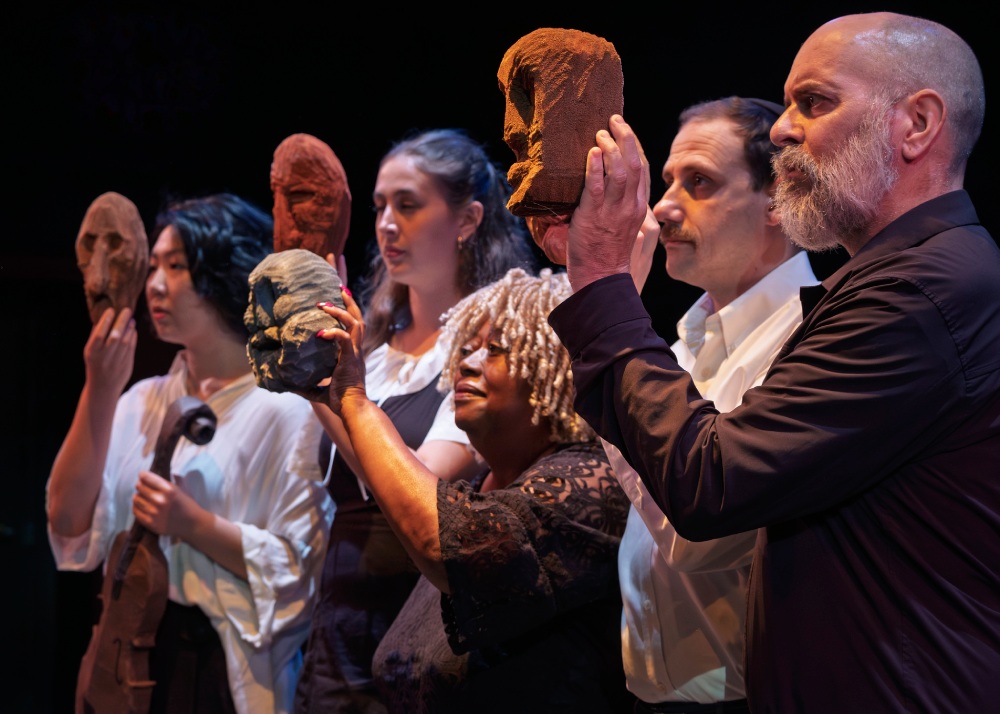
L-R: Jin Ai, Charity Schultz, Freya Churchwell, Zach Kunde, Douglas Levin. Photos by Logan and Candice Conner, Oonphotography.
Starting with the diaspora of the Jewish people that have become scattered throughout the world, the production explores several expressions of Judaism while ultimately reinforcing the idea that, despite their differences, they remain one people - and a remarkable people at that. It touches on beautiful threads of Jewish history, including the teaching that Moses received not only the written Torah referred to as “The Hand” at Mount Sinai but also the Oral Torah referred to as “The Tongue,” which was an interesting fact that I did not ever learn about the Torah in Hebrew school. I was also unaware of another phenomenon that members of the Jewish community called “tonals” actually memorized whole portions of the Torah to recite and sing so that the Torah portion could be performed for groups of students/scholars etc., to discuss and watch. The important thing that came out of this discussion of the Torah and the essential thing that makes Judaism different from other religions is that Jews learned and passed on the teachings of the Torah and the Talmud for the purpose of discussing them and learning from them and interpreting them and re-interpreting them -so as not to force them down anyone’s throat to be followed with blind faith.
As a Jew, I appreciated how the piece pokes gentle fun at our tradition of spirited debate - a trait that can be both energizing and, at times, hilariously counterproductive.
They are so intelligent at debating with each other that sometimes they nitpick each other to the end of a discussion that could otherwise forward the family or community or couple in a more positive way.
One of the production’s most profound scenes comes when a character asks a 90‑year‑old what history lives in the wrinkles of their face - how an entire lifetime, nearly a century of memory, can be held within one fragile human body. Another moment that stayed with me was the gentle but urgent insistence that nurturing future generations is vital to the continuity of the Jewish people.
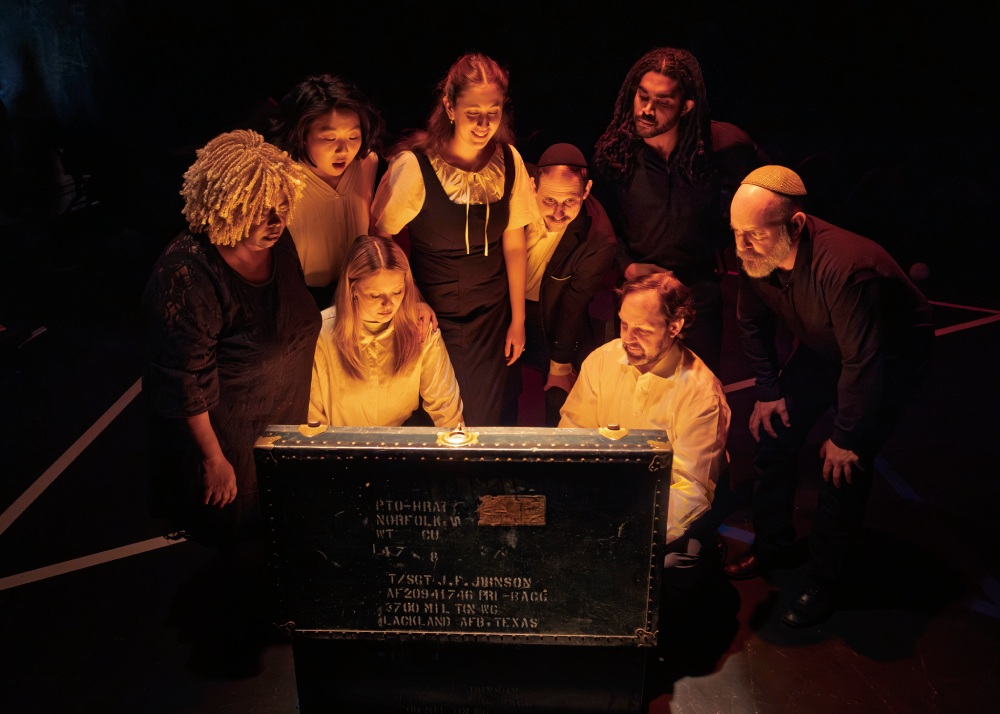
Back row L-R: Freya Churchwell, Jin Ai, Charity Schultz, Xavier Mattison, Zach Kunde, Douglas Levin. Front L-R: Haley Schenk, Daniel Boughton.
The differences among them are many, yet a shared thread still binds them together. One character argues passionately for a two‑state solution, while another hopes her girlfriend will one day be fully embraced by her community. A rabbi even confronts a group of Jewish Christmas carolers, shouting, ‘Why are you doing this?’ as the story considers how and why some Jews celebrate Christmas - a reflection of how the holiday’s overwhelming cultural presence in America can blur the line between religious observance and simple seasonal participation. And still, beneath all these disagreements and divergences, the play returns to the same essential truth: that despite their varied beliefs, identities, and practices, they remain part of one people.
This production was perfect for me as a Reform Jew who has been struggling in recent years with the current rise in antisemitism and my own childhood feelings of being a “self-hating Jew”. I remember being told as a teenager by my talent agent applying for theater roles that I needed to change my last name from Katz to Cates, implying that I would not be cast with a Jewish last name.
The work also reminded me that many young women today - queer and straight alike - continue to push back against the patriarchal elements of Judaism. It echoes the long history of restrictions found in early texts, where girls as young as 12 years old were defined by their childbearing potential and barred from studying sacred writings.
On the plus side, it brought me back to the beauty of the Yiddish language and how I hunger for the sounds of my great grandmother Fanny’s voice and my grandmother Lillian’s voice saying, ‘Have a little nosh!’ and, ‘We love you so much we’re kvelling!’”
The set is intentionally simple: a large Star of David stretches across the floor of Theater Wit’s intimate in‑the‑round space, immediately grounding the production in its cultural and spiritual roots. A few risers punctuate the stage, giving actors elevated platforms for defining moments, while small prop boxes at either end glow when opened, revealing modest but striking items that carry surprising emotional weight. Puppets appear briefly as well, echoing the woodworking projects referenced in the story and adding a tactile, handmade quality to the world. It’s an effective setup for this play - the open space becomes essential as the ensemble moves fluidly around the stage, frequently breaking the fourth wall to bless a volunteering audience member, pass out challah, ask questions, or coax the crowd into clapping along.
By luck, I chose the seat that happened to be in the spotlight for participation, and I was delighted when one actor asked me to be his ‘bubbe’ - his grandmother. When I said, ‘Yes! I will be your grandma!’ He gently took my hand, giving me a grateful squeeze. At another point, one of the actors - dressed as a bride - asked if he could give one of the audience members a blessing. I immediately said, ‘Yes!’ and he came over and placed his hands gently on my head - he was wearing the traditional lace head covering the bride on her wedding day - and he wished me great life blessings of joy and to find a wonderful husband. It was a delightful, intimate moment, and I hope that everyone who sees the show volunteers to experience that.
Throughout much of the play, the actors also wear small placards hanging from their necks, each bearing a single word such as “wrestle,” “struggle,” and “legacy.” These signs become a quiet but potent visual motif, suggesting the burdens, questions, and inheritances each character carries across time. They function almost like distilled themes of Jewish history itself - reminders that to be part of a people is to wrestle with identity, to struggle for continuity, and to consider what legacy one leaves behind. Other words appear as the ensemble shifts through eras, each one offering a compact window into the emotional or spiritual weight of the moment.
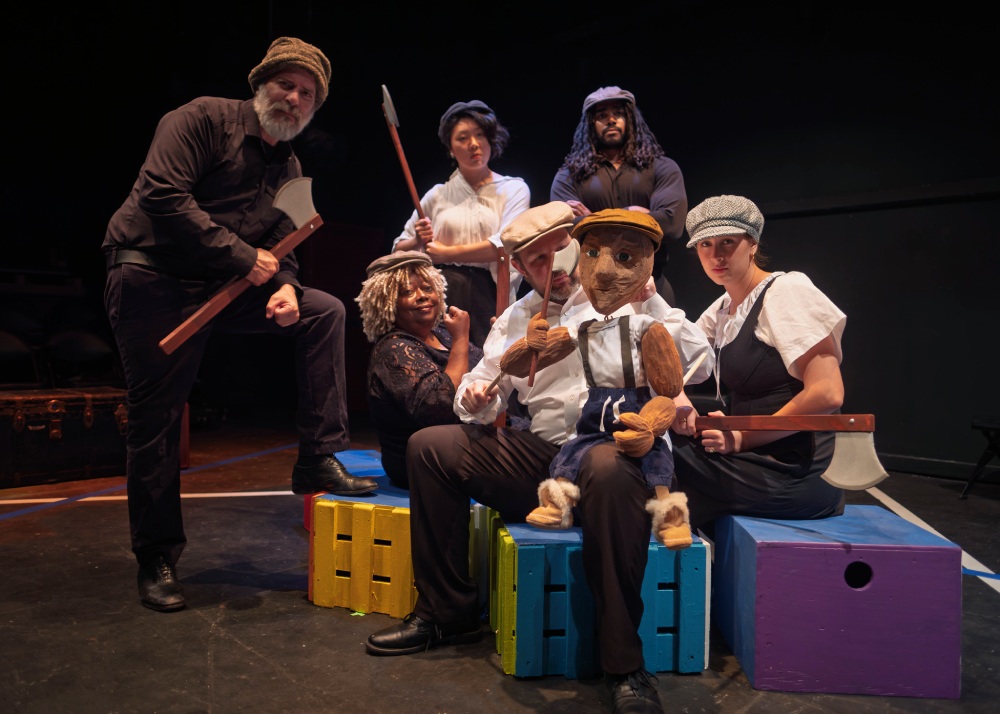
Back row L-R: Douglas Levin, Jin Ai, Xavier Mattison. Front row L-R: Freya Churchwell, Daniel Boughton, Charity Schultz.
My only note - and this is for the author, not the cast or director - is that of all the various types of Jews included in this piece - Reform, Conservative, queer, self‑hating, Orthodox, even atheist - the one type of Jew that was not represented was the Messianic Jew, of which I am one.
Messianic Jews (not to be confused with the organization Jews for Jesus) are Jews who believe that Jesus is the Messiah spoken of in the Old Testament - the ‘Christed One,’ meaning the one anointed with the oil of blessing. In those same scriptures, this figure is described as the blessed one who would be ‘pierced through his hands and feet,’ yet ‘whose bones would not be broken.’
Messianic Jews also believe that, regardless of his lineage - whether Yeshua was a descendant of King David or not - his purpose in allowing himself to be publicly killed, and then healing his own body three days later, was to show that this world is made of spirit, or ‘shimmering motes,’ as he called them. This was long before molecular structure or the effects of consciousness on physical matter were even theorized. All of his miracles were mitzvahs - acts of goodness - centered on healing and feeding the poor, the sick, and the disabled.
At the very least, Jesus was a respected, super advanced, rabbi, rebel and healer who introduced the idea that women were worthy of learning the Torah and receiving healing from his touch whether they were Jewish or not. This Feminist thought alone was a very radical and world changing idea that women of all nations and all religions are eternally grateful for.
Given all that Yeshua represents historically and spiritually to many Jews, I was surprised that his name never surfaced in a piece that explores so many branches of Jewish identity, its factions, and its many splintered paths. I compare his omission from Jewish studies when debating this with my friends to discussing basketball history without mentioning Michael Jordan or discussing physics without ever mentioning Albert Einstein - not a judgment, just an observation about the scope of the narrative.
In any case, author LM Feldman has created a marvelously complex and deliciously enjoyable reminder of all the different expressions of Judaism, and of the lush intelligence and grace of Jewish people around the globe caught up in the current battle to stay alive and well. Le Chaim!
A People was a very deeply inspiring and delightful experience for me, especially at this unprecedented time in history. This heartfelt production of A People helped this Jewish girl from Miami, Florida remember so many of the great things about my Jewish heritage; the sights, the sounds, the heated discussions, the music, the fabulous food, the funny family dinners, my own bat mitzvah… just so many things that make me proud to be a Jew today.
With its blend of live music and rapid-fire storytelling, the production compresses five thousand years of Jewish history and cultural inheritance into a brisk, engaging evening. A People stands out as essential summertime theater, honoring its deep historical foundations while resonating powerfully with contemporary audiences.
Mazel Tov and Highly Recommended!
Running through July 5 at Theater Wit.
Astonrep Approaches Uncle Vanya’s Appeal from a Novel New Angle
Anton Chekhov, a Russian playwright who was also a doctor, can claim a level of regard few writers achieve and maintain so long after their deaths. Born in 1860, the same year the Republican Party nominated Abraham Lincoln for President, his plays are routinely produced on stages in America and around the world because of what they reveal about who we are. That’s especially true for Chekhov’s Uncle Vanya, written in 1899, just a few years before the playwright died. Its popularity may be due to its mystery. Is it about resilience or is it about failure? Is it a comedy or a tragedy? It’s the kind of work that leaves you with questions about not only its two main characters, Sonya and her Uncle Vanya, but also about us.
A part of the city’s theater community since 2011, Astonrep Productions is a small Chicago company intent on “creating compelling and intimate experiences that challenge audiences”. Their interpretation of Uncle Vanya that opened over the weekend at The Edge Off Broadway succeeds in doing so with some reservations.
It’s the first American company to mount this commissioned 2024 Canadian adaptation of Chekhov’s classic. Liisa Repo-Martell’s revamp of the play dutifully adheres to the structure, plot themes and character composition of the original. But the play’s softer aspects, the features that define its essence and purpose, are less reliable and sure.
Displeasure with self is one of first things we get a sense of when the play opens. But even before that awareness sets in, there’s a curiosity the audience notices while they’re selecting their seats before the play begins. A man is slouched in an upholstered chair with one leg over its arm. He’s at the back of the stage and asleep. (We later learn he’s passed out drunk.) Soon after and closer to us, a man and woman are talking. They’re in the sprawling home of a rural Russian estate well over 100 years ago. He’s Mikhail Astrov (Robert Tobin), the local doctor and she’s Marina, a housekeeper very ably played by Liz Cloud, who clearly possesses a warm motherly instinct and a sharp wit. Astrov’s lamenting his fate as a country doctor. It’s all tedium. The people are gossip thirsty “savages”. His life has no fulfillment. He’s not married. He’s not in love with anybody and his youth is behind him. The demands of his work, a sour outlook and his liberties with vodka are catching up with him by slowly dismantling his good looks.
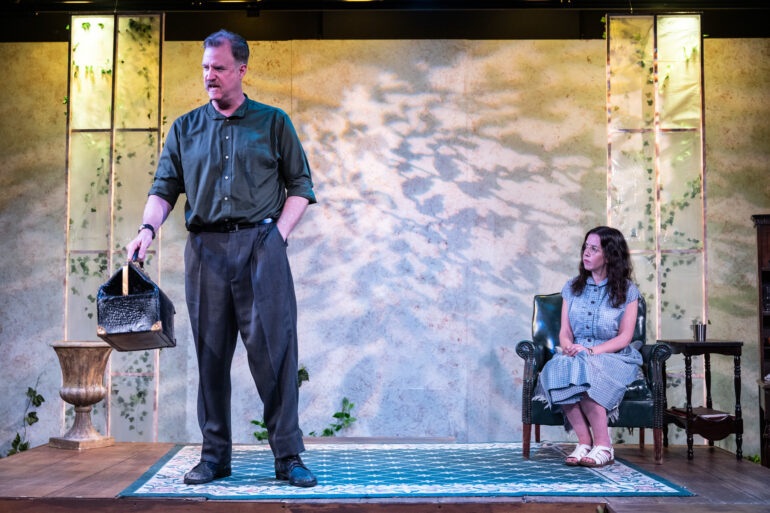
L-R: Robert Tobin, Natalie Hurdle. Photo by Paul Goyette.
By calling him a moron, the doctor’s antipathy for the sleeping man is made clear even before he wakes up.
As more people enter the story, we find ourselves in the middle of a family crisis. Vanya, the man who was sleeping in the chair, and his niece Sonya (Natalie Hurdle) have been the caretakers of the estate since her mother died. Sonya’s father, Alexandre (Geoff Isaac), is a professor in the city who’s been forced out of his university position and has now returned to the homestead. He’d been relying on income from the estate to support his lifestyle in town. He’s not returned alone. Joining him is his much younger and very beautiful second wife, Yelena, with Andi Muriel in the role. Things are tense. Alexandre’s pompous and obliviously demanding. And Vanya, played with visceral intensity by Rian Jairell, is demonstrably resentful.
An appeasing conflict avoider, Sonya’s loyalties are split between the natural draw a child has to her father and her uncle who’s labored with her to keep the estate viable at tremendous personal sacrifice to them both. Now a young woman, she seems to know it’s Vanya who’s been more the nurturing father presence for her and that other than each other, the estate is all that either of them have.
Additional strain is added with the presence of Yelena. Her beauty is like an intoxicant for both Vanya and the dissatisfied doctor, Astrov. They’re both brazen in their desire for her. Watching them shamelessly try to seduce her is equal parts comic and piteous.
With so much instability, friction and doubt in the air, you’d expect to feel the charge of that energy engulfing the air. Directed by Derek Bertelsen, it doesn’t arrive with any real intensity until the second act when Sonya’s father floats the idea of selling the estate. And that’s despite the considerable investments Jairell as Vanya had been contributing up to that point. Because It’s so transparent Alexandre wants the money from the sale to fund his return to the city and his refined form of living, Vanya’s resentment turns to rage. Finally filling the production with heat.
It dials up too when Sonya confesses her attraction, indeed love, for Astrov to Yelena. Unrequited never looked so vulnerable and fragile.
Part of Repo-Martell’s adaptation included revising the language to be more contemporary and ostensibly more approachable. It works in an essential way. Both Jeremiah Barr’s handsome set and Natalie Shoch’s costume designs are ambiguous enough to blur any specific time reference. But in the back of your mind you know this is all happening in a very distant time and place. One where duty and tradition held much more sway. That difference can often be found in the words used to express and explain obligations and choices. Here there’s a nagging sense that you may be missing important steppingstones.
In the end, things aren’t much different from where we found them in the beginning. Except everyone is much more depleted. Drained. But still tasked with shouldering their disappointments and continuing with their lives. In Chekhov’s original script, the word “rest” is used to represent that place of willful resignation that amounts to acceptance of one’s inevitable destiny. In this adaptation, the word “peace” is substituted. They say the same thing about something we’ve all experienced. When we’ve had to pull ourselves up out of the ashes and push forward. Uncle Vanya brings that feeling front and center and offers understanding through catharsis. That alone will keep it in heavy production for a few more centuries at least.
Uncle Vanya
Through July 5, 2026
Astonrep Productions
Venue: The Edge Off Broadway
1133 W. Catalpa Avenue
Chicago, IL 60640
For more information or tickets: https://www.astonrep.com
This review is proudly shared with our friends at www.TheatreInChicago.com.
Couch Penny Ensemble’s An Oak Tree: A Raw, Unrehearsed Descent Into Grief
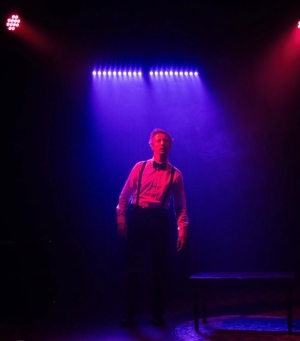
Couch Penny Ensemble, in association with Theatre Arcana, presents the ambitious and experimental An Oak Tree, a raw, unconventional approach to theater that is sure to spark conversations on the nature of grief and the experience itself.
In writing An Oak Tree, playwright Tim Crouch wanted to replicate the disorienting nature of grief. The play features two actors - one who has rehearsed the script (the Hypnotist) and another who has neither seen nor read it (the Father). The Hypnotist acts as a dual guide both for the actor playing the Father and the audience, as this one-of-a-kind experience comes to life.
For each performance, a new, different actor takes on the role of the Father, and it’s their job to live in the moment, breathing life into this character through the use of real-time instructions (given via headphones) and script lines given to them on the spot. The result is an unpolished, raw theater experience. The format is intriguing and innovative - a reflection on grief itself. When tragedy happens, you aren’t prepared for it, and you suddenly find yourself wrestling with a script that is unrehearsed.
Under Bryce Lederer’s direction, the production leans into the play’s shifting dynamics, shaping its unpredictability into something sharply focused and theatrically alive.
Riles August Holiday anchors the evening as the Hypnotist, delivering a technically demanding and well-acted performance. Holiday does a fantastic job of drawing a sharp line between his moments in character - playing a defensive, fragile man - and his moments acting as an administrative guide, calmly steering both his co-star and the audience through the mechanics of the script.
On this evening, Suzy Krueckeberg played the Father, and one can only imagine the excitement and the nerves of taking on such a role. As the Father, she was required to relive the trauma of losing a daughter and process the deterioration of her family without rehearsing - no small task. Krueckeberg did a good job finding the part and taking the audience on the journey with her.
For all its ingenuity, An Oak Tree serves a very specific appetite. This is avant-garde, experimental theater through and through. If you are an audience member searching for that specific brand of rule-breaking performance art, there is plenty to analyze here. Personally, I felt the script left something to be desired. In an examination of grief, I felt at times it was too simplistic or trod ground others had covered more effectively.
That said, it was a unique and interesting experience to see an actor walk a tightrope, constructing a character in front of the audience’s eyes. Holiday’s emotional depth on stage was a treat as well.
An Oak Tree runs at Greenhouse Theater Center until July 5th.
This review is proudly shared with our friends at www.TheatreInChicago.com.
Lookingglass' Untitled Vampire Play has bite

Lookingglass Theatre Company continues its tradition of staging visually inventive and thought-provoking world premieres with its latest production, Untitled Vampire Play. Written by Lookingglass Ensemble Member Kevin Douglas - who has previously crafted well-received work for the company, including Thaddeus and Slocum: A Vaudeville Adventure - this comedy-drama uses supernatural lore to dissect the vulnerabilities of modern relationships.
The story centers on a delightfully bizarre “meet the parents” scenario. Dom (Jordan Anthony Arredondo), an everyman bartender, introduces his parents to his new girlfriend, Val (Courtney Rikki Green). The twist? Val is a centuries-old vampire. But don’t worry - she gets her blood from ethical sources, not human victims. Dom’s parents laugh it off, though, thinking their son’s girlfriend has a few screws loose.
Meanwhile, Val’s “brother” Roderick (Walter Briggs) resurfaces, wanting to reconnect. In reality, they are former lovers, but after his betrayal, she ran away. Val doubts that he’s changed, but her progeny, Rose (Jin Park), gets sucked into his orbit despite being under Val’s supernatural control. As Roderick carelessly makes kills in Chicago, bodies begin piling up, drawing the attention of Dom’s mother - a police detective - and a vampire hunter descended from Van Helsing. Who said love was easy? The result is a look at relationships in all of their messy, bloody glory.
Briggs turns in an excellent performance as Roderick, playing the charismatic bad boy with ease. He channels the classic Hollywood vampire aesthetic with immaculate fashion and a distinct, formal vocal cadence that commands the room. Sure, he’s a villain, but he’s fun to watch, especially with the little flairs he adds to his characterization.
Kareem Bandealy is another standout, tackling two completely contrasting roles. He plays Dom's father, Louie, with a relentless barrage of corny vampire dad jokes, then completely transforms into Lance Tardis Van Helsing, a fierce vampire hunter with an equally fierce hair flip.

Courtney Rikki Green as Val inUntitled Vampire Play at Lookingglass Theatre. Photo by Justin Barbin.
Anchoring the whole cast, though, is Green, who brings immense emotional weight to her performance as the complex Val. Serving as the real window into this hidden world, Green charts her character's profound transformation, as Val wrestles with whether she is seeking genuine love or simply trying to outrun eternal loneliness.
Beneath the fangs, the play asks a deeply human question: What does it mean to love someone? It explores the underlying selfishness that often masks itself as romance. Val wants Dom to turn into a vampire so they can be together forever, viewing his reluctance as a rejection of her identity rather than a defense of his own humanity. Meanwhile, Dom uses Val as an emotional security blanket to quiet his own intense insecurities. Through these characters, Douglas examines how control, weakness, danger, and even lust can taint love, or at least the illusion of it.
The script could use a bit of trimming in its exploration, as there are moments that feel repetitive, alongside a few minor plot weaknesses. For instance, it seems odd that a police detective would wait so long to investigate self-proclaimed vampires once gruesome deaths with animal-like attack marks begin happening. Furthermore, one thing I certainly could have gone without was a gruesome scene where the vampires feast on a victim, using gummy worms to simulate intestines. Still, beneath those rough edges, the play’s core story has real spark, offering a fresh, funny twist on vampire mythology that keeps the audience engaged.
I’d be remiss not to praise the play’s design. The technical execution is a masterclass in atmospheric world-building. Scenic designer Alyssa Mohn delivers an expert landscape featuring coffins that seamlessly rise from and sink into the stage floor. This clever staging pairs beautifully with Andre Pluess’s precise sound design and Jason Lynch’s lighting choices - ranging from moody washes to stark spotlights and flashing accents - to wrap the theater in an escalating sense of intrigue and peril. The atmosphere creates moments when you’re not sure if you might be the next victim.
Inventively directed by Devon de Mayo, the production also incorporates fun moments of audience engagement, whether it’s handing theatergoers caution tape to hold at a crime scene or a rather messy vampire kill that sprays stage blood into the front row.
While it doesn’t entirely break new ground, Untitled Vampire Play is creative and visually arresting. At a time when modern relationships are being heavily dissected in media - such as in the hit Obsession - Untitled Vampire Play tosses its fangs into the conversation, leaving the audience to wrestle with what should encompass the core tenets of love.
Recommended.
Untitled Vampire Play is being performed at Lookingglass Theatre through July 12th.
This review is proudly shared with our friends at www.TheatreInChicago.com.
Tom Stoppard’s epic finale Leopoldstadt is an instant classic at Writers Theatre

What would you do if you found out your heritage wasn’t what you thought it was? In Tom Stoppard’s case, he wrote a sweeping, epic play about it. Glencoe’s Writers Theatre brings Leopoldstadt to the Chicago area for the first time since its West End and Broadway runs in the early 2020s. Directed by Carey Perloff, a longtime friend and collaborator of Stoppard’s, this final stage play proves to be among his best.
Stoppard passed away late last year but he left a decades-long cannon of seminal stage and screenplays. When his semi-autobiographical play “Leopoldstadt” began performances in the West End in early 2020, he was sure it would be his last. Though he wrote it in a year, it took nearly 30 years to find the narrative. Stoppard, who was raised as a gentile most of his life, was told by a family member in 1993 he was of Jewish heritage and that many of his family members were murdered in the Holocaust. Stoppard escaped Czechoslovakia as a child and was raised in the UK entirely unaware.
A blended Jewish-Catholic family’s history in 20th century Vienna is divided neatly into four pivotal scenes with a sizeable cast of some of Chicago’s best. In the first scene, a Christmas party (1900), we’re shown a Vienna in which Jews were considered equals. Families had interfaith marriages and shared holiday celebrations. By the second scene (1924), WWI has redrawn the maps of Europe. Austria, as well as the family, finds itself in a precarious place. Scene three (1938) portrays an Austria fully committed to the Third Reich and family alliances are put to the test when the family is forced out of their home by the Nazis. The final scene (1955) happens in the aftermath of Austria’s reunification following WWII. This last scene mirrors Stoppard’s own life and serves as an emotional climax to a play that is often dense with political and historical theory.

The cast of Leopoldstadt. Photo by Michael Brosilow.
Writers Theatre’s production is as faithful to the original as you can get. Carey Perloff directed the Boston and D.C. premieres too. Along with an all-star cast of Chicago heavy hitters, Perloff’s production will likely be remembered as the definitive Midwestern revival. Between Ken MacDonald’s set and Alex Jeager’s costumes, audiences are sure to be swept away to a different time and place that can feel eerily reminiscent to the present.
As the eras change so do the actors playing the characters. Stoppard’s script trusts that the storytelling is so engaging that audiences will figure out who’s who by the context clues, and he was right. Some may find the story hard to follow but thankfully a helpful lobby installation catches everyone up on the history of Austria during this time period.
Writers Theatre favorite Kate Fry plays a Catholic woman, Gretl, who marries into a prominent Jewish family. Her performance is at first charming but by the end heartbreaking. Jessie Fischer delivers a transformative performance, particularly during the final scene. Rounding out the male ensemble is Ian Barford as Hermann who plays a converted catholic, but it’s his deterioration that is unforgettable. Justin Albinder is given the meatiest part of the final scene and his ability to switch from one emotion to the next is some of the most natural acting of the evening.
Leopoldstadt is every bit as epic as something like Gone with the Wind. Much like the famed novel and movie, this play tells the story of a civilization, a family, lost to the tragedy of war. It’s a story of a family’s near extinction. Stoppard’s brilliance is on full display and how lucky are we to have this capstone for his illustrious career?
Through August 16 at Writers Theatre. 325 Tudor Ct, Glencoe, IL. 847-242-6000
https://www.writerstheatre.org/events/leopoldstadt
This review is proudly shared with our friends at www.TheatreInChicago.com.
PlayMakers Laboratory Celebrates That's Weird, Grandma's 25th Birthday August 23 – September 6, 2026

Join the fun this summer as PlayMakers Laboratory (PML) celebrates a major milestone at That's Weird, Grandma's 25th Birthday, marking a quarter century of the company's long-running original sketch comedy show. Directed by Program Director Brandon Cloyd, the family-friendly comedy extravaganza will play five performances only August 23 – September 6, 2026 at the Neo-Futurist Theater, 5153 N. Ashland Ave. in Chicago. Tickets go on sale Wednesday, July 1, 2026 at www.playmakerslab.org. The press opening is Sunday, August 23 at 2 pm.
That's Weird, Grandma's 25th Birthday will feature current Company Members with PML emeritus members making cameo appearances throughout the run. The cast currently includes Company Members Linnaea Groh, Barry Irving, Lucas Johnson, Indi Gutierrez Marrero, Sam Nieves, Yongwoo Park, Lee Peters, Allison Sokolowski, Brad Stevens, Lex Mann Turner and Tyara Whitted, with emeritus Company Members Nancy Casas, Allison Grischow, Ricky Harris, Jasmine Hernri Jordan, Tom Malinowski, Kate Staiger, Mary Tilden and more!
That's Weird, Grandma features adaptations of stories written during PML's creative writing residencies in Chicago elementary schools. PML's ensemble of professional actors, comedians and musicians bring the young authors' stories to life as raucous sketches, songs and movement pieces, performing first for students in their schools and then for the public. These stories – from hilarious dialogues between unlikely characters to poignant pleas for social change, along with holiday-inspired stories – resonate with adults while celebrating the imaginations of young people.
Production team: Daniel Parsons (Stage Manager).
Performance Schedule:
Sunday, August 23 at 2 pm
Saturday, August 29 at 2 pm
Sunday, August 30 at 2 pm
Saturday, September 5 at 2 pm
Sunday, September 6 at 2 pm
Ticket Prices: adults: $26.06*; youth (aged 4 – 15) $15.76*; Children 3 and under: free **Ticket prices include a processing fee Tickets go on sale Wednesday, July 1, 2026 at www.playmakerslab.org.
About the Director
Brandon Cloyd joined PlayMakers Laboratory in 2007 and has been deeply involved in many facets of the company ever since. Prior to joining PML, Brandon graduated from Northwestern University with a Bachelor of Arts in Theatre and a minor in Business Institutions. Brandon has held many roles in PlayMakers Laboratory before becoming the company's Artistic & Program Director in September 2017. He served with PML as an actor, teaching artist, lead teacher, a member of Teacher Corps, as well as directing shows for schools and public performances of That's Weird, Grandma. Outside of PML, he worked as the Associate Director of Camp Echo, where he has spent 13 summers managing campers and staff at a co-ed sleepaway camp in Upstate New York. Brandon has worked with other theatre companies including Urban Theatre Company, American Theater Company, Filament Theatre, InGen Productions, ACLE's Teatrino in Italy and a founding director with Purple Crayon Players at Northwestern University. Brandon is also a former board member for the League of Chicago Theatres.
About PlayMakers Laboratory
For 29 years, PlayMakers Laboratory has served Chicago Public School students by providing a creative writing residency program aimed primarily at elementary schools. Our company of over 60 teaching artists utilize creative drama and storytelling to promote literacy and self-esteem during our in-school residencies and park district programming. Each year, our programs serve more than 4,000 young people across Chicago. In our six-week writing residencies, a whopping 88% of students improve writing scores by at least one level over the course of our residencies. Plus, 100% of classroom teachers report that our program supports their student's writing and improves confidence and self-esteem.
PlayMakers Laboratory is sponsored in part by Chicago Department of Cultural Affairs and Special Events, The Crown Family Philanthropies, The Field Foundation, The Mardi Gras Fund, Illinois Arts Council, Paul M. Angell Foundation, The Polk Bros Foundation, Siragusa Family Foundation, S&C Electric and generous individuals like you!
Nunsense, Not Quite Immaculate - But Blessed With a Strong Cast

Following its recent winter production of Sister Act, Drury Lane Theatre returns to the convent with Nunsense, a light-hearted musical comedy which, as the title implies, is a lot of nonsense.
The premise is funny, albeit morbid. After an unfortunate mishap, 52 members of the Little Sisters of Hoboken die from tainted soup prepared by Sister Julia, Child of God. With limited resources, the surviving nuns can only cover the funeral expenses of some of their sisters - leaving the remaining four bodies in their convent freezer, awaiting burial. How can they solve this problem? Well, stage a variety show, obviously! After all, while these women are nuns, they all wanted a moment in the spotlight.
E. Faye Butler, who also directed Sister Act, returns to stage Nunsense and injects the same optimism into this show. Unfortunately, it lacks the same substance, failing to elevate its premise beyond the initial idea.
The origin of Nunsense seems to explain its structural weakness. In the early 1980s, playwright Dan Goggin created a line of tongue-in-cheek greeting cards featuring a nun offering witty, irreverent quips. The cards were a hit, and Goggin used them as a jumping-off point for a cabaret show, which was later expanded into a full-length musical.
Unfortunately, the script doesn’t have much narrative depth or structural momentum. It seems to wander through quips and gags, trying to find a laugh rather than developing character or plot. At one point, we learn that a health inspector will fine them if they can’t raise the money by tomorrow, but it doesn’t land as a serious threat or even a driving force for the remainder of the show. The problem even has a quick resolution when Sister Mary Amnesia remembers her identity and discovers she’s suddenly rich thanks to a contest - talk about a deus ex machina (mary-ina, if you will).

Rachel Carreras in Drury Lane THeatre's Nunsense. Photos by Caitlin Dennis.
The book’s weaknesses are unfortunate because the cast is genuinely strong. Every member brings spectacular vocals to the stage, effortlessly belting out musical numbers and sounding excellent throughout.
Sharriese Hamilton delivers a standout performance as Sister Hubert. Her sassy comebacks and vocal riffs are hilarious, especially her trill in their rap. Her big second-act number, "Holier Than Thou," takes the audience to church and gives the show a much-needed jolt of energy. Cory Goodrich, Rachel Carreras, Kelly Felthous, and Aurora Boe also do well in their solo moments, whether it’s physical comedy, playing with a puppet, or ballet. Felthous gets to shine with her audience work and banter, and it is fun to see the cast do callbacks to specific interactions, such as flirting with or chiding audience members.
The show succeeds best when it moves quickly. Without much plot, gags can get tired easily. For instance, the Reverend Mother accidentally inhales a drug found in the girls’ locker room and goes to pieces. The sequence goes on a few beats too long. Transitions also could be tightened so the show doesn’t lose steam between numbers.
Nunsense is a fun idea, but the script fails to execute it satisfyingly. It’s also unclear who the intended audience is; the PG‑13 tone might make it a slightly tougher fit for families, even though they’d otherwise be a natural demographic.
While each performer gets a well-deserved moment to shine, it is a shame that such a talented cast doesn't have better material to serve either their collective skills or a meaningful story. Drury Lane's Nunsense has its moments, but it never quite reaches divine heights.
This review is proudly shared with our friends at www.TheatreInChicago.com.
A Red Orchid Theatre Announces Remount of Hit Production BIRDS OF NORTH AMERICA September 10 – October 4, 2026

A Red Orchid Theatre is thrilled to announce a remount of its critically-acclaimed, father-daughter drama Birds of North America, returning for a limited engagement September 10 – October 4, 2026 at 1531 N. Wells St. in Chicago's Old Town neighborhood. Written by Anna Ouyang Moench and directed by Artistic Director Kirsten Fitzgerald*, the remount will feature the full original cast and creative team. Single tickets go on sale Tuesday, August 4, 2026 at 12 pm at aredorchidtheatre.org or by calling (312) 943-8722.
Reprising their original roles in Birds of North America are Ensemble Member John Judd* with Cassidy Slaughter-Mason. Understudies include Sahar Dika and Guy Wicke.
About the Production:
John and his daughter Caitlyn are birders. As they scan the skies over their backyard in suburban Maryland looking for elusive birds, years go by. Relationships begin and end. Children grow up and parents age. The climate and the world change in small and vast ways. Birds of North America takes a close look at the relationship of a father and daughter over the course of a decade as they struggle to understand the parts of one another that defy understanding.
Birds of North America received critical acclaim during its sell-out Chicago premiere:
★★★★
"A gorgeous little 90-minute two-hander, a beautifully acted and directed
father-daughter play capable of transporting you away... I was transported"
"[John] Judd, one of the Chicago theater's most remarkable actors [is] a perfect fit for this role...
a really beautiful performance and one of Judd's best. (I've seen many.)"
–Chris Jones, Chicago Tribune
★★★½
"A gripping generational dialogue... Slaughter-Mason's performance in this production is moving."
–Mike Davis, Chicago Sun-Times/WBEZ Chicago
RECOMMENDED! "A tender portrait that walks the taut line
between pain and sentimentality with the vivid humor of recognition."
–Irene Hsiao, Chicago Reader
The production team includes Morgan Laszlo (Scenic Designer), Ben Argenta Kress (Costume Designer), Seojung Jang (Lighting Designer), Ethan Korvne (Composer & Sound Designer), Spencer Diaz Tootle (Props Designer and Set Dressing), Jojo Brown (Dramaturg), Amy Carpenter (Assistant Director), Kyle Stoffers (Casting Director), Tom Daniel (Technical Director). Alivia Arizaga (Stage Manager) and Faith Locke (Assistant Stage Manager).
Subscribers for A Red Orchid's soon-to-be-announced 2026-2027 Season may add Birds of North America to their package as at a discounted rate. Season subscriptions will be available in July 2026.
*Denotes A Red Orchid Theatre Ensemble Member
PRODUCTION DETAILS:
Title: Birds of North America
Playwright: Anna Ouyang Moench
Director: Artistic Director Kirsten Fitzgerald*
Cast: Ensemble Member John Judd* (John) with Cassidy Slaughter-Mason (Caitlyn)
Understudies: Sahar Dika and Guy Wicke
Location: A Red Orchid Theatre, 1531 N. Wells St., Chicago
Dates: Opening: Thursday September 10, 2026 at 7 pm
Regular run: Friday, September 11 – Sunday, October 4, 2026 Curtain Times: Thursdays and Fridays at 7 pm; Saturdays 3 pm & 7 pm; and Sundays at 3 pm.
Tickets: $61*. Access, student, senior and group discounts available. Single tickets go on sale Tuesday, August 4, 2026 at 12 pm at aredorchidtheatre.org or by calling (312) 943-8722. *Ticket prices include a processing fee.
About the Artists:
Anna Ouyang Moench (Playwright, she/her) is an award-winning playwright and screenwriter. Her plays include Your Local Theater Presents: A Christmas Carol, by Charles Dickens, Again, Man of God, Birds of North America, Mothers and Sin Eaters. Anna's work has been produced at the La Jolla Playhouse, Williamstown Theatre Festival, the Geffen Playhouse, East West Players, the Playwrights Realm, NAATCO at the Public Theater, A Red Orchid Theater Company, The Gift Theatre, and many others. She is a former Jerome Fellow at the Playwrights' Center, Van Lier fellow at the Lark and Page One fellow at the Playwrights Realm. Awards include two 2023 WGA Awards for her work on Severance (Apple TV+), the 2020 Steinberg Playwright Award, the Gerbode Special Award in the Arts, the Paul Stephen Lim Playwriting Award from the Kennedy Center, and the NYFA Award in Playwriting/Screenwriting. Anna received her MFA in Playwriting from UCSD and now lives
in Los Angeles with her family.
Kirsten Fitzgerald (Director, she/her) is a proud member of the Ensemble at A Red Orchid Theatre and has served as the Artistic Director since 2008. Recent directing credits include the world premiere of Gorgeous by Keiko Green at Raven Theatre, The Moors at A Red Orchid (Jeff Award for Best Production and Best Director of a Play-Midsize) and Dance Nation at Northwestern University's Wirtz Center. As an actor Kirsten has originated roles in the world premieres of The Cave, Grey House, Traitor, Pilgrim's Progress, Weapon of Mass Impact, and more (A Red Orchid); Swing State, I hate It Here (Goodman); Lettie, Appropriate (Victory Gardens); Mary Page Marlow, The Qualms (Steppenwolf). TV: Dark Matter, Shining Girls, Somebody Somewhere, The Exorcist, Sirens, The Big Leap, Chicago Med/Fire/Justice, Underemployed, ER. Film: Widows, Working Man. Kirsten is represented by Grossman & Jack Talent.
John Judd (John, he/him) last appeared on the A Red Orchid Theatre stage in Six Men Dressed Like Joseph Stalin, and was previously seen in The Cave, The Malignant Ampersand, and Gagarin Way, as well as the McCarter Theatre's presentation of Simpatico. A Chicago based actor for forty years, John has acted at The Goodman, Steppenwolf, Chicago Shakespeare Theater, Writer's Theatre, Court Theatre, Drury Lane, Northlight, Shattered Globe, Lookingglass, Victory Gardens and Next, as well as numerous regional, international and Off-Broadway venues.
Cassidy Slaughter-Mason (Caitlyn, she/her) is a Chicago based actor and writer. Recent theater credits include: Brooklyn Laundry (Northlight Theatre), The Luckiest (Raven Theatre, Equity Jeff Award for Best Performer in a Principal Role), How a Boy Falls (Northlight Theatre), Kiss (Haven Theatre), Significant Other (Theatre Wit/About Face) and Rapture Blister Burn (Goodman Theatre, Equity Jeff nomination for Performer in a Supporting Role). Film and TV credits include: All Happy Families, Ultra-City Smiths, Chicago Fire and Easy. Her short film Rabbit Rabbit (co-written with Poppy Golland) will stream this spring on OpenTV. Cassidy is represented by Paonessa Talent Agency.
About A Red Orchid Theatre:
A Red Orchid Theatre has served as an artistic focal point in the heart of the Old Town community of Chicago since 1993 and was honored with a 2016 MacArthur Award for Creative and Effective Institutions. Over the past 32 years, its Resident Ensemble has welcomed into its fold an impressive array of award-winning actors, playwrights and theatre artists with the firm belief that live theatre is the greatest sustenance for the human spirit. A Red Orchid is well known and highly acclaimed for its fearless approach to performance and design in the service of unflinchingly intimate stories.
A Red Orchid Theatre is: Karen Aldridge, Lance Baker, Kamal Angelo Bolden, Esteban Andres Cruz, Dado, Mike Durst, Sherman Edwards, Myron Elliott, Jennifer Engstrom, Kirsten Fitzgerald, Joseph Fosco, Steve Haggard, Levi Holloway, Mierka Girten, Larry Grimm, John Judd, Karen Kawa, Karen Kessler, Travis A. Knight, Danny McCarthy, Shade Murray, Brett Neveu, Sadieh Rifai, Grant Sabin, Michael Shannon, Guy Van Swearingen, Doug Vickers and Natalie West.


Latest Articles
-
 Goodman’s Iceboy! Is a Full‑Tilt Blast of Comic Mayhem
Written by Ken PayneGoodman Theatre’s Iceboy! arrives as a gleefully off the rails musical that blends Broadway glamour, Neanderthal chaos, and theatrical myth making into one of the most delightfully strange premises to hit Chicago in years. It’s a satire, a love letter…
Goodman’s Iceboy! Is a Full‑Tilt Blast of Comic Mayhem
Written by Ken PayneGoodman Theatre’s Iceboy! arrives as a gleefully off the rails musical that blends Broadway glamour, Neanderthal chaos, and theatrical myth making into one of the most delightfully strange premises to hit Chicago in years. It’s a satire, a love letter… -
 All The World's a Stage and Chicago Merely The Best Player: 'As You Like It' in Chicago Parks this summer
Written by Kendall RoyzenIs there anything more alluring than a summer night in Chicago? The lakefront beaches, the meandering pathways, the festivals and street foods, the hidden gardens where free art productions are staged, whatever you like, you can find it in the…
All The World's a Stage and Chicago Merely The Best Player: 'As You Like It' in Chicago Parks this summer
Written by Kendall RoyzenIs there anything more alluring than a summer night in Chicago? The lakefront beaches, the meandering pathways, the festivals and street foods, the hidden gardens where free art productions are staged, whatever you like, you can find it in the… -
 Opera Festival of Chicago Delivers an Assured, Full‑Hearted La Bohème
Written by Kimberly KatzOpera Festival of Chicago continues its season with two mainstage productions - La Bohème and Adriana Lecouvreur - each featuring the Opera Festival of Chicago Orchestra and Chorus and performed at the George Van Dusen Theatre at the North Shore…
Opera Festival of Chicago Delivers an Assured, Full‑Hearted La Bohème
Written by Kimberly KatzOpera Festival of Chicago continues its season with two mainstage productions - La Bohème and Adriana Lecouvreur - each featuring the Opera Festival of Chicago Orchestra and Chorus and performed at the George Van Dusen Theatre at the North Shore… -
A Quietly Ravishing Night: Marriott’s A Little Night Music
Written by Kimberly KatzMarriott Theatre’s in‑the‑round intimacy turns A Little Night Music - which premiered on Broadway in 1973 and later became a 1977 film - into a quietly seductive swirl of glances, secrets, and second chances, the kind of production where the waltz…
Does your theatre company want to connect with Buzz Center Stage or would you like to reach out and say "hello"? Message us through facebook or shoot us an email at This email address is being protected from spambots. You need JavaScript enabled to view it..
*This disclaimer informs readers that the views, thoughts, and opinions expressed in the text belong solely to the author, and not necessarily to Buzz Center Stage. Buzz Center Stage is a non-profit, volunteer-based platform that enables, and encourages, staff members to post their own honest thoughts on a particular production.